



by Tiwari Academy Team
NCERT Class 9 Arts Madhurima Chapter 1 Introduction to the History of Arts Solutions, Exercises and Extra Question Answers for 2026-27 Exams. Chapter 1 of Class 9 Arts Madhurima, titled Introduction to the History of Arts, takes you on a fascinating journey through India’s artistic heritage spanning over 50,000 years. From prehistoric cave paintings at Bhimbetka to the magnificent Chola bronze Nataraja, this chapter covers visual arts, music, dance and theatre together on one timeline.
Quick Links:
- Chapter 1 Exercises Solutions
- Very Short Answer Type Questions
- Short Answer Type Questions
- Long Answer Type Questions
Download Tiwari Academy Learning App to study Class 9 Art Madhurima in phone.
In class 9 Arts Madhurima Chapter 1, you will learn about important ancient texts like the Natyashastra, explore the difference between tangible and intangible cultural heritage and discover how India’s art traditions influenced Southeast Asia. The chapter also highlights living traditions that are still practised today. Whether you love painting, music or history, this chapter connects creativity with culture in a truly inspiring way.
NCERT Class 9 Arts Madhurima Chapter 1 Solutions
Class 9 Arts Madhurima Chapter 1 Question Answer
Page 5 – Let us explore
Which artistic practices and traditions around you can be categorised as either tangible or intangible cultural heritage?
Answer:
𝗧𝗮𝗻𝗴𝗶𝗯𝗹𝗲 𝗖𝘂𝗹𝘁𝘂𝗿𝗮𝗹 𝗛𝗲𝗿𝗶𝘁𝗮𝗴𝗲 𝗮𝗿𝗼𝘂𝗻𝗱 𝘂𝘀:
- Madhubani paintings, Warli paintings, Pattachitra paintings
- Clay pottery and terracotta artefacts made by local artisans
- Handloom textiles and embroidery like Phulkari, Chikankari
- Sculptures and idols made during festivals like Durga Puja, Ganesh Chaturthi
- Old temples, havelis, and monuments in our cities and villages
𝗜𝗻𝘁𝗮𝗻𝗴𝗶𝗯𝗹𝗲 𝗖𝘂𝗹𝘁𝘂𝗿𝗮𝗹 𝗛𝗲𝗿𝗶𝘁𝗮𝗴𝗲 𝗮𝗿𝗼𝘂𝗻𝗱 𝘂𝘀:
- Folk songs sung during weddings, harvest festivals, and birth ceremonies
- Classical and folk dances like Bharatanatyam, Garba, Bihu, Ghoomar
- Storytelling traditions like Kathā, Ramleela performances
- Traditional knowledge of making musical instruments
- Oral traditions passed down through generations in families
Page 5 – Discussion Circle
How do various art forms enrich our lives?
Answer:
Art forms enrich our lives in many ways. Music soothes our emotions and helps us express feelings that words cannot. Dance keeps our body healthy while also telling stories and conveying devotion. Theatre and drama help us understand human nature, build empathy and think critically about society. Visual arts like painting and sculpture beautify our surroundings and preserve our history. Together, all art forms connect us to our cultural roots, bring communities together during festivals and celebrations, provide creative outlets and inspire us to look at the world with curiosity and sensitivity. They also pass down wisdom, values and stories from one generation to the next.
Page 10 – Discussion Circle

What do you think is portrayed by the pose in the figure above?
Answer:
The bronze figurine from Mohenjo-Daro shows a young woman standing with one knee slightly bent, one hand resting on the waist, and the chin slightly lifted. This pose suggests confidence, grace and a relaxed elegance. It possibly portrays a dancer mid-performance or a woman of importance in society. The casual yet self-assured posture indicates that the people of the Sindhu-Sarasvatī civilisation valued beauty, movement and artistic expression. The pose also reflects a high level of skill in the lost-wax technique used to create it, showing the technical sophistication of this ancient civilisation.
Page 11 – Discussion Circle
Compare pottery from the Sindhu-Sarasvatī civilisation with pottery from other ancient civilisations and discuss your observations.
Answer:
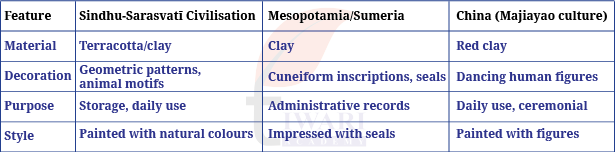
𝗢𝗯𝘀𝗲𝗿𝘃𝗮𝘁𝗶𝗼𝗻𝘀:
All ancient civilisations used locally available clay to make pottery, showing that pottery was a universal need. However, the decorative styles differ – while Sindhu-Sarasvatī pottery uses geometric and natural motifs, Chinese Majiayao pottery interestingly shows dancing figures, similar to how Indian cave paintings also depicted dance and performance. This suggests that across all ancient civilisations, art and daily life were deeply connected. Pottery was not merely a functional object but also a canvas for artistic and cultural expression.
Page 12 – Let us explore
Which category of instruments do you think the harp belongs to? What role might this instrument have played in Egyptian culture?
Answer:
The harp is a string instrument, belonging to the chordophone category – instruments that produce sound through vibrating strings.
In Egyptian culture, the harp likely played a very important role. Since it has survived from around 1390–1295 BCE, it was clearly a valued and carefully crafted instrument. It was probably used in royal courts and religious ceremonies as a symbol of culture and refinement. The arched harp shown in the figure suggests it was played at important gatherings, rituals dedicated to gods and for entertaining the pharaohs. Just as Indian classical music was connected to spiritual and devotional practice, music in Egypt too was likely associated with worship and ceremony. The fact that musical instruments from ancient Egypt have survived till today shows how much these civilisations valued music as part of their cultural life.
Page 13 – Discussion Circle
Why do you think ancient scholars composed treatises that codified the arts?
Answer:
Ancient scholars composed treatises to preserve and systematise the knowledge of arts so that it could be accurately passed on to future generations. Without written records, art traditions depend entirely on oral transmission, which can lead to gradual changes, distortions or even complete loss of knowledge over time.
By codifying the arts, scholars ensured that techniques, theories and philosophical ideas remained consistent and could be properly taught through the guru–śhiṣhya-paramparā. Treatises like the Nāṭyaśhāstra covered drama, dance, music and visual arts in great detail, giving artists a reliable reference and a shared framework across different regions of India. Writing these down also gave the arts a respected, formal status in society — as seen in how Kauṭilya’s Arthaśhāstra recognised performers as contributors to the state’s economy.
On what basis do you think they devised theories, and do you think they remained constant over time?
Answer:
Ancient scholars devised their theories based on careful observation of existing performance practices, study of natural phenomena, human emotions, and deep philosophical thinking. For example, Bharata Muni developed the rasa theory by observing how different performances created different emotional responses in audiences. The Bṛihaddeśhī associated specific colours with musical notes, showing that theories were also built by connecting arts with nature and everyday experience.
These theories did not remain completely constant over time. New commentaries were written by later scholars – such as Abhinavagupta’s Abhinavabhāratī, which built upon and reinterpreted the Nāṭyaśhāstra – showing that each generation expanded upon earlier ideas. Regional variations also developed, adapting classical frameworks to local traditions. So while the core ideas remained deeply influential, they continued to evolve with changing times, places and artistic practices.
Page 17 – Discussion Circle
Observe the captions in the pictures and discuss these points:
1. What are the various animals you see, and what are their symbolic meanings?
Answer:
From the pictures of the Ashokan pillars, we can see the following animals:
- Lion (Vaishali and Rampurva lion capitals) – The lion symbolises power, courage, authority, and royalty. It also represents the Buddha himself, who is often called “Śhākyasimha” meaning the lion of the Śhākya clan. The roaring lion symbolises the spread of the Buddha’s teachings (Dhamma) in all directions.
- Bull (Rampurva bull capital) – The bull symbolises strength, hard work, patience and determination. It represents the qualities needed to walk steadily on the path of Dhamma without being distracted.
- Elephant (Sankissa elephant capital) – The elephant symbolises wisdom, mental strength, stability and the Buddha’s birth, as his mother Queen Māyā is said to have dreamt of a white elephant before his birth. It also represents the power of a calm and controlled mind.
2. What qualities of these animals do you associate with staying on the path of Dhamma?
Answer:
Each animal depicted on the Ashokan pillars represents qualities that are directly connected to the Buddhist way of life and the path of Dhamma.
The lion’s fearlessness and dignified presence remind us to speak the truth boldly and stand firm in our values without being afraid of opposition. The bull’s steadiness and patience remind us to remain disciplined and hardworking in our practice, never giving up even when the path is difficult. The elephant’s calm strength and wisdom remind us to keep our mind peaceful and composed, using intelligence rather than aggression to face challenges.
Together these qualities – courage, patience, wisdom and calmness – are exactly what is needed to follow the path of Dhamma in everyday life.
3. What other details do you appreciate in the capitals?
Answer:
There are several details in the Ashokan pillar capitals that are truly remarkable and worth appreciating.
The mirror polish technique used on the Sarnath lion capital is extraordinary – the surface of the stone was ground so finely that it became smooth and reflective, showing the high level of technical skill of Mauryan sculptors. The Sarnath lion capital, which is now our national emblem, shows four lions standing back to back, which is a powerful and balanced composition representing the spread of Dhamma in all four directions.
The Dhammachakra (wheel of Dhamma) carved at the base of the capitals adds deep philosophical meaning to the sculptures. The detailed carvings of smaller animals and decorative motifs on the base of the capitals show that Mauryan artists paid attention to even the smallest elements of their work. The fact that these pillars have survived for over 2,000 years and still look impressive today is itself a testament to the extraordinary craftsmanship and dedication of the artists of that time.
Page 21 – Discussion Circle
1. What ensures the longevity of an artwork?
Answer:
The longevity of an artwork depends on several factors. The most important is the quality of materials used — natural pigments, high quality stone and carefully prepared surfaces tend to last much longer than low quality or synthetic materials. The skill of the artist also matters greatly, as a well-executed artwork with properly applied layers and techniques is more durable than a poorly made one.
The environment where the artwork is kept plays a huge role — artworks stored in stable, sheltered conditions away from extreme heat, moisture and sunlight last much longer. Regular conservation and maintenance by trained experts also ensures that minor damage is repaired before it becomes irreversible. Finally, respect and protection by the community and government — through laws, awareness and proper management of heritage sites — is essential for an artwork’s survival across centuries.
2. The murals at Ajanta have survived more than 1,500 years for us to see them today. How long do you think murals made today can last?
Answer:
Murals made today using synthetic paints on outdoor walls may last only about 20 to 50 years without regular maintenance, as they are constantly exposed to sunlight, rain, pollution and humidity which cause the colours to fade and the surface to crack.
However, if murals are made using high quality archival materials in properly protected indoor spaces, away from direct sunlight and moisture, they could potentially last for several centuries. With the help of modern conservation science and technology, we now have better tools to preserve artworks than ancient artists did. But even with all this knowledge, it is unlikely that modern murals will naturally survive 1,500 years the way the Ajanta murals did, unless they receive consistent care, protection and restoration over generations.
3. Reflect on the factors that damage artwork. What can ensure their longevity?
Answer:
Several factors cause serious damage to artworks over time. Sunlight and UV rays cause colours to fade and surfaces to crack. Moisture and humidity encourage the growth of fungi and mould on painted surfaces. Air pollution and dust slowly corrode and discolour them. Human touch and vandalism cause scratches and physical damage. Insects and animals can destroy organic materials used in artworks. Natural disasters like earthquakes and floods can cause sudden and complete destruction. Most importantly, simple neglect and lack of maintenance allow small damage to accumulate into irreversible destruction over time.
To ensure their longevity, artworks must be kept in controlled environments with regulated temperature, humidity, and lighting. Regular conservation and restoration by trained professionals is essential to repair damage before it worsens. Digitising and documenting artworks ensures that a record exists even if the original is lost. Strong government laws protecting heritage sites and raising public awareness about the value of cultural heritage are equally important, so that communities actively participate in protecting what belongs to all of us.
Page 27 – Let us explore
The Kailasha Temple’s construction can be compared to an excavation process, where the builders carefully removed rock bit by bit from the top. They had to visualise the entire temple inside the monolith before starting the construction, and could not afford to make mistakes while cutting out rock. What kind of planning would they have done?
Answer:
The construction of the Kailāśha Temple at Ellora would have required extraordinary planning. Since the builders carved downward from the top of a single basalt rock without being able to correct mistakes, they must have first created detailed drawings or models of the entire temple structure. They would have needed to carefully calculate proportions, heights and dimensions before a single cut was made.
The planning must have included deciding the layout of the entire complex — the main shrine, pillars, galleries, and sculptures — and marking these out on the rock surface. Master architects and sculptors would have worked together and teams of workers would have been organised to cut different sections simultaneously. Given that around 4,00,000 tonnes of rock were removed, there must also have been a well-organised system for removing debris. The entire process required not just artistic vision but also deep knowledge of the rock’s properties, structural engineering and precise coordination across hundreds of workers over 18 years.
Page 27 – Let us explore
Palm leaves were commonly used for written texts and documents. Why do you think these musical notations and detailed treatise were inscribed on rock?
Answer:
Musical notations and treatises were inscribed on rock rather than palm leaves for the purpose of permanence and durability. Palm leaf manuscripts, while portable and commonly used for everyday texts, are fragile — they decay over time due to moisture, insects and age. Important knowledge that needed to be preserved for centuries and made accessible to large numbers of people in a particular location, such as a temple, was therefore inscribed on rock.
Rock inscriptions like the Kudumiyanmalai inscription could be read by musicians and scholars who visited the temple, serving as a permanent public record of musical knowledge. Inscribing on rock also gave the knowledge a sacred status, connecting musical theory permanently with the temple and its deity. It was a way of ensuring that this knowledge could never be lost or destroyed, unlike a manuscript that could be damaged or misplaced.
Page 31 – Let us explore
What aspects of the White Tara in Fig.1.48 remind you of the Chola bronze Nataraja?
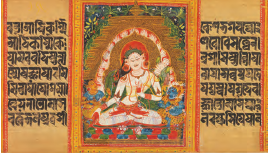
Answer:
Similarities with the Chola bronze Naṭarāja: Both the White Tārā and the Naṭarāja are created with great attention to iconographic detail, where every element of the image carries symbolic meaning. Both figures are shown in a specific posture with deliberate hand gestures (mudras) that communicate spiritual ideas. Both are set against or within a decorative background that adds to their cosmic significance. Both represent divine beings who are deeply connected to the welfare of living beings – Naṭarāja represents cosmic rhythm and liberation, while Tārā represents compassion and protection.
What do you think white symbolises in this image?
Answer:
White in this image likely symbolises purity, peace, spiritual wisdom, and compassion. In Buddhist traditions, White Tārā is associated with long life, healing, and the removal of obstacles. White as a colour represents clarity of mind and the highest form of spiritual knowledge. It also suggests serenity and the absence of impurity, reinforcing the idea of Tārā as a compassionate, all-knowing deity who guides beings toward liberation.
Page 36 – EXERCISES
1. Categories the give list into tangible and intangible cultural heritage:
i. Sculptures
ii. Vedic chanting
iii. Knowledge of waving textiles
iv. Pottery
v. Jewellery
vi. Traditional wedding songs
vii. Kavad katha
viii. Madhubani painting
Answer:
- Tangible Cultural Heritage: Sculptures, Pottery, Jewellery, Madhubani painting
- Intangible Cultural Heritage: Vedic chanting, Knowledge of weaving textiles, Traditional wedding songs, Kāvaḍ Kathā.
2. Why are ancient texts and treatises of Indian arts still relevant today?
i. They contain exact instructions for making different artefacts.
ii. They provide historical knowledge, technical guidance, and philosophical foundations for understanding and practising Indian arts.
iii. They only contain the rules for dance.
iv. They are only useful for studying ancient scripts and languages.
Answer:
ii. They provide historical knowledge, technical guidance, and philosophical foundations for understanding and practising Indian arts.
3. Why do you think the murals in the Ajanta caves have survived close to 1,500 years?
i. Because the murals were repainted every years by local population
ii. Because they contain a mixture of natural and synthetic pigments
iii. Because the caves provided a stable, sheltered environment that protected the painting from sunlight, rain and wind
iv. Because the caves were built on a sacred site where decay does not occur.
Answer:
iii. Because the caves provided a stable, sheltered environment that protected the painting from sunlight, rain and wind
4. Write three rules you would follow when you are at a historical monument, performance, or art gallery, in order to respect the art and ensure its protection from damage.
Answer:
- I will not touch, scratch or deface any artwork, sculpture or monument surface, as even small contact can cause damage over time.
- I will not litter, eat or drink near artworks or inside heritage sites, as moisture and chemicals from food can harm delicate surfaces.
- I will maintain silence and discipline during performances and in galleries and follow all guidelines displayed at the site, such as no-photography zones, to show respect for the art and the artists.
5. Choose any art from you are familiar with. What kind of developments do you see in techniques over time? Use these prompts to guide your responses to the following:
i. Function or role of artworks/performance traditions at different point of time.
ii. Exploration of literacy sources, materials, mediums, and techniques
iii. How are arts processes practised today informed by the past?
Answer:
𝗔𝗿𝘁 𝗳𝗼𝗿𝗺 𝗰𝗵𝗼𝘀𝗲𝗻: 𝗜𝗻𝗱𝗶𝗮𝗻 𝗖𝗹𝗮𝘀𝘀𝗶𝗰𝗮𝗹 𝗗𝗮𝗻𝗰𝗲 — 𝗕𝗵𝗮𝗿𝗮𝘁𝗮𝗻𝗮𝘁𝘆𝗮𝗺
(i) In ancient times, dance was primarily a devotional offering performed inside temples by trained temple dancers (devadasis) as part of religious rituals. During the medieval period under the Bhakti movement, it became a form of spiritual expression accessible to all. In modern times, Bharatanatyam has moved to concert stages and is performed as a classical art form for both cultural and artistic purposes, taught widely in schools and academies.
(ii) The foundational text is the Nāṭyaśhāstra by Bharata Muni, which codified rasa theory, body positions, and hand gestures (mudras). The Abhinaya-darpaṇam by Nandikeśhvara further refined the expressive techniques (abhinaya). Costumes, jewellery and stage lighting have evolved significantly — from simple temple spaces with lamp light to elaborate stage productions with modern lighting and amplified music.
(iii) Today’s Bharatanatyam practitioners still follow the hand gestures, footwork patterns, and rasa theory described in ancient treatises. The guru–śhiṣhya-paramparā (teacher–student tradition) continues as the primary mode of transmission. Contemporary dancers draw themes from the Rāmāyaṇa, Mahābhārata and Purāṇas just as ancient performers did, while also introducing new choreographies on contemporary themes.
6. Write a note on any work of Indian art that you like, which was made before 1200 CE. You can also choose an artwork that hasn’t been provided in the textbook. Describe using any five prompts given below:
i. Material, time period, location/region
ii. Subject/theme
iii. Iconography or symbolise (if any)
iv. Visual characteristics (style/expression)
v. What interests you in the artwork, and how do you connect it to the present times?
vi. Which emotions or navarasa do you experience when you see the artwork, and how do you relate to it?
Answer:
𝗔𝗿𝘁𝘄𝗼𝗿𝗸 𝗰𝗵𝗼𝘀𝗲𝗻: 𝗡𝗮ṭ𝗮𝗿ā𝗷𝗮, 𝗖𝗵𝗼𝗹𝗮 𝗽𝗲𝗿𝗶𝗼𝗱, 𝗕𝗿𝗼𝗻𝘇𝗲, 𝟭𝟬𝘁𝗵 𝗰𝗲𝗻𝘁𝘂𝗿𝘆 𝗖𝗘
(i) The Naṭarāja is a bronze sculpture made during the Chola period in the 10th century CE, originating from Tamil Nadu, South India.
(ii) It depicts Śhiva as the Lord of Dance (Naṭarāja), performing the cosmic dance (Ānanda Tāṇḍava) within a ring of fire, representing the eternal cycle of the universe.
(iii) Every element is deeply symbolic — the ring of fire represents the cyclical nature of the universe; the ḍamaru in the back right hand symbolises the birth of sound and language; the front right hand shows the Abhaya hasta (protection); the front left hand points downward in Gajahasta-mudrā (refuge and emancipation); the right foot crushes Apasmāra Puruṣha, symbolising the defeat of ignorance; and the left foot raised represents mokṣha.
(iv) The Chola sculptors mastered the lost-wax bronze casting technique to achieve extraordinary detail and a sense of fluid movement. The figure radiates dynamic energy and balance simultaneously, with flying locks of hair, multiple arms in graceful positions and a serene yet powerful facial expression.
(v) Most striking about this artwork is how it encodes an entire philosophical worldview — creation, preservation, destruction, illusion, and salvation — within a single dancing figure. In present times, this image continues to inspire dancers, philosophers, and scientists alike. Notably, a large Naṭarāja sculpture stands at CERN (the physics laboratory in Geneva), symbolising the dance of subatomic particles, showing how ancient Indian artistic thought remains globally relevant.
(vi) Viewing the Naṭarāja evokes primarily Adbhuta rasa (wonder and amazement) at the depth of symbolism and the technical mastery of the sculptor. There is also a sense of Śhānta rasa (peace and serenity) that arises from the balanced, harmonious composition, despite the energy it portrays.
Class 9 Arts Madhurima – Questions for Exam Preparation
NCERT Class 9 Arts Madhurima Chapter 1 Very Short Answer Type Questions with Explanation.
Very Short Answer Type Questions
- What is the meaning of the word shruti in the context of Indian tradition?
Answer:
Shruti means “that which is heard.” It refers to the method of transmitting the Vedas through careful listening in the guru–shishya-parampara tradition. - Name the three important treatises on arts written around 500 BCE–600 CE.
Answer:
The three treatises are: (1) Natyashastra by Bharata Muni, (2) Chitra-sutra from the Vishnu-dharmottara Purana, and (3) Silappadigaram by Ilanko Adigal. - What technique was used to create the bronze figurine found at Mohenjo-Daro?
Answer:
The bronze figurine from Mohenjo-Daro was made using the lost-wax technique, which is still used today by Dhokra artists in central and eastern India. - What does UNESCO define as intangible cultural heritage?
Answer:
Intangible cultural heritage includes living expressions like oral traditions, performing arts, social practices, rituals, festive events and knowledge related to nature, passed from ancestors to future generations. - Where are the earliest cave paintings found in India?
Answer:
The earliest cave paintings in India are found at Bhimbetka in Madhya Pradesh, Lakhudiyar in Uttarakhand and several other caves in Andhra Pradesh, Karnataka, Jharkhand, and Bihar. - What is iconography?
Answer:
Iconography is the use of symbolic images to identify characters or themes in art. For example, Shiva is identified by the trishula and damaru and Saraswati by the veena and swan. - Who wrote the Abhinaya-darpanam, and in which century?
Answer:
Abhinaya-darpanam was written by Nandikeshvara in the eleventh century CE. It is the first text dedicated solely to both dance and drama techniques. - What is the significance of the Sarnath lion capital?
Answer:
The Sarnath lion capital is India’s national emblem. Its most striking feature is its lustrous mirror polish, achieved by finely grinding the stone surface until smooth and reflective. - Which colours were used in the cave paintings at Bhimbetka?
Answer:
Red, white, yellow and green colours were used in the Bhimbetka cave paintings. These were made using earth pigments mixed with water and a binder. - What was Kautilya’s Arthashastra’s recognition of performers?
Answer:
Kautilya’s Arthashastra recognised nata, nartaki and gayaka/vadaka as professional performers who contributed to the economy of the state. - What does the word Unakoti mean, and where is it located?
Answer:
Unakoti means “one less than one crore,” believed to be the number of rock-cut carvings in Unakoti, Tripura, spread across a forest area. - Name the earliest surviving manuscript of India and its material.
Answer:
The Gilgit manuscript from Kashmir is the earliest surviving manuscript in India, written on birch bark in the Sharada script, dating to the fifth–sixth century CE. - What is Kudiyattam, and which state is it associated with?
Answer:
Kudiyattam is a performing art tradition combining Sanskrit theatre and dance (kutu). Reconstructed by the Chera ruler Kulashekhara Varman, it continues to be practised in Kerala. - What are the four gateways at Sanchi Stupa called?
Answer:
The four gateways at Sanchi Stupa are called Torana. They were erected between the first century BCE and first century CE and depict scenes from the life of Buddha and Jataka tales. - In the Bṛihaddeśhi, what colour is associated with the note Pa (P)?
Answer:
According to the Brihaddheshi by Matanga Muni, the note Pa (P) is associated with the colour black, representing Krishna.
NCERT Class 9 Arts Madhurima Chapter 1 Short Answer Type Questions with Explanation.
Short Answer Type Questions
- Distinguish between tangible and intangible cultural heritage with one example each.
Answer:
Tangible cultural heritage includes physical objects like sculptures, manuscripts and monuments – for example, the Sanchi Stupa. Intangible cultural heritage includes living expressions like oral traditions and dance forms – for example, Koodiyattam from Kerala. - Why is the Natyashastra considered one of the most important ancient Indian treatises?
Answer:
The Natyashastra by Bharata Muni is among the earliest known treatises on Indian arts. It contains detailed guidance on drama, dance, music and visual arts and most importantly, introduced the rasa theory based on eight bhāvas. - How did Bhakti traditions influence the performing arts in India from the seventh century CE?
Answer:
Bhakti poetry by Alvars and Nayanmars made devotional art accessible to all. Dancers became closely connected to temples, giving rise to temple dancers. Bhakti poetry continues to inspire music, dance and theatre even today. - What makes the Kailasha Temple at Ellora a unique architectural achievement?
Answer:
The Kailasha Temple at Ellora is the largest monolithic free-standing structure in the world. It was carved entirely from a single basalt rock – top to bottom — without any separately attached piece, requiring immense planning and skill. - Explain the significance of the Kudumiyanmalai inscription.
Answer:
The Kudumiyanmalai inscription is a rare musical inscription carved on a cave temple’s rock face in Pudukkottai, Tamil Nadu. It contains musical notes and treatise details in Sanskrit and Tamil, providing valuable insight into ancient classical ragas and Indian music theory. - How did Indian art and culture influence Southeast Asian countries?
Answer:
Indian art and culture spread to Southeast Asia through maritime trade, Chola military expeditions, and travelling monks. The Ramayana and Mahabharata deeply influenced the art, architecture, dance and theatre of countries like Indonesia, Thailand, Vietnam and Cambodia. - What was the Suta-parampara, and how was it performed?
Answer:
The Suta-parampara was an ancient storytelling tradition in which sutas (storytellers) performed narratives from epics using dialogues, voice modulation and gestures. This oral tradition helped transmit stories from the Ramayana and Mahabharata across generations. - Describe the distinguishing features of sculptures made at Mathura and Gandhara.
Answer:
Mathura sculptures used red spotted sandstone and depicted rounded bodies with expressive eyes and faces. Gandhara sculptures, made in grey schist, showed realistic anatomy with resemblance to Greek/Roman style — including wavy hair, flowing robes and lifelike postures. - What is meant by “living traditions”? Give two examples from the chapter.
Answer:
Living traditions are art forms practised continuously over generations whose exact origins may be unknown and cannot be placed on a precise historical timeline. Examples include Dhokra metal craft using the lost-wax process and Warli painting from Maharashtra. - How does the Brihaddheshi by Matanga Muni contribute to our understanding of Indian music?
Answer:
The Brihaddheshi highlights the distinction between classical pan-Indian music (marga) and regional folk-influenced music (deshi). It also associates specific colours with each of the seven musical notes (svaras), showing the deep sensory and aesthetic understanding of ancient Indian music theory.
NCERT Class 9 Arts Madhurima Chapter 1 Long Answer Type Questions with Explanation.
Long Answer Type Questions
- Explain the importance of the integrated arts timeline. Why is it better to study Theatre, Music, Dance and Visual Arts together rather than separately?
Answer:
Studying the four art forms — Theatre, Music, Dance, and Visual Arts — on a single integrated timeline helps us understand how they influenced and shaped one another over centuries. Ideas travelled across regions and art forms simultaneously. For example, the Bhakti movement influenced music, dance, and temple sculpture all at once. The Natyashastra guided both performance and visual representation. When studied in isolation, these connections are lost. The integrated timeline shows that Indian culture was never compartmentalised — it grew as one holistic, interconnected story where every art form borrowed from and enriched the others. - Describe the iconography of the Nataraja sculpture from the Chola period. What does each element symbolise?
Answer:
The Chola bronze Nataraja is one of the most iconic representations of Shiva as the Lord of Dance. The ring of fire surrounding him represents the cyclical nature of the universe. His four hands carry deep symbolic meanings: the back left holds fire symbolising destruction, the front left shows the Gajahasta-mudra representing refuge, the back right holds a damaru representing the birth of sound and language, and the front right shows Abhaya-hasta for protection. His flying hair contains River Ganga and a snake. His left foot symbolises detachment leading to moksha, while his right foot crushes Apasmara Purusha — representing the destruction of ignorance. - Trace the development of painting traditions in ancient India with reference to Ajanta and Sittannavasal caves.
Answer:
The earliest examples of Indian painting traditions date back to prehistoric cave art at Bhimbetka, made with earth pigments in red, white, yellow and green. By the period 500 BCE–600 CE, sophisticated mural traditions had developed. At Ajanta in Maharashtra, artists used earth pigments and natural colours on plaster-primed walls. They skillfully created spatial depth and three-dimensionality through shading and perspective. The blue pigment obtained from lapis lazuli indicates contact with Persian or Central Asian visitors. Sittannavasal in Tamil Nadu represents another major mural tradition from the same period. These murals follow conventions mentioned in the Chitra-sutra of the Vishnu-dharmottara Purana, showing how theory and practice developed together. - Describe how oral traditions and ancient texts together preserved India’s cultural and artistic heritage. Refer to the concepts of shruti and smriti.
Answer:
India developed oral traditions long before the invention of writing. Knowledge was transmitted through listening in the guru–shishya-parampara, a method known as shruti — “that which is heard.” The Vedas were passed on in this way. Texts like the Ramayana, Mahabharata, and Puranas are associated with smriti — meaning memory-based narration — and reflect continuous storytelling traditions. Together, shruti and smriti kept alive the knowledge of music, dance, theatre and literature for thousands of years. These narrative traditions continue today in performance forms like Ramalila, Bhavai, Kavad Katha, Patachitra and Ankiya Nat, proving that oral and written traditions are equally vital to cultural preservation. - How did the period 600 CE to 1200 CE mark a golden era for Indian arts? Discuss with reference to at least three art forms.
Answer:
The period between 600 CE and 1200 CE was a remarkable era of artistic achievement across India. In architecture and sculpture, rock-cut temples like the Kailasha Temple at Ellora and decorated structural temples reflected extraordinary engineering skill. The Chola period produced iconic bronze sculptures including the Nataraja and the 108 Karanas from the Natyashastra were depicted like a storyboard at the Chidambaram temple. In music, important treatises like Sangita-makaranda and Brihaddheshi were written, classifying ragas and distinguishing classical from folk traditions. In performing arts, Kudiyattam combining Sanskrit theatre and dance was reconstructed. Bhakti poetry by the Alvars and Nayanmars deeply influenced music and dance, making art spiritually accessible to all. Manuscript painting also flourished on palm leaves, as seen in the Pala-period illustrated manuscripts.
Frequently Asked Questions – Class 9 Arts Madhurima Chapter 1
Is Class 9 Arts Madhurima Chapter 1 easy or difficult?
Class 9 Arts Madhurima Chapter 1 is moderately easy if you enjoy art, history and culture. The chapter covers a long timeline from 50,000 BCE to 1200 CE, so there are many names, dates, and artworks to remember. However, since it is visual and activity-based, most students find it more interesting than difficult. Reading the figure captions carefully and understanding the four time periods makes it much simpler.
Can I complete Madhurima Chapter 1 in one day?
You can read through Class 9 Arts Madhurima Chapter 1 in one day, but completing it thoroughly – including all activities, discussion circles and exercise questions — will take at least three to four days.
The chapter is 38 pages long and covers four major art forms across multiple time periods. A better approach is to study one time period per day and review key terms before your exam.
How can I score well in Class 9 Madhurima Chapter 1?
To score well in Class 9 Arts Madhurima Chapter 1, focus on these key areas – the four time periods and their major artworks, names of important treatises and their authors, the difference between tangible and intangible heritage, iconography of the Nataraja, and the three sculpture centres (Sarnath, Mathura, Gandhara). Always read figure captions carefully, as exam questions are often based on them.
Is Class 9 Arts Chapter 1 important for the board or school exams?
Yes, Class 9 Arts Madhurima Chapter 1 is foundational for the entire Arts course. It introduces key concepts – rasa theory, cultural heritage, iconography and art history — that are referenced throughout later chapters.
The exercise questions at the end of the chapter, including both short-answer and project-based questions, are likely to appear in school assessments. Parents should ensure students attempt all activities, not just read the text.
What are the most important topics in Class 9 Arts Madhurima Chapter 1 that my child must not miss?
The most important topics in Class 9 Arts Madhurima Chapter 1 are: the definition and examples of tangible and intangible cultural heritage, the Natyashastra and rasa theory, the four time-period timeline, the Bhimbetka cave paintings, the three sculpture centres, the iconography of the Chola Nataraja, the Kailasha Temple at Ellora and the concept of living traditions like Dhokra craft and Kudiyattam.
How can parents help their child prepare Class 9 Arts Chapter 1 at home?
Parents can support their child’s preparation for Class 9 Arts Madhurima Chapter 1 by sharing local folk songs, regional art forms or family traditions that connect to the chapter’s theme of living traditions.
Visiting a nearby museum, art gallery or historical monument can make the learning real and memorable. Watching short documentary videos on Bhimbetka, Ajanta murals or the Nataraja together is also very helpful.
What are the key learning outcomes teachers should assess in Class 9 Madhurima Chapter 1?
In Class 9 Arts Madhurima Chapter 1, teachers should assess Competency C-1.2 through artwork creation and community interaction activities, C-3.2 through discussions on how materials and techniques evolved across time periods and C-4.1 through the ability to trace historical development across Theatre, Music, Dance and Visual Arts with examples. C-4.2 can be assessed through the Q6 exercise where students connect an artwork to their personal experience and present-day context.
How much time should be devoted to teaching Arts Madhurima Chapter 1 in class 9?
Class 9 Arts Madhurima Chapter 1 is the longest and most concept-heavy chapter in the textbook, covering over 5,000 years of art history across four art forms. Teachers should ideally devote eight to ten class periods — two for the introduction and heritage concepts, four for the three time periods with artworks, one for living traditions and two for exercises and project discussions.
Activities and discussion circles should not be skipped, as they develop critical thinking and aesthetic response.
Are the projects in Class 9 Arts Madhurima Chapter 1 mandatory and how should they be evaluated?
The individual project (Q7) and group project (Q8) at the end of Class 9 Arts Madhurima Chapter 1 are integral to the assessment framework under the NEP-aligned curriculum. They assess research skills, cultural awareness and the ability to connect past art traditions with present practice.
Teachers should evaluate them on the basis of depth of observation, originality of expression and connection to the chapter’s themes — not just factual accuracy or presentation quality.