Tiwari Academy  – Free CBSE NCERT Books and Solutions
  • Apps
    • CBSE Apps
    • Hast Rekha App
  • NCERT Solutions
    • NCERT Solutions for Class 12
      • NCERT Solutions for Class 12 Maths
      • NCERT Solutions for Class 12 Physics
      • NCERT Solutions for Class 12 Chemistry
      • NCERT Solutions for Class 12 Biology
      • NCERT Solutions for Class 12 English
      • NCERT Solutions for Class 12 Accounts
      • NCERT Solutions for Class 12 Business Studies
      • NCERT Solutions for Class 12 Economics
      • NCERT Solutions for Class 12 Geography
      • NCERT Solutions for Class 12 Physical Education
      • NCERT Solutions for Class 12 Political Science
      • NCERT Solutions for Class 12 Psychology
      • NCERT Solutions for Class 12 Sociology
    • NCERT Solutions for Class 11
      • NCERT Solutions for Class 11 Maths
      • NCERT Solutions for Class 11 Physics
      • NCERT Solutions for Class 11 Chemistry
      • NCERT Solutions for Class 11 Biology
      • NCERT Solutions for Class 11 English
      • NCERT Solutions for Class 11 Business Studies
      • NCERT Solutions for Class 11 Sociology
      • NCERT Solutions for Class 11 Political Science
      • NCERT Solutions for Class 11 Psychology
      • NCERT Solutions for Class 11 Physical Education
    • NCERT Solutions for Class 10
      • NCERT Solutions for Class 10 Maths
      • NCERT Solutions for Class 10 Science
      • NCERT Solutions for Class 10 English
      • NCERT Solutions for Class 10 Hindi Course A and B
      • NCERT Solutions for Class 10 Sanskrit
      • NCERT Solutions for Class 10 Social Science
    • NCERT Solutions for Class 9
      • NCERT Solutions for Class 9 Maths
      • NCERT Solutions for Class 9 Science
      • NCERT Solutions for Class 9 English
      • NCERT Solutions for Class 9 Hindi
      • NCERT Solutions for Class 9 Sanskrit
      • NCERT Solutions for Class 9 Social Science
    • NCERT Solutions for Class 8
      • NCERT Solutions for Class 8 Maths
      • NCERT Solutions for Class 8 Science
      • NCERT Solutions for Class 8 English
      • NCERT Solutions for Class 8 Hindi
      • NCERT Solutions for Class 8 Sanskrit
      • NCERT Solutions for Class 8 Social Science
      • NCERT Solutions for Class 8 Computer
    • NCERT Solutions for Class 7
      • NCERT Solutions for Class 7 Maths
      • NCERT Solutions for Class 7 Science
      • NCERT Solutions for Class 7 English
      • NCERT Solutions for Class 7 Hindi
      • NCERT Solutions for Class 7 Sanskrit
      • NCERT Solutions for Class 7 Social Science
      • NCERT Solutions for Class 7 Computer
    • NCERT Solutions for Class 6
      • NCERT Solutions for Class 6 Maths
      • NCERT Solutions for Class 6 Science
      • NCERT Solutions for Class 6 English
      • NCERT Solutions for Class 6 Hindi
      • NCERT Solutions for Class 6 Sanskrit
      • NCERT Solutions for Class 6 Social Science
      • NCERT Solutions for Class 6 Computer
    • NCERT Solutions for Class 5
      • NCERT Solutions for Class 5 Hindi
      • NCERT Solutions for Class 5 English
      • NCERT Solutions for Class 5 Maths
      • NCERT Solutions for Class 5 EVS
      • NCERT Solutions for Class 5 Computer
      • NCERT Solutions for Class 5 GK
    • NCERT Solutions for Class 4
      • NCERT Solutions for Class 4 Hindi
      • NCERT Solutions for Class 4 English
      • NCERT Solutions for Class 4 Maths
      • NCERT Solutions for Class 4 EVS
      • NCERT Solutions for Class 4 Computer
      • NCERT Solutions for Class 4 GK
    • NCERT Solutions for Class 3
      • NCERT Solutions for Class 3 Hindi
      • NCERT Solutions for Class 3 English
      • NCERT Solutions for Class 3 Maths
      • NCERT Solutions for Class 3 EVS
      • NCERT Solutions for Class 3 Science
      • NCERT Solutions for Class 3 Computer
      • NCERT Solutions for Class 3 GK
    • NCERT Solutions for Class 2
      • NCERT Solutions for Class 2 Hindi
      • NCERT Solutions for Class 2 English
      • NCERT Solutions for Class 2 Maths
      • NCERT Solutions for Class 2 EVS
      • NCERT Solutions for Class 2 Science
      • NCERT Solutions for Class 2 Computer
      • NCERT Solutions for Class 2 GK
    • NCERT Solutions for Class 1
      • NCERT Solutions for Class 1 Hindi
      • NCERT Solutions for Class 1 English
      • NCERT Solutions for Class 1 Maths
      • NCERT Solutions for Class 1 EVS
      • NCERT Solutions for Class 1 Computer
      • NCERT Solutions for Class 1 Science
      • NCERT Solutions for Class 1 GK
    • Study Material for KG
      • Study Material for KG English
      • Study Material for KG Hindi
      • Study Material for KG Maths
    • Study Material for Nursery
      • Study Material for Nursery Maths
      • Study Material for Nursery English
      • Study Material for Nursery Hindi
  • MCQ
  • NEWS
    • Educational NEWS
    • Explore More
  • Grammar
    • Class 1 English Grammar
      • Class 1 Hindi Vyakaran
    • Class 2 English Grammar
      • Class 2 Hindi Vyakaran
    • Class 3 English Grammar
      • Class 3 Hindi Vyakaran
    • Class 4 English Grammar
      • Class 4 Hindi Vyakaran
    • Class 5 English Grammar
      • Class 5 Hindi Vyakaran
    • Class 6 English Grammar
      • Class 6 Hindi Vyakaran
    • Class 7 English Grammar
      • Class 7 Hindi Vyakaran
    • Class 8 English Grammar
      • Class 8 Hindi Vyakaran
  • Sample Papers
    • CBSE Sample Papers for Class 9
    • CBSE Sample Papers for Class 10
    • CBSE Sample Papers for Class 11
    • CBSE Sample Papers for Class 12
  • NCERT Books
    • NCERT Books for Class 1 All Subjects
    • NCERT Books for Class 2 All Subjects
    • NCERT Books for Class 3 All Subjects
    • NCERT Books for Class 4 All Subjects
    • NCERT Books for Class 5 All Subjects
    • NCERT Books for Class 6 All Subjects
    • NCERT Books for Class 7 All Subjects
    • NCERT Books for Class 8 All Subjects
    • NCERT Books for Class 9 All Subjects
    • NCERT Books for Class 10 All Subjects
    • NCERT Books for Class 11 All Subjects
    • NCERT Books for Class 12 All Subjects
  • Syllabus
    • CBSE Date Sheet 2025
    • CBSE Syllabus
    • NCERT Exemplar
    • What is NIOS?
    • NIOS Online Admission
  • Contact
    • Contact Us
    • About Us
    • Online Tutors
    • Career Options
  • Apps
    • CBSE Apps
    • Hast Rekha App
  • NCERT Solutions
    • NCERT Solutions for Class 12
      • NCERT Solutions for Class 12 Maths
      • NCERT Solutions for Class 12 Physics
      • NCERT Solutions for Class 12 Chemistry
      • NCERT Solutions for Class 12 Biology
      • NCERT Solutions for Class 12 English
      • NCERT Solutions for Class 12 Accounts
      • NCERT Solutions for Class 12 Business Studies
      • NCERT Solutions for Class 12 Economics
      • NCERT Solutions for Class 12 Geography
      • NCERT Solutions for Class 12 Physical Education
      • NCERT Solutions for Class 12 Political Science
      • NCERT Solutions for Class 12 Psychology
      • NCERT Solutions for Class 12 Sociology
    • NCERT Solutions for Class 11
      • NCERT Solutions for Class 11 Maths
      • NCERT Solutions for Class 11 Physics
      • NCERT Solutions for Class 11 Chemistry
      • NCERT Solutions for Class 11 Biology
      • NCERT Solutions for Class 11 English
      • NCERT Solutions for Class 11 Business Studies
      • NCERT Solutions for Class 11 Sociology
      • NCERT Solutions for Class 11 Political Science
      • NCERT Solutions for Class 11 Psychology
      • NCERT Solutions for Class 11 Physical Education
    • NCERT Solutions for Class 10
      • NCERT Solutions for Class 10 Maths
      • NCERT Solutions for Class 10 Science
      • NCERT Solutions for Class 10 English
      • NCERT Solutions for Class 10 Hindi Course A and B
      • NCERT Solutions for Class 10 Sanskrit
      • NCERT Solutions for Class 10 Social Science
    • NCERT Solutions for Class 9
      • NCERT Solutions for Class 9 Maths
      • NCERT Solutions for Class 9 Science
      • NCERT Solutions for Class 9 English
      • NCERT Solutions for Class 9 Hindi
      • NCERT Solutions for Class 9 Sanskrit
      • NCERT Solutions for Class 9 Social Science
    • NCERT Solutions for Class 8
      • NCERT Solutions for Class 8 Maths
      • NCERT Solutions for Class 8 Science
      • NCERT Solutions for Class 8 English
      • NCERT Solutions for Class 8 Hindi
      • NCERT Solutions for Class 8 Sanskrit
      • NCERT Solutions for Class 8 Social Science
      • NCERT Solutions for Class 8 Computer
    • NCERT Solutions for Class 7
      • NCERT Solutions for Class 7 Maths
      • NCERT Solutions for Class 7 Science
      • NCERT Solutions for Class 7 English
      • NCERT Solutions for Class 7 Hindi
      • NCERT Solutions for Class 7 Sanskrit
      • NCERT Solutions for Class 7 Social Science
      • NCERT Solutions for Class 7 Computer
    • NCERT Solutions for Class 6
      • NCERT Solutions for Class 6 Maths
      • NCERT Solutions for Class 6 Science
      • NCERT Solutions for Class 6 English
      • NCERT Solutions for Class 6 Hindi
      • NCERT Solutions for Class 6 Sanskrit
      • NCERT Solutions for Class 6 Social Science
      • NCERT Solutions for Class 6 Computer
    • NCERT Solutions for Class 5
      • NCERT Solutions for Class 5 Hindi
      • NCERT Solutions for Class 5 English
      • NCERT Solutions for Class 5 Maths
      • NCERT Solutions for Class 5 EVS
      • NCERT Solutions for Class 5 Computer
      • NCERT Solutions for Class 5 GK
    • NCERT Solutions for Class 4
      • NCERT Solutions for Class 4 Hindi
      • NCERT Solutions for Class 4 English
      • NCERT Solutions for Class 4 Maths
      • NCERT Solutions for Class 4 EVS
      • NCERT Solutions for Class 4 Computer
      • NCERT Solutions for Class 4 GK
    • NCERT Solutions for Class 3
      • NCERT Solutions for Class 3 Hindi
      • NCERT Solutions for Class 3 English
      • NCERT Solutions for Class 3 Maths
      • NCERT Solutions for Class 3 EVS
      • NCERT Solutions for Class 3 Science
      • NCERT Solutions for Class 3 Computer
      • NCERT Solutions for Class 3 GK
    • NCERT Solutions for Class 2
      • NCERT Solutions for Class 2 Hindi
      • NCERT Solutions for Class 2 English
      • NCERT Solutions for Class 2 Maths
      • NCERT Solutions for Class 2 EVS
      • NCERT Solutions for Class 2 Science
      • NCERT Solutions for Class 2 Computer
      • NCERT Solutions for Class 2 GK
    • NCERT Solutions for Class 1
      • NCERT Solutions for Class 1 Hindi
      • NCERT Solutions for Class 1 English
      • NCERT Solutions for Class 1 Maths
      • NCERT Solutions for Class 1 EVS
      • NCERT Solutions for Class 1 Computer
      • NCERT Solutions for Class 1 Science
      • NCERT Solutions for Class 1 GK
    • Study Material for KG
      • Study Material for KG English
      • Study Material for KG Hindi
      • Study Material for KG Maths
    • Study Material for Nursery
      • Study Material for Nursery Maths
      • Study Material for Nursery English
      • Study Material for Nursery Hindi
  • MCQ
  • NEWS
    • Educational NEWS
    • Explore More
  • Grammar
    • Class 1 English Grammar
      • Class 1 Hindi Vyakaran
    • Class 2 English Grammar
      • Class 2 Hindi Vyakaran
    • Class 3 English Grammar
      • Class 3 Hindi Vyakaran
    • Class 4 English Grammar
      • Class 4 Hindi Vyakaran
    • Class 5 English Grammar
      • Class 5 Hindi Vyakaran
    • Class 6 English Grammar
      • Class 6 Hindi Vyakaran
    • Class 7 English Grammar
      • Class 7 Hindi Vyakaran
    • Class 8 English Grammar
      • Class 8 Hindi Vyakaran
  • Sample Papers
    • CBSE Sample Papers for Class 9
    • CBSE Sample Papers for Class 10
    • CBSE Sample Papers for Class 11
    • CBSE Sample Papers for Class 12
  • NCERT Books
    • NCERT Books for Class 1 All Subjects
    • NCERT Books for Class 2 All Subjects
    • NCERT Books for Class 3 All Subjects
    • NCERT Books for Class 4 All Subjects
    • NCERT Books for Class 5 All Subjects
    • NCERT Books for Class 6 All Subjects
    • NCERT Books for Class 7 All Subjects
    • NCERT Books for Class 8 All Subjects
    • NCERT Books for Class 9 All Subjects
    • NCERT Books for Class 10 All Subjects
    • NCERT Books for Class 11 All Subjects
    • NCERT Books for Class 12 All Subjects
  • Syllabus
    • CBSE Date Sheet 2025
    • CBSE Syllabus
    • NCERT Exemplar
    • What is NIOS?
    • NIOS Online Admission
  • Contact
    • Contact Us
    • About Us
    • Online Tutors
    • Career Options
เคนเคฟเค‚เคฆเฅ€ เคฎเฅ€เคกเคฟเคฏเคฎเคนเคฟเค‚เคฆเฅ€ เคฎเฅ€เคกเคฟเคฏเคฎ Latest BlogsLatest Blogs Ask QuestionsAsk Questions
Tiwari Academy  /  CBSE Class 10 English Exam Paper 2026: Solutions, Answer Key & Analysis

CBSE Class 10 English Exam Paper 2026: Solutions, Answer Key & Analysis

CBSE Class 10 English exam question paper 2026 with complete solutions and answer key.
Post Date: March 3, 2026

Are you looking to verify your answers and calculate your expected score after the recent board exam? You are in the right place! In this comprehensive guide, we are providing the complete CBSE Class 10 English Exam Paper 2026 Solutions to help you evaluate your performance instantly. From the tricky reading comprehension passages to the literature section, we have broken down the entire paper. Scroll down to download the authentic CBSE Class 10 English Answer Key 2026 and access the full Question Paper PDF along with expert paper analysis.
CBSE Class 10 English Exam Paper 2026 Answer and Solutions

Section A (20 Marks) : Reading Skills

1. Read the following text: [10 Marks]

(1)ย Forests are often called the lungs of the Earth, and in India, they are an integral part of the country’s ecological, economic, and cultural fabric. They regulate temperatures and help keep the air clean. Covering about 21.71% of India’s geographical area, forests play a pivotal role in sustaining biodiversity, regulating climate, and supporting the livelihoods of millions of people. However, these verdant expanses face numerous challenges, raising important questions about conservation, sustainable development, and policy priorities.

(2)ย India’s forests are incredibly diverse, ranging from the lush tropical rain forests to the alpine vegetation of the Himalayas. This diversity is home to a wide variety of flora and fauna, many of which are endemic or endangered, such as the Bengal tiger, Indian elephant, and Nilgiri Tahr. Forests also provide critical ecosystem services like water conservation, soil fertility, and carbon sequestration, which are essential in combating climate change.

(3)ย Economically, forests contribute significantly through timber, medicinal plants and Non-Timber Forest Products (NTFPs) like honey and bamboo. They are also central to the lives of tribal communities who depend on them for sustenance and cultural practices. However, this dependence brings to light the complex relationship between human development and forest preservation.

(4)ย Is it possible to achieve economic growth without degrading forest resources? The pressures on India’s forests are immense. Rapid urbanization, industrial expansion, mining, and agricultural encroachment have led to significant deforestation. According to recent reports, India lost around 66,000 hectares of forest cover between 2019 and 2021. This loss not only threatens biodiversity but also exacerbates climate-related challenges such as rising temperatures and erratic rainfall.

(5)ย Policy measures like the Forest Conservation Act of 1980 and initiatives such as Compensatory Afforestation and Van Mahotsav (Forest Festival) reflect efforts to preserve and expand forest areas. However, critics argue that these measures often fail to address ground realities. For instance, afforestation projects may involve planting monoculture species that disrupt ecosystems rather than restore natural biodiversity. Similarly, conflicts arise when policies overlook the rights of indigenous communities, leading to displacement and social tensions. India’s forests are a microcosm of the global struggle to balance development with conservation.

(6)ย Solutions lie in adopting sustainable practices, such as agroforestry, eco-tourism, and community-based conservation models. Empowering local communities to act as custodians of forests ensures both their livelihoods and the health of forest ecosystems. Moreover, raising awareness about the importance of forests can inspire collective action at all levels.

Answer the following questions, based on the passage above:

(i) In paragraph 1, what does the phrase ‘Lungs of the Earth’ refer to with reference to the passage?
Answer:
The phrase ‘Lungs of the Earth’ refers to forests because, just like lungs purify blood in the body, forests regulate temperatures and help keep the air clean, making them essential for the Earth’s ecological health.

(ii)ย Complete the following with the correct option from the two given : Forests play a significant role in sustaining biodiversity by ______
(a) balancing climate change and creating livelihoods for people.
(b) Providing wood for fuel and industries worldwide. (Para 1)
Answer:
The correct option is (a) โ€” balancing climate change and creating livelihoods for people.

(iii) Support the writer’s idea that forests provide critical ecosystem services with textual evidence. (Para 2)
Answer:
The writer’s idea that forests provide critical ecosystem services is supported by the following textual evidence from Para 2: “Forests also provide critical ecosystem services like water conservation, soil fertility and carbon sequestration, which are essential in combating climate change.”

(iv) What do the recent statistics on deforestation reveal about the state of India’s forests?
(A) Deforestation has decreased significantly.
(B) Forest loss has been stabilized.
(C) Forest cover i s rapidly declining.
(D) There is no significant impact on forest cover. (Para 4 )
Answer:
The correct answer is (C) Forest cover is rapidly declining. โ€” The statistics reveal that India lost around 66,000 hectares of forest cover between 2019 and 2021, which shows rapid decline.

(v) Select the concept that best reflects the complex relationship between human development and preservation. (Para 3 )
(a) Rapid urbanization has led to widespread deforestation depriving flora and fauna o f its natural habitat.
(b) The introduction of initiatives like Van Mahotsav serve as compensatory afforestation.
Answer:
The concept that best reflects the complex relationship between human development and forest preservation is (a) โ€” Rapid urbanization has led to widespread deforestation depriving flora and fauna of its natural habitat.

(vi) State whether the following statement is true o r false:
Deforestation is one of the reasons for erratic rainfall. (Para 4)
Answer:
True. According to Para 4, deforestation exacerbates climate-related challenges such as rising temperatures and erratic rainfall.

(vii) List one challenge that critics see in compensatory afforestation measures. (Para 5 )
Answer:
One challenge that critics see in compensatory afforestation is that these projects often involve planting monoculture species that disrupt ecosystems rather than restoring natural biodiversity.

(viii) How do community-based conservation models benefit both forests and local communities? (Para 6 )
Answer:
Community-based conservation models benefit both forests and local communities by empowering local people to act as custodians of forests, which ensures their livelihoods are sustained while also maintaining the health of forest ecosystems.

2.ย Read the following passage carefully: [10 Marks]

The Rise of Electric Vehicles in India:
(1) Electric Vehicles (EVs) are gaining significant traction globally. In India, the push for EVs is driven by concerns over air pollution, rising fuel costs and government’s commitment to reducing carbon emissions. The Indian Government has set ambitious targets for EV adoption, aiming for 30% of private cars, 70% of commercial vehicles, and 80% of two wheelers and three-wheelers to be electric by 2030.

(2) The benefits of EVs extend beyond environmental impact : Lower running cost due to cheaper electricity, reduces maintenance because of fewer moving parts, and lowers noise pollution in urban areas.

(3) Despite the promising outlook, the EV industry in India faces several challenges currently. While public charging stations are slowly increasing, their availability, especially in semi-urban and rural areas, remains a bottleneck. The initial high purchase cost of EVs and concerns about range or the fear o f running out of charge are other causes o f anxiety.

(4) To overcome these hurdles, the government i s offering subsidies and tax benefits to make EVs more affordable. Private companies are investing in developing new EV models with improved battery technology for longer ranges and battery swapping technology is also being explored as a quick alternative to traditional charging.

(5)ย The Indian EV market i s witnessing rapid growth, with sales figures steadily climbing. In 2023, India recorded sales of over 1.5 million EVs, a significant jump from previous years. Two-wheelers dominated the sales, followed b y three-wheelers and then passenger cars. States like Maharashtra, Delhi, and Karnataka have emerged as leaders in E V adoption, largely due to supportive state policies and greater awareness among consumers.

Answer the following questions, based on the above passage:
(i) Electric vehicles offer multiple benefits in India.
Support the above statement in 40 words with evidence from the text.
Answer:
Electric vehicles offer multiple benefits in India. They have lower running costs due to cheaper electricity, require less maintenance because of fewer moving parts and reduce noise pollution in urban areas. These advantages make EVs an economically and environmentally attractive option for Indian consumers.

(ii) Select the option that is true for the assertion and reason given below:
Assertion: EVs are gaining traction in India.
Reason: The Indian government is committed to reducing carbon emissions.
(A) Both the assertion and reason are true, and the reason i s the correct explanation o f the assertion.
(B) Both the assertion and reason are true, but the reason i s not the correct explanation of the assertion.
(C) The assertion i s true, but the reason is false.
(D) The assertion i s false, but the reason is true.
Answer:
The correct answer is (B) โ€” Both the assertion and reason are true, but the reason is not the correct explanation of the assertion. EVs are gaining traction due to multiple reasons including air pollution concerns and rising fuel costs, not just the government’s commitment to reducing carbon emissions alone.

(iii) Justify the following statement:
Despite governmental support, the initial cost of EVs remains a challenge for consumers.
Answer:
Despite the government offering subsidies and tax benefits to make EVs more affordable, the initial high purchase cost of EVs still remains a significant burden for average consumers. The subsidies help reduce the price to some extent, but they are not sufficient to make EVs fully affordable for a large section of the population.

(iv) Complete the following with one suitable reason from the text :
The silent operation of EVs contributes to better urban living because ______.
Answer:
The silent operation of EVs contributes to better urban living because they lower noise pollution in urban areas, making city environments quieter and more comfortable for residents.

(v) “In 2023, India recorded sales of over 1.5 million EVs, a significant jump from previous years.”
State any one inference that can be drawn from the above statement.
Answer:
One inference that can be drawn is that awareness and acceptance of electric vehicles among Indian consumers is growing rapidly, reflecting increasing confidence in EV technology and the positive impact of government policies promoting EV adoption.

(vi) According to the passage, what i s ‘range anxiety’ in the context o f electric vehicles?
Answer:
In the context of electric vehicles, ‘range anxiety’ refers to the fear or concern of running out of charge while driving, especially when charging stations are not easily or widely available, making consumers hesitant to travel longer distances on EVs.

(vii) Based o n the given text, which type o f E V dominated sales in India in 2023?
Answer:
According to the passage, two-wheelers dominated EV sales in India in 2023, followed by three-wheelers and then passenger cars.

(viii) Complete the sentence suitably :
To address the challenge of charging infrastructure, various initiatives are being undertaken, such as _______.
Answer:
To address the challenge of charging infrastructure, various initiatives are being undertaken, such as slowly increasing the number of public charging stations across the country and exploring battery swapping technology as a quick alternative to traditional charging.

(ix) Give one reason t o support why the adoption of EVs is slow in some parts of India.
Answer:
One reason why EV adoption is slow in some parts of India is the lack of availability of public charging stations, especially in semi-urban and rural areas, which remains a major bottleneck and discourages people from switching to electric vehicles.


Section – B [20 Marks] : Grammar and Creative Writing Skills Grammar [10 Marks]

3. Complete any ten of twelve of the following tasks, as directed:

(i) A manager wrote a report to his seniors about his team. Fill in the blank with the correct option to complete the report:
By the end o f this quarter, the assistant manager ______ on this campaign for eight months.
(A) will be working
(B) will have been working
(C) will have working
(D) would have been working
Answer:
The correct answer is (B) will have been working โ€” This is the future perfect continuous tense, which is used to express an action that will have been ongoing for a specific duration by a future point in time.

(ii) Read the given sentence from a sales report. Identify the error and supply the correction i n the given format:
Being checked all the figures twice, she was sure there were no errors.

Error | Correction
_____ | __________

Answer:
Error | Correction
Being checked | Having checked
Explanation:
Error: “Being checked” โ€” Correction: “Having checked” โ€” The correct sentence is: “Having checked all the figures twice, she was sure there were no errors.” A perfect participle is needed here to show a completed action.

(iii) Read the conversation between the store supervisor and the salesman:
Supervisor : “Did you switch off all the lights before leaving office yesterday?”
Salesman – “Yes, I did and I also handed over the keys t o the night supervisor.”
A store supervisor asked the salesman whether he had switched off all the lights before leaving the office the day before.
The salesman confirmed ________.
Report the salesman’s response.
Answer:
The salesman confirmed that he had done so and had also handed over the keys to the night supervisor.

(iv) A school Principal addressed Board aspirants and said:
“_________ candidates must carry their identification proof.”
Fill i n the blank with the appropriate option:
(A) Each
(B) All
(C) Every
(D) O
Answer:
The correct answer is (B) All โ€” “All candidates must carry their identification proof” is the most appropriate usage when referring to the entire group collectively.

(v) Isha said to her parents, “My mentor will always guide me, even after this programme ends.”
Report what Isha said to her parents.
Answer:
Isha told her parents that her mentor would always guide her, even after that programme ended.

(vi) Find the error i n the following sentence and supply the correction:
I was disappointed to see that in the library there was less books on the subject than expected.
Answer:
Error: “less” โ€” Correction: “fewer” โ€” The correct sentence is: “I was disappointed to see that in the library there were fewer books on the subject than expected.” “Fewer” is used for countable nouns like books.

(vii) Fill in the blank with correct option:
My friends ________ the movie tickets before we even reached the ticket counter.
(A) has collected
(B) had collected
(C) collect
(D) will collect
Answer:
The correct answer is (B) had collected โ€” Past perfect tense is used here because collecting tickets happened before reaching the counter.

(viii) Select the correct option to complete the given sentence from a recipe book for students:
After stirring the coca into the melted butter, you ________ add the eggs one at a time before adding the flour.
(A) would
(B) might
(C) may
(D) must
Answer:
The correct answer is (D) must โ€” “Must” is used to give a strong instruction or direction, which is appropriate in a recipe book context.

(ix) Report the following sentence by a customer:
“Did you double-check the address before dispatching the washing machine?”
Answer:
The customer asked whether they had double-checked the address before dispatching the washing machine.

(x) Complete the following sentence by choosing the correct option:
If we had consulted the engineer, we _______ this mistake.
(A) would avoid
(B) will avoid
(C) would have avoided
(D) had avoided
Answer:
The correct answer is (C) would have avoided โ€” This is a third conditional sentence expressing an unreal past situation and its consequence.

(xi) Complete the following newspaper reportย by filling in the blank:
The number of road accidents ________ increased this year.
(A) have
(B) are
(C) has
(D) were
Answer:
The correct answer is (C) has โ€” “The number of” always takes a singular verb, so “has” is correct here.

(xii) The speaker in conversation with a group of ministers said,
” I feel reassured after hearing your opinions.”
What did the speaker say to the ministers?
Answer:
The speaker told the ministers that he/she felt reassured after hearing their opinions.

Creative Writing Skills [10 Marks]

Note: All details presented in the questions in writing section are imaginary and created for assessment purpose.

4. Attempt any one from (A) and (B) given below:

(A) As a parent, you have observed a rise in the number of students feeling a sense o f inadequacy and anxiety. According to you social media is impacting their self worth through constant social comparison and exposure to unrealistic standards. You are Divya / Dinesh Rana – write a letter to the Principal of Sunrise International School, suggesting the need to hold workshops and interactive sessions with students, teachers, and parents to explore the positive aspects o f social media that will strengthen a sense of self identity.
Answer:
Letter to the Principal
27, Sector 12 Rohini, New Delhi 28 February 2026
The Principal Sunrise International School New Delhi
Subject: Request to Conduct Workshops on Social Media and Self Identity
Respected Ma’am/Sir,
I am Divya Rana, a parent of a student enrolled in Class IX of your esteemed school. I am writing this letter to bring to your kind attention a growing concern that I, along with several other parents, have been observing among school students.
In recent times, there has been a noticeable rise in the number of students experiencing feelings of inadequacy, low self-esteem and anxiety. Upon careful observation, I believe that one of the primary reasons behind this alarming trend is the excessive and unregulated use of social media. Platforms that were once designed to connect people have now become spaces where students constantly compare themselves with others, often exposing themselves to unrealistic standards of beauty, success and lifestyle. This constant comparison gradually erodes their confidence and distorts their sense of self-worth.
However, I also firmly believe that social media, when used mindfully and constructively, can be a powerful tool for self-expression, creativity, and building positive communities. Therefore, rather than discouraging its use entirely, I feel it is important to guide our students on how to navigate social media responsibly.
In this regard, I would like to respectfully suggest that the school consider organising workshops and interactive sessions involving students, teachers and parents. These sessions could focus on the following areas:
Educating students about the positive aspects of social media such as networking, skill sharing, and creative expression. Helping them develop a strong and secure sense of self-identity that is not dependent on external validation. Training teachers to identify early signs of anxiety and low self-esteem in students. Encouraging open dialogue between parents and children about their online experiences.
Such initiatives, I believe, will create a more supportive and aware school community. I am confident that under your visionary leadership, this idea will receive the attention it truly deserves. I would be happy to collaborate or contribute in any way possible.
Thanking you in anticipation.
Yours sincerely Divya Rana

OR

(B)ย You are Sneha/Gursharan Singh an art teacher from a reputed public school. You have noticed that most students after class X opt for management or science streams and pursue careers as doctors, engineers or management professionals : You believe that Art is crucial for students a s it fosters creativity, critical thinking, and promotes emotional well-being. Write a letter t o the editor of a local daily expressing your views on the importance of studying art in schools.
Answer:
The Art Teacher Delhi Public School Vasant Kunj, New Delhi 28 February 2026
The Editor The Hindustan Times New Delhi
Subject: The Importance of Studying Art in Schools
Respected Sir/Ma’am,
Through the esteemed columns of your widely read newspaper, I wish to draw the attention of parents, educators, and policymakers towards a matter that I feel deeply concerned about as an art teacher with over a decade of experience in one of the city’s reputed public schools.
It has been my consistent observation over the years that the moment students complete their Class X board examinations, the majority of them are swiftly channelled into either the Science or Commerce stream. The pressure to become doctors, engineers, or management professionals begins at an alarmingly early age. In this relentless pursuit of so-called “practical” careers, one subject that is almost always overlooked and undervalued is Art. I write this letter today to strongly advocate for the importance of art education in our schools and to urge society to reconsider its attitude towards this deeply meaningful discipline.
Art is far more than painting or drawing. It is a language in itself, one that teaches students to observe the world with sensitivity, think independently, and express emotions that words often fail to capture. In a world that is rapidly changing and increasingly demanding innovation, creativity has become one of the most sought-after skills. Art education, by its very nature, nurtures this creativity in students from a young age. It encourages them to approach problems from multiple perspectives, to experiment without fear of failure, and to find unique solutions, all of which are qualities that are invaluable in any profession, including science and management.
Furthermore, art fosters critical thinking in students. When a student analyses a painting, plans a composition, or critiques a piece of work, they are engaging in higher-order thinking that sharpens their intellectual abilities. Research across the world has consistently shown that students who engage with the arts perform better academically overall, as art trains the mind to concentrate, observe, and connect ideas in meaningful ways.
Perhaps most importantly in today’s context, art plays a vital role in promoting emotional well-being among young students. Adolescence is a period of immense psychological pressure, and many students struggle silently with stress, anxiety, and identity crises. Art provides a healthy and constructive outlet for these emotions. It helps students process their feelings, build self-confidence and develop a stronger sense of personal identity. Schools that have incorporated regular art sessions have reported noticeable improvements in the overall mental health and happiness of their students.
It is therefore my humble appeal to parents to not dismiss art as a lesser choice for their children. To school administrators, I urge the inclusion of art as a meaningful and well-resourced part of the curriculum, not merely as an activity period. And to policymakers, I request a serious reconsideration of the space and value given to arts education in our national educational framework.
A nation that nurtures its artists nurtures its soul. Let us give our children the freedom to colour their futures with the full spectrum of their abilities.
Thanking you for providing me this valuable platform.
Yours sincerely Sneha Singh Art Teacher Tiwari Academy, Vasant Kunj.

5. Attempt any one from (A) and (B) given below:

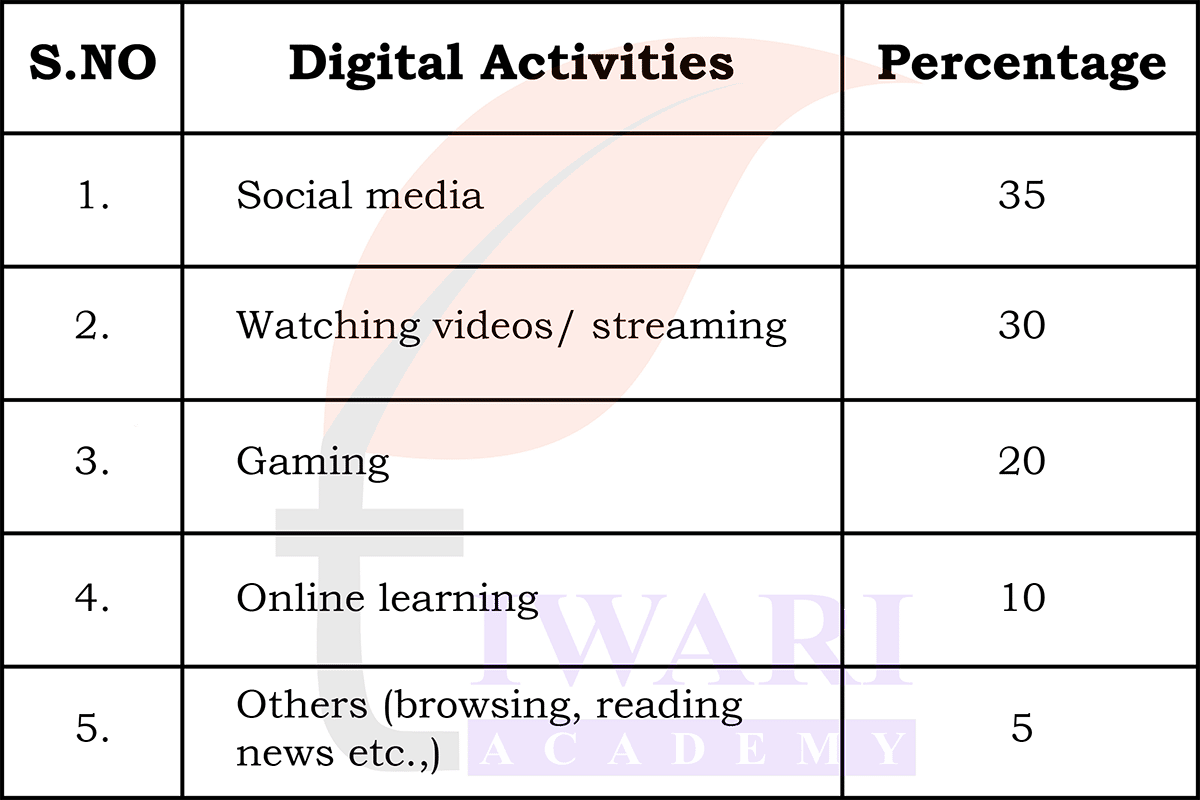
(A) The data given below shows how teenagers spend their daily screen time across different digital activities.

CBSE Class 10 English exam question paper 2026 Question 5A

Analyse the data provided and write a paragraph analyzing how teenagers allocate their daily screen time.
Focus on the activity that occupies the largest proportion of time and o n other major and minor activities in descending order, and on the balance between entertainment and educational screen use. Conclude with an observation about the overall trend.
Answer:
The data presented reveals a clear and thought-provoking picture of how teenagers distribute their daily screen time across various digital activities. Social media emerges as the dominant activity, occupying the largest share of 35% of teenagers’ screen time, reflecting how deeply embedded these platforms have become in the daily lives of young people.
Following closely is watching videos and streaming, which accounts for 30% of their screen time, indicating a strong preference for visual entertainment content. Gaming ranks third with a significant 20%, further highlighting the dominance of entertainment-based activities among teenagers.
In stark contrast, online learning accounts for only 10% of their total screen time, suggesting that educational use of digital devices remains considerably low despite the wide availability of learning platforms and resources. The remaining 5% is spent on miscellaneous activities such as browsing and reading news.
Notably, when the data is viewed in terms of balance between entertainment and education, a striking imbalance becomes evident โ€” a massive 85% of screen time is devoted to entertainment-oriented activities, while only 10% is directed towards learning and self-improvement. The overall trend clearly indicates that teenagers are predominantly using their screen time for leisure and social interaction rather than academic or intellectual enrichment, which raises important questions about the need for greater digital awareness and guided screen time management among the younger generation.

OR

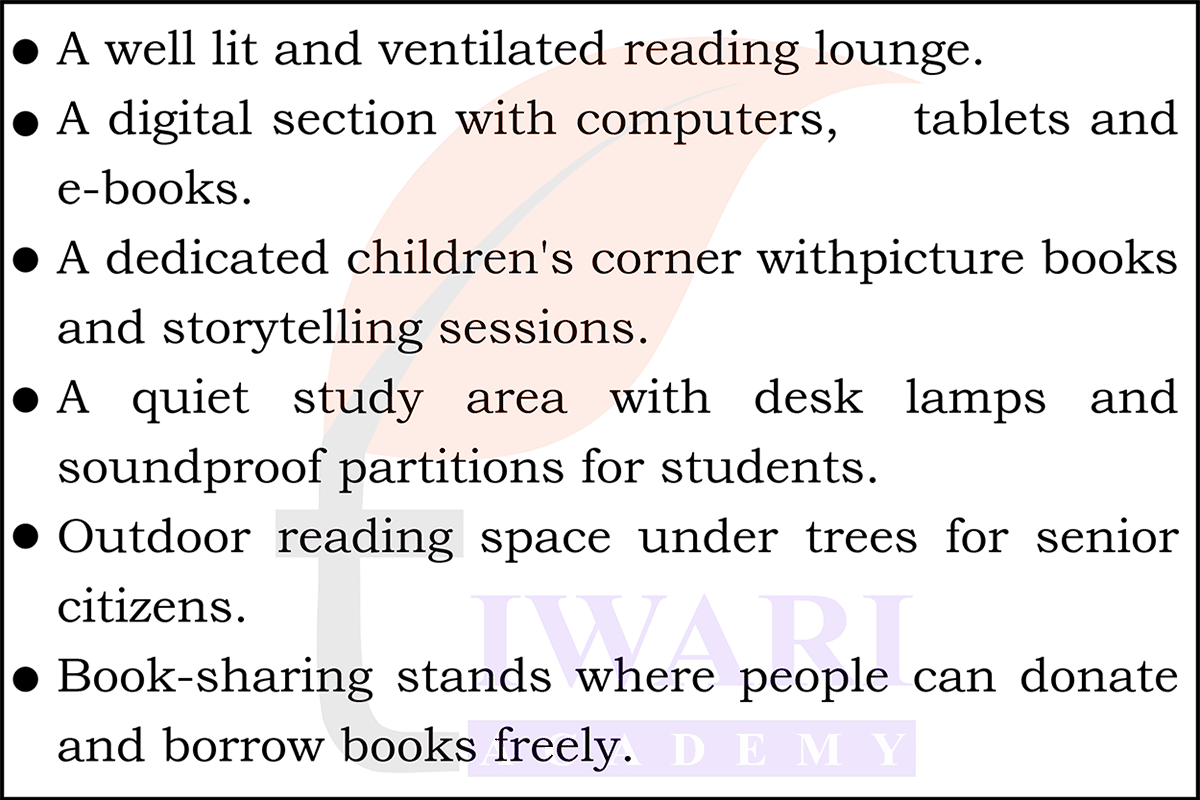
(B) Read the given details o f a community library designed for your neighbourhood:

CBSE Class 10 English exam question paper 2026 Question 5B

Analyse the details and write a n analytical paragraph in about 120 words about the suitability of this library.
Focus o n factors such a s accessibility, reading environment, suitability for different age groups, and community engagement.
Answer:
A Space for Every Reader: Analysing the Community Library
The community library designed for the neighbourhood stands out as a remarkably well-planned and inclusive space that admirably caters to the needs of every section of society. In terms of reading environment, the well-lit and properly ventilated reading lounge ensures physical comfort for all visitors, while the quiet study area equipped with desk lamps and soundproof partitions creates an ideal distraction-free atmosphere specifically for students preparing for examinations. Regarding accessibility and modern relevance, the digital section featuring computers, tablets and e-books successfully bridges the gap between traditional reading habits and contemporary technological needs, making the library accessible and appealing to the digitally inclined generation of today.
The library demonstrates exceptional suitability across different age groups โ€” the dedicated children’s corner with colourful picture books and engaging storytelling sessions fosters a love for reading from the earliest years, while the thoughtfully designed outdoor reading space nestled under trees offers a calm, refreshing, and comfortable environment particularly suited to senior citizens who prefer open-air leisure.
Most commendably, the book-sharing stands, where community members can freely donate and borrow books, reflect a strong and generous spirit of community engagement, transforming the library from a mere reading space into a living, breathing hub of shared knowledge and collective generosity. Overall, this library successfully balances inclusivity, functionality, comfort, and community participation, making it a truly invaluable and irreplaceable asset for the entire neighbourhood.

Section – C : Literature [40 Marks]

6. Read the given extract and answer any one of the following questions (A) and (B) given below: [5 Marks]

(A) Ausable did not fit anyย description of a secret agent Fowler had ever read. Following him down the musty corridor of the gloomy French hotel where Ausable had a room, Fowler felt let down. I t was a small room, on the sixth and top floor and scarcely a setting for a romantic adventure. Ausable was, for one thing, fat, very fat. And then there was his accent. Though he spoke French and German passably, he had never altogether lost the American accent he had brought to Paris from Boston twenty years ago. “You are disappointed,” Ausable said wheezily over his shoulder. (The Midnight Visitor)

(i) Which of the following describes how Fowler felt on seeing Ausable for the first time?
(A) excited and happy
(B) indifferent and disgusted
(C) surprised and disappointed
(D) envious and in awe
Answer:
The correct answer is (C) surprised and disappointed โ€” Fowler had certain romantic and exciting expectations of a secret agent based on what he had read, and upon seeing Ausable, he felt clearly let down as Ausable did not match any of those descriptions.

(ii) How did the hotel’s atmosphere influence Fowler’s mood?
Answer:
The hotel’s atmosphere significantly deepened Fowler’s sense of disappointment and disillusionment. The musty corridor, the gloomy setting, and the small room on the sixth floor were far from the exciting and adventurous environment Fowler had imagined a secret agent would inhabit. Instead of feeling thrilled, Fowler felt that the surroundings were dull and uninspiring, which only added to his feeling that this was “scarcely a setting for a romantic adventure.”

(iii) Fill i n the blank with the correct word from the bracket:
Ausable’s reaction on seeing how Fowler felt shows that he was ________. (observant/ embarrassed)
Answer:
Ausable’s reaction on seeing how Fowler felt shows that he was observant. Even without Fowler expressing his disappointment in words, Ausable perceptively noticed it and remarked “You are disappointed,” demonstrating his sharp ability to read people around him.

(iv) In what way does Ausable defy the typical spy image?
Answer:
Ausable defies the typical spy image in several notable ways. Unlike the sharp, lean and glamorous secret agents Fowler had read about, Ausable was very fat and physically unimpressive. Additionally, despite having lived in Paris for twenty years, he had never lost his American accent from Boston, which made him seem ordinary and unremarkable rather than sophisticated and mysterious. His room was small and plain, further contradicting the exciting and adventurous lifestyle typically associated with secret agents.

OR

(B)ย “I have cherished the ideal of a democratic and free society in which all persons live together in harmony and with equal opportunities. It is an ideal which I hope t o live for and to achieve. But if needs be, it is an ideal for which I a m prepared to die”.
(Nelson Mandela: Long Walk to Freedom)
(i) What is the main ideal Mandela is talking about ?
(A) economic prosperity
(B) representative and free society
(C) absolute power
(D) finishing racism
Answer:
The correct answer is (B) representative and free society โ€” Mandela clearly speaks of cherishing the ideal of a democratic and free society where all persons live together in harmony and with equal opportunities, which best reflects a representative and free society.

(ii) How does the statement reflect Mandela’s commitment to justice? (Answer in about 40 words)
Answer:
The statement reflects Mandela’s unwavering and absolute commitment to justice through his powerful declaration that he is not only willing to live for the ideal of a democratic and free society but is also fully prepared to die for it. This demonstrates that for Mandela, justice and equality were not merely political goals but the very purpose and meaning of his entire existence.

(iii) Fill in the blank with the correct word from the bracket:
Nelson’s vision was not simply to reverse the oppression but to end it completely as he wishes to ________ (fight / appease) all forms of domination in which all persons live with equal opportunities.
Answer:
Nelson’s vision was not simply to reverse the oppression but to end it completely as he wishes to fight all forms of domination in which all persons live with equal opportunities. His vision was inclusive and universal, seeking freedom and dignity for every human being regardless of race or background.

(iv) The phrase “prepared to die” shows Mandela’s :
(A) anxiety
(B) desperation
(C) passion
(D) uprightness
Answer:
The correct answer is (C) passion โ€” The phrase “prepared to die” does not reflect fear, desperation or mere moral uprightness alone, but rather an intense, burning passion and deep personal devotion towards the ideals of freedom, democracy and equality that Mandela had dedicated his entire life to achieving for his people and for all of humanity.


7. Read the following extracts and answer the questions for any one o f the two (A) and (B) : [5 Marks]

(A) What, what is the boy now
who has lost his ball.
What, what is he to do.
I saw it go
Merrily bouncing, down the street and then Merrily over – there it is
in the water!”
No use to say ‘ O there are other balls’.
(The Ball Poem b y John Berryman)
(i) What does the repetition of the word “merrily” suggest in the context of the ball’s movement?
Answer:
The repetition of the word “merrily” is deeply ironic in its context. While the ball bounces away joyfully and carelessly, completely unaware of the loss it is causing, the boy is left devastated. The word suggests that the ball’s movement was light, free, and effortless, which stands in sharp and painful contrast to the grief and helplessness that the boy experiences as he watches it disappear into the water. The repetition emphasises how loss can occur swiftly and indifferently.

(ii) How does this moment contrast the mood of the poem before and after the ball falls into the water? (Answer in about 40 words)
Answer:
Before the ball falls into the water, the mood of the poem is relatively carefree and playful, as the ball bounces merrily down the street. However, after it falls into the water, the mood shifts dramatically to one of grief, helplessness and deep sorrow, as the boy is confronted with his very first experience of irreversible loss.

(iii) Fill in the blank with the correct word from the bracket:
The poet uses the ball as a symbol of the boy’s ________. (childhood/adventure)
Answer:
The poet uses the ball as a symbol of the boy’s childhood โ€” the ball represents all the innocence, joy and carefree happiness of his younger years and its loss symbolises the inevitable end of that precious and irretrievable phase of life.

(iv) The line, ‘No use to say, oh there are other balls’ signifies:
(A) Words of consolation are inappropriate.
(B) The boy must be left alone and play with other toys.
(C) The boy should not be left alone.
(D) No ball will be as expensive a s the one the boy has lost.
Answer:
The correct answer is (A) Words of consolation are inappropriate โ€” The poet emphasises that telling the boy there are other balls completely misses the point, because what the boy has lost is not merely a ball but a piece of his childhood, his memories, and his innocence, which cannot be replaced by any material substitute.

OR

(B) “All night the roots work
To disengage themselves from the cracks
in the veranda floor. The leaves strain towards the glass
small twigs stiff with exertion
long-cramped boughs shuffling
under the roof
like newly discharged patients
half dazed, moving to the clinic doors
(i) What do the roots work upon all night?
Answer:
The roots work all night to disengage themselves from the cracks in the veranda floor. They have been trapped and confined within the cracks for a long time and are straining to free themselves and return to their natural outdoor environment.

(ii) Each part of the trees works to get itself free. Describe their struggle.
(answer in about 40 words)
Answer:
The struggle of each part of the tree is vividly portrayed by the poet. The leaves strain eagerly towards the glass seeking light and freedom, the small twigs become stiff with the effort and exertion of pushing outward and the long cramped boughs shuffle slowly and painfully under the roof, all working together through the night to liberate themselves from their prolonged indoor confinement.

(iii) Fill the blank with one word.
The long branches are compared toย ________.
Answer:
The long branches are compared to patients โ€” specifically, newly discharged patients who are half dazed and slowly moving towards the clinic doors, still adjusting to the outside world after a long period of confinement and restricted movement indoors.

(iv) The phrase ‘half-dazed’ is used for the branches a s they adjust from being indoors to being in the open. It highlights the branches’:
(A) disorientation and fragility
(B) experience and privilege
(C) hurt and injury
(D) barrenness and pain
Answer:
The correct answer is (A) disorientation and fragility โ€” The phrase “half-dazed” beautifully captures the confused and weakened state of the branches as they slowly adjust to the transition from the confined indoor space to the open natural environment outside. Just like patients who have been ill and hospitalised for a long time feel disoriented and fragile upon being discharged, the branches too feel dazed and unsteady as they reclaim their natural freedom.

8.ย Answer any four o f the following five questions, in about 40-50 words each :

(i) In “Two stories about Flying – Part II (Black Aeroplane), what does the narrator’s experience suggest about unexpected help and mystery?
Answer:
In the story, the narrator gets lost in storm clouds at night with no fuel or visibility. A mysterious black aeroplane appears and guides him safely to the runway. However, when he asks about it, no such plane existed. This suggests that help sometimes arrives from inexplicable sources and some mysteries are better accepted with gratitude than questioned.

(ii) In ‘Dust o f Snow’ , what role does the unexpected moment play in shifting the speaker’s mood?
Answer:
The poet was in a mood of sorrow and despair when a crow suddenly shook a hemlock tree, causing snow to fall on him. This simple, unexpected natural moment instantly changed his mood, saving the rest of his day from being wasted. It beautifully conveys that even small moments from nature can bring positivity and relief.

(iii) In ‘From the Diary of Anne Frank’, Anne’s writing reflects her maturity despite her young age. Elaborate.
Answer:
Despite being only thirteen years old, Anne Frank demonstrates remarkable maturity in her diary. She reflects deeply on loneliness, human nature, relationships and the purpose of writing. She questions why people cannot understand each other and analyses her own feelings with great insight, showing emotional depth and intellectual thinking far beyond her young age.

(iv) In ‘Glimpses of India – Part III (Tea from Assam), how does the story connect tea with both culture and economic significance?
Answer:
The story beautifully connects tea with both culture and economy. Rajvir enthusiastically shares interesting legends about the origin of tea, reflecting its deep cultural roots. Simultaneously, the vast tea gardens of Assam represent enormous economic importance, providing livelihoods to thousands of workers and making India one of the world’s largest tea producers, thus blending heritage with commercial significance seamlessly.

(v) In ‘His First Flight’, the reactions o f the young seagull’s family serve as both a challenge and a catalyst for his growth. How does this dual role reflect the complexities of support systems i n real life? (Two Stories about Flying)
Answer:
The young seagull’s family refused to bring him food and even threatened to leave him alone on the ledge unless he flew. This tough love was both painful and motivating. Similarly in real life, support systems sometimes push us through tough love rather than comfort, helping us discover our hidden strengths and overcome our deepest fears.

9. Answer any two of the following three questions, in about 40-50 words each :

(i) In what way was Richard Ebright’s scientific journey enhanced by the support of his mother? (The Making of a Scientist)
Answer:
Richard Ebright’s mother played an absolutely crucial role in shaping his scientific journey. Being his only companion after his father’s death, she encouraged his curiosity by taking him on trips, buying him telescopes, microscopes, books and finding him a mentor. Her constant support and motivation nurtured his passion for collecting butterflies and ultimately led him towards groundbreaking scientific discoveries.

(ii) How does the setting of the hotel room become a tool in Ausable’s plan to defeat Max? (The Midnight Visitor)
Answer:
Ausable cleverly used the hotel room setting to outwit Max. He invented a fictional balcony outside his window, convincing Max it existed. When someone knocked at the door, Ausable claimed it was the police. Fearing capture, Max stepped back onto the supposed balcony and fell to his death. The non-existent balcony became Ausable’s most brilliant and effortless weapon against his enemy.

(iii) What was the passion of Horace Danby and how did he satisfy it? (A Question of Trust)
Answer:
Horace Danby was a respectable maker of locks who had a secret passion for collecting rare and expensive books. To satisfy this costly hobby, he robbed one safe every year, carefully planning each theft in advance. He lived comfortably otherwise but used the stolen money exclusively to purchase the rare books he so deeply and passionately loved collecting throughout his life.

10.ย Answer any one of the following two questions, in about 100-120 words:

(A) How does Lencho’s faith in God, as shown in ” A Letter to God’ contrast with the skepticism o f Kisa Gotami in ‘Sermon a t Benares’.
Support your answer with details from the two texts.
Answer:
Lencho’s Faith vs. Kisa Gotami’s Skepticism
Lencho’s faith in God in “A Letter to God” is absolute, unquestioning, and almost childlike in its simplicity. When hailstorms destroy his entire crop, Lencho does not despair or lose hope. Instead, he writes a letter directly to God asking for a hundred pesos, firmly believing that God will help him without any doubt whatsoever. Even when he receives only seventy pesos, his faith remains completely unshaken โ€” he suspects the post office employees of stealing rather than doubting God’s ability or willingness to help. His faith is so strong and unconditional that it borders on blind devotion, yet it is also deeply touching and sincere in its innocence.
Kisa Gotami, on the other hand, begins her journey in “The Sermon at Benares” in a state of complete denial and desperate grief rather than faithful acceptance. When her young son dies, she refuses to accept his death and carries his dead body from door to door, desperately seeking a cure. She approaches the Buddha not with spiritual faith but with the urgent hope of a grieving mother who cannot come to terms with her unbearable loss. It is only after the Buddha wisely instructs her to bring a mustard seed from a household that has never known death that she gradually understands the universal truth of mortality and finally finds peace and acceptance.
Thus, while Lencho’s faith is immediate, firm, and directed towards God from the very beginning, Kisa Gotami’s spiritual understanding develops slowly through personal experience and suffering. Together, both stories beautifully illustrate that faith and wisdom, whether inherited or earned through grief, ultimately lead human beings towards hope and inner peace.

OR

(B) Analyse how Amanda in the poem ‘Amanda’ and the dragon in the poem The Tale of Custard the Dragon’ yearn for acceptance and a life free from criticism.
Answer:
Amanda and Custard โ€” Yearning for Acceptance
Both Amanda in the poem “Amanda” by Robin Klein and Custard the dragon in “The Tale of Custard the Dragon” by Ogden Nash share a deep and touching desire for acceptance, freedom from constant criticism, and the simple wish to be understood and valued for who they truly are rather than who others want them to be.
Amanda is a young girl who is constantly bombarded with instructions, complaints, and corrections by her mother. She is told not to hunch her shoulders, not to eat chocolate, not to bite her nails, and to do her chores properly. This relentless criticism leaves Amanda feeling suffocated and misunderstood. Unable to express her feelings openly, she retreats into her own beautiful world of imagination and fantasy. She daydreams of being a mermaid drifting silently in the sea, an orphan roaming freely through the streets, and Rapunzel living peacefully in a tower. These daydreams are not mere childish fantasies but a deep longing for a life free from constant judgment and correction. Amanda simply yearns to be accepted as she is, without being endlessly told that she is inadequate or wrong.
Similarly, Custard the dragon is constantly mocked and ridiculed by his companions โ€” Belinda, the little kitten Ink, the mouse Blink, and the little yellow dog Mustard โ€” for being a coward. Despite being the only one with sharp teeth, a mouth like a fireplace, and dangerous spikes, Custard is labelled timid and weak simply because he openly admits his fear and wishes for a safe cage to live in. Nobody accepts him for his honesty or recognises his true inner strength and courage. However, when a real pirate threatens everyone, it is Custard alone who bravely fights and defeats him, proving all his critics completely wrong.
Thus, both Amanda and Custard powerfully represent individuals who are misjudged, undervalued, and denied acceptance by those closest to them. Their stories remind us that true acceptance means valuing a person for their authentic self rather than forcing them to conform to the expectations and standards set by others around them.

11. Answer any one of the following two questions, i n about 100-120 words :

(A) In “The Necklace’, Madam Loisel spends years repaying a debt for a necklace that was never valuable. How does this irony expose the illusion of wealth and the consequences of chasing appearances ?
Answer:
The Irony in “The Necklace” โ€” Illusion of Wealth and Consequences
Guy de Maupassant’s “The Necklace” is built entirely around a devastating and deeply painful irony that serves as the heart of the entire story. Matilda Loisel is a woman who is consumed by an intense desire for wealth, luxury and social recognition despite belonging to a modest middle-class background. She constantly yearns for beautiful jewels, expensive gowns, and grand parties, feeling that she deserves a far more glamorous life than the one she actually has. When her husband manages to obtain an invitation to an elite ministerial ball, Matilda borrows what she believes to be a magnificent diamond necklace from her wealthy friend Madame Forestier, wanting to appear rich and impressive before high society.
At the ball, Matilda shines brilliantly and feels, for one brief and intoxicating night, that she truly belongs to the world of wealth and elegance she has always dreamed of. However, this single night of vanity comes at an absolutely devastating price. She loses the necklace and, too proud and ashamed to confess the truth to Madame Forestier, she and her husband secretly replace it with a real diamond necklace worth thirty-six thousand francs. To repay this enormous debt, they sacrifice everything โ€” their comfortable home, their savings, and their youth. Matilda spends ten long and exhausting years doing rough household work, losing all her beauty and grace in the process.
The cruel and bitter irony is finally revealed at the very end when Madame Forestier confesses that the original necklace was merely a cheap imitation worth only five hundred francs. This single revelation exposes the terrible consequences of Matilda’s obsession with appearances and her inability to be honest. The illusion of wealth that she desperately chased ultimately robbed her of her real life, her beauty, and her precious years. Maupassant thus brilliantly warns readers that the hollow pursuit of appearances and social status can lead to irreversible and tragic consequences in real life.

OR

(B) In ‘The Book That Saved the Earth’, how does the play use humour and irony to comment on both futuristic technology and human assumptions ? What message do you think the author conveys through the Martians’ misinterpretation of a nursery rhyme?
Answer:
Humour, Irony and Message in “The Book That Saved the Earth”
“The Book That Saved the Earth” by Claire Boiko is a brilliantly crafted and thoroughly entertaining play that uses humour and irony with great skill and effectiveness to comment on the dangers of overconfidence, the limitations of assumption, and the amusing gap between advanced technology and basic common sense and understanding.
The play is set in the twenty-fifth century and is presented as a historical account narrated by a Historian in the Museum of Ancient History on Earth. The central irony of the entire play lies in the fact that the mighty and technologically superior Martians, led by the pompous and self-important Think-Tank, plan a full-scale invasion of Earth but are ultimately stopped and driven away not by any powerful weapon, army, or advanced defence system, but simply by a humble and ordinary nursery rhyme book. This irony is both deeply humorous and profoundly meaningful, suggesting that intelligence and technology alone are insufficient without the wisdom to interpret and understand what one encounters correctly.
The humour in the play is largely generated through the character of Think-Tank himself. Despite being worshipped as the most brilliant mind in the entire universe, Think-Tank makes a series of spectacularly foolish and overconfident errors in judgement. When his crew discovers books on Earth, he first confidently declares them to be sandwiches and instructs his crew to eat them. This absurd misinterpretation of something as familiar and simple as a book is brilliantly comic and simultaneously ironic, as it exposes how even the most supposedly superior intelligence can be rendered completely helpless by arrogance and closed-minded assumption.
The most significant and memorable moment of humour and irony in the play comes when the Martians attempt to decode the nursery rhyme “Humpty Dumpty.” Think-Tank interprets it with deadly seriousness, concluding that Earthlings are giants who can destroy Martian eggs and that therefore Earth is far too dangerous to invade. This wildly absurd misinterpretation of a completely harmless and simple children’s rhyme sends the entire Martian fleet fleeing in panic and terror, thus saving Earth from invasion without a single shot being fired.
Through this delightfully comic situation, the author conveys a powerful and timeless message about the dangers of arrogance and the folly of making assumptions without genuine understanding. Think-Tank’s greatest weakness is not lack of intelligence or technology but his absolute refusal to admit ignorance or seek proper clarification. He interprets everything through the narrow lens of his own assumptions and ego, leading to catastrophically wrong conclusions. The author also cleverly suggests that literature, even in its simplest and most innocent form such as a children’s nursery rhyme, carries a power that transcends time, technology, and even interplanetary boundaries.
Overall, the play beautifully and humorously reminds us that true wisdom lies not in the superiority of one’s technology or intellect but in the humility to acknowledge what one does not know and to seek genuine understanding before drawing conclusions.

Frequently Asked Questions (FAQs) โ€“ CBSE Class 10 English Exam 2026

Where can I download the CBSE Class 10 English Answer Key 2026?

You can download the complete and accurate CBSE Class 10 English Answer Key 2026 directly from Tiwari Academy’s this page. We have provided a detailed, section-wise solution guide along with a downloadable PDF for all sets to help you evaluate your performance.

What was the difficulty level of the CBSE Class 10 English exam 2026?

Based on student reactions and expert analysis, the CBSE Class 10 English Paper 2026 was generally considered Easy to Moderate. The reading comprehension section required careful analysis, while the literature and writing sections were straightforward and strictly based on the NCERT syllabus.

How can I get the CBSE Class 10 English Question Paper 2026 PDF?

We have attached the CBSE Class 10 English Question Paper 2026 PDF for multiple sets within this article. Simply scroll to the “Download Question Paper” section and click the link to save it to your device.

Will CBSE provide grace marks for any questions in the 2026 English paper?

CBSE only awards grace marks if a question is proven to be out of the syllabus, incorrectly framed or contains multiple correct options. If the board releases any official notification regarding grace marks for the 2026 English paper, we will update this page immediately.

When will the CBSE Class 10 Result 2026 be declared?

Historically, the Central Board of Secondary Education (CBSE) declares the Class 10 board results in May. For the 2026 academic year, students can expect their results around the second or third week of May 2026 on the official website (cbseresults.nic.in).

Recent Posts
  • CBSE Class 10 English Exam Paper 2026: Solutions, Answer Key & Analysis
  • CBSE Class 10 Science Board Exam Paper 2026: Complete Solutions and Answer Key
  • Class 10 Maths CBSE Exam Paper 2026 Solutions
  • Class 9 Maths Chapter 6 Lines and Angles Preparation
  • Class 4 Maths Exam Preparation with NCERT Solutions


Important Links
  • What is NCERT?
  • Important Questions
  • Vedic Maths Tricks
  • Link Study Materials
  • Useful Resources & Formulae
  • Holiday Homework Solutions


Buy NCERT Books Online

NCERT Books for 2024-25

NCERT Solutions
  • NCERT Solutions for Class 6 Maths
  • NCERT Solutions for Class 7 Maths
  • NCERT Solutions for Class 8 Maths
  • NCERT Solutions for Class 11 Maths
  • NCERT Solutions for Class 12 Maths
  • NCERT Solutions for Class 11 Physics
  • NCERT Solutions for Class 12 Physics


High School
  • Class 9 NCERT Maths Solutions
  • Class 9 NCERT Science Solutions
  • Class 9 NCERT English Solutions
  • Class 10 NCERT Maths Solutions
  • Class 10 NCERT Science Solutions
  • Class 10 NCERT English Solutions
  • Class 10 NCERT Social Solutions

Quick Links
  • NCERT Books
  • NCERT Solutions
  • CBSE Syllabus
  • Home Tutors
  • NIOS Admissions
  • CBSE Sample Papers
  • Vedic Maths Tricks
Help & Support
  • About Us
  • Contact Us
  • Advertise With Us
  • Discussion
  • Latest Blogs
  • Holiday Homework
  • Useful Resources
Copyright 2025 by Tiwari Academy | A step towards Free Education
facebook
twitter
linkedin
youtube
instagram
pinterest
google-news