Tiwari Academy  – Free CBSE NCERT Books and Solutions
  • Apps
    • CBSE Apps
    • Hast Rekha App
  • NCERT Solutions
    • NCERT Solutions for Class 12
      • NCERT Solutions for Class 12 Maths
      • NCERT Solutions for Class 12 Physics
      • NCERT Solutions for Class 12 Chemistry
      • NCERT Solutions for Class 12 Biology
      • NCERT Solutions for Class 12 English
      • NCERT Solutions for Class 12 Accounts
      • NCERT Solutions for Class 12 Business Studies
      • NCERT Solutions for Class 12 Economics
      • NCERT Solutions for Class 12 Geography
      • NCERT Solutions for Class 12 Physical Education
      • NCERT Solutions for Class 12 Political Science
      • NCERT Solutions for Class 12 Psychology
      • NCERT Solutions for Class 12 Sociology
    • NCERT Solutions for Class 11
      • NCERT Solutions for Class 11 Maths
      • NCERT Solutions for Class 11 Physics
      • NCERT Solutions for Class 11 Chemistry
      • NCERT Solutions for Class 11 Biology
      • NCERT Solutions for Class 11 English
      • NCERT Solutions for Class 11 Business Studies
      • NCERT Solutions for Class 11 Sociology
      • NCERT Solutions for Class 11 Political Science
      • NCERT Solutions for Class 11 Psychology
      • NCERT Solutions for Class 11 Physical Education
    • NCERT Solutions for Class 10
      • NCERT Solutions for Class 10 Maths
      • NCERT Solutions for Class 10 Science
      • NCERT Solutions for Class 10 English
      • NCERT Solutions for Class 10 Hindi Course A and B
      • NCERT Solutions for Class 10 Sanskrit
      • NCERT Solutions for Class 10 Social Science
    • NCERT Solutions for Class 9
      • NCERT Solutions for Class 9 Maths
      • NCERT Solutions for Class 9 Science
      • NCERT Solutions for Class 9 English
      • NCERT Solutions for Class 9 Hindi
      • NCERT Solutions for Class 9 Sanskrit
      • NCERT Solutions for Class 9 Social Science
    • NCERT Solutions for Class 8
      • NCERT Solutions for Class 8 Maths
      • NCERT Solutions for Class 8 Science
      • NCERT Solutions for Class 8 English
      • NCERT Solutions for Class 8 Hindi
      • NCERT Solutions for Class 8 Sanskrit
      • NCERT Solutions for Class 8 Social Science
      • NCERT Solutions for Class 8 Computer
    • NCERT Solutions for Class 7
      • NCERT Solutions for Class 7 Maths
      • NCERT Solutions for Class 7 Science
      • NCERT Solutions for Class 7 English
      • NCERT Solutions for Class 7 Hindi
      • NCERT Solutions for Class 7 Sanskrit
      • NCERT Solutions for Class 7 Social Science
      • NCERT Solutions for Class 7 Computer
    • NCERT Solutions for Class 6
      • NCERT Solutions for Class 6 Maths
      • NCERT Solutions for Class 6 Science
      • NCERT Solutions for Class 6 English
      • NCERT Solutions for Class 6 Hindi
      • NCERT Solutions for Class 6 Sanskrit
      • NCERT Solutions for Class 6 Social Science
      • NCERT Solutions for Class 6 Computer
    • NCERT Solutions for Class 5
      • NCERT Solutions for Class 5 Hindi
      • NCERT Solutions for Class 5 English
      • NCERT Solutions for Class 5 Maths
      • NCERT Solutions for Class 5 EVS
      • NCERT Solutions for Class 5 Computer
      • NCERT Solutions for Class 5 GK
    • NCERT Solutions for Class 4
      • NCERT Solutions for Class 4 Hindi
      • NCERT Solutions for Class 4 English
      • NCERT Solutions for Class 4 Maths
      • NCERT Solutions for Class 4 EVS
      • NCERT Solutions for Class 4 Computer
      • NCERT Solutions for Class 4 GK
    • NCERT Solutions for Class 3
      • NCERT Solutions for Class 3 Hindi
      • NCERT Solutions for Class 3 English
      • NCERT Solutions for Class 3 Maths
      • NCERT Solutions for Class 3 EVS
      • NCERT Solutions for Class 3 Science
      • NCERT Solutions for Class 3 Computer
      • NCERT Solutions for Class 3 GK
    • NCERT Solutions for Class 2
      • NCERT Solutions for Class 2 Hindi
      • NCERT Solutions for Class 2 English
      • NCERT Solutions for Class 2 Maths
      • NCERT Solutions for Class 2 EVS
      • NCERT Solutions for Class 2 Science
      • NCERT Solutions for Class 2 Computer
      • NCERT Solutions for Class 2 GK
    • NCERT Solutions for Class 1
      • NCERT Solutions for Class 1 Hindi
      • NCERT Solutions for Class 1 English
      • NCERT Solutions for Class 1 Maths
      • NCERT Solutions for Class 1 EVS
      • NCERT Solutions for Class 1 Computer
      • NCERT Solutions for Class 1 Science
      • NCERT Solutions for Class 1 GK
    • Study Material for KG
      • Study Material for KG English
      • Study Material for KG Hindi
      • Study Material for KG Maths
    • Study Material for Nursery
      • Study Material for Nursery Maths
      • Study Material for Nursery English
      • Study Material for Nursery Hindi
  • MCQ
  • NEWS
    • Educational NEWS
    • Explore More
  • Grammar
    • Class 1 English Grammar
      • Class 1 Hindi Vyakaran
    • Class 2 English Grammar
      • Class 2 Hindi Vyakaran
    • Class 3 English Grammar
      • Class 3 Hindi Vyakaran
    • Class 4 English Grammar
      • Class 4 Hindi Vyakaran
    • Class 5 English Grammar
      • Class 5 Hindi Vyakaran
    • Class 6 English Grammar
      • Class 6 Hindi Vyakaran
    • Class 7 English Grammar
      • Class 7 Hindi Vyakaran
    • Class 8 English Grammar
      • Class 8 Hindi Vyakaran
  • Sample Papers
    • CBSE Sample Papers for Class 9
    • CBSE Sample Papers for Class 10
    • CBSE Sample Papers for Class 11
    • CBSE Sample Papers for Class 12
  • NCERT Books
    • NCERT Books for Class 1 All Subjects
    • NCERT Books for Class 2 All Subjects
    • NCERT Books for Class 3 All Subjects
    • NCERT Books for Class 4 All Subjects
    • NCERT Books for Class 5 All Subjects
    • NCERT Books for Class 6 All Subjects
    • NCERT Books for Class 7 All Subjects
    • NCERT Books for Class 8 All Subjects
    • NCERT Books for Class 9 All Subjects
    • NCERT Books for Class 10 All Subjects
    • NCERT Books for Class 11 All Subjects
    • NCERT Books for Class 12 All Subjects
  • Syllabus
    • CBSE Date Sheet 2025
    • CBSE Syllabus
    • NCERT Exemplar
    • What is NIOS?
    • NIOS Online Admission
  • Contact
    • Contact Us
    • About Us
    • Online Tutors
    • Career Options
  • Apps
    • CBSE Apps
    • Hast Rekha App
  • NCERT Solutions
    • NCERT Solutions for Class 12
      • NCERT Solutions for Class 12 Maths
      • NCERT Solutions for Class 12 Physics
      • NCERT Solutions for Class 12 Chemistry
      • NCERT Solutions for Class 12 Biology
      • NCERT Solutions for Class 12 English
      • NCERT Solutions for Class 12 Accounts
      • NCERT Solutions for Class 12 Business Studies
      • NCERT Solutions for Class 12 Economics
      • NCERT Solutions for Class 12 Geography
      • NCERT Solutions for Class 12 Physical Education
      • NCERT Solutions for Class 12 Political Science
      • NCERT Solutions for Class 12 Psychology
      • NCERT Solutions for Class 12 Sociology
    • NCERT Solutions for Class 11
      • NCERT Solutions for Class 11 Maths
      • NCERT Solutions for Class 11 Physics
      • NCERT Solutions for Class 11 Chemistry
      • NCERT Solutions for Class 11 Biology
      • NCERT Solutions for Class 11 English
      • NCERT Solutions for Class 11 Business Studies
      • NCERT Solutions for Class 11 Sociology
      • NCERT Solutions for Class 11 Political Science
      • NCERT Solutions for Class 11 Psychology
      • NCERT Solutions for Class 11 Physical Education
    • NCERT Solutions for Class 10
      • NCERT Solutions for Class 10 Maths
      • NCERT Solutions for Class 10 Science
      • NCERT Solutions for Class 10 English
      • NCERT Solutions for Class 10 Hindi Course A and B
      • NCERT Solutions for Class 10 Sanskrit
      • NCERT Solutions for Class 10 Social Science
    • NCERT Solutions for Class 9
      • NCERT Solutions for Class 9 Maths
      • NCERT Solutions for Class 9 Science
      • NCERT Solutions for Class 9 English
      • NCERT Solutions for Class 9 Hindi
      • NCERT Solutions for Class 9 Sanskrit
      • NCERT Solutions for Class 9 Social Science
    • NCERT Solutions for Class 8
      • NCERT Solutions for Class 8 Maths
      • NCERT Solutions for Class 8 Science
      • NCERT Solutions for Class 8 English
      • NCERT Solutions for Class 8 Hindi
      • NCERT Solutions for Class 8 Sanskrit
      • NCERT Solutions for Class 8 Social Science
      • NCERT Solutions for Class 8 Computer
    • NCERT Solutions for Class 7
      • NCERT Solutions for Class 7 Maths
      • NCERT Solutions for Class 7 Science
      • NCERT Solutions for Class 7 English
      • NCERT Solutions for Class 7 Hindi
      • NCERT Solutions for Class 7 Sanskrit
      • NCERT Solutions for Class 7 Social Science
      • NCERT Solutions for Class 7 Computer
    • NCERT Solutions for Class 6
      • NCERT Solutions for Class 6 Maths
      • NCERT Solutions for Class 6 Science
      • NCERT Solutions for Class 6 English
      • NCERT Solutions for Class 6 Hindi
      • NCERT Solutions for Class 6 Sanskrit
      • NCERT Solutions for Class 6 Social Science
      • NCERT Solutions for Class 6 Computer
    • NCERT Solutions for Class 5
      • NCERT Solutions for Class 5 Hindi
      • NCERT Solutions for Class 5 English
      • NCERT Solutions for Class 5 Maths
      • NCERT Solutions for Class 5 EVS
      • NCERT Solutions for Class 5 Computer
      • NCERT Solutions for Class 5 GK
    • NCERT Solutions for Class 4
      • NCERT Solutions for Class 4 Hindi
      • NCERT Solutions for Class 4 English
      • NCERT Solutions for Class 4 Maths
      • NCERT Solutions for Class 4 EVS
      • NCERT Solutions for Class 4 Computer
      • NCERT Solutions for Class 4 GK
    • NCERT Solutions for Class 3
      • NCERT Solutions for Class 3 Hindi
      • NCERT Solutions for Class 3 English
      • NCERT Solutions for Class 3 Maths
      • NCERT Solutions for Class 3 EVS
      • NCERT Solutions for Class 3 Science
      • NCERT Solutions for Class 3 Computer
      • NCERT Solutions for Class 3 GK
    • NCERT Solutions for Class 2
      • NCERT Solutions for Class 2 Hindi
      • NCERT Solutions for Class 2 English
      • NCERT Solutions for Class 2 Maths
      • NCERT Solutions for Class 2 EVS
      • NCERT Solutions for Class 2 Science
      • NCERT Solutions for Class 2 Computer
      • NCERT Solutions for Class 2 GK
    • NCERT Solutions for Class 1
      • NCERT Solutions for Class 1 Hindi
      • NCERT Solutions for Class 1 English
      • NCERT Solutions for Class 1 Maths
      • NCERT Solutions for Class 1 EVS
      • NCERT Solutions for Class 1 Computer
      • NCERT Solutions for Class 1 Science
      • NCERT Solutions for Class 1 GK
    • Study Material for KG
      • Study Material for KG English
      • Study Material for KG Hindi
      • Study Material for KG Maths
    • Study Material for Nursery
      • Study Material for Nursery Maths
      • Study Material for Nursery English
      • Study Material for Nursery Hindi
  • MCQ
  • NEWS
    • Educational NEWS
    • Explore More
  • Grammar
    • Class 1 English Grammar
      • Class 1 Hindi Vyakaran
    • Class 2 English Grammar
      • Class 2 Hindi Vyakaran
    • Class 3 English Grammar
      • Class 3 Hindi Vyakaran
    • Class 4 English Grammar
      • Class 4 Hindi Vyakaran
    • Class 5 English Grammar
      • Class 5 Hindi Vyakaran
    • Class 6 English Grammar
      • Class 6 Hindi Vyakaran
    • Class 7 English Grammar
      • Class 7 Hindi Vyakaran
    • Class 8 English Grammar
      • Class 8 Hindi Vyakaran
  • Sample Papers
    • CBSE Sample Papers for Class 9
    • CBSE Sample Papers for Class 10
    • CBSE Sample Papers for Class 11
    • CBSE Sample Papers for Class 12
  • NCERT Books
    • NCERT Books for Class 1 All Subjects
    • NCERT Books for Class 2 All Subjects
    • NCERT Books for Class 3 All Subjects
    • NCERT Books for Class 4 All Subjects
    • NCERT Books for Class 5 All Subjects
    • NCERT Books for Class 6 All Subjects
    • NCERT Books for Class 7 All Subjects
    • NCERT Books for Class 8 All Subjects
    • NCERT Books for Class 9 All Subjects
    • NCERT Books for Class 10 All Subjects
    • NCERT Books for Class 11 All Subjects
    • NCERT Books for Class 12 All Subjects
  • Syllabus
    • CBSE Date Sheet 2025
    • CBSE Syllabus
    • NCERT Exemplar
    • What is NIOS?
    • NIOS Online Admission
  • Contact
    • Contact Us
    • About Us
    • Online Tutors
    • Career Options
เคนเคฟเค‚เคฆเฅ€ เคฎเฅ€เคกเคฟเคฏเคฎเคนเคฟเค‚เคฆเฅ€ เคฎเฅ€เคกเคฟเคฏเคฎ Latest BlogsLatest Blogs Ask QuestionsAsk Questions
Tiwari Academy  /  Class 10 Maths CBSE Exam Paper 2026 Solutions

Class 10 Maths CBSE Exam Paper 2026 Solutions

Class 10 Maths CBSE Exam 2026
Post Date: February 17, 2026

Welcome to the fully solved CBSE Class 10 Maths board paper 2026. Whether you are double-checking your exam performance or practicing for next year, our comprehensive guide has you covered. We have broken down every single question to provide clear, step-by-step CBSE math exam answers. Prepared by expert educators, these Class 10 board exam marking scheme solutions show you exactly how to structure your responses, apply the right formulas, and secure full marks on every problem. Section-wise solution of Class 10 Maths Exam Paper Set 1, 2 and 3 are given below:
  • Section A: Multiple Choice Questions (Q 1-20)
  • Section B: Very Short Answer Questions (Q 21-25)
  • Section C: Short Answer Questions (Q 26-30)
  • Section D: Long Answer Questions (Q 32-35)
  • Section E: Case Study Based Question (Q 36-38)

Class 10 Maths CBSE Exam Paper 2026 – Section A

Q. Numbers 1 to 20 are multiple choices questions of 1 marks each.
1.ย Devansh proved that โ–ณABC ~ โ–ณPQR using SAS similarity criteria. If he found โˆ C = โˆ R, then which of the following was proved true?
(A) AC/AB = PR/PQ
(B) BC/AC = PR/QR
(C) AC/BC = PR/PQ
(D) AC/BC = PR/QR
Solution:
Since โ–ณABC ~ โ–ณPQR (in the same order), the corresponding vertices are:
A โ†” P
B โ†” Q
C โ†” R
Given that โˆ C = โˆ R, side pairs corresponding to these angles are:
AC โ†” PR
BC โ†” QR
In similar triangles, ratios of corresponding sides are equal. So,
AC/BC = PR/QR
Correct Answer: (D) AC/BC = PR/QR

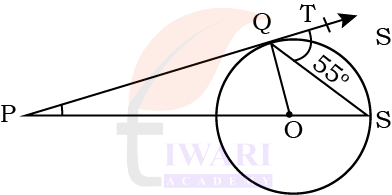
2. In the given figure, PQ is tangent to the circle with centre O. S is a point on the circle such that โˆ SQT = 55ยฐ. The m โˆ QPS is

Class 10 Maths CBSE Exam 2026 Question 2

(A) 55ยฐ
(B) 20ยฐ
(C) 35ยฐ
(D) 70ยฐ
Solution:
Since PQ is tangent at Q, the rays QP and QT form a straight line.
Given โˆ SQT = 55ยฐ.
Therefore, โˆ PQS = 180ยฐ โˆ’ 55ยฐ = 125ยฐ (because PQ and QT are opposite rays)
By the tangentโ€“chord theorem, the angle between tangent QT and chord QS equals the angle in the opposite arc.
So, โˆ QAS = 55ยฐ.
Since AS is a diameter, โˆ AQS = 90ยฐ.
Now in triangle AQS:
โˆ QSA = 180ยฐ โˆ’ (90ยฐ + 55ยฐ)
โˆ QSA = 35ยฐ.
Since P, A, S are collinear, โˆ QSP = 35ยฐ.
Now in triangle PQS:
โˆ QPS = 180ยฐ โˆ’ (125ยฐ + 35ยฐ)
โˆ QPS = 20ยฐ.
Correct answer: (B) 20ยฐ.

3.ย In an A.P., if aโ‚โ‚„ โ€“ aโ‚ˆ = 24, then the common difference of the A.P. is
(A) 6
(B) 4
(C) ยฑ4
(D) 3
Solution:
aโ‚โ‚„ = a + 13d
aโ‚ˆ = a + 7d
Given: aโ‚โ‚„ โˆ’ aโ‚ˆ = 24
So, (a + 13d) โˆ’ (a + 7d) = 24
โ‡’ a + 13d โˆ’ a โˆ’ 7d = 24
โ‡’ 6d = 24
โ‡’ d = 4
Correct answer: (B) 4

4. The value of p for which roots of the quadratic equation xยฒ โ€“ px + 6 = 0 are rational, is
(A) 1
(B) โ€“5
(C) 25
(D) โˆš5
Solution:
For the quadratic equation xยฒ โˆ’ px + 6 = 0
The roots will be rational if the discriminant (D) is a perfect square.
Discriminant, D = bยฒ โˆ’ 4ac
Here, a = 1, b = โˆ’p, c = 6
So, D = (โˆ’p)ยฒ โˆ’ 4(1)(6)
D = pยฒ โˆ’ 24
For rational roots, pยฒ โˆ’ 24 must be a perfect square.
Check the options:
(A) p = 1, so D = 1 โˆ’ 24 = โˆ’23 (not possible)
(B) p = โˆ’5, so D = 25 โˆ’ 24 = 1 (perfect square)
(C) p = 25, so D = 625 โˆ’ 24 = 601 (not a perfect square)
(D) p = โˆš5, so D = 5 โˆ’ 24 = โˆ’19 (not possible)
Correct answer: (B) โˆ’5

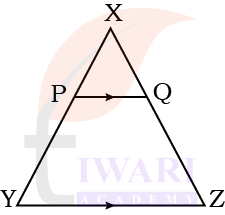
5. In the given figure, PQ โˆฅ YZ such that XP : PY = 2 : 3. If PQ = 5 cm, then YZ equals

Class 10 Maths CBSE Exam 2026 Question 5

(A) 12.5 cm
(B) 10 cm
(C) 15 cm
(D) 7.5 cm
Solution:
By Basic Proportionality Theorem (BPT):
Since PQ โˆฅ YZ, โ–ณXPQ ~ โ–ณXYZ
XP/XY = PQ/YZ
XP/XY = XP/(XP + PY) = 2/(2+3) = 2/5
โˆด 2/5 = 5/YZ
YZ = 25/2 = 12.5 cm
Optionย (A) 12.5 cm is correct.

6. For an acute angle ฮธ, if cos ฮธ = 1/8, then (8 sec ฮธ + 1)/(8 sec ฮธ โ€“ 1) equals
(A) 64/63
(B) 0
(C) 65/63
(D) 1
Solution:
cosฮธ = 1/8 โ†’ secฮธ = 8
8 secฮธ = 8 ร— 8 = 64
So, (8 sec ฮธ + 1)/(8 sec ฮธ โ€“ 1) = (64 + 1)/(64 โ€“ 1) = 65/63
Optionย (C) 65/63 is correct.


7. A card is drawn at random from a well shuffled deck of 52 playing cards. The probability that it is either a ten or a king is
(A) 1/26
(B) 2/13
(C) 1/13
(D) 8/26
Solution:
Number of tens = 4
Number of kings = 4
Total favourable = 4 + 4 = 8
P = 8/52 = 2/13
Option (B) 2/13 is correct.

8. The line segment joining the points P(โ€“4, โ€“2) and Q(10, 4) is divided by y-axis in the ratio
(A) 2 : 5
(B) 1 : 2
(C) 2 : 1
(D) 5 : 2
Solution:
On y-axis, x = 0
By section formula, if ratio = m:n
x = (mxโ‚‚ + nxโ‚)/(m + n)
โ‡’ 0 = (mร—10 + nร—(โ€“4))/(m+n)
โ‡’ 10m โ€“ 4n = 0
โ‡’ 10m = 4n
โ‡’ m/n = 4/10 = 2/5
Option (A) 2:5 is correct.

9. Simplest form of sec A / โˆš(secยฒA โ€“ 1) is
(A) sin A
(B) tan A
(C) cosec A
(D) cos A
Solution:
We know: secยฒA โ€“ 1 = tanยฒA
= secA/โˆš(tanยฒA)
= secA/tanA
= (1/cosA)/(sinA/cosA)
= (1/cosA) ร— (cosA/sinA)
= 1/sinA
= cosecA
Option (C) cosec A is correct.

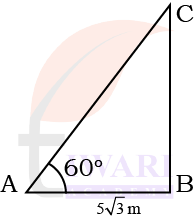
10. A wire is attached from a point A on the ground to the top of a pole BC, making an angle of elevation as 60ยฐ. If AB = 5โˆš3 m, then length of the wire is

Class 10 Maths CBSE Exam 2026 Question 10

(A) 10 m
(B) 10โˆš3 m
(C) 15 m
(D) 5/2 โˆš3 m
Solution:
AB = base = 5โˆš3 m AC = wire (hypotenuse) โˆ A = 60ยฐ
cos60ยฐ = AB/AC
1/2 = 5โˆš3/AC
AC = 10โˆš3 m
Option (B) 10โˆš3 m is correct.


11. If sum and product of zeroes of a polynomial are (โ€“3) and (โ€“2) respectively, then a polynomial is
(A) xยฒ โ€“ 3x โ€“ 2
(B) โ€“xยฒ โ€“ 3x + 2
(C) โ€“xยฒ + 3x โ€“ 2
(D) xยฒ + 3x + 2
Solution:
Sum of zeroes = โˆ’3
Product of zeroes = โˆ’2
So, the quadratic equation: xยฒ โˆ’ (Sum of roots)x + Product of roots
โ‡’ xยฒ + 3x – 2.
โ‡’ -(โˆ’xยฒ โˆ’ 3x + 2)
โ‡’ k(โˆ’xยฒ โˆ’ 3x + 2)
Therefore, Correct answer: (B) โˆ’xยฒ โˆ’ 3x + 2.

12. Meena calculates that the probability of her winning the first prize in a lottery is 0.08. If total 800 tickets were sold, the number of tickets bought by her, is
(A) 64
(B) 640
(C) 100
(D) 10
Solution:
Number of tickets = P ร— Total = 0.08 ร— 800 = 64
Option (A) 64 is correct.

13. A conical cavity of maximum volume is carved out from a wooden solid hemisphere of radius 10 cm. Curved surface area of the cavity carved out is (use ฯ€ = 3.14)

Class 10 Maths CBSE Exam 2026 Question 13

(A) 314โˆš2 cmยฒ
(B) 314 cmยฒ
(C) 3140/3 cmยฒ
(D) 3140โˆš2 cmยฒ
Solution:
For maximum volume cone inside hemisphere:
Cone radius = r = 10 cm
Cone height = h = 10 cm (= radius of hemisphere)
Slant height of cone: l = โˆš(rยฒ + hยฒ) = โˆš(100 + 100) = โˆš200 = 10โˆš2 cm
Curved Surface Area of cone = ฯ€rl = 3.14 ร— 10 ร— 10โˆš2 = 314โˆš2 cmยฒ
Option (A) 314โˆš2 cmยฒ is correct.

14. While calculating mean of a grouped frequency distribution, step deviation method was used ((x โ€“ a)/h = u). It was found that xฬ„ = 64, h = 5 and a = 62.5. The value of ลซ is
(A) 0.5
(B) 1.5
(C) 0.3
(D) 7.5
Solution:
Formula: xฬ„ = a + ลซ ร— h
64 = 62.5 + ลซ ร— 5
1.5 = ลซ ร— 5
ลซ = 1.5/5 = 0.3
Option (C) 0.3 is correct.

15. The area of a sector of a circle of radius 10 cm is 55/3 cmยฒ. The value of central angle is
(A) 21ยฐ/2
(B) 42ยฐ
(C) 105ยฐ
(D) 21ยฐ
Solution:
Area of sector = (ฮธ/360ยฐ) ร— ฯ€rยฒ
55/3 = (ฮธ/360) ร— (22/7) ร— 100
55/3 = (ฮธ/360) ร— 2200/7
55/3 ร— 7/2200 ร— 360 = ฮธ
ฮธ = (55 ร— 7 ร— 360)/(3 ร— 2200)
ฮธ = (138600)/(6600)
ฮธ = 21ยฐ
Option (D) 21ยฐ is correct.

16. A camping tent in hemispherical shape of radius 1.4 m, has a door opening of area 0.50 mยฒ. Outer surface area of the tent is
(A) 11.78 mยฒ
(B) 12.32 mยฒ
(C) 11.82 mยฒ
(D) 12.86 mยฒ
Solution:
Curved Surface Area of hemisphere = 2ฯ€rยฒ
= 2 ร— 22/7 ร— 1.4 ร— 1.4
= 2 ร— 22/7 ร— 1.96
= 2 ร— 6.16
= 12.32 mยฒ
Outer surface area = CSA โ€“ door area = 12.32 โ€“ 0.50 = 11.82 mยฒ
Option (C) 11.82 mยฒ is correct.

17. Which of the following can not be the probability of an event?
(A) 39/100
(B) 0.001/20
(C) 10/0.2
(D) 10%
Solution:
Probability must be between 0 and 1.
(A) 39/100 = 0.39 (Valid)
(B) 0.001/20 = 0.00005 (Valid)
(C) 10/0.2 = 50 (Greater than 1, NOT valid)
(D) 10% = 0.10 (Valid)
Option (C) 10/0.2 is correct.

18. The value of k for which the equation kxยฒ โ€“ 6x โ€“ 4 = 0 has real and equal roots, is
(A) 9/4
(B) โ€“4
(C) โ€“9/4
(D) โ€“2
Solution:
For real and equal roots: D = 0
โ‡’ bยฒ โ€“ 4ac = 0
โ‡’ (โ€“6)ยฒ โ€“ 4(k)(โ€“4) = 0
โ‡’ 36 + 16k = 0
โ‡’ 16k = โ€“36
โ‡’ k = โ€“36/16 = โ€“9/4
Option (C) โ€“9/4 is correct.

(Assertion and Reason Based Questions)

Directions: Questions number 19 and 20 are Assertion and Reason based questions. Two statements are given, one labelled Assertion (A) and the other labelled Reason (R). Select the correct answer from the codes (A), (B), (C) and (D) as given below :
(A) Both Assertion (A) and Reason (R) are true and Reason (R) is the correct explanation of the Assertion (A).
(B) Both Assertion (A) and Reason (R) are true, but Reason (R) is not the correct explanation of the Assertion (A).
(C) Assertion (A) is true, but Reason (R) is false.
(D) Assertion (A) is false, but Reason (R) is true.

19. Assertion (A) : The system of linear equations 3x โ€“ 5y + 7 = 0 and โ€“6x + 10y + 14 = 0 is inconsistent.
Reason (R) : When two linear equations don’t have unique solution, they always represent parallel lines.
Solution:
Assertion (A): 3x โ€“ 5y + 7 = 0 and โ€“6x + 10y + 14 = 0
Check: aโ‚/aโ‚‚ = 3/โ€“6 = โ€“1/2
bโ‚/bโ‚‚ = โ€“5/10 = โ€“1/2
cโ‚/cโ‚‚ = 7/14 = 1/2
Since aโ‚/aโ‚‚ = bโ‚/bโ‚‚ โ‰  cโ‚/cโ‚‚
โ†’ Lines are parallel โ†’ inconsistent, So A is TRUE.
Reason (R): When two equations don’t have unique solution, they always represent parallel lines.
This is FALSE โ€” they could also be coincident lines (infinite solutions), which is also not unique but not parallel.
Option (C) Assertion (A) is true, but Reason (R) is false is correct.

20. Assertion (A) : H.C.F. (36 mยฒ, 18 m) = 18 m, where m is a prime number.
Reason (R) : H.C.F. of two numbers is always less than or equal to the smaller number.
Solution: Assertion (A): HCF(36mยฒ, 18m) = 18m, where m is prime
36mยฒ = 2ยฒ ร— 3ยฒ ร— mยฒ
18m = 2 ร— 3ยฒ ร— m
HCF = 2 ร— 3ยฒ ร— m = 18m โœ“ A is TRUE
Reason (R): HCF of two numbers is always less than or equal to the smaller number.
Smaller number = 18m
HCF = 18m โ‰ค 18m โœ“ R is TRUE
And R correctly explains why HCF = 18m (it equals the smaller number here).
Option (A) Both A and R are true and R is the correct explanation of A is correct.

Class 10 Maths CBSE Exam Paper 2026 – Section B

Q. Numbers 21 to 25 are very short answer questions of 2 marks each.
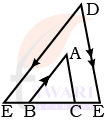
21. In the given figure, AB โˆฅ DE and AC โˆฅ DF. Show that โ–ณABC ~ โ–ณDEF. If BC = 10 cm, EB = CF = 5 cm and AB = 7 cm, then find the length DE.

Class 10 Maths CBSE Exam 2026 Question 21

Solution:
Given: AB โˆฅ DE, AC โˆฅ DF, BC = 10 cm, EB = CF = 5 cm, AB = 7 cm
BE = CF = 5 cm, BC = 10 cm
โˆด BE/BC = CF/BC โ†’ BE = CF (given)
Also, BE + BC = EC โ†’ EC = 15 cm
Similarly, BF = BC + CF = 15 cm
In โ–ณABC and โ–ณDEF:
AB โˆฅ DE โ†’ โˆ ABE = โˆ DEB (alternate angles)
AC โˆฅ DF โ†’ โˆ ACF = โˆ DFC (alternate angles)
Since AB โˆฅ DE and AC โˆฅ DF:
โˆ BAC = โˆ EDF (corresponding angles)
Also: AB/DE = BC/EF = AC/DF
Now, BE/BC = 5/10 = 1/2
โˆด DE/AB = EC/BC = 15/10 = 3/2
โˆด DE = AB ร— 3/2 = 7 ร— 3/2 = DE = 10.5 cm

22.ย (a) For acute angles A and B, if sec (2A โ€“ B) = โˆš2 and cosec (A + B) = 2, then find the values of A and B.
Solution:
Given: sec(2A โ€“ B) = โˆš2 and cosec(A + B) = 2
sec(2A โ€“ B) = โˆš2 = sec 45ยฐ โˆด 2A โ€“ B = 45ยฐ …(i)
cosec(A + B) = 2 = cosec 30ยฐ โˆด A + B = 30ยฐ …(ii)
Adding (i) and (ii): 3A = 75ยฐ โ†’ A = 25ยฐ
From (ii): B = 30ยฐ โ€“ 25ยฐ = B = 5ยฐ

OR

22. (b) Evaluate : (2 cos 30ยฐ โ€“ cotยณ 60ยฐ) / tan 30ยฐ
Solution:
Known values:
cos 30ยฐ = โˆš3/2
cot 60ยฐ = 1/โˆš3
tan 30ยฐ = 1/โˆš3
Numerator: = 2 ร— (โˆš3/2) โ€“ (1/โˆš3)ยณ = โˆš3 โ€“ 1/(3โˆš3) = โˆš3 โ€“ 1/(3โˆš3) = (3โˆš3 ร— โˆš3 โ€“ 1) / (3โˆš3) = (9 โ€“ 1) / (3โˆš3) = 8/(3โˆš3)
Denominator: 1/โˆš3
= [8/(3โˆš3)] รท [1/โˆš3] = 8/(3โˆš3) ร— โˆš3 = 8/3
โˆด Answer = 8/3

23.ย Prove that 4 โ€“ 2โˆš5 is an irrational number given that โˆš5 is irrational.
Solution:
Proof (by contradiction):
Assume 4 โ€“ 2โˆš5 is rational.
Then 4 โ€“ 2โˆš5 = p/q, where p, q are integers, q โ‰  0
โ‡’ 2โˆš5 = 4 โ€“ p/q
โ‡’ โˆš5 = (4q โ€“ p) / 2q
Since p and q are integers, (4q โ€“ p)/2q is rational
โˆด โˆš5 is rational โ€” Contradiction!
Since โˆš5 is given to be irrational, our assumption is wrong.
โˆด 4 โ€“ 2โˆš5 is irrational.

24.ย A bag contains 25 balls. Some of them are yellow and others are green. One ball is drawn at random. If probability of getting a green ball is 3/5, then find the number of yellow balls.
Solution:
Given: Total balls = 25, P(green) = 3/5
Number of green balls = 3/5 ร— 25 = 15
Number of yellow balls = 25 โ€“ 15 = 10

25.ย (a) Vertices of a right triangle ABC with โˆ B = 90ยฐ are A(3, 4), B(1, 1) and C(โ€“8, 7). Find the value of tan A.
Solution:
Given: โˆ B = 90ยฐ, A(3,4), B(1,1), C(โ€“8,7)
BC = โˆš[(โ€“8โ€“1)ยฒ + (7โ€“1)ยฒ] = โˆš[81 + 36] = โˆš117 = 3โˆš13
AB = โˆš[(3โ€“1)ยฒ + (4โ€“1)ยฒ] = โˆš[4 + 9] = โˆš13
AC = โˆš[(3โ€“(โ€“8))ยฒ + (4โ€“7)ยฒ] = โˆš[121 + 9] = โˆš130
In right โ–ณABC, โˆ B = 90ยฐ
tan A = BC/AB = 3โˆš13/โˆš13 = 3
โˆด tan A = 3

OR

25. (b) Using distance formula, prove that the points A(2, 3), B(โ€“7, 0) and C(โ€“1, 2) are collinear.
Solution:
Prove A(2,3), B(โ€“7,0), C(โ€“1,2) are collinear
AB = โˆš[(โ€“7โ€“2)ยฒ + (0โ€“3)ยฒ] = โˆš[81 + 9] = โˆš90 = 3โˆš10
BC = โˆš[(โ€“1โ€“(โ€“7))ยฒ + (2โ€“0)ยฒ] = โˆš[36 + 4] = โˆš40 = 2โˆš10
AC = โˆš[(โ€“1โ€“2)ยฒ + (2โ€“3)ยฒ] = โˆš[9 + 1] = โˆš10
Check: BC + AC = 2โˆš10 + โˆš10 = 3โˆš10 = AB
Since AB = BC + AC, points A, B, C are collinear.

Class 10 Maths CBSE Exam Paper 2026 – Section C

Q. Numbers 26 to 31 are short answer questions of 3 marks each:
26. (a) A circle centered at (2, 1) passes through the points A(5, 6) and B(โ€“3, K). Find the value(s) of K. Hence find length of chord AB.
Solution:
Centre = (2, 1), passes through A(5, 6) and B(โ€“3, K)
Radius using A: rยฒ = (5โ€“2)ยฒ + (6โ€“1)ยฒ = 9 + 25 = 34
Using B: rยฒ = (โ€“3โ€“2)ยฒ + (Kโ€“1)ยฒ = 25 + (Kโ€“1)ยฒ
โˆด 25 + (Kโ€“1)ยฒ = 34 (Kโ€“1)ยฒ = 9 K โ€“ 1 = ยฑ3 K = 4 or K = โ€“2
Length of chord AB (using K = 4): B = (โ€“3, 4) AB = โˆš[(5โ€“(โ€“3))ยฒ + (6โ€“4)ยฒ] = โˆš[64 + 4] = โˆš68 = 2โˆš17 cm

OR

(b) Prove that the point P dividing the line segment joining the points A(โ€“1, 7) and B(4, โ€“3) in the ratio 3 : 2, lies on the line x โ€“ 3y = โ€“1. Also find length of PA and PB.
Solution:
P divides A(โ€“1,7) and B(4,โ€“3) in ratio 3:2
By section formula: P = [(3ร—4 + 2ร—(โ€“1))/(3+2), (3ร—(โ€“3) + 2ร—7)/(3+2)] P = [(12โ€“2)/5, (โ€“9+14)/5] P = [10/5, 5/5] P = (2, 1)
Check on x โ€“ 3y = โ€“1: 2 โ€“ 3(1) = 2 โ€“ 3 = โ€“1 โœ“ P lies on the line.
PA: = โˆš[(2โ€“(โ€“1))ยฒ + (1โ€“7)ยฒ] = โˆš[9 + 36] = โˆš45 = 3โˆš5 units
PB: = โˆš[(2โ€“4)ยฒ + (1โ€“(โ€“3))ยฒ] = โˆš[4 + 16] = โˆš20 = 2โˆš5 units

27. The dimensions of a window are 156 cm ร— 216 cm. Arjun wants to put grill on the window creating complete squares of maximum size. Determine the side length of the square and hence find the number of squares formed.
Solution:
Given: Window = 156 cm ร— 216 cm
Side of largest square = HCF(156, 216)
Finding HCF by Euclid’s division: 216 = 1 ร— 156 + 60 156 = 2 ร— 60 + 36 60 = 1 ร— 36 + 24 36 = 1 ร— 24 + 12 24 = 2 ร— 12 + 0
HCF = 12 cm (side of each square)
Number of squares = (156/12) ร— (216/12) = 13 ร— 18 = 234 squares

28. Use graphical method to solve the system of linear equations : y = โ€“3 and x + 2y = 4.
Solution:
Equation 1: y = โ€“3 (horizontal line)
x: 0 |2 | 4
y: โ€“3|โ€“3|โ€“3
Equation 2: x + 2y = 4 โ†’ x = 4 โ€“ 2y
x: 4|0|โ€“2
y: 0|2| 3
Substituting y = โ€“3 in x + 2y = 4: x + 2(โ€“3) = 4 x โ€“ 6 = 4 x = 10
โˆด Answer: x = 10, y = โ€“3 โ†’ Point (10, โ€“3)

29. (a) In an A.P., 15th term exceeds the 8th term by 21. If sum of first 10 terms is 55, then form the A.P.
Solution:
Given: aโ‚โ‚… โ€“ aโ‚ˆ = 21, Sโ‚โ‚€ = 55
aโ‚โ‚… โ€“ aโ‚ˆ = (a + 14d) โ€“ (a + 7d) = 7d = 21 โˆด d = 3
Sโ‚โ‚€ = 10/2 ร— [2a + 9d] = 55 5[2a + 27] = 55 2a + 27 = 11 2a = โ€“16 a = โ€“8
โˆด A.P. = โ€“8, โ€“5, โ€“2, 1, 4, 7, …

OR

(b) The sum of first n terms of an A.P. is 2nยฒ + 13n. Find its nแต—สฐ term and hence 10th term.
Solution:ย 
Given: Sโ‚™ = 2nยฒ + 13n
nแต—สฐ term: aโ‚™ = Sโ‚™ โ€“ Sโ‚™โ‚‹โ‚ = [2nยฒ + 13n] โ€“ [2(nโ€“1)ยฒ + 13(nโ€“1)] = 2nยฒ + 13n โ€“ [2nยฒ โ€“ 4n + 2 + 13n โ€“ 13] = 2nยฒ + 13n โ€“ 2nยฒ + 4n โ€“ 2 โ€“ 13n + 13 = aโ‚™ = 4n + 11
10th term: aโ‚โ‚€ = 4(10) + 11 = 40 + 11 = 51.


30. A circle of diameter 20 cm is equally divided into five sectors. Find the area and perimeter of one of the sectors.
Solution:
Given: Diameter = 20 cm โ†’ r = 10 cm, 5 equal sectors
Each sector angle = 360ยฐ/5 = 72ยฐ
Area of one sector: = (ฮธ/360ยฐ) ร— ฯ€rยฒ = (72/360) ร— ฯ€ ร— 100 = (1/5) ร— 100ฯ€ = 20ฯ€ = 62.8 cmยฒ
Perimeter of one sector: = 2r + arc length = 2(10) + (72/360) ร— 2ฯ€ ร— 10 = 20 + (1/5) ร— 20ฯ€ = 20 + 4ฯ€ = 20 + 12.56 = 32.56 cm

31. Prove that :
(1 + cot ฮธ โ€“ cosec ฮธ) (1 + tan ฮธ + sec ฮธ) = 2
Solution:
LHS: = (1 + cosฮธ/sinฮธ โ€“ 1/sinฮธ)(1 + sinฮธ/cosฮธ + 1/cosฮธ)
= [(sinฮธ + cosฮธ โ€“ 1)/sinฮธ] ร— [(cosฮธ + sinฮธ + 1)/cosฮธ]
= [(sinฮธ + cosฮธ โ€“ 1)(sinฮธ + cosฮธ + 1)] / (sinฮธ ยท cosฮธ)
= [(sinฮธ + cosฮธ)ยฒ โ€“ 1ยฒ] / (sinฮธ ยท cosฮธ)
= [sinยฒฮธ + 2sinฮธcosฮธ + cosยฒฮธ โ€“ 1] / (sinฮธ ยท cosฮธ)
= [1 + 2sinฮธcosฮธ โ€“ 1] / (sinฮธ ยท cosฮธ)
= [2sinฮธcosฮธ] / (sinฮธ ยท cosฮธ)
= 2 = RHS

Class 10 Maths CBSE Exam Paper 2026 – Section D

Q. numbers 32 to 35 are long answer questions of 5 marks each.
32. By selling an article for โ‚น48, a trader loses as much percent as half of the cost price of the article. Calculate the cost price and loss amount of the article.
Solution:
Let cost price = โ‚นx
Loss% = x/2 % (half of cost price as percentage)
Loss amount = (x/2)/100 ร— x = xยฒ/200
SP = CP โ€“ Loss
โ‡’ 48 = x โ€“ xยฒ/200
โ‡’ xยฒ โ€“ 200x + 9600 = 0
โ‡’ xยฒ โ€“ 120x โ€“ 80x + 9600 = 0
โ‡’ x(x โ€“ 120) โ€“ 80(x โ€“ 120) = 0
โ‡’ (x โ€“ 80)(x โ€“ 120) = 0
โ‡’ x = 80 or x = 120
If x = 80: Loss% = 40%
โ‡’ Loss = 32 and SP = 48
If x = 120: Loss% = 60%
โ‡’ Loss = 72 and SP = 48
Therefore, Cost Price = โ‚น80 and Loss = โ‚น32
OR
Cost Price = โ‚น120, Loss = โ‚น72.

33. PQ and PR are two tangents to a circle with centre O and radius 5 cm. AB is another tangent to the circle at C which lies on OP. If OP = 13 cm, then find the length AB and PA.

Class 10 Maths CBSE Exam 2026 Question 33

Solution:
Given: Circle with centre O, Radius (r) = OQ = OR = OC = 5 cm
OP = 13 cm
PQ and PR are tangents from external point P to the circle.
AB is a tangent to the circle at point C, where C lies on OP
Since PQ is a tangent and OQ is radius:
โˆ OQP = 90ยฐ (Radius โŠฅ Tangent)
In right triangle OQP:
PQยฒ = OPยฒ โˆ’ OQยฒ
โ‡’ PQยฒ = 13ยฒ โˆ’ 5ยฒ
โ‡’ PQยฒ = 169 โˆ’ 25
โ‡’ PQยฒ = 144
โ‡’ PQ = โˆš144 = 12 cm
Since C lies on OP and OC = radius = 5 cm:
โ‡’ PC = OP โˆ’ OC
โ‡’ PC = 13 โˆ’ 5
โ‡’ PC = 8 cm
By the Equal Tangents Theorem (tangents from same external point are equal):
From point A: AQ = AC …(1)
From point B: BR = BC …(2)
From point P: PQ = PR = 12 cm …(3)
Now:
PA + AC = PQ [Since AC = AQ]
โ‡’ PA + AC = 12 …(i)
Similarly PB + BC = PR
โ‡’ PB + BC = 12 …(ii)
By symmetry of the figure: PA = PB and AC = BC
So, AB = AC + BC = 2 ร— AC
Using Pythagoras in right triangle PCB (OC โŠฅ AB, so โˆ PCB = 90ยฐ):
PBยฒ = PCยฒ + BCยฒ
โ‡’ (12 โˆ’ BC)ยฒ = 8ยฒ + BCยฒ [Since PB = 12 โˆ’ BC from eq.(ii)]
โ‡’ 144 โˆ’ 24ยทBC + BCยฒ = 64 + BCยฒ
โ‡’ 144 โˆ’ 24ยทBC = 64
โ‡’ 24ยทBC = 144 โˆ’ 64 = 80
โ‡’ BC = 80 รท 24 = 10/3 cm
So, AC = BC = 10/3 cm (by symmetry)
AB = AC + BC = 10/3 + 10/3 = 20/3 cm
PA = PQ โˆ’ AQ = PQ โˆ’ AC = 12 โˆ’ 10/3 = 36/3 โˆ’ 10/3 = 26/3 cm
AB = 20/3 cm โ‰ˆ 6.67 cm PA = 26/3 cm โ‰ˆ 8.67 cm.

34. (a) D is the mid-point of side BC of โ–ณABC. CE and BF intersect at O, a point on AD. AD is produced to G such that OD = DG. Prove that

Class 10 Maths CBSE Exam 2026 Question 34-Part a

(i) OBGC is a parallelogram.
Solution:
Given: D is midpoint of BC, OD = DG
(i) D is midpoint of BC and also mid point of OG.
So, OD = DG and BD = DC.
โ‡’ Diagonals of OBGC bisect each other at D.
โˆด OBGC is a parallelogram.

(ii) EF โˆฅ BC
Solution:
Since OBGC is a parallelogram [From part (i)]:
GC || OB (which means GC || BF)
BG || OC (which means BG || CE)
Now, consider Triangle ABG:
Since OC || BG (and E lies on OC), we have OE || BG.
By Basic Proportionality Theorem (BPT) in Triangle ABG:
AE / EB = AO / OG — (1)
Now, consider Triangle ACG:
Since OB || GC (and F lies on OB), we have OF || GC.
By Basic Proportionality Theorem (BPT) in Triangle ACG:
AF / FC = AO / OG — (2)
From Equation 1 and Equation 2, we get: AE / EB = AF / FC
In Triangle ABC, since the line EF divides sides AB and AC in the same ratio:
By Converse of BPT: EF || BC
(Hence Proved)

(iii) โ–ณAEF ~ โ–ณABC
Solution:
In Triangle AEF and Triangle ABC:
1. Angle A = Angle A (Common angle)
2. Angle AEF = Angle ABC (Corresponding angles, since EF || BC)
3. Angle AFE = Angle ACB (Corresponding angles, since EF || BC)
By AA (Angle-Angle) Similarity Criterion: โ–ณAEF ~ โ–ณABC.

OR
(b) Through the mid-point Q of side CD of a parallelogram ABCD, the line AR is drawn which intersects BD at P and produced BC at R. Prove that
(i) AQ = QR
(ii) AP = 2PQ
(iii) PR = 2AP

Class 10 Maths CBSE Exam 2026 Question 34-Part b

Solution:
Given: ABCD parallelogram, Q is midpoint of CD, AR intersects BD at P, BC produced at R.
(i) AQ = QR:
In โ–ณDQA and โ–ณCQR:
DQ = QC (Q is midpoint of DC)
โˆ DQA = โˆ CQR (vertically opposite angles)
โˆ QDA = โˆ QCR (alternate interior angles, AD โˆฅ BC)
By AAS: โ–ณDQA โ‰… โ–ณCQR
โˆด AQ = QR

(ii) AP = 2PQ:
From (i): โ–ณDQA โ‰… โ–ณCQR
โ‡’ DA = CR
In parallelogram ABCD, AD = BC.
Therefore, BR = BC + CR = AD + AD = 2AD.
In triangle APD and triangle RPB:
1. Angle PAD = Angle PRB (Alternate interior angles, AD || BR)
2. Angle ADP = Angle RBP (Alternate interior angles, AD || BR)
By AA Similarity:
Triangle APD is similar to Triangle RPB.
So, the ratio of sides is:
AP/PR = AD/BR
โ‡’ AP/PR = AD/2AD
โ‡’ AP/PR = 1/2
โ‡’ PR = 2AP
Now, we know: AQ = AP + PQ
Since AQ = QR (from part i), then AR = 2AQ.
Also, AR = AP + PR.
Substitute PR = 2AP: AP + 2AP = 2(AP + PQ)
โ‡’ 3AP = 2AP + 2PQ
โ‡’ AP = 2PQ (Hence Proved)

(iii) As derived in the similarity step in part (ii):
Since Triangle APD is similar to Triangle RPB,
AP/PR = AD/BR
Substitute BR = 2AD: AP/PR = AD/2AD
โ‡’ AP/PR = 1/2
โ‡’ PR = 2AP (Hence Proved)

35. (a) Find the mean and mode of the following frequency distribution:

Class IntervalFrequency
400 – 45015
450 – 50018
500 – 55020
550 – 60023
600 – 65022
650 – 70012

Solution:

Class 10 Maths CBSE Exam 2026 Question 35-Part a

Mean = a + (ฮฃfd/ฮฃf) ร— h = 575 + (-2750/110) = 575 – 25 = 550
Mode: Maximum frequency = 23, Modal class = 550โ€“600
Mode = l + [(fโ‚ โ€“ fโ‚€)/(2fโ‚ โ€“ fโ‚€ โ€“ fโ‚‚)] ร— h
= 550 + [(23โ€“20)/(46โ€“20โ€“22)] ร— 50
= 550 + [3/4] ร— 50
= 550 + 37.5
= 587.5

OR
(b) If the median of the following frequency distribution is 32.5 and sum of all frequencies is 40, then find the values of fโ‚ and fโ‚‚ :

Class IntervalFrequency
0 – 103
10 – 20fโ‚
20 – 309
30 – 4012
40 – 506
50 – 60fโ‚‚
60 – 702

Solution:
Given: Median = 32.5, ฮฃf = 40
Total: 32 + fโ‚ + fโ‚‚ = 40 โ†’ fโ‚ + fโ‚‚ = 8 …(i)
Median = 32.5, so median class = 30โ€“40
Median = l + [(N/2 โ€“ cf)/f] ร— h
32.5 = 30 + [(20 โ€“ (12+fโ‚))/12] ร— 10
2.5 = [(8 โ€“ fโ‚)/12] ร— 10
2.5 ร— 12 = 10(8 โ€“ fโ‚)
30 = 80 โ€“ 10fโ‚
10fโ‚ = 50
fโ‚ = 5
From (i): fโ‚‚ = 8 โ€“ 5 = fโ‚‚ = 3

Class 10 Maths CBSE Exam Paper 2026 – Section E

This section (Q. 36 to 38) has 3 case study based questions of 4 marks each.
36. Elevated water storage tanks are built to store and supply water to nearby colonies. In the diagram given above, AB is an elevated water tank and CD is a nearby multistorey building. The building is 54 metres away from the water tank.
From a window (W) of the building, the angle of elevation of top of the tank is 45ยฐ and angle of depression of its foot is 30ยฐ.

Class 10 Maths CBSE Exam 2026 Question 36

(i) Write a relation between d (the height of window) and y.
(ii) Determine the value of h.
(iii) (a) Determine height of the water tank.
Solution:
AC = 54 m, angle of elevation of top = 45ยฐ
Angle of depression to foot = 30ยฐ
Here, d = height of window W from ground (XA = WC = d)
h = height of top of tank above window level
(i) Relation between d and y:
In triangle AXW, sin 30ยฐ = d/y
1/2 = d/y
y = 2d

(ii) Value of h:
In triangle BXW, tan 45ยฐ = h/XW
โ‡’ 1 = h/54
โ‡’ h = 54 m

(iii)(a) Height of water tank:
In triangle AXW, tan 30ยฐ = d/XW
โ‡’ 1/โˆš3 = d/54
โ‡’ d = 54/โˆš3 = 18โˆš3
Height of water tank = h + d = 54 + 18โˆš3
= 54 + 18 ร— 1.732
= 54 + 31.17
= 85.17 m โ‰ˆ 54 + 18โˆš3 m

OR

(iii) (b) Find the value of x and height of the window above ground level.
Solution:
Value of x and height of window:
In triangle BXW, cos 45ยฐ = XW/x
โ‡’ 1/โˆš2 = 54/x
โ‡’ x = 54โˆš2

37. An arch of a railway bridge, built on Chenab riverbed, is shown in the above diagram. It is a parabolic arch connecting two hills at P and Q. If the parabolic curve is represented by the polynomial p(x) = โ€“0.0025xยฒ โ€“ 0.025x + 136.

Class 10 Maths CBSE Exam 2026 Question 37

Observe the diagram and based on above information, answer the following questions:
(i) Write the co-ordinates of point A.
(ii) Find the span of the arch.
(iii) (a) Write the zeroes of the polynomial using diagram and verify the relationship between sum of zeroes and polynomials.

OR

(iii) (b) Find the values of p(x) at x = 100 and x = โ€“100. Are they same ?
Solution:
(i) Co-ordinates of point A:
Point A is the highest point (vertex), at x = 0 (from diagram, A is on Y-axis):
p(0) = โ€“0.0025(0) โ€“ 0.025(0) + 136 = 136
โˆด A = (0, 136)

(ii) Span of the arch:
Span = distance from Q to P = 238.5 + 228.5 = 467 m
(From diagram: Q = (โ€“238.5, 0) and P = (228.5, 0))

(iii)(a) Zeroes and verification:
Zeroes from diagram: x = โ€“238.5 and x = 228.5
Sum of zeroes = โ€“238.5 + 228.5 = โ€“10
From polynomial: โ€“b/a = โ€“(โ€“0.025)/(โ€“0.0025) = โ€“10
Product of zeroes = โ€“238.5 ร— 228.5 = โ€“54,507.25
From polynomial: c/a = 136/(โ€“0.0025) = โ€“54,400 โ‰ˆ โ€“54,507.25

(iii)(b) Find p(100) and p(โ€“100):
p(100) = โ€“0.0025(10000) โ€“ 0.025(100) + 136 = โ€“25 โ€“ 2.5 + 136 = 108.5
p(โ€“100) = โ€“0.0025(10000) โ€“ 0.025(โ€“100) + 136 = โ€“25 + 2.5 + 136 = 113.5
No, they are not the same. p(100) = 108.5 โ‰  p(โ€“100) = 113.5

38. A wall mounted lamp, made of fabric, is shown below. Lamp has cuboidal shape, open from top and bottom. A spherical bulb of diameter 7 cm is latched with a very thin rod. (Ignore the rod while making calculations.)

Class 10 Maths CBSE Exam 2026 Question 38

Dimensions of the cuboid are 24 cm ร— 12 cm ร— 17 cm.
(i) Find the surface area of the bulb.
(ii) What could be the maximum diameter of the bulb if at least 1 cm space is left from each side?
(iii) (a) Find the area of the fabric used if there is a fold of 2 cm on top and bottom edges.
OR
(iii) (b) Find the space available inside the lamp.
Solution:
(i) Surface area of spherical bulb:
SA = 4ฯ€rยฒ = 4 ร— 22/7 ร— (3.5)ยฒ = 4 ร— 22/7 ร— 12.25 = 4 ร— 22 ร— 1.75 = 154 cmยฒ

(ii) Maximum diameter of bulb:
Smallest dimension of cuboid base = 12 cm
Leaving 1 cm from each side: 12 โ€“ 2 = 10 cm
Maximum diameter = 10 cm

(iii)(a) Area of fabric used:
Cuboid is open from top and bottom, so there is only 4 lateral faces.
With fold of 2 cm on top and bottom edges, effective height
= 17 + 2ร—2 = 21 cm
Area of fabric = 2(24 + 12) ร— 21 = 1512 cmยฒ

(iii)(b) Space available inside lamp:
Volume of cuboid โ€“ Volume of bulb
Volume of cuboid = 24 ร— 12 ร— 17 = 4896 cmยณ
Volume of bulb = (4/3)ฯ€rยณ
= (4/3) ร— 22/7 ร— (3.5)ยณ
= (4/3) ร— 22/7 ร— 42.875
= 179.67 cmยณ
Space available = 4896 โ€“ 179.67 = 4716.33 cmยณ

Finished reviewing the 2026 CBSE Maths paper? Keep your preparation strong by practicing all textbook chapters. Explore our comprehensive, step-by-step Class 10 Maths Solutions to master every concept for your board exams.

Recent Posts
  • NCERT Solutions for Class 10 Maths 2026-27 – Welcome to Your New Session
  • CBSE Class 10 English Exam Paper 2026: Solutions, Answer Key & Analysis
  • CBSE Class 10 Science Board Exam Paper 2026: Complete Solutions and Answer Key
  • Class 10 Maths CBSE Exam Paper 2026 Solutions
  • Class 9 Maths Chapter 6 Lines and Angles Preparation


Important Links
  • What is NCERT?
  • Important Questions
  • Vedic Maths Tricks
  • Link Study Materials
  • Useful Resources & Formulae
  • Holiday Homework Solutions


Buy NCERT Books Online

NCERT Books for 2026-27

NCERT Solutions
  • NCERT Solutions for Class 6 Maths
  • NCERT Solutions for Class 7 Maths
  • NCERT Solutions for Class 8 Maths
  • NCERT Solutions for Class 11 Maths
  • NCERT Solutions for Class 12 Maths
  • NCERT Solutions for Class 11 Physics
  • NCERT Solutions for Class 12 Physics


High School
  • Class 9 NCERT Maths Solutions
  • Class 9 NCERT Science Solutions
  • Class 9 NCERT English Solutions
  • Class 10 NCERT Maths Solutions
  • Class 10 NCERT Science Solutions
  • Class 10 NCERT English Solutions
  • Class 10 NCERT Social Solutions

Quick Links
  • NCERT Books
  • NCERT Solutions
  • CBSE Syllabus
  • Home Tutors
  • NIOS Admissions
  • CBSE Sample Papers
  • Vedic Maths Tricks
Help & Support
  • About Us
  • Contact Us
  • Advertise With Us
  • Discussion
  • Latest Blogs
  • Holiday Homework
  • Useful Resources
Copyright 2026 by Tiwari Academy | A step towards Free Education
facebook
twitter
linkedin
youtube
instagram
pinterest
google-news