Tiwari Academy  – Free CBSE NCERT Books and Solutions
  • Apps
    • CBSE Apps
    • Hast Rekha App
  • NCERT Solutions
    • NCERT Solutions for Class 12
      • NCERT Solutions for Class 12 Maths
      • NCERT Solutions for Class 12 Physics
      • NCERT Solutions for Class 12 Chemistry
      • NCERT Solutions for Class 12 Biology
      • NCERT Solutions for Class 12 English
      • NCERT Solutions for Class 12 Accounts
      • NCERT Solutions for Class 12 Business Studies
      • NCERT Solutions for Class 12 Economics
      • NCERT Solutions for Class 12 Geography
      • NCERT Solutions for Class 12 Physical Education
      • NCERT Solutions for Class 12 Political Science
      • NCERT Solutions for Class 12 Psychology
      • NCERT Solutions for Class 12 Sociology
    • NCERT Solutions for Class 11
      • NCERT Solutions for Class 11 Maths
      • NCERT Solutions for Class 11 Physics
      • NCERT Solutions for Class 11 Chemistry
      • NCERT Solutions for Class 11 Biology
      • NCERT Solutions for Class 11 English
      • NCERT Solutions for Class 11 Business Studies
      • NCERT Solutions for Class 11 Sociology
      • NCERT Solutions for Class 11 Political Science
      • NCERT Solutions for Class 11 Psychology
      • NCERT Solutions for Class 11 Physical Education
    • NCERT Solutions for Class 10
      • NCERT Solutions for Class 10 Maths
      • NCERT Solutions for Class 10 Science
      • NCERT Solutions for Class 10 English
      • NCERT Solutions for Class 10 Hindi Course A and B
      • NCERT Solutions for Class 10 Sanskrit
      • NCERT Solutions for Class 10 Social Science
    • NCERT Solutions for Class 9
      • NCERT Solutions for Class 9 Maths
      • NCERT Solutions for Class 9 Science
      • NCERT Solutions for Class 9 English
      • NCERT Solutions for Class 9 Hindi
      • NCERT Solutions for Class 9 Sanskrit
      • NCERT Solutions for Class 9 Social Science
    • NCERT Solutions for Class 8
      • NCERT Solutions for Class 8 Maths
      • NCERT Solutions for Class 8 Science
      • NCERT Solutions for Class 8 English
      • NCERT Solutions for Class 8 Hindi
      • NCERT Solutions for Class 8 Sanskrit
      • NCERT Solutions for Class 8 Social Science
      • NCERT Solutions for Class 8 Computer
    • NCERT Solutions for Class 7
      • NCERT Solutions for Class 7 Maths
      • NCERT Solutions for Class 7 Science
      • NCERT Solutions for Class 7 English
      • NCERT Solutions for Class 7 Hindi
      • NCERT Solutions for Class 7 Sanskrit
      • NCERT Solutions for Class 7 Social Science
      • NCERT Solutions for Class 7 Computer
    • NCERT Solutions for Class 6
      • NCERT Solutions for Class 6 Maths
      • NCERT Solutions for Class 6 Science
      • NCERT Solutions for Class 6 English
      • NCERT Solutions for Class 6 Hindi
      • NCERT Solutions for Class 6 Sanskrit
      • NCERT Solutions for Class 6 Social Science
      • NCERT Solutions for Class 6 Computer
    • NCERT Solutions for Class 5
      • NCERT Solutions for Class 5 Hindi
      • NCERT Solutions for Class 5 English
      • NCERT Solutions for Class 5 Maths
      • NCERT Solutions for Class 5 EVS
      • NCERT Solutions for Class 5 Computer
      • NCERT Solutions for Class 5 GK
    • NCERT Solutions for Class 4
      • NCERT Solutions for Class 4 Hindi
      • NCERT Solutions for Class 4 English
      • NCERT Solutions for Class 4 Maths
      • NCERT Solutions for Class 4 EVS
      • NCERT Solutions for Class 4 Computer
      • NCERT Solutions for Class 4 GK
    • NCERT Solutions for Class 3
      • NCERT Solutions for Class 3 Hindi
      • NCERT Solutions for Class 3 English
      • NCERT Solutions for Class 3 Maths
      • NCERT Solutions for Class 3 EVS
      • NCERT Solutions for Class 3 Science
      • NCERT Solutions for Class 3 Computer
      • NCERT Solutions for Class 3 GK
    • NCERT Solutions for Class 2
      • NCERT Solutions for Class 2 Hindi
      • NCERT Solutions for Class 2 English
      • NCERT Solutions for Class 2 Maths
      • NCERT Solutions for Class 2 EVS
      • NCERT Solutions for Class 2 Science
      • NCERT Solutions for Class 2 Computer
      • NCERT Solutions for Class 2 GK
    • NCERT Solutions for Class 1
      • NCERT Solutions for Class 1 Hindi
      • NCERT Solutions for Class 1 English
      • NCERT Solutions for Class 1 Maths
      • NCERT Solutions for Class 1 EVS
      • NCERT Solutions for Class 1 Computer
      • NCERT Solutions for Class 1 Science
      • NCERT Solutions for Class 1 GK
    • Study Material for KG
      • Study Material for KG English
      • Study Material for KG Hindi
      • Study Material for KG Maths
    • Study Material for Nursery
      • Study Material for Nursery Maths
      • Study Material for Nursery English
      • Study Material for Nursery Hindi
  • MCQ
  • NEWS
    • Educational NEWS
    • Explore More
  • Grammar
    • Class 1 English Grammar
      • Class 1 Hindi Vyakaran
    • Class 2 English Grammar
      • Class 2 Hindi Vyakaran
    • Class 3 English Grammar
      • Class 3 Hindi Vyakaran
    • Class 4 English Grammar
      • Class 4 Hindi Vyakaran
    • Class 5 English Grammar
      • Class 5 Hindi Vyakaran
    • Class 6 English Grammar
      • Class 6 Hindi Vyakaran
    • Class 7 English Grammar
      • Class 7 Hindi Vyakaran
    • Class 8 English Grammar
      • Class 8 Hindi Vyakaran
  • Sample Papers
    • CBSE Sample Papers for Class 9
    • CBSE Sample Papers for Class 10
    • CBSE Sample Papers for Class 11
    • CBSE Sample Papers for Class 12
  • NCERT Books
    • NCERT Books for Class 1 All Subjects
    • NCERT Books for Class 2 All Subjects
    • NCERT Books for Class 3 All Subjects
    • NCERT Books for Class 4 All Subjects
    • NCERT Books for Class 5 All Subjects
    • NCERT Books for Class 6 All Subjects
    • NCERT Books for Class 7 All Subjects
    • NCERT Books for Class 8 All Subjects
    • NCERT Books for Class 9 All Subjects
    • NCERT Books for Class 10 All Subjects
    • NCERT Books for Class 11 All Subjects
    • NCERT Books for Class 12 All Subjects
  • Syllabus
    • CBSE Date Sheet 2025
    • CBSE Syllabus
    • NCERT Exemplar
    • What is NIOS?
    • NIOS Online Admission
  • Contact
    • Contact Us
    • About Us
    • Online Tutors
    • Career Options
  • Apps
    • CBSE Apps
    • Hast Rekha App
  • NCERT Solutions
    • NCERT Solutions for Class 12
      • NCERT Solutions for Class 12 Maths
      • NCERT Solutions for Class 12 Physics
      • NCERT Solutions for Class 12 Chemistry
      • NCERT Solutions for Class 12 Biology
      • NCERT Solutions for Class 12 English
      • NCERT Solutions for Class 12 Accounts
      • NCERT Solutions for Class 12 Business Studies
      • NCERT Solutions for Class 12 Economics
      • NCERT Solutions for Class 12 Geography
      • NCERT Solutions for Class 12 Physical Education
      • NCERT Solutions for Class 12 Political Science
      • NCERT Solutions for Class 12 Psychology
      • NCERT Solutions for Class 12 Sociology
    • NCERT Solutions for Class 11
      • NCERT Solutions for Class 11 Maths
      • NCERT Solutions for Class 11 Physics
      • NCERT Solutions for Class 11 Chemistry
      • NCERT Solutions for Class 11 Biology
      • NCERT Solutions for Class 11 English
      • NCERT Solutions for Class 11 Business Studies
      • NCERT Solutions for Class 11 Sociology
      • NCERT Solutions for Class 11 Political Science
      • NCERT Solutions for Class 11 Psychology
      • NCERT Solutions for Class 11 Physical Education
    • NCERT Solutions for Class 10
      • NCERT Solutions for Class 10 Maths
      • NCERT Solutions for Class 10 Science
      • NCERT Solutions for Class 10 English
      • NCERT Solutions for Class 10 Hindi Course A and B
      • NCERT Solutions for Class 10 Sanskrit
      • NCERT Solutions for Class 10 Social Science
    • NCERT Solutions for Class 9
      • NCERT Solutions for Class 9 Maths
      • NCERT Solutions for Class 9 Science
      • NCERT Solutions for Class 9 English
      • NCERT Solutions for Class 9 Hindi
      • NCERT Solutions for Class 9 Sanskrit
      • NCERT Solutions for Class 9 Social Science
    • NCERT Solutions for Class 8
      • NCERT Solutions for Class 8 Maths
      • NCERT Solutions for Class 8 Science
      • NCERT Solutions for Class 8 English
      • NCERT Solutions for Class 8 Hindi
      • NCERT Solutions for Class 8 Sanskrit
      • NCERT Solutions for Class 8 Social Science
      • NCERT Solutions for Class 8 Computer
    • NCERT Solutions for Class 7
      • NCERT Solutions for Class 7 Maths
      • NCERT Solutions for Class 7 Science
      • NCERT Solutions for Class 7 English
      • NCERT Solutions for Class 7 Hindi
      • NCERT Solutions for Class 7 Sanskrit
      • NCERT Solutions for Class 7 Social Science
      • NCERT Solutions for Class 7 Computer
    • NCERT Solutions for Class 6
      • NCERT Solutions for Class 6 Maths
      • NCERT Solutions for Class 6 Science
      • NCERT Solutions for Class 6 English
      • NCERT Solutions for Class 6 Hindi
      • NCERT Solutions for Class 6 Sanskrit
      • NCERT Solutions for Class 6 Social Science
      • NCERT Solutions for Class 6 Computer
    • NCERT Solutions for Class 5
      • NCERT Solutions for Class 5 Hindi
      • NCERT Solutions for Class 5 English
      • NCERT Solutions for Class 5 Maths
      • NCERT Solutions for Class 5 EVS
      • NCERT Solutions for Class 5 Computer
      • NCERT Solutions for Class 5 GK
    • NCERT Solutions for Class 4
      • NCERT Solutions for Class 4 Hindi
      • NCERT Solutions for Class 4 English
      • NCERT Solutions for Class 4 Maths
      • NCERT Solutions for Class 4 EVS
      • NCERT Solutions for Class 4 Computer
      • NCERT Solutions for Class 4 GK
    • NCERT Solutions for Class 3
      • NCERT Solutions for Class 3 Hindi
      • NCERT Solutions for Class 3 English
      • NCERT Solutions for Class 3 Maths
      • NCERT Solutions for Class 3 EVS
      • NCERT Solutions for Class 3 Science
      • NCERT Solutions for Class 3 Computer
      • NCERT Solutions for Class 3 GK
    • NCERT Solutions for Class 2
      • NCERT Solutions for Class 2 Hindi
      • NCERT Solutions for Class 2 English
      • NCERT Solutions for Class 2 Maths
      • NCERT Solutions for Class 2 EVS
      • NCERT Solutions for Class 2 Science
      • NCERT Solutions for Class 2 Computer
      • NCERT Solutions for Class 2 GK
    • NCERT Solutions for Class 1
      • NCERT Solutions for Class 1 Hindi
      • NCERT Solutions for Class 1 English
      • NCERT Solutions for Class 1 Maths
      • NCERT Solutions for Class 1 EVS
      • NCERT Solutions for Class 1 Computer
      • NCERT Solutions for Class 1 Science
      • NCERT Solutions for Class 1 GK
    • Study Material for KG
      • Study Material for KG English
      • Study Material for KG Hindi
      • Study Material for KG Maths
    • Study Material for Nursery
      • Study Material for Nursery Maths
      • Study Material for Nursery English
      • Study Material for Nursery Hindi
  • MCQ
  • NEWS
    • Educational NEWS
    • Explore More
  • Grammar
    • Class 1 English Grammar
      • Class 1 Hindi Vyakaran
    • Class 2 English Grammar
      • Class 2 Hindi Vyakaran
    • Class 3 English Grammar
      • Class 3 Hindi Vyakaran
    • Class 4 English Grammar
      • Class 4 Hindi Vyakaran
    • Class 5 English Grammar
      • Class 5 Hindi Vyakaran
    • Class 6 English Grammar
      • Class 6 Hindi Vyakaran
    • Class 7 English Grammar
      • Class 7 Hindi Vyakaran
    • Class 8 English Grammar
      • Class 8 Hindi Vyakaran
  • Sample Papers
    • CBSE Sample Papers for Class 9
    • CBSE Sample Papers for Class 10
    • CBSE Sample Papers for Class 11
    • CBSE Sample Papers for Class 12
  • NCERT Books
    • NCERT Books for Class 1 All Subjects
    • NCERT Books for Class 2 All Subjects
    • NCERT Books for Class 3 All Subjects
    • NCERT Books for Class 4 All Subjects
    • NCERT Books for Class 5 All Subjects
    • NCERT Books for Class 6 All Subjects
    • NCERT Books for Class 7 All Subjects
    • NCERT Books for Class 8 All Subjects
    • NCERT Books for Class 9 All Subjects
    • NCERT Books for Class 10 All Subjects
    • NCERT Books for Class 11 All Subjects
    • NCERT Books for Class 12 All Subjects
  • Syllabus
    • CBSE Date Sheet 2025
    • CBSE Syllabus
    • NCERT Exemplar
    • What is NIOS?
    • NIOS Online Admission
  • Contact
    • Contact Us
    • About Us
    • Online Tutors
    • Career Options
हिंदी मीडियमहिंदी मीडियम Latest BlogsLatest Blogs Ask QuestionsAsk Questions
Tiwari Academy  /  Class 10 Maths CBSE Exam Paper 2026 Solutions

Class 10 Maths CBSE Exam Paper 2026 Solutions

Class 10 Maths CBSE Exam 2026
Post Date: February 17, 2026

Class 10 Maths CBSE Exam Paper 2026 Solutions provide detailed, step-by-step explanations for all questions asked in the board examination. Each solution is prepared according to the latest CBSE marking scheme to help students understand the correct method of solving problems and score full marks. From MCQs to long answer questions, every solution is explained clearly and systematically to strengthen concepts and improve exam performance.
Class 10 Maths CBSE Exam Paper 2026 – Section A

Q. Numbers 1 to 20 are multiple choices questions of 1 marks each.
1. Devansh proved that △ABC ~ △PQR using SAS similarity criteria. If he found ∠C = ∠R, then which of the following was proved true?
(A) AC/AB = PR/PQ
(B) BC/AC = PR/QR
(C) AC/BC = PR/PQ
(D) AC/BC = PR/QR
Solution:
Since △ABC ~ △PQR (in the same order), the corresponding vertices are:
A ↔ P
B ↔ Q
C ↔ R
Given that ∠C = ∠R, side pairs corresponding to these angles are:
AC ↔ PR
BC ↔ QR
In similar triangles, ratios of corresponding sides are equal. So,
AC/BC = PR/QR
Correct Answer: (D) AC/BC = PR/QR

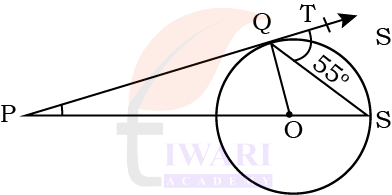
2. In the given figure, PQ is tangent to the circle with centre O. S is a point on the circle such that ∠SQT = 55°. The m ∠QPS is

Class 10 Maths CBSE Exam 2026 Question 2

(A) 55°
(B) 20°
(C) 35°
(D) 70°
Solution:
Since PQ is tangent at Q, the rays QP and QT form a straight line.
Given ∠SQT = 55°.
Therefore, ∠PQS = 180° − 55° = 125° (because PQ and QT are opposite rays)
By the tangent–chord theorem, the angle between tangent QT and chord QS equals the angle in the opposite arc.
So, ∠QAS = 55°.
Since AS is a diameter, ∠AQS = 90°.
Now in triangle AQS:
∠QSA = 180° − (90° + 55°)
∠QSA = 35°.
Since P, A, S are collinear, ∠QSP = 35°.
Now in triangle PQS:
∠QPS = 180° − (125° + 35°)
∠QPS = 20°.
Correct answer: (B) 20°.

3. In an A.P., if a₁₄ – a₈ = 24, then the common difference of the A.P. is
(A) 6
(B) 4
(C) ±4
(D) 3
Solution:
a₁₄ = a + 13d
a₈ = a + 7d
Given: a₁₄ − a₈ = 24
So, (a + 13d) − (a + 7d) = 24
⇒ a + 13d − a − 7d = 24
⇒ 6d = 24
⇒ d = 4
Correct answer: (B) 4

4. The value of p for which roots of the quadratic equation x² – px + 6 = 0 are rational, is
(A) 1
(B) –5
(C) 25
(D) √5
Solution:
For the quadratic equation x² − px + 6 = 0
The roots will be rational if the discriminant (D) is a perfect square.
Discriminant, D = b² − 4ac
Here, a = 1, b = −p, c = 6
So, D = (−p)² − 4(1)(6)
D = p² − 24
For rational roots, p² − 24 must be a perfect square.
Check the options:
(A) p = 1, so D = 1 − 24 = −23 (not possible)
(B) p = −5, so D = 25 − 24 = 1 (perfect square)
(C) p = 25, so D = 625 − 24 = 601 (not a perfect square)
(D) p = √5, so D = 5 − 24 = −19 (not possible)
Correct answer: (B) −5

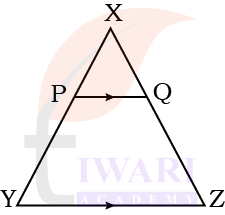
5. In the given figure, PQ ∥ YZ such that XP : PY = 2 : 3. If PQ = 5 cm, then YZ equals

Class 10 Maths CBSE Exam 2026 Question 5

(A) 12.5 cm
(B) 10 cm
(C) 15 cm
(D) 7.5 cm
Solution:
By Basic Proportionality Theorem (BPT):
Since PQ ∥ YZ, △XPQ ~ △XYZ
XP/XY = PQ/YZ
XP/XY = XP/(XP + PY) = 2/(2+3) = 2/5
∴ 2/5 = 5/YZ
YZ = 25/2 = 12.5 cm
Option (A) 12.5 cm is correct.

6. For an acute angle θ, if cos θ = 1/8, then (8 sec θ + 1)/(8 sec θ – 1) equals
(A) 64/63
(B) 0
(C) 65/63
(D) 1
Solution:
cosθ = 1/8 → secθ = 8
8 secθ = 8 × 8 = 64
So, (8 sec θ + 1)/(8 sec θ – 1) = (64 + 1)/(64 – 1) = 65/63
Option (C) 65/63 is correct.

7. A card is drawn at random from a well shuffled deck of 52 playing cards. The probability that it is either a ten or a king is
(A) 1/26
(B) 2/13
(C) 1/13
(D) 8/26
Solution:
Number of tens = 4
Number of kings = 4
Total favourable = 4 + 4 = 8
P = 8/52 = 2/13
Option (B) 2/13 is correct.

8. The line segment joining the points P(–4, –2) and Q(10, 4) is divided by y-axis in the ratio
(A) 2 : 5
(B) 1 : 2
(C) 2 : 1
(D) 5 : 2
Solution:
On y-axis, x = 0
By section formula, if ratio = m:n
x = (mx₂ + nx₁)/(m + n)
⇒ 0 = (m×10 + n×(–4))/(m+n)
⇒ 10m – 4n = 0
⇒ 10m = 4n
⇒ m/n = 4/10 = 2/5
Option (A) 2:5 is correct.

9. Simplest form of sec A / √(sec²A – 1) is
(A) sin A
(B) tan A
(C) cosec A
(D) cos A
Solution:
We know: sec²A – 1 = tan²A
= secA/√(tan²A)
= secA/tanA
= (1/cosA)/(sinA/cosA)
= (1/cosA) × (cosA/sinA)
= 1/sinA
= cosecA
Option (C) cosec A is correct.

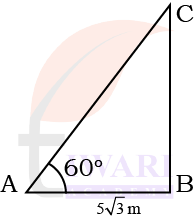
10. A wire is attached from a point A on the ground to the top of a pole BC, making an angle of elevation as 60°. If AB = 5√3 m, then length of the wire is

Class 10 Maths CBSE Exam 2026 Question 10

(A) 10 m
(B) 10√3 m
(C) 15 m
(D) 5/2 √3 m
Solution:
AB = base = 5√3 m AC = wire (hypotenuse) ∠A = 60°
cos60° = AB/AC
1/2 = 5√3/AC
AC = 10√3 m
Option (B) 10√3 m is correct.


11. If sum and product of zeroes of a polynomial are (–3) and (–2) respectively, then a polynomial is
(A) x² – 3x – 2
(B) –x² – 3x + 2
(C) –x² + 3x – 2
(D) x² + 3x + 2
Solution:
Sum of zeroes = −3
Product of zeroes = −2
So, the quadratic equation: x² − (Sum of roots)x + Product of roots
⇒ x² + 3x – 2.
⇒ -(−x² − 3x + 2)
⇒ k(−x² − 3x + 2)
Therefore, Correct answer: (B) −x² − 3x + 2.

12. Meena calculates that the probability of her winning the first prize in a lottery is 0.08. If total 800 tickets were sold, the number of tickets bought by her, is
(A) 64
(B) 640
(C) 100
(D) 10
Solution:
Number of tickets = P × Total = 0.08 × 800 = 64
Option (A) 64 is correct.

13. A conical cavity of maximum volume is carved out from a wooden solid hemisphere of radius 10 cm. Curved surface area of the cavity carved out is (use π = 3.14)

Class 10 Maths CBSE Exam 2026 Question 13

(A) 314√2 cm²
(B) 314 cm²
(C) 3140/3 cm²
(D) 3140√2 cm²
Solution:
For maximum volume cone inside hemisphere:
Cone radius = r = 10 cm
Cone height = h = 10 cm (= radius of hemisphere)
Slant height of cone: l = √(r² + h²) = √(100 + 100) = √200 = 10√2 cm
Curved Surface Area of cone = πrl = 3.14 × 10 × 10√2 = 314√2 cm²
Option (A) 314√2 cm² is correct.

14. While calculating mean of a grouped frequency distribution, step deviation method was used ((x – a)/h = u). It was found that x̄ = 64, h = 5 and a = 62.5. The value of ū is
(A) 0.5
(B) 1.5
(C) 0.3
(D) 7.5
Solution:
Formula: x̄ = a + ū × h
64 = 62.5 + ū × 5
1.5 = ū × 5
ū = 1.5/5 = 0.3
Option (C) 0.3 is correct.

15. The area of a sector of a circle of radius 10 cm is 55/3 cm². The value of central angle is
(A) 21°/2
(B) 42°
(C) 105°
(D) 21°
Solution:
Area of sector = (θ/360°) × πr²
55/3 = (θ/360) × (22/7) × 100
55/3 = (θ/360) × 2200/7
55/3 × 7/2200 × 360 = θ
θ = (55 × 7 × 360)/(3 × 2200)
θ = (138600)/(6600)
θ = 21°
Option (D) 21° is correct.

16. A camping tent in hemispherical shape of radius 1.4 m, has a door opening of area 0.50 m². Outer surface area of the tent is
(A) 11.78 m²
(B) 12.32 m²
(C) 11.82 m²
(D) 12.86 m²
Solution:
Curved Surface Area of hemisphere = 2πr²
= 2 × 22/7 × 1.4 × 1.4
= 2 × 22/7 × 1.96
= 2 × 6.16
= 12.32 m²
Outer surface area = CSA – door area = 12.32 – 0.50 = 11.82 m²
Option (C) 11.82 m² is correct.

17. Which of the following can not be the probability of an event?
(A) 39/100
(B) 0.001/20
(C) 10/0.2
(D) 10%
Solution:
Probability must be between 0 and 1.
(A) 39/100 = 0.39 (Valid)
(B) 0.001/20 = 0.00005 (Valid)
(C) 10/0.2 = 50 (Greater than 1, NOT valid)
(D) 10% = 0.10 (Valid)
Option (C) 10/0.2 is correct.

18. The value of k for which the equation kx² – 6x – 4 = 0 has real and equal roots, is
(A) 9/4
(B) –4
(C) –9/4
(D) –2
Solution:
For real and equal roots: D = 0
⇒ b² – 4ac = 0
⇒ (–6)² – 4(k)(–4) = 0
⇒ 36 + 16k = 0
⇒ 16k = –36
⇒ k = –36/16 = –9/4
Option (C) –9/4 is correct.

(Assertion and Reason Based Questions)

Directions: Questions number 19 and 20 are Assertion and Reason based questions. Two statements are given, one labelled Assertion (A) and the other labelled Reason (R). Select the correct answer from the codes (A), (B), (C) and (D) as given below :
(A) Both Assertion (A) and Reason (R) are true and Reason (R) is the correct explanation of the Assertion (A).
(B) Both Assertion (A) and Reason (R) are true, but Reason (R) is not the correct explanation of the Assertion (A).
(C) Assertion (A) is true, but Reason (R) is false.
(D) Assertion (A) is false, but Reason (R) is true.

19. Assertion (A) : The system of linear equations 3x – 5y + 7 = 0 and –6x + 10y + 14 = 0 is inconsistent.
Reason (R) : When two linear equations don’t have unique solution, they always represent parallel lines.
Solution:
Assertion (A): 3x – 5y + 7 = 0 and –6x + 10y + 14 = 0
Check: a₁/a₂ = 3/–6 = –1/2
b₁/b₂ = –5/10 = –1/2
c₁/c₂ = 7/14 = 1/2
Since a₁/a₂ = b₁/b₂ ≠ c₁/c₂
→ Lines are parallel → inconsistent, So A is TRUE.
Reason (R): When two equations don’t have unique solution, they always represent parallel lines.
This is FALSE — they could also be coincident lines (infinite solutions), which is also not unique but not parallel.
Option (C) Assertion (A) is true, but Reason (R) is false is correct.

20. Assertion (A) : H.C.F. (36 m², 18 m) = 18 m, where m is a prime number.
Reason (R) : H.C.F. of two numbers is always less than or equal to the smaller number.
Solution: Assertion (A): HCF(36m², 18m) = 18m, where m is prime
36m² = 2² × 3² × m²
18m = 2 × 3² × m
HCF = 2 × 3² × m = 18m ✓ A is TRUE
Reason (R): HCF of two numbers is always less than or equal to the smaller number.
Smaller number = 18m
HCF = 18m ≤ 18m ✓ R is TRUE
And R correctly explains why HCF = 18m (it equals the smaller number here).
Option (A) Both A and R are true and R is the correct explanation of A is correct.

Class 10 Maths CBSE Exam Paper 2026 – Section B

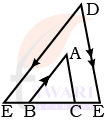
21. In the given figure, AB ∥ DE and AC ∥ DF. Show that △ABC ~ △DEF. If BC = 10 cm, EB = CF = 5 cm and AB = 7 cm, then find the length DE.

Solution:
Given: AB ∥ DE, AC ∥ DF, BC = 10 cm, EB = CF = 5 cm, AB = 7 cm
BE = CF = 5 cm, BC = 10 cm
∴ BE/BC = CF/BC → BE = CF (given)
Also, BE + BC = EC → EC = 15 cm
Similarly, BF = BC + CF = 15 cm
In △ABC and △DEF:
AB ∥ DE → ∠ABE = ∠DEB (alternate angles)
AC ∥ DF → ∠ACF = ∠DFC (alternate angles)
Since AB ∥ DE and AC ∥ DF:
∠BAC = ∠EDF (corresponding angles)
Also: AB/DE = BC/EF = AC/DF
Now, BE/BC = 5/10 = 1/2
∴ DE/AB = EC/BC = 15/10 = 3/2
∴ DE = AB × 3/2 = 7 × 3/2 = DE = 10.5 cm

22. (a) For acute angles A and B, if sec (2A – B) = √2 and cosec (A + B) = 2, then find the values of A and B.
Solution:
Given: sec(2A – B) = √2 and cosec(A + B) = 2
sec(2A – B) = √2 = sec 45° ∴ 2A – B = 45° …(i)
cosec(A + B) = 2 = cosec 30° ∴ A + B = 30° …(ii)
Adding (i) and (ii): 3A = 75° → A = 25°
From (ii): B = 30° – 25° = B = 5°

OR

22. (b) Evaluate : (2 cos 30° – cot³ 60°) / tan 30°
Solution:
Known values:
cos 30° = √3/2
cot 60° = 1/√3
tan 30° = 1/√3
Numerator: = 2 × (√3/2) – (1/√3)³ = √3 – 1/(3√3) = √3 – 1/(3√3) = (3√3 × √3 – 1) / (3√3) = (9 – 1) / (3√3) = 8/(3√3)
Denominator: 1/√3
= [8/(3√3)] ÷ [1/√3] = 8/(3√3) × √3 = 8/3
∴ Answer = 8/3

23. Prove that 4 – 2√5 is an irrational number given that √5 is irrational.
Solution:
Proof (by contradiction):
Assume 4 – 2√5 is rational.
Then 4 – 2√5 = p/q, where p, q are integers, q ≠ 0
⇒ 2√5 = 4 – p/q
⇒ √5 = (4q – p) / 2q
Since p and q are integers, (4q – p)/2q is rational
∴ √5 is rational — Contradiction!
Since √5 is given to be irrational, our assumption is wrong.
∴ 4 – 2√5 is irrational.

24. A bag contains 25 balls. Some of them are yellow and others are green. One ball is drawn at random. If probability of getting a green ball is 3/5, then find the number of yellow balls.
Solution:
Given: Total balls = 25, P(green) = 3/5
Number of green balls = 3/5 × 25 = 15
Number of yellow balls = 25 – 15 = 10

25. (a) Vertices of a right triangle ABC with ∠B = 90° are A(3, 4), B(1, 1) and C(–8, 7). Find the value of tan A.
Solution:
Given: ∠B = 90°, A(3,4), B(1,1), C(–8,7)
BC = √[(–8–1)² + (7–1)²] = √[81 + 36] = √117 = 3√13
AB = √[(3–1)² + (4–1)²] = √[4 + 9] = √13
AC = √[(3–(–8))² + (4–7)²] = √[121 + 9] = √130
In right △ABC, ∠B = 90°
tan A = BC/AB = 3√13/√13 = 3
∴ tan A = 3

OR

25. (b) Using distance formula, prove that the points A(2, 3), B(–7, 0) and C(–1, 2) are collinear.
Solution:
Prove A(2,3), B(–7,0), C(–1,2) are collinear
AB = √[(–7–2)² + (0–3)²] = √[81 + 9] = √90 = 3√10
BC = √[(–1–(–7))² + (2–0)²] = √[36 + 4] = √40 = 2√10
AC = √[(–1–2)² + (2–3)²] = √[9 + 1] = √10
Check: BC + AC = 2√10 + √10 = 3√10 = AB
Since AB = BC + AC, points A, B, C are collinear.

Class 10 Maths CBSE Exam Paper 2026 – Section C

Q. Numbers 26 to 31 are short answer questions of 3 marks each:
26. (a) A circle centered at (2, 1) passes through the points A(5, 6) and B(–3, K). Find the value(s) of K. Hence find length of chord AB.
Solution:
Centre = (2, 1), passes through A(5, 6) and B(–3, K)
Radius using A: r² = (5–2)² + (6–1)² = 9 + 25 = 34
Using B: r² = (–3–2)² + (K–1)² = 25 + (K–1)²
∴ 25 + (K–1)² = 34 (K–1)² = 9 K – 1 = ±3 K = 4 or K = –2
Length of chord AB (using K = 4): B = (–3, 4) AB = √[(5–(–3))² + (6–4)²] = √[64 + 4] = √68 = 2√17 cm

OR

(b) Prove that the point P dividing the line segment joining the points A(–1, 7) and B(4, –3) in the ratio 3 : 2, lies on the line x – 3y = –1. Also find length of PA and PB.
Solution:
P divides A(–1,7) and B(4,–3) in ratio 3:2
By section formula: P = [(3×4 + 2×(–1))/(3+2), (3×(–3) + 2×7)/(3+2)] P = [(12–2)/5, (–9+14)/5] P = [10/5, 5/5] P = (2, 1)
Check on x – 3y = –1: 2 – 3(1) = 2 – 3 = –1 ✓ P lies on the line.
PA: = √[(2–(–1))² + (1–7)²] = √[9 + 36] = √45 = 3√5 units
PB: = √[(2–4)² + (1–(–3))²] = √[4 + 16] = √20 = 2√5 units

27. The dimensions of a window are 156 cm × 216 cm. Arjun wants to put grill on the window creating complete squares of maximum size. Determine the side length of the square and hence find the number of squares formed.
Solution:
Given: Window = 156 cm × 216 cm
Side of largest square = HCF(156, 216)
Finding HCF by Euclid’s division: 216 = 1 × 156 + 60 156 = 2 × 60 + 36 60 = 1 × 36 + 24 36 = 1 × 24 + 12 24 = 2 × 12 + 0
HCF = 12 cm (side of each square)
Number of squares = (156/12) × (216/12) = 13 × 18 = 234 squares

28. Use graphical method to solve the system of linear equations : y = –3 and x + 2y = 4.
Solution:
Equation 1: y = –3 (horizontal line)
x: 0 |2 | 4
y: –3|–3|–3
Equation 2: x + 2y = 4 → x = 4 – 2y
x: 4|0|–2
y: 0|2| 3
Substituting y = –3 in x + 2y = 4: x + 2(–3) = 4 x – 6 = 4 x = 10
∴ Answer: x = 10, y = –3 → Point (10, –3)

29. (a) In an A.P., 15th term exceeds the 8th term by 21. If sum of first 10 terms is 55, then form the A.P.
Solution:
Given: a₁₅ – a₈ = 21, S₁₀ = 55
a₁₅ – a₈ = (a + 14d) – (a + 7d) = 7d = 21 ∴ d = 3
S₁₀ = 10/2 × [2a + 9d] = 55 5[2a + 27] = 55 2a + 27 = 11 2a = –16 a = –8
∴ A.P. = –8, –5, –2, 1, 4, 7, …

OR

(b) The sum of first n terms of an A.P. is 2n² + 13n. Find its nᵗʰ term and hence 10th term.
Solution: 
Given: Sₙ = 2n² + 13n
nᵗʰ term: aₙ = Sₙ – Sₙ₋₁ = [2n² + 13n] – [2(n–1)² + 13(n–1)] = 2n² + 13n – [2n² – 4n + 2 + 13n – 13] = 2n² + 13n – 2n² + 4n – 2 – 13n + 13 = aₙ = 4n + 11
10th term: a₁₀ = 4(10) + 11 = 40 + 11 = 51.

30. A circle of diameter 20 cm is equally divided into five sectors. Find the area and perimeter of one of the sectors.
Solution:
Given: Diameter = 20 cm → r = 10 cm, 5 equal sectors
Each sector angle = 360°/5 = 72°
Area of one sector: = (θ/360°) × πr² = (72/360) × π × 100 = (1/5) × 100π = 20π = 62.8 cm²
Perimeter of one sector: = 2r + arc length = 2(10) + (72/360) × 2π × 10 = 20 + (1/5) × 20π = 20 + 4π = 20 + 12.56 = 32.56 cm

31. Prove that :
(1 + cot θ – cosec θ) (1 + tan θ + sec θ) = 2
Solution:
LHS: = (1 + cosθ/sinθ – 1/sinθ)(1 + sinθ/cosθ + 1/cosθ)
= [(sinθ + cosθ – 1)/sinθ] × [(cosθ + sinθ + 1)/cosθ]
= [(sinθ + cosθ – 1)(sinθ + cosθ + 1)] / (sinθ · cosθ)
= [(sinθ + cosθ)² – 1²] / (sinθ · cosθ)
= [sin²θ + 2sinθcosθ + cos²θ – 1] / (sinθ · cosθ)
= [1 + 2sinθcosθ – 1] / (sinθ · cosθ)
= [2sinθcosθ] / (sinθ · cosθ)
= 2 = RHS

Recent Posts
  • Class 10 Maths CBSE Exam Paper 2026 Solutions
  • Class 9 Maths Chapter 6 Lines and Angles Preparation
  • Class 4 Maths Exam Preparation with NCERT Solutions
  • Class 10 Mathematics Board Exam Preparation
  • Class 8 Maths Preparation Tips for Exams


Important Links
  • What is NCERT?
  • Important Questions
  • Vedic Maths Tricks
  • Link Study Materials
  • Useful Resources & Formulae
  • Holiday Homework Solutions


Buy NCERT Books Online

NCERT Books for 2024-25

NCERT Solutions
  • NCERT Solutions for Class 6 Maths
  • NCERT Solutions for Class 7 Maths
  • NCERT Solutions for Class 8 Maths
  • NCERT Solutions for Class 11 Maths
  • NCERT Solutions for Class 12 Maths
  • NCERT Solutions for Class 11 Physics
  • NCERT Solutions for Class 12 Physics


High School
  • Class 9 NCERT Maths Solutions
  • Class 9 NCERT Science Solutions
  • Class 9 NCERT English Solutions
  • Class 10 NCERT Maths Solutions
  • Class 10 NCERT Science Solutions
  • Class 10 NCERT English Solutions
  • Class 10 NCERT Social Solutions

Quick Links
  • NCERT Books
  • NCERT Solutions
  • CBSE Syllabus
  • Home Tutors
  • NIOS Admissions
  • CBSE Sample Papers
  • Vedic Maths Tricks
Help & Support
  • About Us
  • Contact Us
  • Advertise With Us
  • Discussion
  • Latest Blogs
  • Holiday Homework
  • Useful Resources
Copyright 2025 by Tiwari Academy | A step towards Free Education
facebook
twitter
linkedin
youtube
instagram
pinterest
google-news