



by Tiwari Academy Team
NCERT Solutions for Class 4 English Santoor Chapter 12 Maheshwar for Session 2026-27 all question answers. This introduces students to the story of Queen Ahilya Bai, a warrior queen who built the majestic Maheshwar Fort on the banks of the Narmada River in Madhya Pradesh. Through a conversation between Aarav, Ananya and their Chachi, the fort’s overhanging balconies, its 13-feet statue of the queen and the region’s famous handwoven Maheshwari sarees. These solutions offer clear answers to all textbook exercises, including comprehension questions, synonyms, words with a silent ‘g’, sequencing a passage and articles (a, an, the), helping Class 4 students build stronger reading, vocabulary and grammar skills.
NCERT Class 4 English Santoor Chapter 12 Solutions
Page 128 – Let us Think
A. Answer the following.
1. Who was Ahilya Bai?
See AnswerAhilya Bai was a warrior queen who ruled over Maheshwar, a place in Madhya Pradesh. She belonged to the great Holkar family. She protected her people and built temples, schools and wells. She ruled with kindness, wisdom and people loved her.
2. Where is Maheshwar Fort located? What makes its location special?
See AnswerMaheshwar Fort is located in Madhya Pradesh, about 95 kilometres away from Indore. Its location is special because it is built on a hill, overlooking the town of Maheshwar on one side and the Narmada River on the other side.
3. What materials were used to build Maheshwar Fort, and where did they come from?
See AnswerThe Maheshwar Fort was made of special red stones that were brought from Gujarat and Rajasthan.
4. What does the statue of Queen Ahilya Bai in front of the palace represent?
See AnswerThe 13-feet tall statue of Queen Ahilya Bai stands in front of the palace like a guardian watching over her land. It represents her protective nature and her continued presence as a guardian of the land she ruled.
Page 128 – Let us Think
B. Think and discuss.
1. Aarav and Ananya get excited about visiting Maheshwar Fort. What do you think makes historical places like this interesting?
See AnswerHistorical places like Maheshwar Fort are interesting because they help us learn about our past and our heritage. They tell us stories about brave kings and queens who ruled long ago. These places have beautiful architecture, amazing artwork and wonderful designs that show the skills of people from earlier times. When we visit such places, we can imagine how people lived in those days and understand our history better. Historical places also connect us with our culture and make us feel proud of our ancestors’ achievements.
2. If you were Aarav or Ananya, what part of the fort would you be most excited to see—the overhanging balconies, the statue, or the temples? Why?
See AnswerIf I were Aarav or Ananya, I would be most excited to see the overhanging balconies because they seem to float in the air! It would be amazing to stand on these balconies and look out at the beautiful view of the entire kingdom and the Narmada River. I would wonder how people built such amazing structures so long ago without modern technology. Also, from these balconies, I could see both the town of Maheshwar and the river, just like Queen Ahilya Bai did when she ruled her kingdom.
Page 129 – Let us Learn
A. The words “smiling”, “grinning” and “laughing” have similar meanings.
Example:
• happy, joyful, cheerful
• brave, bold, fearless
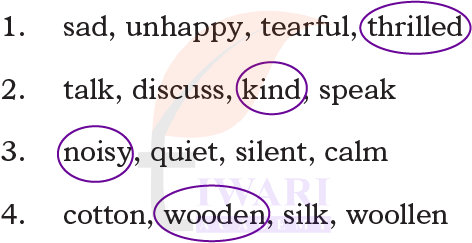
Given below are sets of words that have similar meaning along with a word that does not fit the group. Circle the odd one out.
1. sad, unhappy, tearful, thrilled
2. talk, discuss, kind, speak
3. noisy, quiet, silent, calm
4. cotton, wooden, silk, woollen
Answer:
Find out two such sets of words and write them below
• …………., …………., ………….
• …………., …………., ………….
See Answer1. Big, large, tiny, huge
2. Run, sprint, jog, walk
B. Read the word ‘design’ aloud. What did you observe?
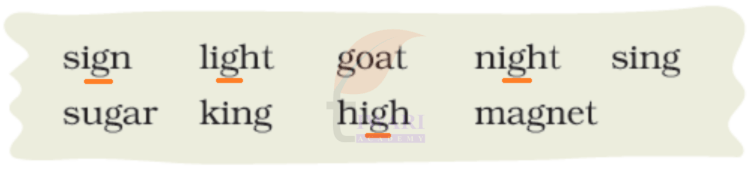
The letter ‘g’ is silent.
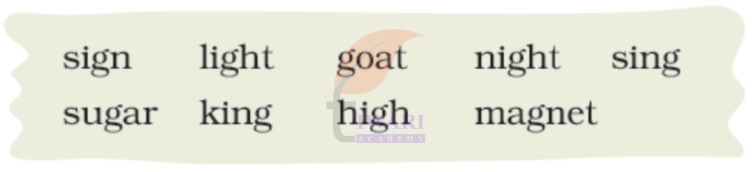
Now, read the following words. Underline the words that have a silent ‘g’ letter.
Answer:
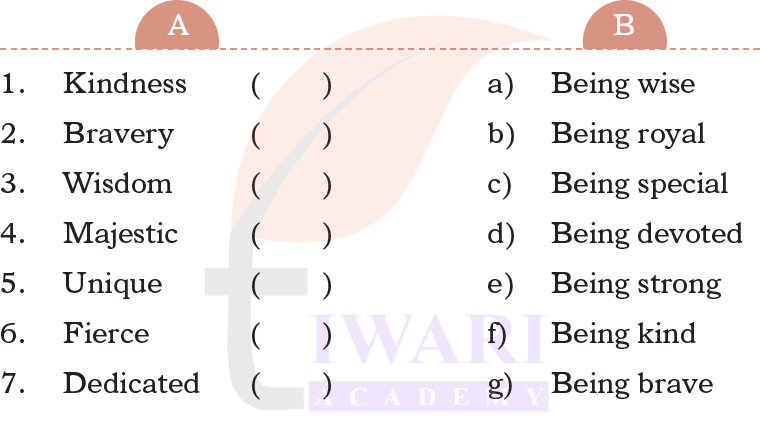
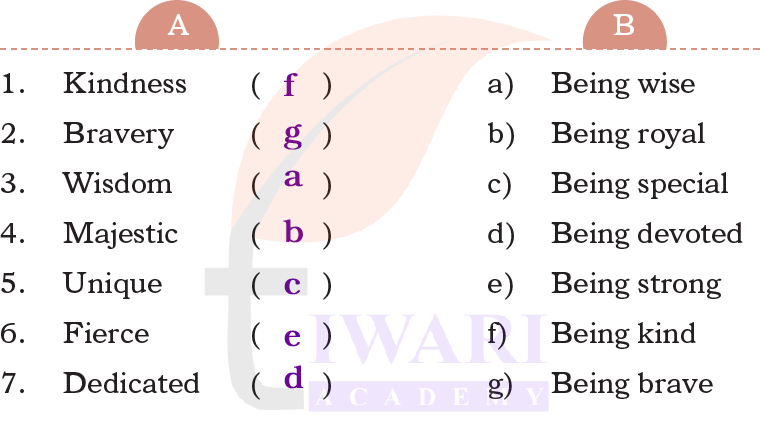
C. Match the following:
Answer:
Page 131 – Let us Listen
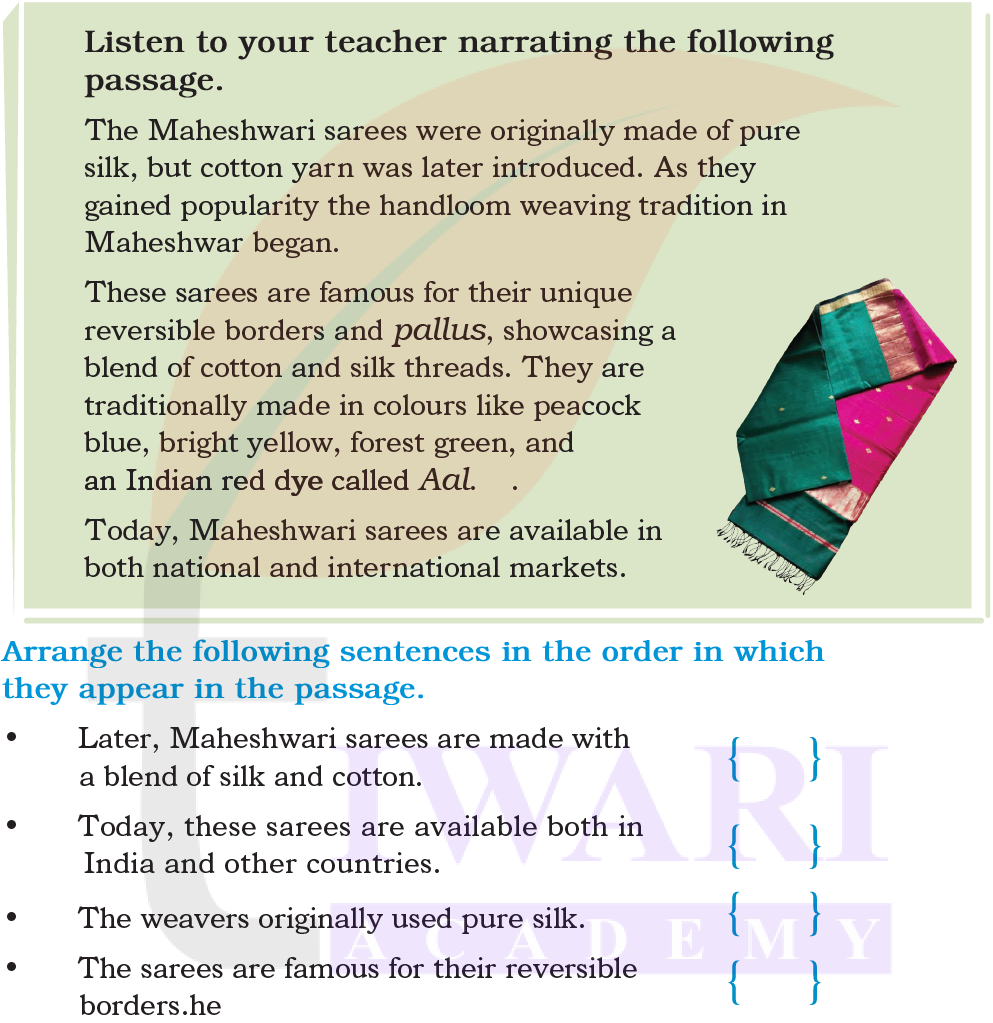
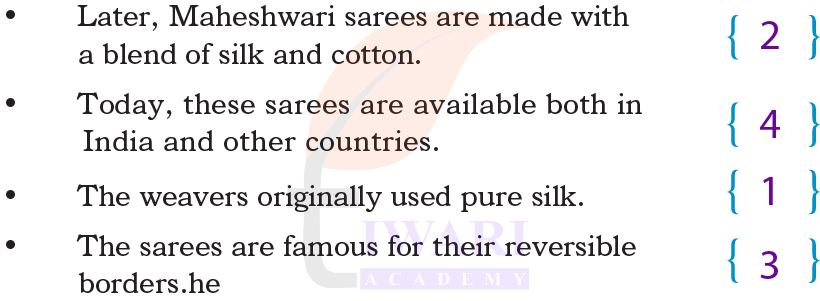
Answer:
Page 132 – Let us Speak
A. Find out from the elders of your home and your locality about any historical place that is there in your town or nearby. You may consider more than one place too! Collect information and pictures of that place and present it to the class.
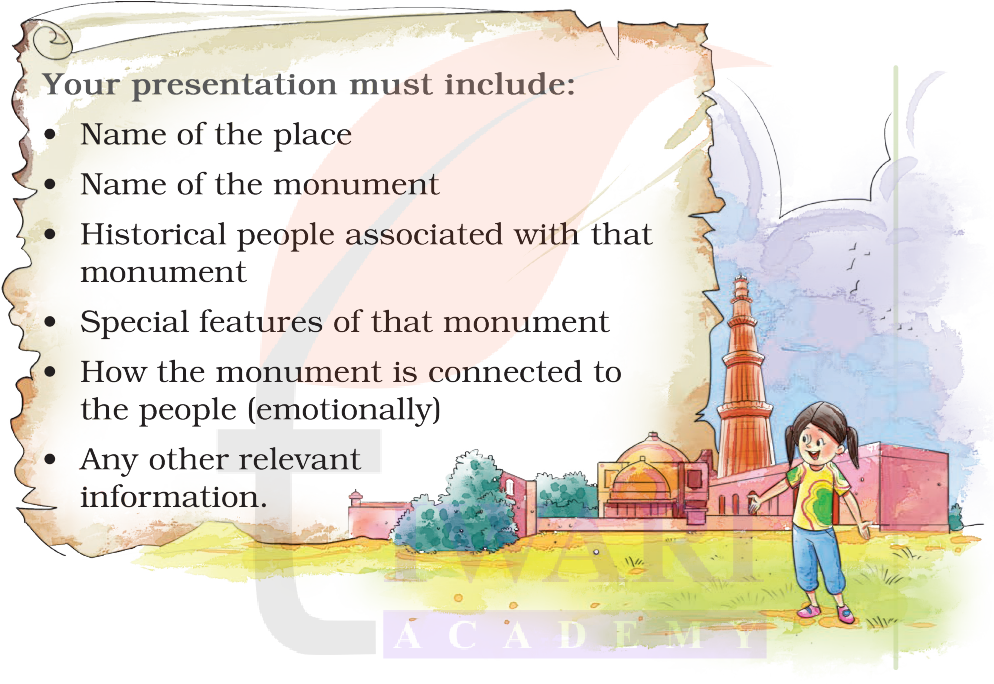
See AnswerName of the place: Agra
Name of the monument: Taj Mahal
Historical people associated with that monument: Emperor Shah Jahan and Mumtaz Mahal
Special features of the monument: Made of white marble, beautiful gardens, perfect symmetry, intricate carvings
How the monument is connected to the people (emotionally): Symbol of love, pride of our country, attracts tourists from all over the world
Any other relevant information: It took 22 years to build, more than 20,000 workers were involved in its construction
B. Complete the passage with suitable Articles (a, an, the)
Once upon ……….. time, there live ……….. monkey on ……….. oak tree. One day, ……….. monkey saw ……….. old man with ……….. bag. ……….. naughty monkey snatched the bag. Inside ……….. bag was ……….. apple, . ……… pear, ……….. olive and ……….. carrot. It gave . ……… pear to ……….. elephant and ……….. carrot to ……….. bear. It kept . ……… olive and ……….. apple inside ……….. empty box. While . ………. monkey slept, ……….. dog found .
See AnswerOnce upon a time, there lived a monkey on an oak tree. One day, the monkey saw an old man with a bag. The naughty monkey snatched the bag. Inside the bag was an apple, a pear, an olive and a carrot. It gave the pear to an elephant and the carrot to a bear. It kept the olive and the apple inside an empty box. While the monkey slept, a dog found the apple and stole it. The monkey was left with only the olive to eat.
Page 133 – Let us Write
A. Imagine you are visiting Maheshwar Fort with your family. Write a short description of what you see and feel as you explore the fort’s balconies and temples.
See AnswerToday, I am visiting the beautiful Maheshwar Fort with my family. As we climb up the hill, I am amazed to see how big and strong the fort looks. The red stones shine in the sunlight. When we reach the top, I run to the overhanging balconies. They really do look like they are floating in the air! Standing on the balcony, I can see the entire town of Maheshwar on one side and the sparkling blue waters of the Narmada River on the other side.
The cool breeze makes me feel like I am flying. Inside the fort, we visit the temples with their beautiful carvings. I stand in front of the tall statue of Queen Ahilya Bai and imagine how brave she must have been. My mother buys a colorful Maheshwari saree and I touch the soft fabric. I feel excited and proud to be in this special place that tells us stories from long ago. This is the best family trip ever!
B. Based on the facts that you have learnt in the lesson, write a short paragraph on the Maheshwar Fort.
See AnswerMaheshwar Fort, also known as Ahilya Fort, is a magnificent structure located in Madhya Pradesh, about 95 kilometers from Indore. It was built by the brave and wise Queen Ahilya Bai Holkar on the banks of the Narmada River. The fort is famous for its unique architecture, especially its overhanging balconies that seem to float in the air. It was constructed using special red stones brought from Gujarat and Rajasthan. The fort stands on a hill, providing a beautiful view of the town of Maheshwar and the Narmada River. A 13-feet tall statue of Queen Ahilya Bai stands in front of the palace, symbolizing her protection over the land. The fort is surrounded by beautifully designed temples and the area is also known for the famous Maheshwari sarees made from cotton and silk with unique designs.
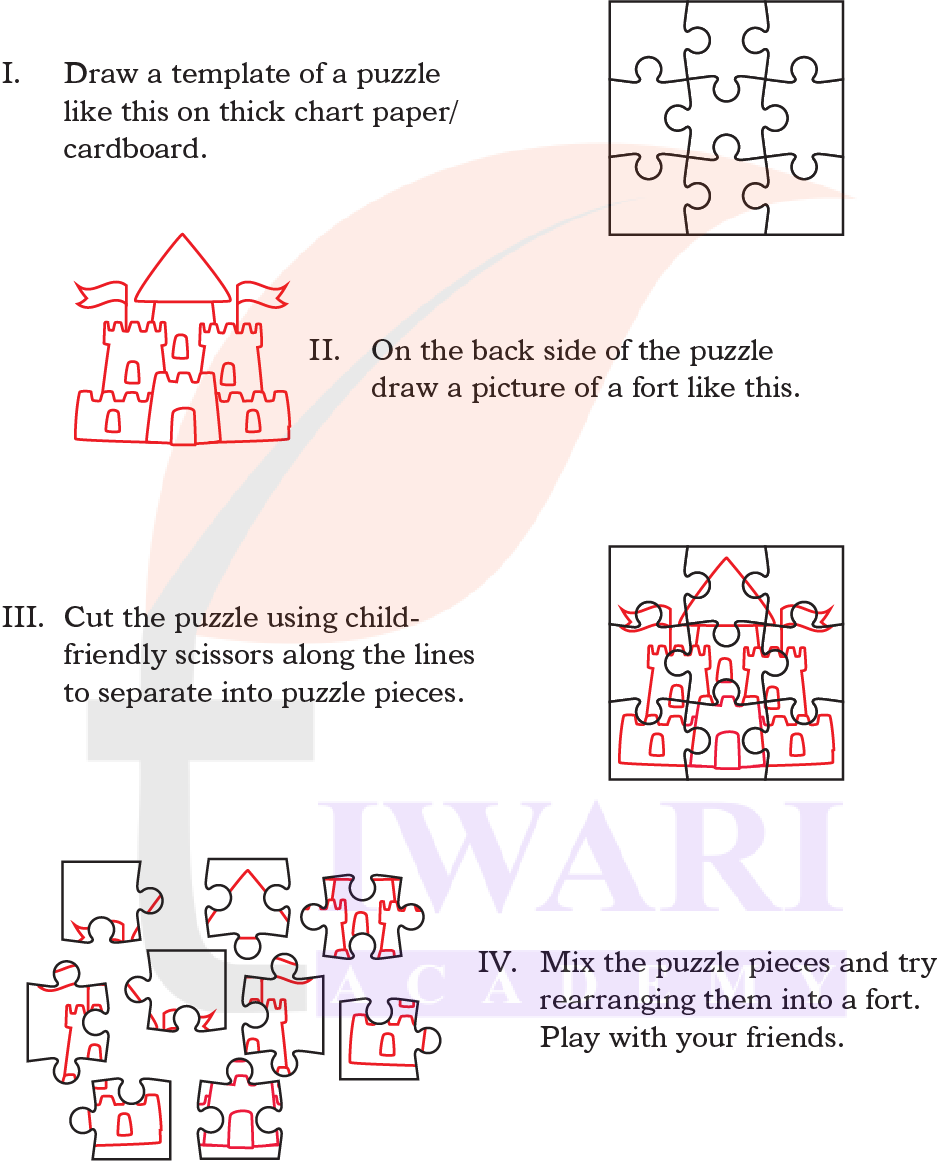
Page 134 – Let us Do
Frequently Asked Questions
Is Class 4 English Santoor Chapter 12 easy?
Yes, it’s a fairly easy and engaging chapter since it’s written as a friendly conversation between two children and their aunt. The historical facts about Maheshwar Fort are explained in simple language and most exercises – comprehension questions and synonyms – are straightforward, though the articles (a, an, the) section needs a bit more careful practice.
How to prepare Class 4 English Chapter 12 in one day?
Read the dialogue once to understand who Queen Ahilya Bai was and what makes Maheshwar Fort special. Go through the New Words (fort, majestic, overhanging, balconies, ruler, unique) and revise the “Let us Think” answers. Then focus on the grammar sections – silent ‘g’ words and the articles exercise – since these need the most attention. About 1 to 1.5 hours is enough for a solid one-day revision.
What is the summary of Class 4 English Santoor Chapter 12?
Aarav and Ananya ask their Chachi about a fort they saw in a newspaper picture and she tells them about Maheshwar Fort (also called Ahilya Fort), built by warrior queen Ahilya Bai on the banks of the Narmada River in Madhya Pradesh. The fort is known for its overhanging balconies, a 13-feet statue of the queen and the region’s famous handwoven Maheshwari sarees. The children end by planning a visit to the fort themselves.
What grammar concept does Chapter 12 teach?
This chapter teaches articles – a, an, and the – through a fill-in-the-blanks story about a monkey and some fruits. Students learn that ‘a’ and ‘an’ are used for something general or mentioned for the first time, while ‘the’ is used for something specific that has already been introduced.