



by Tiwari Academy Team
NCERT Solutions for Class 4 English Santoor Chapter 6 Braille for Session 2026-27. It introduces students to the inspiring life story of Louis Braille, a French boy who lost his eyesight in a childhood accident and later invented the Braille reading system used by blind people worldwide. These solutions offer clear answers to all textbook exercises, Hindi Translation including Let Us Think, Let Us Speak and Let Us Write, along with grammar practice on the past continuous tense, helping Class 4 students build stronger reading, writing and comprehension skills.
NCERT Solutions Class 4 English Santoor Chapter 6 – Exercise Answers
Class 4 English Santoor Chapter 6 Braille – Question Answers
Page 58 – Let us Think
A. Answer the following:
1. Describe the Braille alphabet.
See AnswerBraille is a special way of reading by touching raised dots.
➤ Each English letter has its own pattern of dots.
➤ Braille needs more space because letters must be spaced out.
➤ Braille books are thicker than regular books.
➤ Even people who can see can learn Braille.
2. Why was ‘Night Writing’ not a success?
See AnswerIt was too difficult to understand.
The system was too complicated for people to use.
3. What did Louis Braille do to make reading easier for the blind?
See Answer➤ He made ‘Night Writing’ simpler.
➤ He created the Braille alphabet.
➤ His system uses easy-to-feel dot patterns for each letter.
Page 58 – Let us Think
B. Think and discuss.
1. You may have seen people with blindness walking with a white cane. Why is the cane always white-coloured?
See AnswerWhite color is easy to see.
It tells people that the person is blind.
It helps others give way to blind people.
2. Imagine that the world becomes dark for a day and there is no light. What difficulties might one face on such a day?
See AnswerIf the whole world became dark for a whole day, life would be really hard for everyone. Here are some difficulties I think we would face:
➤ I would not be able to read my books or do my homework.
➤ I might trip and fall while walking or bump into furniture at home.
➤ I would not be able to recognise my friends by their faces – I would need to know them by their voice instead.
➤ Cooking and eating food safely would become difficult for my family.
➤ Cars, buses and bikes could meet with accidents on the road since drivers could not see.
➤ Doctors would find it hard to check and treat patients.
➤ Schools, shops and offices might have to shut down for the day.
➤ Everyone would feel scared and unsafe without any light.
This dark day would help me understand how hard everyday life is for people who are blind and why Louis Braille’s invention of the Braille alphabet is so important for them.
Page 58 – Let us Speak
Close your eyes. Pick an object. Keep the object back. Now complete the sentences and share them with the class.
1. The object in my hand was ………………….. in shape.
See AnswerThe object in my hand was round in shape.
2. The object in my hand was ………………….. (longer/shorter) than my forefinger.
See AnswerThe object in my hand was shorter than my forefinger.
3. The object in my hand was a ………………….. .
See AnswerThe object in my hand was a ball.
Now add two more lines to describe the object.
See AnswerThe ball was smooth and soft.
It was small and easy to hold.
Page 60 – Let us Write
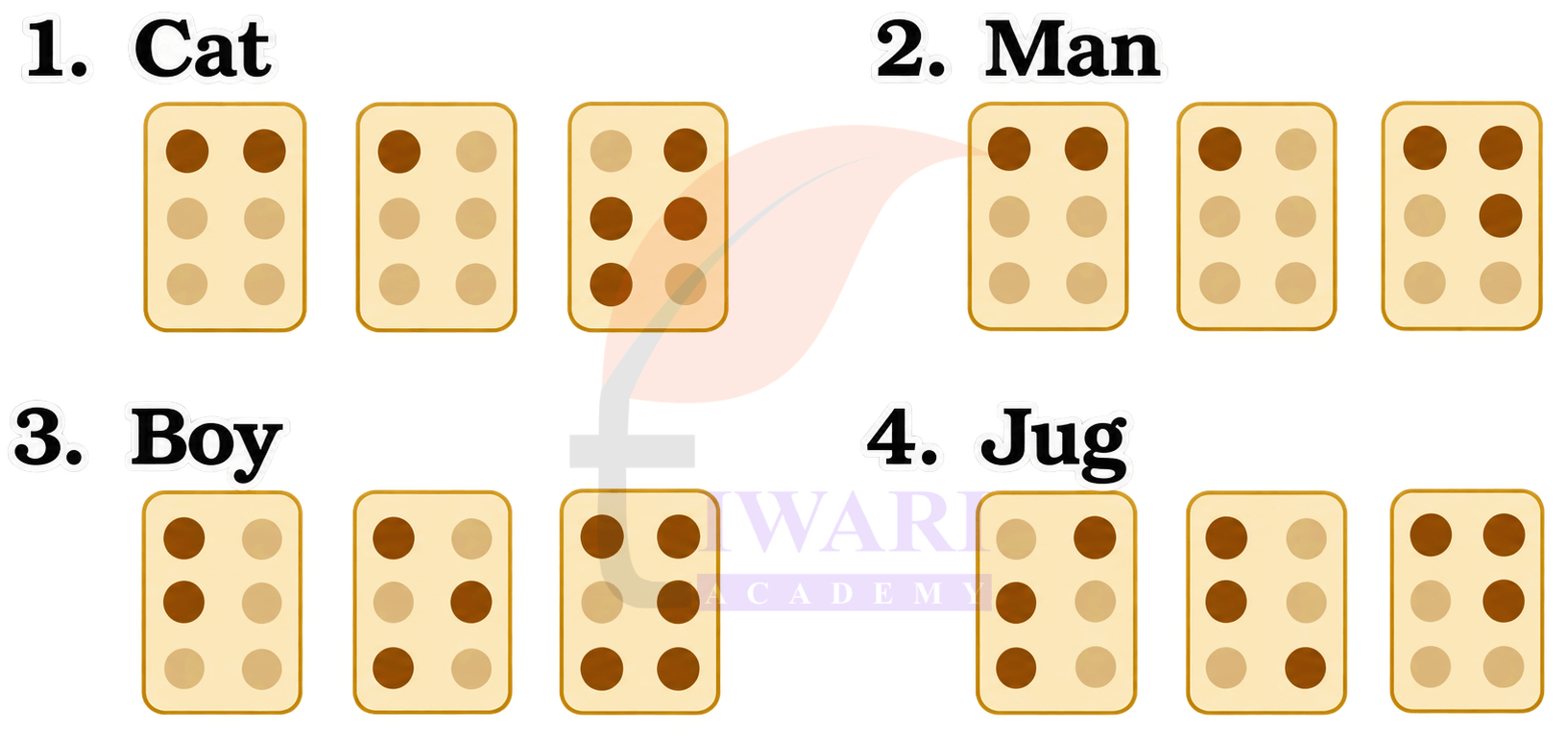
A. Write these words using the Braille alphabet.
You can paste “bindis”. One is done for you.
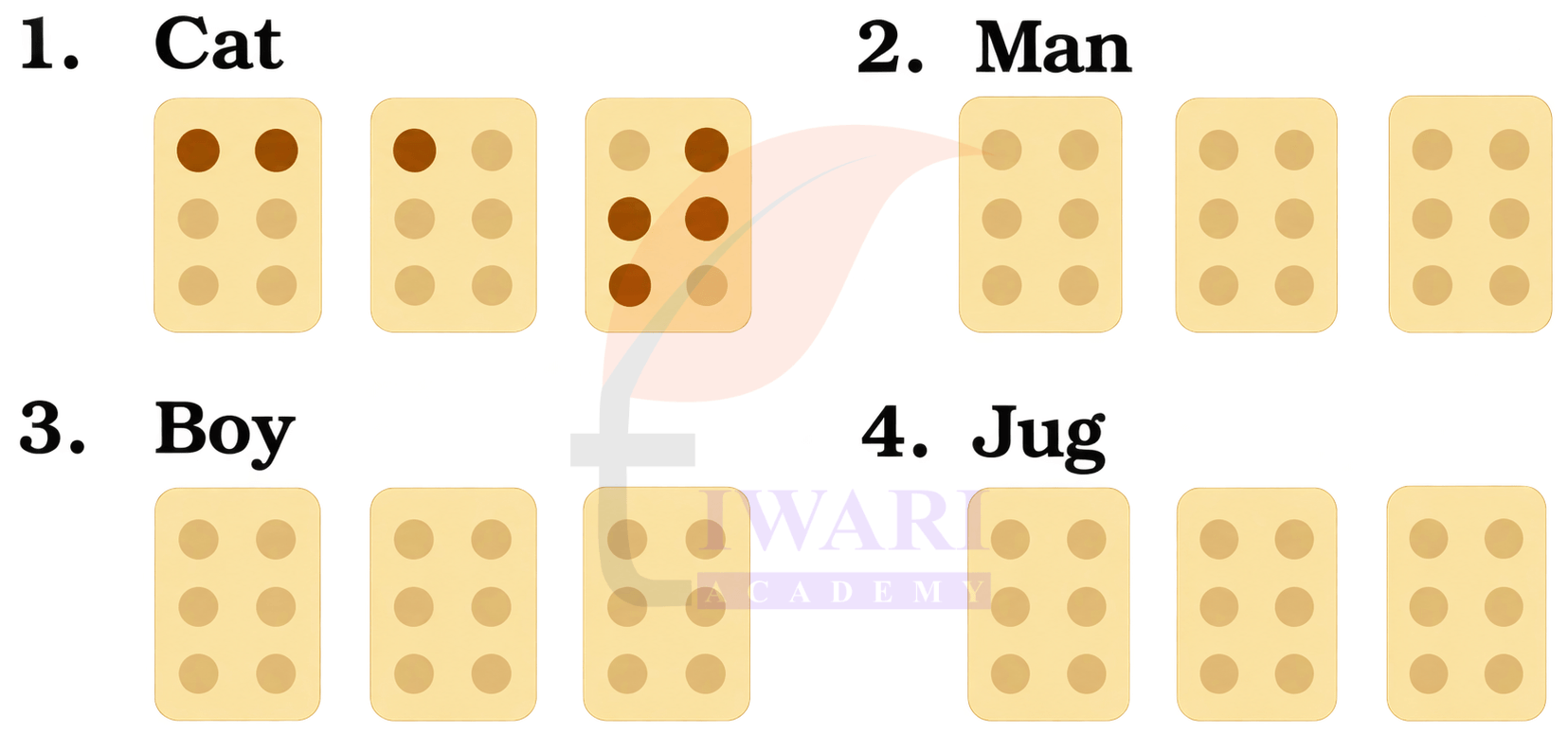
Answer:
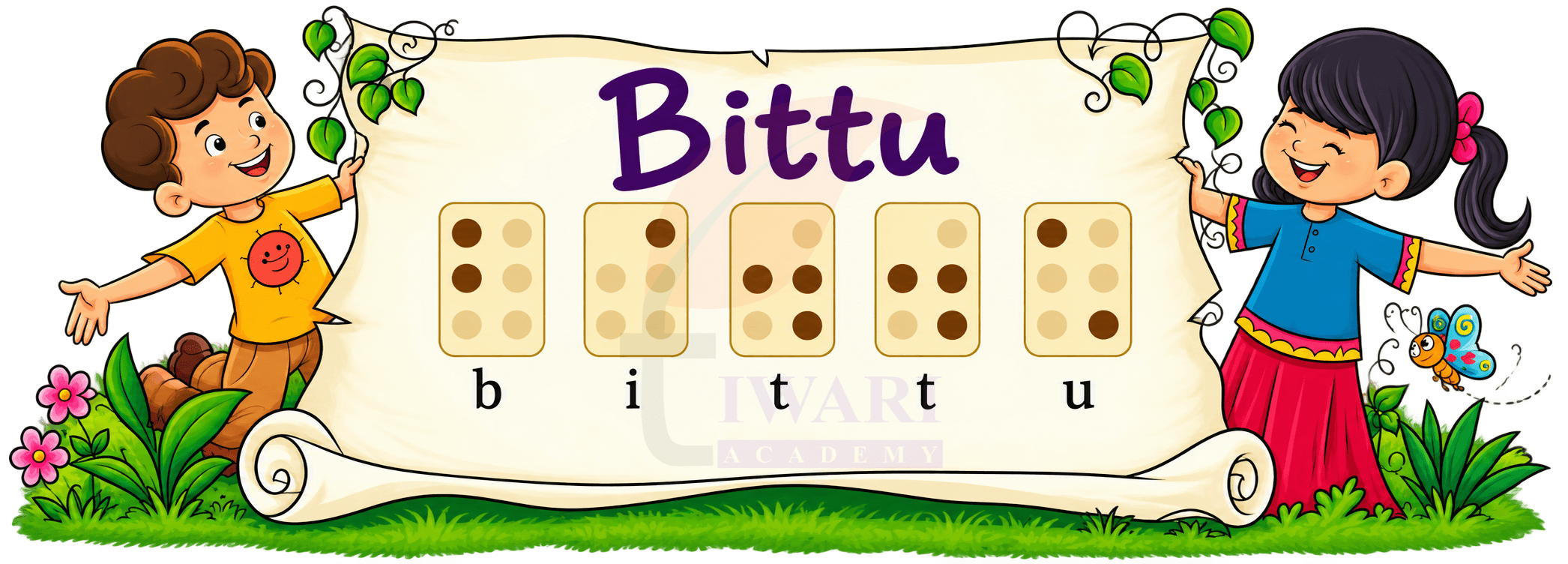
5. Write your name in Braille.
Answer:
B. Louis Braille lost his eyesight in an accident.
Some time ago, a newspaper reported that a child lost one eye while lighting firecrackers.
List the precautions that should be taken to protect eyes from harm.
See Answer1. Do not play with firecrackers.
2. Keep a safe distance from firecrackers.
3. Do not light firecrackers near your face.
4. Wear protective goggles when there is a risk of eye injury.
5. Never touch or rub your eyes with dirty hands.
6. Keep sharp objects away from the eyes.
7. Ask an adult for help when doing anything that may harm the eyes.
C. Read the following sentences and notice the underlined words.
• Long ago, in France, a little boy named Louis Braille was playing near his home.
• The cats were sleeping when I reached home.
• Sameer was playing hopscotch last evening.
Answer:
This part of the chapter teaches the past continuous tense: use was + verb+ing for one person/animal, and were + verb+ing for more than one. The example sentences (Louis Braille “was playing”, the cats “were sleeping”, Sameer “was playing”) show this and the exercise that follows asks you to change present tense sentences to the past. Here’s how a Class 4 student would complete it:
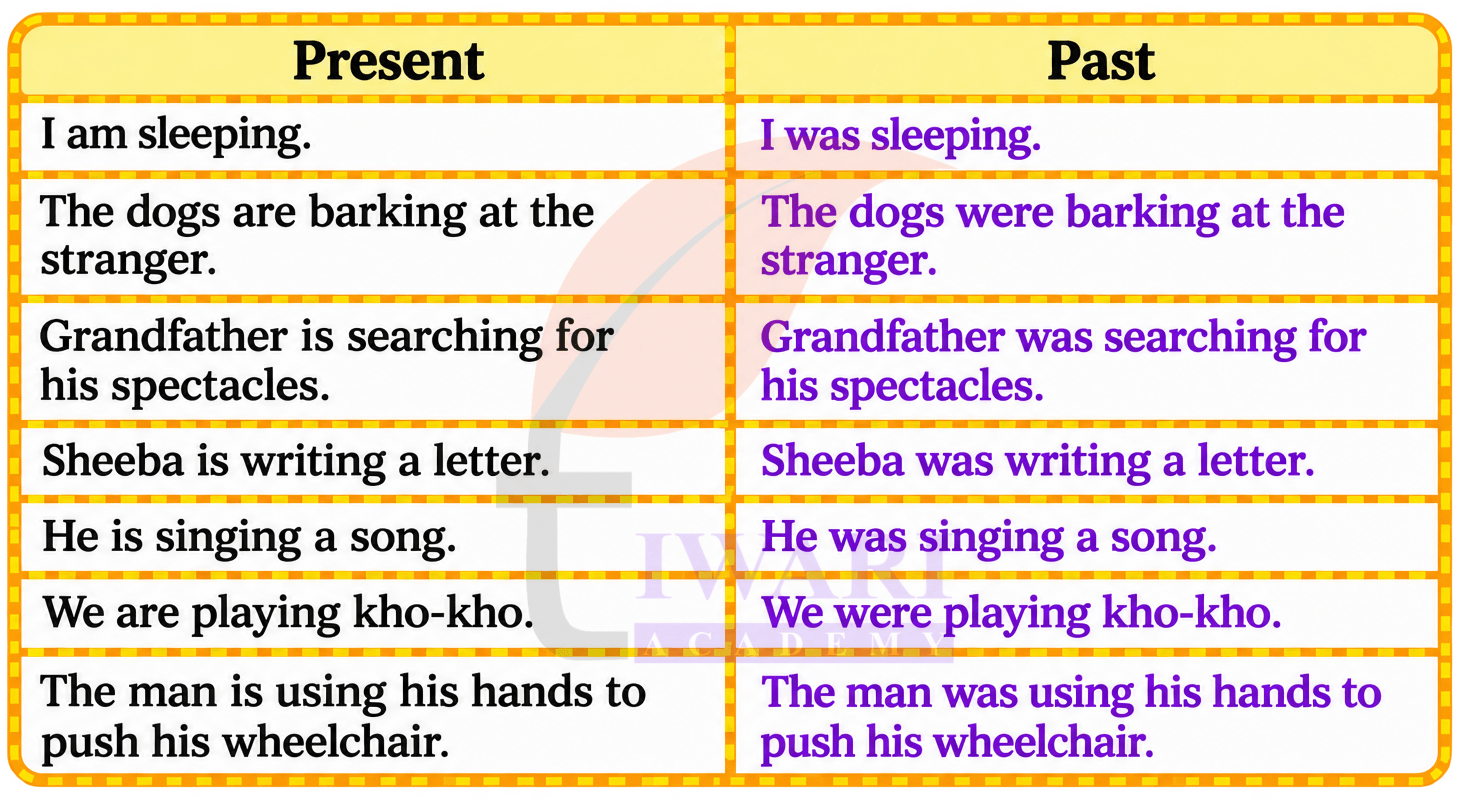
| Present | Past |
|---|---|
| I am sleeping. | I was sleeping. |
| The dogs are barking at the stranger. | The dogs were barking at the stranger. |
| Grandfather is searching for his spectacles. | Grandfather was searching for his spectacles. |
| Sheeba is writing a letter. | Sheeba was writing a letter. |
| He is singing a song. | He was singing a song. |
| We are playing kho-kho. | We were playing kho-kho. |
| The man is using his hands to push his wheelchair. | The man was using his hands to push his wheelchair. |
Quick tip to remember: “dogs” and “we” are more than one, so they take were. All the others (I, Grandfather, Sheeba, He, The man) are just one person, so they take was.
The following sentences describe actions in the present. Change them to the past as shown in the examples.
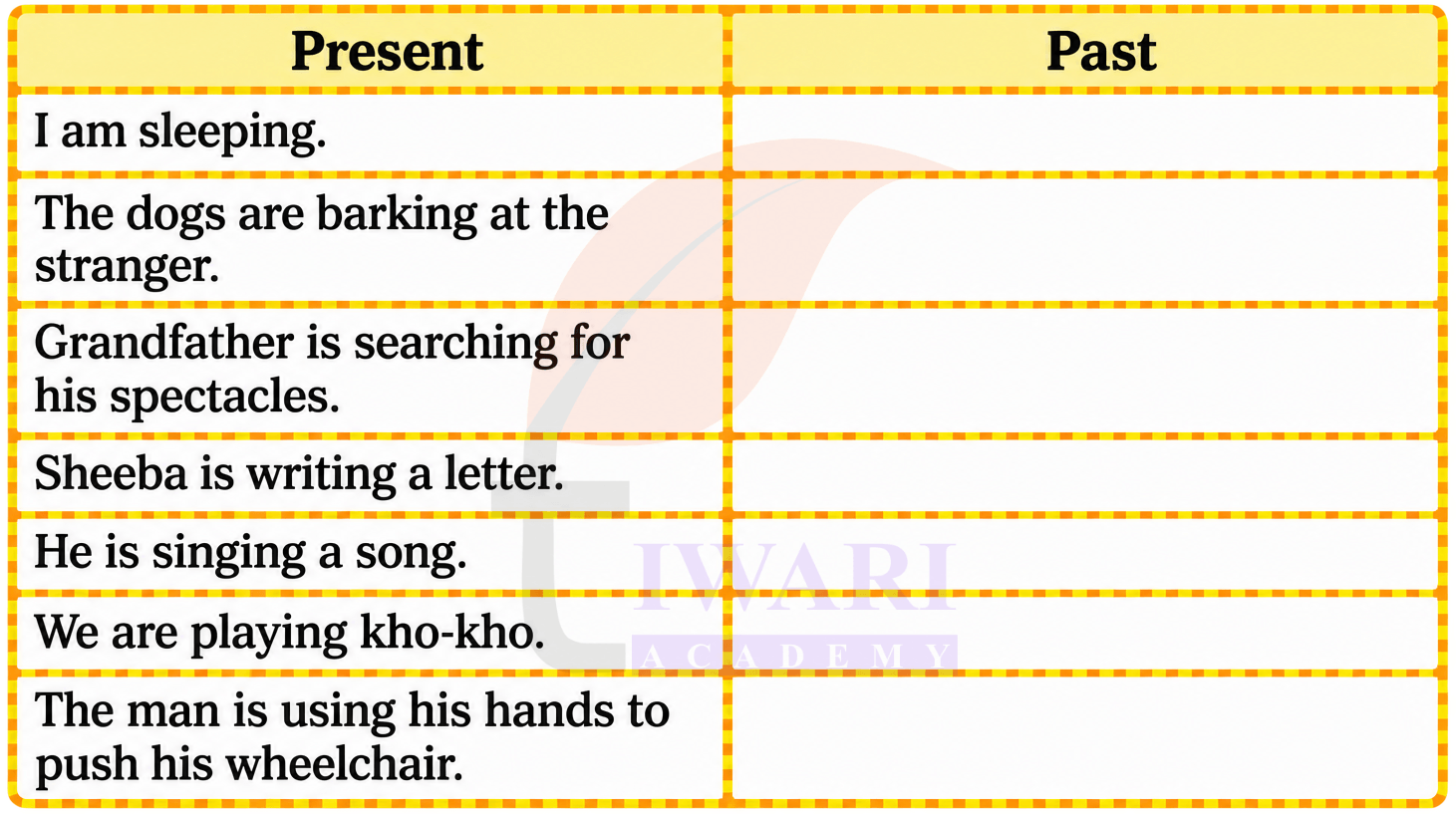
Answer:
D. Look at the picture story.
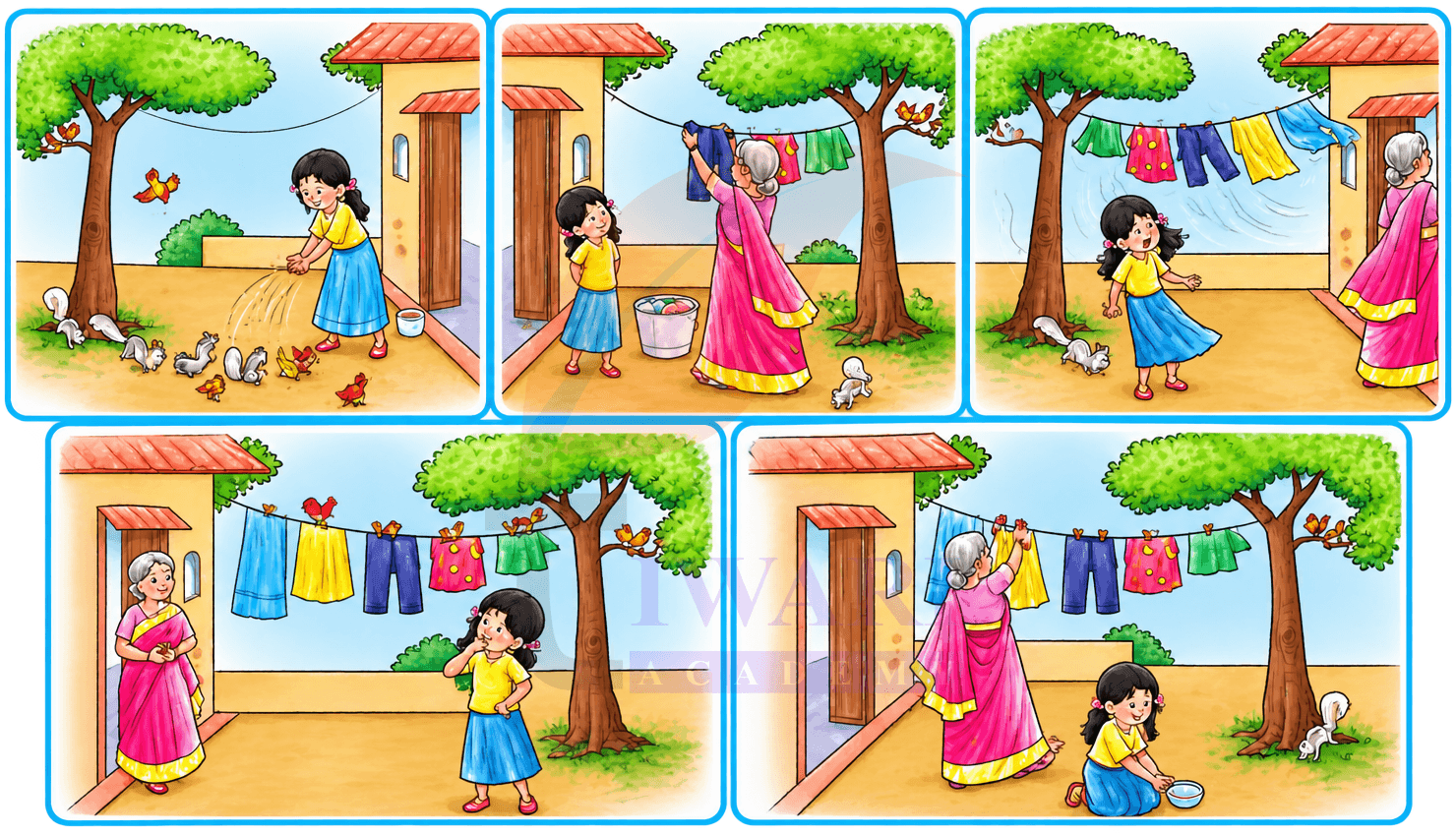
Now fill in the blanks from the suitable options.
was clapping was scattering
were sitting was hanging
was entering was feeding
My friend Tarandeep told me an interesting thing yesterday. She ………………… her friends, the squirrels and the sparrows. She …………………….. grains for them.
Her grandmother ………………… out the clothes to dry on a clothesline.
Grandmother ……………… the house when a strong wind began to blow.
When she returned with the clothes pegs, she saw a wonderful scene! The sparrows and squirrels …………………. on the clothes to prevent them from falling. Tarandeep …………………. her hands with joy. Grandmother put the pegs on the clothes, and Tarandeep set down a bowl of water for her friends.
See AnswerMy friend Tarandeep told me an interesting thing yesterday. She was feeding her friends, the squirrels and the sparrows. She was scattering grains for them.
Her grandmother was hanging out the clothes to dry on a clothesline.
Grandmother was entering the house when a strong wind began to blow.
When she returned with the clothes pegs, she saw a wonderful scene! The sparrows and squirrels were sitting on the clothes to prevent them from falling. Tarandeep was clapping her hands with joy. Grandmother put the pegs on the clothes, and Tarandeep set down a bowl of water for her friends.
Class 4 English Santoor – Unit 2: My Beautiful World – Chapter 6 Braille – Hindi Translation
Class 4 English Santoor Chapter 6 English to Hindi Translation
Long ago, in France, a little boy named Louis Braille was playing outside his home. He was three years old. His father, a blacksmith, was working nearby. Louis started playing with the tools around him.
Hindi Translationबहुत समय पहले की बात है। फ्रांस में लुई ब्रेल नाम का एक छोटा लड़का रहता था। वह अपने घर के बाहर खेल रहा था। वह तीन साल का था। उसके पिता लोहार थे और पास में काम कर रहे थे। लुई आसपास रखे औज़ारों से खेलने लगा।
Suddenly, a sharp tool pierced his eye. He cried out in pain. Within a few days, he became blind in one eye. The other eye also got affected, and he became totally blind.
Hindi Translationअचानक एक तेज़ औज़ार उसकी आँख में चुभ गया। वह दर्द से चीख पड़ा। कुछ ही दिनों में उसकी एक आँख की रोशनी चली गई। दूसरी आँख भी प्रभावित हो गई और वह पूरी तरह से दृष्टिहीन हो गया।
In 1819, Louis, who was ten years old, got admission in the Royal Institute for Young Blind Persons in Paris. He learnt letters by using wood, cloth or pins arranged in pincushions. Around this time, an army man named Capt. Charles Barbier de la Serre had invented something called ‘Night Writing’. It was an alphabet of raised dots and dashes that soldiers could ‘read’ with their fingers in the dark. However, it was too difficult and, therefore, not a success. But Louis, now a teenager, became interested in it and simplified it.
Hindi Translationसन 1819 में, दस वर्ष की उम्र में लुई ने पेरिस के ‘रॉयल इंस्टीट्यूट फॉर यंग ब्लाइंड पर्सन्स’ में दाखिला लिया। वहाँ उसने लकड़ी, कपड़े या पिन-कुशन में लगाए गए पिनों की सहायता से अक्षरों को पहचानना सीखा। इसी समय कैप्टन चार्ल्स बार्बिए डि ला सेरे नामक एक सेनाधिकारी ने ‘नाइट राइटिंग’ नाम की एक प्रणाली का आविष्कार किया। यह उभरे हुए बिंदुओं और डैश की एक वर्णमाला थी, जिसे सैनिक अंधेरे में अपनी उँगलियों से ‘पढ़’ सकते थे। लेकिन यह बहुत कठिन थी और इसलिए सफल नहीं हो सकी। लुई, जो अब किशोर हो चुका था, इसमें रुचि लेने लगा और उसने इसे सरल बना दिया।
He gave the world the Braille alphabet.
Thus, a blind person taught the world to see.
Braille is a method of reading through touch. As you can see in the figure, there is one Braille symbol for each of the twenty-six symbols (letters) of the English alphabet.
Hindi Translationउसने दुनिया को ब्रेल लिपि दी।
इस प्रकार, एक दृष्टिहीन व्यक्ति ने दुनिया को देखने का रास्ता दिखाया।
ब्रेल स्पर्श के माध्यम से पढ़ने की एक विधि है। जैसा कि आप चित्र में देख सकते हैं, अंग्रेज़ी वर्णमाला के छब्बीस अक्षरों में से प्रत्येक अक्षर के लिए ब्रेल का एक अलग चिन्ह होता है।
But Braille requires more space. This is because the letters cannot be written too close together. Since Braille requires more space, a Braille book is thicker than a regular printed book.
Hindi Translationलेकिन ब्रेल में अधिक जगह की आवश्यकता होती है। ऐसा इसलिए है क्योंकि ब्रेल के अक्षरों को एक-दूसरे के बहुत पास नहीं लिखा जा सकता। ब्रेल में अधिक जगह की आवश्यकता होने के कारण, ब्रेल की किताब सामान्य छपी हुई किताब से अधिक मोटी होती है।
Braille is not just for people with blindness. Even people with sight can learn Braille too. Then they can write small poems and stories in Braille.
Hindi Translationब्रेल केवल दृष्टिहीन लोगों के लिए ही नहीं है। जिन लोगों को दिखाई देता है, वे भी ब्रेल सीख सकते हैं। इसके बाद वे ब्रेल में छोटी कविताएँ और कहानियाँ लिख सकते हैं।
Class 4 English Marigold Solutions
Class 4 English Unit 6 Chapter 1 and Chapter 2
Class 4 English Unit 6 Chapter 1 The donkey – Summary
Margaret S. Russel teaches us in the story that every Animals deserve love. She says in the poem that if she would have a little donkey, she would never beat him. Instead of that she would take it to the hay and fed him some corn and make him the world’s greatest donkey.
Class 4 English Unit 6 Chapter 2 I had a little pony – Summary
The poet in this poem sharing the incident. She had a pony named Dapple – Grey, she lent him to a lady to ride but that lady lashed him and made him go through the mire. After that, she promised herself that she would never lend her pony to any lady to ride.
4th English Unit 6 Chapter 2 Word Meaning
| Word | Meaning |
|---|---|
| Donkey | A animal |
| Wallop | Beating |
| Lady | Female |
| Whipped | Beaten |
| Lend | Given to someone for sometime |
| Lashed | Beating with long-tail made of heavy leather |
| Mire | Swampy area |
| Hire | Taking on rent |
Class 4 English Unit 6 Chapter 3 The Milkman’s Cow – Summary
This story was written by Vidhya Pradhan which tells us when the force and cruelty fail kindness always wins. The Story of a milkman and his cow. His cow was in a bad mood and the milkman was making a great effort to take him home to milk him as children were waiting for the milk. Seeing milkman doing struggle and praying to the cow. The policeman came with a stick and wearing a gleaming belt to help he pulled and tugged the cow but the cow didn’t move and the wrestler, grocer, and Ice cream man also joined to help the milkman to make his cow move out of the street but the cow didn’t move.
Finally, a kid came with grass and offered the grass to the cow and the cow start eating and stood up, and then the milkman took the cow home. Seeing the little kid’s kindness and cleverness, the milkman applauds and the police swung his stick and wrestler grind.