



by Tiwari Academy Team
NCERT Solutions for Class 7 Maths Ganita Prakash Part 2 Chapter 4 Another Peek Beyond the Point – Exercises revision for Session 2026-27. Chapter 4 of NCERT Class 7 Maths Ganita Prakash Part 2, extends multiplying and dividing whole numbers to decimals. Students learn to multiply decimals by counting decimal places and to divide them using the same long-division method, discovering that some decimal divisions never terminate. The chapter closes by using decimal arithmetic to explain why calendars need leap years. These NCERT solutions offer clear, step-by-step answers to every “Figure it Out” question in the chapter.
Class 7 Maths all Chapters
NCERT Class 7 Maths Ganita Prakash Part 2 Chapter 4 Solutions
Page 73 – Figure it Out
1. Recall that a tenth is 0.1, a hundredth is 0.01, and so on. Find the following products in tenths, hundredths and so on:
(a) 6 × 4 tenths = 24 tenths
(b) 7 × 0.3
(c) 9 × 5 hundredths
Answer:
Given:
A tenth = 0.1
A hundredth = 0.01
(a) 6 × 4 tenths
We know that 4 tenths = 0.4
Multiply: 6 × 0.4 = 2.4
(b) 7 × 0.3
0.3 = 3 tenths
Multiply: 7 × 0.3 = 2.1
(c) 9 × 5 hundredths
5 hundredths = 0.05
Multiply: 9 × 0.05 = 0.45
2. Find the products:
(a) 27.34 × 6
(b) 4.23 × 3.7
(c) 0.432 × 0.23
Answer:
(a) 27.34 × 6
2734 × 6 = 16404
27.34 has 2 decimal places
So, answer = 164.04
(b) 4.23 × 3.7
423 × 37 = 15651
4.23 has 2 decimal places
3.7 has 1 decimal place
Total decimal places = 2 + 1 = 3
So, answer = 15.651
(c) 0.432 × 0.23
432 × 23 = 9936
0.432 has 3 decimal places
0.23 has 2 decimal places
Total decimal places = 3 + 2 = 5
So, answer = 0.09936
3. Thejus needs 1.65 m of cloth for a shirt. How many metres of cloth are needed for 3 shirts?
Answer:
Given:
Cloth needed for 1 shirt = 1.65 m
Number of shirts = 3
Multiply the amount of cloth by the number of shirts
1.65 × 3
Multiply as if they are whole numbers:
165 × 3 = 495
Now, place the decimal back (2 decimal places in 1.65):
495 ⇒ 4.95
4. Meenu bought 4 notebooks and 3 erasers. The cost of each book was ₹15.50 and each eraser was ₹2.75. How much did she spend in all?
Answer:
Given:
Number of notebooks = 4
Cost of 1 notebook = ₹ 15.50
Number of erasers = 3
Cost of 1 eraser = ₹ 2.75
Step 1: Cost of 4 notebooks
4 × 15.50 = 62.00
Cost of 3 erasers
3 × 2.75 = 8.25
Total cost: 62.00 + 8.25 = 70.25
Meenu spent ₹ 70.25 in all.
5. The thickness of a rupee coin is 1.45 mm. What is the total height of the cylinder formed by placing 36 rupee coins one over the other? Write the answer in centimeters.
Answer:
Given:
Thickness of 1 rupee coin = 1.45 mm
Number of coins = 36
We need total height in cm
Total height in mm
Total height = 36 × 1.45
Multiply carefully:
36 × 1.45
= 36 × (1 + 0.45)
= 36 + (36 × 0.45)
= 36 + 16.2
= 52.2 mm
Convert mm to cm
1 cm = 10 mm ⇒ 52.2 mm = 52.2 ÷ 10 = 5.22 cm
So, the total height of 36 rupee coins is 5.22 cm.
6. The price of 1 kg of oranges is ₹ 56.50. What is the price of 2.250 kg of oranges? Can we write 56.50 as 56.5 and 2.250 as 2.25 and multiply? Will we get the same product? Why?
Answer:
Price of 1 kg oranges = ₹56.50
Weight of oranges = 2.250 kg
Total price = 56.50 × 2.250
Yes, we can write 56.50 as 56.5 and 2.250 as 2.25
Trailing zeros after the decimal do not change the value:
56.50 = 56.5
2.250 = 2.25
Multiplying the simplified numbers gives the same product.
Multiply 56.5 × 2.25 = 127.125
Yes, we can remove the trailing zeros because they don’t affect the value and we will get the same product.
7. Dwarakanath purchases notebooks at a wholesale price of ₹23.6 per piece and sells each notebook at ₹30/-. How much profit does he make if he sells 50 books in a week?
Answer:
Wholesale price (Cost Price) of 1 notebook = ₹ 23.6
Selling price of 1 notebook = ₹ 30
Number of notebooks sold = 50
Profit = Selling price − Cost price
Profit on 1 notebook = 30 − 23.6 = ₹6.4
Profit on 50 notebooks = 6.4 × 50
= ₹ 320
8. Given that 18 × 12 = 216, find the products:
(a) 18 × 1.2
(b) 18 × 0.12
(c) 1.8 × 1.2
(d) 0.18 × 0.12
(e) 0.018 × 0.012
(f) 1.8 × 12
Answer:
Given, 18 × 12 = 216
(a) 18 × 1.2
1.2 is 10 times smaller than 12
So the product is 10 times smaller than 216
18 × 1.2 = 21.6
(b) 18 × 0.12
0.12 is 100 times smaller than 12
So the product is 100 times smaller than 216
18 × 0.12 = 2.16
(c) 1.8 × 1.2
1.8 is 10 times smaller than 18
1.2 is 10 times smaller than 12
So the product is 100 times smaller than 216
1.8 × 1.2 = 2.16
(d) 0.18 × 0.12
0.18 is 100 times smaller than 18
0.12 is 100 times smaller than 12
So the product is 10,000 times smaller than 216
0.18 × 0.12 = 0.0216
(e) 0.018 × 0.012
0.018 is 1000 times smaller than 18
0.012 is 1000 times smaller than 12
So the product is 1,000,000 times smaller than 216
0.018 × 0.012 = 0.000216
(f) 1.8 × 12
1.8 is 10 times smaller than 18
So the product is 10 times smaller than 216
1.8 × 12 = 21.6
9. In which of the following multiplications is the product less than 1? Can you find the answer without actually doing the multiplications?
(a) 7 × 0.6
(b) 0.7 × 0.6
(c) 0.7 × 6
(d) 0.07 × 0.06
Answer:
If one number is greater than 1 and the other is less than 1, the product is greater than the smaller number and usually not less than 1.
If both numbers are less than 1, then the product is less than 1.
Now check each case:
(a) 7 × 0.6
Here, 7 is greater than 1 and 0.6 is less than 1
Product will be greater than 1
(b) 0.7 × 0.6
Here, both 0.7 and 0.6 are less than 1
Product will be less than 1
(c) 0.7 × 6
Here, 6 is greater than 1
Product will be greater than 1
(d) 0.07 × 0.06
Here, both numbers are much smaller than 1
Product will be less than 1
The product is less than 1 in (b) 0.7 × 0.6 and (d) 0.07 × 0.06
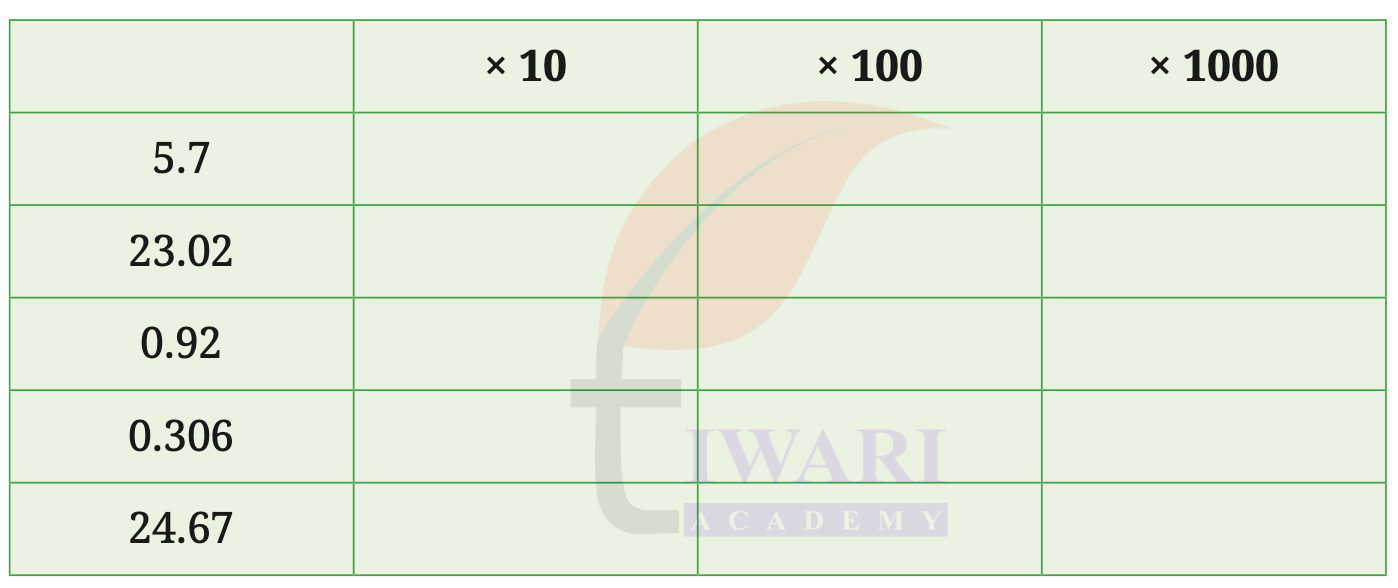
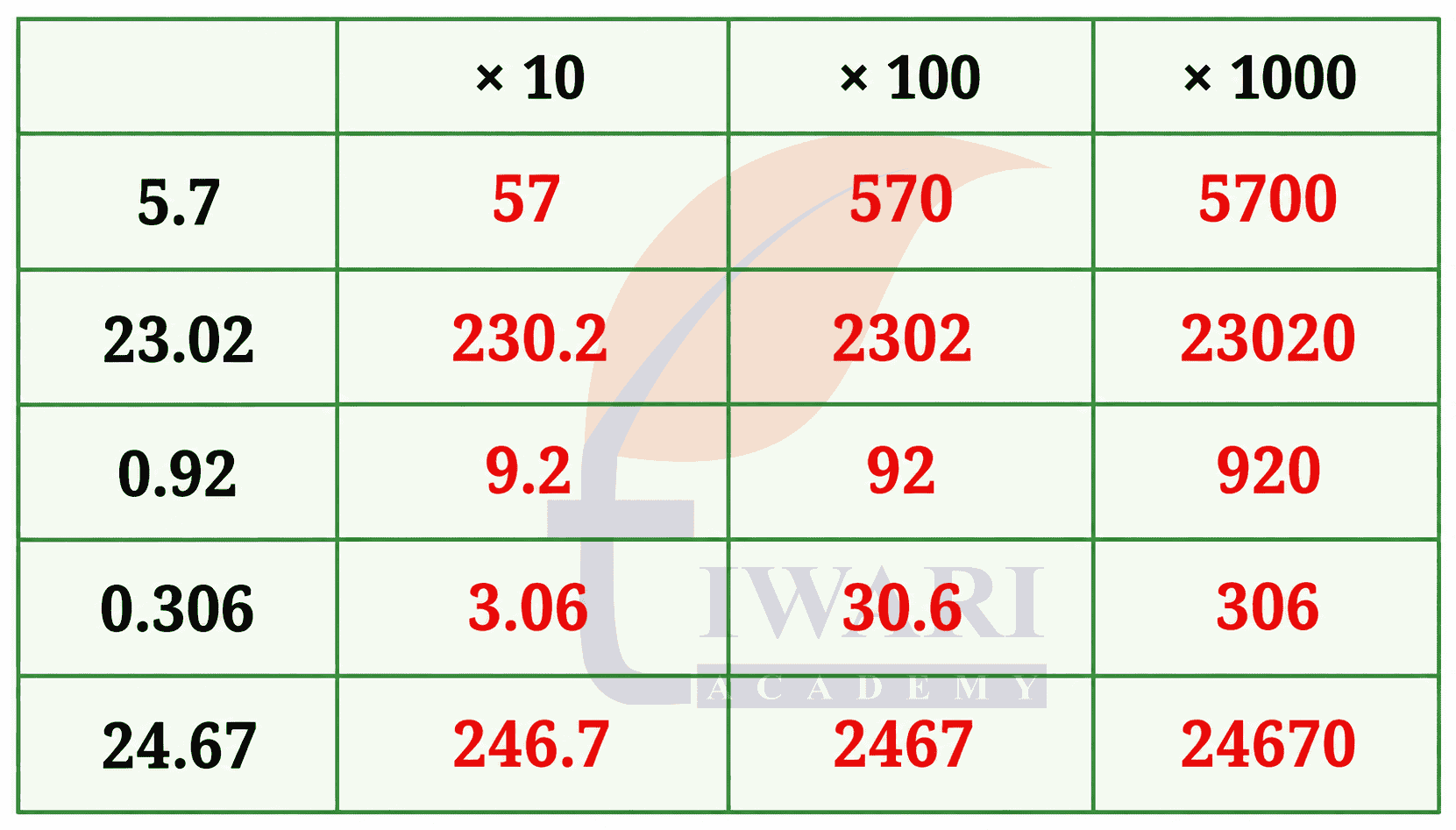
10. Multiplying the following numbers by 10, 100 and 1000 to complete the table.
Answer:
Page 83 – Figure it Out
1. Find the quotient by converting the denominator into 1, 10, 100 or 1000 and verify the solution by the long division method (division by place value).
(a) 18/5
(b) 415/4
(c) 1217/2
(d) 4827/8
Answer:
(a) 18 ÷ 5
18 = 1 Ten + 8 Ones
1 Ten ÷ 5 = 0 Tens (because 5 cannot go into 1 Ten)
Combine 1 Ten + 8 Ones = 18 Ones
18 ÷ 5 = 3 Ones (Quotient)
Remainder = 18 − 15 = 3
Quotient = 3, Remainder = 3
As a decimal: 3 + 3/5 = 3.6
(b) 415 ÷ 4
415 = 4 Hundreds + 1 Ten + 5 Ones
4 Hundreds ÷ 4 = 1 Hundred
Remainder = 0 Hundreds
1 Ten ÷ 4 = 0 Tens
Combine 1 Ten + 5 Ones = 15 Ones
15 ÷ 4 = 3 Ones (Quotient)
Remainder = 15 − 12 = 3
Quotient = 103, Remainder = 3
As a decimal: 103 + 3/4 = 103.75
(c) 1217 ÷ 2
1217 = 1 Thousand + 2 Hundreds + 1 Ten + 7 Ones
1 Thousand ÷ 2 = 0 Thousands
Combine 1 Thousand + 2 Hundreds = 12 Hundreds
12 Hundreds ÷ 2 = 6 Hundreds
Remainder = 0
1 Ten ÷ 2 = 0 Tens
Combine 1 Ten + 7 Ones = 17 Ones
17 ÷ 2 = 8 Ones
Remainder = 1
Quotient = 608, Remainder = 1
As a decimal: 608 + 1/2 = 608.5
(d) 4827 ÷ 8
4827 = 4 Thousands + 8 Hundreds + 2 Tens + 7 Ones
4 Thousands ÷ 8 = 0 Thousands
Combine 4 Thousands + 8 Hundreds = 48 Hundreds
48 ÷ 8 = 6 Hundreds
Remainder = 0
2 Tens ÷ 8 = 0 Tens
Combine 2 Tens + 7 Ones = 27 Ones
27 ÷ 8 = 3 Ones
Remainder = 27 − 24 = 3
Quotient = 603, Remainder = 3
As a decimal: 603 + 3/8 = 603.375
2. Choose the correct answer:
(a) 1526/4 =
(i) 38.15
(ii) 380.15
(iii) 381.5
(iv) 381.05
(b) 3567/8 =
(i) 4458.75
(ii) 44.5875
(iii) 445.875
(iv) 4458.75
Answer:
(a) 1526/4
Divide 1526 by 4:
(4 × 381 = 1524)
Remainder = 2
(2 ÷ 4 = 0.5)
So, 1526 ÷ 4 = 381.5
(b) 3567/8
Divide 3567 by 8:
8 × 445 = 3560
Remainder = 7
7 ÷ 8 = 0.875
So, 3567 ÷ 8 = 445.875
3. What is the quotient?
(a) 132 ÷ 4 =
(b) 13.2 ÷ 4 =
(c) 1.32 ÷ 4 =
(d) 0.132 ÷ 4 =
Answer:
(a) (132 ÷ 4)
132 = 1 hundred + 3 tens + 2 ones
Divide each part by 4
132 ÷ 4 = 33
(b) (13.2 ÷ 4)
13.2 is 10 times smaller than 132
So the answer will be 10 times smaller than 33.
13.2 ÷ 4 = 3.3
(c) (1.32 ÷ 4)
1.32 is 10 times smaller than 13.2
So the quotient will also be 10 times smaller than 3.3.
1.32 ÷ 4 = 0.33
(d) (0.132 ÷ 4)
0.132 is 10 times smaller than 1.32
So the quotient becomes 10 times smaller than 0.33.
0.132 ÷ 4 = 0.033
4. What is the quotient?
(a) 126 ÷ 8 =
(b) 12.6 ÷ 8 =
(c) 1.26 ÷ 8 =
(d) 0.126 ÷ 8 =
(e) 0.0126 ÷ 8 =
Answer:
(a) 126 ÷ 8 = 15.75
(b) 12.6 ÷ 8 = 1.575
(c) 1.26 ÷ 8 = 0.1575
(d) 0.126 ÷ 8 = 0.01575
(e) 0.0126 ÷ 8 = 0.001575
Page 86 – Figure it Out
1. Express the following fractions in decimal form:
(a) 2/5
(b) 13/4
(c) 4/50
(d) 5/8
Answer:
(a) 2/5
Make the denominator 10:
2/5 = (2 × 2)/(5 × 2) = 4/10 = 0.4
(b) 13/4
Make the dnominator 100:
13/4 = (13 × 25)/(4 × 25) = 325/100 = 3.25
(c) 4/50
Make the dnominator 100:
4/50 = (4 × 2)/(50 × 2) = 8/100 = 0.08
(d) 5/8
Make the denominator 1000:
5/8 = (5 × 125)/(8 × 125) = 625/1000 = 0.625
2. Find the quotients:
(a) 24.86 ÷ 1.2
(b) 5.728 ÷ 1.52
Answer:
(a) 24.86 ÷ 1.2
Removing the decimal from divisor
We have: 248.6 ÷ 12
= 20.716 = 20.71 (approximately)
(b) 5.728 ÷ 1.52
Removing decimal from divisor
We have: 572.8 ÷ 152
= 3.768 = 3.76 (approximately)
3. Evaluate the following using the information 156 × 12 = 1872.
(a) 15.6 × 1.2 = _______
(b) 187.2 ÷ 1.2 = _______
(c) 18.72 ÷ 15.6 = _______
(d) 0.156 × 0.12 = _______
Answer:
(a) 15.6 × 1.2 = _______
= 156 ÷ 12
= 18.72
(b) 187.2 ÷ 1.2 = _______
= 1872 ÷ 12
= 156
(c) 18.72 ÷ 15.6 = _______
= 187.2 ÷ 156
= 1.2
(d) 0.156 × 0.12 = _______
= 15.6 ÷ 12
= 0.01872
4. Evaluate the following:
(a) 25 ÷ ______ = 0.025
(b) 25 ÷ ______ = 250
(c) 25 ÷ ______ = 2.5
(d) 25 ÷ 10 = 25 × _____
(e) 25 ÷ 0.10 = 25 × ______
(f) 25 ÷ 0.01 = 25 × ______
Answer:
(a) 25 ÷ 1000 = 0.025
(b) 25 ÷ 0.1 = 250
(c) 25 ÷ 10 = 2.5
(d) 25 ÷ 10 = 25 × 0.1
(e) 25 ÷ 0.10 = 25 × 10
(f) 25 ÷ 0.01 = 25 × 100
5. Find the quotient:
(a) 2.46 ÷ 1.5 =
(b) 2.46 ÷ 0.15 =
(c) 2.46 ÷ 0.015 =
Is the quotient obtained in 24.6 ÷ 1.5 the same as the quotient obtained in 2.46 ÷ 0.15?
Answer:
(a) 2.46 ÷ 1.5 =
Removing decimal from divisor
Now divide: 24.6 ÷ 15
= 1.64
(b) 2.46 ÷ 0.15 =
Removing decimal from divisor
Now divide: 246 ÷ 15
= 16.4
(c) 2.46 ÷ 0.015 =
Removing decimal from divisor
Now divide: 2460 ÷ 15
= 164
Comparing 24.6 ÷ 1.5 and 2.46 ÷ 0.15
Multiply both by 10: 246 ÷ 15 = 16.4
And we already found: 2.46 ÷ 0.15 = 16.4
Yes, the quotient obtained in 24.6 ÷ 1.5 is the same as the quotient obtained in 2.46 ÷ 0.15.
Both equal 16.4
6. A 4 m long wooden block has to be cut into 5 pieces of equal length. What is the length of each piece?
Answer:
Given:
Total length of wooden block = 4 m
Number of equal pieces = 5
Length of each piece = Total length ÷ Number of pieces
Length of each piece = 4 ÷ 5
= 0.8
Each piece will be 0.8 m long
7. If the perimeter of a regular polygon with 12 sides is 208.8 cm, what is the length of its side?
Answer:
Given:
Number of sides = 12 (regular polygon means all sides are equal)
Perimeter = 208.8 cm
We know that:
Perimeter of a regular polygon = Number of sides × Length of one side
So, 208.8 = 12 × Length of one side
Therefore, Length of one side = 208.8 ÷ 12
= 2088 ÷ 120
= 17.4
The length of each side is 17.4 cm
8. 3 litres of watermelon juice is shared among 8 friends equally. How much watermelon juice will each get? Express the quantity of juice in millilitres.
Answer:
Given:
Total quantity of watermelon juice = 3 litres
Number of friends = 8
Quantity each friend gets = Total juice ÷ Number of friends
Quantity each friend gets = 3 ÷ 8
= 0.375 litres
Converting to millilitres:
We know that: 1 litre = 1000 millilitres
So, 0.375 litres = 0.375 × 1000 = 375 millilitres
Each friend will get 375 millilitres (or 375 mL) of watermelon juice.
9. A car covers 234.45 km using 12.6 litres of petrol. What is the distance travelled per litre?
Answer:
Given:
Total distance covered = 234.45 km
Petrol used = 12.6 litres
Distance per litre = Total distance ÷ Petrol used
Distance per litre = 234.45 ÷ 12.6
= 2344.5 ÷ 126
= 18.6
The car travels 18.6 km per litre.
10. 13.5 kg of flour (aata) was distributed equally among 15 students. How much flour did each student receive?
Answer:
Given:
Total flour (aata) = 13.5 kg
Number of students = 15
Distributed equally
Flour per student = Total flour ÷ Number of students
Flour per student = 13.5 ÷ 15
= 0.9
Each student received 0.9 kg of flour.
Page 93 – Figure it Out
1. A 210 gram packet of peanut chikki costs ₹ 70.5, while a 110 gram packet of potato chips costs ₹ 33.25. Which is cheaper?
Answer:
Given,
210 gram peanut chikki cost = ₹ 70.5
110 gram potato chips cost = ₹ 33.25
To find which is cheaper we will find 1 gram rate of each peanut chikki and potato chips.
1 gram peanut chikki cost = 70.5 ÷ 210 = ₹ 0.335 per gram
1 gram potato chips cost = 33.25 ÷ 110 = ₹ 0.302 per gram
Potato chips are cheaper because their cost per gram is less than that of peanut chikki.
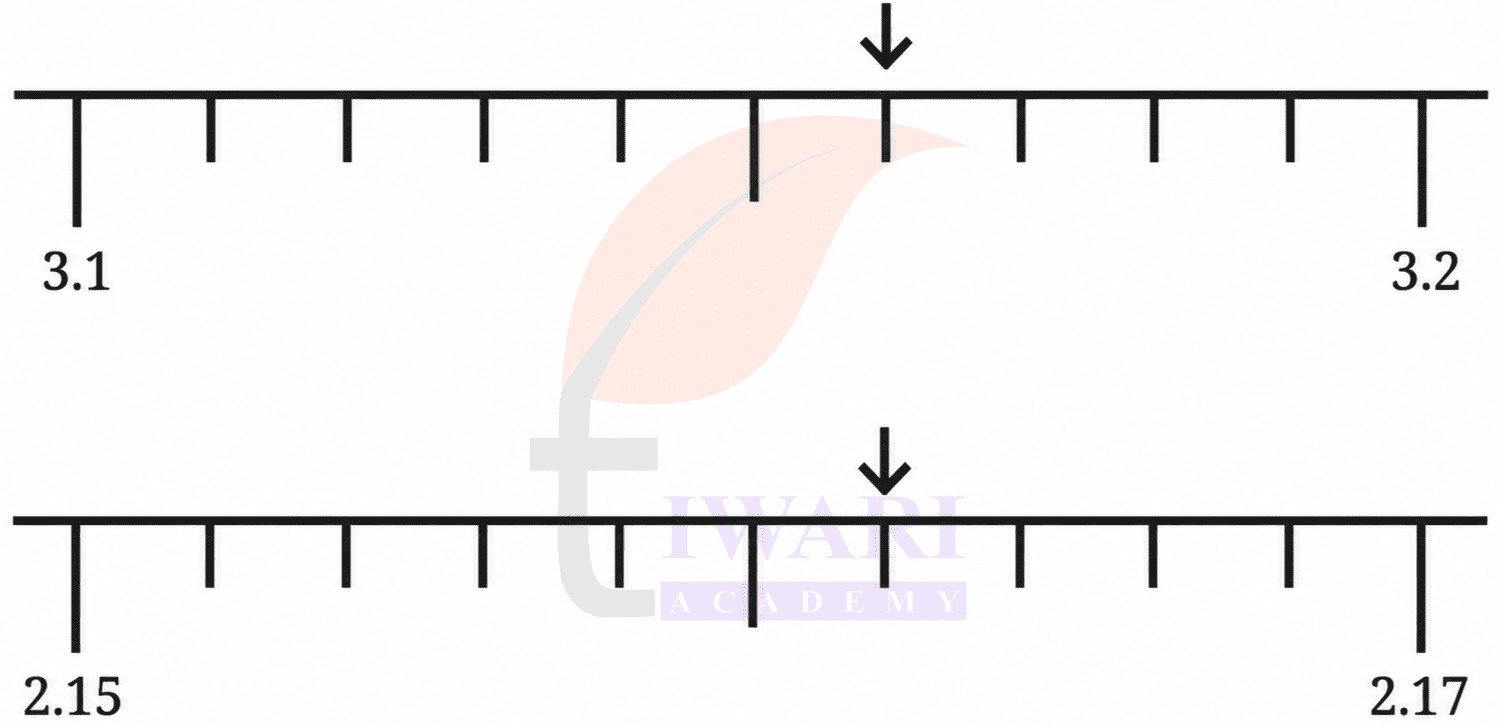
2. Write the decimal number at the arrow mark:
Answer:
First number line (3.1 to 3.2):
The line is divided into 10 equal parts, so each mark represents 0.01.
The arrow points to the 6th mark after 3.1.
= 3.1 + (0.01) × 6 = 3.1 + 0.06 = 3.16
Second number line (2.15 to 2.17):
The line is divided into 10 equal parts. The distance from 2.15 to 2.17 is 0.02, so each division represents 0.002.
The arrow points to the 6th mark after 2.15.
= 2.15 + 6 × 0.002 = 2.15 + 0.012 = 2.162
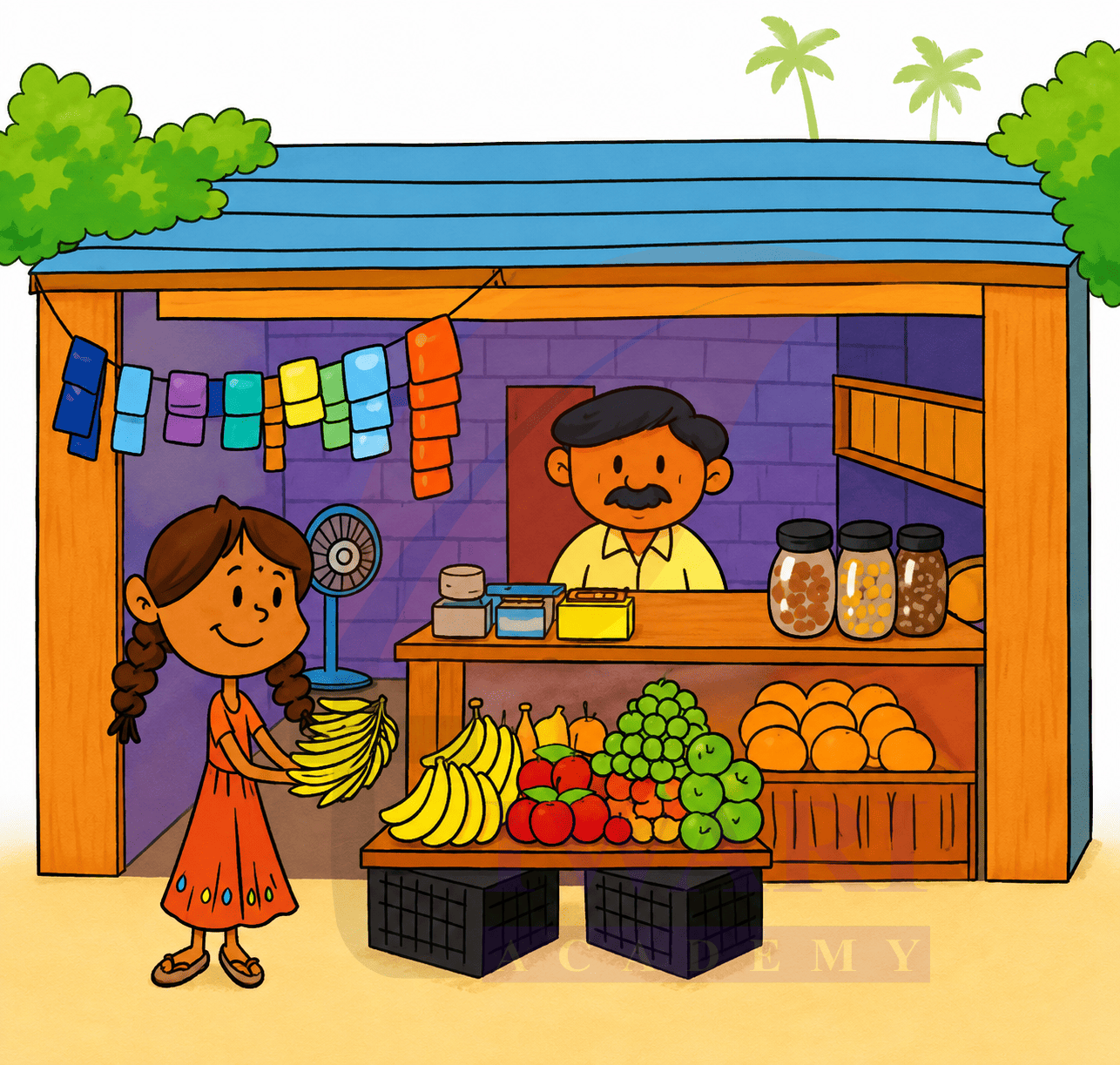
3. Shyamala bought 3 kg bananas at ₹30/- per kg. She counted 35 bananas in all. She sells each banana for ₹5/-. How much profit does she make selling all the bananas?
Answer:
Shyamala bought 3 kg bananas at ₹ 30 per kg.
Total cost price = 3 × 30 = ₹ 90
She counted 35 bananas in all.
She sells each banana for ₹ 5.
Total selling price = 35 × 5 = ₹ 175
Profit = Selling price − Cost price
Profit = 175 − 90 = ₹ 85
Shyamala makes a profit of ₹ 85.
4. A teacher placed textbooks that are 2.5 cm thick on a bookshelf. The teacher wanted to place 80 textbooks on the shelf. The bookshelf is 160 cm long. How many books could be placed on the shelf? Was there any space left? If yes, how much?
Answer:
Thickness of one textbook = 2.5 cm
Length of the bookshelf = 160 cm
Number of books that can be placed on the shelf
160 ÷ 2.5 = 64
So, 64 books can be placed on the shelf.
Space occupied by 64 books
64 × 2.5 = 160 cm
Space left on the shelf
160 − 160 = 0 cm
64 books could be placed on the shelf.
There was no space left on the shelf.
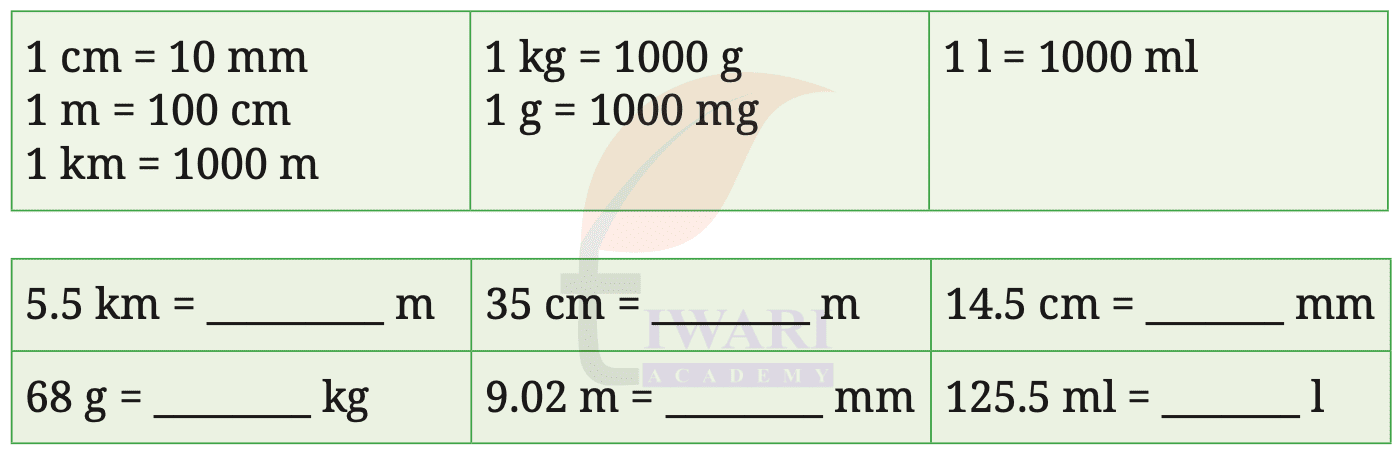
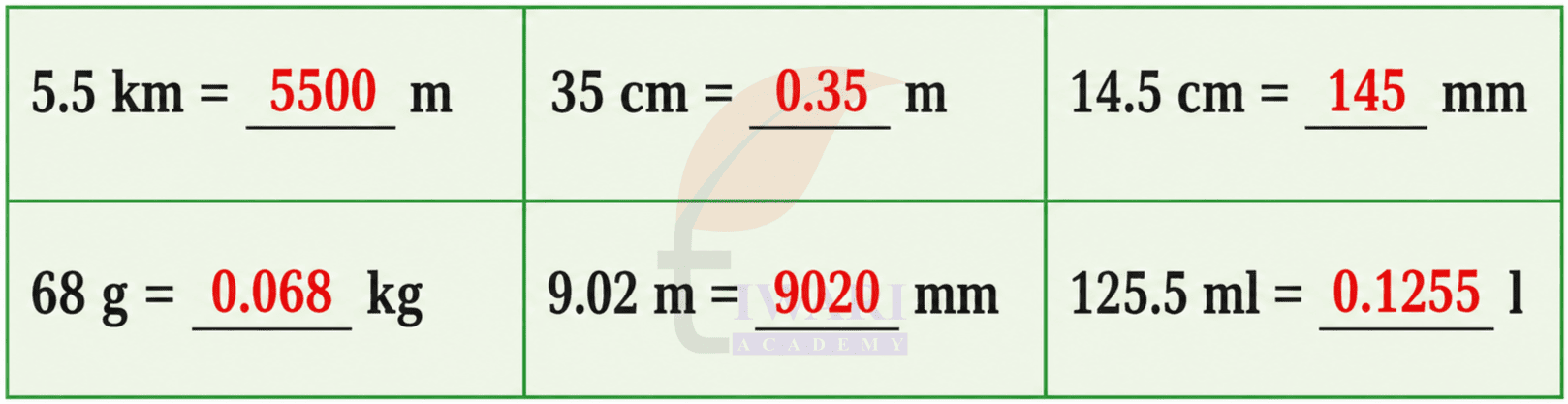
5. Fill in the following blanks appropriately:
Answer:
6. The following problem was set by Sridharacharya in his book, Patiganita. “6¼ is divided by is divided by 2½ and 60¼ is divided by 3½. Tell the quotients separately.” Can you try to solve it by converting the fractions into decimals?
Answer:
First problem:
6¼ is divided by 2½
Converting into decimals:
6¼ = 6.25
2½ = 2.5
Now divide:
6.25 ÷ 2.5 = 2.5
So, the quotient is 2.5.
Second problem:
60¼ is divided by 3½
Converting into decimals:
60¼ = 60.25
3½ = 3.5
Now divide:
60.25 ÷ 3.5 = 17.2142857
So, the quotient is 17.2142857 (approximately).
7. Fill the boxes in at least 2 different ways:
(a) ___ × ___ = 2.4
(b) ___ × ___ = 14.5
Answer:
Here are two different ways to fill each box.
(a)
0.6 × 4 = 2.4
1.2 × 2 = 2.4
(b)
2.9 × 5 = 14.5
1.45 × 10 = 14.5
8. Find the following quotients given that 756 ÷ 36 = 21:
(a) 75.6 ÷ 3.6
(b) 7.56 ÷ 0.36
(c) 756 ÷ 0.36
(d) 75.6 ÷ 360
(e) 7560 ÷ 3.6
(f) 7.56 ÷ 0.36
Answer:
(a) 75.6 ÷ 3.6
Multiply both by 10
⇒ 756 ÷ 36 = 21
(b) 7.56 ÷ 0.36
Multiply both by 100
⇒ 756 ÷ 36 = 21
(c) 756 ÷ 0.36
Multiply both by 100 ⇒ 75600 ÷ 36
Now divide: 75600 ÷ 36 = 2100
(d) 75.6 ÷ 360
Multiply both by 10
⇒ 756 ÷ 3600 = 0.21
(e) 7560 ÷ 3.6
Multiply both by 10
⇒ 75600 ÷ 36 = 2100
(f) 7.56 ÷ 0.36
Multiply both by 100
⇒ (756 ÷ 36 = 21)
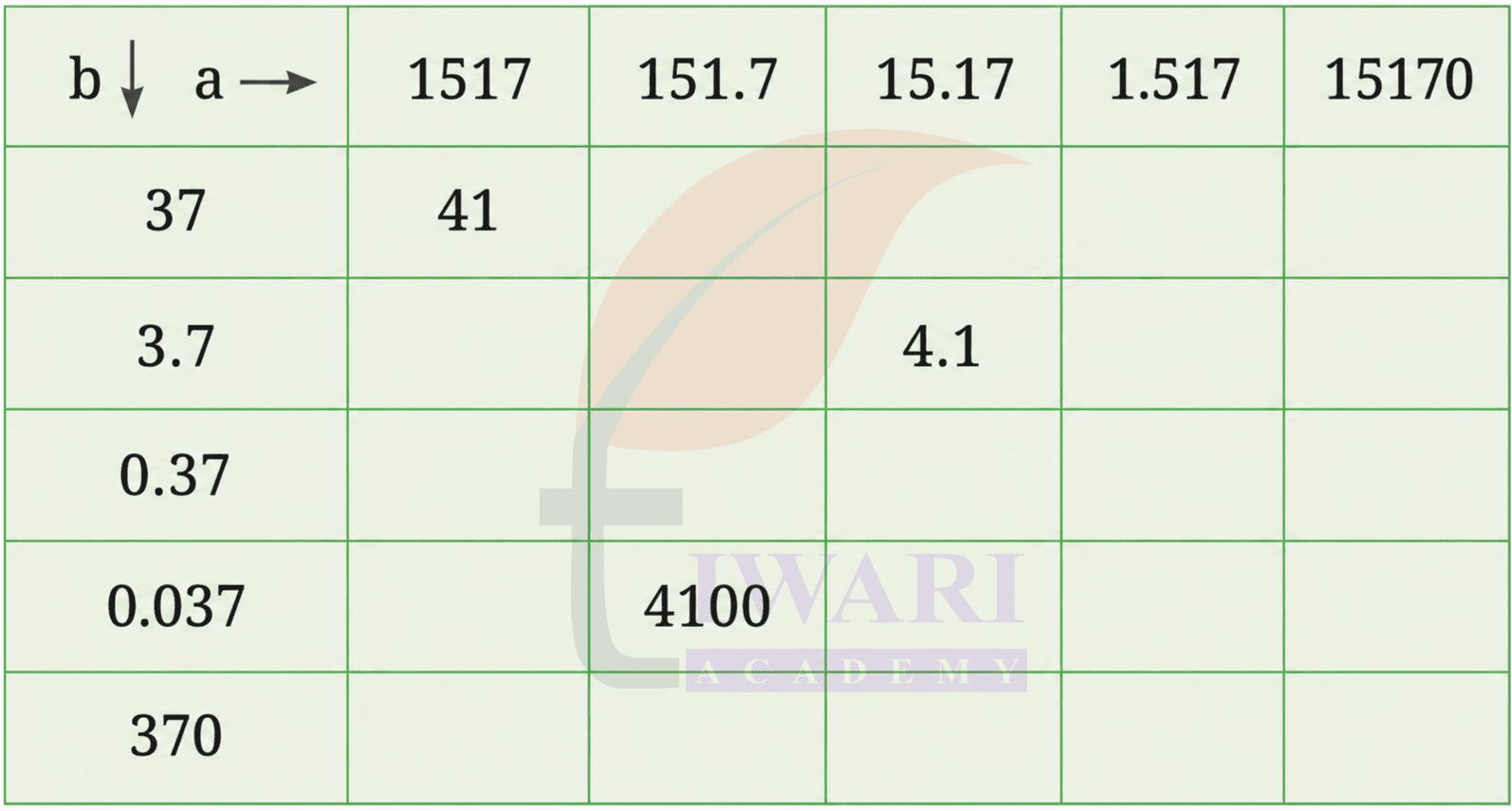
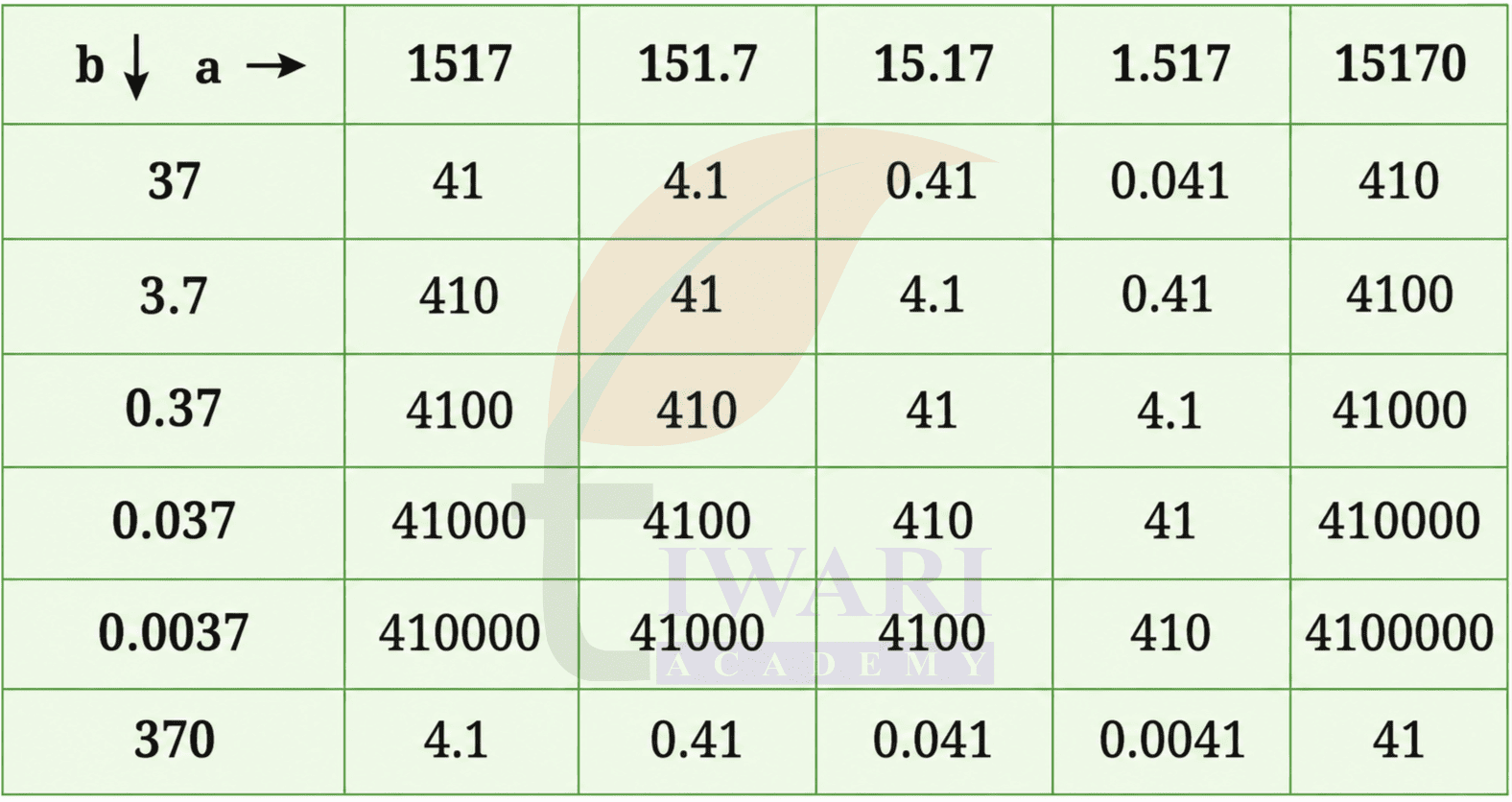
9. Find the missing cells if each cell represents a÷b:
Answer:
10. Using the digits 2, 4, 5, 8, and 0 fill the boxes ____ ____ . ____ × ____ . ____ to get the:
(a) maximum product
(b) minimum product
(c) product greater than 150
(d) product nearest to 100
(e) product nearest to 5
Answer:
(a) Maximum product
To get the maximum product, We need:
Largest digits in the ones places
Next largest in tenths places
Smallest (0) in hundredths place
85.4 × 2.0 = 170.8
(b) Minimum product
To get the minimum product, I need:
Smallest non-zero digits in the ones places
0 in strategic positions
Larger digits in decimal places
2.0 × 4.58 = 9.16
(c) Product greater than 150
85.2 × 4.0 = 340.8 (greater than 150)
Or 52.4 × 8.0 = 419.2
(d) Product nearest to 100
Try different combinations:
25.0 × 4.8 = 120 (20 away)
20.4 × 5.8 = 118.32 (18.32 away)
50.2 × 4.8 = 240.96 (too far)
25.8 × 4.0 = 103.2 (3.2 away from 100)
(e) Product nearest to 5
0.5 × 8.42 = 4.21 (0.79 away from 5)
5.0 × 0.84 = 4.2 (0.8 away from 5)
11. Sort the following expressions in increasing order:
(a) 245.05 × 0.942368
(b) 245.05 × 7.9682
(c) 245.05 ÷ 7.9682
(d) 245.05 ÷ 0.942368
(e) 245.05
(f) 7.9682
Answer:
(a) 245.05 × 0.942368 = 230.97 (multiplying by less than 1, so result < 245.05) (b) 245.05 × 7.9682 = 1952.48 (multiplying by number > 1, so large result)
(c) 245.05 ÷ 7.9682 = 30.76 (dividing by number > 1, so result < 245.05)
(d) 245.05 ÷ 0.942368 = 260.04 (dividing by number < 1, so result > 245.05)
(e) 245.05 = 245.05
(f) 7.9682 = 7.9682
Sorted in increasing order:
(f) < (c) < (a) < (e) < (d) < (b)
7.9682 < 30.76 < 230.97 < 245.05 < 260.04 < 1952.48
FAQs – Class 7 Maths Ganita Prakash Part 2 Chapter 4
Is Class 7 Maths Ganita Prakash Part 2 Chapter 4 easy?
Chapter 4 leans more on careful procedure than the earlier chapters – decimal division by long division involves several rounds of regrouping (ones into tenths, tenths into hundredths and so on), and it’s easy to lose track of the decimal point if you rush. That said, every rule is built up from methods you already know from whole-number multiplication and division, so nothing here is conceptually new. The chapter also has some genuinely fun detours – a repeating-decimal “magic number” and a section that uses decimal arithmetic to explain why leap years exist – which make the practice feel less repetitive.
How to solve Class 7 Maths Ganita Prakash Part 2 Chapter 4 in very short time?
To get through Chapter 4 in one sitting, follow the order the chapter builds in rather than skipping ahead. Start with Section 4.1’s quick recap of place value and decimal fractions, then work through Section 4.2 on multiplying decimals, paying attention to the rule about counting total decimal places. Section 4.3 on division is the longest part – practise the long-division method on a couple of whole-number examples first (like 1324 ÷ 4) before extending it to decimal quotients and decimal divisors. Finish with Section 4.4’s leap-year problem, since it’s really just decimal multiplication and subtraction applied to a real calendar question, before attempting the final “Figure it Out” set.
How many questions are there in Class 7 Ganita Prakash Part 2 Chapter 4?
Chapter 4 has four “Figure it Out” sections that together add up to thirty-five questions – noticeably more than earlier chapters. The first covers decimal multiplication, the next two build up decimal division in stages (first straightforward decimal quotients, then decimal divisors and the surprise that some divisions never terminate) and the last mixes everything together with real-world problems on shopping, measurement, and a historical fraction problem from the mathematician Sridharacharya. Given the volume, it’s worth pacing yourself across the four sets rather than doing them all in one go.
Is Class 7 Maths Ganita Prakash Part 2, Chapter 4 important for the exam?
While exact exam weightage varies by school and year, decimal multiplication and division are used everywhere – money, measurements, rates and speeds, unit conversions – so errors here tend to resurface in almost every other chapter and in daily life. The chapter’s own word problems already look like exam material: profit and loss on bananas, shelf space for textbooks, average speed from distance and time and “without calculating” questions that check whether you understand the decimal-point rule rather than whether you can compute quickly. That last question style, in particular, is worth practising specifically, since it rewards understanding over speed.
How can NCERT Solutions help while solving Class 7 Maths Ganita Prakash Chapter 4?
Several questions in this chapter test understanding of the decimal-point rule rather than raw calculation – for example, using 756 ÷ 36 = 21 to find 75.6 ÷ 360 without dividing again or explaining why multiplying 56.50 by 2.250 gives the same answer whether you write them as 56.5 and 2.25 or keep the extra zeroes. NCERT Solutions walk through this reasoning step by step, showing exactly how many decimal places to count and why the placement rule works, so students can check whether their own shortcut reasoning is actually correct rather than just matching a final number.