



by Tiwari Academy Team
NCERT Solutions for Class 7 Maths Ganita Prakash Part 2 Chapter 6 Constructions and Tilings, prepared as per the latest CBSE syllabus 2026-27. The chapter builds geometric construction skills using only a ruler and compass – drawing perpendicular bisectors, bisecting and copying angles, constructing parallel lines and regular hexagons and creating arch and star designs. It also introduces tiling through tangrams and grid patterns. All in-text and “Figure it Out” questions are solved step by step for exam-ready understanding.
Class 7 Maths all Chapters
NCERT Class 7 Maths Ganita Prakash Part 2 Chapter 6 Solutions
Page 140 – Figure it Out
1. When constructing the perpendicular bisector, is it necessary to have the same radius for the arcs above and below XY? Explore this through construction, and then justify your answer.
[Hint 1: Any point that is of the same distance from X and Y lies on the perpendicular bisector.
Hint 2: We can draw the whole line if any two of its points are known.]
Answer:
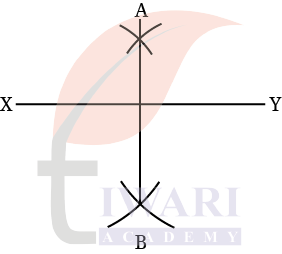
No. Only the two arcs on the same side (one from X, one from Y) need equal radii. The radius above XY can differ from the radius below XY.
Construction:
Draw XY = 4 cm. Using radius 3 cm, draw arcs from X and Y above XY meeting at A. Using radius 4 cm, draw arcs from X and Y below XY meeting at B. Join AB. It still bisects XY at 90°.
Justification:
Since AX = AY, point A is equidistant from X and Y, so A lies on the perpendicular bisector. Since BX = BY, point B is also equidistant from X and Y, so B lies on it too. As two points fix a line, AB is the perpendicular bisector – even with different radii above and below.
2. Is it necessary to construct the pairs of arcs above and below XY? Instead, can we construct both the pairs of arcs on the same side of XY? Explore this through construction, and then justify your answer
Answer:
No, it is not necessary to construct one pair of arcs above XY and the other pair below XY.
We can construct both pairs of arcs on the same side of XY and still get the perpendicular bisector.
Construction:
Draw XY = 4 cm. Using radius 3 cm, draw arcs from X and Y below XY meeting at A. Using radius 4 cm, draw arcs from X and Y below XY meeting at B. Join AB. It still bisects XY at 90°.
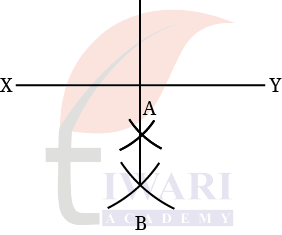
Justification:
Since AX = AY, point A is equidistant from X and Y, so A lies on the perpendicular bisector. Since BX = BY, point B is also equidistant from X and Y, so B lies on it too. As two points fix a line, AB is the perpendicular bisector – even with different radii above and below.
3. While constructing one pair of intersecting arcs, is it necessary that we use the same radii for both of them? Explore this through construction, and then justify your answer.
Answer:
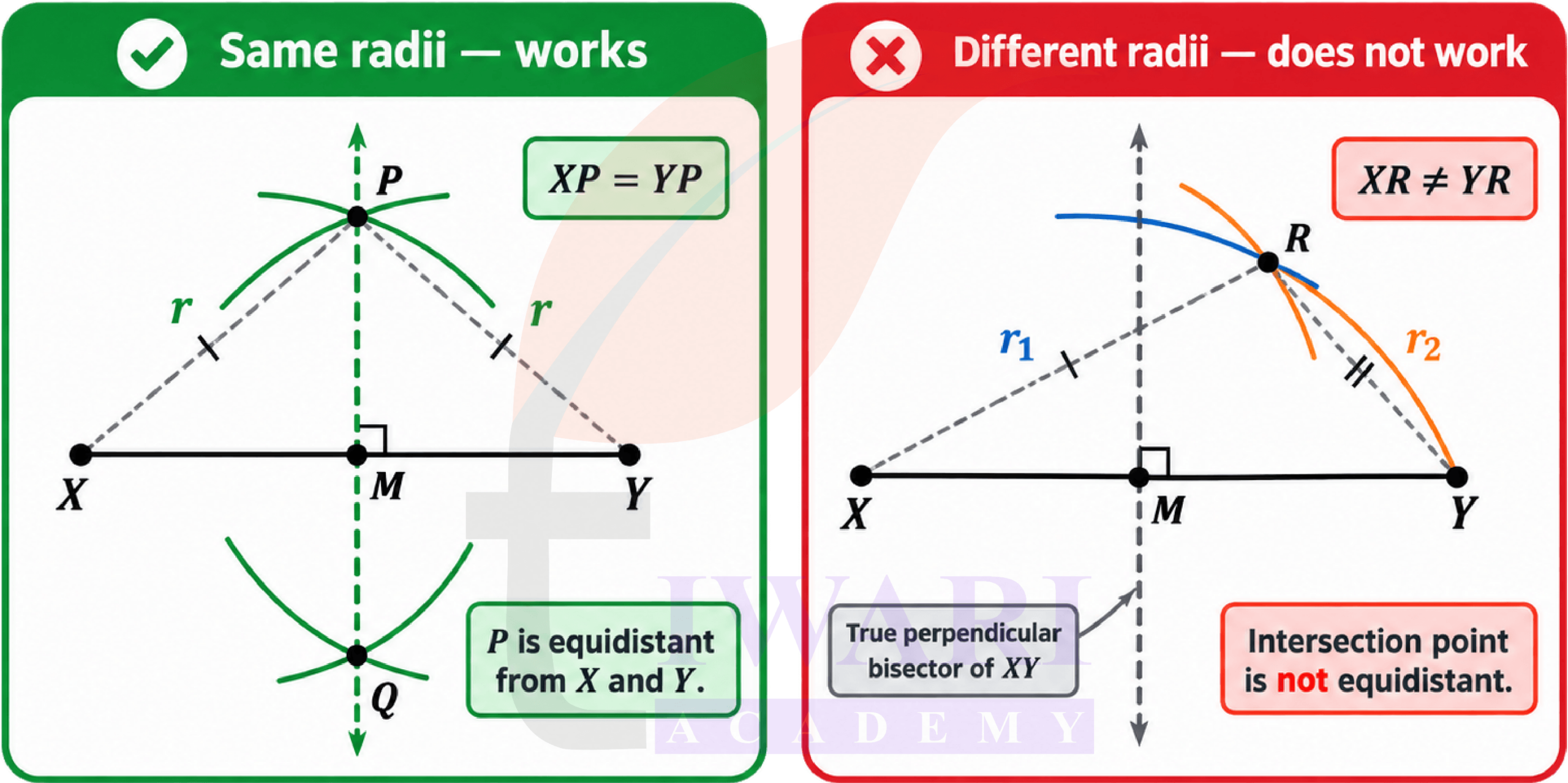
Yes, while constructing one pair of intersecting arcs, it is necessary to use the same radius for both arcs.
Exploration through construction
- Draw a line segment XY.
- With X as centre, draw an arc of a certain radius (more than half of XY).
- With Y as centre, draw an arc with the same radius so that it intersects the first arc at a point P.
- This point P lies on the perpendicular bisector of XY.
With different radius
- With X as centre, draw an arc of one radius.
- With Y as centre, draw another arc of a different radius.
In this case: - The arcs may not intersect at all, even if they intersect, the point of intersection R will not be equidistant from X and Y.
4. Recreate this design using only a ruler and compass.

Answer:

Page 142 – Figure it Out
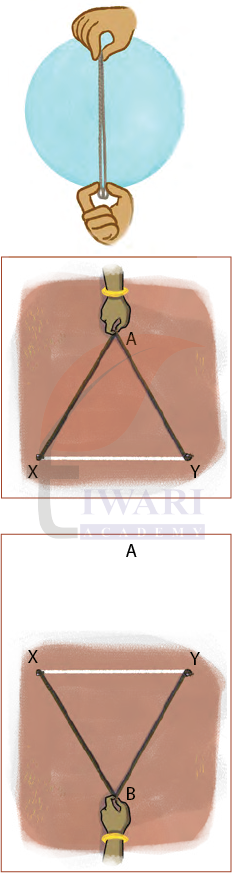
1. Justify why AB in Fig. 6.4 is the perpendicular bisector.
Answer:
When the rope is folded in half, its two parts are equal.
So, when the midpoint is pulled to A,
AX = AY
Similarly, when the midpoint is pulled to B,
BX = BY
Thus, both A and B are equidistant from X and Y. Therefore, the line joining A and B is the perpendicular bisector of XY.
Hence, AB ⟂ XY and AB passes through the midpoint of XY.
So, AB is the perpendicular bisector of XY.
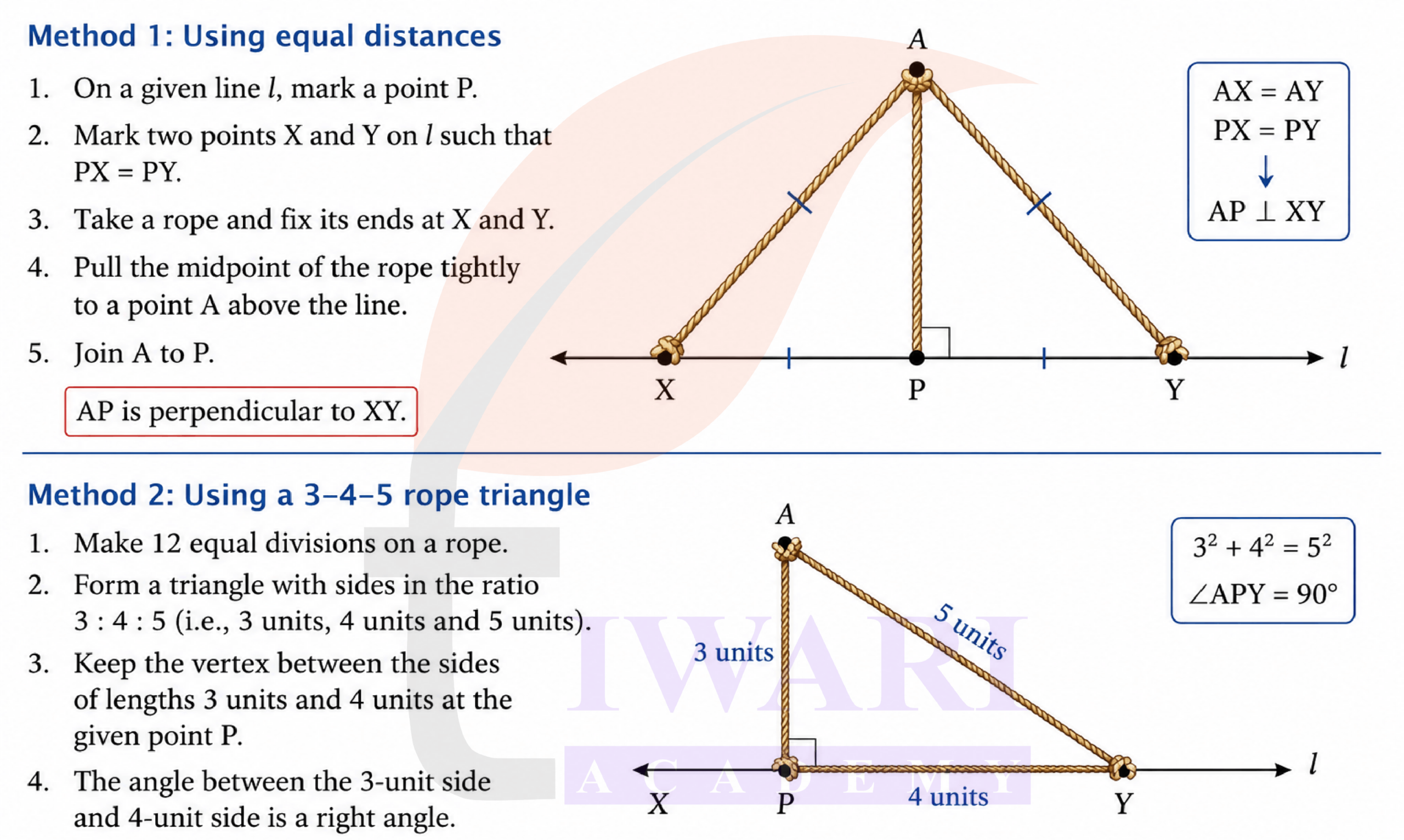
2. Can you think of different methods to construct a 90° angle at a given point on a line using a rope?
Answer:
Page 144 – Figure it Out
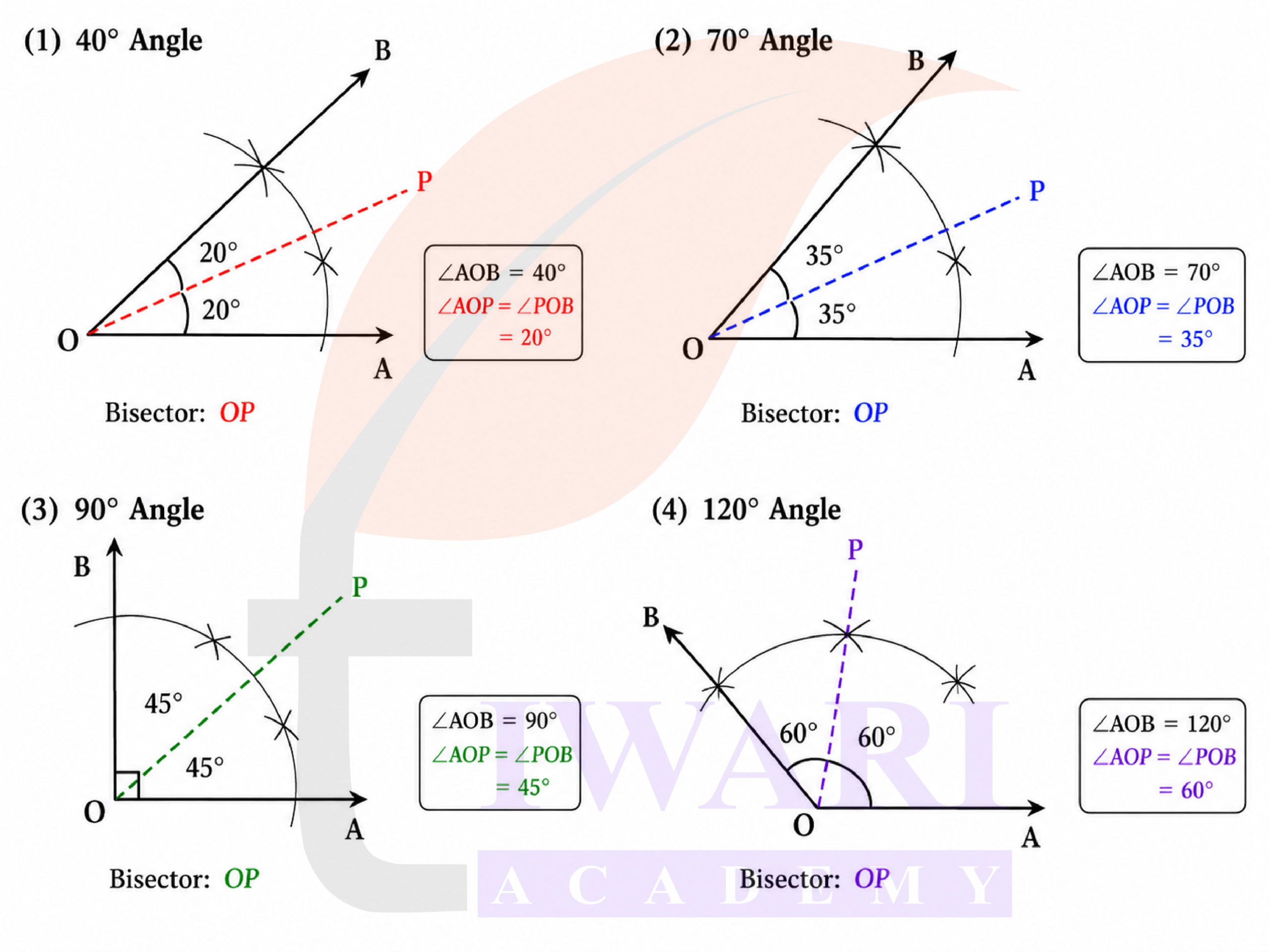
1. Construct at least 4 different angles. Draw their bisectors.
Answer:
2. Construct the 8-petalled figure shown in Fig. 6.5

Answer:

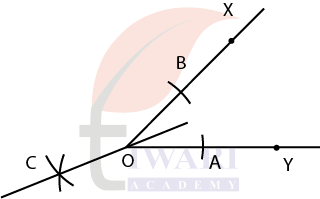
3. In Step 2 of angle bisection, if arcs of equal radius are drawn on the other side, as shown in the figure, will the line OC still be an angle bisector? Explore this through construction, and then justify your answer.
Answer:
Suppose the given angle is ∠XOY.
- With O as centre, draw an arc cutting the two arms of the angle at A and B.
So, OA = OB. - Now with A and B as centres and with the same radius, draw arcs.
- Usually these arcs are drawn inside the angle and meet at a point, giving the usual bisector.
- If instead the equal arcs are drawn on the other side, they meet at another point C.
- Join O to C.
We will find that OC also bisects the angle.
Since the arcs are drawn with equal radius from A and B, the intersection point C satisfies: CA = CB
Also, from the first arc, OA = OB
So both O and C are points equidistant from A and B.
Therefore, both O and C lie on the perpendicular bisector of AB.
Hence, the line OC is the perpendicular bisector of AB.
Now in triangle AOB, we already have OA = OB, so it is an isosceles triangle.
In an isosceles triangle, the line from the vertex O to the perpendicular bisector of the base AB also bisects the angle at O.
So, OC bisects ∠XOY.
4. What are the other angles that can be constructed using angle bisection? Can you construct 65.5° angle?
Answer:
Other angles we can construct:
We already know how to construct a 60° angle (using an equilateral triangle) and a 90° angle (using the perpendicular bisector method). By bisecting these angles and by adding them together using the angle-copying method, we can construct many more angles.
By bisecting (cutting in half again and again):
- 90° → 45° → 22.5° → 11.25°
- 60° → 30° → 15° → 7.5° → 3.75°
By adding angles together:
- 90° + 60° = 150°
- 90° − 60° = 30°
- 60° + 60° = 120°
- 90° + 45° = 135°
- 60° + 15° = 75°
- 90° + 15° = 105°
- 180° − 15° = 165°
So, we can construct every multiple of 15° — that is, 15°, 30°, 45°, 60°, 75°, 90°, 105°, 120°, 135°, 150°, 165° and 180°. Bisecting these further gives us multiples of 7.5°, then multiples of 3.75° and so on.
No, we cannot construct a 65.5° angle using this method.
Every angle we can construct is always a multiple of 15°, or becomes one after being bisected a few times. If we keep doubling 65.5° again and again (65.5° → 131° → 262° → 524° …), we never get an exact multiple of 15°. Since 65.5° cannot be traced back to a multiple of 15° through bisection, it cannot be constructed using only a ruler and compass by this method.
5. Come up with a method to construct the angle bisector using a rope.
Answer:
Method
- Take an angle ∠XOY made by two ropes or lines, with vertex O.
- Using a rope of fixed length, mark points A on OX and B on OY such that OA = OB.
- Now take another rope of the same length.
- With A and B as centres, stretch the rope and mark a point C such that CA = CB.
- Join O and C using the rope.
Since OA = OB, points A and B are equally distant from O.
Since CA = CB, point C is equally distant from the two arms of the angle.
A point equidistant from the arms of an angle lies on its angle bisector.
Conclusion
The line OC, constructed using a rope, is the angle bisector of the given angle.
6. Construct the following figure.

How do we construct the petals so that they are of the maximum possible size within a given square?
Answer:

The radius is half the side of the square, which is the largest possible radius that keeps the arc completely inside the square.
Any larger radius would make the arc go outside the square.
Frequently Asked Questions
Is Class 7 Maths Ganita Prakash Part 2 Chapter 6 difficult?
No, Class 7 Maths Ganita Prakash Part 2 Chapter 6, Constructions and Tilings, is a fairly easy and enjoyable chapter since it is mostly hands-on and involves drawing with a ruler and compass rather than heavy calculations. Concepts like the perpendicular bisector, angle bisection and constructing a 60° angle follow simple, repeatable steps. Students who practice each construction step by step, rather than just reading about it, generally find this chapter easy to master and score well in.
How to solve Class 7 Maths Ganita Prakash Part 2 Chapter 6 in one day?
To solve Class 7 Maths Ganita Prakash Part 2 Chapter 6 in one day, first revise the theory of bisection, perpendicular bisector and angle bisection using the solved examples in the textbook, such as the “Eyes” construction and angle copying steps. Next, practice the key constructions – perpendicular bisector, 90° angle, 60° angle, parallel lines and regular hexagon – using a ruler and compass, since these repeat across most questions. Finally, attempt the “Figure it Out” exercises and the tiling questions using the NCERT Solutions on this page to reinforce the concepts quickly.
What is the importance of Class 7 Maths Ganita Prakash Part 2 Chapter 6 in the half yearly exam?
Class 7 Maths Ganita Prakash Part 2 Chapter 6 carries good weightage in the half-yearly exam because it tests practical construction skills such as drawing a perpendicular bisector, bisecting and copying angles, constructing parallel lines and building a regular hexagon, which are typically asked as direct construction-based questions worth several marks. Since accuracy and correct method matter more than final answers in this chapter, examiners often check the construction steps carefully. Practicing every construction with a ruler and compass, along with the tiling reasoning questions, helps students avoid losing marks on presentation and accuracy.
What topics are covered in Class 7 Maths Ganita Prakash Part 2 Chapter 6?
Class 7 Maths Ganita Prakash Part 2 Chapter 6, Constructions and Tilings, covers the construction of a perpendicular bisector and its use in drawing a 90° angle, bisecting and copying angles, constructing a line parallel to a given line and building a regular hexagon using equilateral triangles and a 60° angle. The chapter also explores decorative designs such as arches, stars and petal patterns using these constructions, along with construction methods from the ancient Śulba-Sūtras using a rope. The second part of the chapter, Tiling, covers tangrams, tiling rectangular grids with 2×1 tiles, and tiling the entire plane using regular polygons.
Is Class 7 Maths Ganita Prakash Part 2 Chapter 6 important for Class 8?
Yes, Class 7 Maths Ganita Prakash Part 2 Chapter 6 is important for Class 8 because it builds the foundational construction skills needed for more advanced geometry, including constructing triangles, quadrilaterals and other polygons using a ruler and compass. A strong grasp of the perpendicular bisector, angle bisection and parallel line construction taught in this chapter makes it much easier to understand congruence, symmetry and geometric proofs in higher classes. The logical reasoning used in tiling problems, such as the black-and-white argument, also strengthens problem-solving skills useful for Class 8 mathematics.