



by Tiwari Academy Team
NCERT Class 9 Science Exploration Chapter 10 Sound Waves: Characteristics and Applications in English and Hindi Medium Solutions, Question Answers for 2026-27 Exam. Class 9 Science Exploration Chapter 10 – Sound Waves: Characteristics and Applications is one of the most engaging and practically grounded chapters in the new NCERT Science Exploration textbook for Session 2026–27. Sound surrounds us every day, from human voices and birds chirping to thunder and musical instruments and this chapter explains the science behind all of it in a structured, inquiry-driven manner.
Quick Links:
- Chapter 10 Exercises Solutions
- Very Short Answer Type Questions
- Short Answer Type Questions
- Long Answer Type Questions
- Class 9 Science Exploration Chapter 10 in Hindi Medium
- Download Class 9 Science Offline App to study Class 9 Science Exploration Offline.
The chapter 10 of 9th Science begins with how sound is produced by vibrating objects, moves into how it propagates as a longitudinal mechanical wave through compressions and rarefactions, and builds up to the mathematical characteristics of sound waves – wavelength, frequency, time period, amplitude and speed. It then explores reflection of sound (echoes and reverberation), followed by a rich section on ultrasonic and infrasonic waves and their applications in SONAR, medical imaging, echolocation and industrial testing.
What makes this chapter particularly special in the 2026–27 edition is its inquiry-based, activity-driven pedagogy — with experiments using rubber bands, tuning forks, slinkies and even mobile apps like Phyphox. It connects physics to Indian science heritage through Sir C. V. Raman’s contributions to acoustics and the acoustic design of instruments like the tabla and mridangam. Cultural references such as the Whistling Village of Meghalaya (Kongthong) and the Whispering Gallery of Gol Gumbaz, Bijapur make the chapter memorable and contextually rich.
Chapter at a Glance – Key Concepts
| Topic | Key Points |
|---|---|
| Production of Sound | Caused by vibrations; vibration = periodic to-and-fro oscillation |
| Propagation of Sound | Travels through solids, liquids, gases; cannot travel in vacuum |
| Sound Wave | Longitudinal mechanical wave; alternating compressions (C) and rarefactions (R) |
| Wavelength (λ) | Distance between two consecutive crests or troughs; SI unit: metre (m) |
| Frequency (ν) | Number of oscillations per unit time; SI unit: hertz (Hz) |
| Time Period (T) | Time for one complete oscillation; T = 1/ν |
| Amplitude | Maximum change in density compared to average density |
| Speed of Sound | v = λ × ν; fastest in solids, slowest in gases |
| Speed in Air | ~331 m s⁻¹ at 0°C; ~344 m s⁻¹ at 22°C |
| Human Audible Range | 20 Hz to 20,000 Hz (20 kHz) |
| Infrasonic Waves | Frequency < 20 Hz; detected by elephants |
| Ultrasonic Waves | Frequency > 20 kHz; detected by bats, dogs, dolphins |
| Echo | Reflection of sound; min. distance = 17 m in air |
| Reverberation | Multiple reflections; arrive within 0.05 s; sound persists |
| Echolocation | Used by bats/dolphins using reflected ultrasonic waves |
| SONAR | Sound Navigation and Ranging; used in underwater exploration |
NCERT Class 9 Science Exploration Chapter 10 Solutions (2026-27 New Syllsbus)
Class 9 Science Exploration Chapter 10 Question Answer
Revise, Reflect, Refine
1. Which observation best supports the idea that sound is a mechanical wave?
(i) Sound shows reflection
(ii) Sound needs a medium to propagate
(iii) Sound has frequency
(iv) Sound carries energy
Answer:
(ii) Sound needs a medium to propagate.
Explanation:
A mechanical wave is defined as a wave that requires a material medium (solid, liquid or gas) to travel. Sound cannot travel in vacuum, which proves that it needs a medium for propagation. Hence, this observation strongly supports that sound is a mechanical wave. The other options are general properties of waves but do not specifically prove that sound is mechanical.
2. For a sound wave propagating in a medium, increasing its frequency will increase its:
(i) wavelength
(ii) speed
(iii) number of compressions per second
(iv) time period
Answer:
(iii) number of compressions per second.
Explanation:
Frequency is defined as the number of vibrations or compressions per second. Therefore, if frequency increases, the number of compressions per second also increases.
- Wavelength decreases (since v = fλ and speed remains constant in a given medium).
- Speed does not change (it depends on the medium).
- Time period decreases (T = 1/f).
3. If 20 compressions pass a point in 4 seconds, the frequency is
(i) 80 Hz
(ii) 5 Hz
(iii) 10 Hz
(iv) 0.2 Hz
Answer:
(ii) 5 Hz
Explanation:
Frequency is the number of compressions or vibrations passing a point in one second.
Given:
Number of compressions = 20
Time = 4 s
Frequency = Number of compressions / Time
= 20/4 = 5 Hz
Therefore, the correct answer is 5 Hz.
4. In a room, the reflected sound reaches the ear 0.05 s after its production. Will it produce an echo or reverberation? Justify your answer.
Answer:
It will produce reverberation, not an echo.
Explanation:
For an echo to be heard separately, the reflected sound must reach the ear at least 0.1 second after the original sound.
Given:
Time gap = 0.05 s
Since 0.05 s is less than 0.1 s, the reflected sound will mix with the original sound and will not be heard as a separate echo. This effect is called reverberation.
Therefore, the sound will produce reverberation.
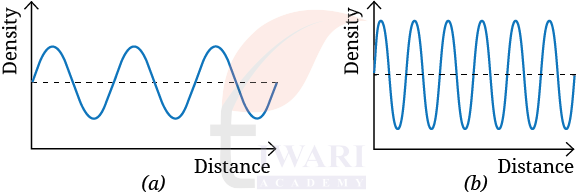
5. Graphs representing two sound waves are given in Fig. 10.30. If the scales on the X and Y axes of the two graphs are the same, which of the two sound waves has (i) greater wavelength, and (ii) smaller amplitude?
Answer:
(i) Greater wavelength:
Wave (a) has greater wavelength.
Explanation:
Wavelength is the distance between two successive compressions or two successive rarefactions. Since graph (a) shows fewer waves in the same horizontal distance, each wave occupies more space. Therefore, wave (a) has a greater wavelength.
(ii) Smaller amplitude:
Wave (a) has smaller amplitude.
Explanation:
Amplitude is the maximum displacement from the mean position. In the graphs, the height of the crests and depth of the troughs from the mean line are smaller in graph (a) than in graph (b). Therefore, wave (a) has smaller amplitude.
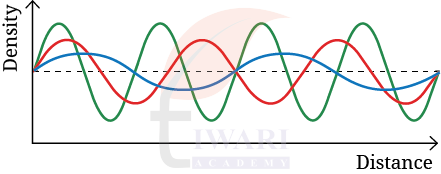
6. The sound waves emitted by three sources A, B and C are represented in Fig. 10.31. If the frequency of A is maximum and C is minimum, identify the corresponding curves, and mark A, B and C on them.
Answer:
Frequency depends on the number of waves present in the same horizontal distance.
- The curve with the greatest number of oscillations has the highest frequency.
- The curve with the smallest number of oscillations has the lowest frequency.
From Fig. 10.31:
- The green curve has the maximum number of oscillations → maximum frequency
- The blue curve has the minimum number of oscillations → minimum frequency
- The red curve has intermediate frequency
Therefore:
- A = Green curve
- B = Red curve
- C = Blue curve
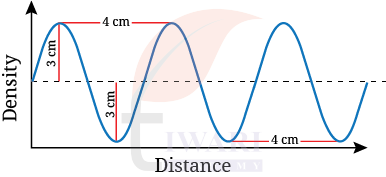
7. Draw a graph to represent a sound wave for which the density amplitude is 3 units and wavelength is 4 cm.
Answer:
To draw the graph:
- Take the horizontal axis as distance
- Take the vertical axis as density
- Mark the mean density line
- The maximum displacement above and below the mean line should be 3 units
- The distance between two successive crests or two successive troughs should be 4 cm
Description of the graph:
- Amplitude = 3 units
- Wavelength = 4 cm
A suitable wave can be drawn with:
- Crest at +3 units
- Trough at −3 units
- Distance from one crest to the next crest = 4 cm.
8. In a movie, while showing the explosion of a spacecraft in space, a flash of light is shown along with sound at the same time. What are the errors in this depiction?
Answer:
There are two errors in this depiction:
1. Sound cannot travel in space:
Space is nearly a vacuum and sound requires a material medium to travel. Therefore, no sound of explosion should be heard in space.
2. Light and sound cannot reach together:
Even if sound could travel, light travels much faster than sound. Therefore, they would not be seen and heard at the same time.
So, in reality, only the flash of light should be seen, but no sound should be heard.
9. A source produces a sound wave of wavelength 3.44 m. If the wave travels with a speed of 344 ms⁻¹, find its time period.
Answer:
Wavelength, λ = 3.44 m
Speed, v = 344 m s⁻¹
Using the relation: v = νλ
⇒ ν = v / λ
⇒ ν = 344 / 3.44
⇒ ν = 100 Hz
Now, Time period, T = 1 / ν
⇒ T = 1 / 100
= 0.01 s
The time period of the sound wave is 0.01 s.
10. A ship searching for a sunken ship sent a sonar signal and detected an echo after 5 s. If ultrasonic wave travels at 1525 m s⁻¹ in seawater, approximately how far down in the ocean is the wreckage of the sunken ship located?
Answer:
Time for echo = 5 s
Speed of ultrasonic wave = 1525 m s⁻¹
The sound travels to the wreckage and back, so the one-way time is:
Time taken to reach wreckage = 5/2 = 2.5 s
Distance = Speed × Time
Distance = 1525 × 2.5 = 3812.5 m
The wreckage is approximately 3812.5 m below the surface of the ocean.
11. A vehicle is fitted with an ultrasonic distance sensor as part of parking assistance system which provides echolocation, while the driver is reversing the vehicle. It emits ultrasonic wave (about 40 kHz) which is reflected by the obstacle. When the warning beep starts sounding at a distance of 1.2 m from the obstacle, how much time is taken by ultrasonic wave to travel to the obstacle and come back? Assume the speed of ultrasonic wave in air to be 345 m s⁻¹.
Answer:
Distance to obstacle = 1.2 m
Speed of ultrasonic wave = 345 m s⁻¹
The wave travels to the obstacle and comes back.
Total distance travelled = 2 × 1.2 = 2.4 m
Time = Distance / Speed
⇒ Time = 2.4/345
= 0.00696 s
The time taken by the ultrasonic wave to travel to the obstacle and come back is about 0.007 s.
12. The speed of sound in air is about 331 m s⁻¹ at 0°C and nearly 344 m s⁻¹ at 22°C. Roughly how much extra time will the sound of thunder take to travel a distance of 1720 m, if the air temperature changes from 22°C to 0°C? Assume that all other conditions remain unchanged.
Answer:
Distance travelled by sound, d = 1720 m
Speed of sound at 22°C, v₁ = 344 m s⁻¹
Speed of sound at 0°C, v₂ = 331 m s⁻¹
We know, Time = Distance / Speed
Time taken at 22°C:
t₁ = 1720 / 344 = 5 s
Time taken at 0°C:
t₂ = 1720 / 331 ≈ 5.20 s
Extra time taken = t₂ − t₁ = 5.20 − 5.00 = 0.20 s (approximately)
The sound of thunder will take about 0.2 s extra time to travel 1720 m when the temperature changes from 22°C to 0°C.
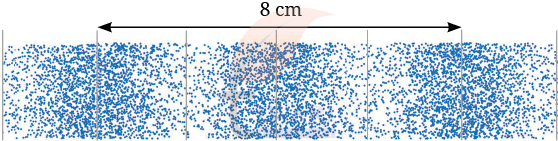
13. The variation of density of medium for a sound wave propagating with a speed of 340 m s⁻¹ is shown in Fig. 10.32. Calculate the wavelength and frequency of the sound wave.
Answer:
From Fig. 10.32, the marked distance 8 cm covers two complete wavelengths.
Therefore, 2λ = 8 cm
⇒ λ = 8/2 = 4 cm
Converting into metre: λ = 4 cm = 0.04 m
Now, using the wave equation: v = fλ
Given:
v = 340 m s⁻¹
λ = 0.04 m
So, f = v / λ
⇒ f = 340 / 0.04 = 8500 Hz
Wavelength of the sound wave = 4 cm
Frequency of the sound wave = 8500 Hz.
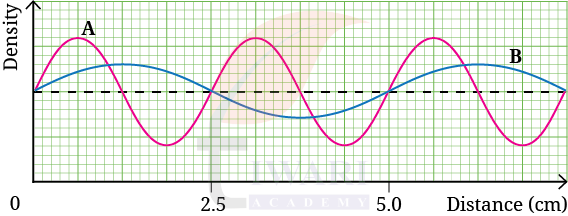
14. The graphical representation of two sound waves A and B propagating at the same speed of 345 ms⁻¹ is shown in Fig. 10.33. What is the wavelength of each of them? Also, calculate their frequencies.
Answer:
Wave A completes more cycles in the same distance, so it has a shorter wavelength.
Wave B completes fewer cycles in the same distance, so it has a longer wavelength.
By observing the graph:
- Wavelength of wave A ≈ 2.5 cm
- Wavelength of wave B ≈ 5.0 cm
Now convert into metre:
For wave A: λ₁ = 2.5 cm = 0.025 m
For wave B: λ₂ = 5.0 cm = 0.05 m
Given speed of both waves: v = 345 m s⁻¹
Using: f = v / λ
For wave A:
f₁ = 345/0.025 = 13800 Hz
For wave B:
f₂ = 345/0.05 = 6900 Hz
Hence, Wavelength of wave A = 2.5 cm and Frequency of wave A = 13,800 Hz.
Wavelength of wave B = 5.0 cm and Frequency of wave B = 6,900 Hz.
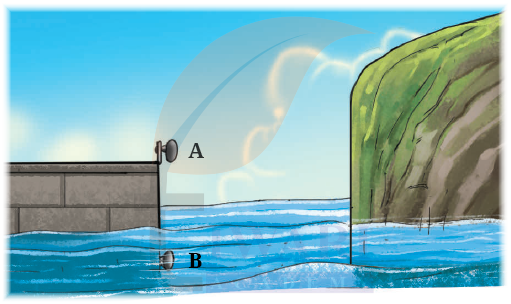
15. Two identical sound sources are placed at A and B — one in air and one submerged in water (Fig. 10.34). Both produce sounds at the same time, which travel horizontally to the vertical side of the cliff and come back. If the time taken by the sound to return to A is 4.5 times than that of B, what is the ratio between the speeds of sound in air and water?
Answer:
Source A is in air
Source B is in water
The sound from both sources travels to the cliff and returns
Time taken for sound to return to A is 4.5 times the time taken to return to B
Let:
Distance from source to cliff be d for both A and B
Speed of sound in air = v_air
Speed of sound in water = v_water
Since the sound goes to the cliff and comes back, total distance travelled in each case = 2d
So,
Time taken in air:
t_air = 2d / v_air
Time taken in water:
t_water = 2d / v_water
According to the question:
t_air = 4.5 × t_water
Substituting:
2d/v_air = 4.5 × (2d/v_water)
⇒ 1/v_air = 4.5/v_water [Cancelling 2d from both sides]
⇒ v_water = 4.5 × v_air
Therefore, v_air : v_water = 1 : 4.5
To write in whole numbers: v_air : v_water = 2 : 9
The ratio between the speeds of sound in air and water is 2 : 9.
Since sound takes more time in air and less time in water for the same distance, sound must travel faster in water than in air. The given time ratio directly gives the inverse speed ratio.
Class 9 Science Exploration Chapter 10 Important Formulae
| Formula | What It Means |
|---|---|
| ν = 1/T | Frequency = Reciprocal of Time Period |
| v = λ × ν | Speed = Wavelength × Frequency |
| v = λ/T | Speed = Wavelength ÷ Time Period |
| distance = (v × t)/2 | For echo/SONAR – one-way distance to the object |
Class 9 Science Exploration Chapter 10 Extra Question Answers
NCERT Class 9 Science Exploration Chapter 10 Very Short Answer Type Questions with Explanation.
Very Short Answer Type Questions
- What is the source of sound?
Answer:
Any vibrating object is the source of sound. The object that produces sound by its vibrations is called the source. - What is vibration?
Answer:
Vibration is the periodic to-and-fro motion (oscillation) of an object about its mean position of rest. - What is a compression in a sound wave?
Answer:
A compression is a region in the medium where the density of particles is higher than the average density, formed when the source moves forward. - What is rarefaction in a sound wave?
Answer:
Rarefaction is a region where the density of the medium is lower than the average density, formed when the source moves backward. - State the SI unit of frequency.
Answer:
The SI unit of frequency is hertz (Hz), equivalent to one oscillation per second (s⁻¹). - Write the relation between frequency (ν) and time period (T).
Answer:
ν = 1/T. Frequency and time period are inversely related; a higher frequency corresponds to a shorter time period. - What is the human audible range of sound?
Answer:
The human audible range is from 20 Hz to 20,000 Hz (20 kHz). This range varies with age and person. - Why can astronauts not hear each other directly during a spacewalk?
Answer:
Outer space is a near vacuum — there is no medium. Since sound requires a material medium to propagate, it cannot travel in space. - Define the wavelength of a sound wave.
Answer:
Wavelength (λ) is the distance between two consecutive crests or two consecutive troughs of a wave. Its SI unit is metre (m). - What is the speed of sound in dry air at 0°C and 22°C?
Answer:
Speed of sound in dry air is approximately 331 m s⁻¹ at 0°C and about 344 m s⁻¹ at 22°C. - What are ultrasonic waves? Give one example of an animal that detects them.
Answer:
Ultrasonic waves have frequency above 20 kHz, inaudible to humans. Bats detect and use ultrasonic waves for echolocation. - What is echolocation?
Answer:
Echolocation is the ability to locate objects by emitting sound waves and detecting the reflected echoes. Bats, dolphins, and whales use it. - What is the minimum distance from a reflecting wall to hear an echo?
Answer:
The minimum distance is 17 m. Sound must travel 34 m (to wall and back) in at least 0.1 s at ~340 m s⁻¹. - Name the instrument commonly used to produce nearly single-frequency sound in experiments.
Answer:
A tuning fork — a U-shaped metal bar (steel or aluminium) with prongs (tines) — produces nearly single-frequency sound when struck. - What is reverberation?
Answer:
Reverberation is the persistence of sound in a large hall due to multiple reflections from surfaces, where reflected sounds arrive within 0.05 s of each other.
NCERT Class 9 Science Exploration Chapter 10 Short Answer Type Questions with Explanation.
Short Answer Type Questions
- Explain with an example how sound is produced.
Answer:
Sound is produced by vibrations. When a tuning fork is struck on a rubber pad, its prongs vibrate, disturbing surrounding air and creating alternating compressions and rarefactions that propagate as sound and reach our ears. - Why does sound need a medium to propagate? Give experimental evidence.
Answer:
Sound is a mechanical wave that requires particles to transmit energy. In the vacuum bell jar experiment, as air is pumped out, the ringing bell becomes inaudible, proving sound cannot propagate in vacuum without a medium. - How are compressions and rarefactions formed by an oscillating piston in a tube?
Answer:
When the piston moves forward, it compresses nearby air, forming a compression. When it moves back, the air expands, forming a rarefaction. Continuous oscillation produces alternating compressions and rarefactions that travel as a sound wave. - Differentiate between longitudinal and transverse waves with examples.
Answer:
In longitudinal waves, particles vibrate parallel to the direction of propagation (e.g., sound waves). In transverse waves, particles vibrate perpendicular to propagation (e.g., light waves). Sound is a longitudinal mechanical wave; light is a transverse, non-mechanical wave. - Why does the intensity of sound decrease with distance from the source?
Answer:
As sound travels outward, it spreads over an increasingly larger area. Since energy must be conserved but is distributed over a larger surface, the energy per unit area (intensity) decreases with distance from the source. - What is the difference between loudness and intensity of sound?
Answer:
Intensity is a measurable physical quantity — sound energy passing through unit area per unit time. Loudness is the subjective human perception of that intensity and depends on the listener’s hearing ability, not just on the wave’s amplitude. - Explain how SONAR works to locate underwater objects.
Answer:
SONAR sends ultrasonic pulses into water. These reflect off underwater objects and return as echoes. By measuring the time taken for the echo to return and knowing the speed of sound in water, the distance of the object is calculated as: distance = (v × t)/2. - What is pitch and how is it related to frequency?
Answer:
Pitch is the human perception of frequency. High-frequency sounds (e.g., whistle) have high pitch; low-frequency sounds (e.g., thunder) have low pitch. In general, pitch increases with frequency, although the exact mathematical relationship between them is complex. - Why does sound travel faster in solids than in liquids or gases?
Answer:
Solids have particles closely packed with strong intermolecular forces, enabling faster and more efficient transfer of vibrational energy. Sound travels about 4–5 times faster in water and 15–20 times faster in solids than in air. - What do we mean when we say sound is a longitudinal wave?
Answer:
In a longitudinal wave, the particles of the medium vibrate parallel to the direction in which the wave travels. In sound, air particles move back and forth in the same direction as the compressions and rarefactions propagate through the medium.
NCERT Class 9 Science Exploration Chapter 10 Long Answer Type Questions with Explanation.
Long Answer Type Questions
1. Describe the propagation of sound through air using the piston-in-tube model. Explain the role of compressions and rarefactions and state what actually travels in a sound wave.
Answer:
Sound propagation through air is effectively modelled using a long tube filled with air, with an oscillating piston at one end and the other end open.
When the piston is stationary: The air inside has a uniform average density throughout.
Forward movement of piston: The piston pushes nearby air particles forward, compressing them into a smaller volume. This creates a region of higher-than-average density called a compression (C). The compressed particles collide with their neighbours ahead, passing the compression forward. Those particles then collide further ahead, and so on – the compression moves forward through the tube without the particles themselves travelling along.
Backward movement of piston: The piston pulls back, and the nearby air particles spread out into the space created. This forms a region of lower-than-average density called a rarefaction (R). This too travels forward through the tube by the particle collision mechanism.
Continuous oscillation: As the piston moves back and forth repeatedly, it generates alternating compressions and rarefactions. These travel away from the source as a sound wave.
Key principle: The particles of the medium do NOT travel with the wave. Each particle only oscillates about its own mean position parallel to the direction of wave propagation. This is why sound is called a longitudinal wave. What actually travels is the disturbance in density — the energy — not the matter itself.
When the medium is unconfined (open air rather than a tube), these compressions and rarefactions spread outward in all directions from the source as spherical waves, reaching a listener and being perceived as sound.
2. Explain the characteristics of a sound wave — wavelength, frequency, time period, amplitude, and speed. Derive the relation connecting speed, wavelength and frequency. Give one worked numerical example.
Answer:
Sound waves are completely described by five interrelated characteristics:
- Wavelength (λ):
The distance between two consecutive compressions (crests) or two consecutive rarefactions (troughs) is the wavelength. It represents one complete cycle of the density oscillation in space. SI unit: metre (m). - Frequency (ν):
The number of complete density oscillations that occur at a fixed point in the medium per unit time is called frequency. High frequency sounds are perceived as high pitch. SI unit: hertz (Hz) = s⁻¹. - Time Period (T):
The time taken for one complete density oscillation at a fixed point is the time period. Frequency and time period are inversely related: ν = 1/T (Equation 10.1) - Amplitude:
The maximum change in density of the medium from average density (in a compression or rarefaction) is the amplitude. Greater amplitude means more energy and greater loudness. Amplitude does not affect the speed or frequency of sound. - Speed (v):
The speed of sound is the distance travelled by a point on the wave (crest or trough) per unit time. Speed depends on the medium: fastest in solids (~5000 m s⁻¹ in steel), intermediate in liquids (~1500 m s⁻¹ in water), and slowest in gases (~340 m s⁻¹ in air at room temperature).
Derivation of v = λν:
In one time period (T), the wave travels a distance of exactly one wavelength (λ). Using the basic relation speed = distance/time: v = λ/T
Since ν = 1/T, substituting:
v = λ × ν (Equation 10.2)
Numerical Example:
A sound wave in air has frequency 440 Hz and speed 344 m s⁻¹. Find its wavelength.
λ = v/ν = 344/440 = 0.782 m.
Comparison: Echo vs. Reverberation
| Feature | Echo | Reverberation |
|---|---|---|
| Definition | Distinct repetition of original sound after reflection | Persistence of sound due to multiple reflections |
| Time gap of reflected sound | More than or equal to 0.1 s after original | Less than 0.05 s between successive reflections |
| Perceived as | Separate, repeated sound | Prolonged, continuous sound |
| Minimum distance needed | 17 m from reflecting surface | Not applicable |
| Typical setting | Mountains, cliffs, open corridors | Large halls, auditoriums, domes |
| Example | Shouting near a mountain | Sound lingering in a concert hall |
Comparison: Infrasonic vs. Ultrasonic Waves
| Feature | Infrasonic Waves | Ultrasonic Waves |
|---|---|---|
| Frequency range | Less than 20 Hz | More than 20,000 Hz (20 kHz) |
| Audible to humans? | No | No |
| Animals that detect them | Elephants | Bats, dogs, cats, dolphins, whales |
| Applications | Detecting earthquakes, volcanic eruptions, severe storms | Medical imaging (ultrasonography), SONAR, kidney stone treatment, industrial cleaning, flaw detection in metals |
FAQs – Class 9 Science Exploration Chapter 10
Is Class 9 Science Exploration Chapter 10 aligned with the new NCERT syllabus 2026–27?
Yes. Chapter 10 – Sound Waves: Characteristics and Applications – is part of the completely redesigned NCERT Science Exploration textbook for Class 9, Session 2026–27. It effectively replaces the older Class 9 Chapter 12 on Sound, and introduces inquiry-based activities, embedded Pause and Ponder questions, “Ready to Go Beyond” extensions, Bridging Science and Society sections and Indian cultural connections — none of which appeared in the previous edition.
What is the best classroom strategy to teach Class 9 Science Exploration Chapter 10?
Use the activity-based approach built into the chapter itself:
- Start with Activity 10.1 (rubber band + cardboard box) to demonstrate that sound is produced by vibrations.
- Use the tuning fork (Activity 10.2) to show vibrating objects produce sound.
- Use the slinky analogy (Activity 10.5) to visualise compressions and rarefactions.
- The Phyphox app (Activity 10.7) can be used to measure frequencies of musical notes live in class.
- Solve numerical examples 10.1–10.6 step-by-step with the class before assigning end-chapter problems.
What is the single most critical concept of Chapter 10 that every student must firmly understand?
The most fundamental and most commonly misunderstood concept is: In a sound wave, particles of the medium do NOT travel with the wave. They only vibrate about their mean positions. It is the density disturbance (compression/rarefaction) that travels. This distinction is foundational to understanding wave propagation, speed and why sound cannot travel in vacuum.
Is Class 9 Science Exploration Chapter 10 difficult for my child?
Chapter 10 is considered moderately easy by most students. The core concepts – vibration, sound as a wave, echoes and ultrasound applications — are relatable to everyday experience. The mathematics involves the wave speed equation (v = λν) and simple substitution-based numerical problems, which are entirely manageable for a student comfortable with basic algebra. Students generally find this chapter less challenging than motion or force chapters.
How much time does a student need to complete Chapter 10 thoroughly?
A focused student typically needs 4–6 hours total:
- Reading and understanding the full chapter: ~2 hours
- Solving all in-chapter Pause and Ponder questions: ~1 hour
- Solving all 15 end-chapter Revise, Reflect, Refine questions: ~1.5 hours
- Revision, formula practice, and diagram drawing: ~1 hour
With prior classroom exposure, home preparation can be reduced to 3–4 hours.
Can student solve all Chapter 10 exercises in one day?
Yes — it is achievable in one dedicated day (5–6 focused hours) if the child has read the chapter or attended school lessons. The MCQ and conceptual questions (Q1–Q8) are relatively quick. The numerical problems (Q9–Q15) require careful application of formulas but are straightforward once the wave equations are clear. Planning one uninterrupted study session is sufficient.
How should I prepare Class 9 Science Exploration Chapter 10 for exams?
Follow this step-by-step approach:
- Read the chapter once end-to-end without interruption.
- Memorise all key formulas: v = λν, T = 1/ν and the echo distance formula.
- Learn key values: speed of sound in air (~340–344 m s⁻¹), audible range (20 Hz–20 kHz), minimum echo distance (17 m).
- Solve all six numerical examples in the chapter (Ex. 10.1–10.6).
- Solve all Pause and Ponder questions — especially the Assertion–Reason questions.
- Practice drawing and labelling density-distance graphs for sound waves.
- Prepare comparison tables: Echo vs. Reverberation; Infrasound vs. Ultrasound; Loudness vs. Intensity.
What are the most important topics in Chapter 10 for the exam?
The highest-yield topics are:
- Compression vs. rarefaction — definition and how they form
- Wave equation: v = λν and numerical problems based on it
- Echo — minimum distance (17 m) and echo distance calculation
- Echo vs. Reverberation — differences and conditions
- Infrasonic vs. Ultrasonic waves — frequency range and detecting animals
- Applications of ultrasound: SONAR, ultrasonography, kidney stone treatment
- Echolocation — bats and dolphins
- Longitudinal vs. Transverse waves
- Graph-based questions on wavelength and amplitude
Is Class 9 Science Exploration Chapter 10 entirely new or similar to the old NCERT syllabus?
The core physics is similar to the older Class 9 Chapter 12 (Sound), but the 2026–27 edition has been significantly updated:
- New activity-based experiments using apps (Phyphox), slinkies, and tuning forks
- “Threads of Curiosity” on echolocation, Whistling Village of Meghalaya, Gol Gumbaz acoustics and sonic booms
- Indian science connections (C. V. Raman, tabla, mridangam)
- “Ready to Go Beyond” sections on seismic waves, transverse waves, and dispersive media
- “Bridging Science and Society” on hearing aids, noise pollution, microphones and audio surveillance drones
- Richer numerical problem sets and higher-order thinking questions