
Tiwari Academy  – Free CBSE NCERT Books and Solutions
  • Apps
    • CBSE Apps
    • Hast Rekha App
  • NCERT Solutions
    • NCERT Solutions for Class 12
      • NCERT Solutions for Class 12 Maths
      • NCERT Solutions for Class 12 Physics
      • NCERT Solutions for Class 12 Chemistry
      • NCERT Solutions for Class 12 Biology
      • NCERT Solutions for Class 12 English
      • NCERT Solutions for Class 12 Accounts
      • NCERT Solutions for Class 12 Business Studies
      • NCERT Solutions for Class 12 Economics
      • NCERT Solutions for Class 12 Geography
      • NCERT Solutions for Class 12 Physical Education
      • NCERT Solutions for Class 12 Political Science
      • NCERT Solutions for Class 12 Psychology
      • NCERT Solutions for Class 12 Sociology
    • NCERT Solutions for Class 11
      • NCERT Solutions for Class 11 Maths
      • NCERT Solutions for Class 11 Physics
      • NCERT Solutions for Class 11 Chemistry
      • NCERT Solutions for Class 11 Biology
      • NCERT Solutions for Class 11 English
      • NCERT Solutions for Class 11 Business Studies
      • NCERT Solutions for Class 11 Sociology
      • NCERT Solutions for Class 11 Political Science
      • NCERT Solutions for Class 11 Psychology
      • NCERT Solutions for Class 11 Physical Education
    • NCERT Solutions for Class 10
      • NCERT Solutions for Class 10 Maths
      • NCERT Solutions for Class 10 Science
      • NCERT Solutions for Class 10 English
      • NCERT Solutions for Class 10 Hindi Course A and B
      • NCERT Solutions for Class 10 Sanskrit
      • NCERT Solutions for Class 10 Social Science
    • NCERT Solutions for Class 9
      • NCERT Solutions for Class 9 Maths
      • NCERT Solutions for Class 9 Science
      • NCERT Solutions for Class 9 English
      • NCERT Solutions for Class 9 Hindi
      • NCERT Solutions for Class 9 Sanskrit
      • NCERT Solutions for Class 9 Social Science
    • NCERT Solutions for Class 8
      • NCERT Solutions for Class 8 Maths
      • NCERT Solutions for Class 8 Science
      • NCERT Solutions for Class 8 English
      • NCERT Solutions for Class 8 Hindi
      • NCERT Solutions for Class 8 Sanskrit
      • NCERT Solutions for Class 8 Social Science
      • NCERT Solutions for Class 8 Computer
    • NCERT Solutions for Class 7
      • NCERT Solutions for Class 7 Maths
      • NCERT Solutions for Class 7 Science
      • NCERT Solutions for Class 7 English
      • NCERT Solutions for Class 7 Hindi
      • NCERT Solutions for Class 7 Sanskrit
      • NCERT Solutions for Class 7 Social Science
      • NCERT Solutions for Class 7 Computer
    • NCERT Solutions for Class 6
      • NCERT Solutions for Class 6 Maths
      • NCERT Solutions for Class 6 Science
      • NCERT Solutions for Class 6 English
      • NCERT Solutions for Class 6 Hindi
      • NCERT Solutions for Class 6 Sanskrit
      • NCERT Solutions for Class 6 Social Science
      • NCERT Solutions for Class 6 Computer
    • NCERT Solutions for Class 5
      • NCERT Solutions for Class 5 Hindi
      • NCERT Solutions for Class 5 English
      • NCERT Solutions for Class 5 Maths
      • NCERT Solutions for Class 5 EVS
      • NCERT Solutions for Class 5 Computer
      • NCERT Solutions for Class 5 GK
    • NCERT Solutions for Class 4
      • NCERT Solutions for Class 4 Hindi
      • NCERT Solutions for Class 4 English
      • NCERT Solutions for Class 4 Maths
      • NCERT Solutions for Class 4 EVS
      • NCERT Solutions for Class 4 Computer
      • NCERT Solutions for Class 4 GK
    • NCERT Solutions for Class 3
      • NCERT Solutions for Class 3 Hindi
      • NCERT Solutions for Class 3 English
      • NCERT Solutions for Class 3 Maths
      • NCERT Solutions for Class 3 EVS
      • NCERT Solutions for Class 3 Science
      • NCERT Solutions for Class 3 Computer
      • NCERT Solutions for Class 3 GK
    • NCERT Solutions for Class 2
      • NCERT Solutions for Class 2 Hindi
      • NCERT Solutions for Class 2 English
      • NCERT Solutions for Class 2 Maths
      • NCERT Solutions for Class 2 EVS
      • NCERT Solutions for Class 2 Science
      • NCERT Solutions for Class 2 Computer
      • NCERT Solutions for Class 2 GK
    • NCERT Solutions for Class 1
      • NCERT Solutions for Class 1 Hindi
      • NCERT Solutions for Class 1 English
      • NCERT Solutions for Class 1 Maths
      • NCERT Solutions for Class 1 EVS
      • NCERT Solutions for Class 1 Computer
      • NCERT Solutions for Class 1 Science
      • NCERT Solutions for Class 1 GK
    • Study Material for KG
      • Study Material for KG English
      • Study Material for KG Hindi
      • Study Material for KG Maths
    • Study Material for Nursery
      • Study Material for Nursery Maths
      • Study Material for Nursery English
      • Study Material for Nursery Hindi
  • MCQ
  • NEWS
    • Educational NEWS
    • Explore More
  • Grammar
    • Class 1 English Grammar
      • Class 1 Hindi Vyakaran
    • Class 2 English Grammar
      • Class 2 Hindi Vyakaran
    • Class 3 English Grammar
      • Class 3 Hindi Vyakaran
    • Class 4 English Grammar
      • Class 4 Hindi Vyakaran
    • Class 5 English Grammar
      • Class 5 Hindi Vyakaran
    • Class 6 English Grammar
      • Class 6 Hindi Vyakaran
    • Class 7 English Grammar
      • Class 7 Hindi Vyakaran
    • Class 8 English Grammar
      • Class 8 Hindi Vyakaran
  • Sample Papers
    • CBSE Sample Papers for Class 9
    • CBSE Sample Papers for Class 10
    • CBSE Sample Papers for Class 11
    • CBSE Sample Papers for Class 12
  • NCERT Books
    • NCERT Books for Class 1 All Subjects
    • NCERT Books for Class 2 All Subjects
    • NCERT Books for Class 3 All Subjects
    • NCERT Books for Class 4 All Subjects
    • NCERT Books for Class 5 All Subjects
    • NCERT Books for Class 6 All Subjects
    • NCERT Books for Class 7 All Subjects
    • NCERT Books for Class 8 All Subjects
    • NCERT Books for Class 9 All Subjects
    • NCERT Books for Class 10 All Subjects
    • NCERT Books for Class 11 All Subjects
    • NCERT Books for Class 12 All Subjects
  • Syllabus
    • CBSE Date Sheet 2025
    • CBSE Syllabus
    • NCERT Exemplar
    • What is NIOS?
    • NIOS Online Admission
  • Contact
    • Contact Us
    • About Us
    • Online Tutors
    • Career Options
  • Apps
    • CBSE Apps
    • Hast Rekha App
  • NCERT Solutions
    • NCERT Solutions for Class 12
      • NCERT Solutions for Class 12 Maths
      • NCERT Solutions for Class 12 Physics
      • NCERT Solutions for Class 12 Chemistry
      • NCERT Solutions for Class 12 Biology
      • NCERT Solutions for Class 12 English
      • NCERT Solutions for Class 12 Accounts
      • NCERT Solutions for Class 12 Business Studies
      • NCERT Solutions for Class 12 Economics
      • NCERT Solutions for Class 12 Geography
      • NCERT Solutions for Class 12 Physical Education
      • NCERT Solutions for Class 12 Political Science
      • NCERT Solutions for Class 12 Psychology
      • NCERT Solutions for Class 12 Sociology
    • NCERT Solutions for Class 11
      • NCERT Solutions for Class 11 Maths
      • NCERT Solutions for Class 11 Physics
      • NCERT Solutions for Class 11 Chemistry
      • NCERT Solutions for Class 11 Biology
      • NCERT Solutions for Class 11 English
      • NCERT Solutions for Class 11 Business Studies
      • NCERT Solutions for Class 11 Sociology
      • NCERT Solutions for Class 11 Political Science
      • NCERT Solutions for Class 11 Psychology
      • NCERT Solutions for Class 11 Physical Education
    • NCERT Solutions for Class 10
      • NCERT Solutions for Class 10 Maths
      • NCERT Solutions for Class 10 Science
      • NCERT Solutions for Class 10 English
      • NCERT Solutions for Class 10 Hindi Course A and B
      • NCERT Solutions for Class 10 Sanskrit
      • NCERT Solutions for Class 10 Social Science
    • NCERT Solutions for Class 9
      • NCERT Solutions for Class 9 Maths
      • NCERT Solutions for Class 9 Science
      • NCERT Solutions for Class 9 English
      • NCERT Solutions for Class 9 Hindi
      • NCERT Solutions for Class 9 Sanskrit
      • NCERT Solutions for Class 9 Social Science
    • NCERT Solutions for Class 8
      • NCERT Solutions for Class 8 Maths
      • NCERT Solutions for Class 8 Science
      • NCERT Solutions for Class 8 English
      • NCERT Solutions for Class 8 Hindi
      • NCERT Solutions for Class 8 Sanskrit
      • NCERT Solutions for Class 8 Social Science
      • NCERT Solutions for Class 8 Computer
    • NCERT Solutions for Class 7
      • NCERT Solutions for Class 7 Maths
      • NCERT Solutions for Class 7 Science
      • NCERT Solutions for Class 7 English
      • NCERT Solutions for Class 7 Hindi
      • NCERT Solutions for Class 7 Sanskrit
      • NCERT Solutions for Class 7 Social Science
      • NCERT Solutions for Class 7 Computer
    • NCERT Solutions for Class 6
      • NCERT Solutions for Class 6 Maths
      • NCERT Solutions for Class 6 Science
      • NCERT Solutions for Class 6 English
      • NCERT Solutions for Class 6 Hindi
      • NCERT Solutions for Class 6 Sanskrit
      • NCERT Solutions for Class 6 Social Science
      • NCERT Solutions for Class 6 Computer
    • NCERT Solutions for Class 5
      • NCERT Solutions for Class 5 Hindi
      • NCERT Solutions for Class 5 English
      • NCERT Solutions for Class 5 Maths
      • NCERT Solutions for Class 5 EVS
      • NCERT Solutions for Class 5 Computer
      • NCERT Solutions for Class 5 GK
    • NCERT Solutions for Class 4
      • NCERT Solutions for Class 4 Hindi
      • NCERT Solutions for Class 4 English
      • NCERT Solutions for Class 4 Maths
      • NCERT Solutions for Class 4 EVS
      • NCERT Solutions for Class 4 Computer
      • NCERT Solutions for Class 4 GK
    • NCERT Solutions for Class 3
      • NCERT Solutions for Class 3 Hindi
      • NCERT Solutions for Class 3 English
      • NCERT Solutions for Class 3 Maths
      • NCERT Solutions for Class 3 EVS
      • NCERT Solutions for Class 3 Science
      • NCERT Solutions for Class 3 Computer
      • NCERT Solutions for Class 3 GK
    • NCERT Solutions for Class 2
      • NCERT Solutions for Class 2 Hindi
      • NCERT Solutions for Class 2 English
      • NCERT Solutions for Class 2 Maths
      • NCERT Solutions for Class 2 EVS
      • NCERT Solutions for Class 2 Science
      • NCERT Solutions for Class 2 Computer
      • NCERT Solutions for Class 2 GK
    • NCERT Solutions for Class 1
      • NCERT Solutions for Class 1 Hindi
      • NCERT Solutions for Class 1 English
      • NCERT Solutions for Class 1 Maths
      • NCERT Solutions for Class 1 EVS
      • NCERT Solutions for Class 1 Computer
      • NCERT Solutions for Class 1 Science
      • NCERT Solutions for Class 1 GK
    • Study Material for KG
      • Study Material for KG English
      • Study Material for KG Hindi
      • Study Material for KG Maths
    • Study Material for Nursery
      • Study Material for Nursery Maths
      • Study Material for Nursery English
      • Study Material for Nursery Hindi
  • MCQ
  • NEWS
    • Educational NEWS
    • Explore More
  • Grammar
    • Class 1 English Grammar
      • Class 1 Hindi Vyakaran
    • Class 2 English Grammar
      • Class 2 Hindi Vyakaran
    • Class 3 English Grammar
      • Class 3 Hindi Vyakaran
    • Class 4 English Grammar
      • Class 4 Hindi Vyakaran
    • Class 5 English Grammar
      • Class 5 Hindi Vyakaran
    • Class 6 English Grammar
      • Class 6 Hindi Vyakaran
    • Class 7 English Grammar
      • Class 7 Hindi Vyakaran
    • Class 8 English Grammar
      • Class 8 Hindi Vyakaran
  • Sample Papers
    • CBSE Sample Papers for Class 9
    • CBSE Sample Papers for Class 10
    • CBSE Sample Papers for Class 11
    • CBSE Sample Papers for Class 12
  • NCERT Books
    • NCERT Books for Class 1 All Subjects
    • NCERT Books for Class 2 All Subjects
    • NCERT Books for Class 3 All Subjects
    • NCERT Books for Class 4 All Subjects
    • NCERT Books for Class 5 All Subjects
    • NCERT Books for Class 6 All Subjects
    • NCERT Books for Class 7 All Subjects
    • NCERT Books for Class 8 All Subjects
    • NCERT Books for Class 9 All Subjects
    • NCERT Books for Class 10 All Subjects
    • NCERT Books for Class 11 All Subjects
    • NCERT Books for Class 12 All Subjects
  • Syllabus
    • CBSE Date Sheet 2025
    • CBSE Syllabus
    • NCERT Exemplar
    • What is NIOS?
    • NIOS Online Admission
  • Contact
    • Contact Us
    • About Us
    • Online Tutors
    • Career Options
เคนเคฟเค‚เคฆเฅ€ เคฎเฅ€เคกเคฟเคฏเคฎเคนเคฟเค‚เคฆเฅ€ เคฎเฅ€เคกเคฟเคฏเคฎ Latest BlogsLatest Blogs Ask QuestionsAsk Questions
Tiwari Academy  /  Latest News  /  Class 7 Maths Syllabus 2026-27: Ganita Prakash Part 1 & Part 2

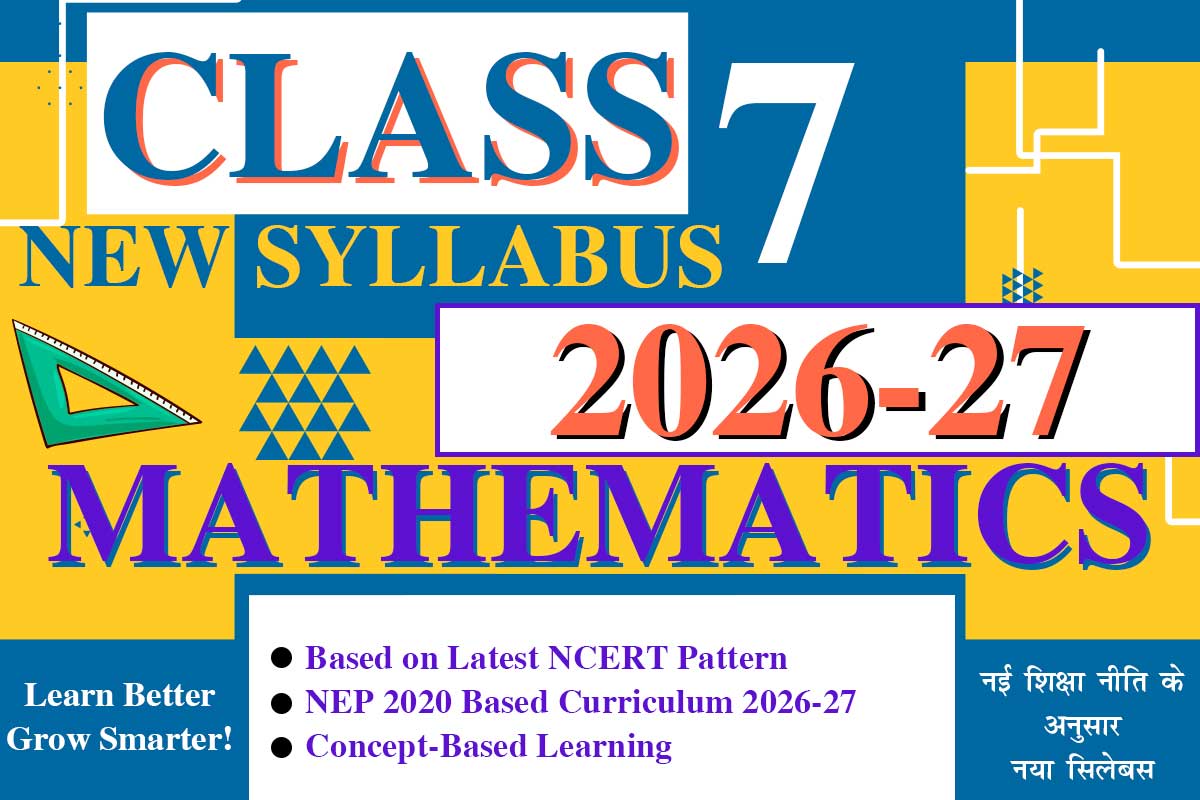
Class 7 Maths Syllabus 2026-27: Ganita Prakash Part 1 & Part 2

Class 7 Maths Syllabus 2026-27
Post Date: April 2, 2026

The Class 7 Maths syllabus has changed for the academic session 2026-27. The national curriculum authority has introduced a two-part textbook called Ganita Prakash for Grade 7 Mathematics, replacing the older curriculum that learners had followed for years. This book is carefully designed to build mathematical thinking progressively – connecting abstract concepts to real-life situations and encouraging genuine exploration rather than formula memorisation.
Whether you are a parent whose child is stepping into Class 7 this year, a teacher planning your lessons or a student wanting to understand what lies ahead – this guide covers everything: what the revised curriculum includes, NCERT textbook solutions, how it differs from the previous book, a full breakdown of all chapters across both volumes and where to find free, step-by-step exercise answers.

What Is Ganita Prakash? The Philosophy Behind the New Curriculum

Ganita Prakash is Sanskrit for Light of Mathematics. This is not simply a re-titled edition of the old textbook โ€” it is a fundamentally redesigned resource, crafted in alignment with two landmark policy frameworks:

  • NEP 2020: The National Education Policy that shifts focus from rote learning to competency-based, experiential understanding.
  • NCF-SE 2023: The National Curriculum Framework for School Education, which prioritises conceptual depth and connects mathematical learning with everyday life.

The two-part series takes forward the journey that began in Grade 6. Topics emerge naturally from real situations – city populations, measurement, number patterns and practical problem-solving. Learners are encouraged to observe, discuss and discover relationships on their own, rather than passively receiving procedures from a teacher or textbook.

What makes the new series genuinely different is its activity-first structure. Every topic opens with observations, puzzles or explorations before any formal definition is introduced. The content also weaves in themes from science, social science, environmental education and value education – giving mathematics a context and a purpose that the older book rarely achieved.

At a Glance – What the Grade 7 Curriculum Now Covers

The revised Grade 7 Mathematics curriculum is structured across two volumes:

VolumeCore Topics Covered
Part 1Large numbers, arithmetic expressions, decimals, algebraic expressions, parallel lines, number patterns, triangles, fractions
Part 2Integers, equations, congruent figures, comparing quantities, solid shapes, data handling, symmetry

Together, both volumes build a thorough foundation in number sense, algebra, geometry and data reasoning – the four pillars of middle-school mathematics.

Ganita Prakash Part 1 – All Chapters Explained

Part 1 forms the first half of the Grade 7 curriculum and introduces foundational ideas through an engaging, activity-based format.

Chapter 1: Large Numbers Around Us

This opening topic builds strong number sense by exploring large quantities encountered in real life โ€” city populations, distances in space, and national-scale statistics. Learners practise reading, writing, and comparing numbers in both the Indian and international systems of numeration. Estimation strategies and rounding are woven throughout, giving young mathematicians practical tools they will use well beyond the classroom.

Topics: place value up to crores and beyond, reading and comparing large numbers, rounding and approximation, and interpreting real-world numerical data.


Chapter 2: Arithmetic Expressions

Here, the focus shifts to how numbers and operations combine to form expressions with specific values. The chapter builds understanding of brackets, the order of operations (BODMAS), and how the same situation can be written in multiple mathematically equivalent ways – a natural gateway into the algebraic thinking that deepens later.

Covered here: forming and evaluating expressions, correct use of brackets, operator precedence and comparing expressions using relational symbols.

Chapter 3: A Peek Beyond the Point

This topic introduces decimal numbers, building directly on earlier work with fractions. The central idea is what it means to divide a unit into ten, a hundred or a thousand equal parts โ€” and how that precision is captured in decimal notation. Conversion between fractions and decimals, ordering and practical applications in measurement and money are all explored.

Core ideas: tenths, hundredths and thousandths, decimal notation, fraction-to-decimal conversion, ordering decimals and real-life measurement contexts.

Chapter 4: Expressions Using Letter-Numbers

This is where algebra enters Grade 7 โ€” one of the most significant conceptual shifts at this level. The idea that a letter can represent an unknown or changing quantity allows mathematical relationships to be written as general rules. This chapter lays the groundwork for equation-solving that comes in Part 2.

What learners explore: the concept of a variable, constructing algebraic expressions, evaluating them for given values, identifying terms and coefficients and distinguishing between constants and variables.

Chapter 5: Parallel and Intersecting Lines

Geometry takes centre stage as this topic examines what happens when lines meet – or deliberately do not. The properties of intersecting lines, the angles formed at crossings and the special relationships that arise when a transversal cuts a pair of parallel lines are all investigated through diagrams, measurement and reasoning.

Topics: vertically opposite angles, angles on a straight line, corresponding angles, alternate angles and co-interior angles with parallel lines.


Chapter 6: Number Play

A playful but mathematically rich exploration, this chapter examines the patterns and properties hidden within numbers. Divisibility rules, prime and composite numbers, prime factorisation and surprising numerical patterns are all examined – with the emphasis firmly on curiosity and the joy of discovery.

Syllabus Covered: divisibility, factors and multiples, prime factorisation, patterns in sequences and properties of special numbers.

Chapter 7: A Tale of Three Intersecting Lines

This chapter reveals the world of triangles by asking what happens when three straight lines intersect. Rather than opening with definitions, it builds the concept of a triangle through the geometry of three crossing lines – a fresh and memorable approach. The angle sum property, the exterior angle theorem, and the triangle inequality all emerge naturally from this starting point.

Key ideas: types of triangles by sides and angles, the angle sum property, the exterior angle theorem and why some combinations of lengths cannot form a triangle.

Chapter 8: Working with Fractions

The closing topic of Part 1 revisits and substantially deepens the understanding of fractions. All four operations – addition, subtraction, multiplication and division – are covered with genuine conceptual clarity and grounded in real-life contexts involving recipes, measurements and sharing.

Course Covered: addition and subtraction of unlike fractions, multiplication and division of fractions, reciprocals, mixed numbers and problem-solving with fractions.

Ganita Prakash Part 2 – All Chapters Explained

Part 2 continues the journey by expanding into negative numbers, equations, congruence, proportional reasoning and spatial thinking.

Chapter 9: Operations on Integers

This chapter extends the number system to include negative numbers fully for the first time. The number line stretches left of zero and rules for all four operations on integers are developed – always anchored in real-world contexts like temperature changes, elevation and financial transactions.

Topics: the number line, additive inverse, rules of signs in multiplication, division and properties including commutativity, associativity and distributivity.

Chapter 10: Fractions and Proportional Reasoning

Building on earlier work with fractions and ratios, this topic develops proportional reasoning – arguably the most practically useful mathematical skill at this level. Connections between ratio, percentage and real-world situations including discounts, the unitary method and quantity comparisons are explored in depth.

Content: equivalent ratios, the unitary method, percentage calculations, comparing quantities and an introduction to proportional relationships.

Chapter 11: Finding the Unknown

Here the algebraic groundwork from Chapter 4 comes into full use: this chapter is entirely about solving equations. Learners move from understanding what an equation means to solving linear equations in one variable and then to forming their own equations from word problems – a skill that underpins all future mathematics.

Topics: structure of an equation, balancing method, transposition, forming equations from real-life statements and verifying solutions by substitution.

Chapter 12: Congruent Figures

This chapter introduces congruence – the idea that two shapes are identical in size and form, even if positioned or oriented differently. The focus is on triangles and the four criteria for establishing congruence (SSS, SAS, ASA and RHS) are each developed with care and illustrated clearly.

Explored here: the meaning of congruence, congruence of line segments and angles, the four triangle criteria and the importance of correctly identifying corresponding vertices.

Chapter 13: Visualising Solid Shapes

Moving from flat geometry into three dimensions, this chapter helps learners see and reason about solid objects – cubes, cuboids, cones, cylinders and spheres. Nets, shadow projections and cross-sections are used to build spatial intuition that is foundational for higher-class geometry.

Covered: types of 3D shapes, nets, top/front/side views of solids and the relationship between two-dimensional drawings and three-dimensional objects.

Chapter 14: Comparing Quantities

This chapter integrates ratio, percentage, profit and loss, discount, and an introduction to simple interest in one cohesive unit. Learners apply these tools to real commercial and financial contexts – making it one of the most immediately practical topics in the entire book.

Content: percentage-based calculations, profit and loss (including percentage), marked price and discount and simple interest.

Chapter 15: Data Handling

In this chapter, learners discover how to collect, organise, and make sense of data – a skill that matters in virtually every field. The arithmetic mean, mode and median are introduced as tools for summarising information and both single and double bar graphs are constructed and interpreted.

What this develops: types of data, arithmetic mean, mode, median, range, reading and drawing bar graphs and drawing meaningful conclusions from data.

The book closes with a visually rich exploration of symmetry across figures drawn from nature, art and geometry. Both line symmetry and rotational symmetry are examined and the concept of order of rotational symmetry gives learners a precise analytical tool for patterns.

Topics: lines of symmetry in regular and irregular figures, rotational symmetry, order and angle of rotation and symmetry in patterns, tiles and natural forms.


How the Revised Curriculum Differs from the Previous Textbook

The shift to the two-part textbook is more than cosmetic. Here is a clear side-by-side comparison:

AspectPrevious TextbookGanita Prakash
FormatSingle volumeTwo volumes (Part 1 and Part 2)
PedagogyFormula-led, procedure-firstConcept-first, exploration-driven
Real-life contextLimited and incidentalDeeply embedded in every topic
Cross-subject integrationMinimalLinked to science, social science, environment
Cognitive focusRecall and drillUnderstanding, reasoning and exploration
Policy alignmentOld NCFNEP 2020 and NCF-SE 2023

The revised curriculum deliberately reduces breadth in favour of depth. Topics once covered superficially across many chapters are now explored more thoroughly within fewer, more focused units. This is better for long-term retention – and better preparation for Class 8, Class 9 and beyond.

How to Study the New Textbook Effectively

Getting the most from this textbook requires a slightly different mindset than what worked with the older book. Here are approaches that align well with how the book is structured:

  • Read before you calculate: Every chapter tells a story before it sets an exercise. Learners who work through the narratives and in-text explorations before attempting problems will understand why a method works – not just how to execute it.
  • Take the “Figure It Out” activities seriously: These mid-chapter prompts are not optional padding – they are central to how the curriculum builds understanding progressively. Attempting them without looking up answers first, even imperfectly, is where genuine mathematical thinking develops.
  • Look for connections across chapters: The two volumes are designed as one continuous journey. The variables introduced in Chapter 4 become the unknowns solved in Chapter 11. The fractions deepened in Chapter 8 underpin the proportional reasoning of Chapter 10. Keeping this thread in view transforms isolated topics into a coherent picture of mathematics.
  • Use answer resources as a check, not a shortcut: Detailed, step-by-step exercise answers – like those freely available at Tiwari Academy’s Class 7 Maths page – are most valuable when consulted after a genuine attempt. The goal is to understand where your reasoning diverged from the correct path, not to copy a completed working.

Tiwari Academy – Free Chapter-wise Help for Ganita Prakash

When a learner encounters a problem they cannot crack, the quality of the resource they consult matters enormously. An answer without explanation teaches nothing. A full working that reveals every step, explains the logic behind each move and connects back to the concept – that is what builds lasting confidence.
Tiwari Academy’s NCERT Solutions for Class 7 Maths are built on exactly that principle. Here is what makes them stand out:

  1. Completely free, no login needed โ€” open to every learner, everywhere in India.
  2. Fully aligned with the revised NCERT textbook โ€” covering all exercises across both volumes for the current session.
  3. Available in English and Hindi medium โ€” so no student is left behind due to language.
  4. Written step-by-step, for learners โ€” genuinely explained, not condensed for teachers.
  5. Downloadable as PDF โ€” for offline access during revision and exam periods.
  6. Organised topic by topic โ€” making it easy to jump directly to the exercise you need.

Whether your child is working through the estimation problems in Chapter 1, reasoning through the congruence criteria of Chapter 12 or interpreting the data graphs of Chapter 15, the Tiwari Academy resource provides clear, reliable guidance – without cost, without registration and without compromise.

Frequently Asked Questions

What is the new Class 7 Maths textbook for session 2026-27?

The new NCERT textbook for Class 7 Mathematics is Ganita Prakash, divided into two volumes – Part 1 and Part 2. It replaces the older single-volume textbook and is designed in alignment with the National Education Policy (NEP) 2020 and the National Curriculum Framework for School Education (NCF-SE) 2023.

How many chapters are there in Ganita Prakash Class 7?

The Grade 7 Mathematics textbook contains topics spread across two volumes. Part 1 covers eight topics including large numbers, arithmetic expressions, decimals, algebraic thinking, geometry and fractions. Part 2 continues with integers, equations, congruence, comparing quantities, data handling, solid shapes and symmetry.

Is Ganita Prakash the prescribed textbook for all CBSE Class 7 schools in 2026-27?

Yes. NCERT has prescribed Ganita Prakash Part 1 and Part 2 as the official Grade 7 Mathematics textbooks for all CBSE-affiliated schools this session. All learners under the CBSE board are expected to follow this updated curriculum.

Does this revised syllabus apply to state boards as well?

Ganita Prakash is an NCERT publication and is primarily mandatory for CBSE schools. Several state boards adopt NCERT textbooks fully or in part. Families should confirm with their school which textbook is officially prescribed.

Where can I download the Ganita Prakash Class 7 PDF?

Both volumes are freely available as PDFs on the official NCERT website at ncert.nic.in. Topic-by-topic exercise answers are also available at Tiwari Academy Class 7 Page.

How will exams be different under this curriculum?

CBSE has not yet released a fully revised examination format, but the competency-based approach of this textbook signals a gradual shift toward questions that test understanding and application rather than pure recall. The exercises within the textbook itself remain the most reliable guide to expected question types.

My child studied the old textbook – how big is the change?

There is some subject overlap (fractions, geometry, algebra, data), but the approach, sequencing and depth are substantially different. The old book’s chapter list does not map directly to Ganita Prakash, so any learner transitioning from the previous curriculum should begin from Chapter 1 of Part 1 rather than trying to match familiar topic names.

Are answers available for all chapters across both volumes on Tiwari Academy?

Yes. Complete exercise answers for every topic in both Part 1 and Part 2 are freely available at https://www.tiwariacademy.com/ncert-solutions/class-7/maths/.

CONCLUSION

Ganita Prakash represents a genuine step forward in how mathematics is taught at the middle-school level. By grounding every topic in real-world situations, encouraging exploration over memorisation and building ideas progressively across two thoughtfully structured volumes, the revised Grade 7 curriculum offers learners a richer and more lasting mathematical education than its predecessor.

Understanding what the updated syllabus contains is the first step. The next is having a reliable resource for when the exercises get challenging – one that shows complete working, explains the reasoning behind each step and stays aligned with the CBSE curriculum throughout the year. For exercise-by-exercise answers across both volumes โ€” free, available in both English and Hindi medium and downloadable as PDF – Tiwari Academy’s Class 7 Maths Solutions is the resource that teachers, parents and learners across India return to, year after year.

Recent Posts
  • NCERT Solutions for Class 10 Maths 2026-27 – Welcome to Your New Session
  • CBSE Class 10 English Exam Paper 2026: Solutions, Answer Key & Analysis
  • CBSE Class 10 Science Board Exam Paper 2026: Complete Solutions and Answer Key
  • Class 10 Maths CBSE Exam Paper 2026 Solutions
  • Class 9 Maths Chapter 6 Lines and Angles Preparation


Important Links
  • What is NCERT?
  • Important Questions
  • Vedic Maths Tricks
  • Link Study Materials
  • Useful Resources & Formulae
  • Holiday Homework Solutions


Buy NCERT Books Online

NCERT Books for 2026-27

NCERT Solutions
  • NCERT Solutions for Class 6 Maths
  • NCERT Solutions for Class 7 Maths
  • NCERT Solutions for Class 8 Maths
  • NCERT Solutions for Class 11 Maths
  • NCERT Solutions for Class 12 Maths
  • NCERT Solutions for Class 11 Physics
  • NCERT Solutions for Class 12 Physics


High School
  • Class 9 NCERT Maths Solutions
  • Class 9 NCERT Science Solutions
  • Class 9 NCERT English Solutions
  • Class 10 NCERT Maths Solutions
  • Class 10 NCERT Science Solutions
  • Class 10 NCERT English Solutions
  • Class 10 NCERT Social Solutions

Quick Links
  • NCERT Books
  • NCERT Solutions
  • CBSE Syllabus
  • Home Tutors
  • NIOS Admissions
  • CBSE Sample Papers
  • Vedic Maths Tricks
Help & Support
  • About Us
  • Contact Us
  • Advertise With Us
  • Discussion
  • Latest Blogs
  • Holiday Homework
  • Useful Resources
Copyright 2026 by Tiwari Academy | A step towards Free Education
facebook
twitter
linkedin
youtube
instagram
pinterest
google-news