Tiwari Academy  – Free CBSE NCERT Books and Solutions
  • Apps
    • CBSE Apps
    • Hast Rekha App
  • NCERT Solutions
    • NCERT Solutions for Class 12
      • NCERT Solutions for Class 12 Maths
      • NCERT Solutions for Class 12 Physics
      • NCERT Solutions for Class 12 Chemistry
      • NCERT Solutions for Class 12 Biology
      • NCERT Solutions for Class 12 English
      • NCERT Solutions for Class 12 Accounts
      • NCERT Solutions for Class 12 Business Studies
      • NCERT Solutions for Class 12 Economics
      • NCERT Solutions for Class 12 Geography
      • NCERT Solutions for Class 12 Physical Education
      • NCERT Solutions for Class 12 Political Science
      • NCERT Solutions for Class 12 Psychology
      • NCERT Solutions for Class 12 Sociology
    • NCERT Solutions for Class 11
      • NCERT Solutions for Class 11 Maths
      • NCERT Solutions for Class 11 Physics
      • NCERT Solutions for Class 11 Chemistry
      • NCERT Solutions for Class 11 Biology
      • NCERT Solutions for Class 11 English
      • NCERT Solutions for Class 11 Business Studies
      • NCERT Solutions for Class 11 Sociology
      • NCERT Solutions for Class 11 Political Science
      • NCERT Solutions for Class 11 Psychology
      • NCERT Solutions for Class 11 Physical Education
    • NCERT Solutions for Class 10
      • NCERT Solutions for Class 10 Maths
      • NCERT Solutions for Class 10 Science
      • NCERT Solutions for Class 10 English
      • NCERT Solutions for Class 10 Hindi Course A and B
      • NCERT Solutions for Class 10 Sanskrit
      • NCERT Solutions for Class 10 Social Science
    • NCERT Solutions for Class 9
      • NCERT Solutions for Class 9 Maths
      • NCERT Solutions for Class 9 Science
      • NCERT Solutions for Class 9 English
      • NCERT Solutions for Class 9 Hindi
      • NCERT Solutions for Class 9 Sanskrit
      • NCERT Solutions for Class 9 Social Science
    • NCERT Solutions for Class 8
      • NCERT Solutions for Class 8 Maths
      • NCERT Solutions for Class 8 Science
      • NCERT Solutions for Class 8 English
      • NCERT Solutions for Class 8 Hindi
      • NCERT Solutions for Class 8 Sanskrit
      • NCERT Solutions for Class 8 Social Science
      • NCERT Solutions for Class 8 Computer
    • NCERT Solutions for Class 7
      • NCERT Solutions for Class 7 Maths
      • NCERT Solutions for Class 7 Science
      • NCERT Solutions for Class 7 English
      • NCERT Solutions for Class 7 Hindi
      • NCERT Solutions for Class 7 Sanskrit
      • NCERT Solutions for Class 7 Social Science
      • NCERT Solutions for Class 7 Computer
    • NCERT Solutions for Class 6
      • NCERT Solutions for Class 6 Maths
      • NCERT Solutions for Class 6 Science
      • NCERT Solutions for Class 6 English
      • NCERT Solutions for Class 6 Hindi
      • NCERT Solutions for Class 6 Sanskrit
      • NCERT Solutions for Class 6 Social Science
      • NCERT Solutions for Class 6 Computer
    • NCERT Solutions for Class 5
      • NCERT Solutions for Class 5 Hindi
      • NCERT Solutions for Class 5 English
      • NCERT Solutions for Class 5 Maths
      • NCERT Solutions for Class 5 EVS
      • NCERT Solutions for Class 5 Computer
      • NCERT Solutions for Class 5 GK
    • NCERT Solutions for Class 4
      • NCERT Solutions for Class 4 Hindi
      • NCERT Solutions for Class 4 English
      • NCERT Solutions for Class 4 Maths
      • NCERT Solutions for Class 4 EVS
      • NCERT Solutions for Class 4 Computer
      • NCERT Solutions for Class 4 GK
    • NCERT Solutions for Class 3
      • NCERT Solutions for Class 3 Hindi
      • NCERT Solutions for Class 3 English
      • NCERT Solutions for Class 3 Maths
      • NCERT Solutions for Class 3 EVS
      • NCERT Solutions for Class 3 Science
      • NCERT Solutions for Class 3 Computer
      • NCERT Solutions for Class 3 GK
    • NCERT Solutions for Class 2
      • NCERT Solutions for Class 2 Hindi
      • NCERT Solutions for Class 2 English
      • NCERT Solutions for Class 2 Maths
      • NCERT Solutions for Class 2 EVS
      • NCERT Solutions for Class 2 Science
      • NCERT Solutions for Class 2 Computer
      • NCERT Solutions for Class 2 GK
    • NCERT Solutions for Class 1
      • NCERT Solutions for Class 1 Hindi
      • NCERT Solutions for Class 1 English
      • NCERT Solutions for Class 1 Maths
      • NCERT Solutions for Class 1 EVS
      • NCERT Solutions for Class 1 Computer
      • NCERT Solutions for Class 1 Science
      • NCERT Solutions for Class 1 GK
    • Study Material for KG
      • Study Material for KG English
      • Study Material for KG Hindi
      • Study Material for KG Maths
    • Study Material for Nursery
      • Study Material for Nursery Maths
      • Study Material for Nursery English
      • Study Material for Nursery Hindi
  • MCQ
  • NEWS
    • Educational NEWS
    • Explore More
  • Grammar
    • Class 1 English Grammar
      • Class 1 Hindi Vyakaran
    • Class 2 English Grammar
      • Class 2 Hindi Vyakaran
    • Class 3 English Grammar
      • Class 3 Hindi Vyakaran
    • Class 4 English Grammar
      • Class 4 Hindi Vyakaran
    • Class 5 English Grammar
      • Class 5 Hindi Vyakaran
    • Class 6 English Grammar
      • Class 6 Hindi Vyakaran
    • Class 7 English Grammar
      • Class 7 Hindi Vyakaran
    • Class 8 English Grammar
      • Class 8 Hindi Vyakaran
  • Sample Papers
    • CBSE Sample Papers for Class 9
    • CBSE Sample Papers for Class 10
    • CBSE Sample Papers for Class 11
    • CBSE Sample Papers for Class 12
  • NCERT Books
    • NCERT Books for Class 1 All Subjects
    • NCERT Books for Class 2 All Subjects
    • NCERT Books for Class 3 All Subjects
    • NCERT Books for Class 4 All Subjects
    • NCERT Books for Class 5 All Subjects
    • NCERT Books for Class 6 All Subjects
    • NCERT Books for Class 7 All Subjects
    • NCERT Books for Class 8 All Subjects
    • NCERT Books for Class 9 All Subjects
    • NCERT Books for Class 10 All Subjects
    • NCERT Books for Class 11 All Subjects
    • NCERT Books for Class 12 All Subjects
  • Syllabus
    • CBSE Date Sheet 2025
    • CBSE Syllabus
    • NCERT Exemplar
    • What is NIOS?
    • NIOS Online Admission
  • Contact
    • Contact Us
    • About Us
    • Online Tutors
    • Career Options
  • Apps
    • CBSE Apps
    • Hast Rekha App
  • NCERT Solutions
    • NCERT Solutions for Class 12
      • NCERT Solutions for Class 12 Maths
      • NCERT Solutions for Class 12 Physics
      • NCERT Solutions for Class 12 Chemistry
      • NCERT Solutions for Class 12 Biology
      • NCERT Solutions for Class 12 English
      • NCERT Solutions for Class 12 Accounts
      • NCERT Solutions for Class 12 Business Studies
      • NCERT Solutions for Class 12 Economics
      • NCERT Solutions for Class 12 Geography
      • NCERT Solutions for Class 12 Physical Education
      • NCERT Solutions for Class 12 Political Science
      • NCERT Solutions for Class 12 Psychology
      • NCERT Solutions for Class 12 Sociology
    • NCERT Solutions for Class 11
      • NCERT Solutions for Class 11 Maths
      • NCERT Solutions for Class 11 Physics
      • NCERT Solutions for Class 11 Chemistry
      • NCERT Solutions for Class 11 Biology
      • NCERT Solutions for Class 11 English
      • NCERT Solutions for Class 11 Business Studies
      • NCERT Solutions for Class 11 Sociology
      • NCERT Solutions for Class 11 Political Science
      • NCERT Solutions for Class 11 Psychology
      • NCERT Solutions for Class 11 Physical Education
    • NCERT Solutions for Class 10
      • NCERT Solutions for Class 10 Maths
      • NCERT Solutions for Class 10 Science
      • NCERT Solutions for Class 10 English
      • NCERT Solutions for Class 10 Hindi Course A and B
      • NCERT Solutions for Class 10 Sanskrit
      • NCERT Solutions for Class 10 Social Science
    • NCERT Solutions for Class 9
      • NCERT Solutions for Class 9 Maths
      • NCERT Solutions for Class 9 Science
      • NCERT Solutions for Class 9 English
      • NCERT Solutions for Class 9 Hindi
      • NCERT Solutions for Class 9 Sanskrit
      • NCERT Solutions for Class 9 Social Science
    • NCERT Solutions for Class 8
      • NCERT Solutions for Class 8 Maths
      • NCERT Solutions for Class 8 Science
      • NCERT Solutions for Class 8 English
      • NCERT Solutions for Class 8 Hindi
      • NCERT Solutions for Class 8 Sanskrit
      • NCERT Solutions for Class 8 Social Science
      • NCERT Solutions for Class 8 Computer
    • NCERT Solutions for Class 7
      • NCERT Solutions for Class 7 Maths
      • NCERT Solutions for Class 7 Science
      • NCERT Solutions for Class 7 English
      • NCERT Solutions for Class 7 Hindi
      • NCERT Solutions for Class 7 Sanskrit
      • NCERT Solutions for Class 7 Social Science
      • NCERT Solutions for Class 7 Computer
    • NCERT Solutions for Class 6
      • NCERT Solutions for Class 6 Maths
      • NCERT Solutions for Class 6 Science
      • NCERT Solutions for Class 6 English
      • NCERT Solutions for Class 6 Hindi
      • NCERT Solutions for Class 6 Sanskrit
      • NCERT Solutions for Class 6 Social Science
      • NCERT Solutions for Class 6 Computer
    • NCERT Solutions for Class 5
      • NCERT Solutions for Class 5 Hindi
      • NCERT Solutions for Class 5 English
      • NCERT Solutions for Class 5 Maths
      • NCERT Solutions for Class 5 EVS
      • NCERT Solutions for Class 5 Computer
      • NCERT Solutions for Class 5 GK
    • NCERT Solutions for Class 4
      • NCERT Solutions for Class 4 Hindi
      • NCERT Solutions for Class 4 English
      • NCERT Solutions for Class 4 Maths
      • NCERT Solutions for Class 4 EVS
      • NCERT Solutions for Class 4 Computer
      • NCERT Solutions for Class 4 GK
    • NCERT Solutions for Class 3
      • NCERT Solutions for Class 3 Hindi
      • NCERT Solutions for Class 3 English
      • NCERT Solutions for Class 3 Maths
      • NCERT Solutions for Class 3 EVS
      • NCERT Solutions for Class 3 Science
      • NCERT Solutions for Class 3 Computer
      • NCERT Solutions for Class 3 GK
    • NCERT Solutions for Class 2
      • NCERT Solutions for Class 2 Hindi
      • NCERT Solutions for Class 2 English
      • NCERT Solutions for Class 2 Maths
      • NCERT Solutions for Class 2 EVS
      • NCERT Solutions for Class 2 Science
      • NCERT Solutions for Class 2 Computer
      • NCERT Solutions for Class 2 GK
    • NCERT Solutions for Class 1
      • NCERT Solutions for Class 1 Hindi
      • NCERT Solutions for Class 1 English
      • NCERT Solutions for Class 1 Maths
      • NCERT Solutions for Class 1 EVS
      • NCERT Solutions for Class 1 Computer
      • NCERT Solutions for Class 1 Science
      • NCERT Solutions for Class 1 GK
    • Study Material for KG
      • Study Material for KG English
      • Study Material for KG Hindi
      • Study Material for KG Maths
    • Study Material for Nursery
      • Study Material for Nursery Maths
      • Study Material for Nursery English
      • Study Material for Nursery Hindi
  • MCQ
  • NEWS
    • Educational NEWS
    • Explore More
  • Grammar
    • Class 1 English Grammar
      • Class 1 Hindi Vyakaran
    • Class 2 English Grammar
      • Class 2 Hindi Vyakaran
    • Class 3 English Grammar
      • Class 3 Hindi Vyakaran
    • Class 4 English Grammar
      • Class 4 Hindi Vyakaran
    • Class 5 English Grammar
      • Class 5 Hindi Vyakaran
    • Class 6 English Grammar
      • Class 6 Hindi Vyakaran
    • Class 7 English Grammar
      • Class 7 Hindi Vyakaran
    • Class 8 English Grammar
      • Class 8 Hindi Vyakaran
  • Sample Papers
    • CBSE Sample Papers for Class 9
    • CBSE Sample Papers for Class 10
    • CBSE Sample Papers for Class 11
    • CBSE Sample Papers for Class 12
  • NCERT Books
    • NCERT Books for Class 1 All Subjects
    • NCERT Books for Class 2 All Subjects
    • NCERT Books for Class 3 All Subjects
    • NCERT Books for Class 4 All Subjects
    • NCERT Books for Class 5 All Subjects
    • NCERT Books for Class 6 All Subjects
    • NCERT Books for Class 7 All Subjects
    • NCERT Books for Class 8 All Subjects
    • NCERT Books for Class 9 All Subjects
    • NCERT Books for Class 10 All Subjects
    • NCERT Books for Class 11 All Subjects
    • NCERT Books for Class 12 All Subjects
  • Syllabus
    • CBSE Date Sheet 2025
    • CBSE Syllabus
    • NCERT Exemplar
    • What is NIOS?
    • NIOS Online Admission
  • Contact
    • Contact Us
    • About Us
    • Online Tutors
    • Career Options
เคนเคฟเค‚เคฆเฅ€ เคฎเฅ€เคกเคฟเคฏเคฎเคนเคฟเค‚เคฆเฅ€ เคฎเฅ€เคกเคฟเคฏเคฎ Latest BlogsLatest Blogs Ask QuestionsAsk Questions
Tiwari Academy  /  Latest News  /  Class 9 English Syllabus 2026-27 - NCERT Kaveri Textbook, Chapters, Goals & Assessment Pattern

Class 9 English Syllabus 2026-27 – NCERT Kaveri Textbook, Chapters, Goals & Assessment Pattern

Class 9 English Syllabus for Session 2026-27
Post Date: April 2, 2026

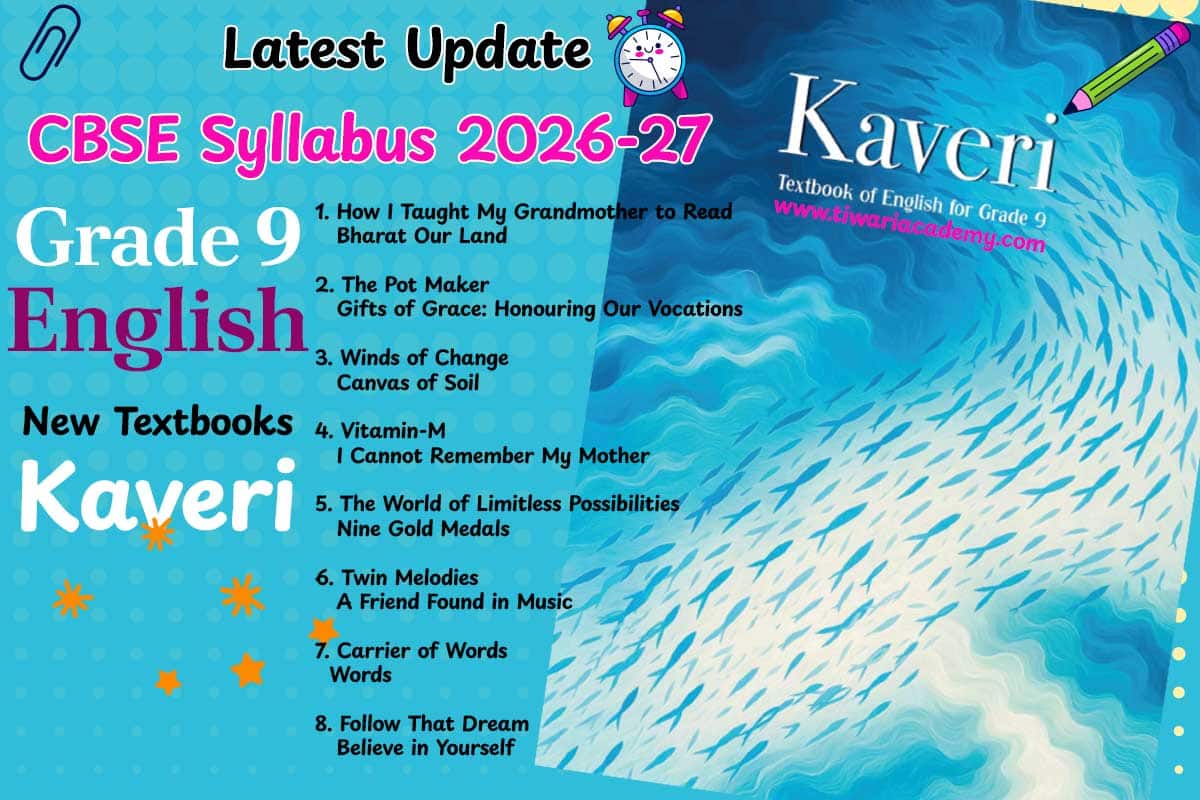
The Class 9 English Syllabus for Session 2026-27 has been redesigned under the National Education Policy (NEP) 2020 and the National Curriculum Framework for School Education (NCF-SE) 2023. Students moving into Grade 9 now work with a brand-new NCERT textbook called Kaveri, which replaces the earlier Beehive and Moments books. This guide covers the complete syllabus – from curricular goals and all eight Kaveri chapters to the assessment pattern – so students, parents and teachers know exactly what to expect this year.
Visit Tiwari Academy for chapter-wise NCERT Solutions for Class 9 English (Kaveri).

What Is the Class 9 English Syllabus 2026-27 Based On?

The revised syllabus is rooted in two key national documents:

  1. National Education Policy (NEP) 2020: Which restructures school education into a 5+3+3+4 design, placing Grade 9 at the start of the Secondary Stage (Phase I).
  2. National Curriculum Framework for School Education (NCF-SE) 2023: Which defines curricular goals, competencies and assessment approaches for each stage.

Under this framework, English in Grade 9 is taught as Language 2 (R2), meaning it sits between the student’s first Indian language (R1) and their third language (R3). The syllabus expects students to achieve linguistic proficiency for academic use in R2 by the end of Grade 10.
The overall emphasis moves away from memorisation toward:

  • Conceptual understanding of texts and language
  • Critical reading and active listening
  • Reasoned argumentation and informed debate
  • Creative and analytical writing across multiple formats.

Curricular Goals and Competencies for Class 9 English

The Class 9 English syllabus is organised around three Curricular Goals (CGs). These are skill-based learning targets that run across all units throughout the year – not chapter topics.

CG-1: Effective Communication

Students use English for a range of oral and written purposes in real-life contexts.

CompetencyWhat Students Learn to Do
C-1.1Discuss, debate, express agreements/disagreements with reasoning
C-1.2Write in narrative, descriptive, expository and persuasive styles
C-1.3Write for real-life needs – notices, invitations, advertisements, letters
C-1.4Use technology (presentations, infographics, podcasts) to communicate ideas

CG-2: Reasoning and Argumentation

Students engage critically with audio and written material to build logical thinking skills.

CompetencyWhat Students Learn to Do
C-2.1Analyse audio/written sources, identify key ideas and note details
C-2.2Apply logical reasoning, detect inconsistencies, evaluate cause and effect.

CG-3: Literary Appreciation and Creative Writing

Students develop sensitivity to literary genres and learn to write creatively using literary devices.

CompetencyWhat Students Learn to Do
C-3.1Read and appreciate literature from different genres and time periods
C-3.2Close-read texts; identify voice, style, point of view and possible meanings
C-3.3Identify and use literary devices โ€” simile, metaphor, imagery, irony, symbolism, alliteration, hyperbole, personification, foreshadowing and oxymoron


NCERT Kaveri Textbook – Class 9 English 2026-27

Kaveri is the official NCERT textbook of English for Grade 9, published in January 2026 (First Edition, priced at โ‚น145). Developed in alignment with NCF-SE 2023, it replaces the dual-book structure of Beehive and Moments with a single, integrated resource.
The textbook contains 8 thematic units. Each unit pairs one prose piece with one poem, linked by a common theme. Genres covered include:

  • Short stories
  • A documentary article
  • An interview
  • A play
  • An expository article
  • A formal letter (epistolary)
  • Eight poems across diverse styles and traditions

Texts are drawn from celebrated Indian authors โ€” including a Nobel Laureate, Padma Shri and Padma Bhushan awardees and Sahitya Akademi recipients โ€” alongside international writers, offering students a genuinely rich literary experience.

All Chapters and Poems in Kaveri – Class 9 English 2026-27

Chapter 1. How I Taught My Grandmother to Read

  • Prose: How I Taught My Grandmother to Read โ€” Sudha Murty (Padma Shri & Padma Bhushan)
  • Poem: Bharat Our Land โ€” Subramania Bharati
  • Theme: The joy of learning, intergenerational bonds and national pride

The prose piece follows a grandmother’s inspiring journey to achieve literacy, guided by her granddaughter, showing that learning leads to independence at any age. The poem evokes India’s natural grandeur, spiritual tradition and the enduring power of knowledge and self-belief.

Chapter 2. The Pot Maker

  • Prose: The Pot Maker โ€” Temsula Ao (Padma Shri & Sahitya Akademi Award)
  • Poem: Gifts of Grace: Honouring Our Vocations
  • Theme: Dignity of labour, traditional craftsmanship and quiet determination

A young girl pursues her passion for pottery despite social and physical barriers. The story explores intergenerational skill transfer and the dignity of traditional craftspersons. The companion poem is a lyrical tribute to skilled vocations โ€” from carpenters to boatmen โ€” celebrating artistry in sincere, honest work.

Chapter 3. Winds of Change

  • Prose: Winds of Change โ€” Expository article (Gaatha.com)
  • Poem: Canvas of Soil โ€” Maya Anthony
  • Theme: Cultural heritage, environment and art in daily life

This unit introduces students to the rich heritage of the traditional Indian pankha โ€” its craftsmanship, regional variations, and cultural symbolism. The poem uses vivid imagery to portray gardening as an artistic act, encouraging students to discover beauty in everyday nature.


Chapter 4. Vitamin-M

  • Prose: Vitamin-M โ€” Asha Nehemiah (Best in Indian Children’s Writing Award)
  • Poem: I Cannot Remember My Mother โ€” Rabindranath Tagore (Nobel Laureate)
  • Theme: Family ties, empathy for the elderly and the power of emotional memory

The story blends humour and concern to explore the evolving relationship between a boy and his grandfather, touching on dignity and independence. Tagore’s poem evokes childhood memories through sensory images โ€” sight, sound and fragrance โ€” showing how emotional memory keeps loved ones present even in absence.

Chapter 5. The World of Limitless Possibilities

  • Prose: The World of Limitless Possibilities โ€” Interview with Dr. Deepa Malik, Paralympic athlete
  • Poem: Nine Gold Medals โ€” David Roth
  • Theme: Resilience, inclusivity and what it truly means to win

The interview presents Dr. Malik’s remarkable journey from personal adversity to global acclaim, demonstrating how dignity and determination break every barrier. The poem captures a powerful moment of solidarity among special athletes who choose empathy over competition – affirming that real victory lies in lifting others.

Chapter 6. Twin Melodies

  • Prose: Twin Melodies (Play) โ€” Mitra Phukan (Katha Award for Translation)
  • Poem: A Friend Found in Music โ€” Bryanna T. Perkins
  • Theme: Music, tradition and the harmony of classical and contemporary forms

The play celebrates how music transcends boundaries of genre, generation and emotion, showing that classical roots and contemporary creativity can coexist beautifully. The poem portrays music as a dependable companion โ€” a personal and cultural language that nurtures identity and offers solace.

Chapter 7. Carrier of Words

  • Prose: Carrier of Words โ€” Documentary article
  • Poem: Words โ€” Charles Swain
  • Theme: Communication, trust and the responsibility that language carries

The documentary article portraits Khetaram, a Gramin Dak Sewak, whose physical journeys across the desert embody a deeper emotional mission โ€” linking families, sustaining hope and honouring trust. The poem reminds students that words only gain true value when they are sincere.

Chapter 8. Follow That Dream

  • Prose: Follow That Dream (Letter) โ€” Irene Chua
  • Poem: Believe in Yourself
  • Theme: Courage, self-belief and preparing for life’s challenges

A mother’s heartfelt letter to her teenage daughter, sharing wisdom and life lessons to help her navigate the world with confidence. It is a text every student can personally relate to. The closing poem affirms that real progress begins with trusting oneself and taking that first step.

Complete Chapter List – Kaveri Textbook at a Glance

UnitAuthor / SourcePoem Title
1. How I Taught My Grandmother to Read (Story)Sudha MurtyBharat Our Land
2. The Pot Maker (Story)Temsula AoGifts of Grace: Honouring Our Vocations
3. Winds of Change (Expository Article)GaathaCanvas of Soil
4. Vitamin-M (Story)Asha NehemiahI Cannot Remember My Mother
5. The World of Limitless Possibilities (Interview)Dr. Deepa MalikNine Gold Medals
6. Twin Melodies (Play)Mitra PhukanA Friend Found in Music
7. Carrier of Words (Documentary Article)–Words
8. Follow That Dream (Letter)Irene ChuaBelieve in Yourself

Structure of Each Chapter in the Kaveri Textbook

Each of the eight units follows a consistent pedagogical structure designed to make students active, independent learners.

  1. Reflect and Respond โ€” Opens every unit; students connect the theme with personal experience before reading.
  2. Reading for Meaning โ€” Encourages critical thinking, inference-drawing and active engagement with the text.
  3. Check Your Understanding โ€” A mid-text checkpoint ensuring comprehension before students proceed.
  4. Critical Reflection โ€” End-of-text questions progressing from factual recall to analysis and personal response.
  5. Vocabulary and Structures in Context โ€” Grammar and vocabulary arising naturally from each chapter’s theme.
  6. Speaking Activity โ€” Oral communication tasks rooted in the unit’s theme.
  7. Listen and Respond โ€” Structured listening tasks developing audio comprehension skills.
  8. Writing Task โ€” Diverse writing formats practised in meaningful, real-life contexts.
  9. Learning Beyond the Text โ€” Projects, presentations, research tasks and community-based experiences.

Each unit also includes QR codes linking to additional digital content and resources for extended learning.

Language Learning Approach and Pedagogy

The 2026-27 syllabus recommends an experiential and activity-based pedagogy. The goal is to make students active participants rather than passive listeners. Key pedagogical strategies include:

  • Pre-reading and post-reading activities for every text
  • Group discussions, classroom debates and structured role-play
  • Oral presentations, interviews, and public speaking exercises
  • Reflective and creative writing โ€” diaries, journals, short stories, poems
  • Project-based and portfolio-based continuous learning
  • Use of films, theatre, music, storytelling and cultural performances
  • Technology integration โ€” scripting podcasts, videos and infographics
  • Exposure to regional, national and international literary traditions

The syllabus stresses helping students make the shift from learning to read” to reading to learn – a transition that becomes natural when students engage genuinely with diverse genres and meaningful texts.

Assessment Pattern in 2026-27 for Class 9 English

The new assessment framework balances ongoing classroom feedback with structured end-of-year evaluation.

Formative Assessment (Ongoing Throughout the Year)

Formative assessments are low-stakes, feedback-driven and central to improving teaching and learning.

Assessment ToolPurpose
Projects (Individual & Group)Assess research, collaboration and communication
PortfoliosTrack writing progress and growth over time
Debates & DiscussionsEvaluate oral fluency, reasoning and argumentation
Role PlaysTest contextual and creative language use
Reflective JournalsConnect texts to personal experience and values
Oral PresentationsBuild structured speaking and listening skills
Graphic OrganisersAssess conceptual connections and idea mapping

Summative Assessment (End of Term / Year)

Assessment TypeDescription
Multiple Choice Questions (MCQs)Objective comprehension and reasoning questions
Constructed ResponsesShort and long answers requiring analysis and writing
Reading AloudTests word recognition, fluency and voice modulation
Listen and RespondStudents listen to a passage and respond orally or in writing
DebatesAssess argumentative fluency, diction and critical thinking
Open-Book TestsFocus on application and synthesis, not memorisation
Portfolio ReviewsCumulative evidence of learning and progress

The syllabus explicitly moves away from the one-size-fits-all model. Assessments are designed to accommodate diverse learners, provide timely constructive feedback and use Holistic Progress Cards (HPCs) to capture a multi-dimensional picture of each student’s development.


Old Syllabus vs New Syllabus 2026-27 – Key Differences

AspectOld SyllabusNew Syllabus 2026-27
TextbooksBeehive + Moments (two books)Kaveri (single integrated textbook)
Policy FrameworkEarlier curriculumNEP 2020 + NCF-SE 2023
Learning FocusContent recall and reproductionCompetency-based, skill-driven learning
Genres CoveredStories and poemsStory, poem, play, interview, documentary article, letter
AssessmentPrimarily written examsFormative + Summative (projects, portfolios, open-book)
PedagogyTeacher-centredExperiential, discussion-based, student-centred
TechnologyLimitedQR codes, podcast scripting, video and infographic creation
Cultural IntegrationSome Indian textsDeep integration – IKS, regional literature, heritage themes

Cross-Cutting Themes in Class 9 English 2026-27

The following themes are woven across all eight units in Kaveri. They are not standalone chapters but are embedded in the stories, poems and activities throughout the book:

  • Indian Knowledge Systems (IKS): connecting modern learning with India’s intellectual traditions
  • Gender sensitivity and inclusion: Equitable representation across texts and activities
  • Environmental awareness: Conservation, ecology and responsible citizenship
  • Cultural heritage and linguistic diversity: Regional literature, crafts, traditions
  • Core values: Empathy, resilience, dignity, compassion and social responsibility
  • Digital and financial literacy: Practical life skills integrated across content
  • Scientific temper and evidence-based thinking: Critical reasoning and inquiry

NCERT Class 9 English (Kaveri) at Tiwari Academy

Working through Kaveri’s eight units becomes more effective when students have access to reliable, well-structured academic support. Tiwari Academy provides NCERT Solutions for Class 9 English that are:

  • Fully updated for the new Kaveri textbook (Session 2026-27)
  • Written in clear, student-friendly language
  • Aligned with all three Curricular Goals of the NCF-SE 2023
  • Covering all prose, poems, vocabulary tasks, grammar sections and writing activities unit by unit

Whether a student is answering comprehension questions from Sudha Murty’s story in Unit 1, interpreting sensory imagery in Tagore’s poem in Unit 4 or writing a formal letter inspired by Unit 8, Tiwari Academy’s solutions provide reliable guidance that builds genuine understanding.
Explore all chapter-wise solutions here: Class 9 English Kaveri Question Answers

Frequently Asked Questions (FAQs) – Class 9 English Syllabus

What is the name of the new Class 9 English textbook for 2026-27?

The new NCERT textbook for Class 9 English is Kaveri, published in January 2026 (First Edition). It replaces the earlier Beehive and Moments textbooks and contains 8 units, each pairing one prose piece with one poem.

How many chapters are there in the Kaveri textbook?

Kaveri has 8 units. Each unit consists of one prose piece – a story, article, interview, play or letter – and one poem. Students engage with a total of 8 prose pieces and 8 poems across a wide range of genres and themes.

Are Beehive and Moments still part of the Class 9 English syllabus?

No. From the current session, Beehive and Moments are no longer prescribed for Class 9 English. They have been replaced by the single integrated textbook Kaveri, developed in accordance with NCF-SE 2023. Students and teachers should refer only to Kaveri this year.

What are the three Curricular Goals for Class 9 English?

The three Curricular Goals defined in the updated syllabus are:

  • CG-1 โ€” Effective Communication through oral and written activities including discussions, essays, letters and new media
  • CG-2 โ€” Reasoning and Argumentation by engaging critically with audio and written material
  • CG-3 โ€” Literary Appreciation and Creative Writing through an analysis of genres, styles and literary devices.

Which authors are featured in the Kaveri textbook?

Kaveri includes texts by several celebrated authors. Key contributors include:

  • Sudha Murty (Padma Shri & Padma Bhushan) โ€” How I Taught My Grandmother to Read
  • Rabindranath Tagore (Nobel Laureate) โ€” I Cannot Remember My Mother
  • Temsula Ao (Padma Shri & Sahitya Akademi Award) โ€” The Pot Maker
  • Subramania Bharati โ€” Bharat Our Land
  • Asha Nehemiah (BICW Award) โ€” Vitamin-M
  • Mitra Phukan (Katha Award) โ€” Twin Melodies
  • Irene Chua โ€” Follow That Dream
  • David Roth โ€” Nine Gold Medals

What is the assessment pattern for Class 9 English?

The assessment structure includes two components:

  1. Formative Assessment โ€” Ongoing, low-stakes tools such as projects, portfolios, debates, role plays, reflective journals, oral presentations and group discussions.
  2. Summative Assessment โ€” End-of-term evaluations including MCQs, constructed responses, reading aloud, listening tasks, open-book tests and portfolio reviews.

The updated syllabus discourages rote-based testing and promotes competency-based evaluation aligned with the three Curricular Goals.

Is the new Class 9 English syllabus based on NEP 2020?

Yes. The new syllabus is fully aligned with the National Education Policy (NEP) 2020 and operationalised through the National Curriculum Framework for School Education (NCF-SE) 2023. It reflects NEP’s emphasis on multilingualism, holistic development, 21st-century skills, and a shift from content-heavy to competency-based education.

Where can I find NCERT Solutions for the Kaveri textbook?

Chapter-wise NCERT Solutions for all 8 units of Kaveri are available at Tiwari Academy Class 9 English, fully updated for the current session and covering all prose pieces, poems, vocabulary sections, grammar tasks and writing activities.

What literary devices are taught through the Kaveri textbook?

Under Curricular Goal 3 (CG-3), students learn to identify and use the following literary devices across the prose and poetry units:

  • Simile and Metaphor
  • Personification and Hyperbole
  • Alliteration and Assonance
  • Imagery and Symbolism
  • Irony and Oxymoron
  • Foreshadowing and Allegory
  • Repetition and Parallelism
  • Rhyme and Rhythm (in poetry)

What cross-cutting themes are integrated across the Kaveri units?

The following themes are woven naturally across all eight units rather than taught as separate topics:

  • Indian Knowledge Systems (IKS)
  • Gender sensitivity and inclusive representation
  • Environmental awareness and conservation
  • Cultural heritage and linguistic diversity of India
  • Core values โ€” empathy, resilience, dignity and social responsibility
  • Digital literacy, financial literacy and citizenship skills
  • Scientific temper and evidence-based reasoning

Conclusion

The Class 9 English Syllabus 2026-27 marks a meaningful shift in how English is taught at the secondary level in India. Grounded in NEP 2020 and NCF-SE 2023, the updated curriculum moves decisively away from rote learning toward a model built on genuine competence – reading critically, writing purposefully, speaking confidently and thinking independently.

The new NCERT textbook Kaveri is at the heart of this change. Its eight carefully curated units bring together stories, poems, a play, an interview, a documentary article, a letter and an expository article from some of India’s finest literary voices โ€” Sudha Murty, Rabindranath Tagore, Temsula Ao and Subramania Bharati โ€” alongside celebrated international authors. Together, they offer Grade 9 students a rich, culturally rooted, and intellectually stimulating English learning experience.

For students, the key takeaway is this: engaging sincerely with Kaveri’s themes, activities and literary pieces โ€” rather than just preparing answers for exams โ€” will build skills that last well beyond the classroom. For parents and teachers, understanding the three Curricular Goals, the unit structure and the balanced assessment pattern helps in providing the right support at the right time.
For chapter-wise NCERT Solutions for all 8 units of the Kaveri textbook, visit Tiwari Academy.

Recent Posts
  • NCERT Solutions for Class 10 Maths 2026-27 – Welcome to Your New Session
  • CBSE Class 10 English Exam Paper 2026: Solutions, Answer Key & Analysis
  • CBSE Class 10 Science Board Exam Paper 2026: Complete Solutions and Answer Key
  • Class 10 Maths CBSE Exam Paper 2026 Solutions
  • Class 9 Maths Chapter 6 Lines and Angles Preparation


Important Links
  • What is NCERT?
  • Important Questions
  • Vedic Maths Tricks
  • Link Study Materials
  • Useful Resources & Formulae
  • Holiday Homework Solutions


Buy NCERT Books Online

NCERT Books for 2026-27

NCERT Solutions
  • NCERT Solutions for Class 6 Maths
  • NCERT Solutions for Class 7 Maths
  • NCERT Solutions for Class 8 Maths
  • NCERT Solutions for Class 11 Maths
  • NCERT Solutions for Class 12 Maths
  • NCERT Solutions for Class 11 Physics
  • NCERT Solutions for Class 12 Physics


High School
  • Class 9 NCERT Maths Solutions
  • Class 9 NCERT Science Solutions
  • Class 9 NCERT English Solutions
  • Class 10 NCERT Maths Solutions
  • Class 10 NCERT Science Solutions
  • Class 10 NCERT English Solutions
  • Class 10 NCERT Social Solutions

Quick Links
  • NCERT Books
  • NCERT Solutions
  • CBSE Syllabus
  • Home Tutors
  • NIOS Admissions
  • CBSE Sample Papers
  • Vedic Maths Tricks
Help & Support
  • About Us
  • Contact Us
  • Advertise With Us
  • Discussion
  • Latest Blogs
  • Holiday Homework
  • Useful Resources
Copyright 2026 by Tiwari Academy | A step towards Free Education
facebook
twitter
linkedin
youtube
instagram
pinterest
google-news