
Tiwari Academy  – Free CBSE NCERT Books and Solutions
  • Apps
    • CBSE Apps
    • Hast Rekha App
  • NCERT Solutions
    • NCERT Solutions for Class 12
      • NCERT Solutions for Class 12 Maths
      • NCERT Solutions for Class 12 Physics
      • NCERT Solutions for Class 12 Chemistry
      • NCERT Solutions for Class 12 Biology
      • NCERT Solutions for Class 12 English
      • NCERT Solutions for Class 12 Accounts
      • NCERT Solutions for Class 12 Business Studies
      • NCERT Solutions for Class 12 Economics
      • NCERT Solutions for Class 12 Geography
      • NCERT Solutions for Class 12 Physical Education
      • NCERT Solutions for Class 12 Political Science
      • NCERT Solutions for Class 12 Psychology
      • NCERT Solutions for Class 12 Sociology
    • NCERT Solutions for Class 11
      • NCERT Solutions for Class 11 Maths
      • NCERT Solutions for Class 11 Physics
      • NCERT Solutions for Class 11 Chemistry
      • NCERT Solutions for Class 11 Biology
      • NCERT Solutions for Class 11 English
      • NCERT Solutions for Class 11 Business Studies
      • NCERT Solutions for Class 11 Sociology
      • NCERT Solutions for Class 11 Political Science
      • NCERT Solutions for Class 11 Psychology
      • NCERT Solutions for Class 11 Physical Education
    • NCERT Solutions for Class 10
      • NCERT Solutions for Class 10 Maths
      • NCERT Solutions for Class 10 Science
      • NCERT Solutions for Class 10 English
      • NCERT Solutions for Class 10 Hindi Course A and B
      • NCERT Solutions for Class 10 Sanskrit
      • NCERT Solutions for Class 10 Social Science
    • NCERT Solutions for Class 9
      • NCERT Solutions for Class 9 Maths
      • NCERT Solutions for Class 9 Science
      • NCERT Solutions for Class 9 English
      • NCERT Solutions for Class 9 Hindi
      • NCERT Solutions for Class 9 Sanskrit
      • NCERT Solutions for Class 9 Social Science
    • NCERT Solutions for Class 8
      • NCERT Solutions for Class 8 Maths
      • NCERT Solutions for Class 8 Science
      • NCERT Solutions for Class 8 English
      • NCERT Solutions for Class 8 Hindi
      • NCERT Solutions for Class 8 Sanskrit
      • NCERT Solutions for Class 8 Social Science
      • NCERT Solutions for Class 8 Computer
    • NCERT Solutions for Class 7
      • NCERT Solutions for Class 7 Maths
      • NCERT Solutions for Class 7 Science
      • NCERT Solutions for Class 7 English
      • NCERT Solutions for Class 7 Hindi
      • NCERT Solutions for Class 7 Sanskrit
      • NCERT Solutions for Class 7 Social Science
      • NCERT Solutions for Class 7 Computer
    • NCERT Solutions for Class 6
      • NCERT Solutions for Class 6 Maths
      • NCERT Solutions for Class 6 Science
      • NCERT Solutions for Class 6 English
      • NCERT Solutions for Class 6 Hindi
      • NCERT Solutions for Class 6 Sanskrit
      • NCERT Solutions for Class 6 Social Science
      • NCERT Solutions for Class 6 Computer
    • NCERT Solutions for Class 5
      • NCERT Solutions for Class 5 Hindi
      • NCERT Solutions for Class 5 English
      • NCERT Solutions for Class 5 Maths
      • NCERT Solutions for Class 5 EVS
      • NCERT Solutions for Class 5 Computer
      • NCERT Solutions for Class 5 GK
    • NCERT Solutions for Class 4
      • NCERT Solutions for Class 4 Hindi
      • NCERT Solutions for Class 4 English
      • NCERT Solutions for Class 4 Maths
      • NCERT Solutions for Class 4 EVS
      • NCERT Solutions for Class 4 Computer
      • NCERT Solutions for Class 4 GK
    • NCERT Solutions for Class 3
      • NCERT Solutions for Class 3 Hindi
      • NCERT Solutions for Class 3 English
      • NCERT Solutions for Class 3 Maths
      • NCERT Solutions for Class 3 EVS
      • NCERT Solutions for Class 3 Science
      • NCERT Solutions for Class 3 Computer
      • NCERT Solutions for Class 3 GK
    • NCERT Solutions for Class 2
      • NCERT Solutions for Class 2 Hindi
      • NCERT Solutions for Class 2 English
      • NCERT Solutions for Class 2 Maths
      • NCERT Solutions for Class 2 EVS
      • NCERT Solutions for Class 2 Science
      • NCERT Solutions for Class 2 Computer
      • NCERT Solutions for Class 2 GK
    • NCERT Solutions for Class 1
      • NCERT Solutions for Class 1 Hindi
      • NCERT Solutions for Class 1 English
      • NCERT Solutions for Class 1 Maths
      • NCERT Solutions for Class 1 EVS
      • NCERT Solutions for Class 1 Computer
      • NCERT Solutions for Class 1 Science
      • NCERT Solutions for Class 1 GK
    • Study Material for KG
      • Study Material for KG English
      • Study Material for KG Hindi
      • Study Material for KG Maths
    • Study Material for Nursery
      • Study Material for Nursery Maths
      • Study Material for Nursery English
      • Study Material for Nursery Hindi
  • MCQ
  • NEWS
    • Educational NEWS
    • Explore More
  • Grammar
    • Class 1 English Grammar
      • Class 1 Hindi Vyakaran
    • Class 2 English Grammar
      • Class 2 Hindi Vyakaran
    • Class 3 English Grammar
      • Class 3 Hindi Vyakaran
    • Class 4 English Grammar
      • Class 4 Hindi Vyakaran
    • Class 5 English Grammar
      • Class 5 Hindi Vyakaran
    • Class 6 English Grammar
      • Class 6 Hindi Vyakaran
    • Class 7 English Grammar
      • Class 7 Hindi Vyakaran
    • Class 8 English Grammar
      • Class 8 Hindi Vyakaran
  • Sample Papers
    • CBSE Sample Papers for Class 9
    • CBSE Sample Papers for Class 10
    • CBSE Sample Papers for Class 11
    • CBSE Sample Papers for Class 12
  • NCERT Books
    • NCERT Books for Class 1 All Subjects
    • NCERT Books for Class 2 All Subjects
    • NCERT Books for Class 3 All Subjects
    • NCERT Books for Class 4 All Subjects
    • NCERT Books for Class 5 All Subjects
    • NCERT Books for Class 6 All Subjects
    • NCERT Books for Class 7 All Subjects
    • NCERT Books for Class 8 All Subjects
    • NCERT Books for Class 9 All Subjects
    • NCERT Books for Class 10 All Subjects
    • NCERT Books for Class 11 All Subjects
    • NCERT Books for Class 12 All Subjects
  • Syllabus
    • CBSE Date Sheet 2025
    • CBSE Syllabus
    • NCERT Exemplar
    • What is NIOS?
    • NIOS Online Admission
  • Contact
    • Contact Us
    • About Us
    • Online Tutors
    • Career Options
  • Apps
    • CBSE Apps
    • Hast Rekha App
  • NCERT Solutions
    • NCERT Solutions for Class 12
      • NCERT Solutions for Class 12 Maths
      • NCERT Solutions for Class 12 Physics
      • NCERT Solutions for Class 12 Chemistry
      • NCERT Solutions for Class 12 Biology
      • NCERT Solutions for Class 12 English
      • NCERT Solutions for Class 12 Accounts
      • NCERT Solutions for Class 12 Business Studies
      • NCERT Solutions for Class 12 Economics
      • NCERT Solutions for Class 12 Geography
      • NCERT Solutions for Class 12 Physical Education
      • NCERT Solutions for Class 12 Political Science
      • NCERT Solutions for Class 12 Psychology
      • NCERT Solutions for Class 12 Sociology
    • NCERT Solutions for Class 11
      • NCERT Solutions for Class 11 Maths
      • NCERT Solutions for Class 11 Physics
      • NCERT Solutions for Class 11 Chemistry
      • NCERT Solutions for Class 11 Biology
      • NCERT Solutions for Class 11 English
      • NCERT Solutions for Class 11 Business Studies
      • NCERT Solutions for Class 11 Sociology
      • NCERT Solutions for Class 11 Political Science
      • NCERT Solutions for Class 11 Psychology
      • NCERT Solutions for Class 11 Physical Education
    • NCERT Solutions for Class 10
      • NCERT Solutions for Class 10 Maths
      • NCERT Solutions for Class 10 Science
      • NCERT Solutions for Class 10 English
      • NCERT Solutions for Class 10 Hindi Course A and B
      • NCERT Solutions for Class 10 Sanskrit
      • NCERT Solutions for Class 10 Social Science
    • NCERT Solutions for Class 9
      • NCERT Solutions for Class 9 Maths
      • NCERT Solutions for Class 9 Science
      • NCERT Solutions for Class 9 English
      • NCERT Solutions for Class 9 Hindi
      • NCERT Solutions for Class 9 Sanskrit
      • NCERT Solutions for Class 9 Social Science
    • NCERT Solutions for Class 8
      • NCERT Solutions for Class 8 Maths
      • NCERT Solutions for Class 8 Science
      • NCERT Solutions for Class 8 English
      • NCERT Solutions for Class 8 Hindi
      • NCERT Solutions for Class 8 Sanskrit
      • NCERT Solutions for Class 8 Social Science
      • NCERT Solutions for Class 8 Computer
    • NCERT Solutions for Class 7
      • NCERT Solutions for Class 7 Maths
      • NCERT Solutions for Class 7 Science
      • NCERT Solutions for Class 7 English
      • NCERT Solutions for Class 7 Hindi
      • NCERT Solutions for Class 7 Sanskrit
      • NCERT Solutions for Class 7 Social Science
      • NCERT Solutions for Class 7 Computer
    • NCERT Solutions for Class 6
      • NCERT Solutions for Class 6 Maths
      • NCERT Solutions for Class 6 Science
      • NCERT Solutions for Class 6 English
      • NCERT Solutions for Class 6 Hindi
      • NCERT Solutions for Class 6 Sanskrit
      • NCERT Solutions for Class 6 Social Science
      • NCERT Solutions for Class 6 Computer
    • NCERT Solutions for Class 5
      • NCERT Solutions for Class 5 Hindi
      • NCERT Solutions for Class 5 English
      • NCERT Solutions for Class 5 Maths
      • NCERT Solutions for Class 5 EVS
      • NCERT Solutions for Class 5 Computer
      • NCERT Solutions for Class 5 GK
    • NCERT Solutions for Class 4
      • NCERT Solutions for Class 4 Hindi
      • NCERT Solutions for Class 4 English
      • NCERT Solutions for Class 4 Maths
      • NCERT Solutions for Class 4 EVS
      • NCERT Solutions for Class 4 Computer
      • NCERT Solutions for Class 4 GK
    • NCERT Solutions for Class 3
      • NCERT Solutions for Class 3 Hindi
      • NCERT Solutions for Class 3 English
      • NCERT Solutions for Class 3 Maths
      • NCERT Solutions for Class 3 EVS
      • NCERT Solutions for Class 3 Science
      • NCERT Solutions for Class 3 Computer
      • NCERT Solutions for Class 3 GK
    • NCERT Solutions for Class 2
      • NCERT Solutions for Class 2 Hindi
      • NCERT Solutions for Class 2 English
      • NCERT Solutions for Class 2 Maths
      • NCERT Solutions for Class 2 EVS
      • NCERT Solutions for Class 2 Science
      • NCERT Solutions for Class 2 Computer
      • NCERT Solutions for Class 2 GK
    • NCERT Solutions for Class 1
      • NCERT Solutions for Class 1 Hindi
      • NCERT Solutions for Class 1 English
      • NCERT Solutions for Class 1 Maths
      • NCERT Solutions for Class 1 EVS
      • NCERT Solutions for Class 1 Computer
      • NCERT Solutions for Class 1 Science
      • NCERT Solutions for Class 1 GK
    • Study Material for KG
      • Study Material for KG English
      • Study Material for KG Hindi
      • Study Material for KG Maths
    • Study Material for Nursery
      • Study Material for Nursery Maths
      • Study Material for Nursery English
      • Study Material for Nursery Hindi
  • MCQ
  • NEWS
    • Educational NEWS
    • Explore More
  • Grammar
    • Class 1 English Grammar
      • Class 1 Hindi Vyakaran
    • Class 2 English Grammar
      • Class 2 Hindi Vyakaran
    • Class 3 English Grammar
      • Class 3 Hindi Vyakaran
    • Class 4 English Grammar
      • Class 4 Hindi Vyakaran
    • Class 5 English Grammar
      • Class 5 Hindi Vyakaran
    • Class 6 English Grammar
      • Class 6 Hindi Vyakaran
    • Class 7 English Grammar
      • Class 7 Hindi Vyakaran
    • Class 8 English Grammar
      • Class 8 Hindi Vyakaran
  • Sample Papers
    • CBSE Sample Papers for Class 9
    • CBSE Sample Papers for Class 10
    • CBSE Sample Papers for Class 11
    • CBSE Sample Papers for Class 12
  • NCERT Books
    • NCERT Books for Class 1 All Subjects
    • NCERT Books for Class 2 All Subjects
    • NCERT Books for Class 3 All Subjects
    • NCERT Books for Class 4 All Subjects
    • NCERT Books for Class 5 All Subjects
    • NCERT Books for Class 6 All Subjects
    • NCERT Books for Class 7 All Subjects
    • NCERT Books for Class 8 All Subjects
    • NCERT Books for Class 9 All Subjects
    • NCERT Books for Class 10 All Subjects
    • NCERT Books for Class 11 All Subjects
    • NCERT Books for Class 12 All Subjects
  • Syllabus
    • CBSE Date Sheet 2025
    • CBSE Syllabus
    • NCERT Exemplar
    • What is NIOS?
    • NIOS Online Admission
  • Contact
    • Contact Us
    • About Us
    • Online Tutors
    • Career Options
हिंदी मीडियमहिंदी मीडियम Latest BlogsLatest Blogs Ask QuestionsAsk Questions
Tiwari Academy  /  Latest News  /  Class 9 Science Syllabus 2026-27: Complete Guide to Chapters, Topics & Learning Outcomes

Class 9 Science Syllabus 2026-27: Complete Guide to Chapters, Topics & Learning Outcomes

Class 9 Science Syllabus 2026-27
Post Date: March 30, 2026

The Class 9 Science Syllabus for Session 2026-27 represents one of the most significant curriculum reforms at the secondary school level in India. Developed under the National Curriculum Framework for School Education (NCF-SE 2023) and shaped by the transformative vision of the National Education Policy (NEP 2020), this syllabus moves firmly away from rote memorisation toward genuine scientific understanding, inquiry-based learning, and real-world application.
For students entering Grade 9, this syllabus sets the foundation for two years of integrated science education. Understanding its structure, chapters, key concepts, and expected competencies is the most important first step toward effective preparation. This comprehensive guide covers everything you need to know — chapter by chapter, concept by concept. Students who want to stay ahead can also refer to chapter-wise NCERT Solutions for Class 9 Science to strengthen their understanding alongside this syllabus overview.

What Is New in This Year’s Science Syllabus?

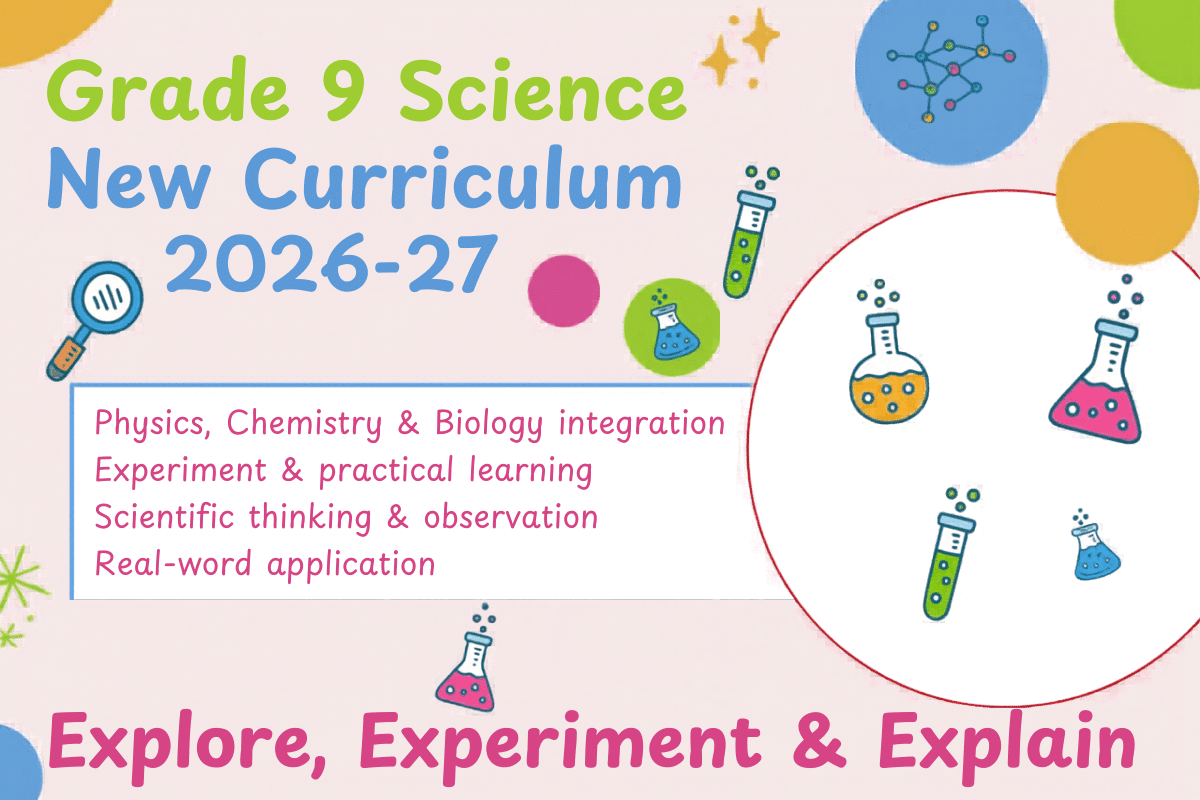
The updated curriculum brings a fundamentally different philosophy to science education. Rather than covering isolated facts, it builds eight broad Curricular Goals (CGs) supported by specific Competencies (Cs) and granular Learning Outcomes (LOs). Science in Grades 9 and 10 is taught as a single integrated subject drawing from Biology, Chemistry, Physics and Earth Science — helping students see connections across disciplines rather than studying each in isolation.
The NEP 2020 and NCF-SE 2023 together envision science classrooms that encourage curiosity, creativity, collaboration and connection with the real world. The goal is not just to produce future scientists, but responsible, critically thinking citizens.

Key Features of the Updated Syllabus

FeatureDetail
Curriculum FrameworkNCF-SE 2023 aligned with NEP 2020
ApproachIntegrated – Biology, Chemistry, Physics, Earth Science
Total Annual Hours130 Hours
Total Annual Periods162 Periods of 50 minutes each
Block Periods100 minutes for lab and hands-on work
TextbookNew NCERT Science Textbook for Grade 9
Assessment StyleCompetency-based, Formative + Summative

Class 9 Science Chapters – Complete List at a Glance

Before diving into individual chapters, here is a bird’s-eye view of the entire syllabus. The course begins with an Introductory Theme of 10 periods, followed by 12 main chapters totalling 162 periods.

Topics / ChaptersSubject AreaPeriods
0. Introductory ThemeGeneral Science10
1. CellBiology12
2. TissuesBiology13
3. ReproductionBiology13
4. DiversityBiology12
5. Exploring Mixtures and Their SeparationChemistry12
6. Structure of an AtomChemistry14
7. Atoms and MoleculesChemistry14
8. Earth as a System: Energy, Matter and LifeEarth Science12
9. MotionPhysics13
10. Force and Laws of MotionPhysics13
11. Work, Energy and Simple MachinesPhysics13
12. SoundPhysics11
Total–162

Curricular Goals and Competencies – The Learning Framework

The Class 9 Science syllabus is not simply a list of topics. It is built around a structured learning framework of four levels — Curricular Aims, Curricular Goals, Competencies, and Learning Outcomes. Understanding this framework helps students focus on what they are truly expected to achieve, rather than just what they need to memorise.
The eight Curricular Goals (CGs) that govern the entire Grade 9 and 10 science curriculum are:

GoalDescription
CG-1Explores the world of matter, its interactions, and properties at the atomic level
CG-2Explores the physical world and understands scientific principles based on observations
CG-3Explores structure and function of the living world at the cellular level
CG-4Explores interconnectedness between organisms and their environment
CG-5Draws linkages between scientific knowledge and other curricular areas
CG-6Appreciates India’s contribution to science through history and the present
CG-7Develops awareness of current scientific discoveries and frontiers
CG-8Explores the nature of science by doing science

These goals are interdependent — they are not to be viewed in isolation. A single chapter may address multiple Curricular Goals simultaneously, which is what makes this syllabus genuinely integrated rather than compartmentalised.

Chapter-wise Syllabus of Class 9 Science

Chapter 1. Cell

Subject: Biology | Periods: 12 | Key Competencies: C-3.1, C-3.2, C-3.3

The science journey of Grade 9 begins with the cell — the fundamental structural and functional unit of all life. This chapter builds the biological foundation on which all subsequent life science chapters rest. Students are introduced to the discovery of the cell and progress through a detailed exploration of its structure and functions.

Key Topics Covered

  • Discovery of cell; plant and animal cells
  • Prokaryotic and eukaryotic cells
  • Structure and function of key organelles — nucleus, mitochondria, chloroplast, endoplasmic reticulum, vacuoles, plasma membrane and cell wall
  • Permeability of cell membranes
  • Cellular division — mitosis and meiosis — and their link to cancer
  • Recent advancements in cell biology

What Students Will Learn

By the end of this chapter, students will be able to:

  1. Differentiate between plant and animal cells, and between prokaryotes and eukaryotes
  2. Describe the structural and functional features of cells and their organelles
  3. Demonstrate osmosis experimentally and prepare slides to observe cell structure
  4. Explain the role of mitosis and meiosis in creating biological similarities and variations
  5. Identify the role of biomolecules in the structure and function of the cell

India Connection: This chapter highlights the significant contributions of Professor Arun Kumar Sharma for his groundbreaking work on chromosomes and methods for chromosome studies.
Frontier Question for Students: Can we create an artificial cell that behaves exactly like a natural living cell?

Chapter 2. Tissues

Subject: Biology | Periods: 13 | Key Competency: C-4.2

Building naturally on Chapter 1, this chapter explores how cells organise into groups to form the structural basis of multicellular organisms. It covers both plant and animal tissues in considerable depth and connects biology directly to physical health and fitness.


Key Topics Covered

Plant Tissues:

  • Meristematic tissues – types and functions
  • Permanent tissues – parenchyma, collenchyma, sclerenchyma
  • Complex permanent tissues – xylem and phloem

Animal Tissues:

  • Epithelial tissue
  • Connective tissue
  • Muscular tissue — striated, smooth, and cardiac
  • Nervous tissue
  • Elementary idea of the musculoskeletal system and types of joints
  • Care of musculoskeletal system – injuries, posture, nutrition and exercise

What Students Will Learn

Students will relate the structure of each tissue type to its function, describe levels of organisation in a multicellular organism and establish connections between tissue function and physical fitness — for example, understanding how muscles, cartilage and bones work together to facilitate movement.

India Connection: The importance of yoga in maintaining physical agility and correct posture is discussed here. The chapter also acknowledges the contributions of Professor Sipra Guha Mukherjee and Professor S.C. Maheshwari to plant tissue culture research in India.

Chapter 3. Reproduction

Subject: Biology | Periods: 13 | Key Competencies: C-3.2, C-3.3, C-4.3

Reproduction is one of the most comprehensive and socially relevant chapters in this syllabus. It addresses reproduction at both the plant and human level, with particular attention to reproductive health — making it both scientifically rich and personally meaningful for students.

Key Topics Covered

  • Introduction to sexual and asexual reproduction
  • Types of asexual reproduction with examples
  • Sexual reproduction in flowering plants – flower parts, pollination, fertilisation and seed dispersal
  • Sexual reproduction in humans – structure and function of male and female reproductive systems, formation of gametes, fertilisation, pregnancy, embryo development and the menstrual cycle
  • Reproductive health and hygiene
  • Introduction to birth control methods and their importance

What Students Will Learn

The key learning outcomes for this chapter include:

  1. Comparing asexual and sexual reproduction across organisms
  2. Describing male and female reproductive organs in plants and animals
  3. Explaining pollination, fertilisation, and the role of biotic and abiotic agents in seed dispersal
  4. Understanding how sexual reproduction introduces genetic variation
  5. Recognising the significance of contraceptive methods for population control and reproductive health

India Connection: India’s contribution to the understanding of human anatomy is highlighted, along with the foundational work of Professor Panchanan Maheshwari in plant reproduction and tissue culture research.

Chapter 4. Diversity

Subject: Biology | Periods: 12 | Key Competency: C-4.1

How do we make sense of the enormous variety of life on Earth? This chapter addresses that fundamental biological question by introducing systematic classification. It moves from the importance of classification to the practical application of binomial nomenclature, giving students both the conceptual framework and the tools to organise the living world.

Key Topics Covered

  • Importance of biological classification
  • Five kingdoms and their key features with examples
  • Major divisions of animals and plants
  • Binomial nomenclature — significance and rules
  • Acellular entities: viruses

What Students Will Learn

Students will classify organisms based on their cellular organisation, number of cells and mode of nutrition. They will apply binomial nomenclature to organisms in their surroundings and analyse fascinating ecological relationships such as those seen in lichens. The chapter also introduces the three-domain classification system based on molecular data – offering a glimpse into cutting-edge taxonomy.

Chapter 5. Exploring Mixtures and Their Separation

Subject: Chemistry | Periods: 12 | Key Competency: C-1.2

The syllabus transitions to Chemistry with this deeply practical chapter. Everyday substances — from saltwater to milk – are mixtures and understanding how to classify, characterise and separate them is a fundamental chemical skill. This chapter is both conceptually clear and experimentally rich.


Key Topics Covered

TopicSubtopics
Types of MixturesHomogeneous, Heterogeneous
Types of SolutionsSolutions, Suspensions, Colloids
Concentration of SolutionsMass/mass %, Mass/volume %, Volume/volume %
Separation TechniquesCrystallisation, Distillation, Paper Chromatography, Sublimation, Centrifugation, Coagulation

What Students Will Learn

Students will classify mixtures, demonstrate all six separation techniques, calculate solution concentrations, analyse solubility graphs and relate these techniques to real-life practices in their local environment. Safe handling of laboratory chemicals and apparatus is also an important learning outcome of this chapter.

India Connection: Traditional Indian distillation practices are discussed, alongside the contributions of Dilip Mahalanabis to science. An interesting cross-disciplinary connection is drawn between the physics of centrifugation and spinning movements in classical dance forms.

Chapter 6. Structure of an Atom

Subject: Chemistry | Periods: 14 | Key Competency: C-1.1

This is one of the most conceptually demanding and historically fascinating chapters in the entire Grade 9 science curriculum. It traces the evolution of our understanding of the atom — from early models to the modern picture – giving students not just scientific knowledge but a sense of how that knowledge was painstakingly built over centuries.

Key Topics Covered

  • Atoms as basic units of elements
  • Subatomic particles – electrons, protons, neutrons
  • Development of atomic models:
    • Thomson’s Plum Pudding Model
    • Rutherford’s Nuclear Model
    • Bohr’s Planetary Model
  • Distribution of electrons in shells (K, L, M, N) for elements up to atomic number 18
  • Valency as combining capacity
  • Atomic number, mass number, isotopes and isobars

What Students Will Learn

By the end of this chapter, students will calculate the number of subatomic particles from atomic and mass numbers, explain the historical development of atomic models, draw electron distribution diagrams, and apply IUPAC chemical symbols for the first 18 elements correctly.

India Connection: The chapter draws a proud connection to Acharya Kanad’s ancient concept of indivisible particles — Parmanu — which predates modern atomic theory by centuries. Students also explore how isotopes are used in medicine and how atomic energy contributes to power generation.

Frontier Question: Is it possible to completely understand everything that happens inside an atom?

Chapter 7. Atoms and Molecules

Subject: Chemistry | Periods: 14 | Key Competency: C-1.1

Closely linked to Chapter 6, this chapter establishes the fundamental laws governing how atoms combine and how matter is organised at the chemical level. It provides the language — symbols, formulae and equations — that students will use throughout their study of chemistry.

Key Topics Covered

  • Law of Conservation of Mass
  • Law of Constant Proportion
  • Dalton’s Atomic Theory
  • Molecules of elements and covalent compounds
  • Ions and ionic compounds
  • Writing chemical formulae using valency
  • Molecular mass and formula unit mass

What Students Will Learn

Students will verify the Law of Conservation of Mass experimentally, write and interpret chemical formulae, calculate molecular and formula unit mass and draw electron dot structures. The contributions of Antoine Lavoisier, Joseph Proust and John Dalton to the development of these laws are woven into the narrative, helping students understand science as a human endeavour built over generations.

Chapter 8. Earth as a System: Energy, Matter and Life

Subject: Earth Science | Periods: 12 | Key Competency: C-2.8

This chapter offers one of the most holistic perspectives in the entire syllabus. It presents the Earth not as a collection of separate systems but as one deeply interconnected whole — where the atmosphere, biosphere, hydrosphere, geosphere and cryosphere constantly interact with each other and with solar energy.

Key Topics Covered

  • Earth as an interconnected system – five spheres
  • Nature of solar energy – solar radiation, electromagnetic spectrum and the speed of light
  • Differential heating of the Earth’s surface and its atmospheric effects
  • Differential warming as the driver of winds – mountain, valley, sea and land breezes
  • Biogeochemical cycles:
    1. Water cycle
    2. Carbon cycle
    3. Nitrogen cycle
    4. Oxygen cycle
  • Human impact on Earth’s system

What Students Will Learn

Students will explain how solar radiation interacts with the Earth’s surface, describe how differential heating drives weather phenomena and trace how elements like carbon, nitrogen, oxygen and water cycle continuously between living and non-living environments. This chapter builds essential environmental awareness and lays the scientific groundwork for understanding climate change.
India Connection: Students reflect on the changing nature of Earth’s environment through traditional Indian knowledge systems.

Chapter 9. Motion

Subject: Physics | Periods: 13 | Key Competency: C-2.1

The Physics section opens with Motion — one of the most mathematically engaging topics at this level. This chapter builds both conceptual and quantitative skills, taking students from basic definitions to the derivation of kinematic equations.

Key Topics Covered

  • Motion – displacement, velocity and acceleration
  • Graphical representation of motion:
    • Position-time (s-t) graphs
    • Velocity-time (v-t) graphs
  • Kinematic equations for uniformly accelerated motion – derived by the graphical method
  • Elementary idea of uniform circular motion

What Students Will Learn

  1. Differentiate between distance and displacement and between speed and velocity
  2. Plot and interpret position-time and velocity-time graphs
  3. Derive the three kinematic equations using the graphical method
  4. Calculate unknown physical quantities using kinematic equations
  5. Derive the expression for speed in uniform circular motion

Solving numerical problems is central to mastering this chapter. Students are encouraged to work through a wide variety of problems to build confidence and accuracy.

Solving numerical problems is central to mastering this chapter. Students looking for step-by-step solved examples can refer to Class 9 Science Solutions at Tiwari Academy for detailed practice.

Chapter 10. Force and Laws of Motion

Subject: Physics | Periods: 13 | Key Competency: C-2.1

Building directly on the Motion chapter, this topic introduces the cause of motion – force. Through Newton’s three laws of motion, students develop a framework for understanding why objects move or stay still, speed up or slow down and interact with each other.

Key Topics Covered

  • Force – balanced and unbalanced forces
  • Force of friction and its role in motion
  • Newton’s First Law of Motion – Law of Inertia
  • Newton’s Second Law of Motion – F = ma
  • Newton’s Third Law of Motion – Action and Reaction
  • SI unit of force – the Newton (N)

What Students Will Learn

Students will identify situations with balanced and unbalanced forces, explain the role of friction in daily life, and apply Newton’s three laws to explain everyday events — from why passengers lurch forward when a bus brakes suddenly to how rockets achieve lift-off. Mathematical application of F = ma is a key skill developed through this chapter.

Chapter 11. Work, Energy and Simple Machines

Subject: Physics | Periods: 13 | Key Competencies: C-2.5, C-2.6

This chapter brings together the concepts of work, energy and mechanical advantage into a unified framework. It is mathematically rich and has strong connections to everyday life – from climbing stairs to using a lever to lift heavy objects.

Key Topics Covered

ConceptKey Points
WorkWork done by a constant force; W = F × d; SI unit – Joule
Work-Energy TheoremRelationship between work done and kinetic energy
Kinetic EnergyKE = ½mv²
Potential EnergyPE = mgh
Conservation of EnergyEnergy can neither be created nor destroyed
PowerP = W/t; SI unit – Watt
Simple MachinesPulley, inclined plane, lever – mechanical advantage

What Students Will Learn

Students will derive the mathematical expressions for kinetic and potential energy, explain energy conversions in free-fall situations, state the law of conservation of energy and demonstrate the mechanical advantage of pulleys, inclined planes and levers. This chapter builds the quantitative problem-solving skills that are heavily tested in board examinations.

Chapter 12. Sound

Subject: Physics | Periods: 11 | Key Competency: C-2.7

The Grade 9 science syllabus concludes with Sound – a chapter that is both scientifically rich and deeply connected to everyday sensory experience. From music to echolocation, sound touches almost every aspect of human life and makes for an engaging, relatable final chapter.

Key Topics Covered

  • Production of sound through vibrations
  • Propagation of sound as a longitudinal wave through a medium
  • Graphical representation of sound waves
  • Characteristics of sound waves:
    • Wavelength, Frequency, Time period
    • Amplitude, Intensity, Speed
  • Human perception of sound – pitch and loudness
  • Propagation through different media – solids, liquids, gases
  • Reflection of sound – echo, reverberation, and echolocation

What Students Will Learn

By the end of this chapter, students will:

  1. Demonstrate sound production through strings, membranes, and air columns
  2. Explain that sound requires a medium for propagation
  3. Derive the mathematical expression for the speed of sound
  4. Describe and calculate echo and reverberation
  5. Connect sound characteristics to music — pitch, loudness, and quality
  6. Explain how animals use echolocation for navigation

India Connection: Students learn about historical buildings designed for echo acoustics, such as the whispering gallery of Gol Gumbaz, and the remarkable scientific contributions of Sir C.V. Raman to the study of sound and light.

Pedagogy Approach in Class 9 Science Syllabus for 2026-27

The new curriculum recommends a rich mix of pedagogical approaches to ensure that science learning is active, engaging, and meaningful. Teachers are encouraged to move beyond the traditional didactic approach and incorporate the following:

  • Hands-on Science: Learning by doing – through experiments, trial and error, and use of scientific instruments
  • Discovery Approach: Students follow their curiosity to discover patterns in the natural world
  • Inquiry Approach: Students navigate open questions like scientists, using observation, experimentation, and inference
  • Project-Centred Approach: Extended projects that connect classroom learning to real-life contexts
  • Demonstration: Teacher-led demonstrations that draw attention to key scientific concepts
  • Collaborative Learning: Peer discussion and group problem-solving

This multi-method approach ensures that students with different learning styles all have meaningful entry points into scientific understanding.

Assessment Pattern for Class 9 Science

Assessment in the updated syllabus goes far beyond recall-based questions. The framework recognises three distinct types of assessment, each serving a different purpose.

Assessment TypePurposeExamples
Formative (Assessment for Learning)Continuous feedback to improve learningClass tests, observations, activities
Summative (Assessment of Learning)Evaluate learning at end of term or yearTerm-end tests, Board examinations
Self-assessment (Assessment as Learning)Students reflect on and monitor own progressSelf-evaluation, reflection journals

The current shift in assessment focuses on:

  • Designing competency-based questions aligned with learning outcomes
  • Prioritising conceptual understanding over rote recall
  • Using case-based questions, simulations, essay-type questions and creative tasks
  • Including practical tests, project work, and oral assessments alongside written tests

Frequently Asked Questions (FAQs)

How many chapters are in Class 9 Science Syllabus 2026-27?

The syllabus has 12 main chapters plus one Introductory Theme. The chapters span Biology (Chapters 1–4), Chemistry (Chapters 5–7), Earth Science (Chapter 8) and Physics (Chapters 9–12).

Which framework is the new Class 9 Science syllabus based on?

It is based on the NCF-SE 2023 and aligned with NEP 2020, emphasising competency-based learning, scientific inquiry and real-life application over rote memorisation.

How many periods are allocated for Class 9 Science?

A total of 162 periods of 50 minutes each are allocated, covering approximately 130 annual hours of instruction across the year.

What is the teaching approach used in the new syllabus?

The approach is integrated – Biology, Chemistry, Physics and Earth Science are combined into a single subject in Grades 9 and 10. Subject-wise separation happens only from Grade 11 onwards.

Which chapters have the most periods in Class 9 Science?

Chapter 6 (Structure of an Atom) and Chapter 7 (Atoms and Molecules) each carry the highest allocation of 14 periods, reflecting their conceptual depth and examination importance.

Where can I find NCERT Solutions for Class 9 Science?

Chapter-wise, step-by-step NCERT Solutions for Class 9 Science are available at Tiwari Academy, covering all 12 chapters with detailed explanations and solved exercises aligned with the current syllabus.

Conclusion: Final Thoughts

This year’s Grade 9 Science syllabus is ambitious, well-structured and deeply meaningful. It challenges students to think scientifically, ask good questions, connect concepts across disciplines and appreciate both the global and Indian contributions to scientific knowledge. With 12 chapters spanning the full breadth of natural science — from the cell to sound, from atoms to the Earth as a system — the curriculum offers a genuinely enriching educational experience.

Starting your preparation with a thorough understanding of the syllabus is the smartest move. Knowing what each chapter demands — conceptually and practically — allows you to plan your study time effectively and approach each topic with clarity and purpose.

For detailed chapter-wise explanations, solved NCERT exercises, and exam-ready practice material, visit Tiwari Academy’s NCERT Solutions for Class 9 Science — your trusted resource for mastering the complete Grade 9 Science curriculum.

Recent Posts
  • NCERT Solutions for Class 10 Maths 2026-27 – Welcome to Your New Session
  • CBSE Class 10 English Exam Paper 2026: Solutions, Answer Key & Analysis
  • CBSE Class 10 Science Board Exam Paper 2026: Complete Solutions and Answer Key
  • Class 10 Maths CBSE Exam Paper 2026 Solutions
  • Class 9 Maths Chapter 6 Lines and Angles Preparation


Important Links
  • What is NCERT?
  • Important Questions
  • Vedic Maths Tricks
  • Link Study Materials
  • Useful Resources & Formulae
  • Holiday Homework Solutions


Buy NCERT Books Online

NCERT Books for 2024-25

NCERT Solutions
  • NCERT Solutions for Class 6 Maths
  • NCERT Solutions for Class 7 Maths
  • NCERT Solutions for Class 8 Maths
  • NCERT Solutions for Class 11 Maths
  • NCERT Solutions for Class 12 Maths
  • NCERT Solutions for Class 11 Physics
  • NCERT Solutions for Class 12 Physics


High School
  • Class 9 NCERT Maths Solutions
  • Class 9 NCERT Science Solutions
  • Class 9 NCERT English Solutions
  • Class 10 NCERT Maths Solutions
  • Class 10 NCERT Science Solutions
  • Class 10 NCERT English Solutions
  • Class 10 NCERT Social Solutions

Quick Links
  • NCERT Books
  • NCERT Solutions
  • CBSE Syllabus
  • Home Tutors
  • NIOS Admissions
  • CBSE Sample Papers
  • Vedic Maths Tricks
Help & Support
  • About Us
  • Contact Us
  • Advertise With Us
  • Discussion
  • Latest Blogs
  • Holiday Homework
  • Useful Resources
Copyright 2026 by Tiwari Academy | A step towards Free Education
facebook
twitter
linkedin
youtube
instagram
pinterest
google-news