


by Tiwari Academy Team
NCERT Solutions for Class 4 English Santoor Chapter 9 Hekko introduce students to a traditional folk game from Nagaland, where ‘Hekko’ means ‘challenging the tiger’. These solutions include English to Hindi Translation and answers to all textbook exercises.
NCERT Solutions Class 4 English Santoor Chapter 9 Hekko
Class 4 English Santoor Chapter 9 Hekko – Question Answers
Page 93 – Let us Think
A. Answer the following.
1. What does the word ‘Hekko’ mean?
See Answer‘Hekko’ means “Challenging the tiger”. ‘Hek’ means to challenge and ‘ko’ means tiger.
2. What are the two teams in the game called?
See AnswerThe two teams in the game are called Aami and Aakho.
3. How many players are there in each team?
See AnswerThere are 11 players in each team.
4. What do the players in the Aami team do inside the circle?
See AnswerThe players in the Aami team stay within the circle by making a human chain. They try to catch the players of the Aakho team by surrounding them when they enter the circle.
5. Why do you think the Aakho team (Tiger) must say “Joko” when they are caught?
See AnswerThe Aakho team must say “Joko” because it means “surrender.” When an Aakho player is caught, they are not released until they surrender by saying “Joko.”
Page 93 – Let us Think
B. Think and discuss.
1. If you were playing the game Hekko, would you prefer to be in the Aami or Aakho team? Why?
See AnswerI would prefer to be in the Aami team because I would enjoy working together with my teammates to catch the Aakho players.
2. If you could add a new rule to the game, what would it be? What would be the benefit of the new rule?
See AnswerI would add a rule that players should not push each other too hard. This rule would make the game safer and prevent injuries.
Page 94 – Let us Learn
A. Choose the correct option to complete the sentence.
1. their/there
✶ …………… (their/there) is a beautiful park in my neighbourhood.
✶ They completed …………… (there/their) work very fast.
See Answer✶ There is a beautiful park in my neighbourhood.
✶ They completed their work very fast.
► Tip: “there” points to a place (like “here”); “their” shows something belongs to them.
2. two/too
✶ …………… of my friends participated in the poster-making competition.
✶ I was …………. tired after playing.
See Answer✶ Two of my friends participated in the poster-making competition.
✶ I was too tired after playing.
► Tip: “two” is the number 2; “too” means “also” or “very much”.
3. through/threw
✶ The bowler ……….. the ball towards the batsman.
✶ I can see the clouds …………. my window pane.
See Answer✶ The bowler threw the ball towards the batsman.
✶ I can see the clouds through my window pane.
► Tip: “threw” is the past tense of throw (an action); “through” means passing from one side to the other.
4. caught/cot
✶ My mother ……….. me eating an ice- cream at night.
✶ I sleep on a ………. when I am at my grandmother’s village.
See Answer✶ My mother caught me eating an ice-cream at night.
✶ I sleep on a cot when I am at my grandmother’s village.
► Tip: “caught” is the past tense of catch; “cot” is a small bed.
5. right/write
✶ While crossing the road, look to your …………. then left, then right again and then cross the road.
✶ ……….. in a neat and legible handwriting.
See Answer✶ While crossing the road, look to your right, then left, then right again and then cross the road.
✶ Write in a neat and legible handwriting.
► Tip: “right” is a direction (or “correct”); “write” is the action of putting words on paper.
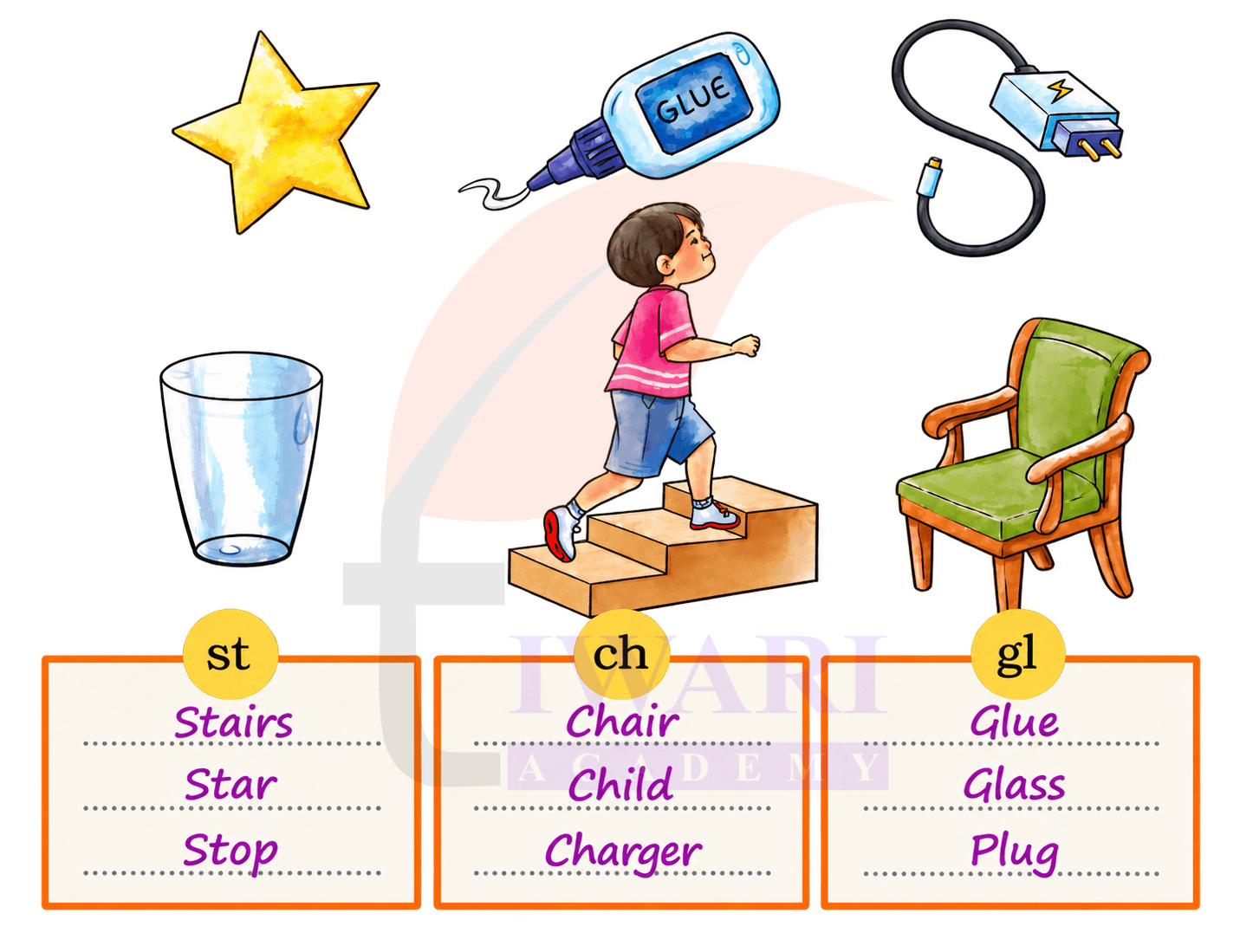
B. Look at the pictures and write their names. One has been done for you.
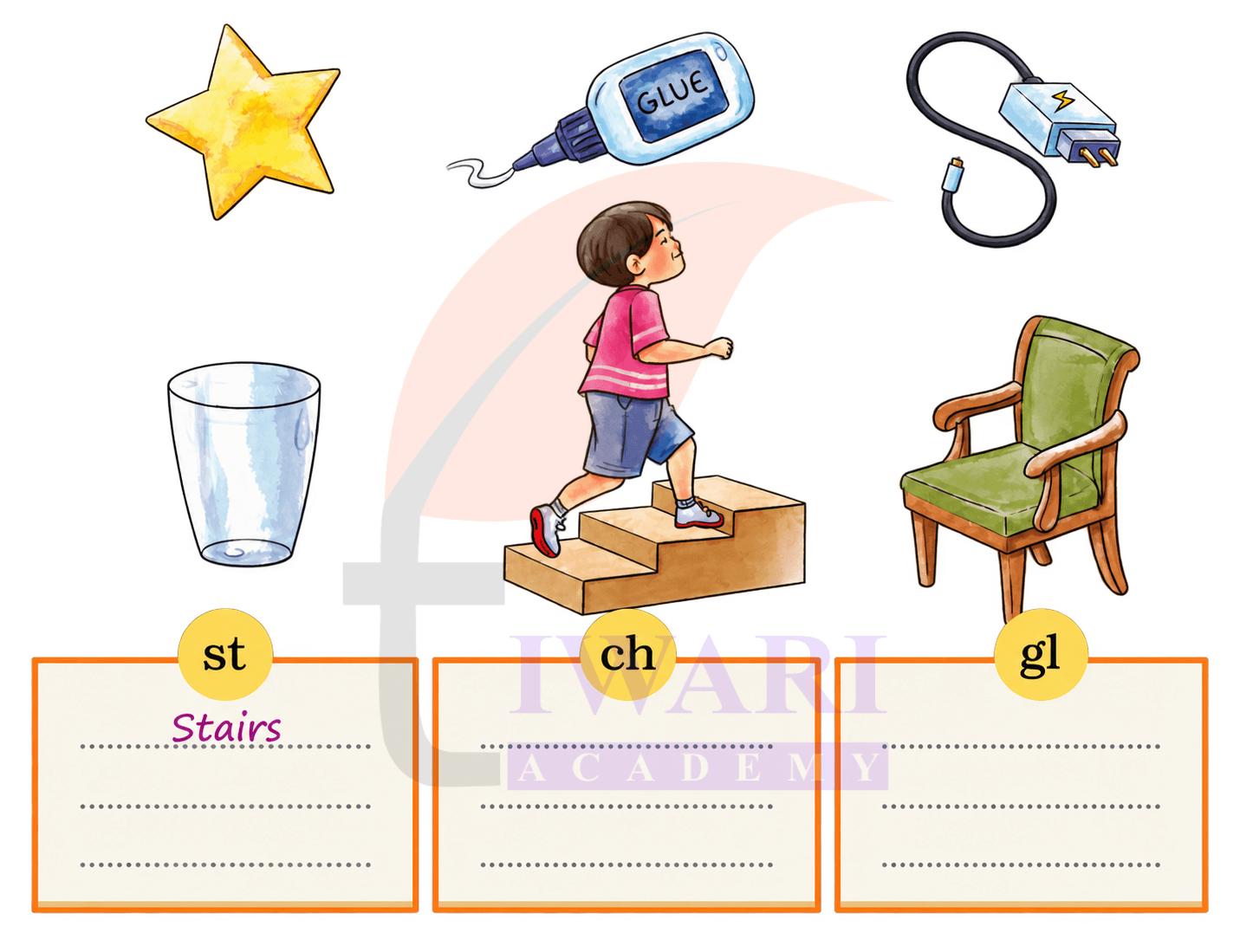
Answer:
C. Match the animals with their sound:
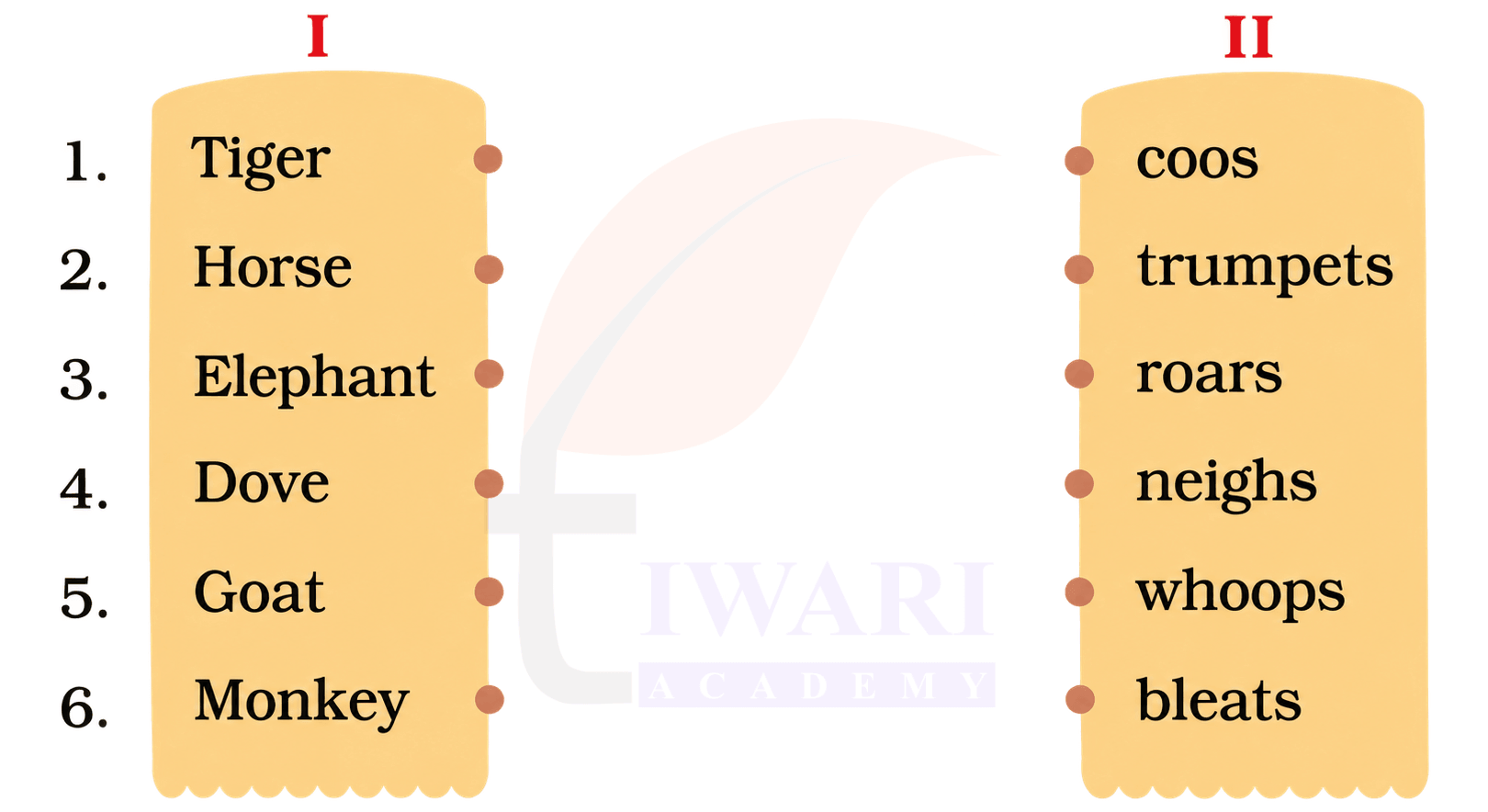
Answer:
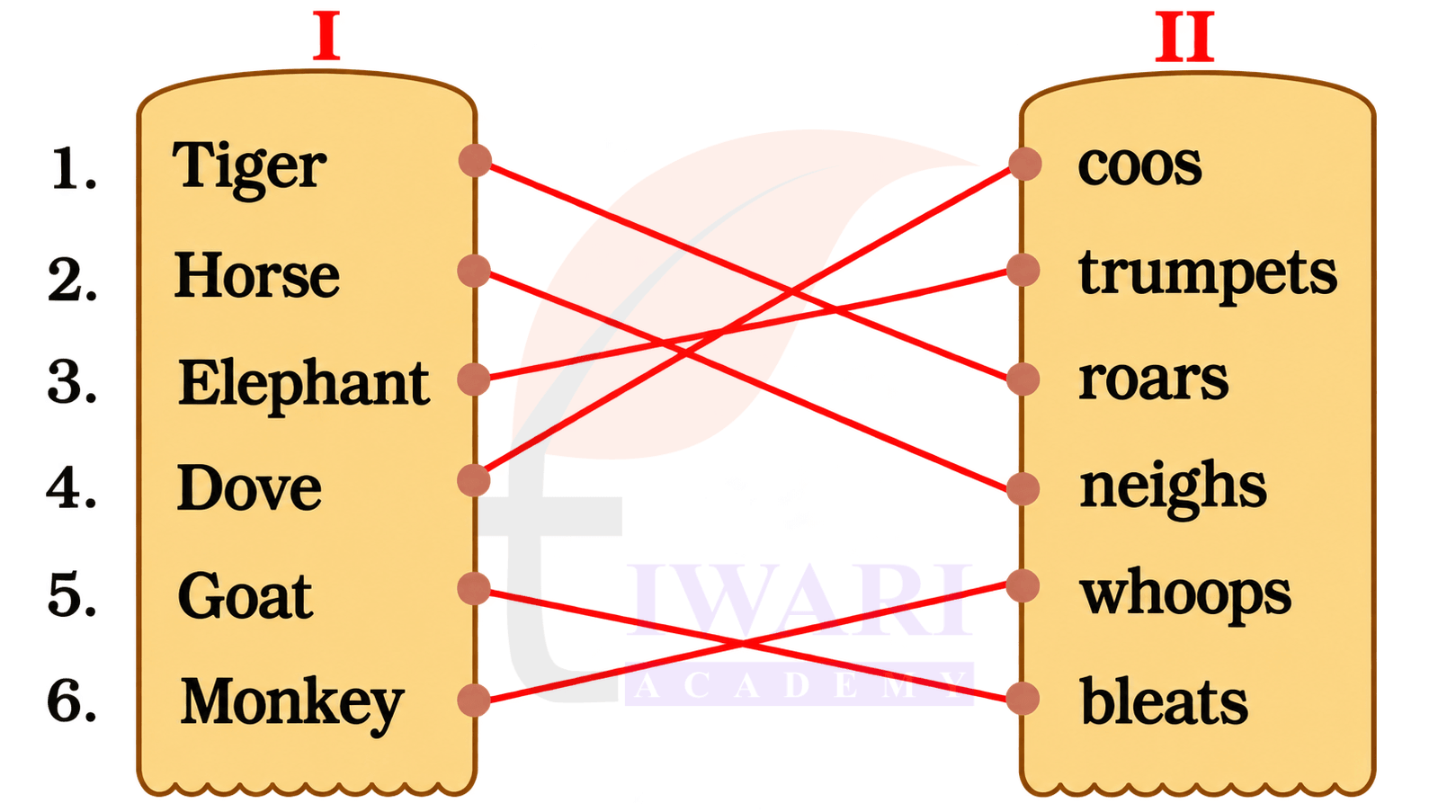
D. Read the following sentences. Notice the underlined words.
Once upon a time, humans and animals lived together. Aakho declared that the tigers had the first right on all the things. The humans challenged Aakho.
• The underlined words tell us that the events happened some time ago or in the past.
• In past simple tense, you can add -ed to verbs to get this form.
See AnswerUnderlined words: Once upon a time, lived, declared, challenged
What I notice:
► lived, declared, challenged – these are action words (verbs) with -ed added at the end to show the action happened in the past.
• live → lived
• declare → declared
• challenge → challenged
► Once upon a time is a phrase, not a verb, but it still tells us the story is set in the past. It’s a phrase often used to begin old stories and folk tales.
E. Fill in the blanks using -ed:
Last week, we ………… (visit) the park for a while. There were many children in the park. They were playing different games. My mother ………… (point) at the children playing kabbadi. On our way home, my sister ………… (jump) in a puddle and muddied everyone’s clothes. I ………… (enjoy) my visit to the park.
See AnswerLast week, we visited the park for a while. There were many children in the park. They were playing different games. My mother pointed at the children playing kabbadi. On our way home, my sister jumped in a puddle and muddied everyone’s clothes. I enjoyed my visit to the park.
My sister ………… (want) to go to the pond but I ………… (decide) to stay and watch the game of kabbadi. I ………… (watch) the game for a while and then ………… (join) my mother and sister. There were many fishes in the pond. I ………… (spot) a goldfish and my sister ………… (notice) two tadpoles in the pond.
See AnswerMy sister wanted to go to the pond but I decided to stay and watch the game of kabbadi. I watched the game for a while and then joined my mother and sister. There were many fishes in the pond. I spotted a goldfish and my sister noticed two tadpoles in the pond.
Page 98 – Let us Listen
Listen to the description of some traditional games of India. Identify each game and write its name in the space given below.
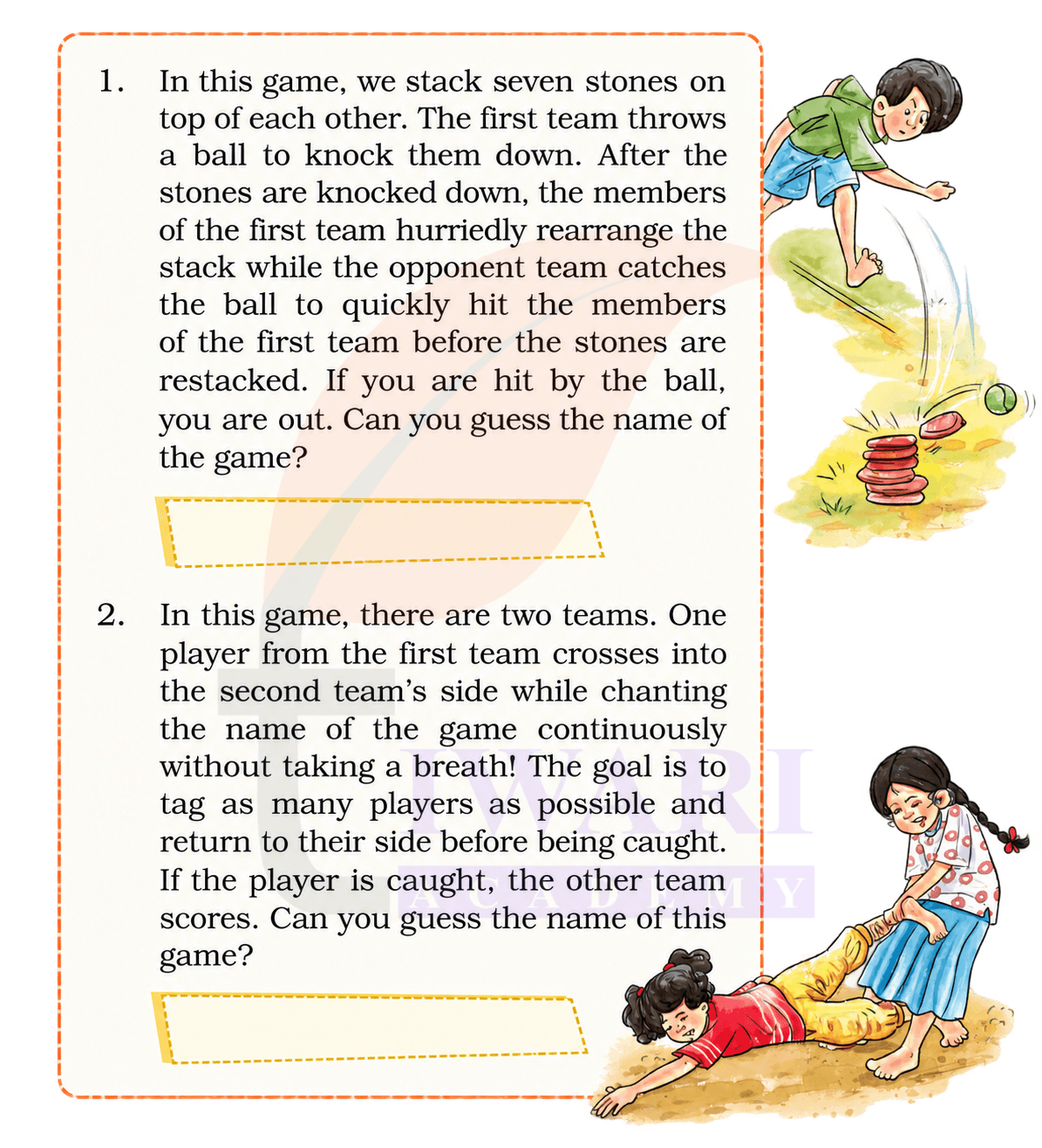
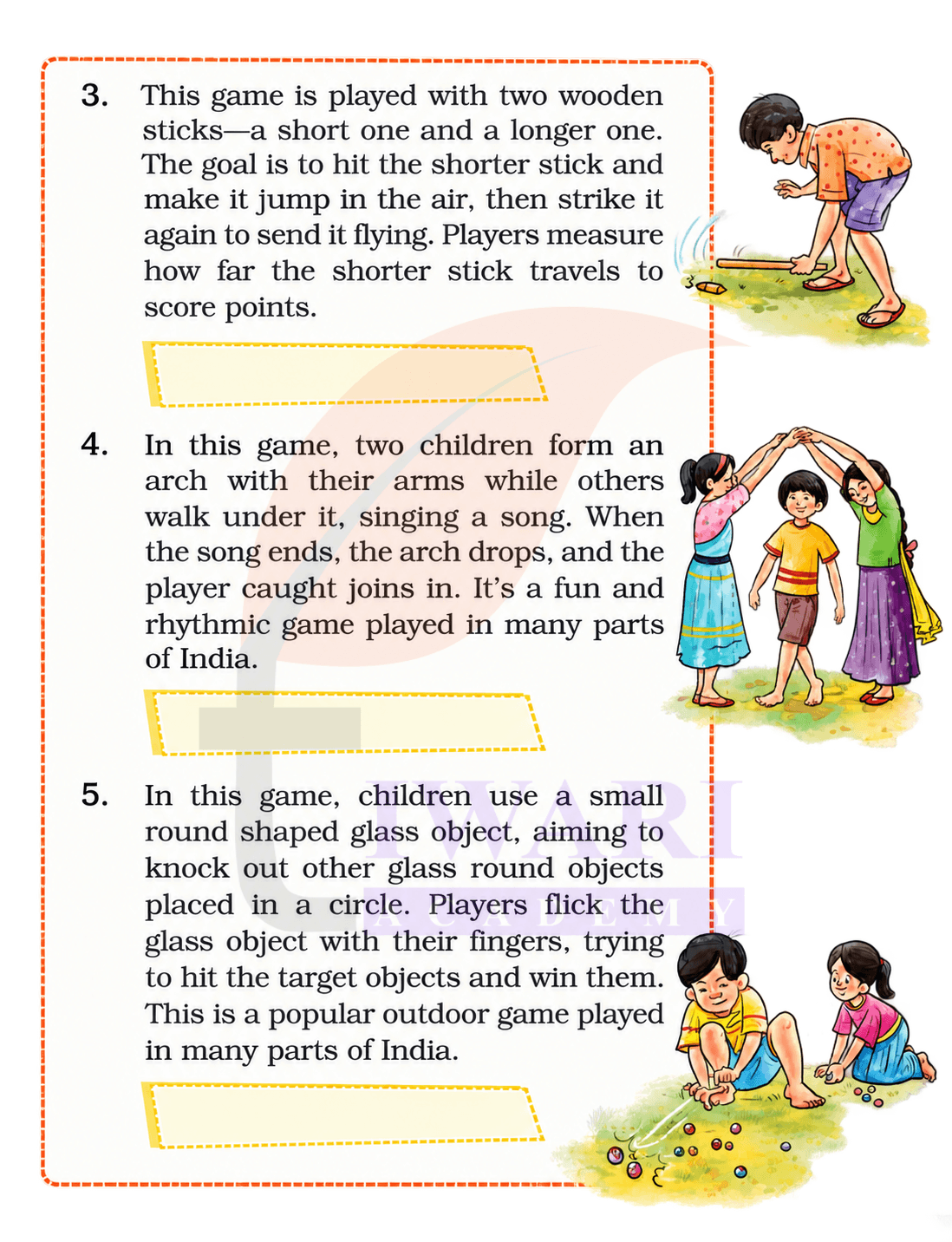
Answer:
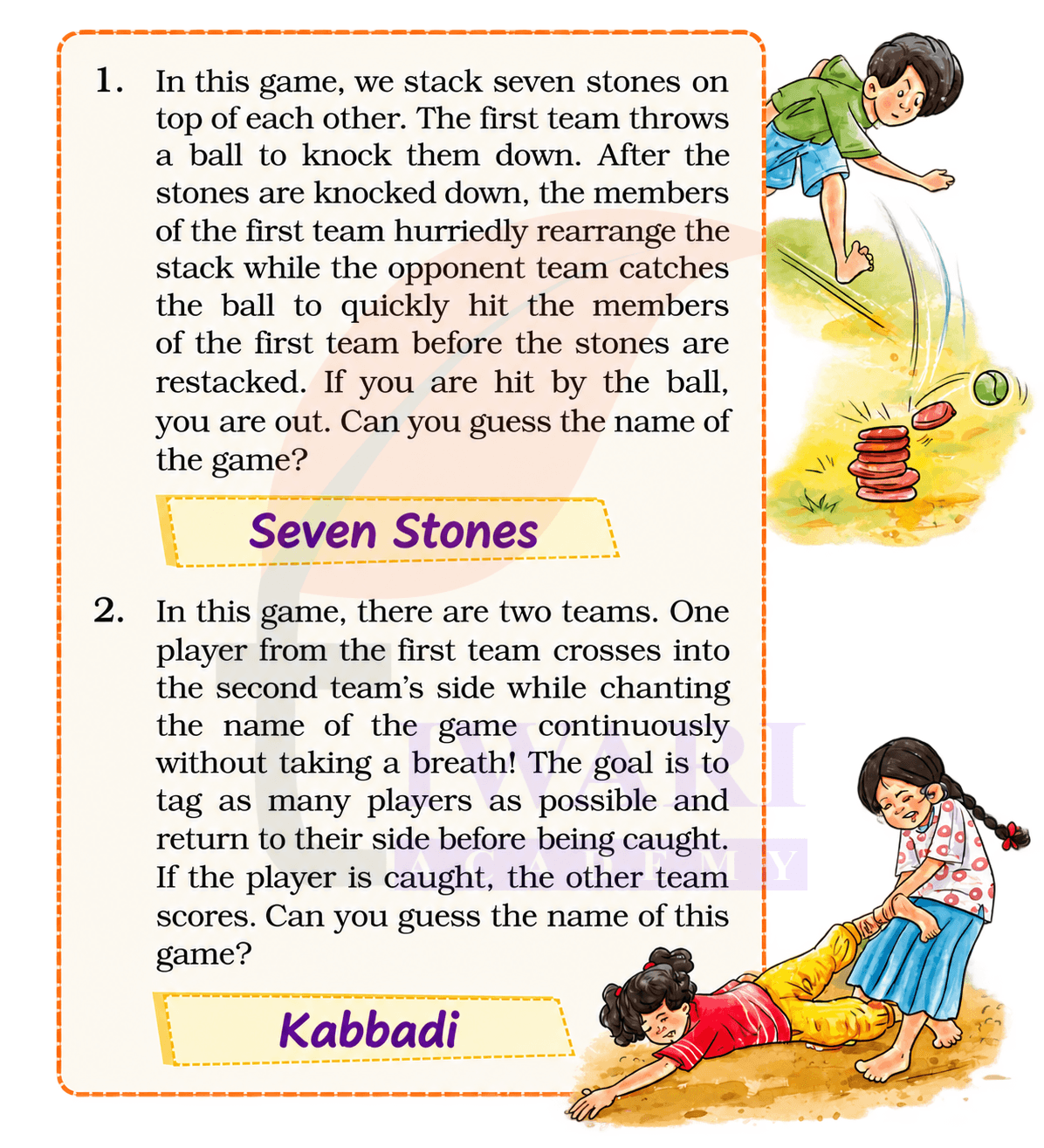
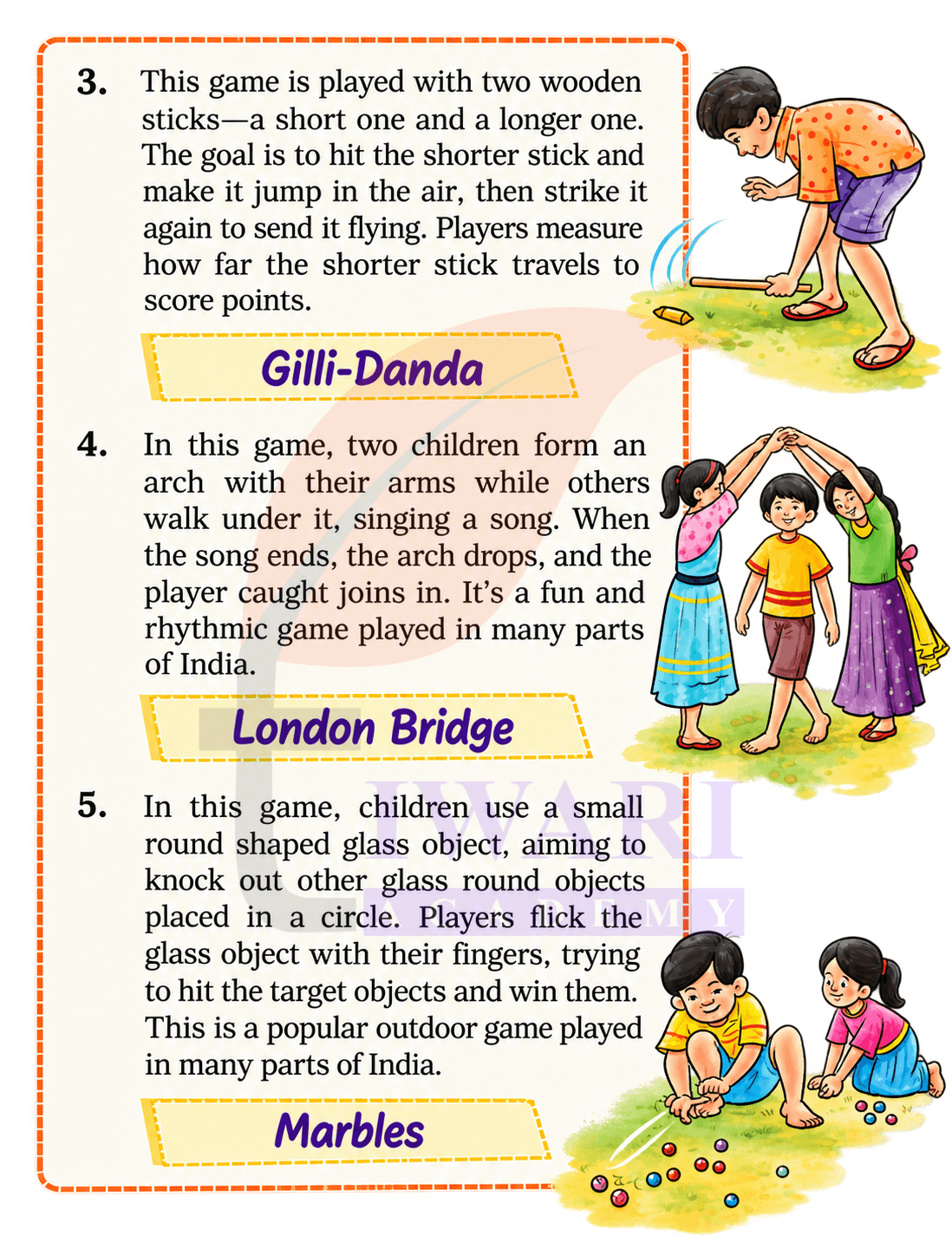
Page 100 – Let us Speak
A. Look at the pictures and identify the games being played.
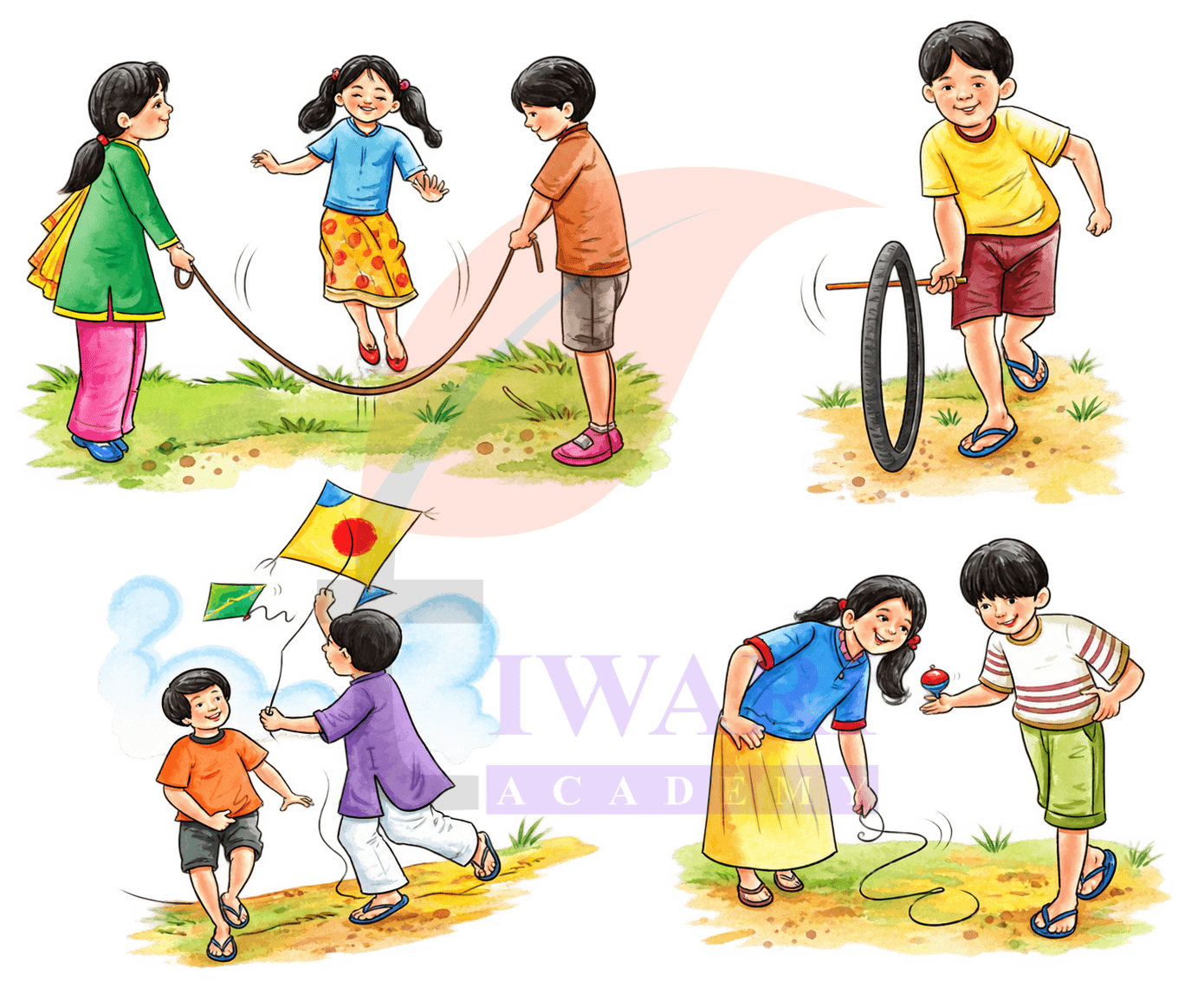
• Have you played any of these games before?
See AnswerYes, I have played some of these games before, such as skipping rope, flying kites and playing with a spinning top.
• Discuss with your partner about the games you recognise.
See AnswerI recognise skipping rope, hoop rolling, kite flying, spinning top and marbles. These are traditional games that children enjoy playing.
• Which one is your favourite? Why do you enjoy playing it?
See AnswerMy favourite game is kite flying because it is exciting and enjoyable. I like watching the colourful kite fly high in the sky.
Page 101 – Let us Write
A. You read how the people of Nagaland made the game of Hekko. Use the space given below to write about a new game that you would like to play.
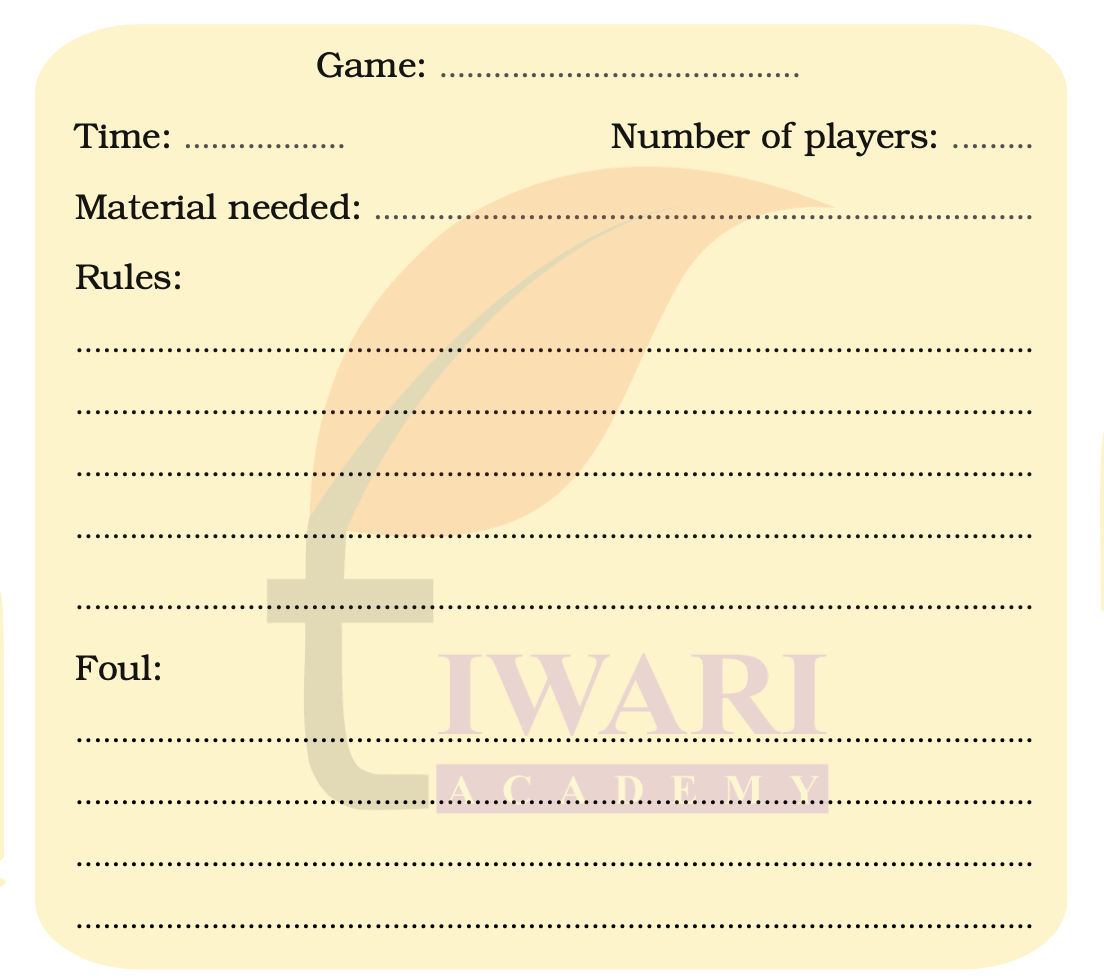
Answer:
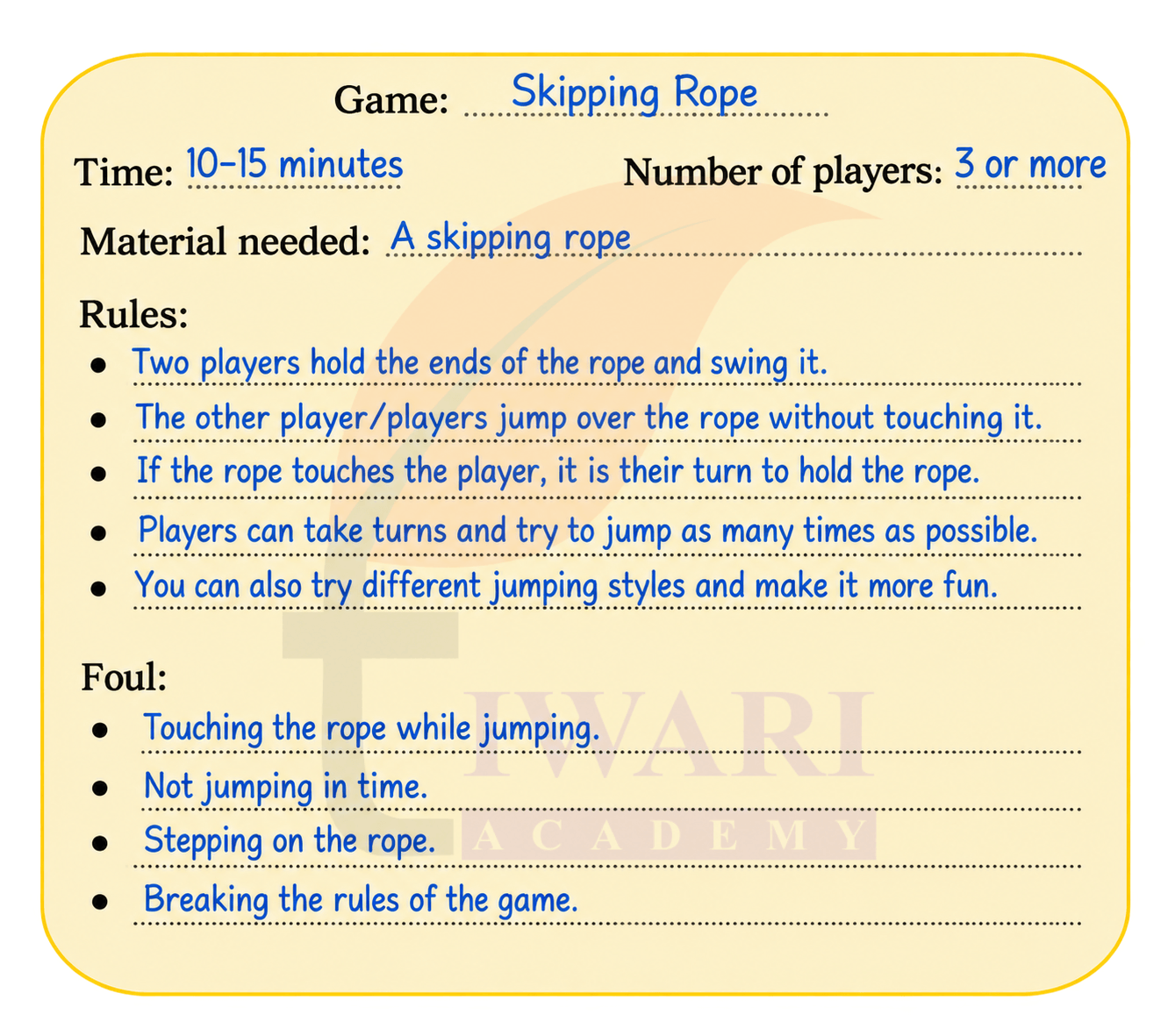
Page 101 – Let us Explore
Nagaland is a land of festivals. Hornbill is one of the festivals to promote the culture of the state. Find out more about it.
See AnswerNagaland is a land of many festivals. The Hornbill Festival is a colourful cultural festival held every year in Nagaland. It showcases the traditions, dances, music, food, handicrafts and customs of the different Naga tribes. The festival is usually held in December at Kisama Heritage Village near Kohima. It brings people together and helps promote and preserve the rich culture of Nagaland.
Class 4 English Santoor – Unit 3: Fun with Games – Chapter 9 Hekko – Hindi Translation
Class 4 English Santoor Chapter 9 English to Hindi Translation
‘Hek’ means to challenge and ‘ko’ means tiger.
Therefore, the word “Hekko” means “Challenging the tiger.”
There is a folk story in Nagaland which talks about “Aami” (The Man) and “Aakho” (The Tiger).
Hindi Translation‘हेक’ का अर्थ है चुनौती देना और ‘को’ का अर्थ है बाघ।
इसलिए, “हेक्को” शब्द का अर्थ है “बाघ को चुनौती देना।”
नागालैंड में एक लोककथा है, जिसमें “आमी” (मनुष्य) और “आखो” (बाघ) के बारे में बताया गया है।
Story: Once upon a time, humans and animals lived together. They had a disagreement about their superiority. The humans challenged Aakho and the challenge came to be known as Hekko.
Hindi Translationकहानी: “एक समय की बात है, जब मनुष्य और जानवर एक साथ रहते थे। उनकी श्रेष्ठता को लेकर आपस में मतभेद हो गया। मनुष्यों ने आखो (बाघ) को चुनौती दी और इस चुनौती को ‘हेक्को’ के नाम से जाना जाने लगा।”
The people in the Mokokchung district of Nagaland play a game named Hekko, which is a well-known sport today.
Hindi Translationनागालैंड के मोकोकचुंग जिले के लोग हेक्को नाम का खेल खेलते हैं, जो आज एक प्रसिद्ध खेल है।
Presently, it is played as a team game between two teams: Aakho and Aami. The strongest people in the village are identified through this game.
Hindi Translationवर्तमान में, यह दो टीमों के बीच खेले जाने वाला एक दल खेल है: एक टीम आमी और दूसरी आखो कहलाती है। इस खेल के माध्यम से गाँव के सबसे ताकतवर लोगों की पहचान की जाती है।
There are 11 players in each team. The toss before the game decides which team will be called Aami and which will be called Aakho.
Hindi Translationप्रत्येक टीम में 11 खिलाड़ी होते हैं। खेल शुरू होने से पहले टॉस किया जाता है, जिससे तय होता है कि कौन-सी टीम आमी कहलाएगी और कौन-सी आखो।
To play, a circle is first drawn, and the Aami team has to stay within the circle by making a human chain, while the Aakho team stays outside the circle.
Hindi Translationसबसे पहले एक गोला बनाया जाता है। आमी टीम के खिलाड़ी मानव शृंखला बनाकर गोले के अंदर रहते हैं, जबकि आखो टीम के खिलाड़ी गोले के बाहर रहते हैं।
At first, two members of the Aakho team enter the circle and try to push the Aami players outside the circle. When an Aami player is pushed out of the circle, he is out and cannot enter again.
Hindi Translationसबसे पहले, आखो टीम के दो खिलाड़ी गोले के अंदर आते हैं और आमी टीम के खिलाड़ियों को गोले से बाहर धकेलने की कोशिश करते हैं। यदि किसी आमी खिलाड़ी को गोले से बाहर धकेल दिया जाता है, तो वह खेल से बाहर हो जाता है और दोबारा गोले के अंदर नहीं आ सकता।
The Aami team also tries to catch the players of the Aakho team by surrounding them. When an Aakho player is caught, he is not released until he says “Joko” (surrender). When one player gets caught and surrenders, another player from the Aakho team enters the circle. Whenever a team gets a player of the opposite team out, it gains points.
Hindi Translationआमी टीम भी आखो टीम के खिलाड़ियों को घेरकर पकड़ने की कोशिश करती है। जब कोई आखो खिलाड़ी पकड़ा जाता है, तो उसे तब तक नहीं छोड़ा जाता, जब तक वह ‘जोको’ (समर्पण) नहीं कहता। जब कोई खिलाड़ी पकड़ा जाता है और समर्पण करता है, तो आखो टीम का एक और खिलाड़ी गोले के अंदर आता है। जब भी कोई टीम विरोधी टीम के किसी खिलाड़ी को खेल से बाहर करती है, तो उसे अंक मिलते हैं।
The game of Hekko gets over when one of the following three things happens:
• All the members of the Aakho team get caught.
• All the members of the Aami team are pushed out of the circle.
• The time runs out. The team with the maximum points wins the game.
Hindi Translationखेल इन तीन स्थितियों में से किसी एक के होने पर समाप्त हो जाता है:
• आखो टीम के सभी खिलाड़ी पकड़े जाते हैं।
• आमी टीम के सभी खिलाड़ी गोले से बाहर धकेल दिए जाते हैं।
• समय समाप्त हो जाता है।
The fastest player of the Aami Team is awarded the title of “Khozuba” and the strongest player of the Aakho team is awarded the title of “Khotiba”.
Hindi Translationआमी टीम के सबसे तेज़ खिलाड़ी को ‘खोजुबा’ का खिताब दिया जाता है। आखो टीम के सबसे ताकतवर खिलाड़ी को ‘खोटिबा’ का खिताब दिया जाता है।
Class 4 English Marigold Solutions
Class 4 English Unit 9 Chapter 1 Books – Summary
The library said that the door is open and asking the kids to come and visit and see the gallery full of tall thin books on the top, and fat bottom books on the bottom of shelves. The student came and took one book and he found pictures and stories full of knowledge.
4th English Unit 9 Chapter 1 Word Meaning
| Word | Meaning |
|---|---|
| Library | Room contains books |
| Wide | Thick |
| Galore | Gallery |
| Skinny | Thin |
| Shelves | Cupboard |
| Wonderful | Surprising, Beautiful |
Class 4 English Unit 9 Chapter 2 Going to buy a book – Summary
Here the poet shared the moment of two siblings where their grandfather gave them some money to buy books. The kids love books with fund facts as knowledge and lots of colorful pictures. Now the problem is both kids are deciding when to go. Today, tomorrow, or when so they decided to go now as they’re excited to buy new books.
Now as they have decided to go now there are yet to decide where to go big shop small shop.
They visited the small shop with a lot of books, the man was very happy and when he saw the kids finding it difficult to choose the books, he showed them the books with lots of pictures, the books with stories, the book with war information.
Kids took the book and sat on the chair and floor and started reading it and then soon they took it to home and sat with the grandfather and started reading there too. This is the poetic way to express the difficulties and happy moments of kids by the Rukmini Bannerji.
4th English Unit 9 Chapter 2 Word Meaning
| Word | Meaning |
|---|---|
| Alone | Without anyone |
| Bookshop | Shop that sells books |
| Machines | The mechanical objects |
| Finally | At last |
| Climbed | Going up with stares |