



by Tiwari Academy Team
NCERT Solutions for Class 9 Social Science Part 2 Chapter 5 Managing Your Personal Finances, help students understand how to plan and use money wisely. The chapter explains the five pillars of personal finance: income, budgeting, saving, investing, protection and risk management. Students also learn about inflation, compounding, investment options like fixed deposits, bonds, shares and mutual funds, insurance, risk and return along with how income tax is calculated under the slab system. These solutions answer all textbook questions in simple language, helping you revise key concepts and prepare well for CBSE 2026-27 exams.
NCERT Class 9 Social Science Part 2 Chapter 5 Solutions
Class 9 Social Science Part 2 Chapter 5 Question Answer
Page 107 – The Big Questions
1. What is personal finance and why is it important for individuals?
Answer:
Personal finance is planning and managing one’s money to meet present needs and future goals. It helps people control spending, save for emergencies, make informed investments, borrow responsibly and protect their families from financial setbacks.
2. What are the pillars of personal finance?
Answer:
The five pillars are income, budgeting, saving, investing, and protection and risk management. Together, they help a person earn and allocate money, prepare for the future, grow resources and manage financial uncertainty.
3. What are some common savings and investment options?
Answer:
Common options include savings accounts, fixed deposits, government-backed savings schemes, bonds, shares and mutual funds. They differ in risk, expected return, liquidity and investment period. A suitable choice depends on the goal and when the money will be needed.
4. How can you protect your savings and assets?
Answer:
Maintain an accessible emergency fund, use appropriate insurance, avoid excessive debt and understand investment risks. Diversifying investments can reduce concentration risk. Use reliable financial institutions, protect account details and review financial commitments regularly.
5. What is income tax?
Answer:
Income tax is a direct tax on taxable income earned during a financial year. It helps finance public services. Tax liability depends on applicable rules, income levels, deductions and rebates; a person’s entire income is not necessarily taxed at one rate.
Page 108 – Think About It
Have you ever thought about earning your own money? What kind of skill would you require and which work would you choose?
Answer:
I would like to create handmade bookmarks for a supervised school fair. I would need design, communication, calculation and time-management skills. The activity should remain safe, age-appropriate and compatible with my studies, with school and parent guidance.
Page 109 – Think About It
Suppose you and your friends need to buy new badminton rackets for an upcoming tournament because the old ones have worn out. How would you manage your budget to cover the cost? Would you cut back on other expenses, use your savings, or borrow the amount from your parents or friends?
Answer:
I would compare suitable rackets, work out the cost and use planned savings first. I would reduce optional spending without cutting essential needs. If savings were insufficient, I would discuss help or a clear repayment arrangement with my parents rather than borrow impulsively from friends.
Page 109 – Let’s Explore
Think of all your expenses and prepare your monthly/weekly budget using the template on Page 122.
Answer:
Model monthly budget, I have ₹1,000 pocket money:
Transport ₹300; stationery ₹200; canteen ₹150; recreation ₹50; savings ₹300.
Total expenses = ₹700. Savings = ₹1,000 − ₹700 = ₹300.
Page 111 – Think About It
What would you do if you received ₹100 today? Would you save some or all of it, or spend it right away?
Answer:
I would first check whether I needed anything essential. If not, I would save most or all of the ₹100 towards a planned goal. I would avoid spending simply because the money was available.
In the Grade 9 Part 1 Chapter ‘Building Blocks in Economics: The Problem of Choice’, you learnt about wants and needs. Would you prefer spending the money on a want or a need?
Answer:
I would meet important needs, such as necessary stationery, before optional wants. Once needs and planned savings were covered, I could use a limited amount for a want. The classification depends on the situation and purpose.
Financial experts often suggest saving first and spending what is left. Do you agree?
Answer:
Yes, setting aside an affordable amount first makes saving regular and reduces impulse spending. However, the amount must be realistic: essential food, housing, health and education cannot be neglected to meet an inflexible savings target.
Do you think individuals with low income can also save? Why or why not?
Answer:
Some can save small amounts by planning carefully, but very low income may barely cover necessities. Saving ability depends on income, living costs and family responsibilities. Low savings do not automatically mean poor discipline; secure income and support are also important.
Page 112 – Let’s Explore
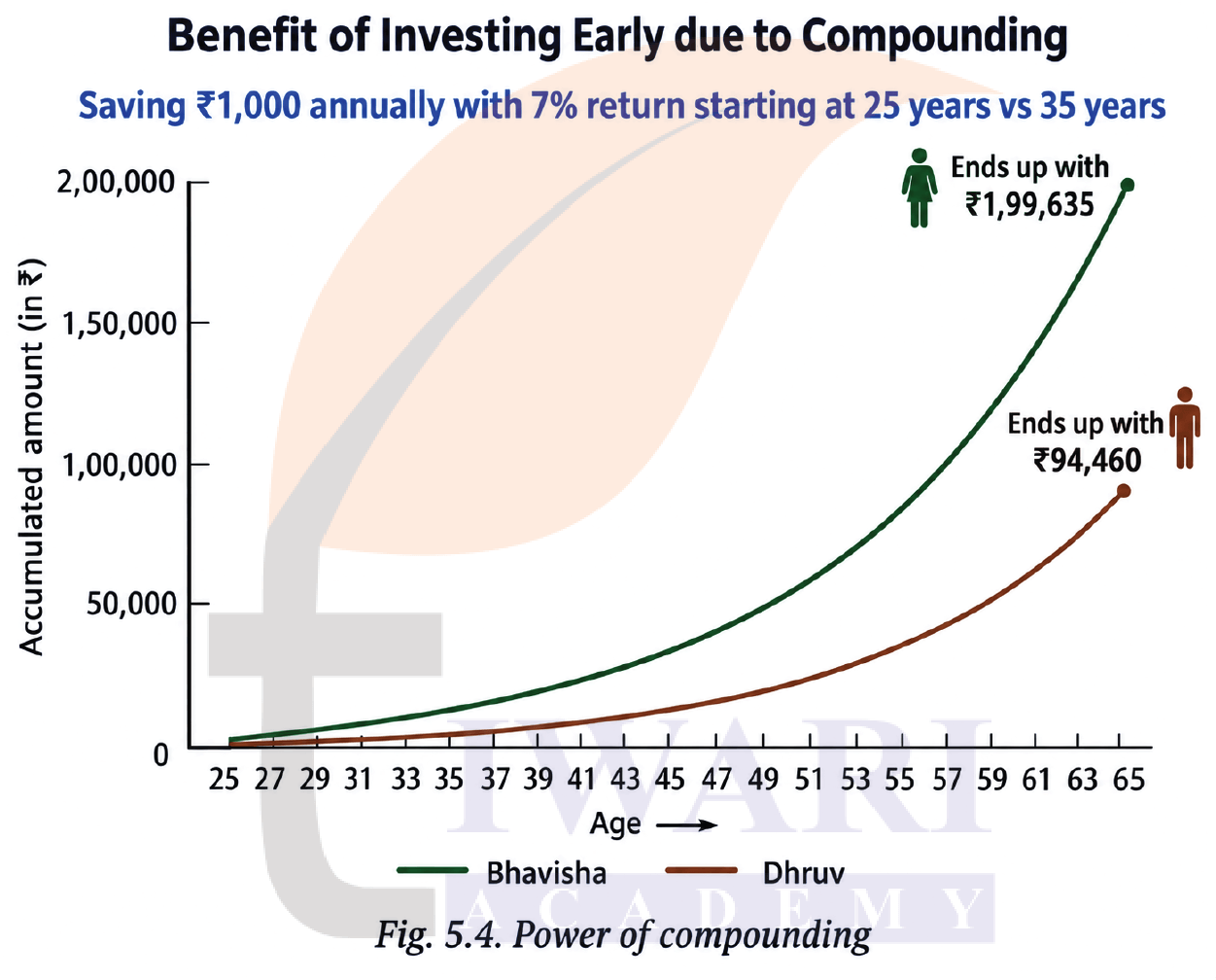
In Fig. 5.4 above, the curves are flatter in the beginning and tend to become steeper in the later years. Why do you think that happens?
Answer:
Compound interest is earned on both the original savings and accumulated interest. As the balance grows, the same percentage produces a larger yearly addition. Regular contributions add further growth, so the curve becomes steeper over time.
Talk to your parents and find out the fixed deposit rates of their bank. You can also refer to the bank’s website.
Answer:
Official bank example checked on 1 October 2026: SBI’s retail domestic term-deposit table lists 6.25% per annum for the general public and 6.75% for senior citizens for 1 year to less than 2 years, in its revised-rate column effective 15 December 2025. Rates and conditions differ by period and product. Record your parent’s bank, the deposit term, applicable customer category and effective date after the conversation.
Page 115 – Think About It
Have you heard this disclaimer in mutual fund advertisements on the television?
“Mutual fund investments are subject to market risks. Please read all scheme-related documents carefully before investing.”
Why do you think this is included?
Answer:
The disclaimer reminds investors that fund values can fall and returns are not guaranteed. Different schemes have different assets, costs and risks. Reading scheme documents helps people understand these features and judge whether the investment fits their goals and time horizon.
Page 117 – Think About It
Have you ever heard your parents say, “This month’s EMI has been paid”?
Answer:
The expression means the family has paid that month’s agreed loan instalment. An EMI normally repays part of the principal and interest. Whether I have personally heard the expression depends on my own experience.
Why might a family choose to buy something on EMI even if it costs more in the long run?
Can having too many EMIs affect savings and emergency funds?
Answer:
A family may need an essential item immediately but prefer to spread payment across future income. For example, ₹3,000 × 12 = ₹36,000, which is ₹6,000 above the ₹30,000 price. Too many EMIs reduce money available for essentials, saving and emergencies, so repayment capacity and total cost must be checked.
Page 120 – Let’s Analyse
Sai’s taxable income is ₹3,80,000 in a financial year. How much income tax does he have to pay according to the above tax slabs?
Answer:
According to Table 5.1 for FY 2025, taxable income up to ₹4,00,000 attracts no tax. Since ₹3,80,000 is below this limit, Sai’s income tax under the stated slabs is ₹0. No further standard deduction should be subtracted because the question already gives taxable income.
Ask your parents, relative or a person in your neighbourhood if they file personal income tax returns. Make a small report on the procedure to file an income tax return.
You may refer to the following website: https://incometaxindia.gov.in/Pages/tax-services/file-income-tax-return.aspx
Answer:
Procedure:
(1) collect income and tax documents;
(2) log in to the official Income Tax e-Filing portal;
(3) choose the applicable assessment year and correct return form;
(4) check income, deductions, tax credits and bank details;
(5) calculate liability and pay any balance due;
(6) submit and verify the return through an available method;
(7) retain the acknowledgement.
Class 9 Social Science Part 2 Chapter 5 Exercises Question Answer
Page 121 – Questions and activities
1. Why is managing money wisely important for all individuals irrespective of their income?
Answer:
Everyone has limited resources and competing needs. Wise money management helps people cover essentials, control unnecessary spending, prepare for emergencies and work towards goals. Even high incomes can be wasted or overwhelmed by debt, while careful planning helps limited incomes stretch further without guaranteeing that all needs can be met.
2. How can budgeting help people balance their present needs with their future financial goals? Give examples.
Answer:
A budget allocates income between current essentials, optional spending and savings. For example, a family can plan food, rent and school expenses while saving monthly for education or emergencies. Tracking spending reveals overspending, allowing adjustments before future goals are affected.
3. School Reopening Budget Activity
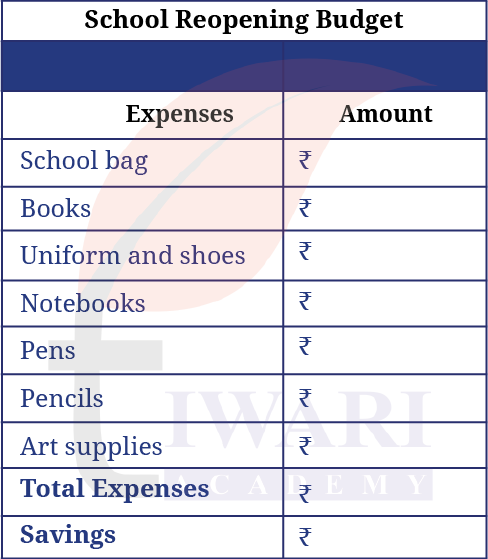
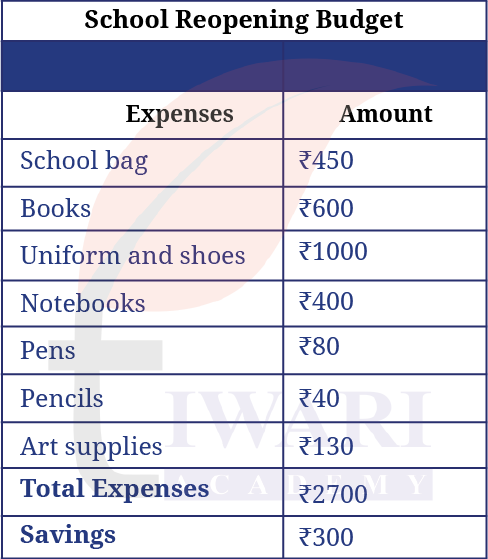
Your parents have given you ₹3,000 to prepare for the new school year. Make a list of the items you need, find out their prices (by visiting local stores, or asking a parent or teacher), and prepare a budget. Calculate the total cost and check whether it stays within ₹3,000.
• If your total is less than ₹3,000, you may add one additional item of your choice.
• If your total exceeds ₹3,000, decide which item(s) you can postpone or avoid buying to stay within your budget.
Use the budget template provided and ensure that all expenses are accurately calculated.
Answer:
4. Why is saving alone often not enough to build wealth in the long run? How do investments help increase the value of money over time?
Answer:
Cash savings may lose purchasing power as prices rise. Investments can generate interest, dividends or increases in value; reinvested returns can compound over time. However, growth is not guaranteed and unsuitable risks or high costs may cause losses. Savings and investments serve different, complementary purposes.
5. Investment Planning Activity
Suppose you received cash gifts worth ₹3000 on your last birthday and decided to save ₹1500. With the help of your teacher, calculate the returns you might have earned if you had invested this amount in different combinations of investments. For example, what returns would you have received if you had invested ₹500 in a fixed deposit, ₹800 in the stock market, and ₹200 in gold? Try other combinations and find information on the returns from different investment options using reliable sources, such as newspapers, magazines, or official websites. Based on your findings, prepare an investment plan explaining why you think each investment option is suitable or unsuitable.
Answer:
Classroom for one year, before costs and taxes: assuming FD return 6%, shares +10% and gold +5%.
Combination 1: ₹500 FD earns ₹30; ₹800 shares earns ₹80; ₹200 gold earns ₹10. Total assumed return ₹120; final value ₹1,620.
Combination 2: ₹1,000 FD earns ₹60; ₹300 shares earns ₹30; ₹200 gold earns ₹10. Total assumed return ₹100; final value ₹1,600.
Loss for Combination 1: FD +6%, shares −10%, gold −5% gives ₹30 − ₹80 − ₹10 = −₹60; final value ₹1,440.
6. How does inflation affect the value of money over time? Why should people consider inflation while making financial decisions?
Answer:
Inflation reduces purchasing power because the same money buys fewer goods and services. If a ₹1,000 bag becomes ₹1,060, unchanged savings no longer buy it. Financial planning should consider rising future costs and whether returns, after costs and taxes, preserve purchasing power.
7. Different investment options involve different levels of risk and return. Do you think taking higher risks is always the best way to earn higher returns? How should a person decide which investment option is most suitable for them?
Answer:
No. Higher risk means a greater possibility of loss, not a promise of higher returns. A person should consider their goal, time horizon, need for cash, ability to absorb losses and product costs. Diversification and an emergency fund can help manage risk; short-term essential money should not depend on uncertain market gains.
8. Why do people buy insurance policies even though they may never face a major loss? How does insurance provide financial security?
Answer:
People buy insurance because an uncertain event can cause a large financial loss. Premiums pool risks across many policyholders and covered claims provide support when specified events occur. Insurance can protect family savings and income, but payment depends on the policy’s coverage, limits, exclusions and conditions.
9. Imagine your family receives ₹1,00,000 from farming, a small business, livestock sales, and savings. Help your family decide how to use the money wisely.
Step 1: Prepare a Budget
Allocate the ₹1,00,000 among the following categories:
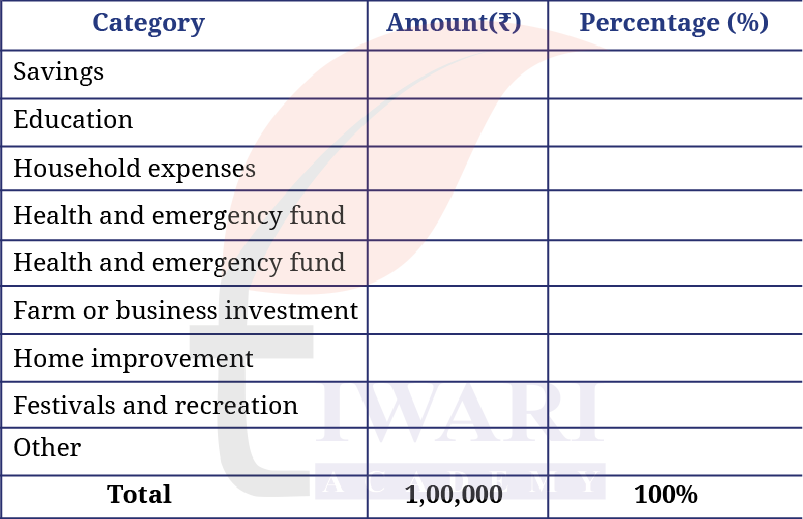
Savings; Education; Household expenses; Health and emergency fund; Farm or business investment; Home improvement; Festivals and recreation; Other.
Step 2: Needs vs Wants
Classify each expense as a need or a want and give a reason.
Examples:
• School fees
• New mobile phone
• Better seeds or livestock feed
• Festival celebrations
• Water storage tank
Step 3: Save for the Future
Suppose your family saves ₹30,000 at 8% compound interest per year.
Using the formula A = P(1 + r)ⁿ, where A: Amount, P: Principal, r: Rate of compound interest, n: number of years, calculate:
1. The amount after 5 years.
2. The interest earned.
Step 4: Save First, Spend Later
Many financial experts recommend:
Expenses = Income − Savings
If your family receives ₹1,00,000 and saves ₹20,000 first, only ₹80,000 is available for spending. This helps ensure that future needs and emergencies can be met.
Step 5: Reflect
1. What percentage of the money did you save?
2. Which expenses were needs and which were wants?
3. How can savings improve a family’s financial security?
4. How does compound interest help money grow?
Challenge: Create a pie chart showing how the ₹1,00,000 was allocated across different categories.
Answer:
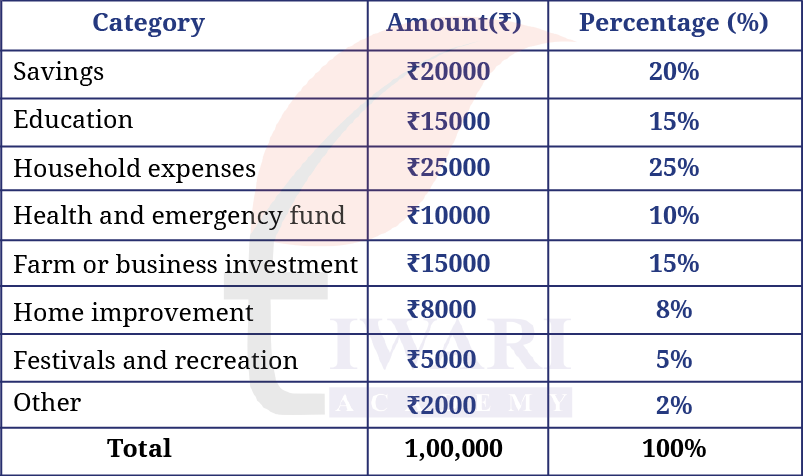
The emergency fund is separate from the ₹20,000 general savings allocation. Previously accumulated savings included in the available ₹1,00,000 are not new earnings.
Step 2: School fees: need for education. New mobile phone: want if an existing phone works, but possibly a need for essential work. Better seeds/feed: productive need. Festival celebrations: mainly a want whose scale can be adjusted. Water tank: need where it provides essential water storage.
Step 3: Separate calculation using the amount specified:
A = ₹30,000 × (1.08)⁵ = ₹44,079.84.
Interest = ₹44,079.84 − ₹30,000 = ₹14,079.84.
Rounded to rupees: amount ₹44,080; interest ₹14,080.
Step 4: ₹1,00,000 − ₹20,000 = ₹80,000 for other allocations, including the separate emergency fund.
Step 5: (1) General savings are 20%; including the separate emergency fund, 30% is set aside. (2) Education, basic household costs, health and essential productive costs are needs; optional recreation and upgrades are wants. (3) Savings cushion emergencies and support planned goals. (4) Compounding earns returns on earlier returns as well as principal.
Extra Question Answers for Exam Preparation
Class 9 Social Science Part 2 Chapter 5 Very Short Answer Type Questions with Explanation.
Very Short Answer Type Questions
- What is a financial goal?
Answer:
A financial goal is a planned money-related objective with a purpose, required amount and target date for achievement. - How does tracking small purchases help budgeting?
Answer:
Tracking small purchases reveals spending patterns and repeated optional expenses, helping people adjust their budget before money runs short. - What is an emergency fund?
Answer:
An emergency fund is accessible money reserved for unexpected essential costs or temporary income loss, reducing dependence on borrowing. - Why is borrowed money different from earned income?
Answer:
Borrowed money creates a repayment obligation, often including interest, whereas earned income is received for work or other earnings. - What is the principal in an interest calculation?
Answer:
The principal is the original sum deposited, invested or borrowed, before interest and other additions or deductions are considered. - What does maturity mean for a fixed-period investment?
Answer:
Maturity is the point when an investment’s agreed term ends and repayment becomes due according to its stated conditions. - Why can a company’s share price fall?
Answer:
Share prices can fall when earnings disappoint, expectations weaken or market conditions reduce investors’ willingness to buy them. - What is a dividend?
Answer:
A dividend is a distribution a company may make to shareholders from profits; payment is not automatically guaranteed. - How is liquidity useful during an emergency?
Answer:
Liquidity allows funds to be accessed quickly for urgent expenses, avoiding forced sales or costly borrowing when difficulties arise. - What is a policy exclusion in insurance?
Answer:
A policy exclusion identifies a loss, event or expense that the insurance contract does not cover under its terms. - Why should borrowers compare total repayments?
Answer:
Comparing total repayments reveals the full borrowing cost, helping borrowers judge affordability beyond an apparently small monthly instalment. - What is progressive taxation?
Answer:
Progressive taxation applies higher rates to higher income ranges, so greater taxable capacity can attract a larger contribution. - What is a tax slab?
Answer:
A tax slab is an income range assigned a particular tax rate, rather than necessarily taxing all income identically. - Why should savings goals reflect household circumstances?
Answer:
Households have different incomes and essential costs, so realistic savings goals must consider health, dependants and living expenses. - How can delayed purchases improve financial choices?
Answer:
Delaying an optional purchase allows time to compare prices, reconsider need and avoid decisions driven mainly by impulse.
Class 9 Social Science Part 2 Chapter 5 Short Answer Type Questions with Explanation.
Short Answer Type Questions
- A student spends ₹40 on snacks each school day. Why should this appear in a budget?
Answer:
Repeated small expenses can become substantial over a month. Recording the daily snack cost makes its total visible and allows the student to compare it with essential expenses and planned savings before deciding an affordable limit. - Distinguish a saving habit from an investment decision.
Answer:
Saving means setting aside money rather than spending it. Investing decides how some of that money is placed in assets to seek returns. The investment choice requires separate consideration of risk, access, costs and time horizon. - Why can a high advertised return be misleading?
Answer:
An advertised return may describe past performance or a favourable possibility rather than a guarantee. Costs, taxes and losses can change the result. Investors should understand the product and compare risk before relying on the figure. - Explain how inflation affects a long-term education goal.
Answer:
Education costs may rise before the money is needed, so a target based only on today’s fees can become insufficient. Planning should allow for future costs and review savings regularly rather than assuming prices remain unchanged. - Why is diversification different from choosing many similar investments?
Answer:
Holding many investments in the same industry can leave them exposed to similar problems. Effective diversification spreads exposure across different holdings or asset types. It reduces concentration risk, though broad market losses can still occur. - How can insurance and emergency savings complement each other?
Answer:
Insurance supports specified covered losses, while emergency savings can meet immediate payments, exclusions or temporary income gaps. Keeping both helps families respond to different situations without assuming that one arrangement will cover every unexpected expense. - Why should a family examine its existing EMIs before taking another loan?
Answer:
Existing EMIs already commit part of future income. Adding another loan can reduce money for essentials and emergencies. Comparing all repayments with realistic income helps the family judge whether additional borrowing would become difficult to manage. - Explain why taxable income and annual salary may differ.
Answer:
Taxable income is calculated under applicable rules, which may allow deductions from salary or include other taxable earnings. Therefore, a salary figure alone does not necessarily equal the amount on which income tax is calculated. - Why does compounding produce larger yearly additions over time?
Answer:
With reinvestment, previous interest becomes part of the balance earning interest. At the same rate, a larger balance generates a larger addition. Continued contributions can increase the effect, although actual investment returns may vary. - How should a student revise a budget after transport costs rise?
Answer:
The student should calculate the new essential transport cost, reduce optional spending where possible and review the savings target. Discussing a persistent shortfall with parents is better than hiding it or borrowing without a repayment plan.
Class 9 Social Science Part 2 Chapter 5 Long Answer Type Questions with Explanation.
Long Answer Type Questions
1. Compare financial planning for an emergency with planning for a distant goal.
Answer: An emergency requires funds that can be accessed quickly and reliably, so liquidity and stability are central. A distant goal allows more time to save and may permit suitable long-term investments, depending on risk capacity. Both plans need realistic targets and regular review. Money reserved for immediate essential needs should not rely on uncertain gains that may disappear just when it is required.
2. Explain how a family can use a budget without making it unrealistically strict.
Answer:
The family should first record realistic income and essential expenses, then agree on affordable savings and optional spending. A small flexible allowance can accommodate ordinary changes. Actual expenses should be reviewed regularly and targets adjusted after major events or price increases. The budget should support informed choices and shared priorities rather than blame family members for unavoidable costs or demand impossible savings.
3. Why does a higher income not automatically guarantee financial security?
Answer:
A high income can be exhausted by excessive spending, large loan repayments or poorly understood investments. Unexpected illness or loss of work may expose these weaknesses. Financial security depends on how resources are managed, including realistic budgeting, emergency savings, suitable protection and controlled debt. Higher income can create opportunities to save, but it does not replace careful decisions and planning for uncertainty.
4. Use an example to distinguish compound interest from simple interest.
Answer:
Suppose ₹1,000 earns 10% annually for two years. With simple interest, each year earns ₹100 on the original principal, producing ₹1,200. With annual compounding, the first year produces ₹1,100; the second earns ₹110 on that larger balance, producing ₹1,210. The extra ₹10 arises because the first year’s interest also earns interest. The difference grows with time if the same conditions continue.
5. Explain why an investment suitable for one person may be unsuitable for another.
Answer:
People differ in goals, income stability, financial responsibilities and ability to absorb losses. Someone needing money next month requires dependable access, while someone saving for a distant goal may accept some fluctuations. Costs and product conditions also matter. Suitability therefore depends on the person’s circumstances and understanding, rather than choosing whichever investment recently earned the highest return or attracted the most publicity.