



by Tiwari Academy Team
NCERT Solutions for Class 9 Social Science Part 2 Chapter 6 From Ideas to Startups, help students understand how an idea can grow into a successful business. The chapter explains entrepreneurship through stories like Lijjat Papad, Mohan Singh Oberoi and the Chettiar community. Students also learn how to prepare a business plan, explore the four functional areas of a business and understand how profit is calculated. It also highlights India’s startup ecosystem and its role in Viksit Bharat 2047. These solutions answer all textbook questions in simple language, helping you revise key concepts and prepare well for CBSE 2026-27 exams.
NCERT Class 9 Social Science Part 2 Chapter 6 Solutions
Class 9 Social Science Part 2 Chapter 6 Question Answer
Page 125 – The Big Questions
1. How does entrepreneurship impact society and the economy?
Answer:
Entrepreneurship turns ideas into useful goods and services. It can create jobs, incomes and innovations, meet local needs and contribute taxes for public services. Responsible businesses also support communities and reduce environmental harm. Success depends on effective planning and management, not merely a new idea.
2. What are some functional areas of a business?
Answer:
The main functional areas are management and operations, finance and accounting, human resources, marketing and sales. They coordinate resources, production, money, staff and customer relationships. Even a small business performs these functions, although one person may handle several roles.
3. How to develop a business plan?
Answer:
Identify a need and propose a feasible solution. Study customers and competitors, estimate costs and funding, plan operations and staffing, set prices and choose promotion methods. Include expected revenue, profit, risks and social effects. Review the plan as customer feedback and circumstances change.
Page 128 – Think About It
What problem was Lijjat solving beyond just selling papads?
What challenges do you think the founders could have faced at the start? How might they have overcome them?
Can you think of a similar cooperative idea you could start in your community?
Answer:
Lijjat created income opportunities, shared ownership and greater economic independence for women. The founders likely faced limited funds, equipment, customer trust and coordination difficulties. Cooperation, consistent quality, careful reinvestment and shared work helped the enterprise grow. A Delhi community could organise a cooperative making reusable cloth bags, sharing training, quality checks and earnings. A school version would remain a supervised learning project.
Page 136 – Let’s Explore
Interview two people in your vicinity who run a business (tailor, shopkeeper, factory owner, etc.) and find out about their journey of starting the business by asking them the following questions:
• Why did they start the business?
• What were the challenges they faced?
• What were the risks taken?
• What did they learn from the process?
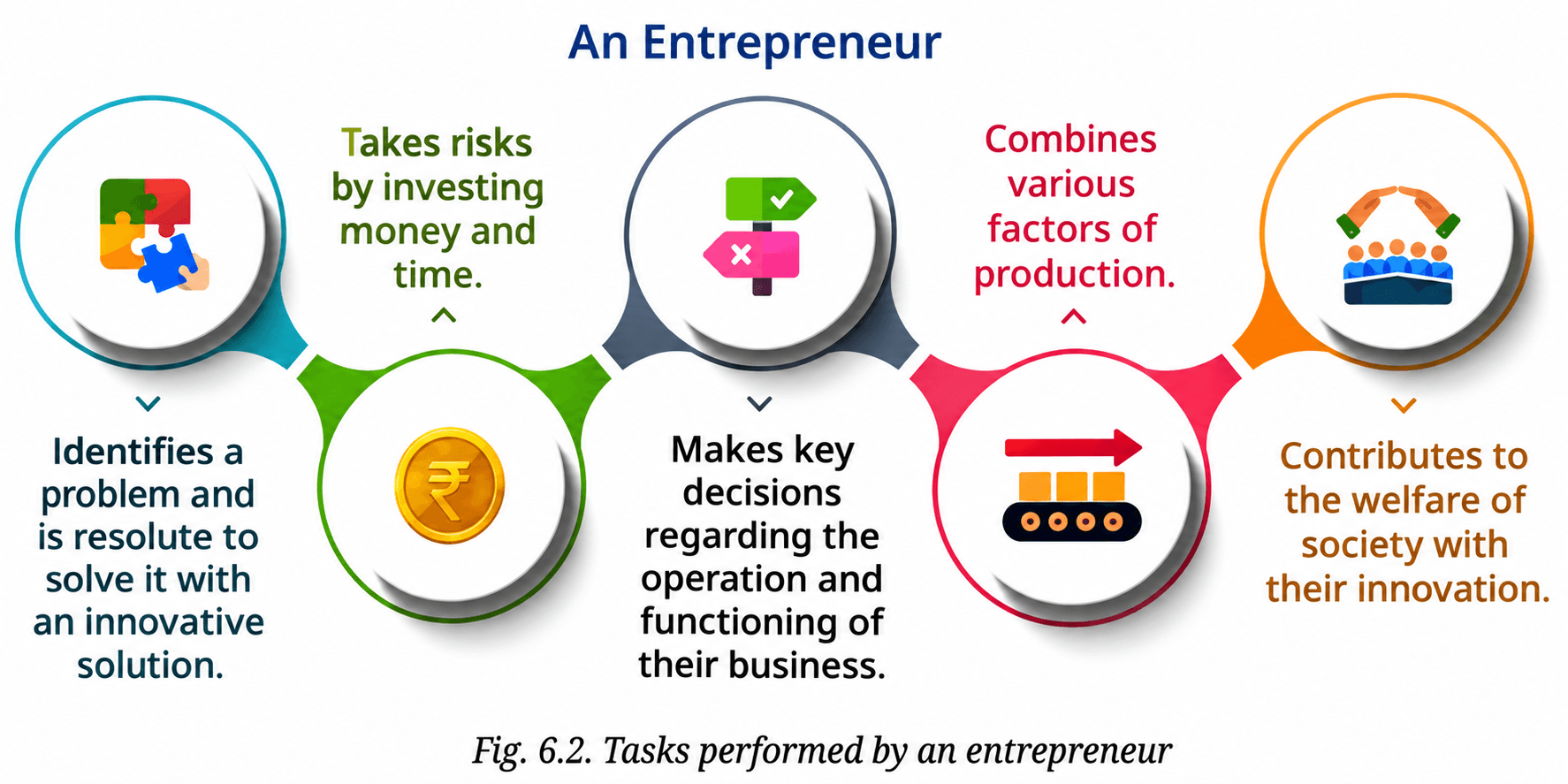
Prepare a short report on the tasks an entrepreneur performs at each stage, with reference to Fig. 6.2.
Answer:
Report framework:
Tailor—need: local stitching and alterations; resources: sewing machine, cloth supplies and skill; possible challenges: irregular orders and competition; risk: investing before demand is certain; lesson: reliable fitting and delivery build repeat customers.
Shopkeeper—need: nearby daily essentials; resources: stock, premises and accounts; possible challenges: price changes and unsold goods; risk: tying funds in inventory; lesson: record sales and restock carefully.
Stages: identify a need → organise resources → take informed risks → make operating decisions → assess results and improve.
Based on the case study of Mohan Singh Oberoi on Page 128, which functional area helped improve the quality of the company’s products?
How did different functional areas work together to make the business successful? Now that you know about the functional areas of a business, create a business plan for your business idea using the template given on Page 142.
Answer:
Management and operations directly improved hotel facilities and service quality. Human resources recruited and trained staff; finance supported renovations and expansion; marketing built a trusted reputation and attracted guests. Customer feedback connected these functions.
Page 137 – Let’s Explore
Find out more about other regional communities who have excelled as entrepreneurs.
Answer:
It include Marwari trading communities associated with Rajasthan, Gujarati merchant communities and Parsi entrepreneurs associated with western India. Their enterprises have included trade, manufacturing, finance and services. Family networks, training, accounting and trust often supported enterprise. These are historical examples, not claims that business ability belongs to any particular community; people from every background can become entrepreneurs.
Class 9 Social Science Part 2 Chapter 6 Exercises Question Answer
Page 140 – Questions and activities
1. Explain why a business can fail even with a great idea if one functional area [finance, human resources (HR), operations, or marketing] is weak. If you were running a bakery, which functional area would you prioritise first and why?
Answer:
A good idea needs money, skilled people, reliable production and customers. Weak finance can leave bills unpaid; poor operations can spoil products; weak HR can reduce service quality; poor marketing can leave customers unaware. I would first secure safe, consistent bakery operations because food quality and hygiene are essential, while coordinating finance, staffing and marketing from the start.
2. Do you think innovation alone is enough to make a business successful? Why or why not?
Answer:
No. Innovation must solve a real customer problem and be affordable to produce and buy. A business also needs sound finance, reliable operations, trained people and effective marketing. Customer feedback, ethical conduct and adaptation help turn an inventive idea into a sustainable enterprise.
3. “A business plan is a dynamic roadmap for a startup.” Explain this statement with suitable examples. When should one change the business plan?
Answer:
A business plan gives direction but must change when evidence changes. A bakery may reduce cakes and increase whole-wheat bread if customers prefer healthier products. Rising ingredient costs may require revised portions, suppliers or prices. Plans should be reviewed after customer feedback, changes in demand, financial difficulties or new opportunities, without abandoning essential quality and ethical standards.
4. Do you think every entrepreneur should think about the impact of their goods or services on society and the environment? Explain using relevant examples.
Answer:
Yes. Businesses affect customers, workers, resources and neighbourhoods. A bakery should provide safe food, fair working conditions and appropriate packaging while reducing waste. A notebook enterprise can reuse clean paper and avoid unnecessary plastic. Considering these effects builds trust and helps ensure that profit does not come at the expense of people or nature.
5. In 1931, two brothers, Digambar and Govind Dandekar, started a small business in South Mumbai selling ink powder. They began with limited resources, using recycled glass bottles to sell liquid ink.
At first, they faced financial problems and struggled to convince customers to trust their products. Instead of giving up, they focused on providing good-quality stationery at affordable prices. As the business grew, they noticed that artists in India did not have access to good art materials. Seeing this as an opportunity, they travelled to Glasgow to study colour chemistry and improve their products. After returning to India, they set up a laboratory to develop colours and art supplies suited to Indian needs. Over time, the company expanded into pencils, crayons, geometry boxes, and paints, eventually becoming a well-known brand.
• What entrepreneurial qualities did the Dandekar brothers display?
• What opportunity did they identify in the market?
• Was travelling to Glasgow a risky decision?
• Which functional area helped the company improve its products?
• How did they serve society apart from earning profits?
Answer:
• They showed perseverance, resourcefulness, observation, willingness to learn and commitment to quality and affordability.
• They identified unmet demand for good art materials suited to Indian users.
• Yes. Travel and study required time and money without assured success, but technical learning could improve their products.
• Management and operations applied research and technical knowledge to product development and quality; finance and skilled staff supported the work.
• They supplied useful educational and artistic materials, created employment and used resources creatively, including recycled bottles at the beginning.
6. How do you think entrepreneurship is important for India’s goal of becoming a developed nation by 2047?
Answer:
Entrepreneurship can create productive jobs, improve goods and services, develop local solutions and support innovation. Successful firms contribute income and taxes, while responsible enterprises can improve sustainability and widen opportunities. These contributions support development when combined with education, infrastructure, fair access to finance and accountable institutions.
7. Choose a product or service and develop a business plan for it using the following template:
• Business name
• Business idea
• Target customers
• Product/service and price
• Marketing idea
• Basic cost and expected profit
Answer:
Business name: ReLeaf Notebooks.
Idea: make notebooks from clean unused paper.
Target customers: students and parents.
Product and price: a small bound notebook at ₹25.
Marketing: school-approved posters, a display sample and pre-orders.
Model monthly cost: ₹1,600 for 100 notebooks, including materials, labour allowance and overheads.
Expected revenue if all sell: 100 × ₹25 = ₹2,500.
Expected profit: ₹2,500 − ₹1,600 = ₹900.
8. Find out about various government schemes to promote entrepreneurs in India. Learn about the eligibility requirements of these schemes. Prepare a write-up and discuss in the class.
Answer:
Research summary checked against official information on 1 October 2026:
- Startup India/DPIIT recognition: eligible incorporated companies, registered partnerships, LLPs or cooperative societies must meet innovation/scalability and other conditions and must not result from splitting an existing business. The current official overview gives a normal recognition period of up to 10 years and a turnover ceiling of ₹200 crore, with separate DeepTech criteria. Recognition does not automatically provide every benefit.
- Pradhan Mantri MUDRA Yojana: supports eligible income-generating micro enterprises through participating lenders. Shishu covers up to ₹50,000; Kishor above ₹50,000 to ₹5 lakh; Tarun above ₹5 lakh to ₹10 lakh. Tarun Plus, above ₹10 lakh to ₹20 lakh, is for eligible borrowers who successfully repaid a previous Tarun loan. Lenders assess the application and repayment capacity.
- PMEGP: supports eligible new micro enterprises; individual applicants must be over 18. For projects above ₹10 lakh in manufacturing or ₹5 lakh in service/business, the stated minimum educational qualification is Class VIII.
Project and applicant conditions apply.
9. Take any popular brand and identify:
• The problem it tackles
• Its initial target customers
• How it differentiated itself from other competitors or brands
• The resources it may have started with
Answer:
- Brand: Lijjat Papad.
- Problem: demand for reliable papads and the need for women’s income opportunities.
- Initial customers: households and local buyers in Mumbai.
- Difference: consistent quality combined with collective ownership and shared participation by women.
- Starting resources: the founders’ skills, a recipe, borrowed equipment, a small amount of money and cooperative effort.
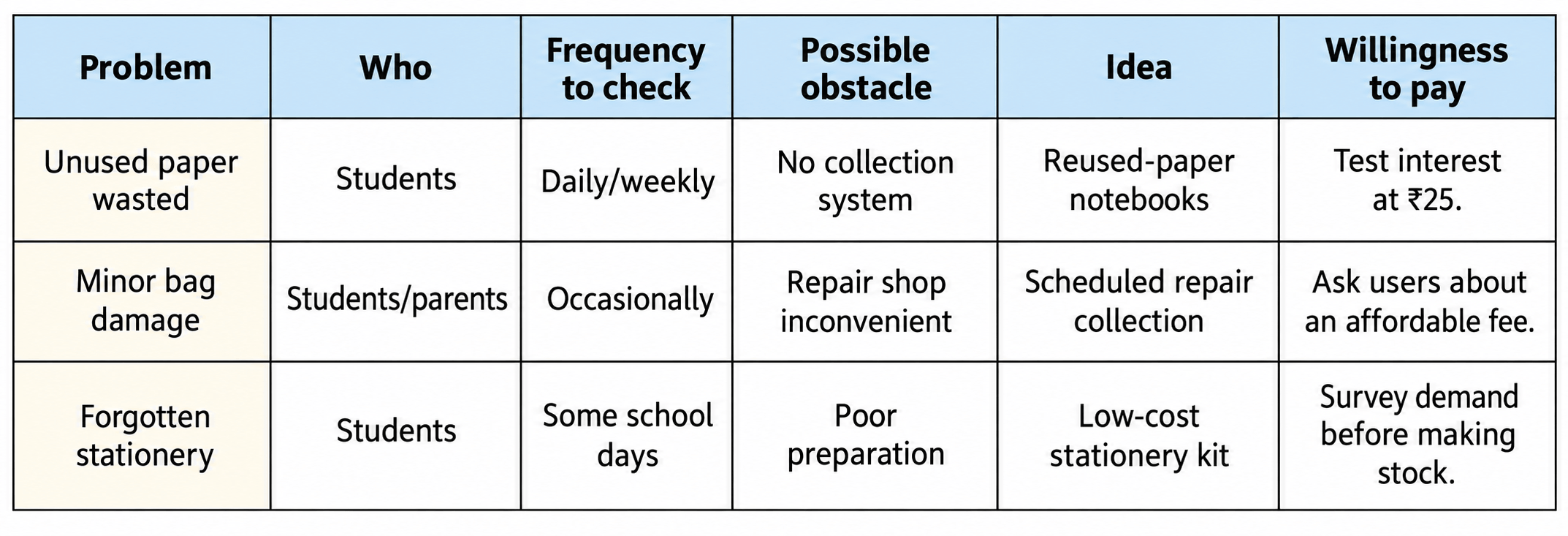
10. Over the next week, observe your daily routine at school and home. Identify 2–3 problems or inconveniences you or others face. For each problem, answer the following questions in a tabular format:
• Who faces this problem?
• How often does it occur?
• Why hasn’t it been solved yet?
• What business idea could solve it?
• Would people pay for your solution?
Answer:
Planning table, a completed week’s observation:
11. Think of your startup idea and fill in the business plan template given below:
a. Business idea
Name of the company or shop:
Product/service:
Tagline (optional):
b. Entrepreneur profile
Founder(s):
Why did you choose this business idea?
What problem does your business solve?
c. Target customers
Who will buy your product or service?
Students; Parents; Local residents; Others; Tourists; Farmers; Businesses
Describe your target customers:
d. Market research
Find answers to the following questions about potential customers.
What do the customers need?
What products or services already exist?
How is your idea different?
e. Product or service description
Describe your product or service. List its key features and benefits:
f. Resources required
Resource: Human Resources; Finance; Materials; Technology; Infrastructure
What is needed and how much?
g. Operations plan
How will the business work? Write the steps. You may depict this using a flow chart.
h. Marketing plan
How will customers learn about your business?
Posters; Social media; Word of mouth; Other; School events; Local market; Newspapers
i. Financial plan
Source(s) of finance:
Estimated monthly cost on various items:
Details of expected monthly revenue sources:
Expected Profit: Revenue − Cost
j. Risks and challenges
What challenges might your business face?
k. Social and environmental impact
How will your business help people or the environment?
l. Conclusion
Why do you believe your business will succeed?
Answer:
a. ReLeaf Notebooks; small notebooks from clean unused paper; tagline: “Give paper another page.”
b. Founders: a teacher-supervised Tiwari Academy team. The idea addresses wasted usable paper and demand for inexpensive notebooks.
c. Customers: students and parents needing rough-work notebooks.
d. Research plan: survey 20 potential buyers, compare existing notebook prices and test a sample. Expected distinction: local paper reuse and custom covers; demand is not yet proven.
e. Product: securely bound, clearly sized notebooks with checked pages and simple covers.
f. Resources: three team roles—production, accounts and sales; ₹1,600 working funds from an approved school activity fund; clean paper, covers and binding supplies; borrowed safe tools and a spreadsheet; approved school workspace.
g. Operations: collect → inspect and sort → cut safely under supervision → bind → check quality → record stock → sell → collect feedback.
h. Marketing: approved posters, school events and word of mouth; take pre-orders before large batches.
i. Monthly costs: paper/covers ₹500, binding ₹300, labour allowance ₹500, transport ₹150, posters ₹50, tool/space allowance ₹100. Total ₹1,600. Revenue: 100 notebooks × ₹25 = ₹2,500. Expected profit ₹900 if all sell. Borrowed tools avoid a large initial equipment purchase; later purchases need a separate budget.
j. Risks: unreliable supply, weak binding and low demand; reduce these through alternative sources, testing and pre-orders.
k. Impact: reduces usable-paper waste, teaches teamwork and offers affordable supplies.
l. The plan may succeed if tested demand, reliable quality and controlled costs support repeat purchases; success is not guaranteed.
12. Visit a factory or a production unit.
Explore how a business operates by visiting a factory or production unit that manufactures a product. Prepare questions for the owner or manager, such as:
• What product does the factory produce?
• Who are its customers?
• How did the business start?
• What challenges did the business face in its early years?
• How does the business manage its finances?
• How are employees recruited and trained?
• How are products supplied to wholesalers, retailers, or consumers?
During the visit, observe the production process carefully. Note the resources used, such as raw materials, machinery and technology, workers, and managers. Interact with the owner or manager and record key information. Take notes and photographs (if permitted).
After the visit:
• Understand the manufacturing process and create a process map showing the journey of the product from raw materials to the final customer.
• Identify barriers to growth, such as:
Financial Barriers: Lack of capital, difficulty obtaining loans or credit, etc.
Technical Barriers: Outdated machinery, limited access to technology, etc.
Human Resource Barriers: Skill shortages, difficulty hiring or retaining workers, etc.
Market Barriers: Competition, limited access to suppliers or customers, etc.
Regulatory Barriers: Complex procedures, licences, approvals, or paperwork, etc.
Recommend some practical solutions through which the business could overcome these challenges. Share your findings by preparing a presentation and a report highlighting your observations, analysis, and recommendations. The format of the report may be as follows:
• Introduction
• Production or service delivery process (with diagrams or flowcharts)
• Resources required
• Barriers identified (supported by observations or evidence)
• Suggested solutions
• Reflection: key lessons learned from the visit
Answer:
━━━━━━━━━━━━━━━━━━━━━━━━━━━━
REPORT: VISIT TO A BISCUIT FACTORY
━━━━━━━━━━━━━━━━━━━━━━━━━━━━
Name: Anuj Tiwari Class: IX Roll No.: 22
1. INTRODUCTION
I visited Shree Balaji Biscuits, a small biscuit factory in Delhi. It makes glucose biscuits and rusk. It started in 2012 and has about 35 workers.
Interview with the Owner:
- Product: Glucose biscuits, salted biscuits and rusk.
- Customers: Wholesalers, small shops and canteens.
- How it started: The owner used his savings and a bank loan, starting with only 8 workers.
- Early challenges: People did not know the brand, money was short and getting licences took time.
- Finances: An accountant keeps daily records and the bank gives a loan when needed.
- Employees: Hired through known people and trained on the job by senior workers.
- Supply: Factory → Wholesaler → Retailer → Consumer, delivered by the factory’s own vans.
2. PRODUCTION PROCESS
Raw Materials
↓
Mixing the dough
↓
Shaping biscuits
↓
Baking in oven
↓
Cooling
↓
Quality check
↓
Packing
↓
Wholesaler → Retailer → Consumer
3. RESOURCES REQUIRED
- Raw materials: Maida, sugar, oil, milk powder, salt
- Machines: Mixer, moulding machine, oven, packing machine
- Workers: Skilled and unskilled workers
- Managers: Owner and production manager
- Others: Building, electricity, water, money, licences
4. BARRIERS IDENTIFIED
- Financial: Shopkeepers pay late, and raw materials are costly.
- Technical: The oven is old, and power cuts stop the machines.
- Human Resource: Trained workers leave for better pay and many take leave during festivals.
- Market: Big brands give tough competition.
- Regulatory: Too many licences and too much paperwork.
5. SUGGESTED SOLUTIONS
- Give a small discount to buyers who pay early and take government loans meant for small businesses.
- Buy a new oven and install solar panels.
- Give workers bonuses and training.
- Make special biscuits like atta or jaggery biscuits and use better packaging.
- Use online government portals for licences.
6. REFLECTION
- A small biscuit packet goes through many steps before reaching us.
- A business needs money, machines, workers and good planning.
- Cleanliness and quality are very important in food factories.
- I learned to respect workers and business owners.
Extra Question Answers for Exam Preparation
Class 9 Social Science Part 2 Chapter 6 Very Short Answer Type Questions with Explanation.
Very Short Answer Type Questions
- What is an unmet customer need?
Answer:
An unmet customer need is a problem or requirement that existing products or services do not adequately address. - Why should an entrepreneur begin with a small trial?
Answer:
A small trial tests demand and quality at limited cost, allowing improvements before committing more money and resources. - What is working capital used for?
Answer:
Working capital supports everyday business needs, such as buying materials and paying routine bills while awaiting customer receipts. - How can customer complaints become useful information?
Answer:
Complaints can reveal recurring faults or unmet expectations, helping a business improve products, service and communication with customers. - Why does a business need accurate sales records?
Answer:
Accurate sales records reveal demand, support financial calculations and help owners plan stock, production and future business decisions. - What does quality control mean?
Answer:
Quality control checks whether products or services meet agreed standards consistently before or during delivery to the customer. - What is a supplier?
Answer:
A supplier provides materials, goods or services that another business needs to produce, operate or serve its customers. - Why should a bakery avoid excessive unsold stock?
Answer:
Excess unsold stock ties up funds and may spoil, causing losses while wasting ingredients, labour and other resources. - What is a customer segment?
Answer:
A customer segment is a group of buyers sharing relevant needs or characteristics that influence their purchasing choices. - Why is employee safety a business responsibility?
Answer:
Safe conditions protect workers from avoidable harm and help the business maintain reliable operations, trust and responsible practices. - What is cash flow?
Answer:
Cash flow describes money moving into and out of a business over time, affecting its ability to pay bills. - How can pre-orders reduce business risk?
Answer:
Pre-orders provide early evidence of demand, helping a business plan quantities and reduce the chance of producing unsold goods. - What does reinvesting profit involve?
Answer:
Reinvesting profit means using some earnings to improve or expand the business instead of withdrawing all earnings personally. - Why should advertising claims be accurate?
Answer:
Accurate advertising helps customers make informed choices and builds trust, while false claims can damage reputation and relationships. - How can enterprise support local skills?
Answer:
Enterprise can create demand for local skills, provide training and income, and help knowledge pass to new workers.
Class 9 Social Science Part 2 Chapter 6 Short Answer Type Questions with Explanation.
Short Answer Type Questions
- How can two businesses sell the same product but offer different value?
Answer:
Businesses may differ in quality, convenience, reliability, design, price or service. A bakery offering dependable early delivery may solve a different customer problem from one specialising in celebration cakes, even though both sell baked goods. - Why should labour be considered when estimating a school enterprise’s costs?
Answer:
Work uses time and skill even when classmates volunteer. Recognising a labour allowance helps students understand the enterprise’s true resource needs and avoids assuming that a business would remain profitable if regular workers required payment. - Explain how finance and operations depend on each other.
Answer:
Operations needs funds for materials, equipment and wages. Finance needs accurate information about production costs, sales and stock to plan payments. Poor coordination can cause shortages, waste or cash difficulties even when customer demand exists. - How can a business test whether customers will pay for an idea?
Answer:
It can show a sample, ask specific price questions and run a small approved trial or pre-order exercise. Actual purchase decisions provide stronger evidence than compliments alone, while feedback reveals possible improvements before expansion. - Why might lowering prices fail to increase profit?
Answer:
Lower prices reduce revenue per unit and may not produce enough additional sales to compensate. If costs remain high, total profit can fall. The owner should examine demand, costs and capacity before changing prices. - Explain the difference between an innovative idea and a viable enterprise.
Answer:
An innovative idea offers something new or improved. A viable enterprise must also attract enough paying customers, cover costs, organise resources and deliver consistently. Practical testing determines whether the idea can support ongoing operations. - How can a neighbourhood repair service benefit the environment?
Answer:
Repairing usable items can extend their life and reduce waste and replacement demand. The service also creates local work. Benefits depend on safe repairs, suitable materials and responsible disposal of parts that cannot be reused. - Why should a business keep an alternative supplier?
Answer:
An alternative supplier can reduce disruption if the main source becomes unavailable, expensive or unreliable. Comparing quality and delivery in advance helps maintain production, although the business should avoid unnecessary stock and unclear commitments. - What can an entrepreneur learn from a month of poor sales?
Answer:
Poor sales may reveal weak demand, unsuitable pricing, limited awareness or quality problems. Reviewing records and customer feedback helps identify the cause. The entrepreneur can then adjust the product or process rather than guessing blindly. - Why does teamwork matter even in a very small enterprise?
Answer:
A small team still needs production, money management and customer communication. Clear roles prevent neglected tasks and duplication. Sharing information helps members solve problems, maintain quality and understand how their work affects the whole venture.
Class 9 Social Science Part 2 Chapter 6 Long Answer Type Questions with Explanation.
Long Answer Type Questions
1. A school stall sells out but reports little profit. Explain possible reasons and an investigation.
Answer:
Selling out shows demand, but profit depends on revenue after all costs. The stall may have priced products too low, bought expensive ingredients or overlooked packaging and transport. The team should total units sold, receipts and every expense, then compare cost per unit with price. Accurate records can reveal whether reducing waste, changing suppliers or adjusting prices would improve the next event.
2. Develop a simple plan to improve an unreliable neighbourhood delivery service.
Answer:
First, record common problems such as late arrivals, missing items or unclear communication. Ask customers and delivery workers about causes. Set realistic delivery areas and time slots, confirm orders and keep a dispatch record. Train staff and provide a clear complaint channel. Review missed deliveries and customer feedback weekly. Expansion should follow dependable service, rather than accepting more orders than the team can manage.
3. Explain why social responsibility can support a business’s long-term success.
Answer:
Customers and workers are more likely to trust a business that provides safe products, fair treatment and honest information. Reducing waste can also lower costs, while responsible use of resources protects the surroundings on which the enterprise depends. These practices do not guarantee profit, but they reduce avoidable harm and help build lasting relationships, making the business better placed to sustain its work.
4. How would you decide whether to expand a small notebook enterprise?
Answer:
I would review actual demand, repeat purchases, product quality and complete cost records. Expansion should be supported by reliable paper supplies, sufficient working funds and a team able to maintain standards. A small increase in production or additional pre-orders would test capacity before a major commitment. I would also consider waste, workspace and customer feedback, rather than expanding simply because the first event was successful.
5. Explain how learning from failure differs from repeatedly taking careless risks.
Answer:
Learning from failure involves identifying causes, checking evidence and changing decisions before trying again. An entrepreneur might test demand on a smaller scale or correct weak accounting. Careless risk-taking ignores these lessons and repeats unsupported assumptions. Persistence is useful when combined with planning and adaptation; it does not mean investing more money in the same approach without understanding why it failed.