



by Tiwari Academy Team
NCERT Solutions for Class 7 English Poorvi Unit 1 Chapter 1 The Day the River Spoke – Question Answers, Summary, Hindi Translation and Exercises questions for 2026-27 Exam. The Day the River Spoke is Chapter 1 of Class 7 English Poorvi Unit 1, written by Kamala Nair. The story follows Jahnavi, a young girl from a coastal village in India who dreams of going to school but is held back by family responsibilities. One day, sitting by the river in tears, she hears the River speak – and its gentle advice changes her life forever. This chapter beautifully highlights the importance of girl child education and the power of courage.
Quick Links:
- NCERT Question Answers
- English to Hindi Translation
- Summary in English and Hindi
- Important Word Meanings
Download Class 7 English App to study Class 7 English Offline.
NCERT Class 7 English Poorvi Unit 1 Chapter 1 Solutions
Class 7 English Poorvi Unit I Chapter 1 Question Answer
Page 1
Let us do these activities before we read.
I. Close your eyes and quietly listen to the sounds around you for a minute.
1. Are they trying to tell you something?
Sounds can communicate information like birds signaling weather changes, vehicles indicating someone’s arrival or natural sounds suggesting changes in the environment.
2. Do you think the things around you also listen to you all day long? Share your answer with your classmates and the teacher.
The environment “listens” by absorbing our sounds, but doesn’t process them as humans do. Plants and animals may respond to human sounds in various ways, but not with human understanding.
II. Jahnavi was a bright young girl who lived with her parents and three brothers in a coastal village in India. Her parents worked on the farm. She had a dream.
1. What could that dream be?
Jahnavi’s dream was to go to school and learn to read like her brothers Ettan and Meena.
2. How could she make her dream come true?
She needed to overcome her fear of going to school, gain her parents’ support and permission and follow the River’s advice to take initiative.
3. What is your dream? What can you do to make your dream come true? Share your answers with your classmates and the teacher.
My dream is to become a teacher. To make my dream come true, I will study hard and improve my knowledge. I will also be kind, patent and work sincerely towards my goal.
Page 3 – Let Us Discuss
1. What was Jahnavi’s dream? Was it important to her? Why?
Jahnavi’s dream was to go to school and learn to read like her brothers Ettan and Meena. This dream was extremely important to her for several reasons:
- She expressed this desire repeatedly to her mother over the years, showing her persistent interest
- She felt left behind as even her younger brother Ramu was being prioritized over her
- She longed for knowledge and had specific curiosities (like “why spiders are yellow in yellow flowers” and “why bamboo trees rustle”)
- She wanted to develop literacy skills like her brothers
- It represented both personal development and equality for her
- By the end of the story, she evolved this dream further, wanting to become a teacher and help other village girls access education
The depth of her emotion about this dream is shown when she cries at the river’s edge, demonstrating how crucial this unfulfilled dream was to her sense of self and future.
2. Do you think the river can help her in fulfilling her dream? How?
Yes, the river helped Jahnavi fulfill her dream in several important ways:
- Provided emotional support by listening to her concerns and fears
- Offered wisdom and encouragement, telling her “little girls can do as much as little boys”
- Gave practical advice on how to approach school (“just slip along one morning and sit there”)
- Built her confidence by reminding her that she wasn’t afraid of natural creatures like lizards and snakes
- Challenged her excuses and helped her see that her fear was the main obstacle
- Suggested a step-by-step approach (“Try going to school first”)
- Empowered her by saying “it’s up to you”, placing the responsibility for change in her hands
- Acted as a mentor figure who believed in her potential when she didn’t believe in herself.
The river’s guidance was effective because at the end of the story, we see that Jahnavi gathered her courage, went to school and was welcomed by the teacher, making her dream a reality.
Page 6 – Let us discuss
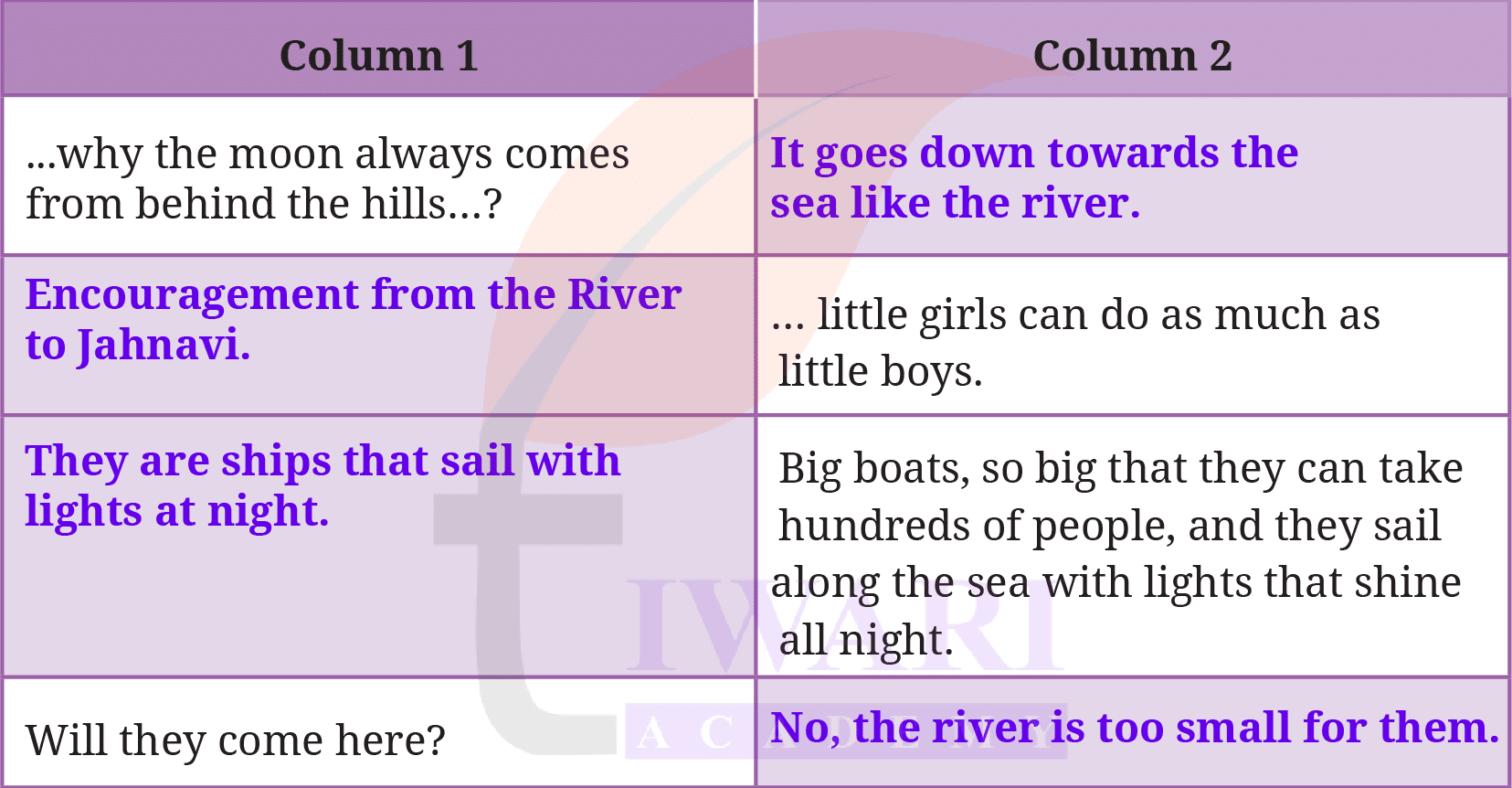
Complete the table given below with Jahnavi’s questions in Column 1 and the River’s answers in Column 2. Check your answers with the teacher.

Answer:
Page 7 – Let us think and reflect
I. Read the extracts given below and answer the questions that follow.
1. “You shouldn’t cry, you know,” the voice went on. “And you really shouldn’t be scared, when you have been coming here to see me every day, well, almost every day.” She was puzzled. It was such a voice, like the river. It couldn’t be the river! “Well, tell me all about it,” said the River, for it was the River. “I’ve got to hurry to reach the sea, you know.”
(i) Complete the sentence with the correct option from those given in the brackets.
The tone of the River in the given extract is __________________. (assuring/sympathising)
(ii) Select a phrase from the extract which shows that Jahnavi was a frequent visitor to the spot.
(iii) Choose the correct option to complete the sentence.
The use of an exclamation mark at the end of the line, ‘It couldn’t be the river!’ express _____________.
A. excitement
B. hesitation
C. irritation
D. Disbelief
(iv) Choose three qualities of the River highlighted in the extract from the words in the box given below.
Answer:
(i) The tone of the River in the given extract is sympathising.
(ii) “You have been coming here to see me every day, well, almost every day”.
(iii) The use of an exclamation mark at the end of the line, ‘It couldn’t be the river!’ expresses disbelief.
(iv) Thoughtful, kind-hearted, affectionate
2. “Can I do something?” asked Jahnavi. “Well, it’s up to you,” said the River. “Seems to me little girls can do as much as little boys—they swim as fast as little boys. You just slip along one morning and sit there in the school and listen to what’s going on, and maybe the teacher will let you stay.” “I couldn’t,” gasped Jahnavi. “I couldn’t! They’d scare me! They’d chase me out.”
(i) Complete the sentence with an appropriate reason.
According to the River, there was no difference between girls and boys because ________.
(ii) Identify whether the following statement is true or false.
The River encourages Jahnavi to have faith in herself and fulfill her desire to go to school.
(iii) Choose the correct option to complete the sentence.
When the River suggests that Jahnavi should ‘slip along’, it means that she should move __________.
A. quickly B. casually C. quietly D. confidently
(iv) What does the repetition of the phrase I couldn’t, tell us?
Answer:
(i) According to the River, there was no difference between girls and boys because they have equal capabilities to learn and achieve.
(ii) True
(iii) When the River suggests that Jahnavi should ‘slip along’, it means that she should move quietly.
(iv) The repetition emphasizes Jahnavi’s intense fear and deep belief that attending school is impossible for her.
II Answer the following questions.
1. Why does the writer describe different aspects of nature in great detail at the beginning of the story? Why do you think the writer does this?
Answer:
The writer describes nature in detail to create a vivid setting and establish a connection between Jahnavi and the natural world. This helps readers understand the importance of the river in Jahnavi’s life and builds the foundation for personifying the river as a mentor.
2. How did the River know so much about Jahnavi?
Answer:
The River knew so much about Jahnavi because she had been visiting the river regularly and sharing her thoughts and concerns there. The River, as a personified character, observed her visits and listened to her when she spoke aloud.
3. Jahnavi says, “And I’m so old now, they’ll never let me go.” What can you infer about Jahnavi and the school from this line?
Answer:
We can infer that Jahnavi is about 10 years old and feels she has passed the typical age when girls in her community start school. This suggests that education opportunities for girls in her village might be limited or delayed compared to boys and there are social barriers to older girls beginning education.
4. Why did the River laugh when Jahnavi said she would be scared at school?
Answer:
The River laughed because it found it ironic that Jahnavi wasn’t afraid of creatures in nature like the green lizard and the bamboo clump (which even had a snake), yet was afraid of going to school with other children.
5. Why should Jahnavi follow the River’s advice?
Answer:
Jahnavi should follow the River’s advice because the River understands her potential, encourages her to overcome her fears and shows her a path to fulfill her dream of education. The River has wisdom from observing many lives and knows that Jahnavi is capable of more than she believes.
6. How does the conversation between Jahnavi and the River make the story more appealing?
Answer:
The conversation makes the story more appealing by personifying the River, adding dialog that children can relate to, creating an imaginary mentor for Jahnavi and presenting complex issues about gender equality and education in a simple, engaging way.
7. What is the main message that the writer intends to convey?
Answer:
The main message is that education is important for all children regardless of gender, and that with determination and courage, one can overcome social barriers and fears to pursue one’s dreams and aspirations.
Page 8 – Let us learn
I. You have learnt that naming words are called nouns and only proper nouns begin with a capital letter. Why has the author used a capital letter for the ‘River’ even when it is a common noun?
(Clue: Has the River been given qualities of a human being?)
Answer:
Because the River is given human qualities (it talks), making it a character.
II. There are a few words related to sound in the text. Pick the words from the text and write them next to the correct definition.
1. made a high-pitched piercing sound
Answer:
Shrieked
2. to cause liquid to strike or fall on something
Answer:
Splashed
3. a low continuous background noise
Answer:
Murmuring
4. cry with loud uncontrollable gasps
Answer:
Sobbed/wailed
5. to make a soft dry sound, like paper or leaves moving
Answer:
Rustled
6. took a short quick breath through the mouth due to surprise, pain or shock
Answer:
Gasped
7: shaking rapidly to make continuous short, sharp sounds
Answer:
Rattling
8. making a lot of noise
Answer:
Noisy
9: made a long, high cry, usually because of pain or sadness
Answer:
Wailed
Now, fill in the blanks with suitable sound words from exercise (II).
The classroom grew (i) _______ as the students noticed the teacher carrying the answer papers. As the teacher turned the pages with a (ii) _______, the children (iii) _______, wondering what comments awaited. Someone (iv) _______ in frustration, and the (v) _______ of the students steadily increased. Finally, when the teacher praised the students for their excellent performance, the students (vi) ________ with excitement.
Answer:
The classroom grew (i) noisy as the students noticed the teacher carrying the answer papers. As the teacher turned the pages with a (ii) rustle, the children (iii) gasped, wondering what comments awaited. Someone (iv) wailed in frustration, and the (v) murmuring of the students steadily increased. Finally, when the teacher praised the students for their excellent performance, the students (vi) shrieked with excitement.
III. The word ‘catamaran’ is used in the text. The word originates from Tamil language ‘kattu maram’ meaning ‘tied wood’.
Find out the meanings of these words. From which Indian language these words were borrowed. An example has been given.
1. karma (Sanskrit) 2. sahib 3. chutney 4. guru
5. verandah 6. jungle 7. areca 8. palanquin
Answer:
1. Karma – Sanskrit
2. Sahib – Urdu
3. Chutney – Hindi
4. Guru – Sanskrit
5. Verandah – Hindi
6. Jungle – Hindi
7. Areca – Kannada
8. Palanquin – Sanskrit
IV. Chandu, the fisherman, has a catamaran that the River preferred to a ship. Given below are some boats that are used in different parts of our country.

(i) Which one would you like to travel in?
(ii) Make a colourful drawing of a boat that you would like to travel in.
Answer:
(i) I’d like to travel in a Shikara (beautiful and peaceful boat from Kashmir).
(ii) The boat that I would like to travel in is as follows:

V Solve the crossword puzzle based on words related to water transport.

Across
1. a large vessel used for transporting goods or passengers by sea
2. a small vessel for travelling on water, typically propelled by oars, sails, or an engine
3. a flat floating structure for travelling across water
4. a boat or ship driven by steam
Down
5. a small, light, narrow boat, pointed at both ends and moved using a paddle
6. a boat with a powerful engine which can change direction easily and is used to pull large ships into and out of port
7. a boat with sails and sometimes an engine, used for either racing or travelling for pleasure, rhymes with ‘cot’
Answer:

VI. Read the highlighted words in the following lines from the text.
“She goes down towards the sea. I’ve seen her; she always takes the same way—over the mountains and down to the sea, like me!”
Prepositions are words that indicate the relationship between nouns or pronouns and other elements in a sentence. They show direction, location, time or logical relationships between ideas.
Now, fill in the blanks with suitable prepositions given within the brackets.
Jahnavi takes the River’s advice and goes to school. On her first day
1. _________ (at/in/on) school, Jahnavi stood nervously. 2. _________ (in/outside/above) the gate, clutching her bag close to her. The bell rang and she hurried 3. _________ (outside/through/inside) the bustling classroom. She found a seat 4. _________ (among/between/from) two friendly classmates. The teacher greeted them warmly and started the lesson 5. _________ (about/in/for) numbers. Jahnavi listened attentively, feeling excited 6. _________ (at/about/for) the new adventure ahead.
Answer:
1. At school, Jahnavi stood nervously. 2. Outside the gate, clutching her bag close to her. The bell rang and she hurried 3. inside the bustling classroom. She found a seat 4. between two friendly classmates. The teacher greeted them warmly and started the lesson 5. about numbers. Jahnavi listened attentively, feeling excited 6. for the new adventure ahead.
VII. Read the highlighted words in the following sentence from the text.
A kingfisher swept down, its wings an arrow of blue in the sunlight.
Words like on, off, up, down can function both as preposition and as adverb.
For example:
• She ran up the stairs. (preposition)
• She rang me up. (adverb)
Fill in the blanks with prepositions or adverbs.
1. The cat jumped ___________ the table. (preposition)
2. The children played ___________ until dark. (adverb)
3. She quickly ran ___________ the park. (preposition)
4. The helicopter was hovering ___________. (adverb)
5. We were just walking ___________, chatting. (adverb)
6. After thoroughly wiping his shoes, he stepped ___________. (adverb)
7. She drove slowly ___________ the sharp curve. (preposition)
8. He placed the keys ___________ the mat before leaving. (preposition)
Answer:
1. The cat jumped onto the table.
2. The children played happily until dark.
3. She quickly ran across the park.
4. The helicopter was hovering overhead.
5. We were just walking along, chatting.
6. After thoroughly wiping his shoes, he stepped inside.
7. She drove slowly around the sharp curve.
8. He placed the keys on the mat before leaving.
Page 12 – Let us listen
I. Read the words given in the box below. You will listen to five people speak about school life. As you listen, circle the words that are used by the speakers. There are two words you do not need.
(Transcript for the teacher on pg. 39 )
Answer:
Words likely used by speakers (example selection based on text):
- Homemaker
- Principal
- Careers
- Books
- Desks
- Advertisements.
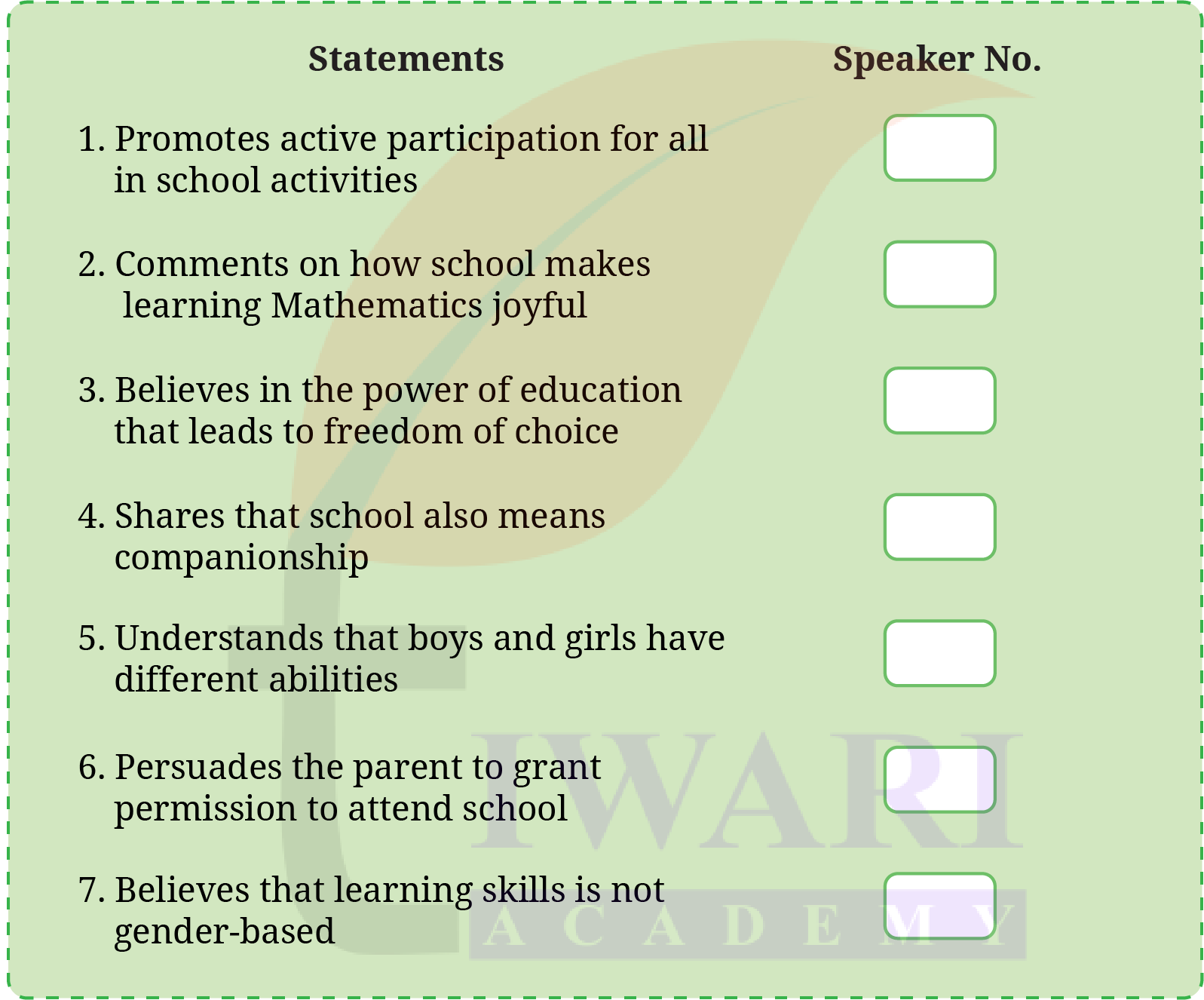
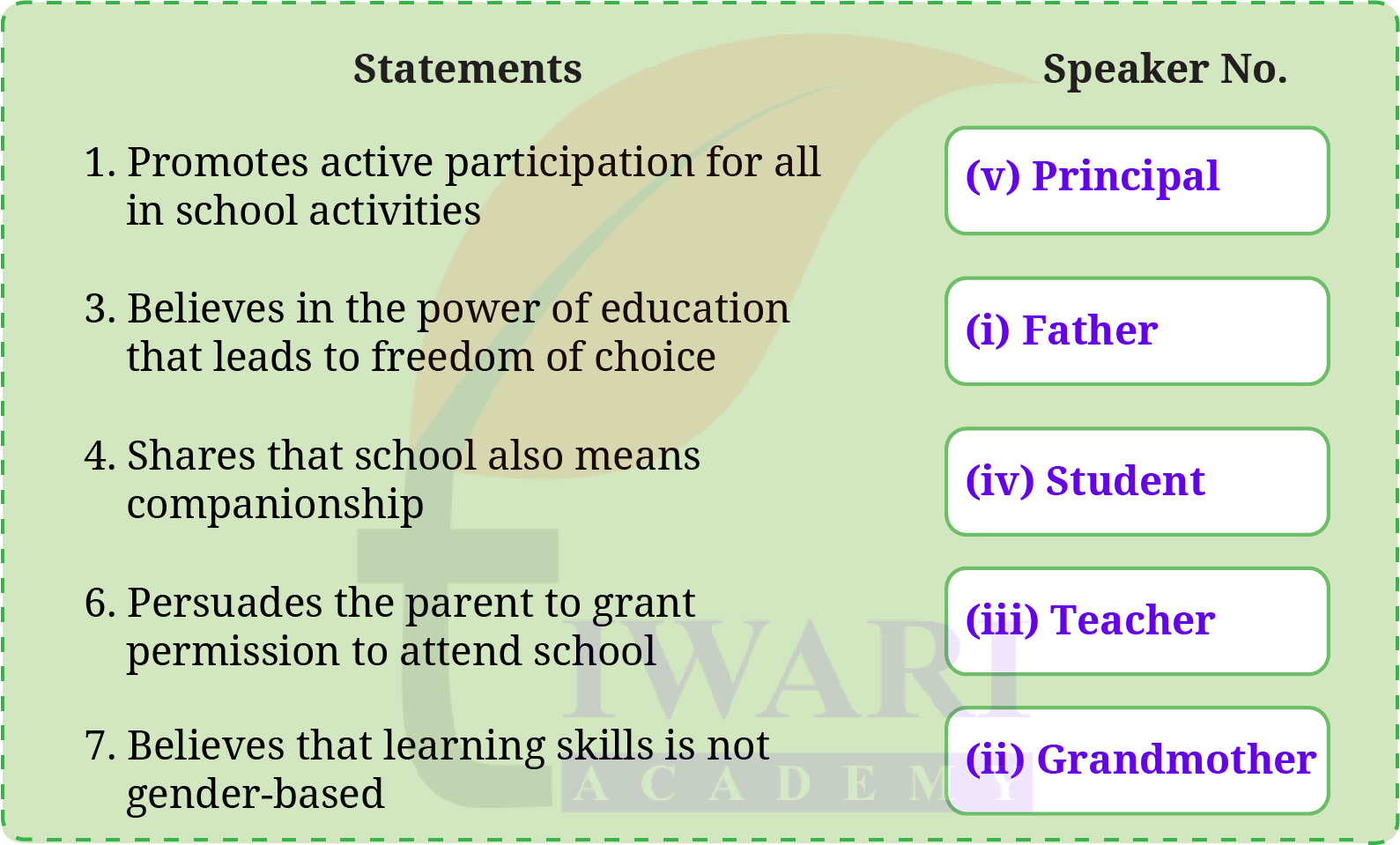
II. You will once again listen to the five speakers. As you listen, match each statement 1–7 to each speaker (i)–(v). There are two statements that you do not need.
Answer:
Page 13 – Let Us Speak
I. Read the sentence given below.
“Dear, dear! What’s the matter? … You shouldn’t cry, you know. And you really shouldn’t be scared, when you have been coming here to see me every day, well, almost every day.” The River spoke to Jahnavi in a ‘sleepy’ voice. Work in pairs and take turns to speak the same sentence in ‘other’ voices. Some hints are given below.
{happy surprised angry scared sad worried}
Answer:
- Happy voice: (Bright and excited)
“Dear, dear! What’s the matter? You shouldn’t cry, you know! And you really shouldn’t be scared!” - Scared voice: (Shaky and whispery)
“Dear… dear? What’s the matter? You… you shouldn’t cry. You really shouldn’t be scared…” - Angry voice: (Firm and loud)
“Dear, dear! What’s the matter?! You shouldn’t cry, and you really shouldn’t be scared!” - Excited voice: (Fast and cheerful)
“Dear, dear! What’s the matter? Oh! You shouldn’t cry, you know—and guess what, you really shouldn’t be scared!” - Worried voice: (Concerned tone)
“Oh dear, dear! What’s the matter? You shouldn’t cry, you know… and you really shouldn’t be scared, should you?”
II Janhavi asks the River for advice and the River gives advice. Read the given situations and work in pairs to ask for and give advice. Take turns to change your roles. Use the prompts given below.
1. Situation (i) : You wish to play football at school but it has an all-boys’ team only.
2. Situation (ii) : You have been unable to score well in Mathematics due to nervousness during exams.
3. Situation (iii) : You really enjoy music classes but do not get enough time to practise for it.
4. Situation (iv) : You cannot see the blackboard clearly from the last bench.
Answer:
1. Student: I really want to join the football team, but it’s only for boys. What do you think I should do?
Friend (Giving advice): I think you should talk to your teacher. Why don’t you suggest starting a mixed team?
2. Student: I always get nervous during Maths exams. I’d appreciate your advice on this issue.
Friend: The best thing to do is to practice more mock tests. If I were you, I’d take help from the teacher too.
3. Student: I enjoy music so much, but I hardly get time to practise. Do you think I should stop it?
Friend: Not at all! I think you should create a small routine—maybe 15 minutes daily. That will help!
4. Student: I can’t see the board from the back bench. What would you do in my position?
Friend: I’d tell the teacher about it and ask to sit in the front. You shouldn’t ignore it.
Page 14 – Let Us Explore
I. Discuss why rivers in India are considered to be sacred and most of them are referred to as female. Some rivers are referred to as male, for example, the Brahmaputra and the Sone.
Answer:
In India, rivers are considered sacred because they give life to people, animals and crops. Many rivers like the Ganga, Yamuna and Saraswati are worshipped as goddesses. They are seen as mothers who provide water and nourishment. Their flowing nature and giving quality are seen as feminine. That’s why we call them “she” or “Mother Ganga.”
However, some rivers like Brahmaputra are considered male, possibly due to their strong and forceful flow.
II. Whole Class Activity
1. India is a multilingual country, and many of us can speak two to three languages easily. Make a list of the languages that everyone in the class can speak and display it on a chart paper in the classroom.
Answer:
Hindi, English, Tamil, Telugu, Punjabi, Bengali, Marathi, Kannada, Urdu
2. In which language do you enjoy reading and learning the most?
Answer:
“I enjoy reading and learning in English because it opens a window to stories and ideas from all around the world.”
III. Read the poster given below and answer the questions that follow.

1. What are the things you can observe in the poster?
2. Why do you think the girls look happy?
3. What is the relation between ‘dignity’ and ‘happiness’?
4. How does a nation prosper when its daughters are happy?
Answer:
1. Happy girls, School building, Books, Bright smiles, Dignity and pride in their faces
2. They look happy because they are getting the opportunity to study and learn, something that empowers them to dream big and shape their future.
3. When someone has dignity, they are respected and valued. This self-respect brings confidence, independence and ultimately happiness.
4. When girls are educated and happy, they grow into strong, knowledgeable women who contribute to the society and economy.
An educated girl uplifts her whole family, and educated families create a stronger, wealthier and healthier nation.
IV. The Government has launched many schemes for the education of the girl child. Some of them are ‘Beti Bachao Beti Padhao’, ‘Balika Samridhi Yojana’, ‘Samagra Shiksha Scheme – Kasturba Gandhi Balika Vidyalayas’, etc. Find out more such schemes from the internet or from your teacher and spread awareness in your neighbourhood.
Answer:
1. National Scheme of Incentive to Girls for Secondary Education (NSIGSE): Gives financial help to girls when they pass Class 8, so they can continue studying.
2. CBSE UDAAN: Supports girls in Class 11 and 12 to prepare for engineering entrance exams.
Spread awareness:
1. I can talk to my neighbours and tell them about these schemes.
2. I can make a small poster and put it up in the community center.
3. I can share information in school and with my friends.
4. I can ask my teacher to help us organise a small awareness session.
Class 7 English Poorvi Unit I Chapter 1 English to Hindi Translation.
Class 7 Poorvi Unit I Chapter 1 Hindi Translation
A big bright tear splashed down her nose. And another.
A kingfisher swept down, its wings an arrow of blue in the sunlight. And a green lizard slithered down to the river’s edge to bask in the sun.
Hindi Translationएक बड़ी चमकदार आँसू की बूंद उसकी नाक पर टपकी। और फिर एक।
एक रामचिरैया नीचे आई, उसके पंख सूरज की रोशनी में नीले तीर की तरह थे। और एक हरी छिपकली धूप सेंकने के लिए नदी के किनारे तक रेंगती हुई आई।
“Dear, dear!” said a sleepy, murmuring voice, “What’s the matter?”
Hindi Translation“अरे, अरे!” एक नींद भरी, बुदबुदाती आवाज़ ने कहा, “क्या बात है?”
Jahnavi was startled, because she was sure she had been quite alone. It couldn’t have been the lizard. And the kingfisher was up in the thicket of bamboo eating the fish it had caught.
Hindi Translationजाह्नवी चौंक गई, क्योंकि उसे यकीन था कि वह बिल्कुल अकेली थी। यह छिपकली तो नहीं हो सकती थी। और रामचिरैया बाँस के झुरमुट में अपनी पकड़ी हुई मछली को खा रही थी।
It couldn’t be the parrots, because parrots shrieked and this was such a sleepy voice. She looked around her. There wasn’t a soul in sight. She was rather scared and wanted to run away.
Hindi Translationयह तोते नहीं हो सकते थे, क्योंकि तोते चीख़ते हैं और यह आवाज़ तो इतनी नींद भरी थी। उसने अपने चारों तरफ देखा। आस-पास कोई नज़र नहीं आ रहा था। वह काफी डर गई थी और भाग जाना चाहती थी।
“You shouldn’t cry, you know,” the voice went on. “And you really shouldn’t be scared, when you have been coming here to see me every day, well, almost every day.”
Hindi Translation“तुम्हें रोना नहीं चाहिए, तुम जानती हो,” आवाज़ ने कहना जारी रखा। “और तुम्हें डरना भी नहीं चाहिए, जबकि तुम हर रोज, यानी ठीक-ठीक कहें तो लगभग हर रोज, मुझसे मिलने यहाँ आती हो।”
“Well, tell me all about it,” said the River, for it was the River. “I’ve got to hurry to reach the sea, you know.”
Hindi Translation“अच्छा, मुझे सब कुछ बताओ,” नदी ने कहा, क्योंकि यह आवाज़ नदी की ही थी। “मुझे समुद्र तक पहुँचने की जल्दी है, तुम जानती हो।”
“They won’t let me go to school,” said Jahnavi. “I asked my mother, ‘Why can’t I go to school like Ettan and Meena?’ And Mother had replied, ‘You are too small, baby. Maybe later.’ ” But when she was five, little Ramu was born and Mother still said, “Maybe next year.
Hindi Translation“वे मुझे स्कूल नहीं जाने देते,” जाह्नवी ने कहा। “मैंने अम्मा से पूछा, ‘मैं एट्टन और मीना की तरह स्कूल क्यों नहीं जा सकती?’ और अम्मा ने जवाब दिया, ‘तुम बहुत छोटी हो, बच्ची। शायद बाद में।’” लेकिन जब वह पाँच साल की हुई, तो छोटे रामू का जन्म हुआ और अम्मा ने फिर भी यही कहा, “शायद अगले साल।
Jahnavi, mind your little brother while I go to the fields.” Now, she was nearly ten and minding Little Appu, who was the smallest. “They don’t want me. They only…”—she stopped with a sob…
Hindi Translationजाह्नवी, जब तक मैं खेतों में जाती हूँ, अपने छोटे भाई का ध्यान रखना।” अब, वह लगभग दस साल की थी और छोटे अप्पू का ध्यान रखती थी जो सबसे छोटा था। “वे मुझे नहीं चाहते। वे बस…” — वह एक सिसकी के साथ रुक गई…
“I am scared to go to school. And I’m so old now, they’ll never let me go. But I want to go. I want to learn to read like Ettan and Meena.” Jahnavi called her brother ‘Ettan’.
Hindi Translation“मुझे स्कूल जाने में डर लगता है। और अब तो मैं इतनी बड़ी हो गई हूँ, वे मुझे कभी नहीं जाने देंगे। पर मैं जाना चाहती हूँ। मैं एट्टन और मीना की तरह पढ़ना सीखना चाहती हूँ।” जाह्नवी अपने भाई को ‘एट्टन’ कहकर बुलाती थी।
Ettan means ‘Elder brother’, but his real name was Gopi. “I want to know why spiders are yellow in yellow flowers, why bamboo trees rustle, why the moon always comes from behind the hills, never the other way, why the baby fish in the field water become frogs, why…”
Hindi Translationएट्टन का मतलब होता है ‘बड़ा भाई’, पर उसका असली नाम गोपी था। “मैं जानना चाहती हूँ कि पीले फूलों में मकड़ियाँ पीली क्यों होती हैं, बाँस के पेड़ सरसराते क्यों हैं, चाँद हमेशा पहाड़ियों के पीछे से ही क्यों निकलता है, दूसरी तरफ से क्यों नहीं, खेत के पानी की छोटी मछलियाँ मेंढक क्यों बन जाती हैं, क्यों…”
“Stop!” said the River. “You make me breathless. So many whys! I can tell you where the moon goes,” the River said conspiratorially.
Hindi Translation“रुको!” नदी ने कहा। “तुमने तो मेरी साँस ही फुला दी। इतने सारे क्यों! मैं तुम्हें बता सकती हूँ कि चाँद कहाँ जाता है,” नदी ने गोपनीय अंदाज़ में कहा।
“It goes down towards the sea. I’ve seen; it always takes the same way—over the mountains and down to the sea, like me!”
Hindi Translation“वह समुद्र की ओर नीचे जाता है। मैंने देखा है; वह हमेशा एक ही रास्ते से जाता है—पहाड़ों के ऊपर से और मेरी तरह समुद्र की ओर!”
Part II
“Even little Ramu goes to school,” said Jahnavi, “pity, the school isn’t by the sea,” said the River. “Then I could take you along, you know.
Hindi Translation“छोटा-सा रामू भी स्कूल जाता है,” जाह्नवी ने कहा। “दुर्भाग्य से, स्कूल समुद्र के किनारे नहीं है,” नदी ने कहा। “तब मैं तुम्हें अपने साथ ले जा सकती थी, तुम्हें पता है।
But, I suppose I couldn’t really. You’d get your feet wet. And that would never do! I’m afraid there’s only one thing you can do.”
Hindi Translationलेकिन, मुझे लगता है कि मैं वास्तव में नहीं जा पाती। तुम्हारे पैर भीग जाते। और यह कभी नहीं होना चाहिए! मुझे डर है कि तुम्हारे लिए केवल एक ही रास्ता है।”
“Can I do something?” asked Jahnavi. “Well, it’s up to you,” said the River. “Seems to me little girls can do as much as little boys—they swim as fast as little boys.
Hindi Translation“क्या मैं कुछ कर सकती हूँ?” जाह्नवी ने पूछा। “खैर, यह तुम पर निर्भर करता है,” नदी ने कहा। “मुझे तो लगता है कि छोटी लड़कियाँ भी छोटे लड़कों जितना ही कर सकती हैं—वे छोटे लड़कों जितनी ही तेज़ तैरती हैं।
You just slip along one morning and sit there in the school and listen to what’s going on and maybe the teacher will let you stay.”
Hindi Translationतुम किसी सुबह चुपचाप वहाँ चली जाना और स्कूल में बैठकर सुनना कि क्या चल रहा है, और शायद शिक्षक तुम्हें रुकने दें।”
“I couldn’t,” gasped Jahnavi. “I couldn’t! They’d scare me! They’d chase me out.”
Hindi Translation“मैं नहीं कर पाऊँगी,” जाह्नवी ने हाँफते हुए कहा। “मैं नहीं कर पाऊँगी! वे मुझे डरा देंगे! वे मुझे बाहर खदेड़ देंगे।”
The River laughed. “You? Scared?” the River said, “when you’re not afraid of the green lizard, or of the snake in the bamboo clump, (Jahnavi startled) or the big trains rattling past that bridge.” “Trains are noisy; I prefer ships,” said the River.
Hindi Translationनदी हँस पड़ी। “तुम? डरी हुई?” नदी ने कहा, “जबकि तुम हरी छिपकली से भी नहीं डरती, न बाँस के झुरमुट में रहने वाले साँप से, (जाह्नवी चौंक गई) न उस पुल से गुज़रने वाली बड़ी-बड़ी रेलगाड़ियों की खड़खड़ाहट से।” “रेलगाड़ियाँ शोर करती हैं; मुझे जहाज़ अधिक पसंद हैं,” नदी ने कहा।
Jahnavi never knew the snake lived in the bamboo clump.
“What are ships?” she asked.
“Big boats,” said the River, “so big that they can take hundreds of people and they sail along the sea with lights that shine all night.”
Jahnavi held her breath. “Will they come here?” she asked.
Hindi Translationजाह्नवी को नहीं पता था कि बाँस के झुरमुट में साँप रहता है।
“जहाज़ क्या होते हैं?” उसने पूछा।
“बड़ी नावें,” नदी ने कहा, “इतनी बड़ी कि वे सैकड़ों लोगों को ले जा सकते हैं और वे समुद्र में रात भर जगमगाती रोशनी के साथ चलते हैं।”
जाह्नवी ने साँस रोककर सुना। “क्या वे यहाँ आएँगे?” उसने पूछा।
“I’m afraid not,” said the River. “Too large, you know. Chandu’s catamaran is good enough for me. Chandu can take you to see a ship, someday.”
“They’d never let me!” wailed Jahnavi.
“Try going to school first,” said the River. “Remember—it’s up to you!”
Hindi Translation“मुझे डर है कि नहीं,” नदी ने कहा। “बहुत बड़े होते हैं, तुम्हें पता है। मेरे लिए तो चंदू का कट्टमरं (catamaran) ही काफ़ी है। चंदू किसी दिन तुम्हें एक जहाज़ देखने ले जा सकता है।”
“वे मुझे कभी नहीं जाने देंगे!” जाह्नवी ने विलाप किया।
“पहले स्कूल जाने की कोशिश करो,” नदी ने कहा। “याद रखो—यह तुम पर निर्भर करता है!”
Jahnavi gathered courage. The next day she reached the school, panting and out of breath and stood by the door listening while the teacher read out the lesson.
Hindi Translationजाह्नवी ने हिम्मत जुटाई। अगले दिन वह स्कूल पहुँची, हाँफती हुई और बेदम, और दरवाज़े के पास खड़ी होकर सुनने लगी जबकि शिक्षक पाठ पढ़ा रहे थे।
It was a story about a prince called Asˊhoka, who became a great king. Little Appu had fallen asleep on her shoulder. She crept nearer and nearer till she was in the back row, squatting with the others on the earthen floor. Little Appu made no noise and she listened.
Hindi Translationयह अशोक नाम के एक राजकुमार की कहानी थी, जो एक महान राजा बना। छोटा अप्पू उसके कंधे पर सो गया था। वह करीब और करीब रेंगती हुई पीछे वाली पंक्ति में जा पहुँची और दूसरे बच्चों की तरह मिट्टी के फर्श पर बैठ गई। छोटा अप्पू ने कोई शोर नहीं किया और वह सुनती रही।
“Where did you spring from, little girl?” asked the teacher. “And what is your name? You’re new in my class.”
Hindi Translation“तुम छोटी लड़की, कहाँ से आ गई?” शिक्षक ने पूछा। “और तुम्हारा नाम क्या है? तुम मेरी कक्षा में नई हो।”
“She’s Gopi’s sister, Gopi is in the next class,” said one of the boys. “It’s Jahnavi,” said another. “So, you’re Gopi’s little sister? Nice lad, Gopi.”
Hindi Translation“यह गोपी की बहन है, गोपी अगली कक्षा में है,” एक लड़के ने कहा। “इसका नाम जाह्नवी है,” दूसरे ने कहा। “तो, तुम गोपी की छोटी बहन हो? अच्छा लड़का है, गोपी।”
“If you really, really want to come to my school, Jahnavi,” the teacher had said, “we’ll talk to your father about it. Don’t you worry. We’ll find a way.”
Hindi Translation“अगर तुम सचमुच, सचमुच मेरे स्कूल आना चाहती हो, जाह्नवी,” शिक्षक ने कहा, “तो हम तुम्हारे पिता से इस बारे में बात करेंगे। तुम चिंता मत करो। हम कोई रास्ता निकाल लेंगे।”
Jahnavi saw the teacher walking up the steps to their gate the next evening when she was lighting the lamp. She could see her father scratching his cheek the way he did when he was worried and the teacher was nodding and saying something she couldn’t make out.
Hindi Translationजाह्नवी ने अगली शाम दीया जलाते समय शिक्षक को उनके फाटक की सीढ़ियाँ चढ़ते देखा। वह देख सकती थी कि उसके पिता अपने गाल खुजला रहे थे, जैसे वे चिंतित होने पर करते थे, और शिक्षक सिर हिलाकर कुछ कह रहे थे जो वह स्पष्ट नहीं सुन पा रही थी।
And Mother said, “Little Jahnavi, I shall miss you when you go to school. Girls should learn as much as they want. When I was your age, I wanted to go to school, but your grandmother said ‘No’, but now, I am glad the teacher came to talk to your father.”
Hindi Translationऔर माँ ने कहा, “छोटी जाह्नवी, जब तुम स्कूल जाओगी तो मुझे तुम्हारी कमी खलेगी। लड़कियों को जितना चाहें उतना सीखना चाहिए। जब मैं तुम्हारी उम्र की थी, मैं स्कूल जाना चाहती थी, लेकिन तुम्हारी दादी ने ‘ना’ कह दिया था, लेकिन अब, मुझे खुशी है कि शिक्षक तुम्हारे पिता से बात करने आए।”
And Jahnavi said, “Mother, when I grow up, I’ll be a teacher and I’ll go from house to house in our
village and ask all the little girls to come to myschool. And I’ll teach them all that I’m going to
learn.”
Hindi Translationऔर जाह्नवी ने कहा, “माँ, जब मैं बड़ी हो जाऊँगी, मैं एक शिक्षिका बनूँगी और अपने गाँव में घर-घर जाऊँगी और सभी छोटी लड़कियों को अपने स्कूल आने के लिए कहूँगी। और मैं उन्हें वह सब सिखाऊँगी जो मैं सीखने जा रही हूँ।”
And she went down the path between the fields the next morning before school began, to meet the River.
Hindi Translationऔर वह अगली सुबह स्कूल शुरू होने से पहले, नदी से मिलने के लिए खेतों के बीच के रास्ते से नीचे की ओर गई।
“I did it!” she told the River. “I was scared, but I did it! And they’re letting me go. I’m going to learn to write my name and do sums and find out why our little fishes in the rice fields turn into frogs.” She heard the river’s sleepy chuckle, “Come again, little girl and I’ll tell you all about
the ships that sail the sea.”
Hindi Translation“मैंने कर दिखाया!” उसने नदी से कहा। “मैं डर गई थी, लेकिन मैंने कर दिखाया! और वे मुझे जाने दे रहे हैं। मैं अपना नाम लिखना और हिसाब करना सीखने जा रही हूँ और यह जानने जा रही हूँ कि हमारे चावल के खेतों में छोटी मछलियाँ कैसे मेंढक बन जाती हैं।” उसने नदी की नींद भरी हल्की हँसी सुनी, “फिर आना, छोटी लड़की, और मैं तुम्हें उन जहाज़ों के बारे में सब कुछ बताऊँगी जो समुद्र में तैरते हैं।”
Kamala Nair
(An extract adapted from The Day the River Spoke)
Hindi Translationकमला नायर
(द डे द रिवर स्पोक से लिए गए एक अंश का अनुकूलित रूप)
Class 7 English Poorvi Unit I Chapter 1 Summary in English and Hindi.
Class 7 English Poorvi Unit I Chapter 1 Summary
Jahnavi is a bright and curious young girl who lives with her parents and three brothers – Gopi (called Ettan, meaning Elder Brother), Ramu, and little Appu – in a coastal village in India. Her parents work on the farm. While her brothers attend school, Jahnavi is always kept at home to look after the younger children. First she was told she was too small, then when she was five, Ramu was born and she had to mind him. Now she is nearly ten and still caring for little Appu.
One day, Jahnavi sits by the riverside crying. Suddenly she hears a gentle, sleepy voice speaking to her – it is the River itself. The River asks what is troubling her and Jahnavi pours out her sorrow. She says she has never been allowed to go to school like her brothers. She is also full of questions about the natural world – why spiders are yellow in yellow flowers, why bamboo trees rustle, why the moon always comes from behind the hills and why baby fish in rice fields turn into frogs.
The River listens patiently and encourages her warmly. It tells her that little girls can do as much as little boys and advises her to simply walk into school one morning and sit quietly, and perhaps the teacher will let her stay. Jahnavi is frightened but the River reminds her that she is not afraid of lizards, snakes or rattling trains – so why should school scare her?
Gathering all her courage, Jahnavi goes to school the very next day with little Appu asleep on her shoulder. She creeps into the back row and listens carefully to the lesson about the great king Ashoka. The teacher notices her, learns her name, and promises to find a way for her to stay.
That evening the teacher visits Jahnavi’s home and speaks to her father. Jahnavi’s mother, who had herself wanted to go to school as a child but was denied the chance, is glad the teacher came and says that girls should learn as much as they want. The next morning Jahnavi runs to the River with the happy news. She promises to learn to write her name, do sums and find answers to all her questions. The River chuckles and invites her to come again – and promises to tell her all about the ships that sail the sea.
Summary in Hindiजाह्नवी एक होशियार और जिज्ञासु लड़की है जो भारत के एक तटीय गाँव में अपने माता-पिता और तीन भाइयों – गोपी (जिसे वह एट्टन यानी बड़ा भाई कहती है), रामू और छोटे अप्पू – के साथ रहती है। उसके माता-पिता खेत में काम करते हैं। जहाँ उसके भाई स्कूल जाते हैं, वहीं जाह्नवी को हमेशा घर पर छोटे बच्चों की देखभाल के लिए रोका जाता है। पहले कहा गया कि वह बहुत छोटी है, फिर जब वह पाँच साल की हुई तो रामू का जन्म हुआ। अब वह लगभग दस साल की है और अभी भी छोटे अप्पू की देखभाल कर रही है।
एक दिन जाह्नवी नदी के किनारे बैठकर रो रही होती है। अचानक उसे एक धीमी, नींद भरी आवाज़ सुनाई देती है – यह नदी खुद है। नदी पूछती है कि क्या बात है और जाह्नवी अपना सारा दुख बता देती है। वह कहती है कि उसे कभी स्कूल नहीं जाने दिया गया। उसके मन में प्रकृति से जुड़े अनेक सवाल भी हैं – पीले फूलों में मकड़ियाँ पीली क्यों होती हैं, बाँस के पेड़ सरसराते क्यों हैं, चाँद हमेशा पहाड़ियों के पीछे से क्यों आता है, और धान के खेतों की छोटी मछलियाँ मेंढक क्यों बन जाती हैं।
नदी धैर्य से सुनती है और उसे प्रोत्साहित करती है। वह कहती है कि लड़कियाँ लड़कों जितना काम कर सकती हैं और सलाह देती है कि जाह्नवी एक सुबह चुपचाप स्कूल में घुस जाए और बैठ जाए। जाह्नवी डरती है लेकिन नदी उसे याद दिलाती है कि वह छिपकलियों, साँपों और खड़खड़ाती ट्रेनों से नहीं डरती – तो स्कूल से क्यों डरे।
हिम्मत जुटाकर जाह्नवी अगले ही दिन कंधे पर सोए हुए अप्पू के साथ स्कूल पहुँचती है। वह पिछली पंक्ति में चुपचाप बैठ जाती है और महान राजा अशोक के बारे में पाठ ध्यान से सुनती है। अध्यापक उसे देखते हैं, उसका नाम जानते हैं और वादा करते हैं कि कोई रास्ता निकाला जाएगा।
उस शाम अध्यापक जाह्नवी के घर आते हैं और उसके पिता से बात करते हैं। जाह्नवी की माँ, जो खुद भी बचपन में स्कूल जाना चाहती थीं पर नहीं जा सकीं, खुश होती हैं और कहती हैं कि लड़कियों को जितना चाहें उतना सीखना चाहिए। अगली सुबह जाह्नवी खुशी-खुशी नदी के पास दौड़ती है और वादा करती है कि वह अपना नाम लिखना, हिसाब करना और अपने सभी सवालों के जवाब ढूँढना सीखेगी। नदी हँसती है और उसे फिर आने का न्योता देती है।
Class 7 English Poorvi Unit I Chapter 1 Word Meanings.
Poorvi Unit I Chapter 1 Word-Meaning
| Word | Meaning in English | Meaning in Hindi |
|---|---|---|
| Splashed | Fell in drops making a sound | छींटे पड़ना |
| Slithered | Moved by sliding from side to side | फिसलते हुए चलना |
| Murmuring | Speaking in a low, soft voice | धीमी आवाज़ में बोलना |
| Startled | Surprised or shocked suddenly | चौंक जाना |
| Thicket | A dense group of bushes and trees | झाड़ियों और पेड़ों का घना समूह |
| Shrieked | Made a high-pitched piercing sound | चीखना |
| Rustle | Light sound made by leaves moving | सरसराहट |
| Conspiratorially | In a secretive manner | रहस्यमय तरीके से |
| Clump | A small group of trees growing together | पेड़ों का छोटा समूह |
| Rattling | Noise made by shaking things rapidly | खड़खड़ाहट |
| Catamaran | A kind of boat with two hulls | एक प्रकार की नाव |
| Wailed | Cried loudly with grief | ज़ोर से रोना या चिल्लाना |
| Panting | Breathing quickly due to exertion | हाँफना |
| Squatting | Sitting with knees bent close to body | उकड़ूँ बैठना |
| Ettan | Elder brother in Malayalam | बड़ा भाई (मलयालम में) |
Frequently Asked Questions
What is “The Day the River Spoke” about?
The chapter is about Jahnavi, a nearly ten-year-old girl who is denied schooling because she must look after her younger siblings at home. While crying by the riverside one day, she hears the River speak to her. The River encourages her, saying little girls can do as much as little boys and advises her to simply walk into school and sit down. Jahnavi gathers courage, does exactly that and her teacher helps her get formally enrolled. By the end, Jahnavi dreams of becoming a teacher herself and educating all the girls in her village.
The chapter is written by Kamala Nair and is an adapted extract from her original work The Day the River Spoke. It is part of Unit 1 – Learning Together – in the NCERT Class 7 English textbook Poorvi.
Why does the River speak with a capital letter in the story?
The author uses a capital letter for “River” because the River has been given human qualities – it speaks, listens, laughs, gives advice and shows affection towards Jahnavi. This literary device is called personification. Capitalising the River also reflects the Indian cultural tradition of treating rivers as living, sacred beings worthy of deep respect.
What is the moral of “The Day the River Spoke”?
The moral of the story is that every child, regardless of gender, deserves the right to education. It also teaches that courage and self-belief are the most powerful tools one can have. No matter how many obstacles stand in the way, taking that first step – as Jahnavi does by walking into school – can change everything. The River’s words, “It’s up to you”, sum up the chapter’s central message perfectly.