



by Tiwari Academy Team
Class 7 English Poorvi Unit I Chapter 2 Try Again NCERT Solutions – Question Answers, Summary of the chapter and Hindi Translation for 2026-27 Exam. Try Again is the second chapter of Class 7 English Poorvi Unit 1, a poem written by Eliza Cook. It narrates the story of King Bruce of Scotland, who sits in deep despair after repeatedly failing to achieve something great for his people. At his lowest moment, he watches a tiny spider attempt to climb to its cobweb – falling nine times before finally succeeding on the tenth try. Inspired by the spider’s determination, the King resolves to try once more and ultimately succeeds.
Quick Links:
- NCERT Question Answers
- English to Hindi Translation
- Summary in English and Hindi
- Important Word Meanings
Download Class 7 English App to study Class 7 English Offline.
NCERT Class 7 English Poorvi Unit I Chapter 2 Solutions
Class 7 English Poorvi Unit I Chapter 2 Question Answer
Page 16
Let us do these activities before we read.
I. Who inspires you to do your best?
Answer:
My parents and teachers inspire me to always do my best.
II. Work in pairs, identify what you see in the pictures given below. What can we learn from them? Share your answers with your classmates and the teacher.

Answer:
1. A beehive with bees and honeycomb
2. A spider on its web
3. Birds (geese or ducks) flying in formation
4. A bird’s nest with a bird perched on it
5. A line of ants working together
6. An apple tree full of fruit
Page 19 – Let us discuss
I. Complete the summary of the poem by filling in the blanks with suitable words from the text given in the box below. Share your answers with teacher. An example has been given in the box below.
Share your answers with the teacher. An example has been given.
The poem, written in a narrative style, tells the story of King Bruce of Scotland, who was feeling 1. _______ after failing multiple times to achieve something 2. ______ for his people. In a moment of 3._____, he observed a spider trying to reach its web high above. The spider 4. _____ every time it fell after getting close to its goal. It made nine 5. _____ and finally succeeded. The king said that the spider had 6. _____ and so would he. Inspired by the spider’s determination, King Bruce decided to 7. _____. When he 8.______ this time, he ultimately succeeded.
Answer:
The poem, written in a narrative style, tells the story of King Bruce of Scotland, who was feeling 1. low after failing multiple times to achieve something 2. great for his people. In a moment of 3. despair, he observed a spider trying to reach its web high above. The spider 4. mounted every time it fell after getting close to its goal. It made nine 5. attempts and finally succeeded. The king said that the spider had 6. conquered and so would he. Inspired by the spider’s determination, King Bruce decided to 7. strive. When he 8. tried this time, he ultimately succeeded.
II. Complete the following sentences suitably.
1. We can say that the poet uses the narrative style because ________.
2. The central idea of the poem is ________.
Answer:
1. The poet uses the narrative style because it tells a story about King Bruce in a simple, engaging way.
2. The central idea of the poem is perseverance and the importance of not giving up despite failures.
III. Pick three examples from the poem for each of the following:
1. lines that describe the spider’s efforts
2. alliteration (the repetition of the same consonant sounds at the beginning of closely connected words)
Answer:
1. (a). “It soon began to cling and crawl”
(b). “Again it fell and swung below”
(c). “Nine brave attempts were counted”
2. (a). “delicate thread it had to tread”
(b). “steadily, steadily”
(c). “flung himself down in low despair”
IV. Why does the poet repeat the following words or phrases in the poem?
tried and tried; steadily, steadily; up, up
Answer:
The poet repeats phrases like “tried and tried”, “steadily, steadily” and “up, up” to emphasize persistence and continuous effort.
V. Fill in the blanks by choosing the correct answer from within the brackets.
1. The rhyme scheme of the poem is ____________. (AABB/ABBA/ABAB)
2. ‘Bravo’ is an example of ____________. (conjunction/interjection/adjective)
3. The poet uses ‘twas and ‘tis for the sake of ____________. (rhythm/rhyme/contraction)
Answer:
1. The rhyme scheme of the poem is AABB.
2. ‘Bravo’ is an example of interjection.
3. The poet uses ‘twas and ‘tis for the sake of rhythm.
VI The spider’s climbing is compared to King Bruce’s own struggles. Just as the spider repeatedly attempts to reach its web, Bruce is trying to achieve a great deed for his people. This poetic device is called metaphor. It strengthens the poem’s message about perseverance-keep trying till we succeed.
1. Read the following sentences and identify metaphors and similes. Write M for metaphor and S for simile.
(i) He ran as fast as a cheetah.
(ii) The world is a stage.
(iii) The night was as dark as coal.
(iv) He sang like an angel.
(v) Her voice was music to his ears.
(vi) The classroom was a zoo.
(vii) The baby slept like a log.
(viii) Her smile was as bright as the sun.
(ix) The lake was a mirror, reflecting the sky.
Answer:
(i) He ran as fast as a cheetah. S
(ii) The world is a stage. M
(iii) The night was as dark as coal. S
(iv) He sang like an angel. S
(v) Her voice was music to his ears. M
(vi) The classroom was a zoo. M
(vii) The baby slept like a log. S
(viii) Her smile was as bright as the sun. S
(ix) The lake was a mirror, reflecting the sky. M
2. Read the following sentences and transform the similes to metaphors and metaphors to similes. Two examples have been given.
(i) Knowledge spreads like the branches of a mighty tree.
Knowledge is a spreading branch of a mighty tree.
(ii) His courage was a beacon, guiding us through the storm.
• His courage was as bright as a beacon guiding us through the storm.
• His courage was like a beacon guiding us through the storm.
(iii) The book was a treasure chest, filled with endless adventures.
(iv) Her laughter was a melody that brightened the darkest days.
(v) The mountain stood as a guard, watching over the valley below.
(vi) The night was like a velvet cloak, wrapping the world in mystery.
(vii) Her thoughts were like butterflies in a summer meadow.
Answer:
(iii) The book is a treasure chest filled with endless adventures.
(iv) Her laughter was like a melody that brightened the darkest days.
(v) The mountain was a guard, watching over the valley below.
(vi) The night was a velvet cloak wrapping the world in mystery.
(vii) Her thoughts were butterflies fluttering in a summer meadow.
Page 21 – Let us think and reflect
I. Read the extracts given below and answer the questions that follow.
1. He flung himself down in low despair,
As grieved as man could be;
And after a while he pondered there,
“I’ll give it all up,” said he.
Now just at that moment a spider dropped,
With its silken, filmy clue;
(i). Select the phrase which shows the physical expression of the King’s emotional state.
(ii). Why does the poet use the word ‘low’ before despair?
(iii). Choose the correct option to complete the sentence.
In the line, ‘And after a while he pondered there’, the word ‘pondered’ means _____________.
A. paused B. thought C. noticed D. rested
(iv). Choose the correct option from the words given in the brackets.
The phrase ‘silken filmy clue’ creates an image of something that is ____________ (long and light/very delicate and soft).
Answer:
(i). “He flung himself down in low despair”
(ii). To emphasize the deep sadness of the King.
(iii). In the line, ‘And after a while he pondered there’, the word ‘pondered’ means thought.
(iv). The phrase ‘silken filmy clue’ creates an image of something that is very delicate and soft.
2. “…when it toils so hard to reach and cling, And tumbles every time.”
But up the insect went once more,
Ah me! ’tis an anxious minutes;
He’s only a foot from his cobweb door,
oh say, will he lose or win it?
(i) Choose the correct option to complete the analogy.
toil: hard::____________:___________
A. roll: tumble
B. tumble: circle
C. compress: roll
D. jump: tumble
Answer:
toil : hard :: jump : tumble
(ii). List any two characteristics of the spider highlighted in the line, ‘But up the insect went once more’.
Answer:
Persistent and Brave.
(iii) Choose the correct option to complete the sentence.
The expression ‘Ah me!’ in the extract indicates a sense of_______________.
A. happiness
B. stress
C. relief
D. loneliness
Answer:
B. Stress
(iv) Complete the sentence with an appropriate reason.
Readers are able to relate to this extract because___________.
Answer:
Because readers often experience moments where they try repeatedly before succeeding.
II Answer the following questions.
1. How does the first stanza help in setting the mood of the poem?
Answer:
Sets a sad and hopeless tone.
2. Describe how King Bruce’s attitude changes from the beginning towards the end of the poem.
Answer:
From despair to hope and determination.
3. The poet describes every action of the spider in great detail. What does this tell us about his attitude towards the spider?
Answer:
Shows admiration for perseverance.
4. How does the spider inspire us to overcome despair and not give up?
Answer:
Showing persistence despite repeated failures.
5. The poem teaches us that failures are stepping stones to success. Explain.
Answer:
Each failure teaches us lessons leading to eventual success.
6. The spider’s journey tells us that anyone can be a source of inspiration in our lives. Elaborate.
Answer:
Even a small spider inspired a king, showing inspiration can come from anywhere.
Page 22 – Let us learn
I. Write the opposites of the following words taken from the poem.
1. up x_____________
2. fast x_____________
3. glad x_____________
4. win x_____________
5. succeed x_____________
Answer:
1. up x down
2. fast x slow
3. glad x sad
4. win x lose
5. succeed x fail
II. Choose the correct meaning of the underlined words in the following sentences from the box given below. Frame sentences of your own for these words.
1. work very hard and/or for a long time
2. prepared themselves for something difficult
3. an attempt to do something new or difficult
4. to try very hard to achieve something
2. prepared themselves for something difficult
3. an attempt to do something new or difficult
4. to try very hard to achieve something
(i) Please make every endeavour to arrive on time.
(ii) Ants toil tirelessly to save food for rainy season.
(iii) We encourage all students to strive to do their best.
(iv) The sailors braced themselves against the strong wind.
Answer:
(i) An attempt
(ii) Work hard
(iii) Try hard
(iv) Prepared themselves
III. The poem uses words that show distance.
For example:
a long way up, inch by inch, higher and higher, half-yard higher
Classify the words or phrases in the box given below based on the distance (far or near) and write in the space provided. You may take the help of a dictionary.
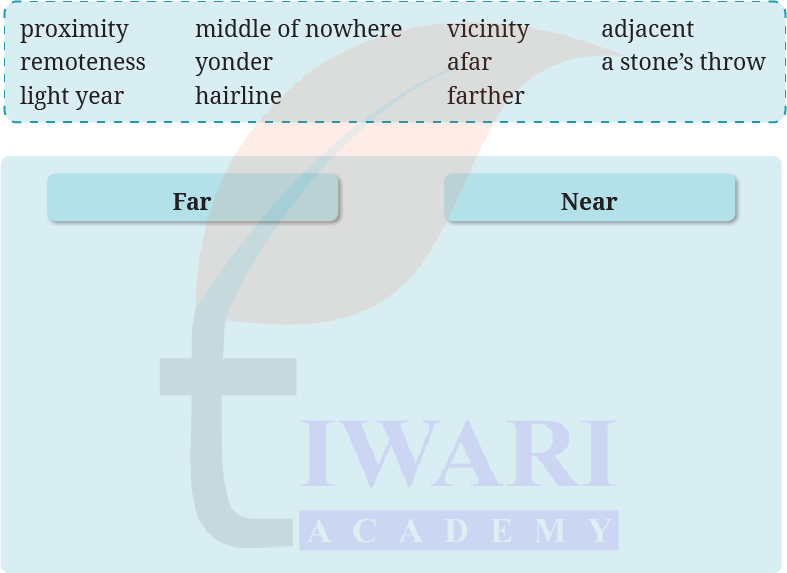
Answer:

IV. Read the following line from the poem.
‘Twas a delicate thread it had to tread,
Now repeat the lines five to six times. Are you able to say it clearly?
Create more tongue twisters of your own.
Answer:
1. Six slippery spiders swiftly spin sticky silk.
2. Tiny threads twist tightly through thick thickets.
3. Busy Bruce bravely battled big bold breezes.
4. Spiders spinning silky strings swiftly spring skyward.
Page 24 – Let us listen
I. You will listen to a story about an ant. Read the questions given below and before you listen, guess the answers to these questions.
(Transcript for the teacher on pg. 40)
1. What was the ant known for?
(i) Determination (ii) Strength (iii) Wisdom
Answer:
(i) Determination
2. Why was the ant unable to take the roti home?
(i). It was stuck under a rock.
(ii). It was too heavy to carry.
(iii). It was pulled by other ants.
Answer:
(ii) It was too heavy to carry.
3. What was the bird doing?
(i). Playing with the ant
(ii). Searching for food
(iii). Picking up leaves
Answer:
(ii) Searching for food (Building a nest — picking twigs/leaves)
4. How did the bird make the ant feel?
(i) Proud
(ii) Inspired
(iii) Relaxed
Answer:
(ii) Inspired
5. How did the fellow ants help?
(i). By advising the ant continuously
(ii). By standing still near the ant
(iii). By joining the ant in her efforts
Answer:
(iii) By joining the ant in her efforts.
II. Now, listen to the story once again and as you listen, check whether your answers are correct.
Answer:
After listening again, the guessed answers match the story correctly!
Page 25 – Let us speak
Narrate a personal experience about a time when you were motivated by someone or something to carry on and never give up. Your perseverance helped you.
Use the following sentence prompts as a guide for your narration. Use as per your topic.
1. Introduction:
• I remember a time when I felt like giving up. It was when…
• There was a moment in my life when I faced a big challenge. It happened when…
2. Describe the challenge:
• The challenge I faced was…
• I was struggling with…
• The problem seemed too big because…
3. Feeling disheartened:
• At first, I felt discouraged and thought about giving up because…
• I didn’t think I could succeed because…
• I felt upset and wanted to leave because…
4. The source of motivation:
• But then, I saw/heard/read about…
• Someone/something inspired me to keep going. It was…
• I remembered the poem… do not quit…
5. Taking action:
• After feeling inspired, I decided to…
• I gathered my strength and…
• With a new sense of willpower, I…
• I asked for help from…
6. The result:
• In the end, I was able to…
• Thanks to standing firm and never giving up, I achieved…
• I felt proud because…
• It was worth it because…
7. Reflection:
• This experience taught me that…
• I learned that perseverance is the key to success…
• Now, I always remember to…
• The lesson I learnt from this is…
Answer:
Introduction: I remember a time when I felt like giving up. It was when I was preparing for a speech competition in school.
The Challenge: The challenge I faced was that I had a fear of speaking in front of many people.
Feeling Disheartened: At first, I felt discouraged and thought about giving up because I forgot my lines during practice.
The Source of Motivation: But then, I saw a video about how even great speakers once made mistakes, and I remembered the poem “Try Again”.
Taking Action: After feeling inspired, I decided to keep practicing every day in front of my family.
The Result: In the end, I was able to confidently deliver my speech and even won second place!
Reflection: This experience taught me that perseverance is the key to success. Now, I always remember to try again no matter how hard it seems.
Page 26 – Let us write
King Bruce was inspired by the spider that kept on trying till it was successful.
Think about the steps you can take to overcome a difficult situation and write them down.
Now, write a letter to your cousin on how you plan to overcome any difficult situation. Also, advise not to quit and persevere.
Remember to use transition words like ‘To begin with…,’ ‘Next…,’ ‘After that…,’ ‘Then…,’ ‘Finally…,’ to share the steps of your plan.
You may begin this way:
20, Rajendra Nagar
Jeevanpur
23 August 20XX
Dear Monika,
Thank you for your letter asking me about…
You may end this way:
Yours affectionately,
Deepa
Answer:
20, Rajendra Nagar
Jeevanpur
23 August 20XX
Dear Monika,
Thank you for your letter asking me about how to overcome difficult situations. I am happy to share my thoughts with you.
To begin with, I believe that if we face a difficulty, we should not lose hope. Next, we should think calmly and plan small steps to solve the problem. After that, we must keep trying again and again, even if we fail. Then, we can take help and advice from our family, friends, or teachers. Finally, with patience and hard work, we will surely succeed.
Remember, never quit easily. Perseverance always leads to success! Stay strong and always try again, just like King Bruce and the Spider.
Yours affectionately,
Deepa
Page 26 – Let us explore
I. Collect folk songs in your own language that connect us with nature and compile them as a class project.
Answer:
1. Hindi
Song Name: “Barse Badariya Sawan Ki”
Meaning: Celebrates the monsoon rains, the joy of farmers, and the blooming of fields.
Lines:
“Barse badariya sawan ki, bheege angana aangan ki…”
(Clouds of rain pour down, drenching the courtyard.)
2. Punjabi
Song Name: “Kale Megha”
Meaning: Black clouds are welcomed for the crops.
Lines:
“Kale megha, kale megha paani to barsaayo…”
(Dark clouds, pour down your precious rain!)
3. Gujarati
Song Name: “Halarda” (Lullabies often mention nature)
Meaning: Describes trees, rivers, and mountains while singing to a child.
Lines:
“Vagya re bansuri van ma, vage vanma vagar…”
(The flute plays sweetly in the forests.)
II. Did you know that spiders are not insects? They belong to a group called the arachnids. Observe a spider and an ant from a distance and note down the differences between them. Share your observations with your classmates. Ask your Science teacher for more information to know about spiders better.
Answer:
Features Spider
1. Group – Arachnid
2. Number of legs – 8 legs
3. Body Parts – 2 main parts (Cephalothorax and Abdomen)
4. Wings – No wings (some spiderlings float using silk)
5. Antennae – No antennae
6. Eyes – Usually 6-8 simple eyes
7. Movement – Moves Slowly, Spins webs, Jumps
8. Habitat – Webs, tree bark, ground, corners of walls
9. Special Skill – Spins silk to make webs
10. Color – Brown, black, grey (depends on species)
Features Ant
1. Group – Arachnid
2. Number of legs – 8 legs
3. Body Parts – 2 main parts (Cephalothorax and Abdomen)
4. Wings – No wings (some spiderlings float using silk)
5. Antennae – No antennae
6. Eyes – Usually 6-8 simple eyes
7. Movement – Moves Slowly, Spins webs, Jumps
8. Habitat – Webs, tree bark, ground, corners of walls
9. Special Skill – Spins silk to make webs
10. Color – Brown, black, grey (depends on species)
Class 7 English Poorvi Unit I Chapter 2 English to Hindi Translation.
Class 7 English Poorvi Unit I Chapter 2 Hindi Translation
King Bruce of Scotland flung himself down
In a lonely mood to think;
‘Tis true he was monarch, and wore a crown,
But his heart was beginning to sink.
Hindi Translationस्कॉटलैंड के राजा ब्रूस ने खुद को नीचे झोंक दिया
एक अकेले मूड में सोचने के लिए;
यह सच था कि वह सम्राट थे, और उन्होंने एक मुकुट पहना था,
लेकिन उनका दिल डूबने लगा था।
For he had been trying to do a great deed,
To make his people glad;
He had tried and tried, but couldn’t succeed
And so he became quite sad.
Hindi Translationक्योंकि वह एक महान काम करने की कोशिश कर रहे थे,
अपनी प्रजा को खुश करने के लिए;
उन्होंने कोशिश की और कोशिश की, लेकिन सफल नहीं हो सके
और इसलिए वे काफी उदास हो गए।
He flung himself down in low despair,
As grieved as man could be;
And after a while he pondered there,
“I’ll give it all up,” said he.
Hindi Translationउन्होंने खुद को निराशा में नीचे झोंक दिया,
जितना दुखी कोई आदमी हो सकता है;
और कुछ देर बाद वहां विचार किया,
“मैं यह सब छोड़ दूंगा,” उन्होंने कहा।
Now just at that moment a spider dropped,
With its silken, filmy clue;
And the King, in the midst of his thinking, stopped
To see what the spider would do.
Hindi Translationअब ठीक उसी क्षण एक मकड़ी गिरी,
अपने रेशमी, जाली सूत्र के साथ;
और राजा, अपनी सोच के बीच में, रुक गया
यह देखने के लिए कि मकड़ी क्या करेगी।
‘Twas a long way up to the ceiling dome,
And it hung by a rope so fine;
That how it would get to its cobweb home,
King Bruce could not divine.
Hindi Translationछत के गुंबद तक का रास्ता लंबा था,
और यह एक बहुत बारीक रस्सी से लटकी हुई थी;
कि यह अपने मकड़ी के जाले के घर तक कैसे पहुंचेगी,
राजा ब्रूस समझ नहीं पा रहे थे।
It soon began to cling and crawl
Straight up with strong endeavour;
But down it came with a slippery sprawl,
As near to the ground as ever.
Hindi Translationउसने जल्दी ही चिपकना और रेंगना शुरू कर दिया
पूरे जोर के साथ सीधे ऊपर;
लेकिन यह एक फिसलन भरे विस्तार के साथ नीचे आ गई,
जितना कभी जमीन के करीब थी।
Up, up it ran, not a second to stay,
To utter the least complaint;
Till it fell still lower, and there it lay,
A little dizzy and faint.
Hindi Translationऊपर, ऊपर वह दौड़ी,, बिना एक सेकंड रुके,
बिना कोई शिकायत किए;
जब तक वह और भी नीचे नहीं गिरी, और वहाँ यह पड़ी रही,
थोड़ा चक्कर और बेहोश।
Its head grew steady — again it went,
And travelled a half-yard higher;
‘Twas a delicate thread it had to tread,
And a road where its feet would tire.
Hindi Translationउसका सिर स्थिर हो गया — फिर से वह चली,
और आधा गज और ऊँचा चली गई;
यह एक नाजुक धागा था जिस पर उसे चलना था,
और एक ऐसा रास्ता जहाँ उसके पैर थक जाते।
Again it fell and swung below,
But again it quickly mounted;
Till up and down, now fast, now slow,
Nine brave attempts were counted.
Hindi Translationफिर वह गिरी और नीचे झूल गई,
परंतु फिर तुरंत चढ़ गई;
ऊपर-नीचे, कभी तेज़, कभी धीमा,
नौ बार हिम्मत भरी कोशिशें गिनी गईं।
“Sure,” cried the King, “that foolish thing
Will strive no more to climb;
When it toils so hard to reach and cling,
And tumbles every time.”
Hindi Translation“निश्चित ही,” राजा ने पुकारा, “यह मूर्ख चीज़
अब और नहीं चढ़ने का प्रयास करेगी;
जब वह पहुँचने और चिपकने के लिए इतनी मेहनत करती है,
और हर बार गिर पड़ती है।”
But up the insect went once more,
Ah me! ‘tis an anxious minute;
He’s only a foot from his cobweb door,
Oh say, will he lose or win it?
Hindi Translationपर मकड़ी फिर से ऊपर गई,
हे भगवान! यह एक चिंताजनक पल है;
वह अपने मकड़ी के जाले के दरवाज़े से सिर्फ एक फुट दूर है,
ओ बताओ, क्या वह हारेगी या जीतेगी?
Steadily, steadily, inch by inch,
Higher and higher he got;
And a bold little run at the very last pinch
Put him into his native cot.
Hindi Translationस्थिरता से, स्थिरता से, इंच-इंच करके,
वह और ऊँचा और ऊँचा होती गई;
और आखिरी पल में एक साहसी छोटी दौड़ ने
उसे उसके अपने घोंसले में पहुँचा दिया।
“Bravo, bravo!” the King cried out,
“All honour to those who try;
The spider up there, defied despair;
He conquered, and why shouldn’t I?”
Hindi Translation“शाबाश, शाबाश!” राजा चिल्लाया,
“प्रयास करने वालों को सारा सम्मान;
ऊपर वह मकड़ी, उसने निराशा को चुनौती दी;
उसने जीत हासिल की, और मैं क्यों नहीं कर सकता?”
And Bruce of Scotland braced his mind,
And gossips tell the tale,
That he tried once more as he tried before,
And that time did not fail.
Hindi Translationऔर स्कॉटलैंड के ब्रूस ने अपना मन मज़बूत किया,
और लोक-कथाएँ यह किस्सा सुनाती हैं,
कि उसने पहले की तरह एक बार और प्रयास किया,
और उस बार वह विफल नहीं हुआ।
Class 7 English Poorvi Unit I Chapter 2 Summary in English and Hindi.
Class 7 Poorvi Unit I Chapter 2 Summary
The poem “Try Again” by Eliza Cook tells the story of King Bruce of Scotland in a narrative and rhyming style. The King is sitting alone in a lonely mood, feeling deeply sad and hopeless. Although he is a monarch who wears a crown, his heart is sinking because he has tried again and again to do something great for his people but has not succeeded. In complete despair he thinks of giving up everything.
Just at that moment a spider drops from the ceiling on a thin silken thread. The King pauses and watches with curiosity. The spider tries to climb back up to its cobweb high near the ceiling, but the thread is extremely delicate and the distance is long. The spider climbs hard but slips and falls back down nearly to the ground. Yet it does not give up. It tries again and again – going up and coming down, sometimes fast and sometimes slow. The King counts nine brave attempts and every single time the spider falls back.
At one point even the King thinks the spider is foolish to keep trying after so many failures. But the spider makes a tenth attempt. This time it climbs steadily, inch by inch, higher and higher, until with one last bold little run it finally reaches its cobweb home. The King is overjoyed and cries out “Bravo, bravo!” He realises that the tiny spider defied despair and conquered. He asks himself – if this small creature can do it, why can he not?
Inspired and filled with new determination, King Bruce braces his mind and tries once more – exactly as he had tried before. And this time he does not fail. The poem leaves the reader with a powerful and timeless lesson — never give up, no matter how many times you fall.
Summary in Hindiएलिज़ा कुक की कविता, ट्राई अगेन, स्कॉटलैंड के राजा ब्रूस की कहानी एक वर्णनात्मक और तुकबंदी वाली शैली में सुनाती है। राजा एकांत में बैठे हैं और बहुत दुखी और निराश महसूस कर रहे हैं। हालाँकि वह एक राजा हैं जो मुकुट पहनते हैं, उनका दिल डूब रहा है क्योंकि उन्होंने अपनी प्रजा के लिए कुछ महान करने की बार-बार कोशिश की है लेकिन सफल नहीं हो पाए। पूरी तरह निराश होकर वह सब कुछ छोड़ देने की सोचते हैं।
ठीक उसी समय एक मकड़ी एक पतले रेशमी धागे पर छत से नीचे उतरती है। राजा रुककर जिज्ञासा से देखने लगते हैं। मकड़ी अपने जाले तक वापस चढ़ने की कोशिश करती है जो छत के पास ऊँचाई पर है, लेकिन धागा बेहद नाज़ुक है और दूरी भी बहुत अधिक है। मकड़ी जोर लगाकर चढ़ती है लेकिन फिसलकर लगभग ज़मीन तक वापस आ जाती है। फिर भी वह हार नहीं मानती। वह बार-बार कोशिश करती है – ऊपर जाती है और नीचे आती है, कभी तेज़ और कभी धीरे। राजा नौ साहसी प्रयास गिनते हैं और हर बार मकड़ी नीचे गिर जाती है।
एक पल के लिए राजा भी सोचते हैं कि इतनी बार गिरने के बाद भी कोशिश करना मूर्खता है। लेकिन मकड़ी दसवीं बार कोशिश करती है। इस बार वह धीरे-धीरे इंच-इंच करके ऊपर चढ़ती है और अंत में एक आखिरी छोटी छलाँग के साथ अपने जाले तक पहुँच जाती है। राजा खुशी से चिल्लाते हैं – “वाह, वाह!” वह महसूस करते हैं कि इस छोटी सी मकड़ी ने निराशा को हरा दिया और जीत गई। वह खुद से पूछते हैं – अगर यह छोटा सा जीव कर सकता है, तो मैं क्यों नहीं?
प्रेरित और नए उत्साह से भरकर राजा ब्रूस अपना मन मज़बूत करते हैं और ठीक वैसे ही एक बार और कोशिश करते हैं जैसे पहले की थी। और इस बार वह असफल नहीं होते। कविता पाठक को एक शक्तिशाली और कालजयी सीख देकर समाप्त होती है – कभी हार मत मानो, चाहे कितनी भी बार गिरो।
Class 7 English Poorvi Unit I Chapter 2 Word Meanings.
Class 7 English Poorvi Chapter 2 Word Meaning
| Word | Meaning in English | Meaning in Hindi |
|---|---|---|
| Monarch | A king or queen who rules a country | राजा या रानी |
| Despair | Complete loss of hope | निराशा |
| Pondered | Thought carefully and deeply | गहराई से सोचना |
| Filmy | Very thin and delicate | बहुत पतला और नाज़ुक |
| Clue | Here, the silken thread of the spider | मकड़ी का रेशमी धागा |
| Divine | Here, to figure out or guess | अनुमान लगाना |
| Endeavour | A serious attempt to do something | प्रयास करना |
| Toil | To work very hard for a long time | कठिन परिश्रम करना |
| Sprawl | To fall with limbs spread out | फैलकर गिरना |
| Faint | Weak and dizzy | कमज़ोर और चक्कर आना |
| Anxious | Worried and nervous | चिंतित |
| Conquered | Successfully overcame a challenge | जीत लेना |
| Braced | Prepared oneself for something difficult | खुद को तैयार करना |
| Strive | To try very hard to achieve something | पूरी कोशिश करना |
| Gossips | People who spread stories and tales | कहानियाँ फैलाने वाले लोग |
Frequently Asked Questions
What is the poem “Try Again” about?
“Try Again” is a narrative poem about King Bruce of Scotland, who has failed multiple times in his efforts to do something great for his people and is on the verge of giving up completely. While sitting alone in despair, he observes a spider attempting to climb up to its cobweb. The spider falls repeatedly – nine times in total – but never stops trying. On its tenth attempt, it finally reaches its web. This sight deeply inspires King Bruce, who decides to try once more and this time succeeds. The poem teaches that perseverance and determination always lead to success.
Who wrote the poem “Try Again” in Class 7 Poorvi?
The poem is written by Eliza Cook (1818–1889), a well-known English poet famous for her simple, moralistic, and narrative-style verses. “Try Again” is part of Unit 1 – Learning Together – in the NCERT Class 7 English textbook Poorvi. The poem is based on the popular legend of King Robert the Bruce of Scotland and the spider.
What poetic devices are used in the poem “Try Again”?
The poem uses several poetic devices. Alliteration appears in phrases like “silken, filmy clue” and “slippery sprawl”. Repetition is used effectively with phrases like “tried and tried”, “up, up” and “steadily, steadily” to emphasise the idea of continuous effort. The spider’s struggle serves as an extended metaphor for King Bruce’s own struggle to succeed. Interjection appears in “Bravo, bravo!” which expresses the King’s spontaneous joy. The poem follows an ABAB rhyme scheme throughout.
What is the moral of the poem “Try Again”?
The central moral of the poem is that one should never give up, no matter how many times one fails. Every failure is a stepping stone towards success. The spider’s ten attempts to reach its cobweb symbolise that persistence and courage in the face of repeated setbacks will eventually lead to victory. The poem also conveys that inspiration can come from the smallest and most unexpected sources — even a tiny spider can change the mindset of a king.