



by Tiwari Academy Team
NCERT Class 7 Social Science Chapter 10 Part 1 The Constitution of India – An Introduction Solutions – Exercise and Extra Question Answers. Chapter 10 of the new NCERT Class 7 Social Science textbook (Exploring Society: India and Beyond, Part 1), The Constitution of India – An Introduction, is part of the updated syllabus for the 2026-27 academic session. This chapter explains what a constitution is and why every nation needs one and traces how the Indian Constitution was written by the Constituent Assembly between 1946 and 1949 under the chairmanship of Dr. Rajendra Prasad, with the Drafting Committee led by Dr. B.R. Ambedkar. It explores the influences that shaped the Constitution – the Indian freedom movement, India’s civilisational heritage and lessons from constitutions across the world – along with its key features like Fundamental Rights, Fundamental Duties, Directive Principles of State Policy and the Preamble.
Quick Links:
- Exercises Question Answers
- Very Short Answer Type Questions
- Short Answer Type Questions
- Long Answer Type Questions
Download Class 7 Social Science App to study Class 7 Social Offline.
NCERT Class 7 Social Science Part 1 Chapter 10 Solutions
Class 7 Social Science Part 1 Chapter 10 Question Answer
Page 209 – The Big Questions
1. What is a constitution and why do we need one?
Answer:
A constitution is a document that lays down the basic principles and laws of a nation. It tells us how the government will work, what rights and duties citizens have, and what values the country believes in. We need one because without a rulebook, there would be confusion and disputes about how the country should be run, just like a game needs rules so that everyone agrees on how to play fairly.
2. How was the Indian Constitution prepared?
Answer:
It was prepared by a Constituent Assembly formed in 1946, which had 389 members (later 299 after Partition), including 15 women. Dr. Rajendra Prasad was the Chairman and the Drafting Committee was headed by Dr. B.R. Ambedkar. It took almost three years to write, was adopted on 26 November 1949 and came into effect on 26 January 1950, which we celebrate as Republic Day.
3. How did our freedom struggle and civilisational heritage influence the Constitution?
Answer:
The freedom struggle gave values like equality, justice, freedom, and fraternity, since many freedom fighters were part of the Constituent Assembly. India’s civilisational heritage gave ideas like respect for different viewpoints, care for nature, respect for women and concepts like “the world is one family”, which shaped things like our Fundamental Duties.
4. What are the key features of the Constitution of India? Why is it still relevant, even though it was written more than seventy years ago?
Answer:
Key features include the three organs of government (legislature, executive, judiciary), separation of powers, Fundamental Rights, Fundamental Duties, Directive Principles of State Policy and the Preamble. It is still relevant because it is a “living document” – it can be amended when needed, so it keeps adjusting to the changing needs of the country.
Page 211 – Let’s Explore
Imagine that your school has reached the final tournament in kabaddi at the state-level. The opponent is a strong team that has won the tournament two years in a row. They are aiming to win a third time, a hat-trick. The match is on, and a player from your team has just got one of the players from the other team ‘out’; then a dispute breaks out. The player from the other team insists that she had already crossed into her team area before your team player caught her. The referee has seen that the player from the other team was indeed ‘out’. To settle the dispute amicably, she pulls out a little official rulebook. The team captains confer with the referee and look at the rules. They then agree that the player was indeed ‘out’, and your team has won the state-level trophy. Discuss in your group what might have happened if there was no official rulebook that the referee and the team captains could refer to. What is required to ensure everyone agrees to abide by the rulebook? What might happen if the team captains did not agree to refer to the rulebook at all? Think of a game that you play often and list the rules you follow. Each group will then present their set of rules to the rest of the class. Listen to each presentation, discuss the rules, and work together to decide on a common set of rules for the game. What challenges do you face in reaching a consensus on rules that everyone agrees with? What could be the ‘rulebook’ for a country? How would it be made?
Answer:
• If there was no official rulebook, the referee and captains would have nothing to check the dispute against and the argument might never be settled fairly. Everyone might just believe their own team is right and it could lead to fights. For everyone to agree to follow the rulebook, it should be made fairly, known to all players in advance and applied equally to both teams. If the captains refused to accept the rulebook, the match could not continue peacefully – there would be chaos.
(This asks students to list rules of their own favorite game with classmates and discuss as a group, so this part can’t really be “answered” for someone else – it’s meant to be done in class.)
• A “rulebook” for a country would be its constitution. It would be made by a group of representatives chosen by the people, who discuss and agree on rules for how the country should be governed.
Page 221 – Let’s Explore
Read the quotation given below. Which article of the Constitution do you think she was referring to? Why do you think she said that the equality of women was not a new concept for India? Discuss in the class.
Answer:
She was most likely referring to Article 14 (Right to Equality) and the idea of equality between men and women found across the Fundamental Rights. She said equality of women was not a new concept for India because Indian civilisational heritage already respected women and treated men and women as equals in ideal terms, even though in practice social conditions had sometimes not allowed this ideal to be followed. The Constitution was simply restoring and guaranteeing that old ideal, not inventing something new.
Page 223 – Let’s Explore
→ There was a time when people were not allowed to fly the national flag at their homes. This changed in 2004 when a citizen felt it was his right to express pride in his country and challenged the rule in court. The Supreme Court agreed, saying that flying the flag is part of the Fundamental Right to Freedom of Expression. We can now fly the tricolour with pride, keeping in mind that it should never be dishonoured.
→ We studied the Panchayati Raj System in Grade 6. This was not a part of the original Constitution; it was integrated in it in 1992 with the 73rd Constitutional Amendment Act.
→ Can you find out the amendments made to the Constitution in the past ten years?
Answer:
In the past ten years, our Constitution has been amended several times to make our country better. The 101st Amendment (2016) introduced GST which created one single tax system for the whole country. The 102nd Amendment (2018) gave constitutional status to the National Commission for Backward Classes. The 103rd Amendment (2019) provided 10% reservation for Economically Weaker Sections in education and jobs. The 104th Amendment (2020) extended reservation for SCs and STs in Parliament and state assemblies till 2030. The 105th Amendment (2021) gave back the power to states to make their own OBC lists. Most recently, the 106th Amendment (2023) – also known as the Women’s Reservation Bill – reserved one-third of seats in Lok Sabha and state assemblies for women. These amendments show that our Constitution is a living document that keeps changing with time.
Page 226 – Let’s Explore
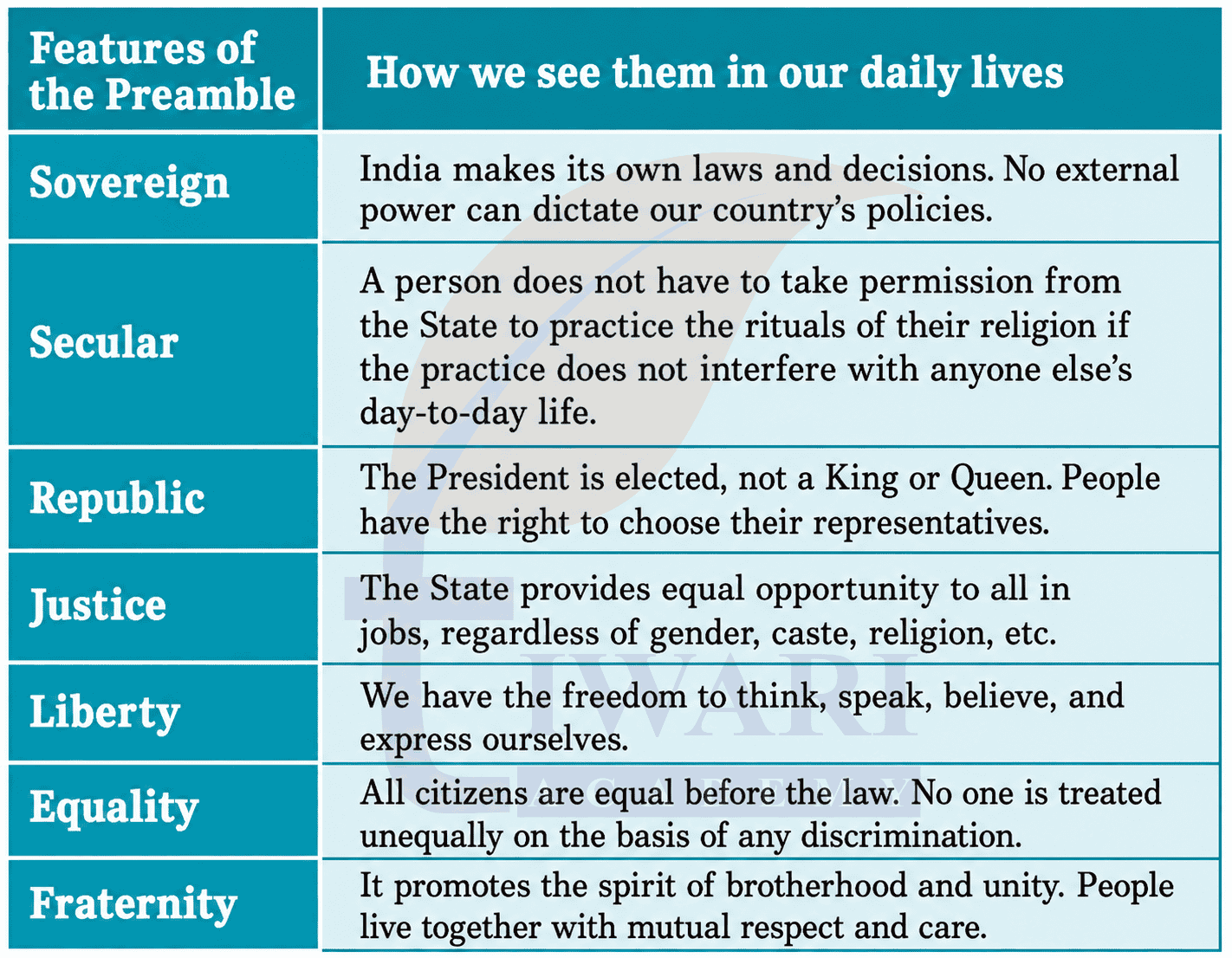
Below is the list of features given in the Preamble. Read them closely from the image above and write down examples of the application of these values in daily life around you. Two have been completed to help you with the exercise.
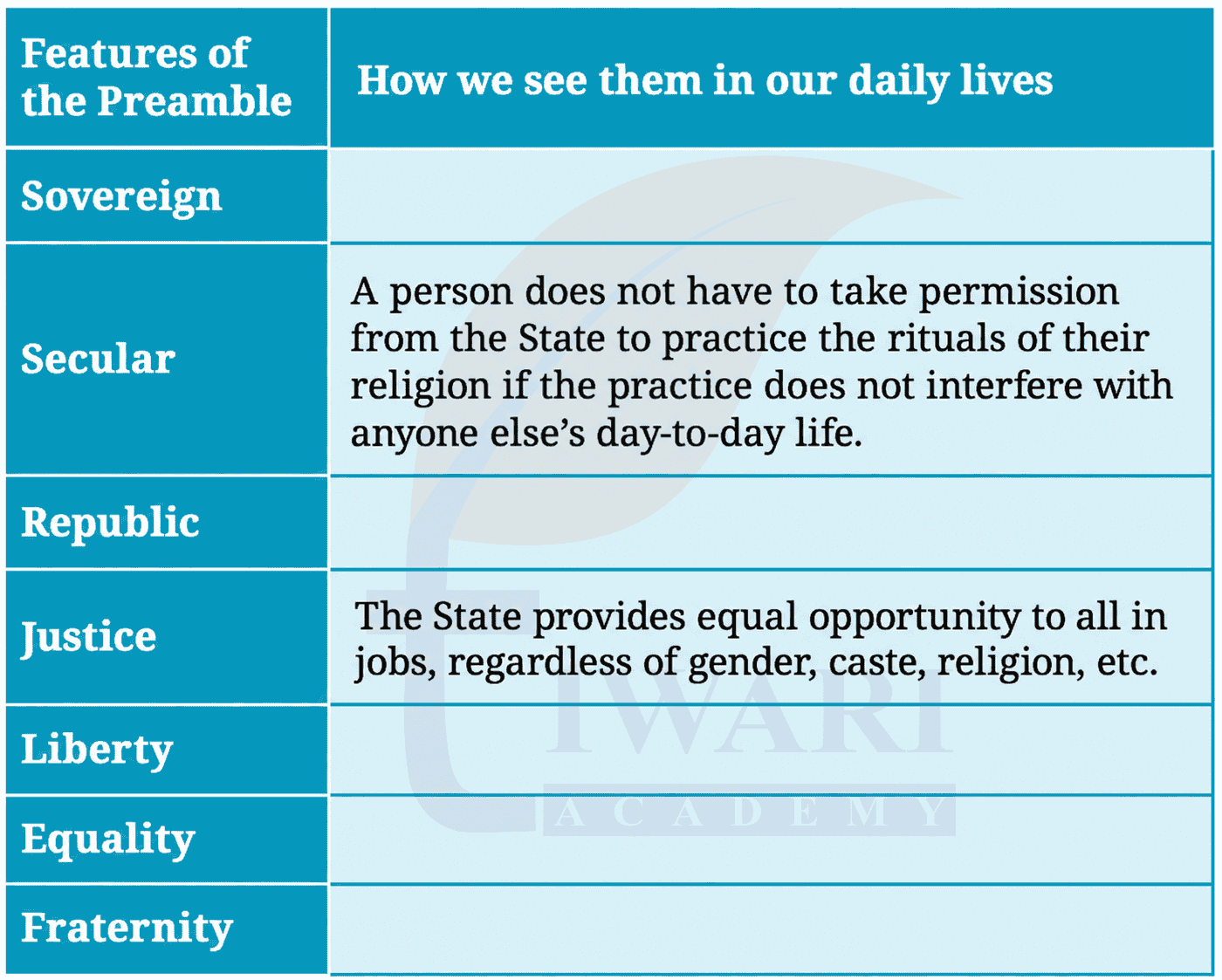
Answer:
Page 227 – Questions and activities
1. “The Constituent Assembly had representatives from diverse backgrounds in India.” Why do you think it was important to have a diverse set of representatives from all over India?
Answer:
It was important because India is a large country with many regions, languages, religions, cultures and social groups. If only a few people from one region or community had written the Constitution, it might not have represented the needs and views of everyone in the country. Having diverse representatives ensured that the Constitution reflected the concerns of different provinces, professions and social groups, including women. This made the Constitution more fair, inclusive and acceptable to all citizens of India, since it was truly “of the people”, not just of a select few.
2. Read the statements below carefully and identify which key features / values in the Constitution of India are reflected in each statement.
a. Sheena, Rajat and Harsh are standing in a line. They are excited to cast their first vote in the general elections.
b. Radha, Imon and Harpreet study in the same class in the same school.
c. Parents must make arrangements to ensure their children’s education.
d. People of all castes, genders and religions can use the village well.
Answer:
Identifying key features/values reflected in each statement:
a. Sheena, Rajat and Harsh standing in line to cast their first vote → This reflects Universal Adult Franchise (the right of every eligible citizen to vote).
b. Radha, Imon and Harpreet studying in the same class in the same school → This reflects Equality (equal access to education regardless of background).
c. Parents must make arrangements to ensure their children’s education → This reflects Fundamental Duties (the duty of parents/guardians to provide education to children between 6 and 14 years).
d. People of all castes, genders and religions using the village well → This reflects Right against Discrimination/Equality (no one is denied access to public places based on caste, gender or religion).
3. It is said that ‘All citizens in India are equal before the law’. Do you think this is a fact? If yes, why? If not, why not? Formulate your arguments.
Answer:
Yes, I think this is a fact, because the Constitution clearly guarantees the Right to Equality under Article 14, which states that all citizens are equal before the law. This means no person can be given special treatment or discriminated against by the law based on caste, religion, gender or social status. However, in real life, achieving this ideal completely can be difficult due to social inequalities, lack of awareness about legal rights, poverty or corruption, which may sometimes prevent people from getting equal treatment in practice. So, while equality before the law is a guaranteed constitutional right, society still needs to work towards making sure it is followed properly and fairly for everyone in daily life.
4. You have learnt that ‘India is the only country that provided universal adult franchise to its citizens from the beginning.’ Can you explain why India did it?
Answer:
India provided universal adult franchise from the very beginning because our freedom struggle was based on the values of equality and justice for all. The makers of the Constitution believed that in a true democracy, every citizen, regardless of caste, gender, religion or economic status, should have an equal right to choose their government. This was a bold step, especially since many other democracies, like Switzerland and the UK, gave voting rights to all their citizens (including women) much later. India wanted to build an inclusive democracy from day one, where the poorest and most marginalised citizens also had a voice in choosing their representatives, reflecting the country’s commitment to equality and justice.
5. How did the freedom struggle inspire the making of the Constitution of India? How did India’s civilisational heritage inspire some of the key features in the Constitution of India? Explain.
Answer:
The freedom struggle inspired the Constitution because many of its leaders, who fought for India’s independence, became members of the Constituent Assembly. They carried forward the values they had fought for, such as equality, justice, freedom and fraternity and used the Constitution as a tool to achieve these ideals for independent India.
India’s civilisational heritage also played a big role. Ancient Indian traditions valued the acceptance of different viewpoints, respect for Nature, pursuit of knowledge, respect for women and concepts like vasudhaiva kutumbakam (“the world is one family”). Governance traditions from mahājanapadas, sanghas and concepts like rājadharma emphasised the duties and role of people in governance. These ideas influenced features like the Fundamental Duties in our Constitution, showing that our ancient values of collective responsibility and respect for others were carried forward into the modern Constitution.
6. Do you think we, as a society, have achieved all the ideals of the Constitution? If not, what can we each do as citizens to move our country closer to these ideals?
Answer:
I don’t think we have achieved all the ideals of the Constitution yet. Even though the Constitution promises equality, justice, liberty and fraternity to all, in real life we still see problems like discrimination based on caste, gender inequality, poverty and unequal access to education and opportunities in many parts of the country.
As citizens, we can take small steps to move closer to these ideals. We can respect and value people from different castes, religions and backgrounds equally, and speak up against discrimination when we see it. We can also fulfil our Fundamental Duties, like respecting the Constitution, protecting the environment, and valuing India’s diverse culture. Additionally, being aware of our rights and using them responsibly, helping spread awareness about equality and justice among our friends and family and supporting causes that help disadvantaged groups can help us contribute towards building a society that truly reflects the values enshrined in our Constitution.
7. Read the clues carefully to solve the crossword on the next page to uncover important concepts from the Indian Constitution.

Answer:
Across
2. LEGISLATURE – The branch of government that makes laws.
7. FUNDAMENTAL DUTIES – The part of the Constitution that outlines the duties of citizens towards the country.
8. SUPREME COURT – The highest court in India that protects the Constitution.
9. REPUBLIC – A system where the head of state is elected, not hereditary.
10. AMENDMENT – The process by which the Constitution can be changed over time.
Down
1. CONSTITUENT ASSEMBLY – The group of people who wrote the Indian Constitution.
3. PREAMBLE – The statement at the beginning of the Constitution that tells us the values it upholds.
4. CONSTITUTION – The document that lays out the rules and laws of a country.
5. HELIUM – The gas used to preserve the original Constitution safely.
6. FUNDAMENTAL RIGHTS – Basic rights given to every citizen, like freedom and equality.
Class 7 Social Science Part 1 Chapter 10 Extra Questions
Class 7 Social Science Part 1 Chapter 10 Very Short Answer Type Questions.
Very Short Answer Type Questions
1. What is a constitution?
See AnswerA constitution is a document that spells out a nation’s basic principles and laws.
2. When did the Constitution of India come into effect?
See AnswerThe Constitution of India came into effect on 26 January 1950, celebrated as Republic Day.
3. Who was the Chairman of the Constituent Assembly?
See AnswerDr. Rajendra Prasad was the Chairman of the Constituent Assembly.
4. Who chaired the Drafting Committee of the Constitution?
See AnswerDr. B.R. Ambedkar chaired the Drafting Committee of the Constitution.
5. When was the Constituent Assembly formed?
See AnswerThe Constituent Assembly was formed on 9 December 1946.
6. How many parts and schedules does the Constitution of India have today?
See AnswerThe Constitution of India has 25 parts and 12 schedules.
7. Why is the Constitution preserved in a helium-filled case?
See AnswerHelium doesn’t react with paper or ink, helping preserve the Constitution over time.
8. Name one country whose constitution inspired the Directive Principles of State Policy.
See AnswerThe Directive Principles of State Policy were inspired by the Irish Constitution.
9. What are Fundamental Duties?
See AnswerFundamental Duties are moral obligations of citizens, such as respecting the Constitution and national symbols.
10. What is the difference between Fundamental Rights and Directive Principles?
See AnswerFundamental Rights are enforceable in court; Directive Principles are guidelines the government should try to follow.
11. When was Part IV-A (Fundamental Duties) added to the Constitution?
See AnswerPart IV-A, containing Fundamental Duties, was added to the Constitution in 1976.
12. When was the Panchayati Raj System added to the Constitution?
See AnswerIt was added in 1992 through the 73rd Constitutional Amendment Act.
13. Who wrote the text of the Constitution by hand?
See AnswerCalligrapher Prem Behari Narain Raizada wrote the text of the Constitution by hand.
14. Who illustrated the pages of the Constitution?
See AnswerNandalal Bose and his team illustrated the pages of the Constitution.
15. Name any three values mentioned in the Preamble of the Indian Constitution.
See AnswerThree values in the Preamble are Justice, Liberty and Equality (also Fraternity, Sovereign, Secular, Democratic Republic).
Class 7 Social Science Part 1 Chapter 10 Short Answer Type Questions.
Short Answer Type Questions
1. Why do we need a constitution for a country?
See AnswerA constitution acts like a rulebook that lays out the framework of government, checks and balances between its organs, rights and duties of citizens and the long-term goals of the nation, ensuring fairness and order.
2. How was the Indian Constitution developed?
See AnswerThe Indian Constitution was written by the Constituent Assembly, formed in 1946 with representatives from diverse regions and social groups. It was adopted on 26 November 1949 and came into effect on 26 January 1950.
3. How did the Indian freedom movement influence the Constitution?
See AnswerMany freedom movement leaders were members of the Constituent Assembly and carried forward values like equality, justice, freedom and fraternity, using the Constitution as a tool to achieve the ideals of the freedom struggle.
4. How did India’s civilisational heritage shape the Constitution?
See AnswerConcepts like vasudhaiva kutumbakam, respect for different viewpoints, Nature as sacred and duties-based governance from India’s ancient traditions influenced the Constitution, especially concepts like Fundamental Duties.
5. Name three countries whose constitutions influenced India’s Constitution and what was adopted from them.
See AnswerLiberty, equality and fraternity were adopted from France’s constitution; the Directive Principles of State Policy were inspired by Ireland; and the independent judiciary concept was shaped by the American Constitution.
6. What is the difference between Fundamental Rights and Directive Principles of State Policy?
See AnswerFundamental Rights are enforceable promises that citizens can demand in court if violated. Directive Principles are goals or guidelines for the government to work towards, but cannot be enforced through the judiciary.
7. Why is the Constitution called a ‘living document’?
See AnswerThe Constitution is called a living document because it can be amended over time to address new needs, such as the addition of Fundamental Duties in 1976 and integration of the Panchayati Raj System in 1992.
8. What does the Preamble of the Indian Constitution tell us?
See AnswerThe Preamble summarises the Constitution’s core values — that India is a Sovereign, Socialist, Secular, Democratic Republic committed to Justice, Liberty, Equality and Fraternity for all its citizens.
9. How were amendments to the Constitution made, according to the chapter?
See AnswerAmendments are rigorously debated in Parliament, sometimes requiring debate in legislative assemblies too. Public opinions are often sought and some changes, like the national flag ruling in 2004, come through popular movements or court decisions.
10. What role did women play in shaping the Constitution, as reflected in the chapter?
See AnswerThe Constituent Assembly had 15 women members. Begum Aizaz Rasul spoke about equality of women being an ideal long cherished in India, affirmed and assured through the Constitution’s provisions.
Class 7 Social Science Part 1 Chapter 10 Long Answer Type Questions.
Long Answer Type Questions
1. Explain what a constitution is and why every country needs one, using examples from the chapter.
See AnswerA constitution is a document that lays out a nation’s basic principles and laws – it defines the framework of the legislature, executive and judiciary, establishes checks and balances between them, states citizens’ rights and duties and outlines the country’s long-term goals. As shown through the kabaddi match example in the chapter, just like a game needs an official rulebook to settle disputes fairly, a country needs a constitution to function smoothly, resolve conflicts and ensure everyone agrees on the same set of rules for governance.
2. Describe the process through which the Indian Constitution was developed.
See AnswerThe Indian Constitution was developed by the Constituent Assembly, formed on 9 December 1946, with 389 members initially (later reduced to 299 after Partition), including 15 women, representing India’s diverse regions and social groups. Dr. Rajendra Prasad served as its Chairman, while the Drafting Committee, chaired by Dr. B.R. Ambedkar, prepared the initial text. After almost three years of deliberation, the Constitution was adopted on 26 November 1949 and came into effect on 26 January 1950, a day we now celebrate as Republic Day.
3. Explain the three major influences that shaped the Indian Constitution.
See AnswerThe Indian Constitution was shaped by three major influences. First, the Indian freedom movement contributed values like equality, justice, freedom and fraternity, as many freedom fighters were part of the Constituent Assembly. Second, India’s civilisational heritage brought in ideas like vasudhaiva kutumbakam, respect for diverse viewpoints and duty-based governance, reflected in provisions like Fundamental Duties. Third, following the spirit of “let noble thoughts come from every side”, the makers studied constitutions of France, Ireland, the USA, the UK and others, adopting ideas like liberty-equality-fraternity from France and an independent judiciary from the USA.
4. Differentiate between Fundamental Rights, Fundamental Duties, and Directive Principles of State Policy.
See AnswerFundamental Rights are guaranteed rights, such as the Right to Equality and Right to Freedom, which citizens can demand and enforce through courts if violated. Fundamental Duties are moral responsibilities of citizens, like respecting the Constitution, protecting the environment and valuing India’s composite culture, though they are not legally enforceable. Directive Principles of State Policy are goals the government should strive to achieve, such as ensuring a good standard of living or protecting the environment, but citizens cannot go to court to demand these, as they act more like guidelines than strict rules.
5. Why is the Indian Constitution described as a ‘living document’, and how has it evolved since 1950?
See AnswerThe Indian Constitution is called a living document because its makers understood that new laws and rules would be needed as the country evolved, so they allowed for amendments through a rigorous parliamentary process. For example, it originally had 22 parts and 8 schedules, which have grown to 25 parts and 12 schedules today. Fundamental Duties were added in 1976 through the 42nd Amendment and the Panchayati Raj System was formally integrated in 1992 through the 73rd Amendment. Even court decisions, like the 2004 ruling allowing citizens to fly the national flag, show how the Constitution continues to adapt to society’s needs.
Frequently Asked Questions
What does Chapter 10 of Class 7 Social Science 2026-27 teach students?
Chapter 10, The Constitution of India – An Introduction, teaches students what a constitution is, why it is needed, how the Indian Constitution was made and what shaped it – including the freedom struggle, India’s civilisational heritage and ideas from other countries’ constitutions. It also introduces key features like Fundamental Rights, Fundamental Duties, Directive Principles of State Policy and the Preamble.
Who were the key people involved in making the Indian Constitution, according to Class 7 Social Science Chapter 10?
The chapter highlights Dr. Rajendra Prasad, who was the Chairman of the Constituent Assembly and Dr. B.R. Ambedkar, who chaired the Drafting Committee that prepared the initial text of the Constitution. It also mentions Dr. Sachidananda Sinha, the first president of the Constituent Assembly, and contributors like calligrapher Prem Behari Narain Raizada and artist Nandalal Bose.
How is Class 7 Social Science Chapter 10 connected to what was taught in Grade 6?
This chapter builds directly on Grade 6 concepts such as the meaning of ‘constitution’, the three organs of government (legislature, executive, judiciary), the Panchayati Raj system and the idea of “Unity in Diversity”. Grade 7 goes further by explaining how these concepts are structured and protected within the actual Constitution of India.
Why do teachers consider the Preamble an important part to explain carefully in class?
Teachers emphasise the Preamble because it summarises the core values of the Constitution – Sovereign, Socialist, Secular, Democratic, Republic, Justice, Liberty, Equality and Fraternity – in one concise passage. Understanding these terms helps students connect abstract constitutional values to real-life examples, which is often tested in exams through matching and application-based questions.
Is the Constitution of India considered a fixed, unchangeable document, as explained in Class 7 Social Science Chapter 10?
No. The chapter explains that the Constitution is a “living document” that can be amended over time through a rigorous process involving debate in Parliament. Examples given include the addition of Fundamental Duties in 1976 and the integration of the Panchayati Raj System through the 73rd Constitutional Amendment in 1992.
How will Class 7 Social Science Chapter 10 help students in their exams for the 2026-27 session?
This chapter combines conceptual understanding (like the difference between Fundamental Rights and Directive Principles of State Policy) with activity-based learning, such as crosswords and matching exercises. Practising the question-answer sets below, along with the textbook’s own activities, will help students build strong conceptual clarity and score well in exams.