



by Tiwari Academy Team
NCERT Class 7 Social Science Chapter 7 Part 1 The Gupta Era: An Age of Tireless Creativity Solutions – Exercises Questions with Extra Practice Questions for Exam. Chapter 7, The Gupta Era: An Age of Tireless Creativity, from the NCERT Class 7 Social Science textbook Exploring Society: India and Beyond (Part 1), for the 2026-27 session, takes students into one of the most celebrated periods of Indian history – often called the “classical age” of India. Continuing the journey of time-travellers Bhavisha and Dhruv, who begin their exploration at Delhi’s famous rust-resistant Iron Pillar, the chapter traces the rise of the Gupta dynasty after the decline of the Kushana Empire, covering rulers like Chandragupta I, Samudragupta the warrior-king and Chandragupta II (Vikramaditya). Students learn about Gupta governance, trade and the fascinating account of Chinese traveller Faxian, alongside the extraordinary achievements of the period in science, mathematics, medicine and the arts – including the work of Aryabhata, Varahamihira, and the poet Kalidasa. The chapter also explores the codification of Ayurveda, the flourishing of Gupta art at Sarnath, Ajanta, Udayagiri and the parallel kingdoms of the Vakatakas, Pallavas and Kamarupa that thrived alongside the Guptas before their eventual decline due to Huna invasions. This guide provides a complete summary, key concepts and practice questions to help students revise Chapter 7 effectively for exams.
Quick Links:
- Exercises Question Answers
- Very Short Answer Type Questions
- Short Answer Type Questions
- Long Answer Type Questions
Download Class 7 Social Science App to study Class 7 Social Offline.
NCERT Class 7 Social Science Part 1 Chapter 7 Solutions
Class 7 Social Science Part 1 Chapter 7 Question Answer
Page 145 – The Big Questions
1. Who were the Guptas? Why is the Gupta period sometimes called the ‘classical age’ in Indian history?
Answer:
The Guptas were a powerful dynasty that ruled India after the Kushāṇas. Their period (4th–6th century CE) is called the ‘classical age’ because it saw great achievements in art, literature (like Kalidasa’s works), science (Aryabhata) and stable governance, making it a golden era of Indian culture.
2. What was happening in the rest of the subcontinent at this time?
Answer:
After the Mauryas, India split into many kingdoms like the Shungas, Satavāhanas and Chera-Chola-Pāndyas in the south. Foreigners like Indo-Greeks and Kushāṇas invaded but blended with Indian culture. Trade, art and literature flourished, creating a mix of new ideas and traditions.
3. Who were some great figures of this period, and why do their stories matter today?
Answer:
The Gupta period (4th–6th century CE) is called the ‘classical age’ because it saw golden achievements in art (Ajanta caves), literature (Kalidasa’s works), science (Aryabhata’s discoveries) and stable rule. It set standards for future Indian culture and learning.
Page 151 – Let’s Explore
In the Grade 6 chapter ‘Timeline and Sources of History’, we listed multiple sources that help us understand the past. Compile a list of the sources we have referred to so far in the chapter. What did we learn from each source?
Answer:
- Inscriptions (like the Iron Pillar inscription, the prayāga praśhasti by Harisena) – these told us about King Chandra (Chandragupta II) and about Samudragupta’s military victories and his support for art and learning.
- Coins (gold coins of Chandragupta I, Samudragupta playing the veena, the aśhvamedha coin) – these told us about the kings’ names, their queens, the gods they worshipped and important events like the aśhvamedha yajña.
- Archaeological remains (the Iron Pillar itself) – this showed us the advanced metallurgical skills of that time.
- Literary sources (the Viṣhṇu Purāṇa) – this told us about the regions the Gupta dynasty ruled over.
- Travelogue (Faxian’s account) – this gave us a picture of how society and people lived under Gupta rule.
Page 151 – Let’s Explore
Take a political map of India and locate the present-day states and Union territories where the Guptas ruled (see Fig. 7.8). Mark these states on the map and count how many you found. Then, compare your findings with your friends to see if everyone got the same number or discovered something different!
Answer:
The Gupta Empire covered present-day states like Uttar Pradesh, Bihar, Madhya Pradesh, parts of Rajasthan, Gujarat, and parts of West Bengal, along with Delhi. So on my map I would mark around 6-7 present-day states/UTs. (Different classmates might count slightly differently depending on how they read the borders, since the text says borders were approximate!)
Page 153 – Let’s Explore
Read the excerpt from Faxian given above and identify the key features of the society he describes. Write down your observations and compare your notes with your friends — you might be surprised to see how differently others interpret the same text!
Answer:
- People were happy and prosperous and there wasn’t too much government interference (no need to register households).
- Farmers paid a portion of their grain as tax to the king.
- Government workers (guards, attendants) were paid salaries.
- Cities were rich and well-developed, especially in the Gangetic plains.
- Rich merchants (Vaishyas) built charity houses, hospitals and helped the poor, orphans and sick.
- There was proper law and order – even the streets/lanes were well-maintained.
This shows Gupta society had good governance, charity systems and care for the needy – though (as the book reminds us) this was only one traveller’s view and he also mentioned that chandālas were treated badly, so not everyone in society had an equally good life.
Page 155 – Let’s Explore
Observe the painting of Prabhāvatī Gupta sitting in her court (Fig. 7.10). Take note of the details — her attire, posture, the people around her, and the setting of the court. What do these elements tell you about her life, role, and the time she lived in? Discuss your observations in groups and share your insights with the class.
Answer:
In the picture, Prabhāvatī Gupta is shown sitting on a throne wearing royal clothes and jewellery, holding a small child (maybe one of her sons) this shows she was a queen and a mother ruling as regent. There are attendants and scholars/priests standing around her with folded hands, which shows she was respected and had authority like a king would. The court setting with pillars and decorations shows the wealth and grandeur of the Vākāṭaka kingdom. This tells us that women could also become rulers and hold real power during this period, even though it may not have been very common.
Page 159 – Let’s Explore
Let’s join Bhavisha and Dhruv with their time machine in the time of the Guptas. You are getting an opportunity to meet Āryabhaṭa and Varāhamihira—what would you ask them? Divide the class into two groups and create a series of questions for an interview with them.
Answer:
For Āryabhaṭa:
- How did you figure out that the Earth spins on its axis without modern instruments?
- How did you calculate the length of a year so accurately?
- What inspired you to study mathematics and astronomy?
For Varāhamihira:
- How were you able to write about so many different subjects in one book?
- How did you use astronomy to help with things like farming and architecture?
- What was it like living and studying in Ujjayinī?
Page 160 – Let’s Explore
Take a close look at the samples of Gupta sculptures shown in Fig 7.15.1. and 7.15.2. By looking at the attributes, can you guess which deities are depicted here? Write your observations in the space provided and share your thoughts during the class discussion!
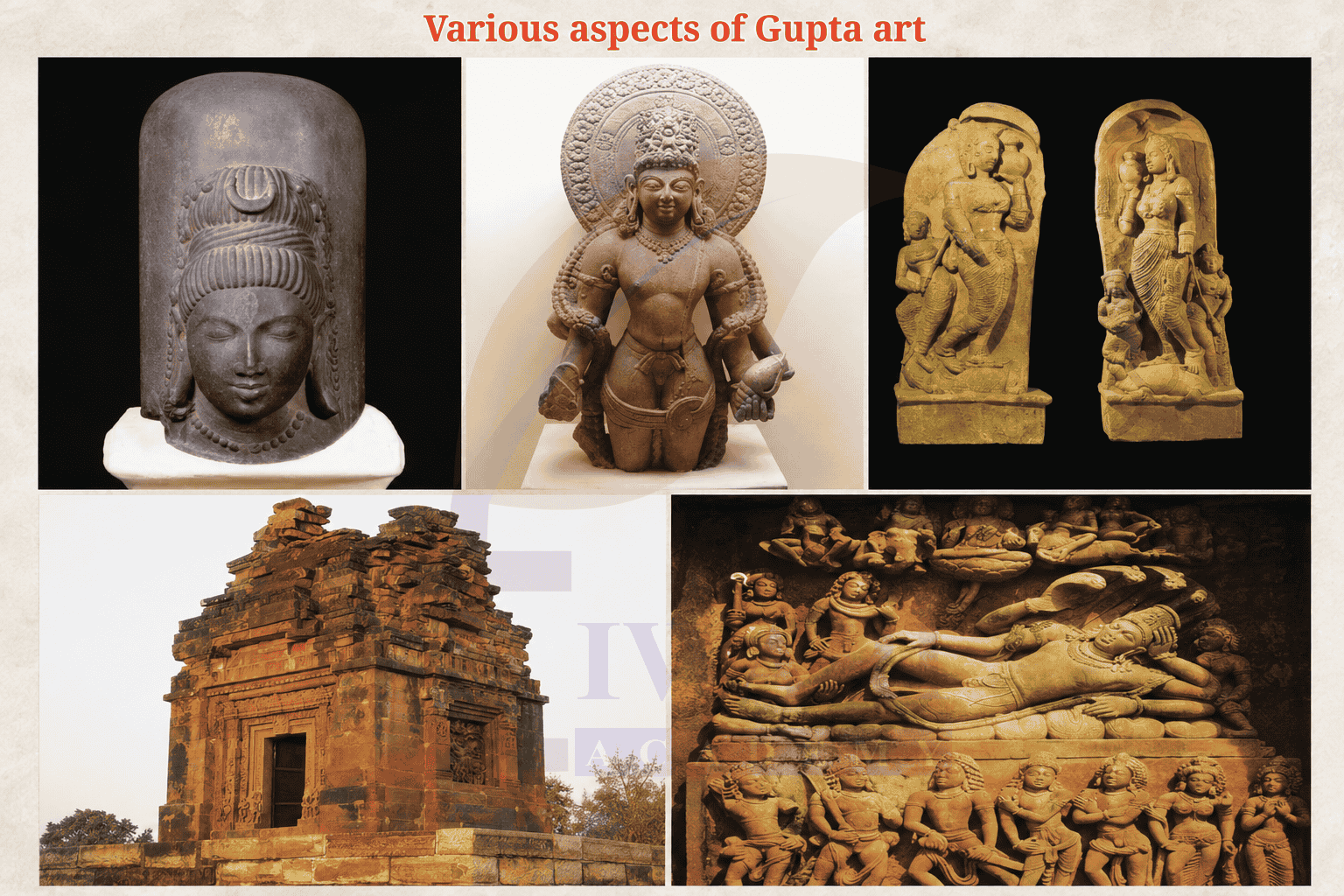
Answer:
I think the sculptures likely show these two river goddesses: Ganga can be identified because she stands on a makara (crocodile-like creature), while Yamuna stands on a tortoise. Both have water flowing over their heads and hold a pot, showing they represent rivers. If the sculptures instead show a different deity, I would look for other special symbols/objects (like a weapon or vehicle) held by the figure to help identify them, since Gupta sculptures usually show gods with clear symbols to represent who they are.
Page 165 – Questions and activities
1. Imagine you receive a letter from someone living in the Gupta Empire. The letter starts like this: “Greetings from Pāṭaliputra! Life here is vibrant and full of excitement. Just yesterday, I witnessed …” Complete the letter with a short paragraph (250–300 words) describing life in the Gupta Empire.
Greetings from Pāṭaliputra! Life here is vibrant and full of excitement. Just yesterday, I witnessed a grand royal procession passing through the main streets, with soldiers marching in perfect formation, elephants decorated with golden cloth, and horses trotting proudly alongside. People lined the roads, cheering as the king’s guards passed by in their fine uniforms. I heard someone say that our emperor, Chandragupta II, was returning from a visit to the Udayagiri caves, where he had gone to offer prayers to Lord Vishnu.
Our city is truly one of the greatest in the Middle Kingdom, just as travellers say. The markets are always busy, filled with merchants selling textiles, spices, gems and beautiful pottery. I even saw a foreign trader from across the sea bargaining for silk and sandalwood at the market square. My father, who works as a scribe recording land grants on copper plates, tells me that traders from as far as Rome and China visit our ports, making our kingdom rich and prosperous.
Yesterday evening, I also visited a gathering where a poet was reciting verses from Kālidāsa’s beautiful compositions and everyone sat in complete silence, mesmerised by his words. My uncle, who studies at a centre of learning nearby, spoke excitedly about a scholar named Āryabhaṭa, who has made incredible discoveries about the stars, the sun and the moon. He says our kingdom is home to the finest minds in the world right now!
The city is peaceful, well-organised and clean, with wide lanes and beautiful homes belonging to wealthy merchants. Charitable houses run by kind Vaishya families care for the poor, the sick and doctors freely give medicine to those in need. Truly, I feel fortunate to be living in such a golden age of learning, art and prosperity.
With warm regards,
A resident of Pāṭaliputra
2. Which Gupta ruler was also known as the ‘Vikramāditya’?
Answer:
The Gupta ruler Chandragupta II (reigned c. 375–415 CE) was famously known as ‘Vikramāditya’ (“Sun of Valor”). His reign marked the peak of the Gupta Empire’s golden age. There are following reasons that he earned tittle:
- Military Conquests: He expanded the empire by defeating the Shakas (Western Kshatrapas), gaining control over key ports like Ujjain, which boosted trade.
- Cultural Flourishing: His court welcomed legendary scholars like Kalidasa and Aryabhata, making it a hub of art, literature, and science.
- Coinage: His gold coins, inscribed with “Vikramāditya”, depict him as a warrior-king and patron of learning.
3. “Periods of peace support the development of various aspects of sociocultural life, literature, and the development of science and technology.’ Examine this statement in the light of the Gupta empire.
Answer:
The Gupta Empire (4th-6th century CE) perfectly shows how peace helps a civilization grow. With stable rule and less warfare, people could focus on creating beautiful art and making new discoveries.
During this Golden Age:
- Literature flourished with poets like Kalidasa writing famous plays and poems
- Scientists like Aryabhata studied stars and invented important math concepts
- Artists created amazing cave paintings at Ajanta
- Builders made magnificent temples and the rust-free Iron Pillar
- Nalanda University became a great center of learning
Trade brought wealth that supported these activities. Without constant wars, scholars had time to think, artists could practice their skills and craftsmen developed new techniques. This peaceful period allowed Hindu, Buddhist and Jain traditions to all grow together. The Gupta Empire proves that when a society has peace, it can achieve amazing things in art, science and culture.
4. Recreate a scene from a Gupta ruler’s court. Write a short script, assign roles like the king, ministers, and scholars, and enact a role play to bring the Gupta era to life!
Answer:

[Scene: A grand palace hall with carved pillars and a view of temples in the distance. The King sits on a golden throne draped with a royal banner bearing the emblem of Garuḍa. The Mantri sits close by. The Senapati, Scholar (Astronomer), and Scholar (Physician) sit before the throne. A Guard stands alert with a spear and an Attendant waves the royal chauri.]
King: (addressing the court) Mantri, how fares the empire today?
Mantri (Chief Minister): (unrolling a scroll) Your Majesty, the land grants to the priests and local rulers have been recorded on copper plates, as you commanded. Trade flourishes and the treasury grows stronger by the day.
King: Good. A prosperous treasury allows us to support scholars, physicians and soldiers alike. Senapati, what of our borders?
Senapati (Commander of Army): (bowing) Your Majesty, our forces remain strong and disciplined. No enemy dares to test the might of the Gupta army while we stand guard.
King: Well done. Now, tell me – what have our scholars discovered?
Scholar (Astronomer): (holding up a circular chart) Your Majesty, I have been studying the movement of the stars and planets. I believe the Earth itself spins and that is why day turns to night.
King: (leaning forward, intrigued) A bold claim indeed! Your wisdom brings great honour to this court.
Scholar (Physician): (looking up from his manuscript) Your Majesty, I am compiling the treatments and remedies passed down through generations, so that no illness may go untreated in your kingdom.
King: Excellent. Knowledge of the body is as valuable as knowledge of the stars. See that your findings are shared widely, so our people may live long and healthy lives.
Mantri (Chief Minister): Your Majesty, shall I record today’s proceedings for the royal chronicles?
King: (nodding, gesturing outward toward the pillars and gardens beyond) Yes, let it be written – that in this court, the sword protects, the mind discovers and wisdom guides the throne. This is the strength of our empire.
[The Guard stands firm, the Attendant waves the chauri gently and the court bows as the scene ends.]
[End of Scene]
5. Match the two columns:
| Column A | Column B |
|---|---|
| (1) Känchipuram | (a) Known for vibrant cave paintings that depict the Jätaka tales. |
| (2) Ujjayini | (b) Famous for rock-cut caves featuring intricate carvings of Hindu deities, especially Vishnu. |
| (3) Udayagiri | (c) Capital of the Guptas. |
| (4) Ajanta | (d) Known as ‘a city of a thousand temples’. |
| (5) Pätaliputra | (e) A prominent centre of learning in ancient India. |
Answer:
| Column A | Column B |
|---|---|
| (1) Känchipuram | (d) Known as ‘a city of a thousand temples’. |
| (2) Ujjayini | (e) A prominent centre of learning in ancient India. |
| (3) Udayagiri | (b) Famous for rock-cut caves featuring intricate carvings of Hindu deities, especially Vishnu. |
| (4) Ajanta | (a) Known for vibrant cave paintings that depict the Jätaka tales. |
| (5) Pätaliputra | (c) Capital of the Guptas. |
6. Who were the Pallavas and where did they rule?
Answer:
The Pallavas were an important dynasty that ruled parts of southern India, mainly in present-day Tamil Nadu and Andhra Pradesh, from the 3rd to 9th century CE. While the Gupta Empire flourished in the north, the Pallavas created their own golden age in the south.
They were famous for:
- Building beautiful stone temples (like the Shore Temple at Mahabalipuram).
- Developing Dravidian-style architecture, which influenced later temples.
- Promoting art, literature, Sanskrit and Tamil culture.
- Rivaling the Chalukyas of the Deccan in power.
Though not part of the Gupta Empire, the Pallavas show how different regions of India thrived during this creative period. Their legacy lives on in the magnificent temples they built.
7. Organise an exploration trip with your teachers to a nearby historical site, museum, or heritage building. After the trip, write a detailed report describing your experience. Include key observations about the site’s historical significance, the architecture, artefacts, and any interesting facts you learned during the visit. Reflect on how the trip enhanced your understanding of history.
Answer:
Site Visited: Qutub Minar Complex and the Iron Pillar, Mehrauli, Delhi
Accompanied by: Class Teacher and Social Science Teacher
Introduction: As part of our Social Science curriculum on Chapter 7, The Gupta Era: An Age of Tireless Creativity, our teachers organised an educational trip to the Qutub Minar complex in Mehrauli, Delhi. This site is especially significant to us because it houses the famous Iron Pillar, the very monument mentioned at the beginning of our chapter, where Bhavisha and Dhruv first begin their journey into the Gupta era. I was very excited to see with my own eyes the same pillar we had read about in class.
Historical Significance: Our teacher explained that although the Qutub Minar itself was built much later, the Iron Pillar standing within the complex is over 1,600 years old and dates back to the Gupta period. The inscription on the pillar refers to a king named “Chandra”, who historians identify with Chandragupta II, one of the greatest rulers of the Gupta dynasty. It was fascinating to learn that the pillar was originally erected elsewhere, possibly near the Udayagiri caves in Madhya Pradesh and was brought to Delhi centuries later.
Observations on Architecture and Artefacts: Standing in front of the Iron Pillar, I noticed how tall and solid it looked, with faint Brahmi inscriptions visible along its surface, just like the picture in our textbook. Our teacher pointed out that the pillar shows no signs of rust despite standing in the open for over sixteen centuries, which is a remarkable example of the advanced metallurgical skills of ancient India. We also observed the surrounding archaeological remains, including old carved pillars and structures that reflect a mix of architectural styles from different periods layered on top of one another, showing how history builds upon itself at the same site.
Interesting Facts Learned: During the visit, our guide shared that scientists believe the pillar’s rust-resistance is due to a thin protective layer formed by the special iron used and its reaction with oxygen in the air – something we had also read about in our “Don’t Miss Out” box in the chapter. It was interesting to connect this scientific explanation with what we had studied about the advanced knowledge systems of the Gupta period, including Aryabhata’s discoveries in mathematics and astronomy.
Reflection: This trip helped me understand history in a much deeper way than just reading from the textbook. Seeing the actual Iron Pillar made the story of Chandragupta II and the Gupta Empire feel real and alive, rather than just names and dates in a book. I also realised how historians use physical evidence, like inscriptions on this very pillar, to piece together facts about rulers and their achievements, similar to how we learned about sources like the prayaga prashasti and Faxian’s travelogue in class. This experience has made me appreciate that history is not just something to memorise, but something we can still see, touch and explore around us even today.
Class 7 Social Science Part 1 Chapter 7 Extra Questions for Exam Preparation
Class 7 Social Science Part 1 Chapter 7 Very Short Answer Type Questions.
Very Short Answer Type Questions
1. Which empire weakened by the 3rd century CE, paving the way for the Guptas?
See AnswerThe Kushana Empire, which spread over the north and northwest, weakened by the 3rd century CE.
2. Where is the famous Iron Pillar associated with the Gupta era located?
See AnswerThe famous Iron Pillar is located in Mehrauli, Delhi, though it was originally erected elsewhere.
3. Who was Chandragupta II also known as?
See AnswerChandragupta II was also known as ‘Vikramāditya’, one of the renowned rulers of the Gupta dynasty.
4. Name the court poet who composed the prayaga prashasti.
See AnswerHarisena, the court poet of Samudragupta, composed the prayaga prashasti.
5. What was Samudragupta’s ambition, as described in the prayaga prashasti?
See AnswerSamudragupta’s ambition was to be ‘dharani-bandha’, meaning to ‘unify the Earth’.
6. Name the Chinese traveller who visited India during the Gupta period.
See AnswerFaxian, a Chinese traveller, visited India in the early 5th century CE during the Gupta period.
7. What title is given to Prabhavati Gupta in one of her inscriptions?
See AnswerOne inscription describes Prabhavati Gupta as the ‘mother of two kings’.
8. Name the famous mathematician-astronomer who authored the Aryabhatiya.
See AnswerĀryabhaṭa, who lived in Kusumapura near present-day Patna, authored the Aryabhatiya.
9. Where did Varahamihira live, and what is his famous work called?
See AnswerVarahamihira lived in Ujjayini and his famous encyclopedic work is called the Brihat Samhita.
10. Name the famous poem by Kalidasa that tells the story of a yaksha.
See AnswerKalidasa’s famous poem Meghadutam or ‘The Cloud Messenger’, tells the story of a yaksha.
11. Which two ancient Ayurvedic texts were compiled during the Gupta period?
See AnswerThe Charaka Samhita and Sushruta Samhita were compiled and given final shape during the Gupta period.
12. Name the university patronised by the Gupta rulers for Buddhist learning.
See AnswerThe Gupta rulers patronised the renowned Nalanda university for Buddhist learning.
13. Which tribe caused the decline of the Gupta Empire?
See AnswerThe fierce Huna tribe from central Asia repeatedly attacked and weakened the Gupta Empire.
14. What was the capital of the Pallava dynasty and what was it known as?
See AnswerKanchipuram was the capital of the Pallavas, known as the ‘city of a thousand temples’.
15. Name the dynasty that ruled the Kamarupa kingdom in the northeast.
See AnswerThe Varman dynasty ruled the Kamarupa kingdom in the northeastern region.
Class 7 Social Science Part 1 Chapter 7 Short Answer Type Questions.
Short Answer Type Questions
1. Why is the Gupta period considered a “new power” emerging after the Kushanas?
See AnswerBy the 3rd century CE, the Kushana Empire, which spread over the north and northwest, began weakening. This created space for new kingdoms to emerge and the Gupta dynasty rose to prominence, establishing a powerful empire that set the stage for consolidation.
2. What does the inscription on the Iron Pillar of Delhi tell us about Chandragupta II?
See AnswerThe inscription on the Iron Pillar speaks of a king named ‘Chandra’, identified with Chandragupta II. It reveals that he was a devotee of Vishnu, as his mount Garuda often appears on inscriptions and that the pillar celebrates his achievements.
3. Describe Samudragupta’s achievements as mentioned in the prayaga prashasti.
See AnswerAccording to the prayaga prashasti, composed by court poet Harisena, Samudragupta fought many wars, defeating kings and expanding his empire. Many defeated kings were reinstated and paid tribute, while others submitted without protest out of fear of his might.
4. What key observations did Faxian make about Indian society during the Gupta period?
See AnswerFaxian observed that people were numerous and happy, needing no registration with officials. He noted that cities were prosperous, Vaishya families ran charitable houses for the poor and sick and doctors provided treatment and medicines to the needy.
5. Describe the administrative system used by the Gupta rulers to govern their empire.
See AnswerThe Gupta Empire had a well-organised system where, instead of controlling everything centrally, the empire was divided into provinces with land granted to local rulers, priests and chieftains. These land grants were inscribed on copper plates to maintain accurate records.
6. What role did Prabhavati Gupta play as a regent ruler?
See AnswerPrabhavati Gupta, daughter of Chandragupta II, became regent ruler of the Vakataka kingdom after her husband, a Vakataka prince, died early. She ensured strong ties between the Vakatakas and Guptas and is also associated with constructing seven temples dedicated to Vishnu.
7. Describe Aryabhata’s major contributions to mathematics and astronomy.
See AnswerAryabhata authored the Aryabhatiya, giving formulas to calculate the motions of the Sun, Moon, and planets. He proposed that the Earth spins on its axis, calculated the length of a year very close to modern values and explained solar and lunar eclipses correctly.
8. What is Ayurveda, and how was it developed during the Gupta period?
See AnswerAyurveda is India’s traditional system of medicine with roots going back several centuries BCE. During the Gupta period, texts like the Charaka Samhita and Sushruta Samhita were compiled and given final shape, covering diagnosis, treatment, diet and surgical techniques.
9. Describe the significance of the Ajanta caves in Gupta-era art.
See AnswerThe Ajanta caves, carved with the support of the Guptas and Vakatakas, are renowned for their elaborate rock-cut architecture and beautiful paintings, such as the depiction of Bodhisattva Padmapani. They represent one of the finest examples of Gupta-era artistic achievement.
10. What led to the decline of the Gupta Empire by the 6th century CE?
See AnswerBy the 6th century CE, the Gupta Empire began declining as later rulers faced repeated invasions from the fierce Huna tribe of central Asia. At the same time, the rise of powerful regional rulers led to internal conflicts, weakening central control.
Class 7 Social Science Part 1 Chapter 7 Long Answer Type Questions.
Long Answer Type Questions
1. Explain why the Gupta period is often called the “Classical Age” of India, with reference to achievements in science, mathematics, literature, and art discussed in the chapter.
See AnswerThe Gupta period is called the “Classical Age” of India because the prolonged period of peace and stability it provided allowed remarkable achievements across multiple fields, setting standards of excellence that influenced generations to come. In science and mathematics, Aryabhata calculated the motions of celestial bodies, proposed that the Earth spins on its axis and gave a near-accurate length of the year, while Varahamihira’s encyclopedic Brihat Samhita covered astronomy, architecture and even farming. In medicine, texts like the Charaka Samhita and Sushruta Samhita were compiled, laying the foundation for Ayurveda. In literature, Sanskrit flourished through the works of Kalidasa, whose poem Meghadutam remains celebrated for its beauty. In art and architecture, magnificent works emerged at Sarnath, Ajanta and Udayagiri, while metallurgy advanced remarkably, as seen in the rust-resistant Iron Pillar of Delhi. This combination of scientific, literary and artistic brilliance, supported by a stable and prosperous economy, is why historians regard this era as India’s classical golden age.
2. Trace the rise of the Gupta Empire from Chandragupta I to Chandragupta II, describing the key achievements and strategies of each ruler in expanding and consolidating the empire.
See AnswerThe Gupta Empire rose to prominence after the decline of the Kushana Empire in the 3rd century CE, emerging from a region near present-day Uttar Pradesh. Chandragupta I laid the foundation of the empire through strategic alliances and is remembered for his coins, including one featuring him with his queen, Kumaradevi. His son, Samudragupta, expanded the empire significantly through military conquests; the prayaga prashasti, composed by his court poet Harisena, describes his ambition to “unify the Earth”, noting that he defeated many kings, some of whom were reinstated as tributaries while others submitted without resistance. Samudragupta also supported art, learning, and trade and is depicted playing the veena on one of his coins. His son, Chandragupta II, also known as Vikramaditya, continued this legacy, associated with the Iron Pillar of Delhi dedicated to Vishnu. Under his rule, the empire reached new heights in art, literature and science, with scholars like Aryabhata and poets like Kalidasa flourishing in his court, marking the peak of Gupta achievement.
3. Discuss the governance and administrative system of the Gupta Empire, including the role of land grants, titles and matrimonial alliances, with examples from the chapter.
See AnswerThe Gupta Empire had a well-organised system of governance that balanced central authority with regional autonomy. Rather than controlling everything from one place, the empire was divided into provinces, with land granted to local rulers, priests and chieftains; these grants were carefully inscribed on copper plates to maintain accurate records, many of which have since been discovered by archaeologists. Gupta rulers adopted grand titles like ‘maharajadhiraja’, ‘samrat’ and ‘chakravartin’ to reflect their claim to supreme authority, distinguishing themselves from earlier rulers who used simpler titles like ‘rajan’ and ‘maharaja’. To expand and consolidate their empire, the Guptas used military conquests, diplomacy and matrimonial alliances. A notable example is Prabhavati Gupta, daughter of Chandragupta II, who was married into the Vakataka royal family and later became regent ruler after her husband’s early death, ensuring strong ties between the two kingdoms remained intact. This combination of decentralised administration, prestigious titles, and strategic alliances helped the Guptas maintain a stable and prosperous empire.
4. Describe the contributions of important scholars and literary figures of the Gupta era – Aryabhata, Varahamihira and Kalidasa and explain their lasting impact on Indian science and literature.
See AnswerThe Gupta era produced some of India’s most celebrated scholars and literary figures, whose work continues to influence knowledge systems today. Aryabhata, who lived in Kusumapura around 500 CE, authored the Aryabhatiya, providing formulas for calculating the motions of the Sun, Moon and planets, proposing that the Earth spins on its axis and giving remarkably accurate estimates for the length of a year and the size of the Earth; many of his mathematical techniques are still taught in schools today. Varahamihira, a contemporary scholar from Ujjayini, authored the encyclopedic Brihat Samhita, covering diverse subjects from astronomy and astrology to architecture, town planning and farming, demonstrating an impressive combination of observation and logical reasoning. In literature, Kalidasa became renowned for his exquisite Sanskrit poetry, most famously the Meghadutam, which tells the emotional story of a banished yaksha sending a message to his beloved through a passing cloud, while also vividly describing the landscapes of north India. Together, these figures exemplify the intellectual and cultural richness of the Gupta “Classical Age”.
5. Explain how Faxian’s travelogue serves as a historical source, and discuss what it reveals about Gupta society, while also reflecting on the limitations of relying on a single source.
See AnswerFaxian’s travelogue, written by the Chinese Buddhist traveller who visited India in the early 5th century CE, serves as a valuable primary source for understanding Gupta-era society because it offers a firsthand account from someone who personally observed the culture, governance and daily life of the time. His writings describe a happy and prosperous population, cities that were among the greatest in the Gangetic plains and a compassionate society where wealthy Vaishya families ran charitable houses for the poor, orphans and sick, with doctors providing free treatment and medicine. However, historians caution that such accounts reflect only the writer’s perspective at one point in time and for a limited portion of society. Notably, elsewhere in his travelogue, Faxian also describes the harsh treatment of the chandalas, who were regarded as outcastes and lived outside city limits, showing that Gupta society was not uniformly prosperous or fair for everyone. This reminds us that historians must assess multiple sources, perspectives, and interpretations before drawing complete conclusions about any historical period.
Frequently Asked Questions
Is Class 7 Social Science Chapter 7, The Gupta Era, easy?
This chapter is generally considered one of the more enjoyable and manageable chapters in the book because it centres around a single dominant dynasty – the Guptas – rather than juggling many competing kingdoms at once, as in the previous chapter. However, students need to be careful with the many names of scholars, rulers and their achievements (Aryabhata, Varahamihira, Kalidasa, Chandragupta I, Chandragupta II, Samudragupta), which can get confusing if not organised properly during revision.
How to score well in Class 7 Social Science Chapter 7?
To score well, students should prepare a simple table linking each important figure of the Gupta era to their key achievement – for example, Aryabhata with astronomy and mathematics, Varahamihira with the Brihat Samhita and Kalidasa with the Meghadutam. Practising the “Let’s Explore” activities, understanding primary sources like Faxian’s travelogue and the prayaga prashasti and revising the timeline (Fig. 7.19) at the end of the chapter are also very effective ways to strengthen exam preparation.
What are the main topics to revise in Class 7 Social Science Chapter 7?
The main topics to revise are: the rise of the Gupta dynasty after the Kushanas; the achievements of Chandragupta I, Samudragupta and Chandragupta II; Gupta governance and administration; the account of Faxian on Gupta society; scientific and literary achievements (Aryabhata, Varahamihira, Kalidasa, Ayurveda); Gupta art and architecture (Ajanta, Sarnath, Udayagiri); and the parallel kingdoms of the Vakatakas, Pallavas, and Kamarupa, along with the decline of the Guptas due to Huna invasions.
How much time should a Class 7 student spend preparing Class 7 Social Science Chapter 7 for exams?
Since the chapter has a good balance of political history, science, and art, students generally benefit from 3 short revision sessions: one for the political history of the Guptas (rulers, governance, trade), one for scientific and literary achievements (Aryabhata, Varahamihira, Kalidasa, Ayurveda) and one for art, architecture and the parallel kingdoms (Vakatakas, Pallavas, Kamarupa) along with the chapter’s timeline and maps.
Are there any tricky or commonly confused points in Class 7 Social Science Chapter 7?
Yes, a common point of confusion is mixing up Chandragupta II of the Gupta dynasty with Chandragupta Maurya of the Maurya dynasty – the chapter itself specifically points this out. Students should also be careful not to confuse Aryabhata (mathematics and astronomy) with Varahamihira (an encyclopedic scholar covering astrology, architecture, and farming too), since both lived around the same period and are easily mixed up.
Does Class 7 Social Science Chapter 7 have activities important for internal assessment or projects?
Yes, the chapter includes several strong project-worthy activities, such as writing a letter describing daily life in the Gupta Empire, analysing Faxian’s travelogue excerpt, creating an interview script with Aryabhata and Varahamihira and organising a role play recreating a Gupta ruler’s court. Teachers often use these activities for classwork, projects or internal assessment marks.