



by Tiwari Academy Team
NCERT Class 7 Social Science Chapter 9 Part 1 From the Rulers to the Ruled: Types of Government Solutions – Exercises and Extra Question Answers. Chapter 9 of the new NCERT Class 7 Social Science textbook (Exploring Society: India and Beyond, Part 1), From the Rulers to the Ruled: Types of Government, is part of the updated syllabus for the 2026-27 academic session. This chapter builds on what students learnt in Grade 6 about government and democracy and takes it further by explaining different forms of government found around the world, such as direct and representative democracy, parliamentary and presidential democracy, monarchy, theocracy, dictatorship and oligarchy. It also explores the legislative, executive and judicial functions of government, the fundamental principles of democracy and historical examples of early Indian republics like the Vajji mahājanapada and the Uttaramerur inscriptions.
Quick Links:
- Exercises Question Answers
- Very Short Answer Type Questions
- Short Answer Type Questions
- Long Answer Type Questions
Download Class 7 Social Science App to study Class 7 Social Offline.
NCERT Class 7 Social Science Part 1 Chapter 9 Solutions
Class 7 Social Science Part 1 Chapter 9 Question Answer
Page 185 – The Big Questions
1. What are the different types of government?
Answer:
There are many types of government. The most common one today is democracy, which has different forms — direct democracy, representative democracy (which is further of two kinds: parliamentary and presidential). Apart from democracy, there are other types like monarchy (absolute and constitutional), theocracy, dictatorship and oligarchy.
2. Where do governments get their power from?
Answer:
It depends on the type of government. In a democracy, the power comes from the people – they choose their government through elections. In a monarchy, power usually comes from being born into the royal family (hereditary). In a theocracy, power comes from religious beliefs and religious leaders. In a dictatorship, power is usually taken by force by one person or a small group, without any real limits from a constitution.
3. How does a country’s government interact with the people?
Answer:
This also depends on the type of government. In a democracy, the government is accountable to the people – meaning it has to answer to them, protect their rights and provide for their basic needs. If people are unhappy, they can change their representatives through elections. In non-democratic governments like dictatorships or absolute monarchies, the government doesn’t really need to answer to the people and people often have very limited freedom or say in decisions.
4. Why does democracy matter?
Answer:
Democracy matters because it gives people the power to choose their own government and change it if it doesn’t work well. It protects important things like equality, freedom of speech and citizens’ rights. It makes sure the government works for the wellbeing of all people, not just a few powerful families or groups, unlike monarchies, dictatorships or oligarchies.
Page 186 – Let’s Explore
The government also has many other roles. Try to list them.
Answer:
Apart from the roles already listed, the government also: builds and maintains roads, bridges and public transport; protects the environment; helps during natural disasters like floods or earthquakes; runs post offices; provides electricity and water supply; makes sure elections happen fairly; and protects consumer rights.
Page 188 – Let’s Explore
Which of the three methods do you think is most effective? Why?
Answer:
I think the third method students choosing their own representatives through voting is the most effective. This is because it makes sure every grade has someone speaking for them and that person is chosen by the students themselves, so they will actually represent what that grade wants and needs. It’s fair and democratic, unlike the first method (too many people, hard to decide anything) or the second method (Head Teacher choosing means students don’t get a real voice).
Page 196 – Let’s Explore
Fill the blank columns under Country A and Country B in table 9.1 given on the previous page by taking two different countries of your choice.
Answer:
| Institution – Executive | Legislature | Judiciary |
|---|---|---|
| Country A: France – President | two houses — National Assembly (Lower) and Senate (Upper) | independent from executive and legislature (separation of power) |
| Country B: Japan – prime minister and the council of ministers | two houses — House of Representatives (Lower) and House of Councillors (Upper) | independent from executive and legislature (separation of power) |
Analyse the table and discuss amongst yourselves the similarities and differences in all the examples.
Answer:
Even though France and Japan are both democracies, France follows a more presidential system (like the USA) while Japan follows a parliamentary system (like India and Australia). This shows that democracies can be structured very differently even though they all believe in elections and representing the people.
Page 196 – Let’s Explore
→ After studying the above examples, list the core principles of a democratic government. Based on your understanding, do the activity given below:
→ You have to form a Student Committee in your school.
Make a plan and execute it in a democratic manner, ensuring that:
- Functions of the committee are well defined
- The election process of the committee members is democratic
Answer:
Core principles: equality, freedom, representative participation, universal adult franchise, fundamental rights and independent judiciary.
My plan for a democratic Student Committee:
- Functions defined: The committee will handle things like organizing sports events, deciding morning assembly speakers and taking care of cleanliness drives.
- Election process: Every student above a certain age (say, class 6 and above) gets to vote. Each class can nominate one candidate. Voting will be done through secret ballot (writing the name on paper and putting it in a box) so it’s fair and private, just like real elections. The candidate with the most votes from each class becomes their class representative on the committee.
Page 204 – Let’s Explore
Does Shane’s country look like a democracy?
Answer:
No, it doesn’t look like a democracy at all. There’s no freedom of choice – even his haircut and clothes are decided by the government and he can’t access outside information freely.
How do you think Shane’s everyday life would be?
Answer:
His life would be very restricted and controlled. He wouldn’t have freedom to choose what he wants to do, wear, or think and he might live in constant fear of being watched or reported on by others.
Would you like to live in such a country? Explain why?
Answer:
No, I would not like to live in such a country because I value my freedom to make my own choices – like what I wear, what I believe in, and what information I can access. A life with no personal freedom and constant government control sounds very difficult and unfair.
Page 205 – Let’s Explore
Look carefully at the picture in Fig. 9.13 on the previous page. It depicts an elected body in the USA in the late 19th century. The people shown in the cartoon are all elected members. What do you observe? What do you see at the top left-hand corner of the cartoon? Who do you think is making decisions in this elected body?
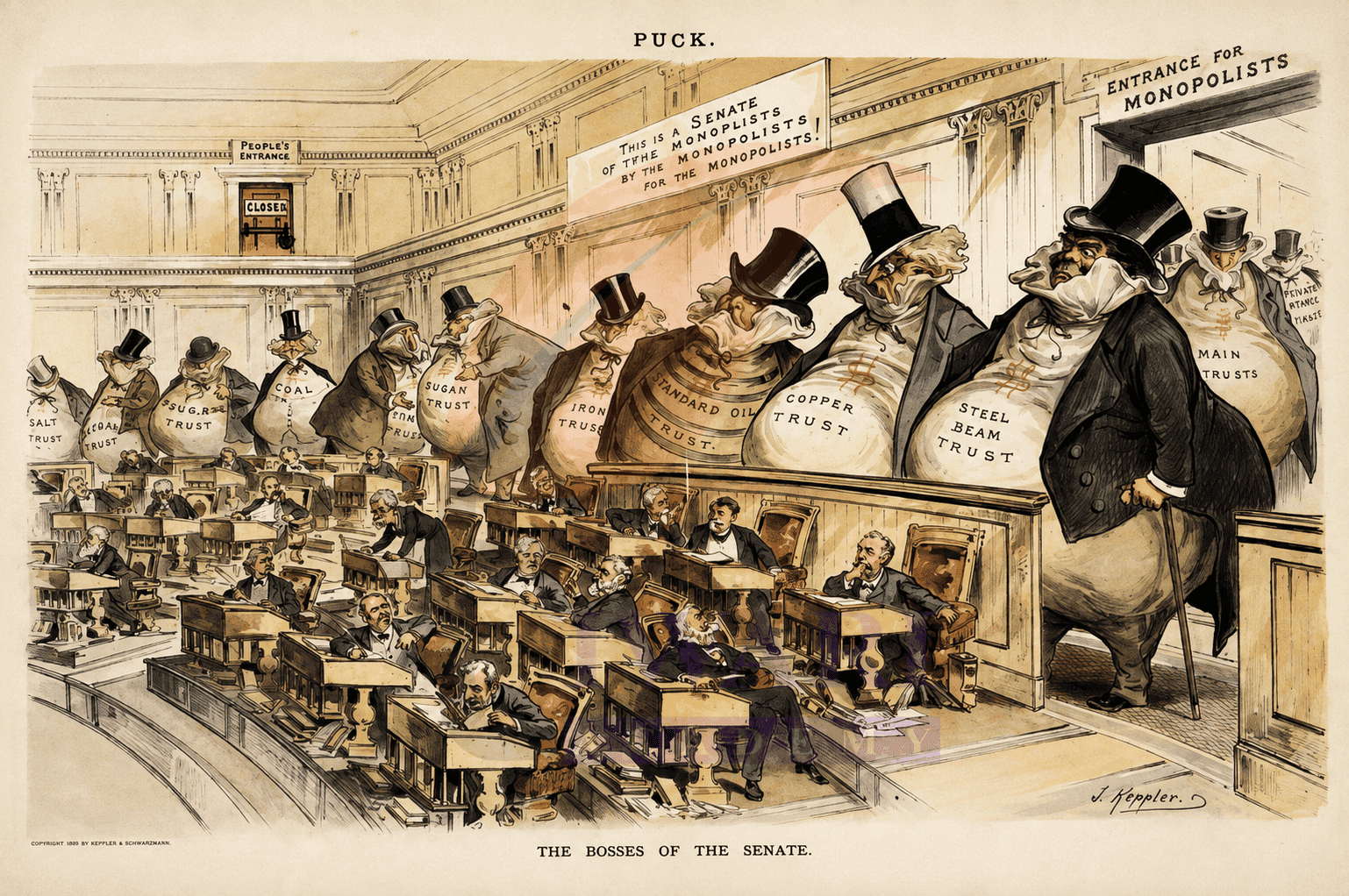
Answer:
I can see large figures labelled with names like “Trust” (representing big companies/industries) standing behind or looming over the elected representatives who are sitting at their desks. At the top left corner, there seems to be a sign saying something like “People’s entrance closed”, which suggests that ordinary people are being kept out of the decision-making process. This tells me that even though these are elected representatives (chosen in a democracy), the big businessmen/wealthy trusts are the ones really controlling and influencing the decisions – showing how a democracy can behave like an oligarchy if a small, powerful group has too much influence.
Can a democracy turn into an oligarchy? What can people do to keep democracy strong?
Answer:
Yes, I think it can, if wealthy people or a small group of powerful politicians start controlling all the important decisions instead of the actual elected representatives working for ordinary citizens. People can stay informed, vote responsibly, question their leaders, participate in discussions, report corruption and make sure that wealthy groups don’t have too much control over government decisions.
Page 206 – Let’s Explore
You have learnt the basic characteristics of various forms of governments. Do a small role play of the various forms in your classroom:
→ Enact democracy
→ Enact monarchy
→ Enact dictatorship
→ What do you find to be the most suitable form of government?
Answer:
For this activity, our class would divide into three groups and act out short skits:
• Democracy skit: Students would show a class electing a representative through voting, discussing rules together and holding leaders accountable if promises aren’t kept.
• Monarchy skit: Students would show one student being “born” into leadership just because of family, making all decisions without asking others.
• Dictatorship skit: Students would show one person taking over by force, not listening to anyone else’s opinion and punishing anyone who disagrees.
I think democracy is the most suitable form of government because it gives equal rights and freedom to all people, allows citizens to choose their own leaders and makes the government answerable to the people. Unlike monarchy or dictatorship, if the government doesn’t do its job well, people have the power to change it through elections.
Page 207 – Questions and activities
1. Write names of the various types of government that you have learnt in the chapter.
Answer:
The types of government learned in the chapter are: Democracy (including Direct Democracy and Representative Democracy [Parliamentary and Presidential]), Monarchy (including Absolute Monarchy and Constitutional Monarchy), Theocracy, Dictatorship and Oligarchy.
2. Which type of Government does India have? And why is that called that type?
Answer:
India has a Parliamentary Democracy. It is called a democracy because the people choose their representatives through elections (universal adult franchise). It is called parliamentary because the executive branch (Prime Minister and Council of Ministers) is drawn from and accountable to the legislature (Parliament, specifically the Lok Sabha).
3. You read that an independent judiciary is present in all types of democracies. State any three reasons why you think it is important for the judiciary to be independent.
Answer:
Three reasons why an independent judiciary is important in a democracy are:
- To protect the fundamental rights of citizens, ensuring they are upheld against potential violations by the government or other individuals.
- To ensure the rule of law, meaning that laws are applied equally and fairly to everyone, including the government itself (executive and legislative branches).
- To provide checks and balances on the power of the executive and legislature, preventing them from exceeding their authority or acting unconstitutionally.
4. Do you think democratic government is better than other forms of government? Why?
Answer:
Yes, the text suggests democracy is generally considered a better form of government. Reasons include:
- It upholds fundamental principles like equality and freedom for citizens.
- The source of power rests with the people, who choose their representatives.
- The government is accountable to the people and can be changed through elections.
- It aims (ideally) for the well-being and prosperity of all citizens.
- It provides mechanisms for peaceful transitions of power.
5. These are some practices in a few different countries. Can you match the practice with the type of government?
| S. No | Practice in the country | Type of Government |
|---|---|---|
| I. | All citizens treated equally before law | Dictatorship |
| II. | The government refers to the religious leader for each and every decision it takes | Monarchy |
| III. | After the queen’s death, her son became the new king | Democracy |
| IV. | The ruler is not bound to follow any Constitution. He makes all the decisions as per his choice | Theocracy |
Answer:
| S. No | Practice in the country | Type of Government |
|---|---|---|
| I. | All citizens treated equally before law | Democracy |
| II. | The government refers to the religious leader for each and every decision it takes | Theocracy |
| III. | After the queen’s death, her son became the new king | Monarchy |
| IV. | The ruler is not bound to follow any Constitution. He makes all the decisions as per his choice | Dictatorship |
6. Below is a list of countries. Find out the types of government these countries have:
| S. No | Country | Type of Government |
|---|---|---|
| 1. | Bhutan | – |
| 2. | Nepal | – |
| 3. | Bangladesh | – |
| 4. | South Africa | – |
| 5. | Brazil | – |
Answer:
| S. No | Country | Type of Government |
|---|---|---|
| 1. | Bhutan | Monarchy |
| 2. | Nepal | Federal democratic republic |
| 3. | Bangladesh | Democracy |
| 4. | South Africa | Democracy |
| 5. | Brazil | Democracy |
7. What are possible hurdles in a democracy in achieving its values and ideals? How can they be overcome?
Answer:
Possible Hurdles: Corruption, wealth disparity, excessive control over democratic institutions by a few, erosion of the judiciary’s independence, manipulation of information channels.
Overcoming Hurdles: Requires citizen vigilance, active participation (like vswer oting), promoting transparency and accountability in government, protecting freedom of the press and access to information, strengthening independent institutions and civic education on democratic values.
8. Democracy is different from monarchy and dictatorship. Explain.
Answer:
Democracy is different from monarchy and dictatorship in many ways:
- Who gets power: In a democracy, the people are the source of power, and they choose their government through elections. In a monarchy, power is usually hereditary, passing from the king or queen to their children. In a dictatorship, one person or a small group grabs absolute power, often without any elections at all.
- Accountability: In a democracy, the government is accountable to the people. If it does not perform well, people can change their representatives through elections. In a monarchy and dictatorship, the ruler is usually not accountable to the people and cannot easily be removed.
- Rights and freedom: A democracy protects fundamental rights like equality, freedom of speech and expression for all citizens. In a dictatorship, like we read about Hitler or Idi Amin, people’s rights are often crushed and there is no freedom to oppose the ruler. In an absolute monarchy too, the king has complete control and people may not have equal rights.
- Rules and constitution: In a democracy, the government works according to a constitution and there is a separation of power between the legislature, executive and judiciary. In a dictatorship, the ruler is not bound by any constitution and can make decisions as per their own choice. In an absolute monarchy also, the king may not be bound by any law.
- Working for the people: A democracy is designed to work for the equality and welfare of all citizens. In contrast, a dictatorship or an absolute monarchy might work only for the benefit of the ruler or a small group and not care about the wellbeing of all the people.
So, democracy stands apart from monarchy and dictatorship mainly because it gives power to the people, keeps the government accountable and protects the rights and freedom of every citizen.
Class 7 Social Science Part 1 Chapter 9 Extra Questions
Class 7 Social Science Part 1 Chapter 9 Very Short Answer Type Questions.
Very Short Answer Type Questions
1. What is the legislative function of government?
See AnswerThe legislative function is the creation of rules and laws that serve as the framework for running the country.
2. What is the executive function of government?
See AnswerThe executive function is the implementation of rules and administration of the country according to them.
3. What is the judicial function of government?
See AnswerThe judicial function is ensuring that the rules made by the government are followed.
4. What does ‘universal adult franchise’ mean?
See AnswerIt means every citizen above a certain age has the right to vote to choose their representative.
5. What is a representative in a democracy?
See AnswerA representative is a person chosen to act or make decisions on behalf of another person or group.
6. What is accountability in a democracy?
See AnswerAccountability means the government is answerable to the people who have elected them.
7. Name the two houses of the Indian Parliament.
See AnswerThe two houses are the Lok Sabha (Lower House) and the Rajya Sabha (Upper House).
8. What is ‘separation of power’?
See AnswerIt means the legislature, executive and judiciary work independently without interfering in each other’s functions.
9. What is a republic?
See AnswerA republic is a form of government in which the head of state is elected and not a hereditary monarch.
10. What is an absolute monarchy?
See AnswerIt is a monarchy where the monarch has complete control over making laws, enforcing them and judging disputes.
11. What is a constitutional monarchy?
See AnswerIt is a monarchy where the king or queen has only nominal power and real power lies with elected representatives.
12. What is a theocracy?
See AnswerA theocracy is a form of government where the country is ruled by the rules of religion and religious leaders.
13. What is a dictatorship?
See AnswerA dictatorship is a form of government where one person or a small group holds absolute, unlimited power.
14. What is an oligarchy?
See AnswerAn oligarchy is a government where a small, powerful group, usually wealthy or influential people, makes all decisions.
15. Name any two ancient Indian mahājanapadas known as early republics.
See AnswerThe Vajji (Vṛiji) mahājanapada, especially ruled by the Lichchhavi clan, is a well-known example of an early republic.
Class 7 Social Science Part 1 Chapter 9 Short Answer Type Questions.
Short Answer Type Questions
1. What are the main functions performed by a government?
See AnswerA government maintains law and order, ensures peace and security, manages foreign relations, takes care of national defence, provides essential services like education and healthcare, manages the economy and works for people’s welfare.
2. How does a direct democracy work, and what is its limitation?
See AnswerIn a direct democracy, all citizens directly participate in making rules and decisions, as practised in Switzerland. Its main limitation is that it becomes very difficult to manage in larger countries with many people.
3. What is representative democracy, and how is it different from direct democracy?
See AnswerIn representative democracy, people elect representatives through universal adult franchise instead of governing directly themselves. Unlike direct democracy, the government remains accountable to the people through regular elections at fixed intervals.
4. Explain the difference between parliamentary and presidential democracy.
See AnswerIn a parliamentary democracy, the executive is part of the legislature and accountable to it, as in India. In a presidential democracy, the executive (President) is elected separately and works independently of the legislature, as in the USA.
5. What are the fundamental principles of democracy mentioned in the chapter?
See AnswerThe fundamental principles include equality, freedom, representative participation, universal adult franchise, fundamental rights of citizens and an independent judiciary that protects these rights and ensures laws are followed.
6. How is an absolute monarchy different from a constitutional monarchy?
See AnswerIn an absolute monarchy, like Saudi Arabia, the monarch has complete control over laws and governance. In a constitutional monarchy, like the UK, the monarch has only nominal power, while elected representatives hold real power.
7. What is a theocracy, and give an example mentioned in the chapter.
See AnswerA theocracy is a government ruled by religious rules and leaders. Iran is an example, where the Supreme Leader, chosen by Islamic clerics, holds ultimate authority alongside an elected president and parliament.
8. Give examples of dictators mentioned in the chapter and their impact.
See AnswerAdolf Hitler in Germany caused World War II and the killing of six million Jews and other groups. Idi Amin in Uganda was responsible for the merciless killing of thousands and forced many Indians to flee.
9. What is the significance of the Uttaramerur inscriptions?
See AnswerThe Uttaramerur inscriptions from 10th century CE Tamil Nadu describe the election process for the village sabhā, including sealed ballot boxes, member qualifications, duties and the removal of corrupt members, showing an early democratic tradition.
10. Why is an independent judiciary important in a democracy?
See AnswerAn independent judiciary ensures that every citizen’s fundamental rights are protected and that laws are followed by both citizens and the government itself, without being influenced or controlled by the executive or legislature.
Class 7 Social Science Part 1 Chapter 9 Long Answer Type Questions.
Long Answer Type Questions
1. Explain the three main functions of government with examples.
See AnswerA government performs three functions. The legislative function involves making rules and laws, such as the Parliament passing laws in India. The executive function involves implementing these laws and running daily administration, carried out by the Prime Minister and Council of Ministers. The judicial function involves ensuring these rules are followed, done by an independent judiciary that settles disputes and protects citizens’ rights. Together, these three functions allow a government to create order, govern effectively and maintain justice in the country.
2. Describe the different forms of democratic government explained in the chapter.
See AnswerDemocracy can take different forms. In direct democracy, all citizens participate directly in decision-making, as seen in parts of Switzerland, though it’s hard to manage in large countries. Most modern democracies are representative democracies, where people elect representatives through universal adult franchise. This is further divided into parliamentary democracy, where the executive is part of the legislature and accountable to it (like India) and presidential democracy, where the executive works independently of the legislature (like the USA). Each form differs in how power is formed and shared.
3. Compare monarchy, theocracy and dictatorship as forms of government.
See AnswerA monarchy is ruled by a hereditary king or queen, and can be absolute (complete control, like Saudi Arabia) or constitutional (nominal power, like the UK). A theocracy is governed according to religious laws and leaders, such as Iran, where the Supreme Leader holds ultimate authority based on Islamic principles. A dictatorship is ruled by one person or a small group with unlimited power and no constitutional checks, as seen in the rule of Hitler in Germany and Idi Amin in Uganda, both of whom caused great harm to their people.
4. Why does democracy matter, and what challenges do democracies face today?
See AnswerDemocracy matters because it allows people to choose their own government, express their opinions freely, and hold their representatives accountable through elections. Unlike dictatorships or absolute monarchies, democratic governments must work for the equality, freedom and wellbeing of all citizens. However, democracies today face challenges like corruption, wealth disparity, excessive influence of a few powerful groups, erosion of judicial independence and misuse of information channels. Citizens need to remain alert and active to protect democratic values from being weakened by these problems.
5. Discuss the historical evidence of early republics and democratic traditions in India.
See AnswerIndia has a long history of democratic traditions even before modern democracy. In the Vajji (Vṛiji) mahājanapada, the Lichchhavi clan practised collective decision-making, chose leaders based on merit, and filled key positions through elections, making it an early republic. Later, during the Chola period, the Uttaramerur inscriptions from 10th century Tamil Nadu describe a detailed election process for the village sabhā, including sealed ballot boxes, qualifications for candidates and rules for removing corrupt members. These examples show that the values of collective decision-making and accountability existed in India for centuries.
Frequently Asked Questions
What is Chapter 9 of Class 7 Social Science 2026-27 about?
Chapter 9, From the Rulers to the Ruled: Types of Government, explains what government is, its main functions and the different types of government that exist in the world today, including democracy, monarchy, theocracy, dictatorship and oligarchy. It also explains why democracy is considered an important and popular form of government.
Is Class 7 Social Science Chapter 9 part of the new NCERT syllabus for 2026-27?
Yes. This chapter is included in the revised NCERT Class 7 Social Science textbook titled “Exploring Society: India and Beyond, Part 1”, which has been prepared under the new curriculum framework and reprinted for the 2026-27 academic session.
What are the three functions of government explained in Class 7 Social Science Chapter 9?
The chapter explains that every government performs three main functions: the legislative function (making rules and laws), the executive function (implementing these rules and running the administration) and the judicial function (ensuring the rules are followed). Understanding these functions helps students see how different types of government organise power differently.
How will Class 7 Social Science Chapter 9 help students in exams?
This chapter builds conceptual clarity about government structures using relatable examples like a school committee, along with comparative tables of different countries. Practising the question-answer sets below, along with the tables and activities in the textbook, will help students prepare well for class tests and exams.
What historical examples of early democracy in India does Class 7 Social Science Chapter 9 mention?
The chapter mentions early republics such as the Vajji (Vṛiji) mahājanapada, where the Lichchhavi clan practised collective decision-making and elections for key positions. It also cites the Uttaramerur inscriptions from Tamil Nadu (10th century CE), which describe detailed rules for electing members to the village sabhā, including sealed ballot boxes and qualifications for members.