



by Tiwari Academy Team
NCERT Class 7 Social Science Chapter 3 Part 1 Climates of India Solutions in English and Hindi Medium – Exercises and Extra Question Answers with explanation. Chapter 3 of Class 7 Social Science, Climates of India, is part of the new NCERT book Exploring Society: India and Beyond for the 2026-27 session. This chapter builds on the previous chapter about weather and explains how climate is different – a long-term pattern rather than a day-to-day experience. Students learn about India’s traditional six seasons or ritus, the different types of climates found across the country from alpine in the Himalayas to arid in the Thar Desert and the five key factors that shape climate: latitude, altitude, proximity to the sea, wind and topography. A major highlight of the chapter is a detailed explanation of the southwest and northeast monsoons, how they form and why they are central to Indian agriculture, culture and festivals. The chapter also covers climate-related disasters like cyclones, floods, landslides and forest fires and closes with an important discussion on climate change and its growing impact on India. This makes it a well-rounded chapter connecting geography with everyday life, culture and current environmental concerns.
Quick Links:
- Exercises Question Answers
- Very Short Answer Type Questions
- Short Answer Type Questions
- Long Answer Type Questions
- Class 7 Social Science Chapter 3 in Hindi Medium
- Download Class 7 Social Science App to study Class 7 Social Offline.
NCERT Class 7 Social Science Part 1 Chapter 3 Solutions
Class 7 Social Science Part 1 Chapter 3 Question Answer
Page 45 – The Big Questions
1. What make India’s climate so diverse?
Answer:
India has mountains, deserts, plains, plateaus and coasts. Because of these different landforms, latitude, altitude and closeness to the sea, different parts of India have very different climates.
2. What are the monsoons? How are they formed?
Answer:
Monsoons are seasonal winds that bring rain to India. In summer, land gets hotter than the sea, so winds blow from the sea to the land, bringing rain. In winter, this reverses.
3. What is the effect of climate on economy, culture and society?
Answer:
Climate decides what crops we grow, what clothes we wear and what festivals we celebrate. It also affects farming, food prices and jobs.
4. How can understanding climate help us prepare for natural disasters?
Answer:
If we understand climate patterns, we can predict floods, cyclones and heat waves in advance and take safety measures like evacuating people or storing food and water.
5. What is climate change? What are its consequences?
Answer:
Climate change means long-term changes in temperature and rainfall patterns, mostly caused by human activities like burning fossil fuels. It causes global warming, unusual weather and more disasters like floods and heat waves.
Page 47 – Let’s Explore
Which are your favourite seasons? Write a short essay explaining your seasons.
Answer:
My favourite seasons is winter and monsoon.
Winter is my absolute favourite. The cool breeze feels like nature’s air conditioner after the hot summer. I love wearing my warm sweaters and drinking hot chocolate in the morning. The best part is the winter holidays when we celebrate Christmas and New Year with family. I also enjoy eating oranges, carrots and gajar ka halwa that my mother makes. The foggy mornings make everything look mysterious and beautiful, like a scene from a movie.
Monsoon comes a close second. The first rain after summer is magical. The smell of wet earth is the best perfume in the world. I love getting drenched in the rain with my friends after school. We make paper boats and float them in the puddles. The green trees look fresher and the sky turns grey and beautiful. However, I don’t like it when heavy rains cause water-logging and we can’t go out to play.
Every season has its own beauty, but winter and monsoon fill my heart with joy the most. I wait for them every year like a child waits for a festival.
Discuss in groups of three or four and find out whether these are specific events connected to the seasons in your region. Collect information about them – songs, feasts with specific types of food, practice in different seasons, etc. Document these and share your discoveries with your class.
Answer:
In my area, we celebrate Baisakhi in spring, which is linked to the wheat harvest. People sing folk songs and eat special sweets like sarson ka saag and makki ki roti during this season.
Do you know which trees in your area change colours before the onset of winter? Are there trees that shed their leaves around this time? Why do you think this happens? Find out and document the local names of these trees.
Answer:
Yes, some trees like the peepal tree shed their leaves before winter. This happens because trees save energy in cold weather when there is less sunlight.
Page 51 – Let’s Explore
Udhagamandalam (Ooty) and Coimbatore are almost at the same latitude. The range of summer temperatures in Ooty is 10–25° while that in Coimbatore is 25 –38°. Why do you think there is such a difference in temperature between these two places?
Answer:
Ooty is at a higher altitude than Coimbatore. Since temperature decreases as altitude increases, Ooty stays cooler even though both places are at the same latitude.
Page 56 – Let’s Explore
Since the ability to predict the monsoon rainfall has been an important aspect of life in India, our ancestors observed Nature around them carefully. They developed local traditional knowledge through their experience. This traditional knowledge is an important heritage we must preserve. For example, fishermen on the Konkan coast predict the onset of the monsoon when fishes that normally stay under water are seen at the surface; in parts of southern India monsoon is said to arrive within 50 days after the Golden Shower tree (Cassia fistula) blossoms. Some communities also believe that when crows build their nests high on tree-tops, it indicates less rainfall, whereas if the nests are lower, rainfall is likely to be heavy. Make a list of such local knowledge about rain, fog, snow or hail in your area.
Answer:
In my area, elders say that if ants start moving in long lines carrying food, rain is coming soon. Also, when the sky turns reddish in the evening, it usually means good weather the next day.
Page 56 – Let’s Explore
Reach out to your grandparents or elders in your neighbourhood. Ask them about the traditional festivals and dances they remember from their childhood and youth, especially those related to agriculture and rain. What rituals did they participate in? Then organise a cultural fest with your friends. You can showcase some of the dances, songs and activities your elders shared with you. Whether it is a dance, harvest ritual, or a simple story about a prayer to rain gods, try to bring these traditions to life for your classmates.
Answer:
I talked to my grandmother and our neighbour, Mr. Sharma, about the old festivals they celebrated when they were young. My nani told me that in her village in Bihar, they performed the Kajari dance during the monsoon and sang songs to please the rain god, while Mr. Sharma remembered the Teej festival where women danced in green clothes and did fasts for good harvest. My grandmother even participated in Paddy transplantation rituals where they would sing folk songs while planting rice. Inspired by their stories, my friends and I decided to organise a small cultural fest in our school. We practised a simple Kajari dance, sang a monsoon folk song and told everyone about the rain prayers and harvest rituals our elders shared. It felt amazing to bring those beautiful old traditions back to life for our classmates.
Page 60 – Let’s Explore
Have you seen or read about floods? Look at the physical map of India. Discuss in pairs why you think floods occur in the area mentioned above.
Answer:
Floods happen in states like Bihar, Assam and Kerala because they get heavy rainfall and have big rivers that overflow. Looking at the map, these states are close to major rivers like the Ganga and Brahmaputra, so the water has nowhere to go during heavy rains.
Page 62 – Let’s Explore
Observe Fig. 3.15. Describe the effects they may have on people, plants, animals and economic life.
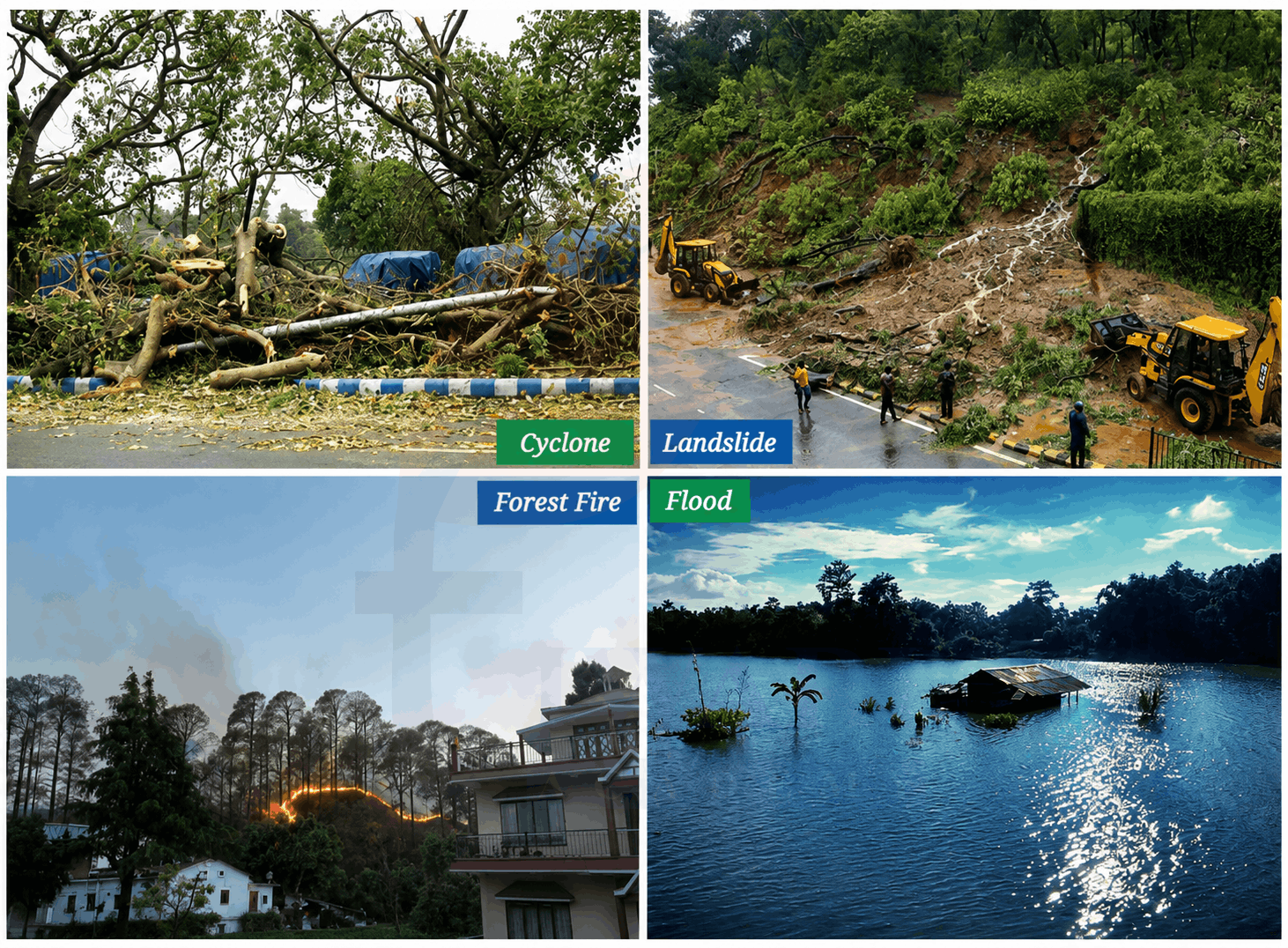
Answer:
- Cyclone – Breaks trees, damages houses and can kill people and animals.
- Landslide – Blocks roads, destroys homes and can bury people under mud and rocks.
- Forest fire – Kills animals, destroys trees and pollutes the air.
- Flood – Damages crops, homes and spreads diseases through dirty water.
In groups of four or five, identify in each of the above disasters the part of natural causes and the part of human causes. Compare your conclusions.
Answer:
| Disasters | Natural causes | Human causes |
|---|---|---|
| Cyclone | Strong sea winds | None directly |
| Landslide | Heavy rain | Cutting trees, bad construction |
| Forest fire | Dry weather | Carelessness like throwing burning matchsticks |
| Flood | Heavy rain | Blocked drains, poor city planning |
Discuss in the same groups series of preventive measures that could help avoid the above disasters.
Answer:
Preventive measures
- Plant more trees to stop landslides and forest fires.
- Build better drainage systems to prevent floods.
- Avoid construction in risky areas like riverbanks and steep hills.
- Spread awareness about not littering or causing fires in forests.
Page 65 – Questions and activities
1. Match the climatic factors with their effects:
| Column A | Column B |
|---|---|
| (1) Latitude | (a) Brings wet air to India during summer |
| (2) Altitude | (b) Creates different climates in the north and south |
| (3) Proximity to the ocean | (c) Keeps higher places cooler |
| (4) Monsoon winds | (d) Moderates the temperature |
Answer:
| Column A | Column B |
|---|---|
| (1) Latitude | (b) Creates different climates in the north and south |
| (2) Altitude | (c) Keeps higher places cooler |
| (3) Proximity to the ocean | (d) Moderates the temperature |
| (4) Monsoon winds | (a) Brings wet air to India during summer |
2. Answer the following questions:
a) What is the difference between weather and climate?
Answer:
Weather is what’s happening outside your window right now. It’s the rain falling today, the heat wave this week or the snow that might come tomorrow. Weather changes quickly – sometimes even within the same day!
Climate, on the other hand, is the pattern of weather in a place over a long time – usually 30 years or more. It’s like looking at the big picture of what the weather is usually like in your area during different seasons.
For Example: If you look outside and see it’s raining, that’s the weather. But if I tell you that Cherapunji gets a lot of rain throughout the year, especially in winter, that’s describing Seattle’s climate.
Even though Cherapunji has a rainy climate, it can still have sunny days with no rain at all (weather). And even though jaipur has a hot, dry desert climate, it can occasionally have rainy days (weather).
b) Why do places near the ocean have milder temperatures than places far away from it?
Answer:
Places near the ocean have milder temperatures because water heats up and cools down more slowly than land. This means:
- In summer, the ocean absorbs heat and keeps coastal areas cooler.
- In winter, the ocean releases stored heat, keeping coastal areas warmer.
- Places far from the ocean (like deserts or plains) experience extreme temperatures because land heats and cools quickly.
Example – Example: Mumbai has moderate weather, while Delhi has very hot summers and cold winters.
c) What role do monsoon winds play in affecting India’s climate?
Answer:
Monsoon winds are seasonal winds that bring heavy rainfall to India, mainly in summer. Their effects are:
- Summer Monsoon (June-September): Moist winds from the Indian Ocean bring rain, helping farmers grow crops like rice.
- Winter Monsoon (October-February): Dry winds from land to sea bring little rain, leading to cooler and drier weather.
- Without monsoons, India would face droughts, affecting agriculture and water supply.
(Example: Kerala receives heavy monsoon rains, while Rajasthan gets less rain.)
d) Why is Chennai warm or hot throughout the year, while Leh is cold?
Answer:
Chennai and Leh have different climates due to latitude, altitude and distance from the sea:
Factors: Chennai (Hot) and Leh (Cold)
- Latitude Near equator → More sunlight → Hotter Far from equator → Less sunlight → Colder
- Altitude Low-lying → Warmer High in Himalayas → Thin air → Very cold
- Distance from Sea Coastal → Ocean moderates temperature (but still hot due to tropical location)
- Inland → No ocean influence → Extreme cold
3. Look at a map of India given at the end of this book. Identify the climate for these cities – Leh, Chennai, Delhi, Panaji and Jaipur.
Answer:
- Leh (Ladakh)
Climate Type: Cold Desert Climate
Characteristics: Extremely cold winters, short cool summers, very low rainfall and high altitude desert conditions. - Chennai (Tamil Nadu)
Climate Type: Tropical Wet and Dry Climate
Characteristics: Hot and humid year-round, distinct wet (monsoon) and dry seasons, with most rainfall (October–December). - Delhi
Climate Type: Semi-Arid Climate
Characteristics: Extreme summer heat, mild winters, monsoon rains (July–September) and occasional winter fog. - Panaji (Goa)
Climate Type: Tropical Monsoon Climate
Characteristics: Heavy monsoon rains (June–September), hot and humid weather and a short dry season. - Jaipur (Rajasthan)
Climate Type: Hot Semi-Arid Climate
Characteristics: Hot summers, mild winters, low rainfall and frequent droughts.
• Is the place near the sea, in the mountains or in the desert?
Answer:
-
- Leh (Ladakh) Situated in the mountains
- Chennai (Tamilnadu) is situated near to sea.
- Delhi is situated in the plane. Far from Mountain, Dessert and Sea.
- Panaji (Goa) is a coastal area.
- Jaipur (Rajasthan) is situated near to dessert.
• How do these factors affect the climate there?
Answer:
| City | Climate Type | Key Features |
|---|---|---|
| Leh | Cold Desert | Very cold, dry, high-altitude desert |
| Chennai | Tropical Wet & Dry | Hot, humid, monsoon rains |
| Delhi | Semi-Arid | Extreme summers, monsoon rains |
| Panaji | Tropical Monsoon | Heavy monsoons, high humidity |
| Jaipur | Hot Semi-Arid | Hot, dry, low rainfall |
4. Draw the monsoon cycle in summers and winters on a map of India.
• Label where the winds blow in summer and winter
• Show the direction of winds during the monsoon
Answer:

5. Make a colourful poster showing festivals in India linked to farming and weather (e.g., Baisakhi, Onam). Add pictures or drawings of these festivals.
Answer:

6. Imagine you are a farmer in India. Write a short diary entry about how you would prepare for the rainy season.
Answer:
Diary Entry
June 1, 2024
Preparing for rains—cleaning irrigation canals, repairing bunds and buying seeds. Hope the monsoon is timely! Praying for a good harvest this year. Fields ready, waiting for the first showers.
Diary Entry
June 15, 2024
Monsoon has arrived! Planted saplings today. Fields are lush and muddy. Worried about pests, so applied neem mix. Hope the rains stay steady, not too heavy.
—Farmer
7. Identify a natural disaster (e.g., cyclone, flood, landslide, or forest fire) and write a short essay that includes the causes and impacts. Suggest actions that individuals, communities and the government can take to reduce the impact.
Answer:Odisha, a coastal state in India, frequently faces devastating floods due to heavy monsoon rains, cyclones and overflowing rivers like the Mahanadi. Deforestation, poor drainage systems, and unplanned urbanization worsen the situation. These floods destroy homes, crops and infrastructure, leading to loss of life, Farmers suffer huge losses and children miss school for months.
To reduce flood impacts, individuals should avoid building houses in flood-prone areas and plant trees to prevent soil erosion. Communities can build raised shelters, store emergency supplies and create early warning systems. The government must improve drainage and Better disaster response teams and public awareness campaigns can save lives.
Class 7 Social Science Part 1 Chapter 3 Extra Questions for Exam Preparation
Class 7 Social Science Part 1 Chapter 3 Very Short Answer Type Questions.
Very Short Answer Type Questions
1. What is climate?
See AnswerClimate is the long-term pattern of weather in a region over several decades.
2. Name the six traditional seasons or ritus of India.
See AnswerVasanta, grishma, varsha, sharad, hemanta and shishir.
3. What type of climate does the Himalayan region have?
See AnswerThe Himalayas have an alpine climate with cold, snowy winters and cool summers.
4. What type of climate does the Thar Desert have?
See AnswerThe Thar Desert has an arid climate with hot days, cool nights and little rainfall.
5. Name the five factors that determine climate.
See AnswerLatitude, altitude, proximity to the sea, wind and topography.
6. What does “monsoon” mean and where does the word come from?
See AnswerMonsoon comes from the Arabic word “mausim,” meaning season.
7. Which direction does the summer monsoon wind blow from?
See AnswerThe summer monsoon blows from the southwest, called the southwest monsoon.
8. Which place receives the highest average annual rainfall in the world?
See AnswerMawsynram in Meghalaya receives the highest average annual rainfall.
9. What is a microclimate?
See AnswerA microclimate is a climate localised in a small area, different from its surroundings.
10. What is an “urban heat island”?
See AnswerA city with many buildings and little vegetation that traps heat, becoming warmer than surroundings.
11. What is the “eye of the cyclone”?
See AnswerThe cloudless centre of a cyclone is called the eye of the cyclone.
12. Name the force specially trained to respond to disasters in India.
See AnswerThe National Disaster Response Force (NDRF).
13. What caused the 2013 Uttarakhand disaster?
See AnswerA sudden glacial burst caused by continuous heavy rain over several days.
14. What are fossil fuels?
See AnswerFossil fuels are energy sources like coal, petroleum and natural gas formed from ancient remains.
15. What is climate mitigation?
See AnswerMitigation means adopting steps to slow down global warming and reduce its causes.
Class 7 Social Science Part 1 Chapter 3 Short Answer Type Questions.
Short Answer Type Questions
1. How is climate different from weather and seasons?
See AnswerWeather is what we experience daily, like rain or sunshine and keeps changing. Seasons recur yearly and affect weather patterns. Climate is the long-term pattern of weather in a region, studied over several decades and stays relatively stable.
2. Why is the climate near the Equator hotter than near the poles?
See AnswerAt the Equator, the sun’s rays fall almost perpendicular, focusing energy on a smaller area. Near the poles, rays are oblique and spread over a larger surface and pass through more atmosphere, resulting in less heat received.
3. Why do coastal areas have milder temperatures than inland areas?
See AnswerThe sea absorbs and loses heat slowly, acting as a temperature moderator for nearby coastal regions. This keeps coastal summers cooler and winters milder, while inland areas away from the sea experience more extreme temperatures.
4. Explain how the southwest monsoon brings rain to India.
See AnswerIn summer, the Asian landmass heats up faster than the ocean, creating low pressure over land. This draws moisture-laden winds from the ocean towards the land and this moisture condenses and falls as heavy monsoon rain.
5. Why does the Western Ghats’ western slope receive more rainfall than the Deccan Plateau?
See AnswerThe Western Ghats act as a natural barrier to the monsoon winds coming from the sea. Their western slopes receive heavy rainfall as winds rise and cool, while the Deccan Plateau to the east receives comparatively less rainfall.
6. How are cyclones formed?
See AnswerCyclones form when atmospheric pressure near the sea becomes very low compared to surrounding areas. Air rushes in from the surroundings, bringing moisture that forms clouds, which rotate around a calm centre called the eye of the cyclone.
7. What causes floods in the Himalayan regions specifically?
See AnswerIn the Himalayas, floods often occur due to glacial bursts, where glacial lakes held back by rock and ice barriers overflow or break due to fast glacier melting or heavy rainfall, releasing large amounts of water suddenly.
8. How do human activities increase the risk of landslides and forest fires?
See AnswerCutting down forests, building infrastructure without proper planning, and constructing too many buildings block natural water flow, increasing landslide risk. Similarly, human carelessness alongside dry conditions and high winds often triggers forest fires.
9. How does climate affect the economy, according to the chapter?
See AnswerPoor rainfall or “monsoon failure”, harms agriculture, forces women to walk long distances for water and pushes agricultural labourers to migrate to cities. Food becomes costlier, causing inflation and industries dependent on water and predictable weather also suffer.
10. How do human activities contribute to climate change?
See AnswerSince the 19th century, burning fossil fuels, deforestation and harmful industrial practices have released excess greenhouse gases like carbon dioxide. This traps extra heat in the atmosphere, causing rapid global warming and disrupting long-standing climate patterns.
Class 7 Social Science Part 1 Chapter 3 Long Answer Type Questions.
Long Answer Type Questions
1. Describe the different types of climates found across India, as explained in the chapter.
See AnswerIndia shows remarkable climatic diversity. The Himalayas have an alpine climate with cold, snowy winters and cool summers, while lower hilly areas have a temperate climate, home to many hill stations. The northern plains experience a subtropical climate with hot summers and cold winters, ideal for wheat cultivation. The Thar Desert in the west has an arid climate with extremely hot days, cool nights and scarce rainfall. The western coastal strip has a tropical wet climate favourable for rice and spices, the Deccan Plateau has a semi-arid climate and eastern India along with the southern peninsula experiences a tropical climate with distinct wet and dry periods controlled by monsoon winds.
2. Explain the five factors that determine the climate of a region, with examples from India.
See AnswerClimate is shaped by five main factors. Latitude affects temperature since places near the Equator, like Kanniyakumari, receive more direct sunlight and stay warmer than places at higher latitudes, like Srinagar. Altitude cools temperatures at higher places since air becomes less dense, explaining why hill stations like Shimla and Darjeeling are cooler. Proximity to the sea moderates temperature, making coastal Mumbai milder than inland Nagpur at a similar latitude. Wind patterns carry either dry, hot air from deserts or moist air from oceans, affecting rainfall and temperature. Finally, topography, such as mountain ranges like the Himalayas, can block cold winds or like the flat Thar Desert, offer no such protection.
3. Explain the mechanism of the southwest and northeast monsoons and their importance for India.
See AnswerThe monsoon mechanism is based on the fact that land heats and cools faster than the ocean. In summer, the Asian landmass heats up rapidly, creating a low-pressure zone that draws moisture-laden winds in from the cooler, high-pressure ocean, resulting in the southwest monsoon, which advances from southern India in June and covers the subcontinent by mid-July. In winter, the land cools faster than the ocean, reversing the wind direction from land to sea; while these winds are generally dry, a portion passing over the Bay of Bengal picks up moisture and brings rainfall to parts of east and south India as the northeast monsoon. These monsoons are vital for agriculture, replenishing rivers and soil and are deeply woven into India’s festivals and cultural traditions.
4. Describe the major climate-related disasters discussed in the chapter and their causes.
See AnswerIndia’s diverse climate can trigger several disasters. Cyclones form when intense low-pressure systems develop near the sea, especially affecting the eastern coast, causing loss of life, property damage and soil erosion. Floods occur when heavy rainfall or overflowing rivers submerge normally dry land, common in states like Uttar Pradesh, Bihar, Kerala and Assam, while in the Himalayas, floods often result from glacial bursts, as tragically seen in the 2013 Uttarakhand disaster near Kedarnath. Landslides, triggered by heavy rain or human activities like deforestation, are common in hilly states like Himachal Pradesh and Uttarakhand. Forest fires, fuelled by dry conditions, droughts, high winds or human carelessness, damage forests, wildlife and air quality, particularly in states like Uttarakhand and Chhattisgarh.
5. What is climate change, and what are its causes and consequences, according to the chapter?
See AnswerClimate change refers to significant, long-term shifts in temperature, precipitation, and weather patterns, occurring either globally or regionally. While natural processes drove climate change for millions of years, since the 19th century, human activities like burning fossil fuels, deforestation and harmful industrial practices have released excessive greenhouse gases such as carbon dioxide, intensifying the planet’s natural greenhouse effect and causing rapid global warming. In India, this is already visible – for instance, early 2025 saw average temperatures 1 to 3°C above normal, leading to a shorter, milder winter that affected agriculture and small industries. To address this, governments promote mitigation measures like reducing emissions, planting trees and adopting renewable energy, though these efforts often compete with the demand for continued economic growth and consumption.
Frequently Asked Questions
What is Class 7 Social Science Chapter 3 “Climates of India” about?
This chapter explains the difference between weather, seasons, climate and explores the various types of climates found in India, from the alpine climate of the Himalayas to the arid climate of the Thar Desert. It also covers the factors that determine climate, the formation and importance of the monsoons, the impact of climate on culture and economy, climate-related disasters and the growing concern of climate change.
What is the difference between weather and climate as explained in Class 7 Social Science Chapter 3?
Weather is what we experience day to day — it could be rainy, sunny or windy and it keeps changing. Climate, on the other hand, is the long-term pattern of weather that a region experiences over several decades or more. So while weather can change within hours, climate reflects a stable, recurring pattern specific to a region, such as the Himalayas being consistently cold or the Thar Desert being consistently dry.
What are the traditional six seasons or “ritus” mentioned in Class 7 Social Science Chapter 3?
The chapter explains that many parts of India traditionally divide the year into six seasons or ritus: vasanta (spring), grishma (summer), varsha (rainy season), sharad (autumn), hemanta (pre-winter) and shishir (winter). Each ritu is associated with specific festivals and rituals, such as Vasanta Panchami during spring and Sharad Purnima during autumn, showing how deeply Indian culture is connected to seasonal changes.
How does climate change affect India, based on the examples given in Class 7 Social Science Chapter 3?
The chapter notes that rising temperatures are now noticeable across many parts of India, giving the example of early 2025, when the country’s average temperature was 1 to 3°C above normal, leading to a shorter and milder winter. This affects agriculture and small-scale industries that depend on predictable seasonal patterns, showing students how climate change is not just a global issue but one with real, local consequences.
Why is understanding India’s climate important for students, beyond exams?
Understanding climate helps students appreciate how deeply it shapes everyday life in India – from the crops farmers grow and the festivals communities celebrate, to how cities plan for disasters like floods and cyclones. It also builds awareness about climate change and the importance of sustainable practices, encouraging young learners to think about environmental responsibility from an early age, which is valuable well beyond the classroom.