



by Tiwari Academy Team
NCERT Class 7 Social Science Chapter 5 Part 1 The Rise of Empires Solutions – Exercises and Extra Question Answers for CBSE Exam. Chapter 5, The Rise of Empires, from the NCERT Class 7 Social Science textbook Exploring Society: India and Beyond (Part 1), for the 2026-27 session, takes students on a fascinating journey through the political history of ancient India from the 6th to the 2nd century BCE. Through the engaging story of time-travellers Bhavisha and Dhruv, who visit the magnificent city of Pāṭaliputra, students learn what an empire truly is and how it differs from a kingdom. The chapter traces the rise of Magadha as a powerful mahājanapada, the reign of the Nanda dynasty, Alexander’s invasion of northwestern India and finally the establishment of the mighty Maurya Empire under Chandragupta Maurya, guided by his mentor Kauṭilya (Chanakya). It also covers Emperor Ashoka’s transformation after the Kalinga war, his edicts and his message of dhamma, along with a look at trade, guilds, art, architecture and daily life in the Mauryan period. This guide provides a complete summary, important terms and practice questions to help students revise Chapter 5 effectively for exams.
Quick Links:
- Exercises Question Answers
- Very Short Answer Type Questions
- Short Answer Type Questions
- Long Answer Type Questions
Download Class 7 Social Science App to study Class 7 Social Offline.
NCERT Class 7 Social Science Part 1 Chapter 5 Solutions
Class 7 Social Science Part 1 Chapter 5 Question Answer
Page 83 – The Big questions?
1. What is an empire?
Answer:
An empire is a large territory made up of many smaller kingdoms, ruled by one powerful emperor. The smaller kingdoms keep their own local rulers, but those rulers become tributaries – they accept the emperor’s authority and pay tribute (money, goods, etc.) to him.
2. How did empires rise and shape Indian civilisation?
Answer:
Empires rose when powerful kingdoms (like Magadha) gained strong economies, iron technology, fertile land and military strength and gradually conquered or absorbed neighbouring kingdoms. They shaped India by bringing political unity, common laws, trade networks, coins, roads and by spreading art, architecture and religions like Buddhism across large parts of the Subcontinent.
3. What factors facilitated the transition from kingdoms to empires?
Answer:
- A strong army to conquer and control other kingdoms
- Rich natural resources (fertile land, iron ore, forests)
- Growing trade and a good economy to fund the army and administration
- Control over rivers and trade routes
- Able rulers and advisors (like Chandragupta Maurya and Kauṭilya)
4. What was life like from the 6th to the 2nd century BCE?
Answer:
This was a period of big change – the rise of Magadha, the Nanda dynasty, Alexander’s invasion and the rise of the mighty Maurya empire under Chandragupta and Ashoka. Cities like Pāṭaliputra flourished with trade, administration and well-planned streets; society had farmers, artisans, traders and guilds; and religions like Buddhism and Jainism spread widely.
Page 89 – Let’s Explore
Empires extended over vast areas and had diverse people with differing languages, customs and cultures. How do you think the emperors made sure that they lived in harmony? Discuss in groups and share your thoughts with the class.
I think emperors used several smart methods to keep peace among such different groups of people in their empire.
- Firstly, I believe emperors allowed local kings and chiefs to keep ruling their own regions instead of removing them completely. This way, people still felt some connection to their own local ruler and customs, even though they were paying tribute to the emperor. This must have made people feel less upset about being conquered.
- Secondly, emperors probably didn’t force everyone to follow one single religion, language or way of life. For example, we read that Ashoka respected different sects like Buddhists, Brahmans, Ajivikas, and Jains, and even appointed officers of dhamma to look after the welfare of all these groups equally. This shows that instead of forcing his own beliefs on people, he tried to include and respect everyone’s traditions.
- Thirdly, I think good roads, trade routes, and communication networks (like the Uttarapatha and Dakshinapatha we saw on the map) helped connect people from different regions. When people trade with each other and travel to different places, they start understanding each other’s cultures better and this reduces conflicts.
- Fourthly, emperors like Ashoka used edicts written in the local language (Prakrit) and script (Brahmi) so that ordinary people could understand the ruler’s message directly. This made people feel like the emperor cared about them and was talking to them personally, not ruling from far away.
- Lastly, I think having a fair and strong system of law and justice, like Kauṭilya described, where officials were told to be impartial and not harsh, would have helped different communities feel safe and equally treated, even if their customs were different.
So overall, I feel the emperors kept harmony by mixing local freedom with central control, respecting different religions and cultures, building good communication and trade links and trying to rule fairly rather than only through fear.
Looking at the many challenges involved in managing an empire, why should a king be so keen to expand his kingdom into an empire and become an emperor? Here are a few possible answers; see if you can think of a few more:
- An ambition to ‘rule the entire world’, a metaphor for controlling large territories and ensuring that they would be remembered for posterity;
- A wish to bring large areas under control and gain access to their resources to build economic and military strength;
- A desire for great wealth for himself and for the empire.
Answer:
Some more reasons a king might want to expand his kingdom into an empire:
- To protect his kingdom better by controlling neighbouring areas before enemies could attack from there.
- To control important trade routes and rivers, which would bring in more money.
- To be remembered as a great and powerful ruler in history.
- To get access to soldiers, elephants and resources from more regions to make the kingdom stronger.
Page 91 – Let’s Explore
Warfare apart, what other methods do you think the rulers might have used to expand their empires? Pen your ideas and share them with your class.
Answer:
Apart from war, rulers could have expanded their empires by:
- Making alliances and friendships with neighbouring kings through marriages.
- Offering protection to smaller, weaker kingdoms in exchange for tribute.
- Controlling trade routes so other kingdoms depended on them for goods.
- Spreading their religion or culture so people felt connected to them.
Page 93 – Let’s Explore
→ Observe the map of the trade routes. Identify geographical features that helped the traders travel across the Subcontinent.
→ What modes of transport on those roads do you think were available at the time?
Answer:
• Geographical features that helped traders travel across the subcontinent were rivers like the Ganga, Son and Yamuna, which were used for water transport and mountain passes in the northwest that connected India to Central Asia and beyond.
• The modes of transport available at that time were probably bullock carts and horses on land and boats or ships on rivers and the sea.
Page 94 – Let’s Explore
→ Take a close look at the panel given above. How many types of weapons can you identify? What different uses of iron can you make out?
→ In the left part of the panel, a parasol (chhattra) is kept over the casket containing the Buddha’s relics. Why do you think this was done?
Answer:
• In the panel, I can see soldiers carrying swords, spears, bows and arrows and shields, which were probably made of iron. Iron was used to make weapons for the army, as well as tools like ploughs for farming.
• The parasol (chhattra) was probably kept over the Buddha’s relics to show respect and honour, since umbrellas or parasols were a symbol of royalty and importance in ancient India.
Page 103 – Let’s Explore
Organise a group discussion in your class and compare the features of Kauṭilya’s idea of an empire with a modern nation.
Answer:
Kautilya’s saptanga included the king, ministers, territory, forts, treasury, army and allies. In a modern nation, we still have similar things – a government (like the king), ministers, defined borders (territory), armed forces (like the army), a treasury (tax money) and diplomatic relations with other countries (like allies). The big difference is that today we have elected leaders instead of kings and citizens have rights and can vote.
Page 107 – Let’s Explore
Aśhoka details instructions on the conduct of his officials and mentions ways to ensure that they practised fairness in one of his edicts. Read the translation below and share your thoughts on whether those ways would have been successful in helping manage his empire and how.
“By order of the Beloved of the Gods — the officers and city magistrates […] are to be instructed thus: […] You are in charge of many thousands of living beings. You should gain the affection of men. All men are my children, and just as I desire for my children that they should obtain welfare and happiness both in this world and the next, the same do I desire for all men. […] You should strive to practice impartiality. […] The root of all this is to be even-tempered and not rash in your work. […] This inscription has been engraved here in order that the city magistrates should at all times see to it that men are never imprisoned or tortured without good reason. […] And for this purpose, I shall send out on tour every five years, an officer who is not severe or harsh; who, having investigated this matter…, shall see that they carry out my instructions.”
Answer:
I think Ashoka’s instructions could have helped manage the empire well because he asked officers to be fair, patient and not harsh with people. Sending inspectors every five years to check on officials would have stopped them from misusing their power. This shows Ashoka cared about good governance and justice for his people.
Page 109 – Let’s Explore
Wear the hat of a historian. Look carefully at the artefacts presented on the spread on the next page. What conclusions can you draw about people and life during the Mauryan era?
Answer:
Looking at the terracotta figurines and sculptures, I can tell that people in the Mauryan era enjoyed art, dance and jewellery, since the figures show elaborate headdresses and ornaments. The worship of goddesses (like the Saptamatrikas) shows that religion was important in daily life. The detailed horse figurine also shows they valued horses, probably for travel and the army.
Page 112– Let’s Explore
Notice the different symbols in the coins. Can you guess what any of the symbols in the coins below might means?
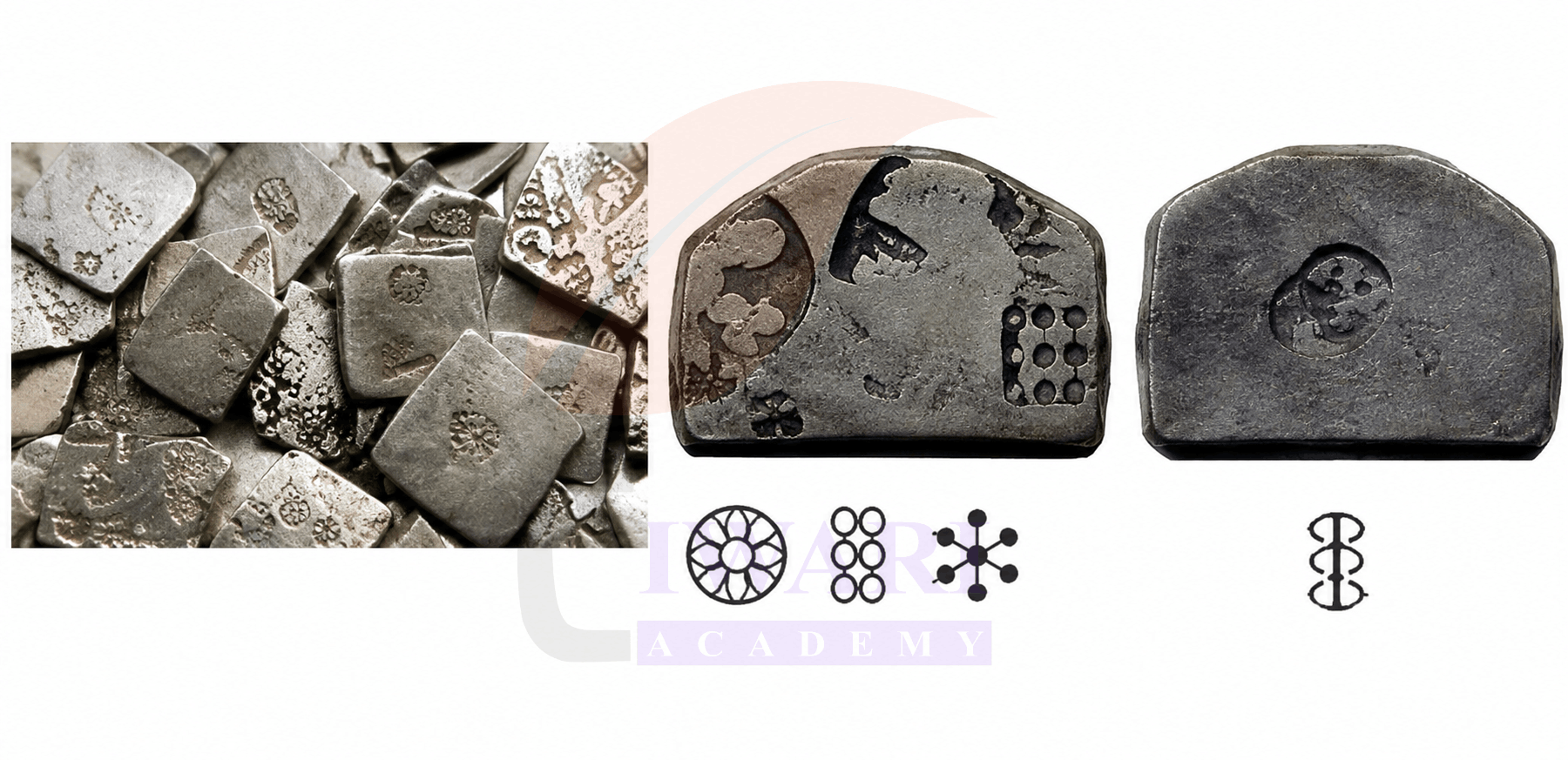
Answer:
The symbols on the coins might represent important things like the sun (for power or the king), animals (for strength) or religious symbols like the wheel (dharmachakra), which could show the ruler’s beliefs or blessings for good fortune and prosperity.
Page 91 – Questions and activities
1. What are the features of an empire, and how is it different from a kingdom? Explain.
Answer:
An empire is a vast territory formed by merging smaller kingdoms under a powerful emperor. Unlike a kingdom, which is smaller and ruled by a single king, an empire controls diverse regions, cultures and trade networks. Empires maintain armies, build roads, collect taxes and enforce laws across their lands. For example, during the 2nd century BCE in India, the Shunga Kingdom ruled parts of northern India after the Mauryan Empire declined. While kingdoms like the Shungas governed smaller regions, empires like the Mauryas had centralized control over much larger areas, with complex administration and far-reaching influence. Empires also promoted trade, art and infrastructure on a grander scale than kingdoms.
2. What are some important factors for the transition from kingdoms to empires?
Answer:
The transition from kingdoms to empires was driven by several key factors. “Strong leadership and strategy” played a big role, as seen with Kautilya’s ideas in the “Arthashāstra”. He believed a kingdom needed seven key elements—like a strong king, ministers, treasury and army—to grow into an empire. “Control over resources”, such as fertile land, iron for weapons and trade routes, also helped kingdoms like Magadha expand. “Economic power” was crucial—empires like the Mauryas built granaries, issued coins and taxed trade to fund their armies and cities. “Military strength” allowed them to conquer smaller kingdoms, while “good administration” kept the empire united. Life in the Mauryan period shows how well-planned cities, roads and fair laws made empires stable and prosperous.
3. Alexander is considered an important king in the history of the world – why do you think that is so?
Answer:
Alexander the Great is considered an important king in history because he built one of the largest empires ever, stretching from Greece to India. He was a brilliant military leader who conquered powerful kingdoms like Persia. His campaigns introduced Greek culture to new regions, creating a mix of Greek and local traditions. Though his rule in India was brief, he left a lasting impact—like the Indo-Greek cultural exchange and the use of satraps (governors) to manage distant lands. His bravery in battles, like the one against King Porus and his curiosity about Indian philosophy (shown in his talks with Gymnosophists) made him legendary. Despite his early death, his empire inspired future rulers and shaped history.
4. In early Indian history, the Mauryas are considered important. State your reasons.
Answer:
The Mauryas were considered important in early Indian history for several key reasons:
- First, they created India’s first major empire, uniting almost the entire subcontinent under one rule, which brought political stability and reduced warfare between smaller kingdoms.
- Second, they established an effective administrative system based on Kauṭilya’s principles, with organized taxation and governance structures that influenced future kingdoms.
- Third, under Chandragupta and Aśhoka, they developed extensive trade networks and economic systems, including the widespread use of punch-marked coins.
- Fourth, they contributed significantly to art and architecture, creating distinctive styles seen in polished stone pillars, stūpas like Sanchi and elaborate sculptures.
- Finally, Aśhoka’s promotion of dharma through rock and pillar edicts, along with his support of Buddhism, had lasting cultural and religious impacts across Asia, with symbols like the lion capital becoming India’s national emblem.
5. What were some of Kauṭilya’s key ideas? Which ones of these can you observe even today in the world around us?
Answer:
Kautilya’s key ideas focused on strong and fair governance. In his “Arthashāstra”, he described the “saptanga” (seven parts of a kingdom): a strong king, wise ministers, fertile land, fortified cities, a rich treasury, a powerful army and loyal allies. He believed a king’s happiness depended on his people’s welfare and emphasized justice, corruption-free administration and care for villages (building roads, wells, etc.).
Today, we see similar ideas: leaders rely on advisors (ministers), countries prioritize strong economies (treasury) and armies and governments build infrastructure (roads, schools) for public welfare—just like Kautilya advised!
Class 7 Social Science Part 1 Chapter 5 Extra Questions for Exam Preparation
Class 7 Social Science Part 1 Chapter 5 Very Short Answer Type Questions.
Very Short Answer Type Questions
1. Who is the author of the Arthaśhāstra?
See AnswerKauṭilya (also known as Chanakya or Vishnugupta) is the author of the Arthaśhāstra.
2. What does the Latin word ‘imperium’ mean?
See AnswerThe Latin word ‘imperium’ means “supreme power”, from which the word ’empire’ is derived.
3. Name the capital city of the Maurya Empire.
See AnswerPāṭaliputra, located around modern-day Patna, was the capital of the Maurya Empire.
4. Who founded the Nanda dynasty?
See AnswerMahāpadma Nanda founded the Nanda dynasty around the 5th century BCE in Magadha.
5. Who was Chandragupta Maurya’s mentor and strategic advisor?
See AnswerKauṭilya, a teacher at Takshashila university, was his mentor and strategic advisor.
6. Which war changed Emperor Ashoka’s outlook towards violence?
See AnswerThe Kalinga war changed Ashoka’s outlook, leading him to adopt peace and non-violence.
7. What script were most of Ashoka’s edicts written in?
See AnswerMost of Ashoka’s edicts were inscribed in Prakrit language, written in the Brahmi script.
8. What title did Ashoka use for himself in his edicts?
See AnswerAshoka called himself “Devanampiya Piyadasi”, meaning “Beloved of the Gods”.
9. Name the Greek historian who visited Chandragupta Maurya’s court.
See AnswerMegasthenes, a Greek historian and diplomat, visited Chandragupta Maurya’s court.
10. What is a ‘tributary’ in the context of an empire?
See AnswerA tributary is a ruler or state that submits to an emperor and pays tribute regularly.
11. What are guilds called in ancient Sanskrit texts?
See AnswerGuilds are called śhreṇīs in ancient Sanskrit texts.
12. Who was the last and highly unpopular king of the Nanda dynasty?
See AnswerDhana Nanda was the last, highly unpopular king of the Nanda dynasty.
13. What symbol from Ashokan pillars is part of India’s national flag?
See AnswerThe dharmachakra or wheel of dharma, is depicted at the centre of India’s national flag.
14. Which king ruled the Pauravas during Alexander’s invasion?
See AnswerKing Porus ruled the Pauravas during Alexander’s invasion of India.
15. What are the two important trade routes shown on the ancient map?
See AnswerThe Uttarapatha (northern route) and the Dakshinapatha (southern route) are shown on the map.
Class 7 Social Science Part 1 Chapter 5 Short Answer Type Questions.
Short Answer Type Questions
1. Explain any two features of an empire as described in the chapter.
See AnswerAn empire maintains an army to control tributary states and expand or defend its territory. It also maintains an administration with officials who manage territories, collect taxes and uphold law and order across the empire’s vast lands.
2. Why was Magadha’s location advantageous for the rise of an empire?
See AnswerMagadha was located in the resource-rich Ganga plains with fertile land, abundant forests providing timber and elephants and access to iron ore from nearby hills. The Ganga and Son rivers also offered geographical advantages for trade and transportation.
3. Describe the role of iron technology in Magadha’s expansion.
See AnswerIron ore and minerals from nearby hilly regions proved crucial for Magadha’s expansion. Iron ploughs increased agricultural produce by making tilling easier, while lighter and sharper iron weapons strengthened the army’s fighting capabilities, aiding conquest.
4. What was the importance of trade routes and guilds for maintaining an empire?
See AnswerTrade routes ensured that goods grew in quantity and variety, generating income for producers and tax revenue for rulers. Guilds organised traders and craftsmen into powerful associations, sharing resources and information, which strengthened the empire’s economy.
5. How did Ashoka try to project himself as a benevolent ruler in his edicts?
See AnswerAshoka claimed to provide medical care for people and animals even beyond his empire, prohibited hunting and cruelty to animals and established rest houses, wells and shade trees along roads. He also encouraged different religious sects to respect one another.
6. What happened to Alexander’s empire after his death?
See AnswerAfter Alexander fell ill and died in Babylon at the age of 32, his immense empire faced rebellions and political turmoil. It was soon divided among his generals and satraps, who created their own independent kingdoms.
7. Describe any two features of city life during the Mauryan period.
See AnswerCities like Pāṭaliputra were well-planned with palaces, public buildings and streets bearing signage. Communication happened through couriers carrying messages and water vessels were kept at regular intervals along the streets as a precaution against fire.
8. Why is the institution of guilds considered a mark of self-organising ability of Indian society?
See AnswerGuilds had the autonomy to create their own internal rules without royal interference, as cultivators, traders, herdsmen and artisans had authority over their respective classes. This shows that Indian society could organise itself effectively without needing constant state control.
9. Explain the meaning and importance of ‘dharma’ in the context of Ashoka’s rule.
See AnswerDharma means moral law, duty, truth, order, and ethics combined, extending to living in harmony with the cosmic order. Ashoka encouraged his subjects to follow dharma through edicts inscribed on rocks and pillars across his empire.
10. What were the reasons that could lead a king to expand his kingdom into an empire?
A king might be driven by ambition to “rule the entire world” and be remembered for posterity, a wish to control large areas and access their resources for economic and military strength or simply a desire for great wealth for himself and the empire.
Class 7 Social Science Part 1 Chapter 5 Long Answer Type Questions.
Long Answer Type Questions
1. Explain in detail what an empire is, its key features, and how it differs from a kingdom, using examples from the chapter.
See AnswerAn empire is a collection of smaller kingdoms or territories brought under the authority of one powerful ruler or emperor, often through war. Unlike a kingdom, where a single ruler governs one cohesive territory directly, an empire allows the smaller conquered territories to retain their own local rulers, who become tributaries paying tribute—money, gold, grain, livestock or other valuable goods—to the emperor as a sign of submission. Ancient Sanskrit texts used terms like samrāj (“lord of all”), adhirāja (“overlord”), and rājādhirāja (“king of kings”) for emperors, distinguishing them from ordinary kings. Key features of an empire include maintaining a strong army, a central administration to manage taxes and law and order, control over resources like mines and forests, issuing currency and laws, encouraging art and learning and maintaining communication networks like roads for trade and administration—all centred on the emperor’s authority over the empire’s territories.
2. Trace the rise of Magadha and describe how it became a dominant centre of power leading to the emergence of the Nanda and Maurya empires.
See AnswerMagadha, located in modern-day south Bihar, was one of the sixteen mahājanapadas of north India. It rose to prominence between the 6th and 4th centuries BCE due to several advantages: it lay in the resource-rich Ganga plains with fertile land, dense forests supplying timber and elephants and access to iron ore from nearby hills. The use of iron ploughs boosted agricultural surplus, while iron weapons strengthened its army. The Ganga and Son rivers provided excellent transportation for trade, further increasing the kingdom’s wealth. Powerful early kings like Ajātaśhatru strengthened Magadha’s dominance. Around the 5th century BCE, Mahāpadma Nanda unified many smaller kingdoms to found the Nanda dynasty, issuing coins and maintaining a large army. However, the last Nanda king, Dhana Nanda, became deeply unpopular due to his oppression of the people, which paved the way for Chandragupta Maurya, guided by Kauṭilya, to overthrow the Nandas and establish the Maurya Empire around 321 BCE.
3. Describe Kauṭilya’s concept of the Saptānga and explain how it helped in establishing and consolidating the Maurya Empire.
See AnswerKauṭilya, in his text the Arthaśhāstra, described the saptānga, or the seven essential limbs that constitute a kingdom: the king (swāmi), the ministers and officials (amātya), the territory and population (janapada), fortified towns and cities (durga), the treasury (kosha), the army and law enforcement (danda), and the allies (mitra). According to Kauṭilya, these seven elements together must work in harmony to create a settled, well-protected, and prosperous kingdom, maintained through both warfare and diplomatic alliances as needed. He emphasised strong administration, laws against corruption, and specified punishments for wrongdoing. His central philosophy was that a king’s happiness lies in the happiness of his subjects, meaning the ruler must prioritise the people’s welfare above his own interests. This structured and people-centric vision of statecraft guided Chandragupta Maurya in expanding and consolidating the Maurya Empire from the northern plains to the Deccan plateau, making it one of the greatest empires in Indian history.
4. Discuss Emperor Ashoka’s transformation after the Kalinga war and describe his administrative and religious achievements, including his edicts and their significance.
See AnswerAshoka, Chandragupta’s grandson, began his reign as an ambitious ruler who expanded the Maurya Empire to cover almost the entire Indian subcontinent. However, after marching on Kalinga (modern-day Odisha) and witnessing the enormous death and destruction caused by the ferocious war, he underwent a profound transformation. He chose to give up violence and embraced the path of peace and non-violence taught by the Buddha, becoming devoted to spreading dhamma. He sent emissaries to Sri Lanka, Thailand, Central Asia, and beyond to spread Buddhist teachings. Ashoka became known as a “great communicator” for issuing edicts engraved on rocks and pillars across his empire, written mostly in Prakrit using the Brahmi script, encouraging people to follow dharma. In these edicts, he called himself “Devanampiya Piyadasi” and projected himself as a benevolent ruler—claiming to provide medical care for humans and animals, prohibiting cruelty to animals, building rest houses and wells, and instructing officials to practise fairness and avoid unjust imprisonment or torture. His legacy continues through India’s national emblem, based on his Sarnath Lion Capital, and the national motto “Satyameva Jayate.”
5. Explain the causes behind the fragile nature and eventual decline of empires, with reference to the Maurya Empire and other historical examples mentioned in the chapter.
See AnswerEmpires, as the chapter explains, are something of a paradox: while they can bring political unity and reduce warfare among smaller kingdoms, leading to greater prosperity, they are almost always established through war and maintained through force and repression, making them inherently fragile and unstable over time. Several factors contribute to their decline. Distant regions often feel tempted to become independent, especially when the emperor demands increased tribute during long military campaigns or droughts, leading to resentment among local rulers. If a powerful emperor is succeeded by a weaker one, local kings or chieftains may simply stop paying tribute. The larger an empire grows, the harder it becomes to hold together, as seen when Alexander’s vast empire divided among his generals and satraps soon after his death. Similarly, the Maurya Empire continued for only about half a century after Ashoka’s death before his successors failed to hold it together and by around 185 BCE, many smaller kingdoms broke away and became independent. Economic crises caused by natural calamities like droughts or floods can further destabilise an empire’s structure, as seen across history in the decline of the Roman, Persian, Ottoman, Spanish and Russian empires as well.
Frequently Asked Questions
Is “The Rise of Empires” a new chapter in the 2026-27 NCERT syllabus or was it there before?
This chapter is part of the recently revised NCERT Class 7 Social Science textbook Exploring Society: India and Beyond (Part 1), introduced under the new curriculum framework. Content on Magadha, the Nandas and the Mauryas existed in earlier NCERT books too, but this chapter has been reorganised, renumbered and rewritten with a new storytelling format (the Bhavisha-Dhruv narrative), new activity boxes, and updated illustrations for the 2026-27 session.
While the exact exam pattern depends on the school or board, chapters like this one – which cover major dynasties, key rulers and important concepts like Saptānga and dhamma – typically carry 1-mark objective questions, 3-mark short answers and at least one 5-mark long answer question, given the volume of content and its historical significance.
This chapter has a good mix of narrative storytelling and factual content, which generally makes it more engaging than purely factual chapters. However, because it covers multiple dynasties (Nandas, Mauryas), key figures (Kauṭilya, Ashoka, Alexander), and concepts (Saptānga, dharma, guilds), students usually benefit from 2-3 focused revision sessions, along with practicing map-based and edict-based questions separately.
Yes, the chapter includes several “Let’s Explore” activities that teachers commonly assign as homework or classwork, such as researching the Brahmi script, discussing Kauṭilya’s ideas of good governance versus a modern nation or planning an imaginary 3rd-century BCE journey from Kaushambi to Kaveripattanam using the trade route map.
Yes – a distinctive feature of this chapter is its direct link to India’s national emblem (the Sarnath Lion Capital) and the national flag’s dharmachakra, both explained through Ashoka’s Mauryan legacy. This connection is often tested as a standalone question in exams, so it’s worth remembering separately from the general Mauryan history content.