



by Tiwari Academy Team
NCERT Class 7 Social Science Chapter 8 Part 1 How the Land Becomes Sacred Solutions – Exercises and Extra Question Answers for 2026-27 Exams. Chapter 8 of the new NCERT Class 7 Social Science textbook (Exploring Society: India and Beyond, Part 1), How the Land Becomes Sacred, is part of the updated syllabus for the 2026-27 academic session. This chapter helps students understand the meaning of “sacredness”, how sacred places are found across every religion and community in India and how pilgrimage traditions like the chār dhām yātrā, the 12 jyotirlingas and the 51 Shakti pīṭhas connect distant regions into a single sacred geography. It also explores sacred rivers, mountains, forests, sacred groves and shows how pilgrimage routes historically supported trade and cultural integration across the Indian subcontinent.
Quick Links:
- Exercises Question Answers
- Very Short Answer Type Questions
- Short Answer Type Questions
- Long Answer Type Questions
Download Class 7 Social Science App to study Class 7 Social Offline.
NCERT Class 7 Social Science Part 1 Chapter 8 Solutions
Class 7 Social Science Part 1 Chapter 8 Question Answer
Page 167 – The Big Questions
1. What is ‘sacredness’?
Answer:
Sacredness refers to the deep religious or spiritual significance of places, objects or journeys, evoking reverence. It connects geography, traditions and divinity, as seen in India’s sacred sites and natural elements.
2. How does the land become sacred?
Answer:
Land becomes sacred through religious significance (shrines, pilgrimages), natural reverence (rivers, mountains) and cultural traditions that link geography to divinity, creating networks of holy sites across India.
3. How do sacred sites and pilgrimage networks connect with the life and culture of the people?
Answer:
Sacred sites and pilgrimages connect people to shared traditions, foster cultural unity across regions and sustain economic activities (trade, crafts), while reinforcing spiritual and ecological values in daily life.
4. What role did sacred geography play in the cultural integration of the Indian Subcontinent?
Answer:
Sacred geography unified India by connecting diverse regions through pilgrimage networks (e.g., Char Dham), fostering shared traditions, cultural exchanges and economic ties, while reinforcing spiritual and ecological bonds.
Page 168 – Let’s Explore
Do any of the pictures look familiar to you? Can you name similar places found in your neighbourhood?
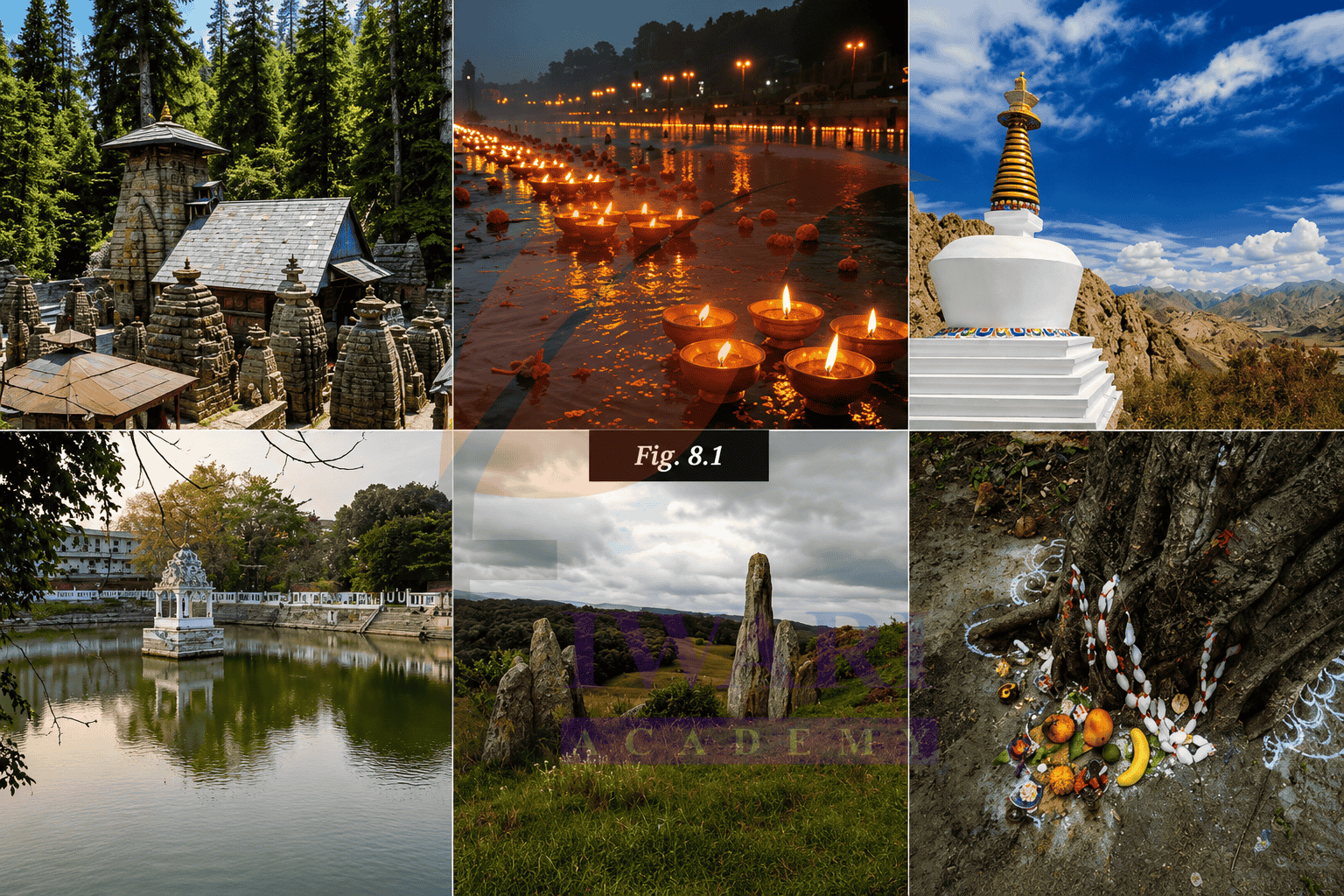
Answer:
Yes, some of these places look familiar. In my neighbourhood, there is a Hindu temple, a small pond and a Peepal tree where people offer prayers. During festivals, people also light earthen lamps (diyas) near temples and water bodies. These places are important for worship and bring the community together.
Page 171 – Let’s Explore
Read the excerpt. What are your observations? Locate the route the group must have taken from Rameswaram to Haridwar. Why do you think the group was going straight to Haridwar instead of stopping at Delhi?
Answer:
My observations: The group was very determined and organized — they carried their own food (atta, ghee, sugar) and pots for a very long three-month journey and they travelled with a mix of men and women from their village together.
The route from Rameswaram (in the far south, Tamil Nadu) to Haridwar (in the north, Uttarakhand) would have gone roughly through Tamil Nadu → Andhra Pradesh/Telangana → Madhya Pradesh → Uttar Pradesh → Delhi → Haridwar, covering almost the whole length of India from south to north.
I think the group didn’t stop in Delhi because their pilgrimage goal was specifically Haridwar and pilgrims usually have a fixed sacred destination and limited time — they only had to change trains, not visit Delhi as a sacred site, so they didn’t want to waste time or money stopping there.
In ancient times, when people were travelling from Madurai in Tamil Nadu to Varanasi in Uttar Pradesh, what languages would they come across? How would they communicate with people in those places? Where would they stay? What food would they eat?
Answer:
- Languages: They would come across Tamil in Madurai, then various regional languages like Telugu, Marathi, Hindi and Bhojpuri as they moved north towards Varanasi.
- Communication: Since they might not know all these languages, they probably communicated using simple words, gestures or through Sanskrit, which was commonly understood by priests and scholars everywhere as a common sacred language.
- Stay: They would probably stay at dharamshalas (rest houses for pilgrims), temples or with kind local people along the way.
- Food: They would eat simple food they carried with them (like grains, ghee) or whatever local food was available in each region they passed through.
Page 173 – Let’s Explore
Note the locations of the chār dhām. What do you think it implied for the people when they travelled north-south and east-west?
Answer:
The chār dhām are located in the four corners of India – Badrinath (north), Rameswaram (south), Puri (east) and Dwarka (west). I think this was done on purpose so that pilgrims travelling to complete the chār dhām yātrā would have to cross the entire length and breadth of India. This made people from very distant and different regions feel connected to one whole country, even though they spoke different languages and had different customs. It created a feeling of “one India” through the shared practice of pilgrimage.
Page 174 – Let’s Explore
Can you identify the names of a few traditional tīrthas given in the map above? You can refer to the political map at the end of the book for help.
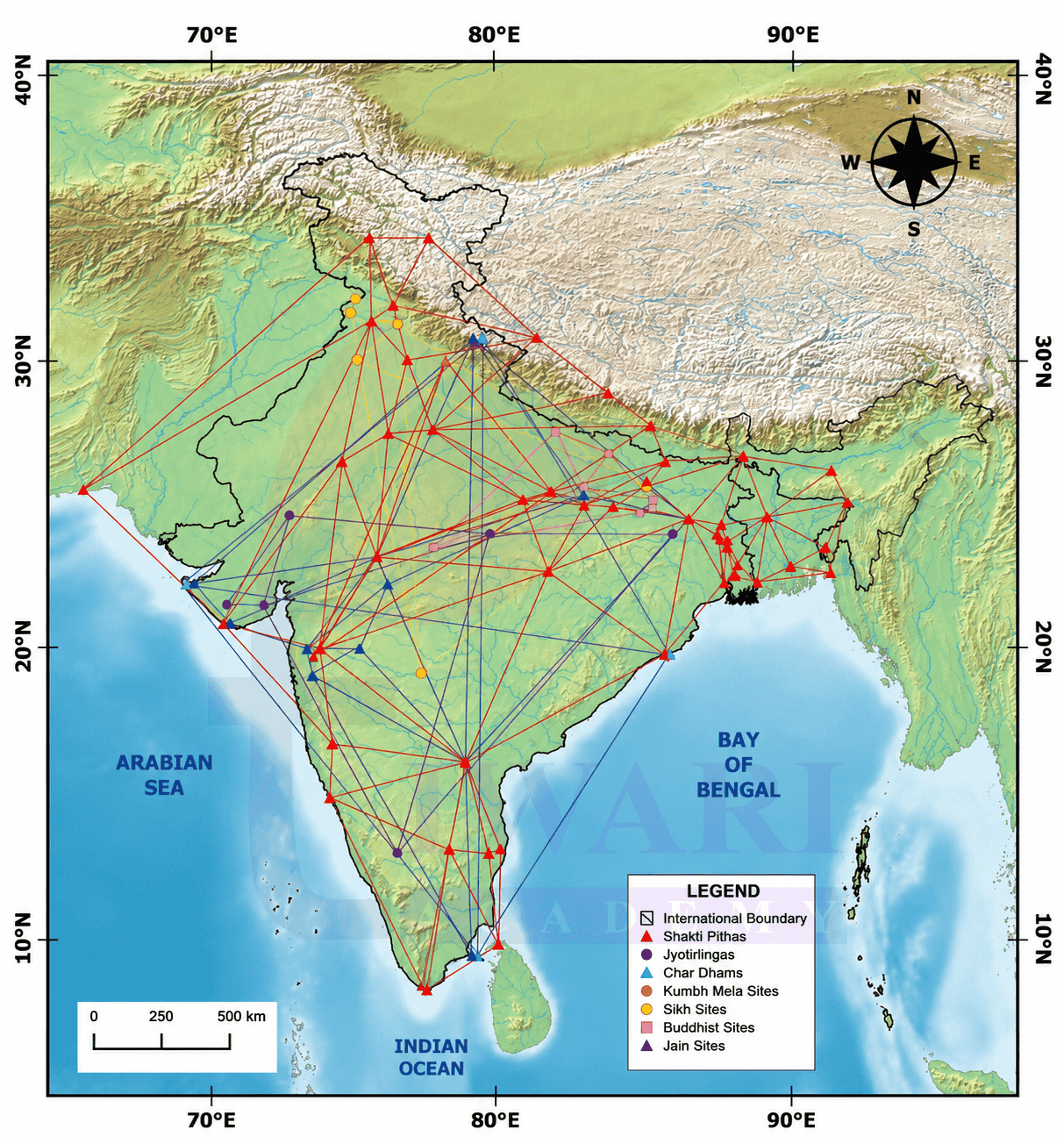
Answer:
The chār dhām are located in the four corners of India — Badrinath (north), Rameswaram (south), Puri (east) and Dwarka (west).
Page 181 – Let’s Explore
Take a sheet of transparent paper that can be used for tracing. Trace a map of the trade routes from the chapter ‘The Rise of Empires’. Place it on top of the map of the important tīrthas. What do you observe?
Answer:
If I trace the trade routes (Uttarapatha and Dakṣhinapātha) from the earlier chapter and place them over the map of tirthas, I would observe that many trade routes pass through or very close to important sacred sites like Ujjayinī (Ujjain), Kaushāmbī and Pratiṣhṭhāna (Paithan). This shows that pilgrimage routes and trade routes often overlapped — meaning traders and pilgrims used the same paths, which helped both trade and religious travel grow together and also helped spread ideas, goods and culture across India.
Page 183 – Questions and activities
1. Read the following statement by a well-known environmental thinker, David Suzuki:
“The way we see the world shapes the way we treat it. If a mountain is a deity, not a pile of ore; if a river is one of the veins of the land, not potential irrigation water; if a forest is a sacred grove, not timber; if other species are biological kin, not resources; or if the planet is our mother, not an opportunity—then we will treat each other with greater respect. Thus is the challenge, to look at the world from a different perspective.”
Discuss in small groups. What do you think this statement means? What implication does it have for our actions with respect to the air, water, land, trees and mountains
around us?
Answer:
When I read this statement by David Suzuki, I understood that the way we look at something decides how we treat it. If I think of a mountain as just a “pile of ore” or rock that can be sold for money, I will not think twice before cutting it down or mining it. But if I think of the same mountain as a god or a sacred being, like we learnt in our chapter about Mount Kailash or the Taranaki Maunga mountain of the Maoris, then I will treat it with respect and try to protect it instead of harming it.
This connects to what we studied in Chapter 8 — how in India, rivers like the Ganga and Yamuna are called “Ganga ji” and “Yamuna ji” with respect, almost like they are family members, not just water for irrigation. Similarly, forests are protected as sacred groves because people believe deities live there, so no one is allowed to cut trees or hunt animals in them.
What it means for our actions:
- Air: If we think of air as something sacred that we share with all living beings, we will try not to pollute it with smoke or harmful gases.
- Water: If we see rivers as sacred, like our elders do, we won’t throw garbage or chemicals into them.
- Land: If we treat the land as our Mother Earth (Bhūdevī), as mentioned in the chapter, we will use it carefully and not overuse it for construction or industry.
- Trees: If trees like the peepul tree are seen as sacred, we will plant more trees and not cut them without reason.
- Mountains: If mountains are respected as sacred places, we will avoid unnecessary mining and blasting that destroys them.
So, I think this statement teaches us that respecting nature as sacred, the way our ancestors did through sacred geography, sacred rivers and sacred groves, can help us solve today’s problems of pollution and environmental damage. If we start seeing nature as part of our family instead of just a resource, we will naturally become more responsible towards the air, water, land, trees and mountains around us.
2. List the sacred sites in your region. Enquire into why they are considered sacred. Are there stories connected with these sacred places? Write a short essay of 150 words.
(Hint: You could speak to elders in your family and community, discuss with your teacher, read books and articles, etc., to gather relevant information.)
Answer:
I live in Delhi, so this is the list of sacred places in the Delhi.
- Jama Masjid: Built by Mughal Emperor Shah Jahan, it is one of India’s largest mosques, revered for its architectural grandeur and as a center of Islamic worship.
- Lotus Temple (Bahá’í House of Worship): A symbol of unity, this lotus-shaped temple welcomes people of all faiths for meditation and prayer, embodying the Bahá’í principle of oneness.
- Akshardham Temple: A modern Hindu temple complex dedicated to Swaminarayan, showcasing India’s spiritual heritage through intricate carvings, exhibitions and rituals
- Gurudwara Bangla Sahib: Associated with Guru Har Krishan Sahib, the eighth Sikh Guru, it is sacred for its healing waters and community service (langar).
- Yogmaya Temple: An ancient temple dedicated to Goddess Yogmaya, believed to be the sister of Krishna, with roots tracing back to the Mahabharata era.
- Nizamuddin Dargah: The shrine of Sufi saint Hazrat Nizamuddin Auliya, revered for its qawwali traditions and spiritual solace.
3. Why do you think natural elements like rivers, mountains and forests are considered sacred for the people? How do they contribute to our lives?
Answer:
Natural elements like rivers, mountains and forests are considered sacred because they are seen as manifestations of the divine (e.g., rivers like Ganga are worshipped as goddesses) and sustain life. Sacred texts like the Bhāgavata Purāṇa describe Earth as the body of the divine, making its features worthy of reverence. These elements contribute to our lives in key ways:
- Rivers (Ganga, Yamuna) provide water, support agriculture, and symbolize purity. Pilgrimage sites along rivers (e.g., Prayagraj) unite people spiritually.
- Mountains (e.g., Kailash) are seen as bridges between heaven and earth, inspiring perseverance through pilgrimages.
- Forests and trees (like the sacred pipal, Banyan) offer oxygen, medicine and shelter, while sacred groves protect biodiversity.
Tribal communities, like the Dongria Khonds, worship hills like Niyam Dongar, ensuring ecological balance. By treating nature as sacred, traditions discourage harm and promote conservation. Thus, sacred geography blends faith, ecology and survival, reminding us to respect and protect nature.
4. Why do people visit a tīrtha or other sacred sites?
Answer:
People visit a tīrtha or other sacred sites mainly because it helps them grow spiritually. A tīrtha symbolically means crossing from an ordinary life to a higher, spiritual life, so visiting one is seen as an inner journey, not just a physical trip.
Many people also do it as a religious duty, like completing the chār dhām yātrā or visiting Sikh takhts, since these places are connected to important figures such as the Buddha, the Sikh Gurus or the Jain Tīrthankaras.
Lastly, pilgrimages create a sense of unity, as they connect people from different parts of India, giving them, as Nehru said, “the feeling of one country and one culture”.
5. How did the ancient pilgrimage routes help in fostering trade during those times? Do you think the sacred sites help in developing the economy of the region?
Answer:
Ancient pilgrimage routes helped in fostering trade because pilgrims and traders often travelled on the same paths. Pilgrims needed food, supplies and other items for their long journeys and traders could provide these things along the way. So, as pilgrims moved from one sacred site to another, merchants also carried their goods to distant towns and cities, using routes like the Uttarapatha and the Dakshinapatha. This overlap meant that goods like cotton, spices, gold and sandalwood could travel across the country alongside pilgrims.
Yes, I think sacred sites do help in developing the economy of a region. When many pilgrims visit a place like Bodh Gaya or Sabarimala every year, it creates a need for food, stay, transport and local goods, which gives work to local people such as shopkeepers, guides and craftsmen. Even today, places like Haridwar during the Kumbh Mela see a huge boost in local business because of the large number of visitors. So, sacred sites are not just important for religion, but also help in the economic growth of the region around them.
6. How do sacred places influence the culture and traditions of the people living near them?
Answer:
Sacred places have a strong influence on the culture and traditions of the people living near them. Since these places are considered holy, local communities often build their festivals, rituals and daily practices around them. For example, people near sacred groves like Mawphlong in Meghalaya avoid hunting, tree-felling or mining, as they believe deities live there and this respect becomes part of their local traditions and way of life.
Sacred places also give rise to local legends and stories, like how many regions in India have shrines claiming that heroes from the Mahābhārata or Rāmāyaṇa passed through their area. This allows different communities to feel connected to these epics in their own unique way.
In addition, sacred rivers, mountains and trees near a place shape how people speak about and treat nature – for instance, calling rivers “Ganga ji” or “Yamuna ji” with respect. So, sacred places influence local language, festivals, food, occupations and even the way people protect their environment, making them an important part of regional culture and identity.
7. From the various sacred sites of India, select two of your choice and create a project explaining their significance.
Answer:
Project: Significance of Sacred Sites in India
Site 1: Bodh Gaya (Bihar)
About the place: Bodh Gaya is a small town in Bihar, located on the banks of the Falgu river.
Why it is sacred: According to Buddhist tradition, this is the place where the Buddha attained enlightenment while meditating under a peepul (bodhi) tree. Today, the Mahabodhi Temple stands here, along with a descendant of the original bodhi tree.
Significance:
- It is one of the most important pilgrimage sites for Buddhists all over the world.
- It receives more than four million visitors every year, showing its huge religious importance.
- The bodhi tree here connects the site to nature worship, since the peepul tree (Ficus religiosa) is sacred to Hinduism, Buddhism, Sikhism and Jainism.
- It has boosted the local economy through tourism, hotels, shops and transport services.
Site 2: Amritsar (Punjab) – Golden Temple and Akal Takht
About the place: Amritsar in Punjab is home to the Golden Temple (Harmandir Sahib) and the Akal Takht.
Why it is sacred: The Akal Takht, located within the Golden Temple complex, is one of the five takhts or seats of spiritual authority in Sikhism. It is deeply connected to the teachings and history of the Sikh Gurus.
Significance:
- Sikhs aspire to visit this place at least once in their lifetime as part of their faith.
- It reflects the tradition of pilgrimages undertaken by Sikh Gurus, like Guru Nanak, to various sacred places across India.
- The site brings together people from different backgrounds, since the Golden Temple serves free food (langar) to all visitors regardless of religion.
- It strengthens community bonding, culture and charity work in the region around Amritsar.
Conclusion: Both Bodh Gaya and Amritsar show how sacred sites are not just religious places but also centres that connect history, culture, nature and economy. They bring people together from different parts of India and the world, spreading values of peace, respect and unity.
8. What is the two-fold significance of a tīrthayātrā or a pilgrimage?
Answer:
A tīrthayātrā or pilgrimage has a two-fold significance — one spiritual and one social-economic.
Spiritual significance: A pilgrimage is not just a physical journey but also an inner journey. It helps a person grow spiritually and follow a specific code of conduct, helping them move from an ordinary life to a higher, more meaningful one.
Social and economic significance: As pilgrims travel to different sacred sites, they meet traders, merchants and people from different regions along the way. This helps in the exchange of goods, ideas, languages and customs, fostering trade and boosting the local economy. Over time, this constant movement of people also helped in the cultural integration of the whole Indian subcontinent, connecting people from the north to the south and the east to the west into “one country and one culture,” as Nehru described it.
Class 7 Social Science Part 1 Chapter 8 Extra Questions for Exam Preparation
Class 7 Social Science Part 1 Chapter 8 Very Short Answer Type Questions.
Very Short Answer Type Questions
1. What does the word ‘sacredness’ mean?
See AnswerSacredness means finding deep religious or spiritual significance in a place, journey or land worthy of reverence.
2. What is a pilgrimage?
See AnswerA pilgrimage is a journey to a sacred place that is significant within a religion or belief system.
3. What is a tīrtha?
See AnswerA tīrtha is a place symbolising the crossing from ordinary worldly life to a higher spiritual life.
4. Name the relic stūpa mentioned in the chapter.
See AnswerThe Great Stūpa at Sanchi in Madhya Pradesh is a well-known relic stūpa.
5. Where did the Buddha attain enlightenment?
See AnswerThe Buddha attained enlightenment at the Mahabodhi Stūpa in Bodh Gaya, Bihar.
6. What are takhts in Sikhism?
See AnswerTakhts are seats or centres of spiritual authority in the Sikh tradition.
7. What is a Tīrthankara in Jainism?
See AnswerA Tīrthankara is someone who guides the crossing from ordinary life to higher spiritual life.
8. Name the four sites of the chār dhām yātrā’s directional pattern.
See AnswerThe chār dhām sites are located in the southern, northern, eastern and western corners of India.
9. How many jyotirlingas are there?
See AnswerThere are 12 jyotirlingas, sacred shrines dedicated to Lord Shiva.
10. How many Shakti pīṭhas are there?
See AnswerThere are 51 Shakti pīṭhas spread across the Indian subcontinent, including Bangladesh and Pakistan.
11. Which four places host the Kumbh Mela?
See AnswerHaridwar, Prayagraj, Nashik and Ujjain host the Kumbh Mela.
12. What is the botanical name of the peepul tree?
See AnswerIts botanical name is Ficus religiosa, meaning the ‘religious’ or sacred fig tree.
13. What are sacred groves?
See AnswerSacred groves are natural forests protected by communities because they are seen as abodes of deities.
14. Name one sacred grove name used in Tamil Nadu.
See AnswerIn Tamil Nadu, a sacred grove is called kovilkādu.
15. Which mountain do the Maoris consider sacred?
See AnswerThe Maoris of New Zealand regard Mount Taranaki Maunga as sacred, like their ancestor.
Class 7 Social Science Part 1 Chapter 8 Short Answer Type Questions.
Short Answer Type Questions
1. Why do people undertake pilgrimages in India?
See AnswerPeople undertake pilgrimages to visit sacred sites connected to their faith, seek spiritual growth and follow age-old traditions. It is both a physical journey and an inner journey guided by a specific code of conduct followed for thousands of years.
2. How did pilgrimage routes help in cultural integration of India?
See AnswerAs pilgrims travelled across India for centuries without modern transport, their paths crossed those of traders, teachers and scholars. This constant mixing of people, ideas, languages and goods gradually integrated the culture of the whole subcontinent.
3. Explain the story behind the Shakti pīṭhas.
See AnswerAccording to the story, Satī immolated herself after her father insulted Shiva. To calm Shiva’s grief and anger, Vishnu cut up her body with his chakra. The 51 places where her body parts fell became the Shakti pīṭhas.
4. Why are mountains often considered sacred in India?
See AnswerMountains are seen as symbolic gateways from earth to heaven because of their height. Many tīrthas and temples are built on hilltops and the difficult journey up the mountain represents the challenging inner spiritual path.
5. What role do sacred groves play in the environment?
See AnswerSacred groves protect natural forests from hunting, tree-felling and mining because communities see them as abodes of deities. This protection helps preserve biodiversity, shelters small water bodies and supports water conservation in many regions.
6. How are rivers connected to sacredness in India?
See AnswerRivers have been worshipped since Vedic times, as shown in the nadīstuti sūkta of the Rigveda. Major rivers like Ganga, Yamuna and Kaveri are treated with reverence and called by respectful names like ‘Ganga ji’.
7. What is the significance of the Kumbh Mela?
See AnswerThe Kumbh Mela originates from the legend of amrita manthana, where drops of the divine nectar fell at four places. Bathing in the rivers there during the fixed period is considered highly auspicious and it is a UNESCO-recognised intangible heritage.
8. How does sacred geography exist beyond India?
See AnswerSacred geography is a worldwide concept. Ancient Greece had sacred mountains and groves, Native Americans shared a special sacred bond with nature and the Maoris of New Zealand consider Mount Taranaki Maunga sacred, even granting it legal rights.
9. Why is the peepul tree considered special?
See AnswerThe peepul or bodhi tree is sacred to Hinduism, Buddhism, Sikhism, Jainism and its botanical name Ficus religiosa means “religious fig tree”. It also has medicinal uses and provides food and shelter to birds and animals.
10. How were pilgrimage routes and trade routes connected in ancient India?
See AnswerPilgrims needed goods along their journeys, which traders supplied, so pilgrimage and trade routes often overlapped. Routes like the Uttarapatha and Dakshinapatha carried goods such as cotton, spices and gems alongside pilgrims travelling to sacred sites.
Class 7 Social Science Part 1 Chapter 8 Long Answer Type Questions.
Long Answer Type Questions
1. Describe how different religions in India have their own sacred sites.
See AnswerAlmost every religion in India has sacred places of its own. Buddhism reveres sites linked to the Buddha’s life, such as the Great Stūpa at Sanchi and Bodh Gaya. Sikhism has takhts like the Akal Takht at Amritsar, associated with the Gurus. Jainism reveres tīrthas connected to Tīrthankaras, such as Mount Abu and Girnar. Religions like Islam, Christianity, Judaism and Zoroastrianism, though originating outside India, also have important shrines here, such as the Dargah Sharif of Ajmer, that draw pilgrims from many faiths.
2. Explain the concept of sacred geography with examples from the chapter.
See AnswerSacred geography means that sacred sites are not scattered randomly but form interconnected networks across the whole land, making the geography itself sacred. Examples include the chār dhām yātrā, whose four sites lie in India’s northern, southern, eastern and western corners; the 12 jyotirlingas dedicated to Shiva; and the 51 Shakti pīṭhas spread across the subcontinent, including parts of Bangladesh and Pakistan. As pilgrims travel between these sites, the entire land becomes bound together by shared reverence and tradition.
3. How does the chapter explain the relationship between pilgrimage, trade and cultural integration?
See AnswerPilgrims travelling long distances across India for religious reasons often crossed paths with merchants, traders, and scholars travelling for other purposes like exchanging goods or debating ideas. Their routes frequently overlapped, such as along the Uttarapatha and Dakshinapatha trade routes. This constant meeting of people led to sharing of goods, languages, customs and beliefs, enriching everyone involved. Over centuries, this complex process became a major factor in integrating the diverse cultures of the Indian subcontinent into one shared civilisation.
4. Why are natural elements like rivers, mountains, trees and forests considered sacred in India?
See AnswerIn Hindu, tribal and folk traditions, Nature itself is believed to have a divine presence, so rivers, mountains, trees, plants and even stones are treated as sacred. Rivers like Ganga and Yamuna are worshipped as goddesses; mountains are seen as gateways between earth and heaven; and trees like the peepul are sacred across multiple religions. This belief encouraged people to protect natural landscapes, as seen in sacred groves maintained by tribal communities like the Dongria Khonds and the Todas, ultimately linking spirituality with ecological conservation.
5. What is the two-fold significance of a tīrthayātrā or pilgrimage and why is it still relevant today?
See AnswerA tīrthayātrā has both a spiritual and a social-economic significance. Spiritually, it is an inner journey requiring discipline, aimed at personal growth and connecting with the divine, as followed for over 3,000 years. Socially and economically, pilgrimage routes fostered trade, cultural exchange and pan-Indian integration by bringing diverse people together. Today, this tradition remains relevant because the sacred worldview it promotes—seeing rivers, mountains and forests as sacred rather than mere resources—encourages people to protect the environment and fight pollution and overexploitation of natural sites.
Frequently Asked Questions
What is Chapter 8 of Class 7 Social Science 2026-27 about?
Chapter 8, How the Land Becomes Sacred, explains the concept of sacredness and how different religions and communities in India consider certain places, rivers, mountains and forests as holy. It covers pilgrimage traditions across Hinduism, Buddhism, Sikhism, Jainism and tribal belief systems and shows how these sacred networks helped integrate the culture and geography of the Indian subcontinent over thousands of years.
Is Class 7 Social Science Chapter 8 part of the new NCERT syllabus for 2026-27?
Yes. This chapter is included in the revised NCERT Class 7 Social Science textbook titled “Exploring Society: India and Beyond, Part 1”, which has been prepared under the new curriculum framework and reprinted for the 2026-27 academic session.
What are the Big Questions of Class 7 Social Science Chapter 8?
The chapter is built around four Big Questions: What is ‘sacredness’? How does the land become sacred? How do sacred sites and pilgrimage networks connect with the life and culture of the people? And what role did sacred geography play in the cultural integration of the Indian Subcontinent?
How will Class 7 Social Science Chapter 8 help students in exams?
This chapter builds conceptual understanding of geography, culture and religion together, which is tested through short and long answer questions, map-based activities and reasoning-based questions such as why pilgrimage routes overlapped with trade routes. Practising the question-answer sets below will help students prepare well for class tests and exams.
Are there any activities or projects mentioned in Class 7 Social Science Chapter 8?
Yes, the chapter includes several “Let’s Explore” and “Think About It” activities, such as identifying sacred places on a map, tracing trade routes over pilgrimage routes and writing a short essay about sacred sites in one’s own region, along with a project on any two chosen sacred sites of India.