



by Tiwari Academy Team
NCERT Class 7 Social Science Chapter 12 Part 1 Understanding Markets Solutions – Exercises and Extra Question Answers for Exam. Chapter 12 of NCERT Class 7 “Exploring Society: India and Beyond” (Part 1), Understanding Markets, introduces students to the concept of markets and how they function in our everyday economic life. This chapter is part of the newly issued NCERT textbook for the 2026-27 academic session. It explains what a market is, using examples ranging from the historic Hampi Bazaar of the 16th century to modern-day online shopping platforms. Students learn how prices are determined through the interaction of demand and supply, the difference between physical and online markets, domestic and international markets and wholesale and retail markets. The chapter also explores the government’s role in regulating markets – controlling prices, ensuring quality and safety standards and providing public goods – along with practical guidance on how consumers can assess the quality of products through certification marks like FSSAI, ISI, AGMARK and BEE Star ratings. With real-life examples like the Surat textile market and Manipur’s Ima Keithal, this chapter connects economic theory to everyday experiences of buying and selling.
Quick Links:
- Exercises Question Answers
- Very Short Answer Type Questions
- Short Answer Type Questions
- Long Answer Type Questions
Download Class 7 Social Science App to study Class 7 Social Offline.
NCERT Class 7 Social Science Part 1 Chapter 12 Solutions
Class 7 Social Science Part 1 Chapter 12 Question Answer
Page 249 – The Big Questions
1. What are markets and how do they function?
Answer:
A market is a place where people buy and sell goods and services — it can be a physical place like a bazaar, or online. Markets function through buyers and sellers agreeing on a price. Buyers and sellers often negotiate and bargain until they reach a price that works for both and only then does the transaction take place.
2. What is the role of markets in people’s lives?
Answer:
Markets help individuals, households, and businesses get goods and services they cannot produce themselves. They connect producers to consumers through wholesalers, distributors and retailers. Markets also bring people together, allowing exchange of ideas, cultures, traditions and often build long-term relationships between buyers and sellers.
3. What role does the government play in markets?
Answer:
The government controls prices of certain essential goods (like setting maximum prices for lifesaving drugs or minimum prices for crops), ensures quality and safety standards (like FSSAI for food), reduces harmful effects of markets on environment, health and provides public goods like roads, parks and policing that private producers wouldn’t offer for free.
4. How can consumers assess the quality of goods and services they purchase?
Answer:
Consumers can check government certification marks like FSSAI (food safety), ISI mark (safety standards), AGMARK (agricultural products) and BEE Star ratings (energy efficiency of appliances). They can also rely on word-of-mouth recommendations from family and friends and online reviews and ratings when shopping online.
Page 251 – Let’s Explore
Can you imagine what this bazaar must have looked like during its peak?
Answer:
I imagine the Hampi Bazaar at its peak would have been a colourful and noisy place, crowded with traders selling grains, silk, precious stones, animals and craftsmen making jewellery right there on the streets, with people from many different countries visiting to trade.
Do you know of any old markets from your state? How would they be similar or different from today’s markets? Discuss with elders in the family and community.
Answer:
I talked to my grandfather about the old market in our town, which used to be a weekly haat under a big banyan tree. He said people walked or came by bullock carts and there were no fixed shops – just vendors sitting on mats selling fresh vegetables, handmade pottery and jaggery in exchange for grains. There were no plastic bags, no fixed prices and people bargained with smiles. Today, our markets have concrete buildings, supermarkets with AC, online payments and everything packed in plastic. The old market was slower but friendlier – everyone knew each other and trusted the quality. Today’s market is faster and has more choices, but my grandfather says it has lost the warmth and personal connection of the old days.
Page 251 – Let’s Explore
Observe the illustration. What are these people discussing? Imagine you and your partner as a buyer and a seller of guavas. Prepare a set of dialogues between both of you and present it in your class as a skit.
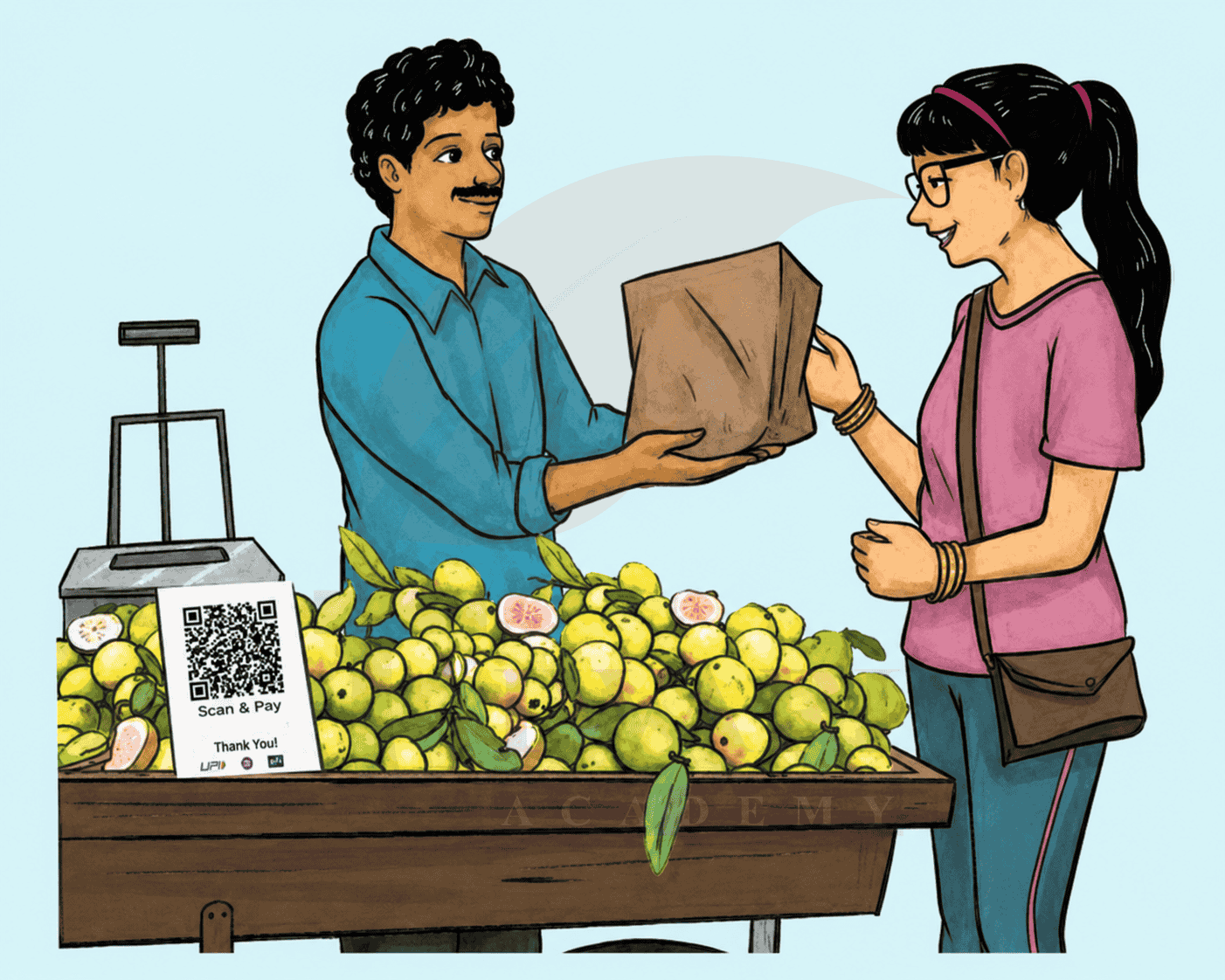
Answer:
Seller: Hello! Fresh and sweet guavas are here. Would you like to buy some?
Buyer: Yes, they look nice. How much do they cost?
Seller: They are ₹60 per kilogram.
Buyer: That’s a bit expensive. Can you give them for ₹50 per kilogram?
Seller: I can give them for ₹55 per kilogram because they are fresh.
Buyer: Okay. Please give me 2 kilograms.
Seller: Sure. Here are your guavas. They weigh exactly 2 kilograms.
Buyer: Thank you. Here is ₹110.
Seller: Thank you! Here is your bag.
Buyer: Thanks. Have a nice day!
Seller: You’re welcome. Please visit again!
Page 257 – Let’s Explore
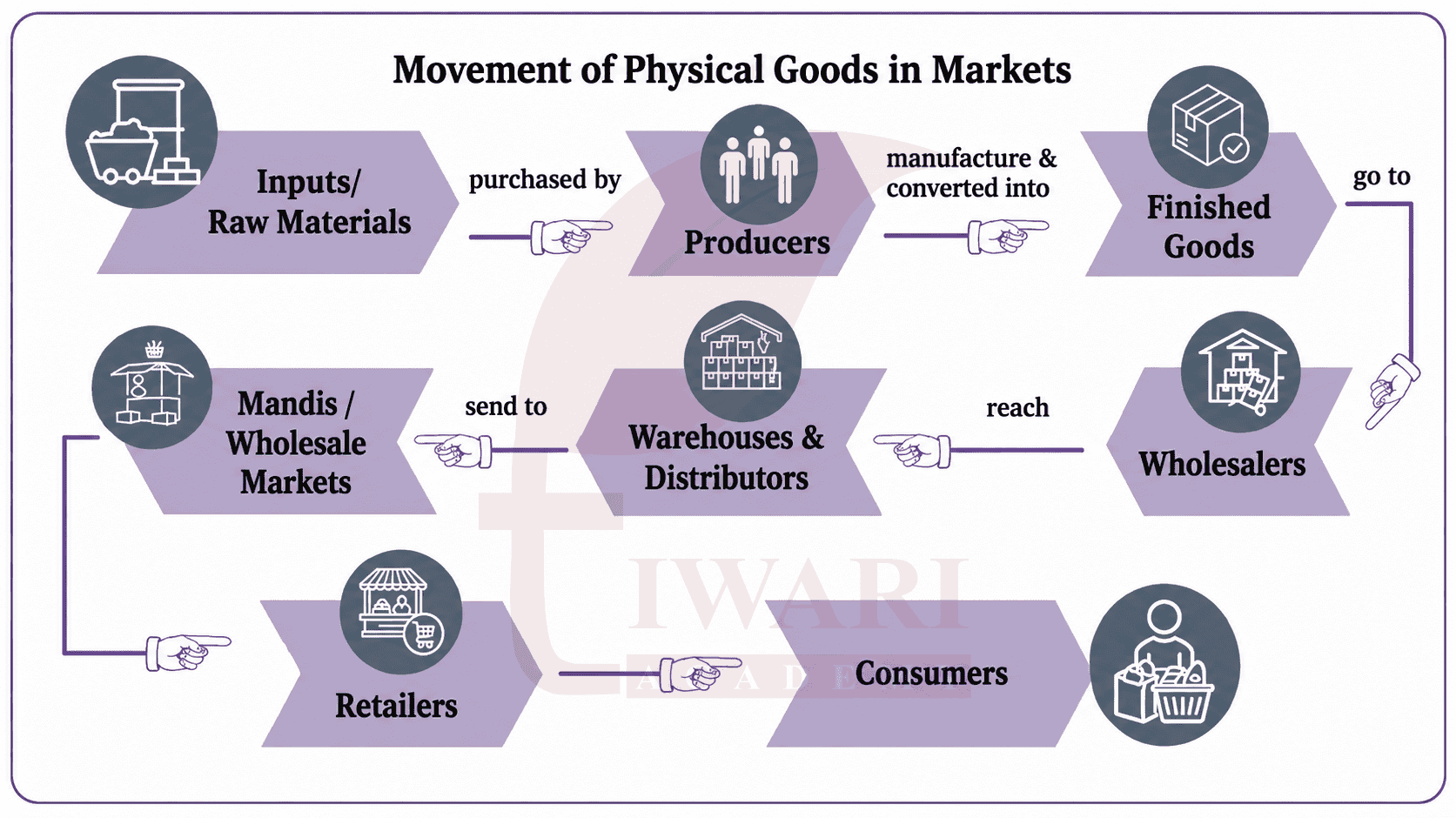
Observe the diagram and describe the flow of goods from the manufacturer / producer to the consumer. What is the role of the wholesaler and the retailer in the flow?
Answer:
The producer buys raw materials and makes finished goods. These goods are sent to wholesalers through warehouses and distributors. The wholesalers supply the goods to retailers and the retailers sell them to the consumers.
- Role of the Wholesaler: Buys goods in large quantities from producers and supplies them to retailers.
- Role of the Retailer: Buys goods from wholesalers and sells them in small quantities directly to consumers.
Page 262 – Let’s Explore
Ask your nearest retailer about a product, its place of origin, and the chain of suppliers in the process of the product reaching the shop. Trace this using a flow chart like Fig. 12.11 and share it in class.
Answer:
Product Chosen: Packaged Biscuits
Flow Chart:
Raw Materials (Wheat Flour, Sugar, Milk, Oil)
⬇️
Manufacturer (Biscuit Factory)
⬇️
Warehouse & Distributor
⬇️
Wholesaler
⬇️
Retailer (Nearest Grocery Shop)
⬇️
Consumer (Customer)
I visited a nearby grocery shop and asked the shopkeeper about a packet of biscuits. He told me that the biscuits are made in a factory using wheat flour, sugar, milk and oil. They are sent to warehouses and distributors, then to wholesalers. The wholesalers supply them to local retailers, and finally the retailer sells them to customers.
Page 263 – Let’s Explore
Consumers prefer to buy refrigerators that use less electricity. When a large number of consumers begin to ask for refrigerators that use less electricity, what do you think happens in the network you saw in Fig. 12.11?
Answer:
If many consumers prefer refrigerators that use less electricity, retailers will order more of these refrigerators from wholesalers. The wholesalers will then ask manufacturers to produce more energy-efficient refrigerators. As a result, manufacturers will make more such models and fewer old models, so the whole supply chain changes according to consumers’ demand.
Page 265 – Let’s Explore
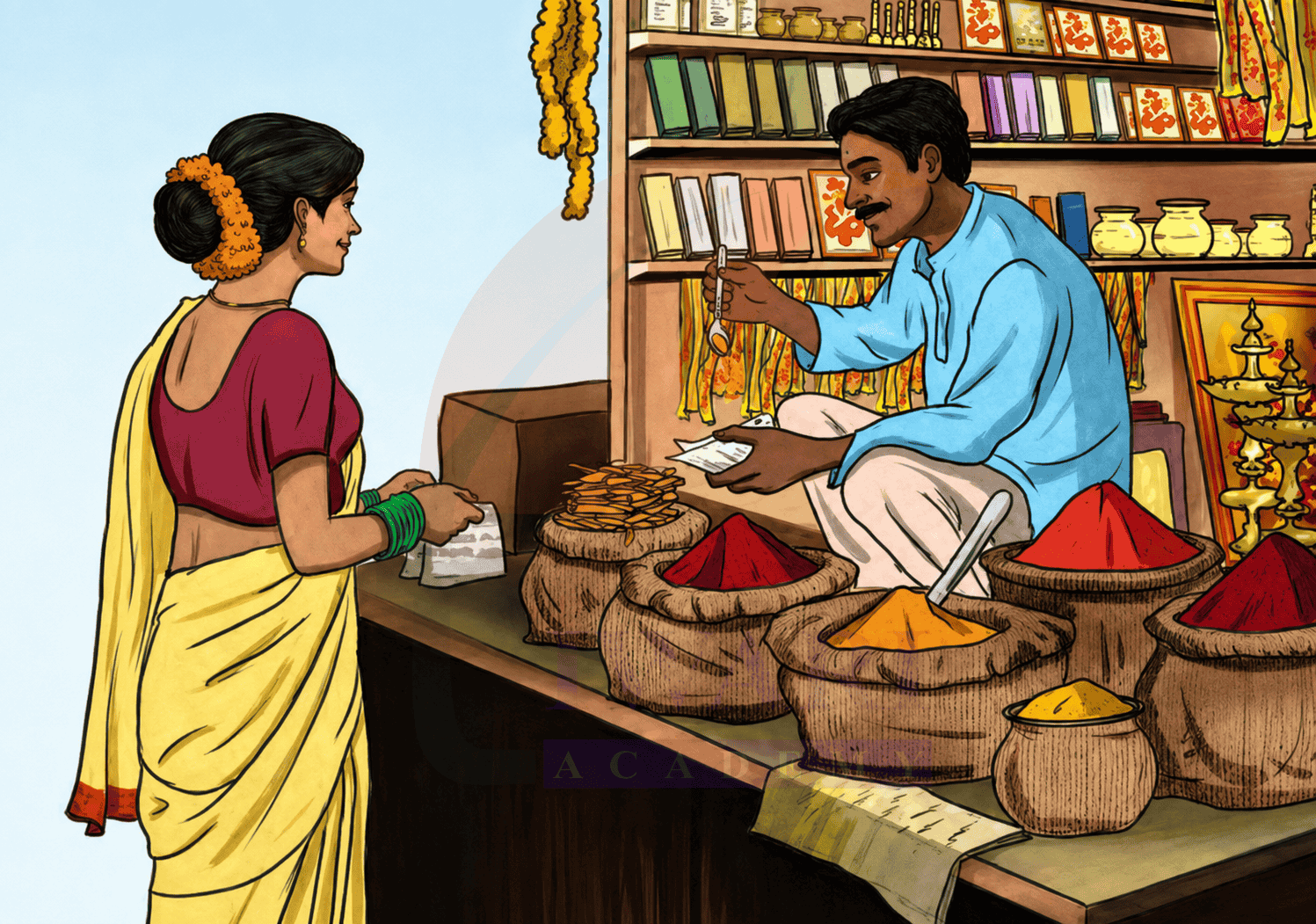
Have you observed any such practices in your community or neighbourhood? Describe the practice as a drawing or in a short paragraph.
Answer:
Yes, I have observed such a practice in my neighbourhood. When we buy sweets or fruits during festivals, many shopkeepers give a small extra sweet or fruit free of cost as a token of good wishes. Some grocery shopkeepers also offer a few toffees or a small packet of mouth freshener to customers. These traditions help build trust and maintain good relationships between buyers and sellers.
Page 266 – Let’s Explore
Onions are an important part of the cuisine in most parts of India. In some seasons, the supply of onions comes down in the market. What do you think happens to the price of onion when this happen?
Answer:
When the supply of onions goes down, the price of onions increases because there is less quantity available for the same or higher demand. If suppliers don’t bring enough onions to the market, the government may step in to release onions from buffer stock, control exports or import onions from other countries to stabilize prices for consumers.
What will happen is the people supplying onions do not bring the required quantities to the market? What do you think the government should do in this situation?
Answer:
Other areas of government involvement in markets: setting safety standards for helmets and vehicles, regulating school fees, monitoring stock markets, and controlling pollution from factories. Some feel government intervention should be reduced in areas where private businesses can compete fairly without needing price controls, but this should be discussed with family members as opinions may vary.
Page 269 – Let’s Explore
Check out the BEE Star labels on the electronic devices in your home and make a chart of all devices in an increasing order of their energy efficiency.
Answer:
| S. No. | Electronic Device | BEE Star Rating |
|---|---|---|
| 1. | Refrigerator | ⭐⭐ (2 Star) |
| 2. | Air Conditioner | ⭐⭐⭐ (3 Star) |
| 3. | Washing Machine | ⭐⭐⭐⭐ (4 Star) |
| 4. | LED Television | ⭐⭐⭐⭐⭐ (5 Star) |
| 5. | Ceiling Fan | ⭐⭐⭐⭐⭐ (5 Star) |
Page 271 – Questions and activities
1. What are the main features of a market? Recall a recent visit to a market to purchase a product. What are the different features of a market that you observed during this visit?
Answer:
The main features of a market include buyers and sellers negotiating prices, a variety of goods and services and different types like physical (shops, stalls) or online. Markets also involve wholesalers and retailers.
During a recent visit to a vegetable market, I noticed:
- Buyers and sellers bargaining over prices.
- Different stalls offering fresh produce, grains and spices.
- Wholesalers supplying bulk items to small vendors.
- Price tags and negotiations to reach fair deals.
- Certification marks (like AGMARK) on packaged foods.
- Social interactions – vendors chatting with regular customers.
Markets ensure goods reach consumers while creating jobs and connecting communities, just as described in the document.
2. Remember the epigraph from a famous economist at the beginning of the chapter? Discuss its relevance in the context of the chapter you have read.
Answer:
Adam Smith’s epigraph perfectly captures the chapter’s key idea: markets thrive when people exchange goods and services they can’t produce alone. The chapter shows this through examples like farmers selling crops they grow, artisans trading handmade goods and online platforms connecting buyers and sellers globally. Markets create prosperity by allowing specialization-farmers focus on crops, tailors on clothes and others buy what they need. The Hampi Bazaar story illustrates how markets historically enabled trade of diverse goods (spices, jewels, fabrics), boosting economic growth. Today, this continues through local vegetable markets, Surat’s textile trade and e-commerce. Markets don’t just distribute goods-they link people, create jobs and spread ideas, proving Smith’s point that mutual need drives collective prosperity.
3. In the example of buying and selling of guavas, imagine that the seller is getting a good price, and is able to make a profit. He will try to get more guavas from farmers to be able to sell them at the same price and increase his earnings. What is the farmer likely to do in this kind of a situation? Do you think he will start thinking about the demand for guavas in the next season? What is likely to be his response?
Answer:
If guava prices are good and the seller wants more, I (the farmer) would:
- Grow more guavas next season to earn more profit.
- Watch the demand-if too many farmers grow guavas, prices may fall later (like the tomato).
- Plan carefully-balance my crops to avoid waste if the market gets flooded.
The chapter shows how prices guide farmers. High prices encourage more production, but oversupply can hurt profits later. I’d think ahead, just like the document explains about market cycles!
4. Match the following types of markets with their characteristics:
| S.No. | Markets | Criteria |
|---|---|---|
| 1 | Physical market | Goods and services flow outside the nation’s boundaries |
| 2 | Online market | Deals in bulk quantities |
| 3 | Domestic market | Serves the final consumers with goods and services |
| 4 | International market | Requires physical presence of buyers and seller |
| 5 | Wholesale market | Buyers and sellers meet virtually and can transact at any time |
| 6 | Retail market | Lies within the boundaries of a nation. |
Answer:
| S.No. | Markets | Criteria |
|---|---|---|
| 1 | Physical market | Requires physical presence of buyers and seller |
| 2 | Online market | Buyers and sellers meet virtually and can transact at any time |
| 3 | Domestic market | Lies within the boundaries of a nation. |
| 4 | International market | Goods and services flow outside the nation’s boundaries |
| 5 | Wholesale market | Deals in bulk quantities |
| 6 | Retail market | Serves the final consumers with goods and services |
5. Prices are generally determined by the interaction between demand from buyers and supply by sellers. Can you think of products where prices are high despite lesser number of buyers demanding the product? What could be the reasons for that?
Answer:
Some products have high prices even with few buyers because:
- Luxury goods (like diamonds or designer clothes): High production costs and brand value keep prices up, even if only a few can afford them (Surat’s diamond industry in the document shows skilled craftsmanship adds value).
- Life-saving medicines: Few buyers need them, but R&D costs and patents make them expensive (the government price controls for such drugs).
- Handmade products: Unique, labor-intensive items (like paintings) are priced high due to skill and rarity, even if demand is low.
Scarcity, expertise or regulations can outweigh low demand in pricing.
6. Look at the real life situation that a retail seller of vegetables encountered: A family came to shop for vegetables. The price of beans that the seller on the cart was offering was ₹30 / kg. The lady started to bargain with the seller to bring the price down to ₹25 / kg. The seller protested and refused to sell at that price saying he would make a loss at that price. The lady walks away. The family then goes to a super bazaar nearby. They buy vegetables in the super bazaar where they pay ₹40 / kg for the beans that is neatly packed in a plastic bag. What are the reasons that the family does this? Are there factors that affect buying and selling which are not directly connected to price?
Answer:
The family chose the super bazaar despite higher prices because:
- Convenience: Pre-packaged beans save time (unlike bargaining at carts).
- Quality perception: Neat packaging suggests freshness/hygiene (like FSSAI-certified foods in the document).
- Trust: Supermarkets offer standardized weights (government monitors this, as mentioned).
- Non-price factors: The document shows markets involve more than just price (e.g., relationships, convenience).
Even with higher costs, buyers often value ease, reliability and quality over bargaining.
7. There are some districts in India that are famous for growing tomatoes. However, during some seasons, the situation is not good for farmers. With a large quantity of harvest, there are reports of farmers throwing away their produce and all their hard work going to waste. Why do you think farmers do this? What role can wholesalers play in such situations? What are the possible ways of ensuring that the tomatoes are not wasted, and the farmers are also not at a loss?
Answer:
Farmers sometimes discard tomatoes due to oversupply, which crashes prices below their costs (like the onion example in the chapter). Wholesalers can help by:
- Storing surplus in cold storages (mentioned for perishables) to sell later.
- Connecting farmers to distant markets (like Surat’s textile traders do).
- Pushing for processing (e.g., tomato paste) to reduce waste.
Solutions:
- Government could fix minimum prices (as done for wheat/rice).
- Improve transport links to move excess produce faster.
- Teach farmers demand trends to plan crops better.
Markets need balance to protect farmers’ hard work!
8. Have you heard about or visited a school carnival / fair organized by your school or any other school? Discuss with your friends and teachers about the kind of activities organized by students there. How do they conduct selling and negotiation with the buyers?
Answer:
Discussion About School Carnival:
Student 1: “At our carnival, we set up food stalls, game booths and craft corners. I sold handmade bookmarks!”
Student 2: “We priced items low, like ₹10-20, but bargained too. Some buyers asked for discounts!”
Teacher: “How did you handle negotiations?”
Student 3: “We explained costs—like materials for friendship bands—so buyers agreed to pay ₹15 instead of ₹10.”
Teacher: “Just like real markets! You balanced price, demand, and persuasion.”
Student 1: “Yes! And group discounts worked—like ‘3 cookies for ₹20’!”
Teacher: “Great! You applied supply, demand and smart pricing naturally!”
9. Choose any 5 products and check out the label with the certification signs discussed in the chapter. Did you find products that did not have a logo? Why do you think this is so?
Answer:
I checked the labels of 5 products at home and here’s what I found:
| S.No. | Product | Certification Mark |
|---|---|---|
| 1 | Packet of biscuits | FSSAI logo |
| 2 | Electric mixer-grinder | ISI mark |
| 3 | Packet of turmeric powder | AGMARK |
| 4 | Refrigerator | BEE Star rating (4-star) |
| 5 | A handmade cloth bag bought from a local street vendor | No logo found |
Products without a logo:
Yes, I did find a product without any certification logo – the handmade cloth bag I bought from a street vendor near my house. It had no FSSAI, ISI, AGMARK or BEE Star mark on it.
Why I think this happens:
- Small-scale/unorganised sellers: The bag was made by a local craftsperson or small vendor who sells directly without going through a big manufacturing company. Certification requires registration, testing and fees, which small sellers often cannot afford or don’t know how to apply for.
- Not a regulated category: Certification marks like FSSAI (food), ISI (electrical/construction), AGMARK (agriculture) and BEE Star (electronics) apply only to specific categories of goods. A cloth bag doesn’t fall under any of these categories, so it may not require a mandatory certification mark in the first place.
- Local/handmade products: Handicraft and handmade items sold directly by artisans (like the market example of Aakriti, the painter, in our chapter) often don’t have a “ready market” with formal certification systems, since they are sold on trust, reputation and personal relationships rather than official quality checks.
- Cost and awareness: Getting a product certified costs money and requires following government procedures. Very small sellers may not have the resources or awareness to get their products certified, even if the product is genuinely good in quality.
This activity helped me understand that while certification marks are important for consumer trust and safety, many goods in the informal or unorganised market sector – especially handmade or local products – still function well through personal trust and reputation
10. You and your classmates have manufactured a soap bar. Design a label for its packaging. What in your opinion should be mentioned on the label for the consumer to know the product better?
Answer:
For your “Clear Skin” soap bar, the label should include:
- Ingredients (e.g., natural oils, fragrance)
- Net weight (e.g., 100g)
- Manufacturing/Expiry date (for safety)
- Usage instructions (e.g., “For face & body”)
- Certification marks (like FSSAI for hygiene, if applicable)
- Contact details (manufacturer’s address)
Class 7 Social Science Part 1 Chapter 12 Extra Questions for Exam Preparation
Class 7 Social Science Part 1 Chapter 12 Very Short Answer Type Questions.
Very Short Answer Type Questions
1. What is a market?
See AnswerA market is a place where people buy and sell goods, either physically or online.
2. What is another name for a market in Hindi?
See AnswerIn Hindi, a market is also called a “haat” or “bazaar.”
3. Who called Hampi “the best-provided city in the world”?
See AnswerPortuguese traveller Domingos Paes called Hampi “the best-provided city in the world”.
4. What is price?
See AnswerPrice is the amount at which a buyer is willing to buy and a seller is willing to sell.
5. What is a physical market?
See AnswerA physical market is where buyers meet sellers in person to purchase goods or services.
6. What is a domestic market?
See AnswerA domestic market is where goods and services are bought and sold within a country’s boundaries.
7. What is an international market?
See AnswerAn international market involves trade of goods and services across a country’s borders.
8. What is export?
See AnswerExport means selling goods or services produced in one country to a buyer in another country.
9. What is import?
See AnswerImport means buying goods or services from other countries into one’s own country.
10. Who are aggregators?
See AnswerAggregators are websites or apps that combine offers from many sellers for online buyers.
11. What is “Ima Keithal”?
See AnswerIma Keithal, or Mother’s Market, is a unique women-run market in Imphal, Manipur.
12. What does FSSAI stand for?
See AnswerFSSAI stands for Food Safety and Standards Authority of India.
13. What does AGMARK certify?
See AnswerAGMARK certifies the quality of agricultural products like vegetables, fruits and spices.
14. What is a public good?
See AnswerA public good is a service like roads or parks available to all members of society.
15. What is cold storage?
See AnswerCold storage is a warehouse designed to maintain low temperatures to preserve perishable goods.
Class 7 Social Science Part 1 Chapter 12 Short Answer Type Questions.
Short Answer Type Questions
1. What features are needed for a place to be called a market?
See AnswerEvery market needs a buyer and a seller who agree on a price for a transaction. Often, buyers and sellers negotiate and bargain until they reach a mutually acceptable price for goods or services.
2. How is price determined in a market?
See AnswerPrice is determined by negotiation between buyers and sellers. If the seller sets a price too high or too low, the transaction may not happen easily. Over time, demand and supply help fix a fair, mutually acceptable price.
3. What is the difference between physical and online markets?
See AnswerIn physical markets, buyers meet sellers in person and pay for goods directly. In online markets, buyers and sellers transact through apps or websites without meeting physically and goods are delivered to the buyer’s doorstep.
4. Explain the role of wholesalers in the market.
See AnswerWholesalers buy goods in bulk directly from producers or manufacturers and store them in warehouses or godowns. They then supply these goods to retailers, ensuring uninterrupted availability of products to shopkeepers and eventually, consumers.
5. What role does the government play in controlling prices?
The government sets maximum price limits for essential goods like lifesaving drugs and minimum prices for crops like wheat to protect farmers. It also fixes minimum wages so that employers pay workers fairly.
6. How does the government ensure quality and safety standards?
See AnswerThe government sets procedures for approving products like medicines and conducts sample testing to check quality. This protects consumers from unsafe or substandard goods and ensures manufacturers follow required safety regulations.
7. What is meant by “mitigating external effects of markets”?
See AnswerSometimes market production, like factories making single-use plastics, harms the environment or health. The government intervenes with strict regulations to control such negative effects, protecting the environment and public health from market activities.
8. Describe the significance of Ima Keithal of Imphal.
See AnswerIma Keithal is a market in Imphal run by about 3000 women who sell vegetables, clothes and handicrafts. It provides employment to many families and acts as a melting pot where different communities exchange ideas and traditions.
9. How do certification marks help consumers?
See AnswerCertification marks like FSSAI, ISI, AGMARK and BEE Star are given by government agencies to confirm that products meet minimum quality and safety standards, helping consumers make informed decisions while purchasing goods.
10. What is the significance of the Surat textile market?
See AnswerSurat is Asia’s oldest textile hub, where raw cotton from nearby states is processed into finished fabric through weaving, dyeing and stitching. The finished products move through wholesale markets to retailers across India and abroad.
Class 7 Social Science Part 1 Chapter 12 Long Answer Type Questions.
Long Answer Type Questions
1. Explain how prices are decided in a market with the help of the guava example given in the chapter.
See AnswerIn the guava example, if the seller fixes a very high price like ₹80/kg, buyers walk away without buying. If the seller fixes a very low price like ₹20/kg, too many buyers rush in and demand exceeds supply. Over time, through repeated bargaining, the seller learns the price that is “just right” – not too high for the buyer, not too low for the seller, such as ₹40/kg. This shows how demand and supply interact to fix a fair market price acceptable to both parties.
2. Describe the movement of physical goods in a market, from producer to consumer.
See AnswerGoods begin as raw materials or inputs purchased by producers, who manufacture them into finished goods. These finished goods go to mandis or wholesale markets, then to warehouses and distributors, who supply them to wholesalers. Wholesalers pass goods to retailers, who finally sell them to consumers in smaller quantities. This entire chain – producers, wholesalers, distributors and retailers – ensures that goods reach households efficiently, even across large distances and difficult terrains.
3. Discuss the different ways in which the government plays a role in markets.
See AnswerThe government plays several roles in markets: it controls prices by setting maximum limits on essential goods like medicines and minimum prices for crops to protect farmers; it ensures quality and safety standards through testing and certification of products like medicines; it mitigates the negative external effects of markets, such as pollution from factories, through strict regulations; and it provides public goods like roads, parks and policing that private producers do not find profitable to supply, ensuring welfare of all citizens.
4. How can consumers assess the quality of products and services they purchase? Explain with examples.
See AnswerConsumers can assess product quality through government certification marks such as FSSAI (food safety), ISI mark (electrical and construction goods), AGMARK (agricultural products) and BEE Star ratings (energy efficiency of appliances). These marks confirm that products meet minimum government-set standards. Additionally, consumers rely on reputation built through word of mouth from family and friends and online reviews and ratings from other buyers, especially when shopping through e-commerce platforms, to decide whether a product or service is worth purchasing.
5. Explain the non-economic significance of markets in people’s lives, giving examples from the chapter.
See AnswerWhile markets primarily facilitate buying and selling, they also hold social and cultural importance. Long-term relationships often develop between buyers and sellers, such as families trusting the same tailor, jeweller or grocer for generations. Markets like Ima Keithal in Imphal, run entirely by women, act as melting pots of culture where different communities exchange ideas and traditions. Similarly, traditions like giving free haldi-kumkum to buyers in South India show that markets are spaces of goodwill and community bonding, beyond mere commercial transactions.
Frequently Asked Questions
What is Chapter 12 of Class 7 Social Science 2026-27 about?
Chapter 12, “Understanding Markets”, is part of the new NCERT textbook “Exploring Society: India and Beyond” for the 2026-27 session. It covers the meaning of markets, how prices are decided between buyers and sellers, different types of markets like physical, online, domestic, international, wholesale and retail markets, the role of the government in regulating markets and how consumers can check the quality of products they purchase using certification marks.
Is Class 7 Social Science Chapter 12 part of the old NCERT Civics/Economics textbook?
No, this chapter is not from the earlier Civics or Economics textbooks. It is part of the newly restructured NCERT Social Science textbook called “Exploring Society: India and Beyond”, introduced under the revised curriculum for Class 7, applicable from the 2026-27 academic session onward, replacing the earlier subject-wise books.
What are the Big Questions covered in Class 7 Social Science Chapter 12?
The chapter is built around four Big Questions: what markets are and how they function, the role of markets in people’s lives, the role of the government in markets and how consumers can assess the quality of goods and services they purchase. These questions guide the entire discussion in the chapter.
What is the difference between a wholesale market and a retail market according to Class 7 Social Science Chapter 12?
A wholesale market involves buying and selling goods in large quantities, usually between producers, wholesalers and distributors, before the goods reach shopkeepers. A retail market, on the other hand, involves selling smaller quantities of goods directly to final consumers through local shops, stores or malls for personal consumption rather than resale.
What do FSSAI, ISI, AGMARK and BEE Star mean, as explained in Class 7 Social Science Chapter 12?
FSSAI (Food Safety and Standards Authority of India) certifies food safety; ISI (Indian Standards Institution) mark ensures quality of electrical and construction goods; AGMARK certifies agricultural products like fruits, spices and honey; and BEE Star rating shows the energy efficiency of electronic appliances. These help consumers assess product quality before buying.
How does the government control prices in a market, as per Class 7 Social Science Chapter 12?
The government controls prices by setting maximum price limits on essential goods like lifesaving drugs and minimum support prices for agricultural products like wheat and paddy to protect farmers from losses. It also sets minimum wages to ensure fair payment to workers, balancing the interests of both buyers and sellers.