



by Tiwari Academy Team
NCERT Class 7 Social Science Chapter 3 Part 2 Empires and Kingdoms: 6th to 10th Centuries Solutions – Exercises and Extra Question Answers. Chapter 3 of Class 7 Social Science Part 2, Empires and Kingdoms: 6th to 10th Centuries, takes students on a journey through post-Gupta India, a period often mistakenly seen as an “age of disorder” but actually rich in political innovation, art, trade and learning. The chapter covers Harshavardhana’s reign at Kannauj, the long Tripartite Struggle among the Pālas, Gurjara-Pratīhāras, Rāṣhṭrakūṭas and powerful southern dynasties like the Chālukyas, Pallavas and Cholas. It also explores Kashmir under the Kārkoṭas, the travels of the Chinese pilgrim Xuanzang, India’s mathematical achievements through scholars like Brahmagupta, the rise of the Bhakti movement and the foreign invasions of the Hūṇas and Arabs. This NCERT chapter, part of the updated 2026-27 syllabus, helps students understand how regional kingdoms shaped India’s political, cultural and religious identity between 600 CE and 900 CE.
Quick Links:
- Exercises Question Answers
- Very Short Answer Type Questions
- Short Answer Type Questions
- Long Answer Type Questions
Download Class 7 Social Science App to study Class 7 Social Offline.
NCERT Class 7 Social Science Part 2 Chapter 3 Solutions
Class 7 Social Science Part 2 Chapter 3 Question Answer
Page 61 – The Big Questions?
1. What major changes characterised this period?
Answer:
The period from the 6th to the 10th centuries was marked by the rise of many powerful regional kingdoms after the decline of the Gupta Empire. New dynasties such as the Pushyabhutis, Chalukyas, Pallavas, Palas, Gurjara-Pratiharas, Rashtrakutas and Cholas emerged. Trade, agriculture, temple building, literature, education and regional languages flourished, making this a period of political, cultural and economic growth.
2. How did the political, cultural, and religious developments shape India during this period?
Answer:
During this period, many regional kingdoms strengthened their administration and promoted trade and agriculture. Kings built magnificent temples and supported art, literature, education and architecture. Centres of learning such as Nalanda and Vikramashila flourished. Rulers respected different religious traditions, including Hinduism, Buddhism and Jainism, while the Bhakti movement also spread, enriching India’s cultural and religious life.
3. What was the impact of foreign invasions and interactions on Indian society and polity during this period?
Answer:
Foreign invasions, such as the Arab conquest of Sindh, led Indian rulers to strengthen their kingdoms and defend their territories. At the same time, peaceful interactions with travellers, scholars and merchants from countries like China, Southeast Asia and West Asia promoted trade, cultural exchange, learning and the spread of ideas. These contacts enriched Indian society while preserving its diverse cultural traditions.
Page 64 – Let’s Explore
Do you recall where the capital of the earlier Maurya and Gupta empires was located?
Answer:
The capital of both the Maurya Empire and the Gupta Empire was Pataliputra (present-day Patna in Bihar).
How do you think this shift may have shaped the sub-continent’s politics in the years to come?
Answer:
The shift of the political centre from Pataliputra to Kannauj led to the rise of many powerful regional kingdoms after the decline of the Gupta Empire. Kannauj became an important political and strategic centre, leading to competition among powerful dynasties such as the Palas, Gurjara-Pratiharas and Rashtrakutas. This resulted in the growth of regional powers and a more decentralised political system across the Indian subcontinent.
If you know the Devanagari script, with the help of your teacher try to identify some of the letters in Harṣha’s signature (Fig. 3.5).
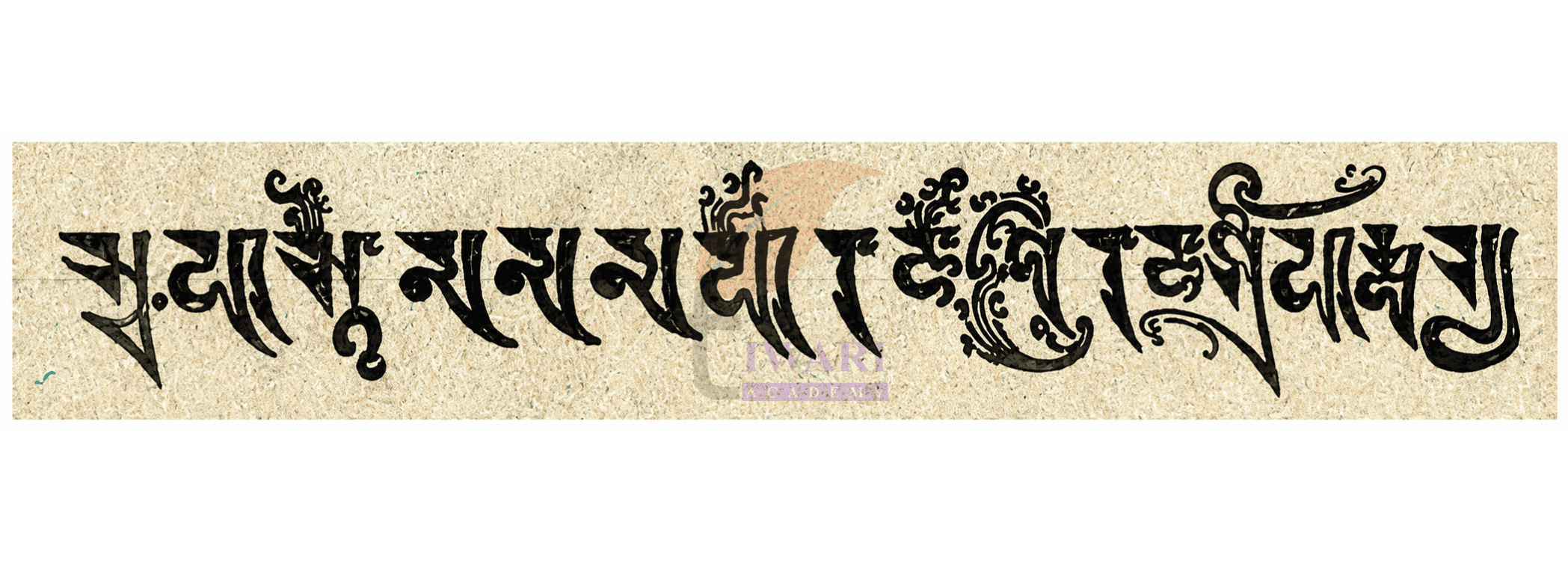
Answer:
On observing Harṣha’s signature, some letters of the Nagari script can be identified, such as श्री (Śhrī), ह (Ha), र (Ra), ष (Ṣha) and स्य (Sya). The signature reads “श्री हर्षस्य” (Śhrī Harṣhasya), meaning “of Śhrī Harṣha”. This activity helps students understand the early form of the Devanagari script and its historical development.
Page 66 – Let’s Explore
Looking at the map (Fig. 3.7), can you identify a few mountain passes or desert areas that Xuanzang had to cross while travelling between China and India?
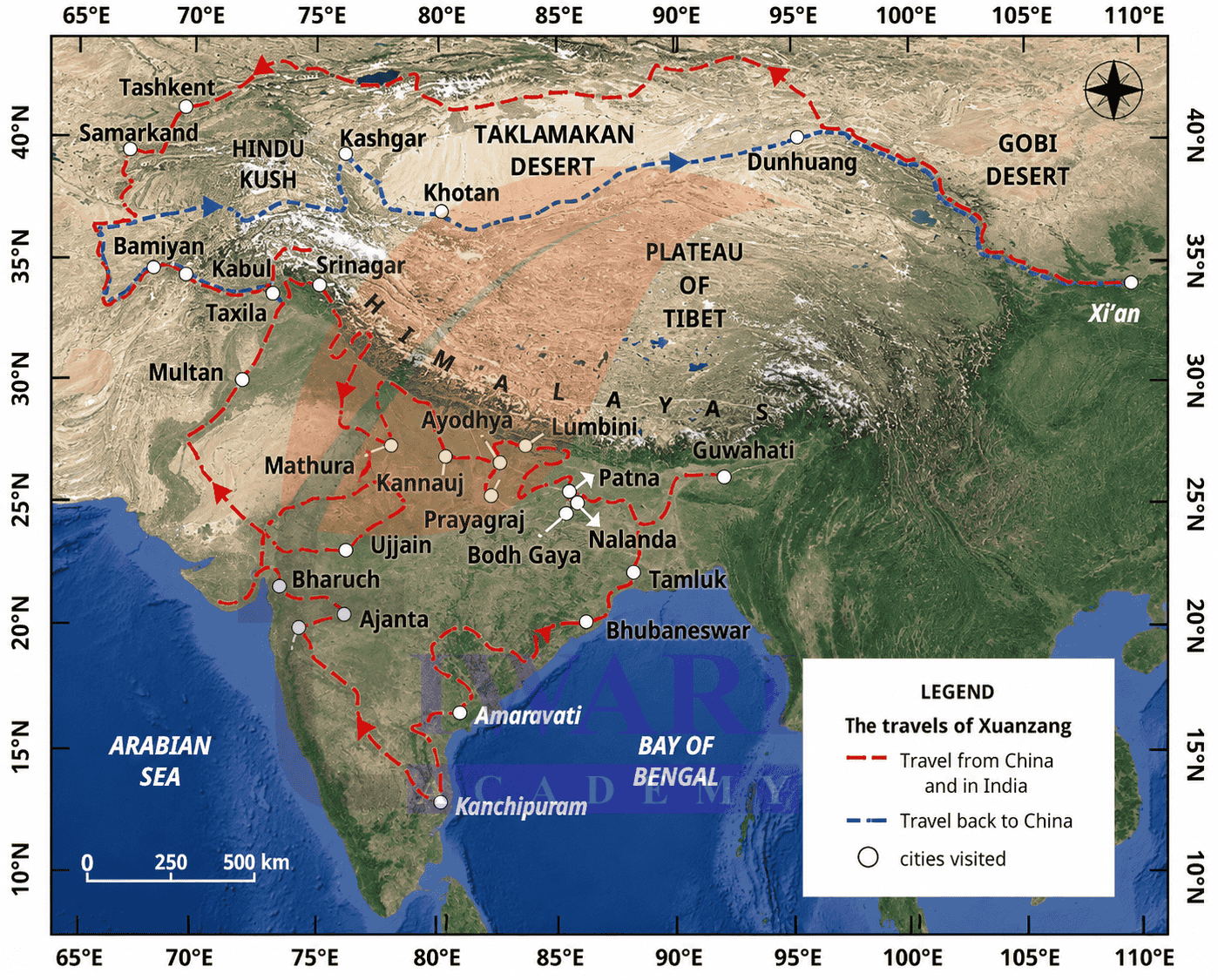
Answer:
Xuanzang crossed several difficult regions during his journey, including the Taklamakan Desert, the Gobi Desert, the Hindu Kush Mountains and the Himalayas. These were among the most challenging routes between China and India.
Can you also identify a few important Buddhist centres of learning that Xuanzang visited in India? Do you know something of their significance?
Answer:
Xuanzang visited important Buddhist centres such as Nalanda, Bodh Gaya, Taxila and Amaravati. Nalanda was one of the greatest universities of ancient India, famous for higher learning and Buddhist studies. Bodh Gaya is the place where Gautama Buddha attained enlightenment. These centres were renowned for education, religion and the spread of Buddhist knowledge across Asia.
Page 68 – Let’s Explore
Why was Kannauj so attractive to those powerful dynasties? Observe its location on the map (Fig. 3.3) and discuss in class.
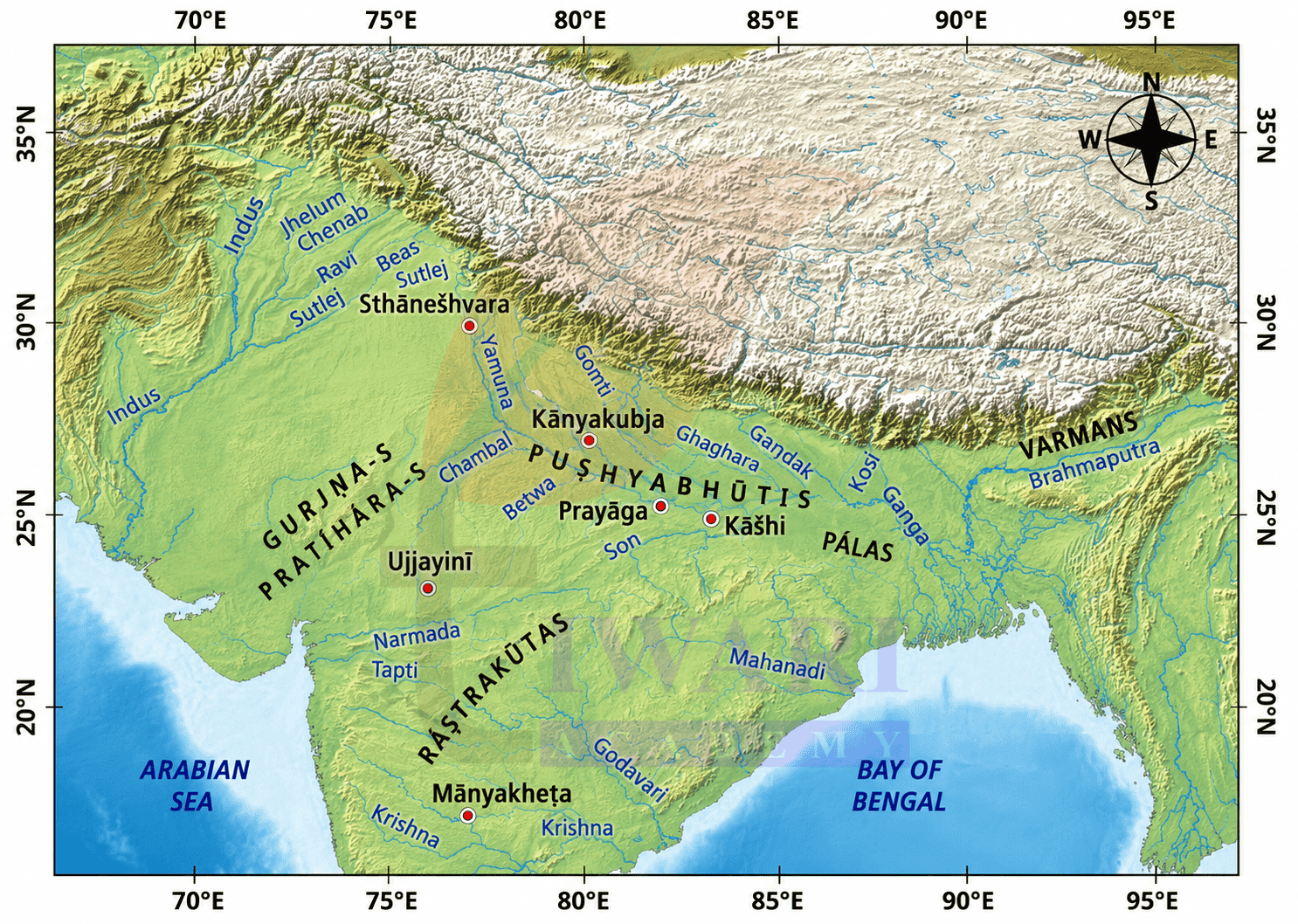
Answer:
Kannauj was attractive to powerful dynasties because of its strategic location in the fertile Ganga plains. It lay on important trade routes and was close to major rivers, making it an important centre for trade, administration and communication. Controlling Kannauj also brought political prestige and economic advantages. Therefore, the Palas, Gurjara-Pratiharas and Rashtrakutas fought for control over the city during the Tripartite Struggle.
Page 74 – Let’s Explore
What qualities does Kalhaṇa think a historian should have?
Answer:
According to Kalhaṇa, a historian should be truthful, fair, unbiased and objective. A historian should carefully study reliable sources and present historical facts honestly without being influenced by personal likes or dislikes.
What do these lines reveal about his method of gathering information? In what ways does it resemble or differ from the way history is currently written?
Answer:
Kalhaṇa gathered information by consulting earlier books, inscriptions, royal grants, temple records and other written sources. Like modern historians, he compared different sources before writing history. However, unlike modern historical writing, his work also aimed to teach moral lessons through historical events.
Kalhaṇa also writes, “That noble-minded poet is alone worthy of praise whose words, like that of a judge, remain free from love or hatred in relating the facts of the past”. What does he mean by ‘free from love or hatred’? How would meeting this condition make a historian more reliable?
Answer:
By “free from love or hatred”, Kalhaṇa means that a historian should not be biased in favour of or against any person or ruler. A historian should present facts honestly and impartially. This makes the historian more reliable because readers can trust that the information is accurate, fair and based on evidence rather than personal opinions.
According to tradition, Ādi Śhankarāchārya, the 8th-century scholar and teacher of the advaita vedānta school of philosophy, visited the hill shown in this sketch; the stone temple at the top is known as Shankaracharya temple or Jyeshteshwara temple.
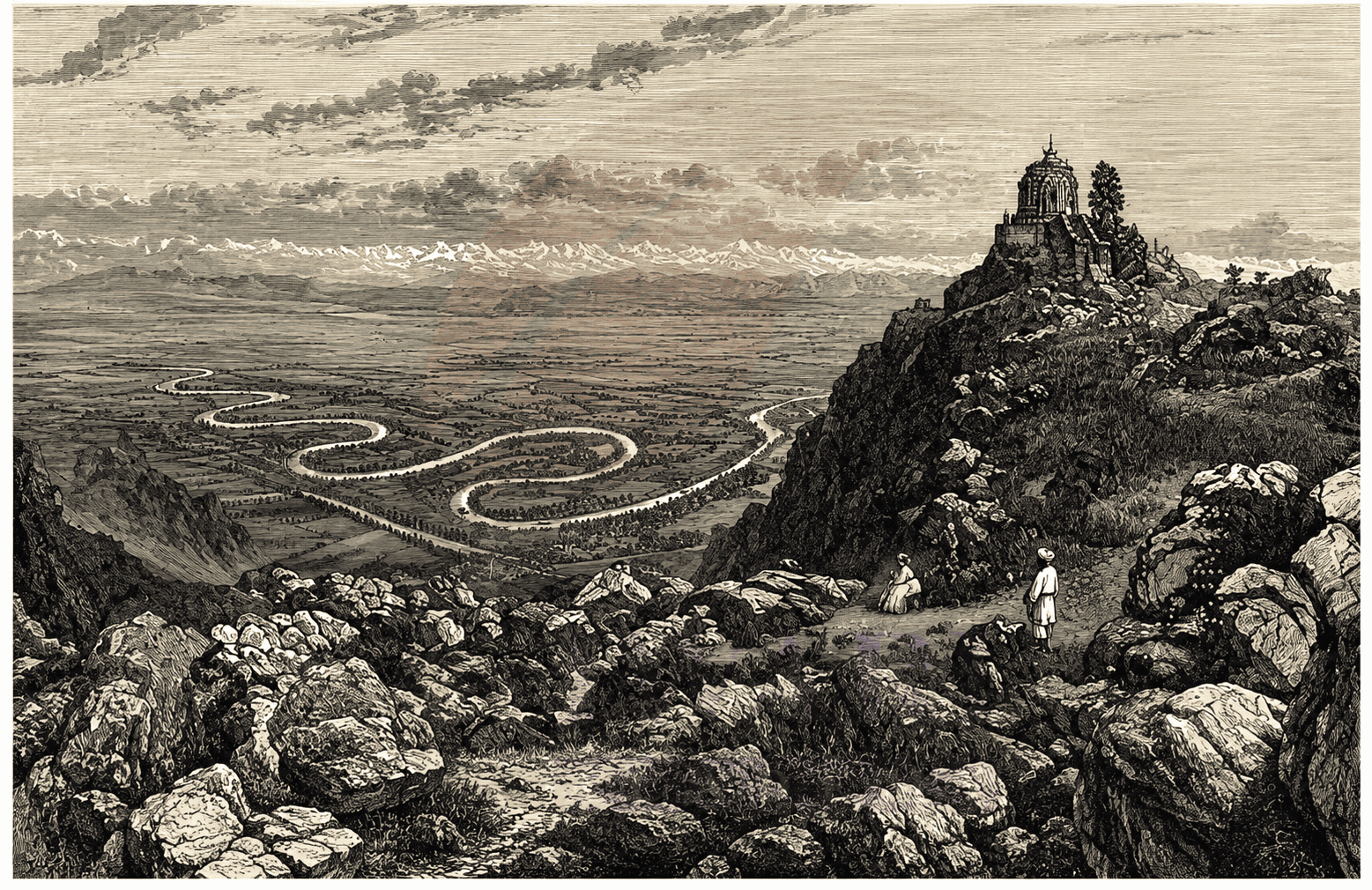
Śhankarāchārya taught that brahman is the ultimate reality or the pure consciousness and that the world as we perceive it is māyā or illusion. He established four maṭhas (monasteries and centres of learning) at Badrinath, Puri, Dwarka and Sringeri. Mark the location of these cities on a map; why do you think he chose four different corners of India rather than more central locations?
Answer:
The four maṭhas established by Ādi Śhankarāchārya are:
- Badrinath – Uttarakhand (North)
- Puri – Odisha (East)
- Dwarka – Gujarat (West)
- Sringeri – Karnataka (South)
He chose four different corners of India to spread the teachings of Advaita Vedānta throughout the country. This helped connect people from different regions, promote cultural, spiritual unity and establish centres of learning that were accessible across the entire subcontinent.
Page 79 – Let’s Explore
Note this panel’s (Fig. 3.18) highly dynamic three-dimensional composition, expressing Durga’s confident assault on the demon.
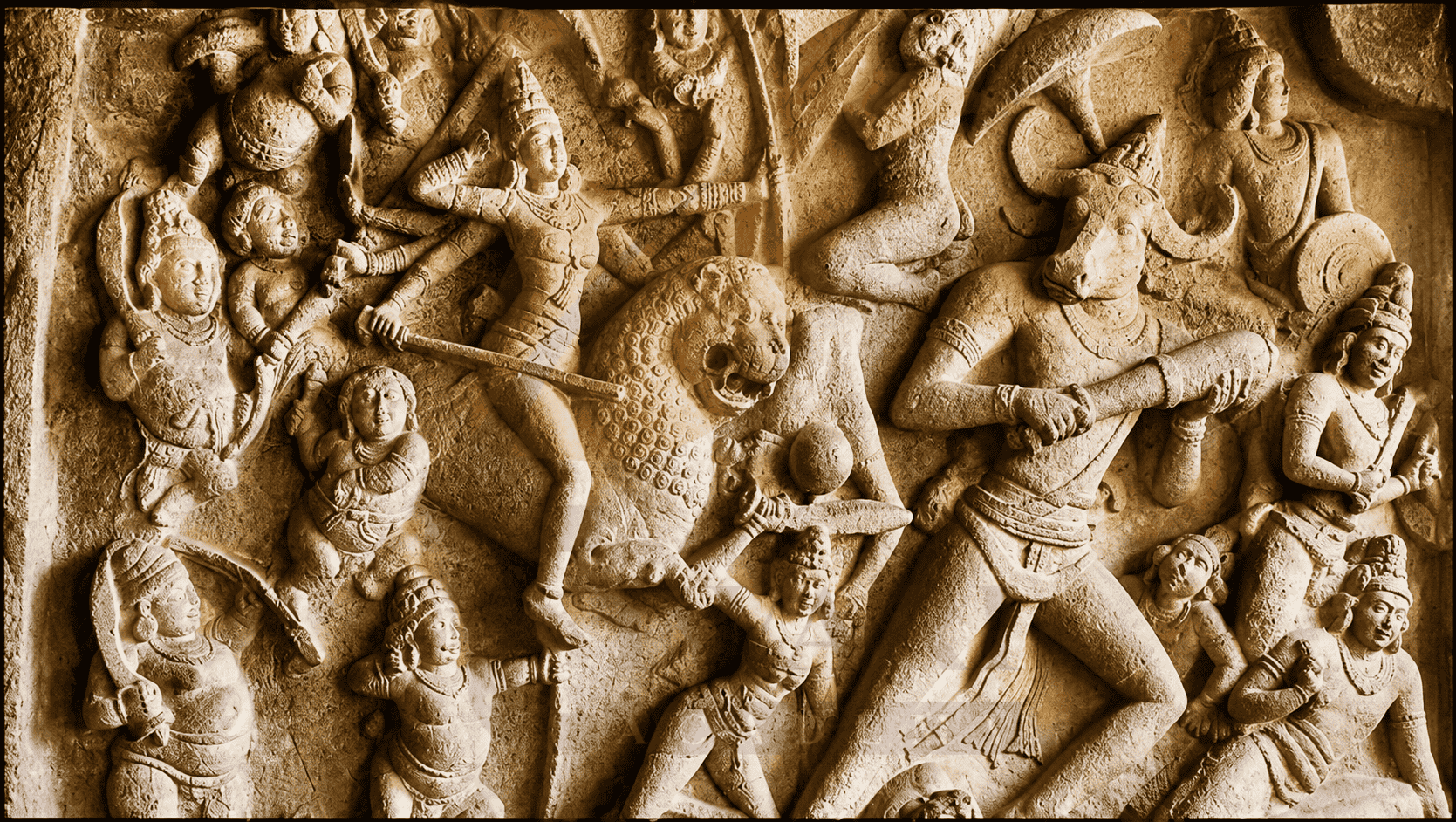
Can you identify some of Durga’s many weapons? And her vāhana?
Answer:
In the panel, Goddess Durga is shown holding several weapons such as a trident (trishul), sword, bow, arrow, shield and spear. Her vāhana (vehicle) is the lion, which symbolises courage, strength and fearlessness.
What are the main differences between her attendants and the demon’s attendants?
Answer:
Durga’s attendants appear calm, confident and are actively supporting her in the battle. In contrast, the demon’s attendants look frightened, confused and are trying to defend themselves or flee, showing that they are losing the battle.
What does the demon’s slanted posture and general attitude indicate?
Answer:
The demon’s slanted posture and anxious expression indicate that he is losing the battle. It shows fear, weakness and defeat, while highlighting Goddess Durga’s courage, confidence and victory over evil.
Page 90 – Let’s Explore
What details do you observe in these coins (Fig. 3.26)? Why do the coins of Toramāṇa and Skandagupta appear so similar? What conclusions can you draw?
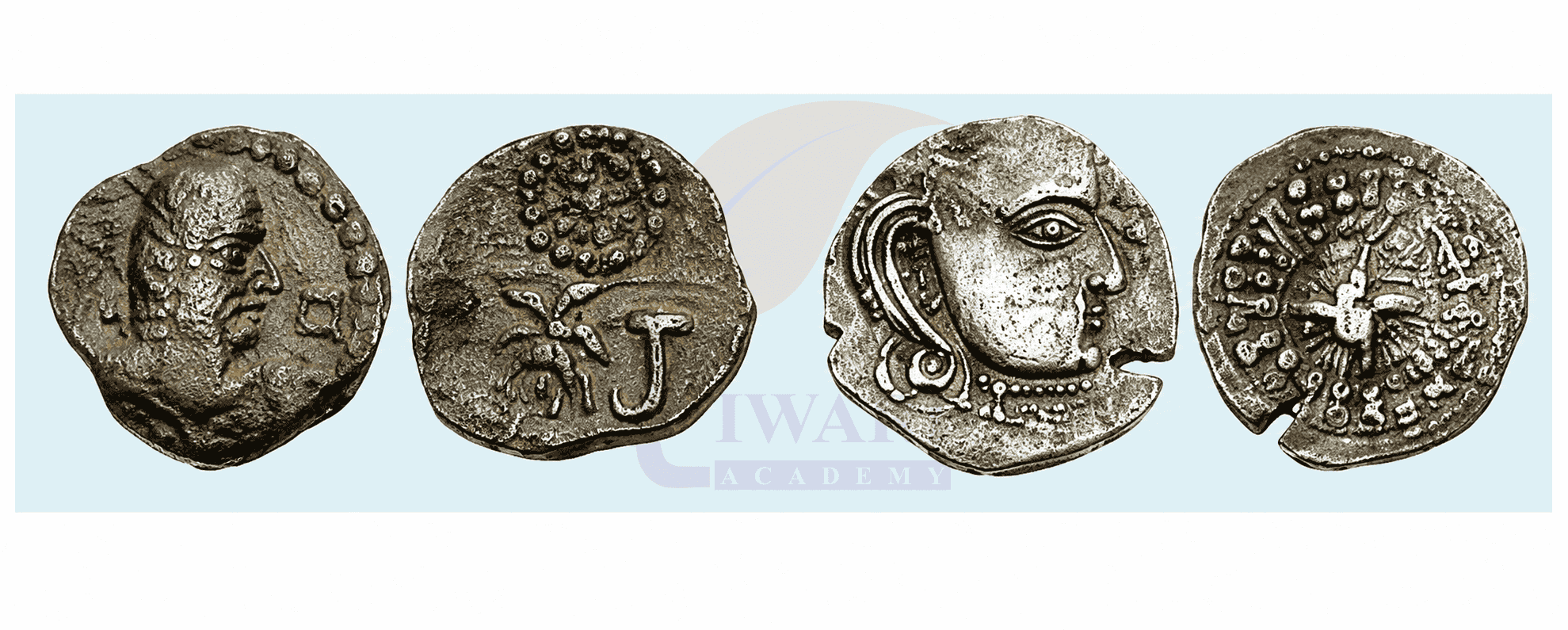
Answer:
The coins show the portrait of the ruler on one side and symbols with inscriptions on the other. Both coins have a similar design, style and shape. Toramāṇa’s coin even uses the Brahmi script, like the Gupta coins.
The coins of Toramāṇa and Skandagupta appear similar because the Hūṇa ruler Toramāṇa adopted the coinage style of the Gupta Empire. This made his coins familiar and acceptable to the people.
From this, we can conclude that even foreign rulers adopted Indian traditions, scripts and administrative practices after establishing their rule. It also shows the strong influence of the Gupta Empire on later rulers.
Page 91 – Let’s Explore
The Chachnāma records that when King Dāhar was killed, his widowed queen put up a brave resistance, and when the situation became hopeless, she immolated herself along with other ladies. Another queen ordered her treasure to be distributed among the brave soldiers and inspired them to stand against the invaders.
What does this suggest about the way the indigenous people responded to invasions?
Answer:
This suggests that the indigenous people responded to invasions with courage, determination and a strong desire to defend their kingdom. They united to resist the invaders and continued fighting even in difficult circumstances.
Why do you think the queen chose to give away her treasure?
Answer:
The queen gave away her treasure to encourage and support the soldiers. It helped boost their morale, provide resources for the defence of the kingdom and inspire them to continue fighting bravely against the invaders.
What does this reveal about the role of women in warfare?
Answer:
This reveals that women played an important role in times of war. They showed courage, inspired soldiers, took leadership in difficult situations and actively supported the defence of their kingdom. Their actions demonstrate bravery, sacrifice and patriotism.
Page 96 – Questions and activities
1. If you lived in Kannauj during the struggle between the Pālas, the Pratīhāras and the Rāṣhṭrakūṭas, how would it change your daily life and your estimate of the rulers? Write a letter on this to your friend living in Kanchipuram.
Answer:
Kannauj
15 July
Dear Friend,
I hope you are doing well in Kanchipuram. Life in Kannauj has become very difficult because of the continuous conflicts between the Pālas, the Pratīhāras and the Rāṣhṭrakūṭas. The frequent wars have disturbed trade, farming and daily life. Many people are worried about their safety and livelihood.
Although the rulers are brave and powerful, I feel they should work for peace instead of fighting for control over Kannauj. Peace would help the people live happily and allow trade and agriculture to flourish.
I hope the conflicts end soon and that I can visit you one day.
Your loving friend,
Murugan
2. Emperors and kings during this period controlled only core regions and governed other regions through subordinate vassals. What would be the advantages and the challenges of such a system?
Answer:
Advantages:
- It made administration easier over large territories.
- Local rulers understood the needs of their people better.
- The king received military support and tribute from the vassals.
Challenges:
- Some vassals became too powerful and rebelled against the king.
- Their loyalty was sometimes uncertain.
- Frequent conflicts between rulers weakened political stability.
3. In what ways were the invasions of the Hūṇas and the Arabs different in their aims, methods, and impact on the Indian subcontinent? Prepare a write-up, discuss and present it in the class.
Answer:
The Hūṇas invaded mainly to conquer territory and establish political control. They attacked different parts of north India and fought many battles with Indian rulers.
The Arabs first came as traders but later invaded Sindh to establish political rule. They also brought new ideas, trade links and cultural contacts with West Asia.
While both invasions affected Indian politics, the Hūṇa invasions mainly caused political instability, whereas the Arab presence also encouraged cultural exchange and increased trade with West Asia.
4. Imagine you are a common citizen watching the Prayāga assembly. How would you react to Harṣha giving away most of his wealth?
Answer:
I would admire King Harṣha for his generosity and kindness. His willingness to donate his wealth to religious groups, scholars and poor people shows that he cared for the welfare of his subjects. I would feel proud to have such a generous ruler.
5. Forming groups, let each group choose one Ālvār and one Nāyanār and prepare a biography poster or booklet. Include their life stories and a sample poem or two (in translation).
Answer:
Ālvār: Nammāḻvār
- He was one of the greatest Vaiṣṇava saints.
- He devoted his life to the worship of Lord Vishnu.
- His devotional hymns are included in the Nālāyira Divya Prabandham.
Translation:
“My heart belongs only to the Lord,
Who protects all beings with love”.
Nāyanār: Appar (Tirunāvukkarasar)
- He was a famous Śhaiva saint.
- He spread devotion to Lord Śhiva through his hymns.
- His songs inspired many people to follow the path of bhakti.
Translation:
“O Lord Śhiva,
Guide me on the path of truth and devotion”.
6. You will notice that our maps show only ancient names for the kingdoms’ capitals and main cities. Using a pencil, mark the modern names next to their original names. Refer the current map of India and try to locate those cities on it.
Answer:
- Kānyakubja – Kannauj (Uttar Pradesh)
- Sthāneśhvara – Thanesar (Haryana)
- Vātāpi – Badami (Karnataka)
- Āryapura (Aihole) – Aihole (Karnataka)
- Mānyakheṭa – Malkhed (Karnataka)
- Kānchī (Kanchipura) – Kanchipuram (Tamil Nadu)
- Prāgjyotiṣha – Guwahati (Assam)
- Prayāga – Prayagraj (Uttar Pradesh)
- Ujjayinī – Ujjain (Madhya Pradesh)
- Tanjāvūr – Thanjavur (Tamil Nadu)
7. Match the ruler or the dynasty with the city.
| Column 1 | Column 2 |
|---|---|
| (a) Rāṣhṭrakūṭas | (i) Kānchī |
| (b) Gurjara-Pratīhāras | (ii) Tanjāvūr |
| (c) Cholas | (iii) Mānyakheṭa |
| (d) Harṣhavardhana | (iv) Ujjayinī |
| (e) Pallavas | (v) Kānyakubja |
Answer:
| Column 1 | Column 2 |
|---|---|
| (a) Rāṣhṭrakūṭas | (iii) Mānyakheṭa |
| (b) Gurjara-Pratīhāras | (iv) Ujjayinī |
| (c) Cholas | (ii) Tanjāvūr |
| (d) Harṣhavardhana | (v) Kānyakubja |
| (e) Pallavas | (i) Kānchī |
Class 7 Social Science Part 2 Chapter 3 Extra Questions for Exam Preparation
Class 7 Social Science Part 2 Chapter 3 Very Short Answer Type Questions.
Very Short Answer Type Questions
1. Who founded the Pushyabhuti dynasty’s rule at Kannauj?
See AnswerHarshavardhana ascended the throne at Kannauj in 606 CE, belonging to the Pushyabhuti (Vardhana) dynasty.
2. Which Chinese pilgrim visited India during Harsha’s reign?
See AnswerXuanzang, a Chinese Buddhist pilgrim, visited India between 630-644 CE and left a detailed travelogue.
3. Who defeated Harsha’s attempt to expand south of the Narmada?
See AnswerPulakeśhin II of the Chālukya dynasty defeated Harsha and stopped his southward expansion.
4. Name the three dynasties involved in the Tripartite Struggle.
See AnswerThe Pālas, the Gurjara-Pratīhāras and the Rāṣhṭrakūṭas fought for control of Kannauj.
5. Who founded the Pāla dynasty?
See AnswerGopāla was chosen by the people in 750 CE to restore order, founding the Pāla dynasty.
6. Which university did Dharmapāla found?
See AnswerDharmapāla founded Vikramaśhilā university in the late 8th century on the banks of the Ganga.
7. Who was the celebrated Gurjara-Pratīhāra ruler of the 9th century?
See AnswerKing Bhoja, also called Mihira and Ādi Varāha, built a large empire across north India.
8. Where was the Rāṣhṭrakūṭa capital located?
See AnswerThe Rāṣhṭrakūṭa capital was Mānyakheṭa (modern Malkheda) in present-day Karnataka.
9. Which temple did Krishna I get built at Ellora?
See AnswerKing Krishna I built the Kailaśhanātha temple, the largest rock-cut temple in India.
10. Who authored the Rājatarangiṇī?
See AnswerKalhaṇa, a Kashmiri scholar-poet, wrote the Rājatarangiṇī, a history of Kashmir’s kings, in the 12th century.
11. Who founded the Chālukya dynasty?
See AnswerPulakeśhin I founded the Chālukya dynasty in the mid-6th century CE, with capital at Vātāpi.
12. Who defeated Pulakeśhin II and captured Badami?
See AnswerNarasimhavarman I, the Pallava king also called ‘Mamalla’, defeated Pulakeśhin II and captured Badami.
13. Who founded the Chola dynasty’s revival in the 9th century?
See AnswerVijayālaya founded the new Chola capital at Tanjāvūr, reviving Chola power in the 9th century.
14. Who led the Arab conquest of Sindh?
See AnswerMuhammad bin Qasim led the Arab forces that conquered Sindh, defeating King Dāhar.
15. Who introduced rules of zero and negative numbers in mathematics?
See AnswerBrahmagupta introduced arithmetic rules for zero, negative numbers and fractions in Brahmasphutasiddhānta.
Class 7 Social Science Part 2 Chapter 3 Short Answer Type Questions.
Short Answer Type Questions
1. Describe Harshavardhana’s contribution to literature and religion.
See AnswerHarsha was a fine poet and dramatist who wrote three Sanskrit plays. He patronised scholars like Bāṇabhaṭṭa, who wrote Kādambarī. Inscriptions show he was devoted to Śhiva, but he also deeply supported Buddhism, showing broad religious tolerance.
2. What does Kalhaṇa’s Rājatarangiṇī tell us about writing history?
See AnswerKalhaṇa examined eleven earlier works, inscriptions and royal grants to write a connected account of Kashmir’s kings. He believed a true historian must be free from love or hatred, remaining impartial like a judge while recording facts.
3. How did Vikramaśhilā function as a centre of learning?
See AnswerVikramaśhilā had six colleges, monasteries, temples and a huge library where nearly 3,000 scholars studied. Admission was highly selective through “gatekeeper” scholars called dvārapaṇḍitas and it maintained strong ties with Tibetan Buddhism for centuries.
4. Explain the system of sāmantas in this period’s administration.
See AnswerKings directly ruled core regions but governed other areas through subordinate rulers called sāmantas, who led armies and managed local administration. Their loyalty was often fragile and some, like the Rāṣhṭrakūṭas, eventually overthrew their own overlords.
5. What role did Kanchipuram play under the Pallavas?
See AnswerKanchipuram was both a cultural and economic hub, trading in spices, textiles and ivory. Alongside its port Māmallapuram, it connected with Sri Lanka and Southeast Asia and Chinese, Persian and Roman coins have been found there.
6. How did the Hūṇas get assimilated into Indian society?
See AnswerBy the 7th century, Hūṇas served as soldiers and local administrators, with one even serving on a temple council. They adopted Sanskrit and Prakrit, used Gupta-style titles and coin designs and worshipped Hindu deities.
7. Describe the outcome of the early Arab invasions before Muhammad bin Qasim.
See AnswerIn 637 CE, Arab naval raids struck Thānā, Bhārukachchha and Debal but failed to gain lasting territory. Early attempts to conquer Afghan kingdoms also failed due to fierce local resistance, until Qasim’s later campaign succeeded in Sindh.
8. What does the chapter say about the position of women in this period?
See AnswerWomen’s status varied by region and class. Bāṇabhaṭṭa’s Harṣhacharita shows women in agriculture, crafts and courts as entertainers and musicians. Some queens, like Diddā of Kashmir and Tribhuvana Mahādevī, even ruled independently and issued land grants.
9. How did trade and urbanisation develop during this period?
See AnswerLand grants expanded agriculture, while merchant guilds supported trade and religious activities. India’s west coast traded with Iran, Iraq and Africa, while the east coast connected to Southeast Asia and China, keeping cities like Kānyakubja thriving.
10. What does the varna-jāti system’s flexibility show about this period?
See AnswerJātis multiplied based on occupation and region and while discrimination against some communities existed, the system was not rigid. Dynasties like the Pālas were originally Śhūdras but later became regarded as Kṣhatriyas, showing social mobility.
Class 7 Social Science Part 2 Chapter 3 Long Answer Type Questions.
Long Answer Type Questions
1. Describe Harshavardhana’s reign and his relationship with Xuanzang.
See AnswerHarshavardhana ascended the throne at Kannauj in 606 CE and expanded his empire across northern and eastern India, though its exact extent is uncertain. He was a poet, patronised scholars like Bāṇabhaṭṭa and respected multiple faiths despite being linked to both Śhiva worship and Buddhism. He welcomed the Chinese pilgrim Xuanzang, holding a grand assembly at Kannauj in his honour and hosting religious gatherings at Prayāga every five years, where he gave away wealth to Buddhists, Brahmins and the poor. Xuanzang’s travelogue describes Harsha as a just, energetic ruler, giving historians vital insights into politics and culture of the time.
2. Explain the Tripartite Struggle for Kannauj and its significance.
See AnswerAfter Harsha’s death in 647 CE, north India fell into political turmoil and Kannauj became the centre of a long “Tripartite Struggle” between the Pālas from the east, Gurjara-Pratīhāras from the west, and Rāṣhṭrakūṭas from the Deccan. Throughout the 8th and 9th centuries, these three powers repeatedly fought each other with fluctuating results but no lasting victor. Kannauj’s location on the Ganga made it economically and strategically valuable, symbolising control over the fertile Gangetic plains. This prolonged conflict weakened all three empires over time and eventually allowed new powers, including the Ghaznavids, to challenge them.
3. Discuss the contributions of southern dynasties like the Pallavas and Cholas.
See AnswerThe Pallavas, ruling from Kānchī, reached their peak under Mahendravarman I and Narasimhavarman I, who defeated Pulakeśhin II and captured Badami. They built magnificent rock-cut temples at Māmallapuram and developed extensive maritime trade with Southeast Asia through their port. They patronised Sanskrit and Tamil literature and multiple religious traditions. After the Pallavas declined, the Cholas, revived under Vijayālaya and expanded by Aditya I, built one of South India’s largest empires, known for efficient administration, a powerful navy, magnificent temple architecture and bronze sculptures like the Naṭarāja, with dominance lasting until the 13th century.
4. How did foreign invasions of the Hūṇas and Arabs impact India differently?
See AnswerThe Hūṇas, a branch of the Central Asian Huns, invaded northern India in the early 6th century, weakening the Gupta Empire, but were eventually defeated by the Aulikara dynasty. By the 7th century, they had fully assimilated into Indian society, serving as soldiers and administrators while adopting Sanskrit, Hindu symbols and Gupta-style coinage. In contrast, Arab invasions beginning in 637 CE were religiously driven; Muhammad bin Qasim’s conquest of Sindh in the 8th century involved temple destruction and conflict framed as religious war. However, unlike other regions, Arab rule in India remained politically and religiously limited, confined mainly to Sindh and Punjab, and they eventually had to allow Hindus and Buddhists to rebuild temples and continue worship.
5. Explain the cultural and religious developments of this period, including the Bhakti Movement.
See AnswerThis period witnessed vibrant coexistence among Hinduism, Buddhism and Jainism, with rulers often patronising multiple faiths regardless of personal belief, as seen with Harsha, Dharmapāla and Amoghavarṣha I. Tantric traditions emerged around the 6th century, influencing both Hindu and Buddhist practices, while the Purāṇas integrated local deities into pan-Indian worship. From the 6th century, the Bhakti Movement spread from South India through the Tamil poet-saints, the 12 Ālvārs devoted to Vishnu and 63 Nāyanārs devoted to Shiva, whose devotional poetry emphasised a direct personal relationship with God open to all, regardless of caste or gender. This movement gradually spread across India, reshaping literature, society and religious life for centuries to come.
Frequently Asked Questions
What is Class 7 Chapter 3 Empires and Kingdoms: 6th to 10th Centuries about?
This chapter describes the period after the decline of the Gupta Empire, from around 600 CE to 900 CE. It explains how regional powers like the Puṣhyabhūtis, Pālas, Gurjara-Pratīhāras, Rāṣhṭrakūṭas, Chālukyas, Pallavas and Cholas rose to prominence, alongside developments in trade, religion, science and society and the arrival of foreign invaders like the Hūṇas and Arabs.
Harshavardhana was a powerful 7th-century ruler of the Puṣhyabhūti dynasty who ruled from Kannauj starting in 606 CE. He was a poet, patron of scholars like Bāṇabhaṭṭa and host to the Chinese pilgrim Xuanzang. He tried to unite northern India but was checked by Pulakeśhin II in the south, making him a key transitional figure of the era.
This chapter builds foundational understanding of Indian political history between the Gupta and Delhi Sultanate periods. It is important for exams as it introduces key dynasties, rulers, historical sources like Xuanzang’s travelogue and concepts like sāmantas and jāti, which are frequently asked in school assessments.
The Bhakti Movement was a widespread devotional tradition that began around the 6th century in South India through the Tamil poet-saints called the Ālvārs (devotees of Vishnu) and Nāyanārs (devotees of Shiva). It emphasized a personal, direct relationship with God, cutting across caste and gender divisions and later spread across India.
The chapter highlights Brahmagupta, who introduced rules for arithmetic with zero and negative numbers in his work Brahmasphutasiddhānta, along with Bhāskara I (trigonometry), Virahānka (the Fibonacci-type sequence) and Mahāvīra, showing India’s major contributions to mathematics and astronomy during this era.