



by Tiwari Academy Team
NCERT Class 7 Social Science Chapter 4 Part 2 – Turning Tides: 11th and 12th Centuries Solutions – Exercises and Extra Question Answers for Session 2026-27 Exam. Chapter 4 of Class 7 Social Science Part 2, Turning Tides: 11th and 12th Centuries, marks a crucial transition point in Indian history. Unlike the earlier Arab invasions that had limited impact, this chapter explains how Turkic invasions by Mahmūd of Ghazni and Muhammad Ghūrī penetrated deep into north India, leading to widespread destruction of temples and centres of learning like Nālandā and Vikramaśhilā and eventually paving the way for the Delhi Sultanate. At the same time, the chapter highlights how many Indian kingdoms flourished – the Cholas under Rājarāja and Rājendra I built a powerful navy and expanded overseas, the Chandellas built magnificent temples at Khajuraho, the Hoysalas and Kākatīyas rose to prominence in the south and scholars like Bhāskarāchārya and al-Bīrūnī made lasting contributions to science. It also covers thinker-saints like Rāmānujāchārya and Basaveśhvara, whose teachings reshaped religious and social life.
Quick Links:
- Exercises Question Answers
- Very Short Answer Type Questions
- Short Answer Type Questions
- Long Answer Type Questions
Download Class 7 Social Science App to study Class 7 Social Offline.
NCERT Class 7 Social Science Part 2 Chapter 4 Solutions
Class 7 Social Science Part 2 Chapter 4 Question Answer
Page 97 – The Big Questions
1. Why are the 11th and 12th centuries seen as a period of transition in Indian history?
Answer:
This period saw the shift from earlier resistance against foreign invaders (like the Arabs) to actual conquest and establishment of foreign rule in parts of north India by Turkic powers. Mahmud of Ghazni’s raids and later Muhammad Ghuri’s conquest of Delhi permanently changed the political landscape, while also introducing Islam more deeply into India’s religious life – making this period a genuine “turning point” between older and newer eras of Indian history.
2. Which new powers emerged during this period? What were the essential features of their economic, military and administrative systems?
Answer:
New powers included the Ghaznavids and Ghurids (Turkic invaders) and Indian dynasties like the Paramaras, Chahamanas (Chauhans), Chaulukyas, Senas, Eastern Gangas, Kakatiyas, Hoysalas and the peak of the Cholas. Economically, they depended on agriculture, trade (especially maritime trade with China and Southeast Asia) and tribute/taxes. Militarily, kingdoms maintained large armies with horses, elephants and camels, needing efficient administration for revenue collection. Muhammad Ghuri introduced a more centralised system with temporary land assignments to officers for revenue and military service – a system later expanded under the Delhi Sultanate.
3. What high accomplishments in architecture, literature, science, etc., do we come across during this period?
Answer:
This period gave us mathematical works of Bhaskaracharya (Lilavati, Bijaganita, Siddhantashiromani); the encyclopaedic works of King Bhoja Paramara and Someshvara III; magnificent temples like Brihadishvara (Thanjavur), Kandariya Mahadeva and Lakshmana temples (Khajuraho), Hoysala temples (Belur, Halebidu) and Angkor Wat in Cambodia; philosophical contributions of Ramanujacharya and Basaveshvara; and Rajendra Chola’s remarkable naval expedition to Southeast Asia.
Page 100 – Let’s Explore
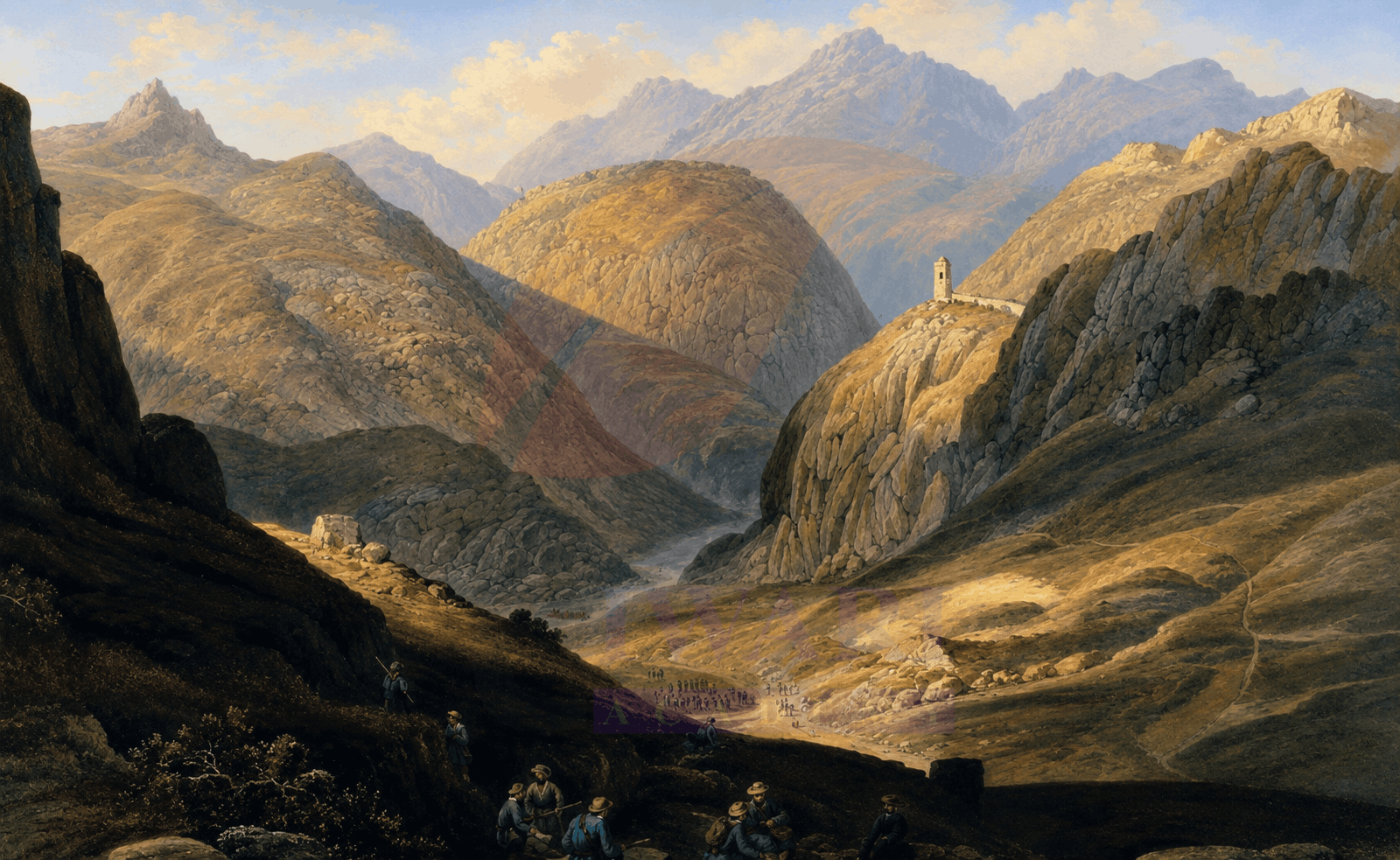
Observe the sketch of the Khyber Pass (Fig. 4.3). What kind of terrain does it depict?
- What advantages would it offer to an army trying to reach the Indus plains? But also, what dangers?
- Thinking of the caravans of traders that passed through the Khyber pass for many centuries, let’s ask the same questions about the advantages as well as dangers.
Answer:
The terrain is rocky, narrow, and mountainous, cutting through the Hindu Kush range.
- For an army: The narrow pass allowed a determined force to move through mountains that would otherwise block a huge army, giving access to the Indus plains. But the danger was that a small defending force could block or ambush a much larger invading army in such a narrow passage, making the pass easy to defend.
- For traders: The pass offered a shorter, established route connecting India to Central Asia, letting caravans avoid going around the mountains. But dangers included harsh terrain, robbers and the risk of being caught in political conflicts or invasions passing through the same route.
Page 103 – Let’s Explore
In later centuries, the Somanatha temple was rebuilt and destroyed again several times; the existing temple was build in 1950 and inaugurated the next year by the then President of India, Rajendra Prasad. Why do you think it was decided to fund the construction entirely from public donations?
Answer:
Public donations were likely chosen to make the temple a genuine symbol of the whole nation’s collective faith, unity and resilience rather than a government-funded project – showing that the temple’s rebuilding represented ordinary people’s devotion and India’s determination to restore what had been repeatedly destroyed by invaders, on its own terms.
Page 112 – Let’s Explore
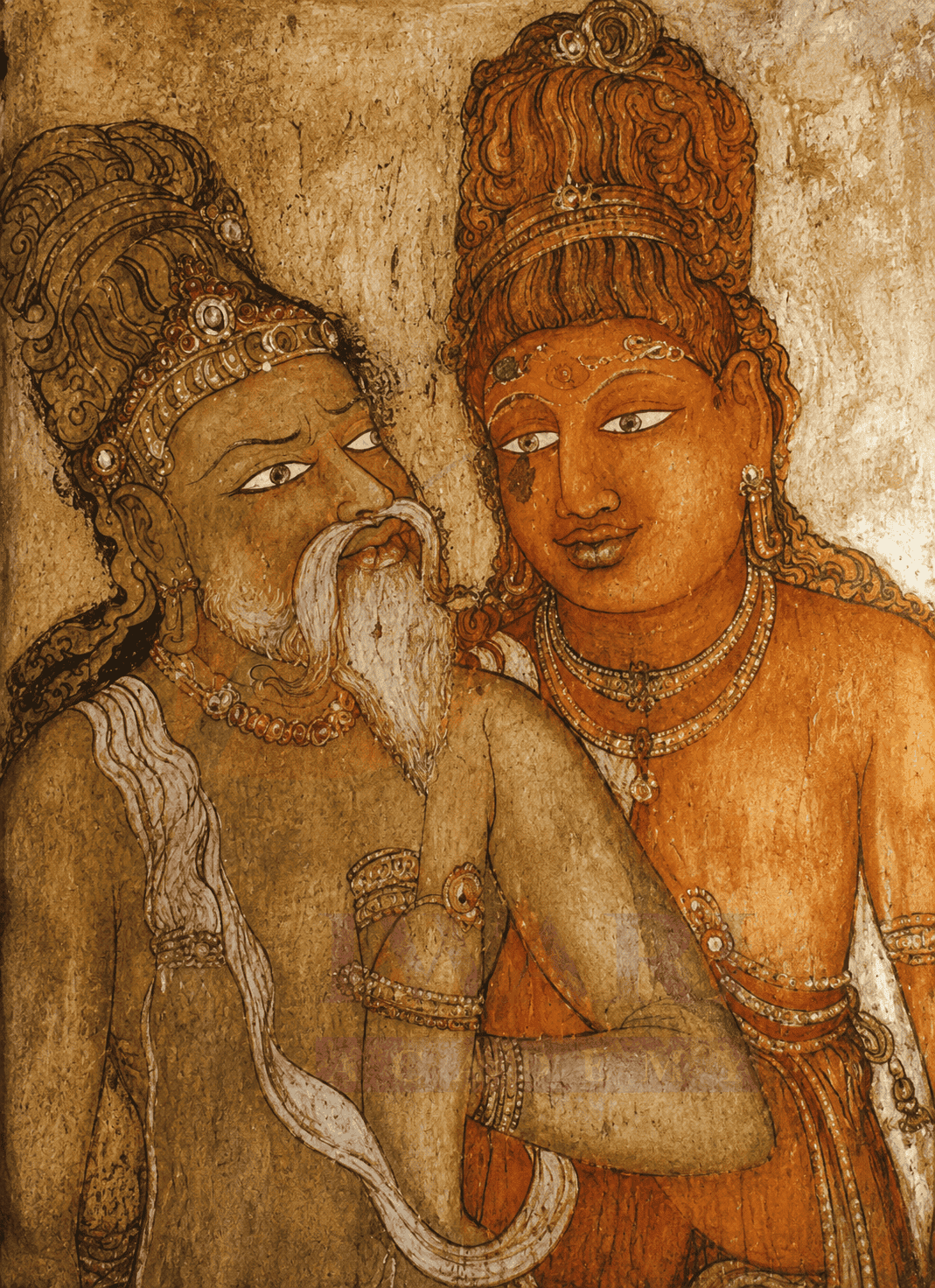
In the painting Fig. 4.14, can you make out who is the king and who is the guru? What does the king’s posture and general attitude express?
Answer:
The king’s posture sitting close to his guru, with a gentle, reverent expression and body slightly bowed towards him expresses devotion, humility and respect. Even though Rajendra Chola was one of the most powerful rulers of his time, with a vast empire and a victorious navy, his attitude here shows that he still valued spiritual guidance and considered himself a humble student in front of his guru. This reflects an important idea in Indian tradition that true power and greatness go hand in hand with humility and respect for wisdom and spiritual learning and that even great kings placed their guru’s teachings above their own royal status.
Page 117 – Let’s Explore
Writing some 60 years after Bakhtiyār Khiljī’s campaign through Bihar, the historian Minhaj al-Siraj Jūzjānī, recorded in his Tabakāt-i-Nāsirī how Bakhtiyar’s forces captured a ‘fortress’ and “acquired great booty”. He adds, “The greater number of the inhabitants of that place were Brāhmans, and all those Brāhmans had their heads shaven; and they were all slain. There were a great number of books there. … It was found that the whole of that fortress and city was a college, and in [their] tongue, they call a college bihār”.
Remembering the meaning of vihāra and noting that Nālandā was known in ancient inscriptions as ‘Nālandā Mahāvihāra’, can you find two more clues in the above passage to identify the ‘fortress’ near the Nālandā university? (Hint: Who do you think these ‘Brāhmans’ actually were?)
Answer:
Besides the word “bihar” (college) matching “vihara”, here are two more clues from the passage:
- Clue 1: The shaven heads: The passage says the “Brahmans” found there “had their heads shaven”. This is actually a key clue that they were not Brahmans at all, but Buddhist monks since shaving the head is a well-known practice of Buddhist monks (not something Brahmans typically did). The chronicler, being unfamiliar with Buddhist monastic tradition, likely mistook the shaven-headed scholars in robes for a group of “Brahmans” simply because he saw them as learned, priestly figures.
- Clue 2: The huge number of books: The passage mentions “a great number of books there”. This directly matches what we know about Nalanda – it was famous for its massive library spread across multiple multi-storey buildings, containing lakhs of manuscripts.
Page 121 – Let’s Explore
In Kalyāṇī, Basavaṇṇa established an Anubhava Maṇḍapa (literally, ‘pavilion of experience’), where men and women from every social, economic, religious or linguistic background, including saints and philosophers, could assemble to discuss all aspects of life, including moral values and religion.
Why, in your opinion, did Basava want people from all backgrounds to come together and exchange ideas?
Answer:
Basaveshvara rejected caste distinctions and ritualism, and taught personal devotion and dedicated work. He believed that all men and women have equal spiritual potential, no matter their social rank. So he wanted people from every background rich or poor, men or women any caste or religion to sit together and talk freely, because he felt everyone’s ideas and experiences mattered equally, not just the ideas of “important” or “high-caste” people.
If something like an Anubhava Maṇḍapa existed today, what important topics do you think people ought to discuss there?
Answer:
Topics like:
- Treating everyone equally, no matter their caste, religion or how rich or poor they are
- Making sure girls and boys get the same opportunities
- Helping the poor and needy in our society
- Taking care of the environment
- Respecting people from different religions and cultures
- Making sure everyone gets a good education
What lessons can we draw from the Anubhava Maṇḍapa spirit to create a just and civil society today?
Answer:
- We should listen to everyone’s opinion, not just people who are rich, powerful or from a certain caste or background.
- A person should be respected for being a good human being, not because of their caste or how much money they have.
- Talking and discussing things calmly with people who think differently is better than fighting or ignoring them.
- Just like Basava made a special place for everyone to talk freely, we too should create spaces (like in schools or community meetings) where everyone feels free to share their views.
- Treating all people – men and women, rich and poor – as equals, like Basava taught, helps make society fairer and more peaceful.
Pages 123 – Questions and activities
1. Why is the period under consideration in this chapter regarded as a major transition in Indian history? Give two examples each of change and continuity from this period.
Answer:
This period is a transition because it combines the beginning of long-term foreign (Turkic) political control in parts of India with the continued flourishing of native Indian kingdoms, culture and trade elsewhere.
Examples of change:
- Muhammad Ghuri’s conquest of Delhi established lasting Turkic political control (unlike Mahmud, who only raided and left), setting the stage for the Delhi Sultanate.
- Destruction of major Buddhist learning centres like Nalanda and Vikramashila by Bakhtiyar Khilji contributed to the decline of Buddhism in India.
Examples of continuity:
- Trade with China and Southeast Asia kept growing throughout this period despite the disturbances in the north.
- Sanskrit and regional-language literature, science (like Bhaskaracharya’s works) and temple architecture (like at Khajuraho, Belur, Halebidu) continued to flourish uninterrupted in most of India.
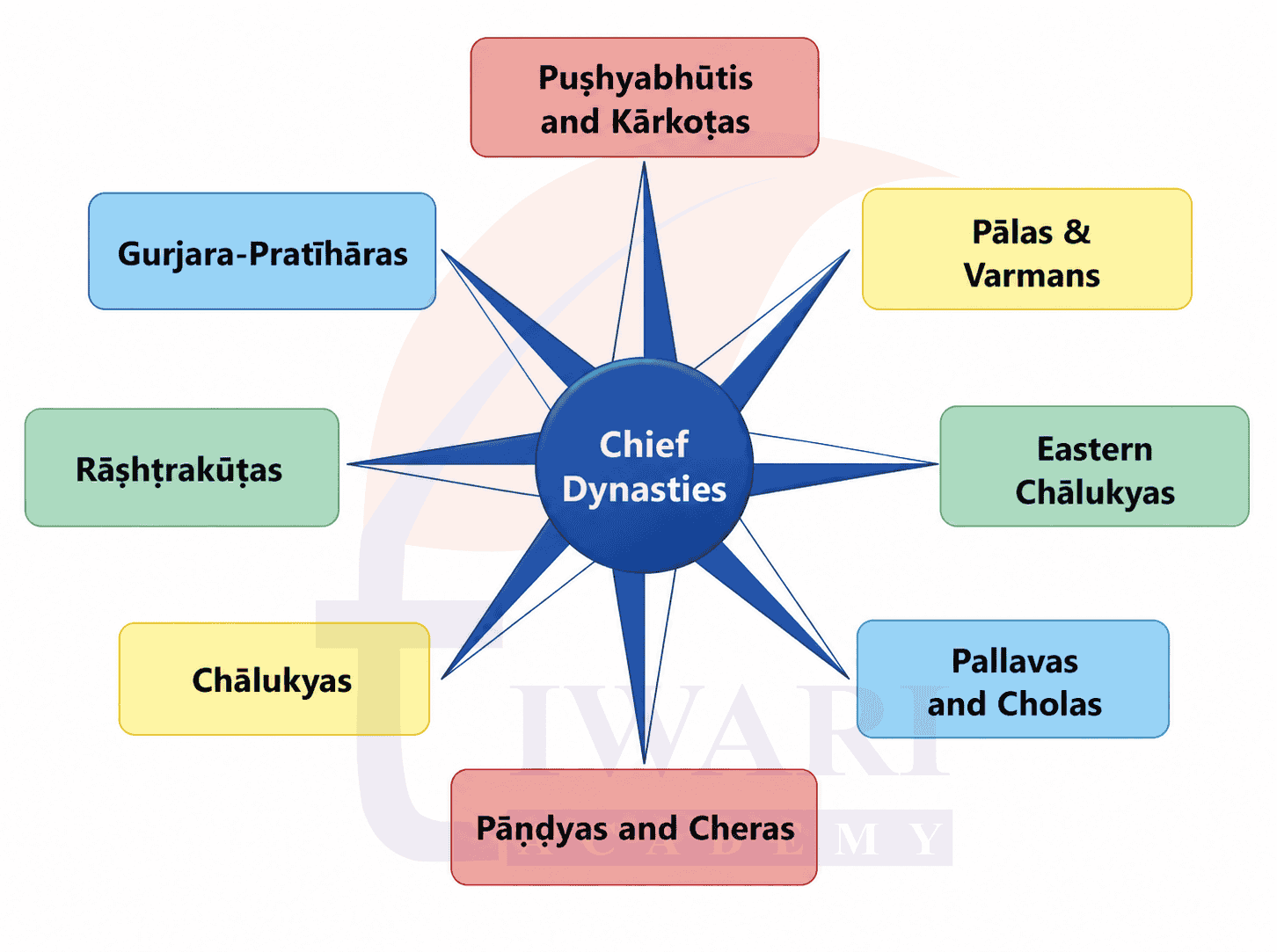
2. Observe Fig 3.27 in the previous chapter and draw a similar ‘star of dynasties’ gathering all or most of the dynasties that appear in this chapter.
Answer:
Dynasties to include: Ghaznavids, Ghurids, Hindu Shahis, Paramaras, Chahamanas (Chauhans), Chaulukyas (Solankis), Senas, Eastern Gangas, Western & Eastern Chalukyas, Kakatiyas, Hoysalas, Cholas, Pandyas.
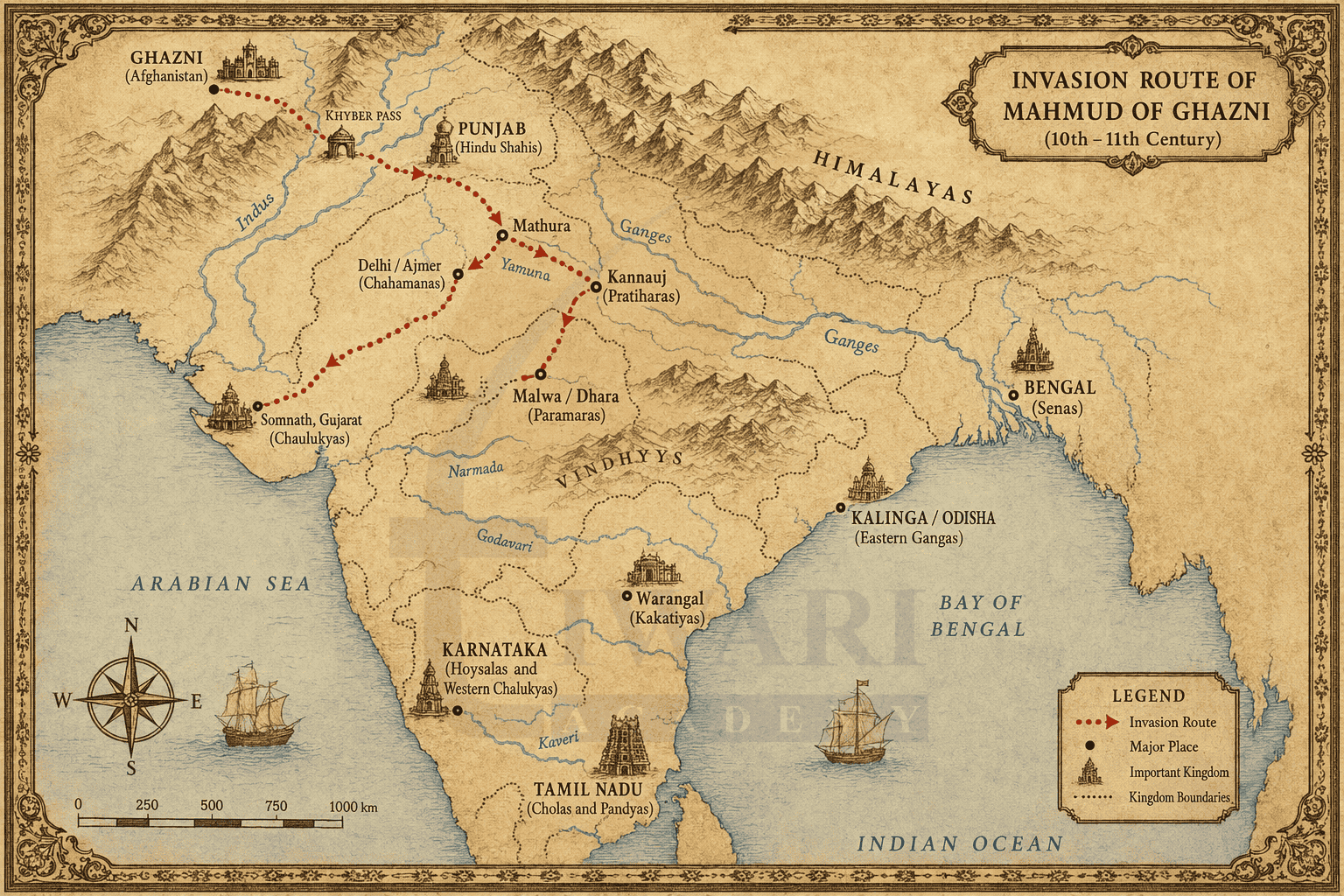
3. Taking a map of the Subcontinent, draw a geographical tour that covers all or most dynasties in this chapter (you can draw inspiration from some of the ‘travels’ the chapter’s narration follows.)
Answer:
Start at Ghazni (Afghanistan) → Khyber Pass → Punjab (Hindu Shahis) → Mathura → Kannauj (Pratiharas) → Somnath, Gujarat (Chaulukyas) → Malwa/Dhara (Paramaras) → Delhi/Ajmer (Chahamanas) → Bengal (Senas) → Kalinga/Odisha (Eastern Gangas) → Warangal (Kakatiyas) → Karnataka (Hoysalas, Western Chalukyas) → Tamil Nadu (Cholas, Pandyas).
4. With the help of map of India and Southeast Asia, can you calculate the approximate distance that Rajendra I’s fleet of ships had to navigate to reach their objective?
Answer:
Rajendra Chola’s fleet sailed from the Chola coast (Tamil Nadu, around Nagapattinam) across the Bay of Bengal, through the Strait of Malacca, to the Srivijaya Empire’s territory (parts of present-day Malaysia/Sumatra, Indonesia). Using a map scale, this is roughly 2,500–3,000 km of sea travel one way a huge naval achievement for that era, showing the Cholas’ advanced shipbuilding and navigation skills.
5. Match these two pairs:
| Column A | Column B |
|---|---|
| (a) Eastern Gangas | (i) Belur |
| (b) Chandellas | (ii) Brihadishvara temple |
| (c) Paramaras | (iii) Konark Sun temple |
| (d) Hoysalas | (iv) Kandariya Mahadeva temple |
| (e) Cholas | (v) Bhojeshwar temple |
Answer:
| Column A | Column B |
|---|---|
| (a) Eastern Gangas | (iii) Konark Sun temple |
| (b) Chandellas | (iv) Kandariya Mahadeva temple |
| (c) Paramaras | (v) Bhojeshwar temple |
| (d) Hoysalas | (i) Belur |
| (e) Cholas | (ii) Brihadishvara temple |
6. Working in groups, compare the dynasties in this chapter and in the preceding one; create a table to list the dynasties present in both, those that disappear from the preceding period, and those that appear in this chapter’s period.
Answer:
| Dynasties in both Chapter 3 and 4 | Dynasties that disappear after Chapter 3 | Dynasties that appear in Chapter 4 |
|---|---|---|
| Cholas | Pushyabhuti (Vardhana) | Hindu Shahis |
| Pālas | Chalukyas | Ghaznavids |
| Gurjara-Pratīhāras | Pallavas | Ghurids |
| Rāṣhṭrakūṭas | Varmans | Chāhamānas (Chauhans) |
| – | – | Paramāras, Chandellas, Chaulukyas (Solankis), Eastern Gangas, Senas, Kāmarūpa, Kākatīyas |
7. Using the chapter and any additional reading, prepare a short note explaining (1) why centres of learning like Nālandā were important; (2) how their destruction may have affected education and culture in India.
Answer:
Nalanda was one of the world’s greatest ancient universities, home to a massive library with lakhs of manuscripts, attracting scholars and students from across Asia – including Chinese pilgrims like Xuanzang, Yijing, and Tibetan monks. It was a centre for advanced study in Buddhism, philosophy, medicine and science, and helped spread Indian knowledge internationally.
Its destruction by Bakhtiyar Khilji’s forces (with the library reportedly burning for months) caused irreplaceable loss of manuscripts and knowledge, killed many scholars and monks and – according to historians – was a major factor in the decline of Buddhism in India, since such centres were vital for training monks and preserving Buddhist texts and teaching traditions. This weakened India’s position as a global centre of learning for centuries.
8. Why do you think Mahmūd of Ghazni carry out repeated raids from Afghanistan into India, while Muhammad Ghūrī sought territorial expansion into India and long-term control? Write a short note on how their motives shaped the outcomes of their campaigns.
Answer:
Mahmud of Ghazni’s main goal appears to have been plunder – gaining wealth (temple treasures, prisoners for slave trade) to fund his kingdom back in Ghazni and spreading his version of Islam through destruction of “infidel” temples, without wanting to govern India itself. This is why he returned to Ghazni after each of his 17 campaigns rather than staying.
Muhammad Ghuri, on the other hand, aimed for permanent territorial conquest and political control visible in how he left behind trusted generals like Qutb-ud-din Aibak to consolidate and administer conquered lands rather than simply looting and leaving.
This difference in motive shaped very different outcomes: Mahmud’s raids caused massive destruction but left no lasting political structure in most of India (beyond Punjab); Muhammad Ghuri’s approach led directly to the establishment of long-term Turkic rule in Delhi and the Gangetic plains, eventually resulting in the Delhi Sultanate a much more permanent and far-reaching change in Indian history.
Class 7 Social Science Part 2 Chapter 4 Extra Questions for Exam Preparation
Class 7 Social Science Part 2 Chapter 4 Very Short Answer Type Questions.
Very Short Answer Type Questions
1. Which pass did the Hindu Shāhis control against Ghaznavid invasions?
See AnswerThe Hindu Shāhis controlled the Khyber Pass, a major mountain route through the Hindu Kush range.
2. Who defeated Jayapāla’s son Ānandapāla in 1008?
See AnswerMahmūd of Ghazni defeated Ānandapāla in 1008 after a long battle in northern Punjab.
3. Which temple did Mahmūd destroy in Gujarat?
See AnswerMahmūd destroyed the Somanātha Śhiva temple at Somnath and looted its enormous treasures.
4. Who accompanied Mahmūd of Ghazni and wrote about India?
See AnswerAl-Bīrūnī, a Persian scholar, accompanied Mahmūd and wrote an encyclopaedic survey of India.
5. What is Bhāskarāchārya’s most famous mathematical work?
See AnswerLīlāvatī is Bhāskarāchārya’s most famous work, teaching basic mathematics through lively riddles.
6. Which dynasty ruled Bengal after the decline of the Pālas?
See AnswerThe Sena dynasty emerged as the dominant power over Bengal, with capital at Nādīya.
7. Who built the Bṛihadīśhvara temple at Thanjavur?
See AnswerRājarāja Chola I built the Bṛihadīśhvara temple, a masterpiece of architecture and engineering.
8. What title did Rājendra Chola I take after his northern campaigns?
See AnswerRājendra Chola I took the title ‘Gangaikoṇḍachola’, meaning “the Chola who seized Gangā”.
9. Who founded the Hoysala dynasty according to legend?
See AnswerAccording to legend, Sāla founded the Hoysala dynasty after saving an ascetic from a tiger.
10. Where was the Kākatīya capital located?
See AnswerThe Kākatīya capital was Orugallu, known today as Warangal, in present-day Telangana.
11. Who defeated Muhammad Ghūrī at the First Battle of Tarain?
See AnswerPṛithvīrāja III (Prithviraj Chauhan) defeated Muhammad Ghūrī at Tarain in 1191.
12. Who founded the Delhi Sultanate after Muhammad Ghūrī’s death?
See AnswerQutb-ud-din Aibak, Muhammad Ghūrī’s general, later founded the Delhi Sultanate.
13. Which Buddhist centres of learning did Bakhtiyār Khiljī destroy?
See AnswerBakhtiyār Khiljī destroyed the Buddhist monasteries and universities of Nālandā and Vikramaśhilā.
14. Who founded the Lingāyat movement?
See AnswerBasaveśhvara, a royal minister at Kalyāṇī, founded the Lingāyat movement rejecting caste distinctions.
15. Which temple in Cambodia shows Indian cultural influence?
See AnswerThe Angkor Wat temple in Cambodia, built by King Sūryavarman II, shows strong Indian influence.
Class 7 Social Science Part 2 Chapter 4 Short Answer Type Questions.
Short Answer Type Questions
1. Describe the role of the Khyber Pass in India’s history.
See AnswerThe Khyber Pass was a major mountain route through the Hindu Kush range, used by invaders to enter India for centuries. It was also a vital trade route connecting India to Central Asia and the path taken by Buddhist scholars and monks.
2. What did al-Bīrūnī write about the impact of Mahmūd’s campaigns?
See AnswerAl-Bīrūnī noted that Mahmūd’s campaigns ruined the prosperity of the country and scattered the Hindus like “atoms of dust”. He observed that Indian sciences retreated to places beyond Mahmūd’s reach, such as Kashmir and Varanasi.
3. Explain the significance of Bhāskarāchārya’s works.
See AnswerBhāskarāchārya wrote Līlāvatī, Bījagaṇita, and Siddhāntaśhiromaṇi, covering basic mathematics, algebra and astronomy. His works, written in clear poetic style with examples, influenced generations of scholars and were translated into Persian during the Mughal period.
4. How did Rājendra Chola I’s naval expedition against Śhrīvijaya come about?
See AnswerThe conflict arose from competition over maritime trade with China through the Strait of Malacca, controlled by the Śhrīvijaya king. Rājendra’s navy defeated Śhrīvijaya forces and captured their capital, but he did not occupy the territory.
5. What was Bhoja Paramāra’s contribution to governance and learning?
See AnswerBhoja Paramāra built a vast lake near Bhopal for irrigation, constructed the Bhojeshwar Temple and wrote extensively on architecture, governance, poetics and medicine. His capital Dhārā became a renowned centre attracting scholars from across India.
6. Describe the legend behind the name ‘Hoysala’.
See AnswerAccording to legend, founder Sāla saved an ascetic from a tiger attack after being commanded “Poy, Sāla” (strike, Sāla) in old Kannada. In gratitude, the ascetic blessed him with kingship, giving rise to the dynasty’s name.
7. What happened to Nālandā’s library after Bakhtiyār Khiljī’s attack?
See AnswerNālandā’s library, spread over three multi-storey buildings with lakhs of manuscripts, is said to have burned for months after the attack. Tibetan scholars fled back to Tibet, carrying as many manuscripts as they could save.
8. How did Muhammad Ghūrī’s administrative system differ from earlier ones?
See AnswerMuhammad Ghūrī’s system was more centralised, granting temporary land assignments to officers in exchange for revenue collection and military service. This system was later further developed during the period of the Delhi Sultanate.
9. What was the Anubhava Maṇḍapa established by Basaveśhvara?
See AnswerThe Anubhava Maṇḍapa was a pavilion in Kalyāṇī where men and women from all social, economic, religious, and linguistic backgrounds could assemble to discuss moral values, religion and all aspects of life together.
10. Describe the destruction and resistance during Bakhtiyār Khiljī’s Kāmarūpa expedition.
See AnswerWhile attempting an expedition into Tibet through Kāmarūpa in 1205, Bakhtiyār Khiljī faced fierce resistance from local forces, who inflicted severe losses and destroyed food and fodder, effectively starving his army into retreat.
Class 7 Social Science Part 2 Chapter 4 Long Answer Type Questions.
Long Answer Type Questions
1. Describe Mahmūd of Ghazni’s invasions of India and their impact.
See AnswerMahmūd of Ghazni, ruler of the Ghaznavid dynasty, conducted 17 campaigns into India in the early 11th century. After defeating the Hindu Shāhi rulers Jayapāla and Ānandapāla, he gained access to the Indus plains and launched raids on wealthy cities like Mathura, Kannauj and Somnath, destroying magnificent temples and looting enormous treasures. His campaigns involved the slaughter of civilians and capture of prisoners sold into slavery. Although he faced strong resistance from rulers like the Chandellas, his cavalry-based army proved decisive. However, Mahmūd never attempted to establish permanent rule in India beyond Punjab and after his death in 1030, his empire eventually disintegrated.
2. Explain how Muhammad Ghūrī’s conquests differed from Mahmūd of Ghazni’s and led to lasting change.
See AnswerUnlike Mahmūd, who merely raided and withdrew with plunder, Muhammad Ghūrī sought permanent territorial control. After early setbacks, including defeat by the Chaulukyas of Gujarat in 1178 and by Pṛithvīrāja III at the First Battle of Tarain in 1191, he returned with a larger army and defeated and executed Pṛithvīrāja at the Second Battle of Tarain in 1192. He captured Delhi and left behind trusted commanders, notably Qutb-ud-din Aibak, to consolidate his gains. Aibak’s general Bakhtiyār Khiljī extended conquests into Bihar and Bengal, destroying centres like Nālandā. After Muhammad Ghūrī’s death in 1206, his territories remained under his generals, eventually leading to the founding of the Delhi Sultanate.
3. Discuss the achievements of the Cholas as “masters of the seas.”
See AnswerThe Cholas, ruling from Tanjāvūr, reached their peak under Rājarāja Chola I and his son Rājendra Chola I. Rājarāja conquered parts of Karnataka, Andhra Pradesh, the Maldives and northern Sri Lanka, and built the magnificent Bṛihadīśhvara temple at Thanjavur. Rājendra I expanded further into Odisha and Bengal, earning the title ‘Gangaikoṇḍachola’. Most notably, he launched a successful naval expedition against the Śhrīvijaya Empire over trade competition in the Strait of Malacca, defeating their forces and capturing their capital, though without permanent occupation. The Cholas also built roads, tanks and canals, though frequent wars with neighbours eventually drained their treasury, leading to decline by the 13th century.
4. How did Indian rulers resist foreign invasions during this period? Give examples.
See AnswerDespite the eventual success of Turkic invasions, Indian rulers offered persistent resistance throughout the 11th and 12th centuries. The Hindu Shāhis, supported by other north Indian rulers, long resisted Ghaznavid attacks by controlling the Khyber Pass. The Chandellas fiercely opposed Mahmūd’s campaigns. Suheldev defeated and killed Sālār Masūd at Bahraich. Pṛithvīrāja III defeated Muhammad Ghūrī at the First Battle of Tarain in 1191 and the Chaulukya forces (possibly led by Queen Nāīkīdevī) repelled Ghūrī’s invasion of Gujarat in 1178. Later, the local ruler of Kāmarūpa decisively defeated Bakhtiyār Khiljī’s army in 1205, forcing him to retreat with heavy losses. These examples show that resistance, though ultimately unable to stop the invasions permanently, was widespread and often successful.
5. Explain the cultural and religious developments of the 11th and 12th centuries, including the contributions of thinker-saints.
See AnswerDespite political turmoil, this period saw remarkable cultural achievements. Scholars like Bhāskarāchārya made pioneering contributions to mathematics and astronomy through works like Līlāvatī and Siddhāntaśhiromaṇi, while Bhoja Paramāra authored texts on architecture, governance, and medicine. Magnificent temples were built, including the Khajuraho temples by the Chandellas, the Hoysala temples at Belur and Halebidu and the Bṛihadīśhvara temple by the Cholas. Two influential thinker-saints emerged in south India: Rāmānujāchārya developed viśhiṣhṭādvaita vedānta, emphasising bhakti and surrender to the divine, while Basaveśhvara founded the Lingāyat movement, rejecting caste distinctions and establishing the Anubhava Maṇḍapa where people of all backgrounds could discuss spiritual and social matters together. These developments show that despite invasions, India’s intellectual and cultural traditions remained vibrant and continued to influence regions like Southeast Asia, as seen in Cambodia’s Angkor Wat temple.
Frequently Asked Questions
What is Class 7 Chapter 4 Turning Tides: 11th and 12th Centuries about?
This chapter describes a transitional period in Indian history when Turkic invaders, especially Mahmūd of Ghazni and Muhammad Ghūrī, launched deep incursions into north India, causing major political shifts. It also covers powerful regional dynasties like the Cholas, Chandellas, Hoysalas, Kākatīyas and Paramāras, along with cultural and scientific achievements of the period.
This chapter is important because it bridges the earlier regional kingdoms era with the upcoming Delhi Sultanate period taught in Grade 8. It introduces key historical figures, invasions, dynasties and cultural developments that are essential for understanding medieval Indian history and are frequently tested in school exams.
The chapter highlights strong Indian resistance, such as Pṛithvīrāja III’s initial victory over Muhammad Ghūrī at the First Battle of Tarain in 1191, Suheldev’s defeat of Sālār Masūd at Bahraich and the local ruler of Kāmarūpa defeating Bakhtiyār Khiljī in 1205. It shows that while Turkic invasions eventually succeeded in parts of north India, they faced persistent and sometimes successful opposition.