



by Tiwari Academy Team
NCERT Class 7 Social Science Chapter 5 Part 2 India, a Home to Many Solutions – Exercises and Extra Question Answers for Session 2026-27 Exam Preparation. Chapter 5 of Class 7 Social Science Part 2, India, a Home to Many, explores India’s long tradition of welcoming persecuted and migrant communities from across the world. The chapter narrates the inspiring stories of the Bene Israel and Cochin Jews who fled persecution and found refuge on India’s coasts, the Syriac Christians who escaped religious hostility in West Asia, the Parsis who carried their sacred fire to Gujarat after the fall of the Sassanid Empire and Arab merchants who peacefully settled and built India’s oldest mosque. It also covers the Siddis of African origin, the Armenians who thrived under Mughal patronage, the Baha’i community, the extraordinary story of the “Good Maharaja” of Nawanagar who saved Polish orphans during World War II and the Tibetan refugees who found a second home in India after 1959. Through these accounts, the chapter illustrates India’s civilisational values of vasudhaiva kutumbakam (the whole world is family) and atithi devo bhava (a guest is like God).
Quick Links:
- Exercises Question Answers
- Very Short Answer Type Questions
- Short Answer Type Questions
- Long Answer Type Questions
Download Class 7 Social Science App to study Class 7 Social Offline.
NCERT Class 7 Social Science Part 2 Chapter 5 Solutions
Class 7 Social Science Part 2 Chapter 5 Question Answer
Page 125 – The Big Questions
1. What has made India a home for people from different parts of the world?
Answer:
India has a long coastline, so people could easily travel here by ship (like the Jews, Parsis, and Arabs). Some also came through mountain routes, like the Tibetans. Most importantly, Indian culture always valued peace and hospitality, so people from other countries felt safe and welcome here.
2. Why did oppressed or persecuted people from other countries seek refuge in India?
Answer:
In many countries, people were treated badly just because of their religion — they were attacked, forced to change their faith, or their temples/places of worship were destroyed. For example, the Parsis and Baha’is were persecuted in Persia and Tibetan Buddhists faced trouble under Chinese rule. India was known as a place where people could practise their own religion freely and without fear, so they came here for safety.
3. What is it about the nature of Indian society that enables people to assimilate here?
Answer:
Indian society believes in values like vasudhaiva kutumbakam (“the whole world is one family”) and atithi devo bhava (“a guest is like God”). Because of this, outsiders were not just allowed to stay, but were also respected – they were given land and allowed to build their own temples, synagogues or churches. In return, these communities also adopted Indian clothes, food and customs, which helped them blend in fully with Indian society over time.
Page 128 – Let’s Explore
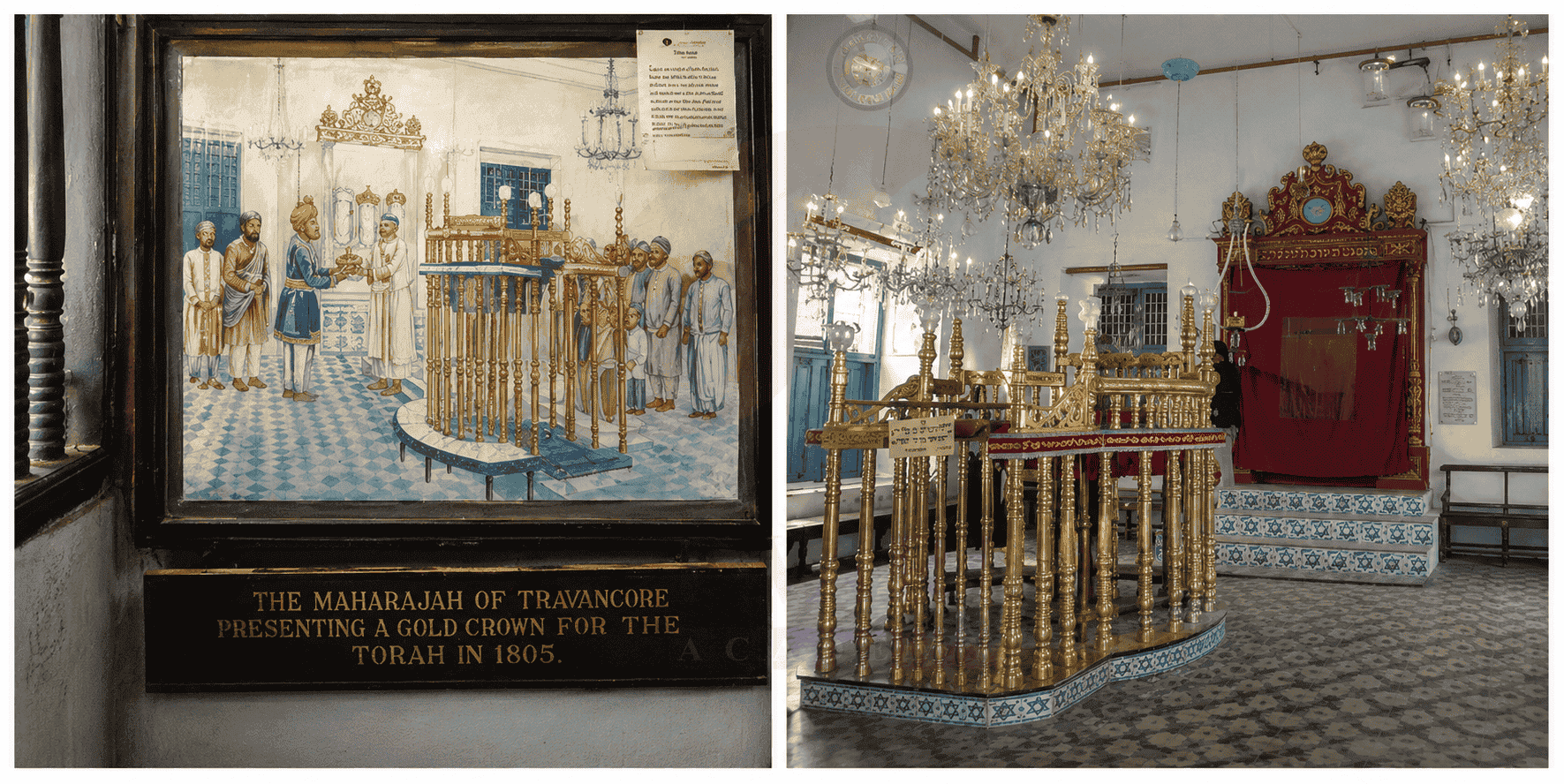
Look at the two pictures below. Is the place shown in both the photographs the same? Why is the Maharaja of Travancore (the name of the kingdom in and around Kochi at that time) giving such an expensive gift to the Jewish synagogue for the Torah (religious book of the Jews)?
Answer:
Yes, it is the same place – the Kochi (Paradesi) synagogue. The first picture is a painting / plaque showing the Maharaja of Travancore presenting a gold crown for the Torah in 1805 and the second is a present-day photo of the same synagogue’s interior.
The Maharaja gave such an expensive gift because he respected and honoured the Jewish community living in his kingdom. It shows that the Jews were not just tolerated but treated with genuine respect and friendship by the local ruler a sign of true acceptance, not just permission to stay.
Page 129 – Let’s Explore
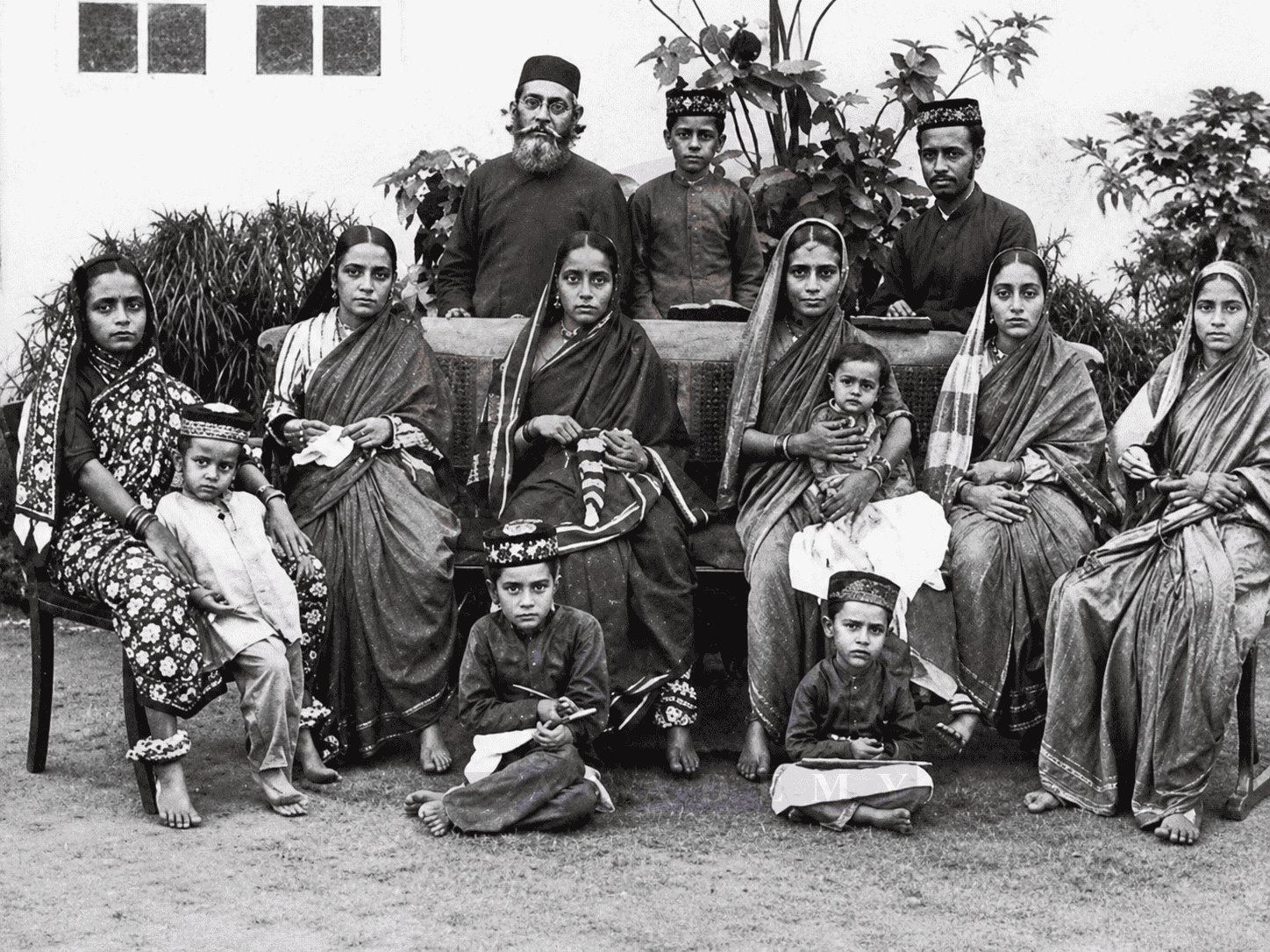
Observe the picture Fig 5.4 What clues do you get about the integration of the Jewish community into Indian society over time?
Answer:
The family in the photo (Fig. 5.4) is dressed in Indian-style clothing – the women wear saris and the men wear caps similar to local styles. This shows that over time, the Jewish community adopted local Indian dress and customs while still keeping their Jewish identity, proving they had blended well into Indian society rather than staying separate.
Page 130 – Let’s Explore
Observe the pictures below. What are the clues you get about the integration of the Syriac Christian community into Indian society?

Answer:
The wedding ceremony shows the bride wearing a sari, gold jewellery, and mehendi-style decorations, along with rituals like a priest blessing the couple – very similar to Hindu Indian weddings. This shows that even though Syriac Christians kept their own religion, they adopted Indian wedding customs, clothing and traditions, showing deep integration into Indian society.
Page 132 – Let’s Explore
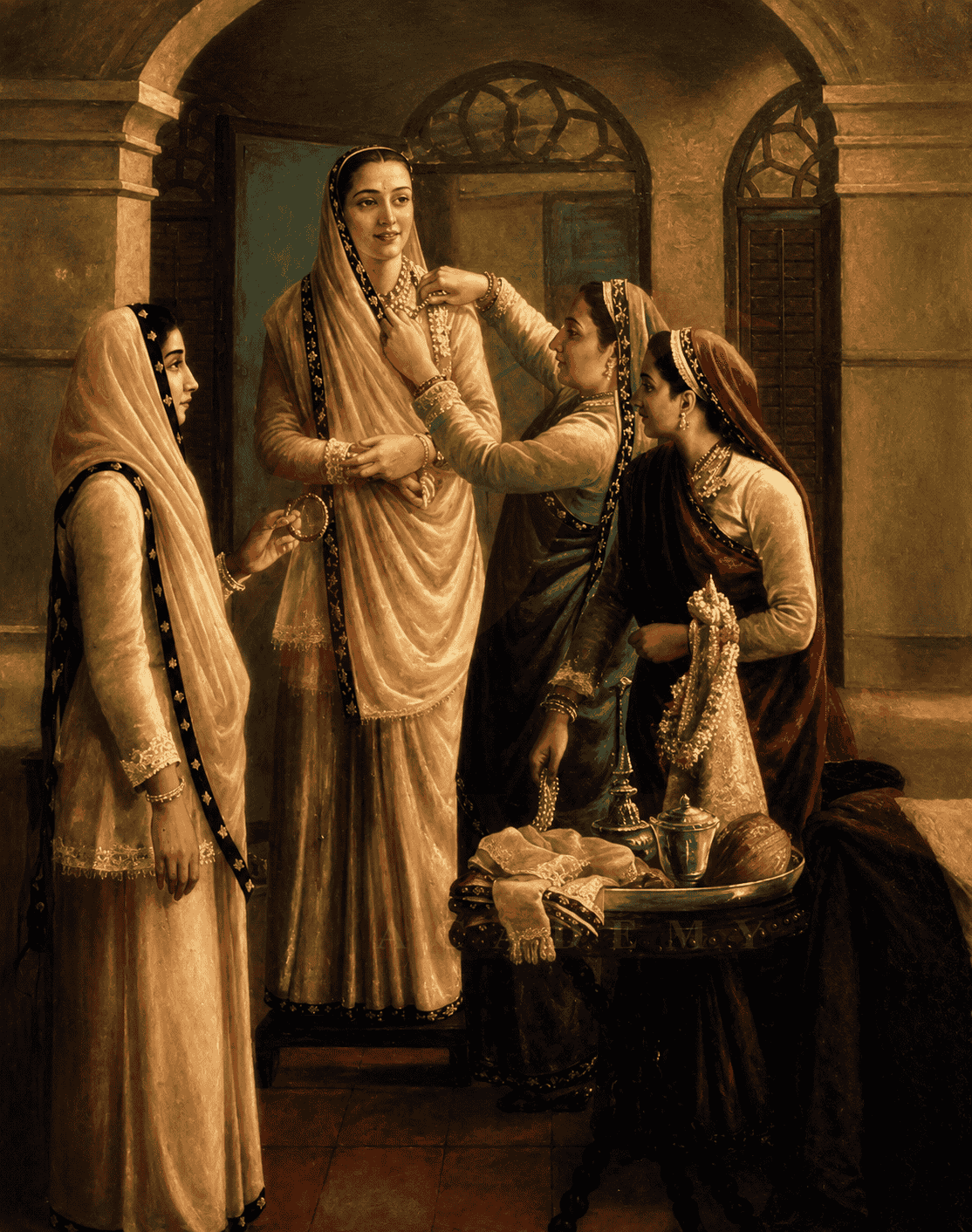
This painting of a Parsi bride getting ready for her wedding shows many aspects of Indian culture. Do any of them seem familiar to you? Based on what you see, can you draw any conclusions about the integration of Parsi culture in India?
Answer:
Yes. The painting shows the bride wearing a sari-like drape, gold jewellery and other women helping decorate her, which are all familiar Indian customs. This shows that the Parsis fully adopted Indian dress, rituals and wedding customs while keeping their own Zoroastrian faith – a clear sign that Parsi culture blended deeply with Indian traditions over time.
Page 134 – Let’s Explore
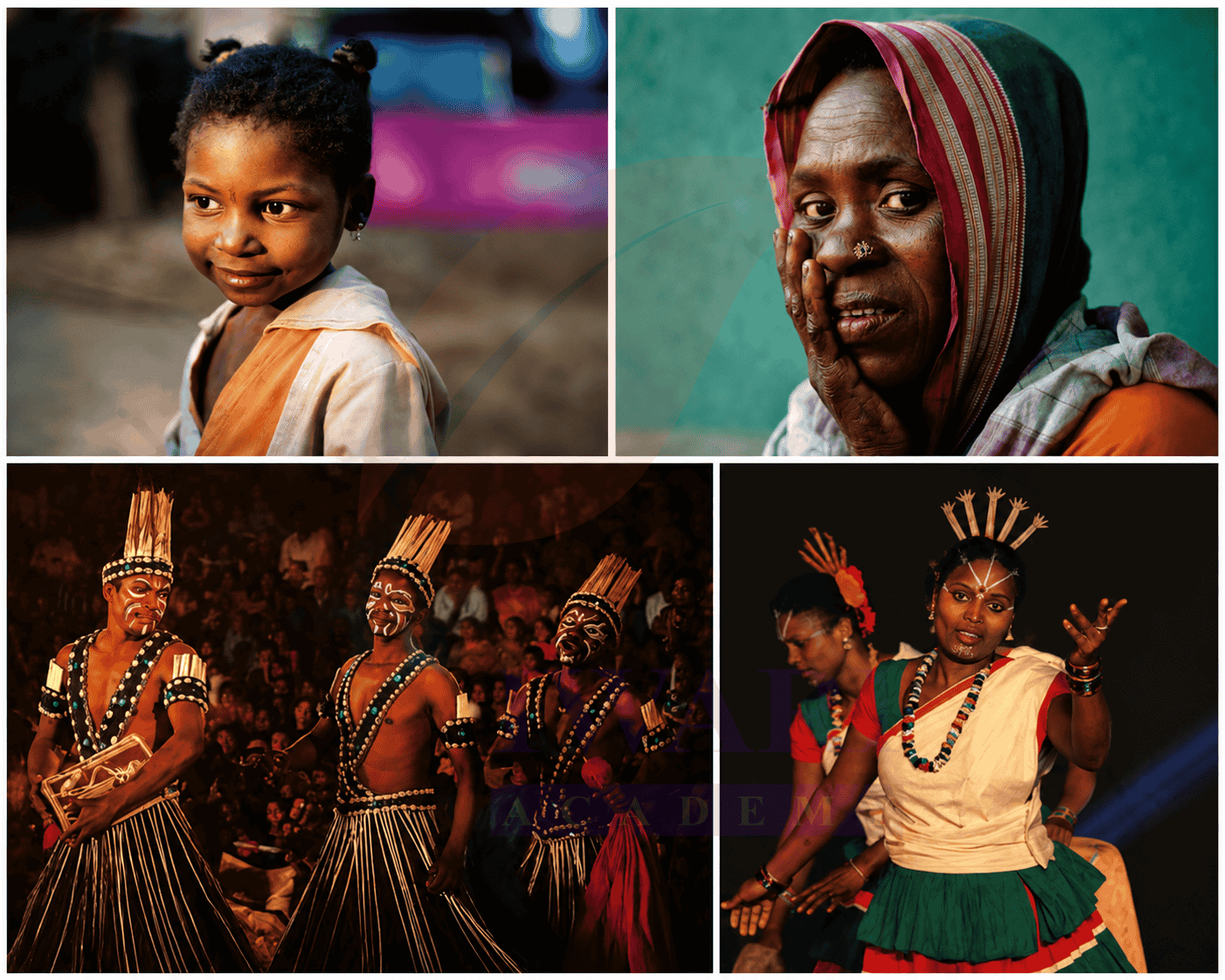
What clues do you get about African and Indian cultural integration from the pictures here and above? Identify and name a few features that are distinctly Indian.
Answer:
The Siddi dancers wear African-style feathered headdresses and use African drumming styles, but they also wear Indian-style clothing/jewellery and perform in an Indian social setting. Distinctly Indian features include the sari-style or Indian clothing worn by some dancers and the fact that Siddis practise Hinduism, Islam or Christianity like other Indians. This mix shows a genuine fusion of African roots with Indian culture, rather than one replacing the other.
Page 140 – Let’s Explore
Are there communities in your neighbourhood whose ancestors might have come to India centuries ago and made it their home? Have a class discussion on what their experience may have been.
Answer:
In many neighbourhoods across India, you can find families with surnames or traditions linked to Parsi, Anglo-Indian, Armenian or Jewish ancestry or communities like Tibetans running restaurants and shops. Their ancestors likely faced hardship or persecution, arrived with very little and slowly built a life, business or place of worship, gradually blending Indian customs with their own – just like the examples in this chapter.
Page 140 – Let’s Explore
Identify similar values in any story or local tradition etc. known to you. You could ask your guardians or relatives too. Collect these stories and create a class manuscript. You could include illustrations.
Answer:
Similar values can be found in many Indian folk tales and traditions, such as stories where a guest is welcomed and fed first before the family eats (reflecting atithi devo bhava) or panchayat traditions where outsiders in need are given shelter and food without asking too many questions. Local grandparents often share stories of helping travellers or strangers during festivals, showing that hospitality and kindness to outsiders is a value passed down through generations, not just something written in old texts.
Page 142 – Questions and Activities
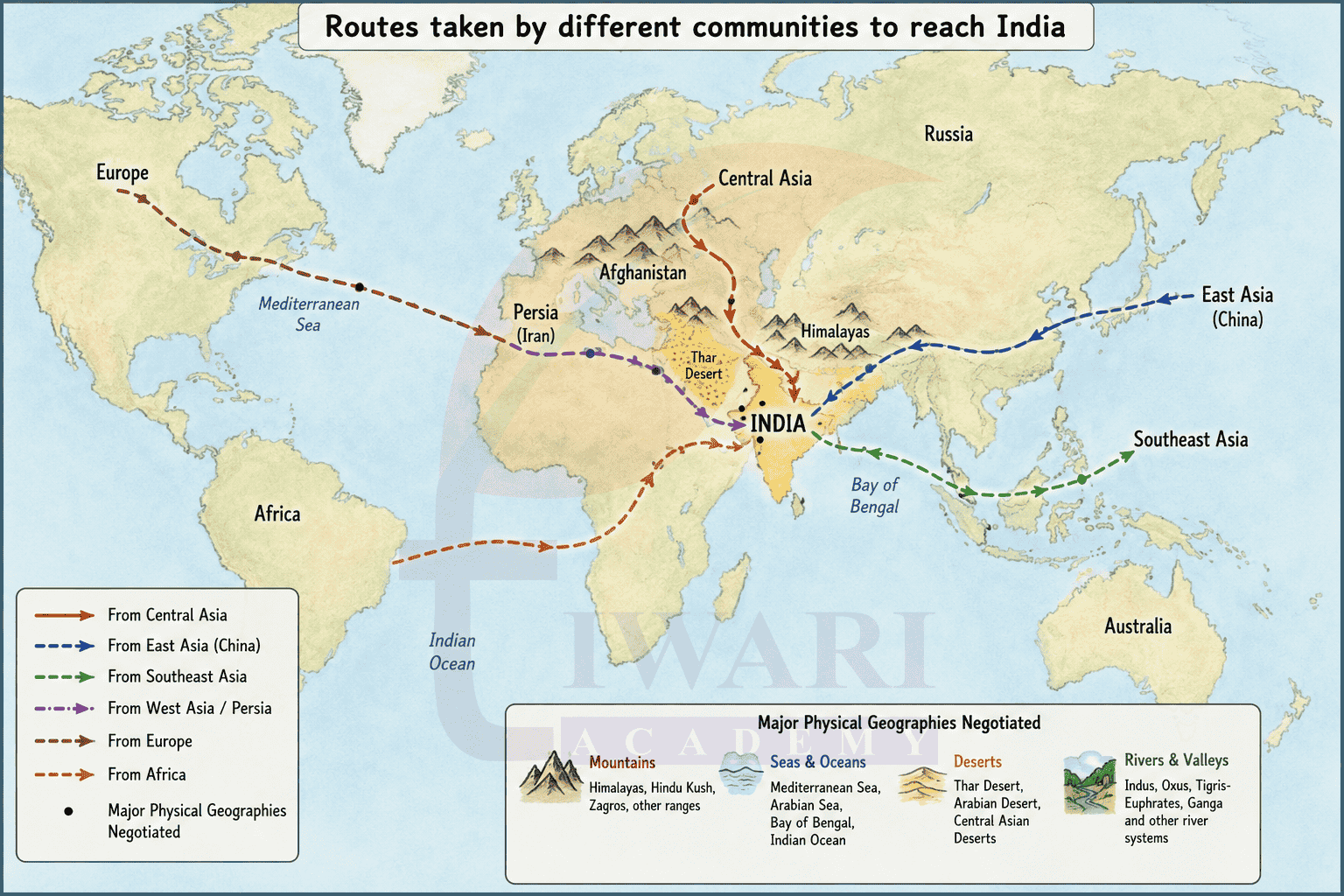
1. On the outline of a world map, try to trace the routes that the communities mentioned in this chapter may have used to reach India. What types of physical geographies did they have to negotiate?
Answer:
- Map IdeasJews (Bene Israel) came by sea from West Asia (ancient Israel) across the Arabian Sea to the Konkan coast.
- Jews (Cochin Jews) came later from West Asia to Kerala’s coast.
- Syriac Christians travelled by land and sea trade routes from West Asia to the Malabar coast (Kerala).
- Parsis sailed across the Arabian Sea from Persia (Iran) to Gujarat’s coast.
- Arab merchants sailed across the Arabian Sea from West Asia to Kerala, Gujarat and Karnataka.
- Siddis were brought by sea from Africa as enslaved people by Arab, Portuguese and British traders.
- Armenians travelled by land and sea trade routes from Armenia through Persia to Agra, Surat, Kolkata and Chennai.
- Baha’is came from Persia (Iran) to India.
- Tibetans crossed the Himalayan mountain range on foot/land routes into India.
Physical geographies negotiated: the Arabian Sea (rough sea voyages), the Himalayan mountain range (extremely difficult terrain for Tibetans) and long overland trade routes through deserts and mountains (for Armenians and Arabs).
2. What are the key values intrinsic to Indian culture that enable it to welcome people of different backgrounds?
Answer:
- Vasudhaiva kutumbakam – “the whole world is family”
- Atithi devo bhava – “a guest is like God”
- Sarve bhavantu sukhinah – “may all creatures be happy”
- A general spirit of compassion, tolerance and acceptance of different religions and cultures, allowing communities to practise their own faith freely while also becoming part of Indian society.
3. Homi Bhabha, Sam Maneckshaw, Ratan Tata, Fali Nariman, Nani Palkivala, and Cornelia Sorabji are a few names of Parsis who excelled in their respective fields. Find out more about people from other communities that made India their home and their contributions.
Answer:
- Jewish community: General J.F.R. Jacob (Indian Army general who played a key role in the 1971 war).
- Syriac Christian community: K.M. Cherian (cardiac surgeon), Verghese Kurien (though from a related Christian community, known as the “Father of the White Revolution”).
- Armenian community: Michael Madhusudan Dutt had partial Armenian heritage on his mother’s side (though mainly known as a Bengali poet) – students can research Armenian traders’ descendants like the Aratoon family in Kolkata.
- Siddi community: Hirabai Lobi (mentioned in the chapter – social worker, Padma Shri awardee).
- Tibetan community in India: The 14th Dalai Lama (Nobel Peace Prize winner, spiritual leader).
4. Take up a class project. Divide the class into groups. Each group takes up a small project to study a little more about the communities that we have been listed here. Share what you have gathered with your classmates through one of these ways drama, posters, song, painting, etc.
Answer:
Class Project – Communities of India
Our group chose the Ladakhi community for our project.
We collected information about their food, clothes, festivals, language and culture. We found that the people of Ladakh wear warm clothes because it is very cold there. They celebrate the Losar festival and are known for their unique traditions.
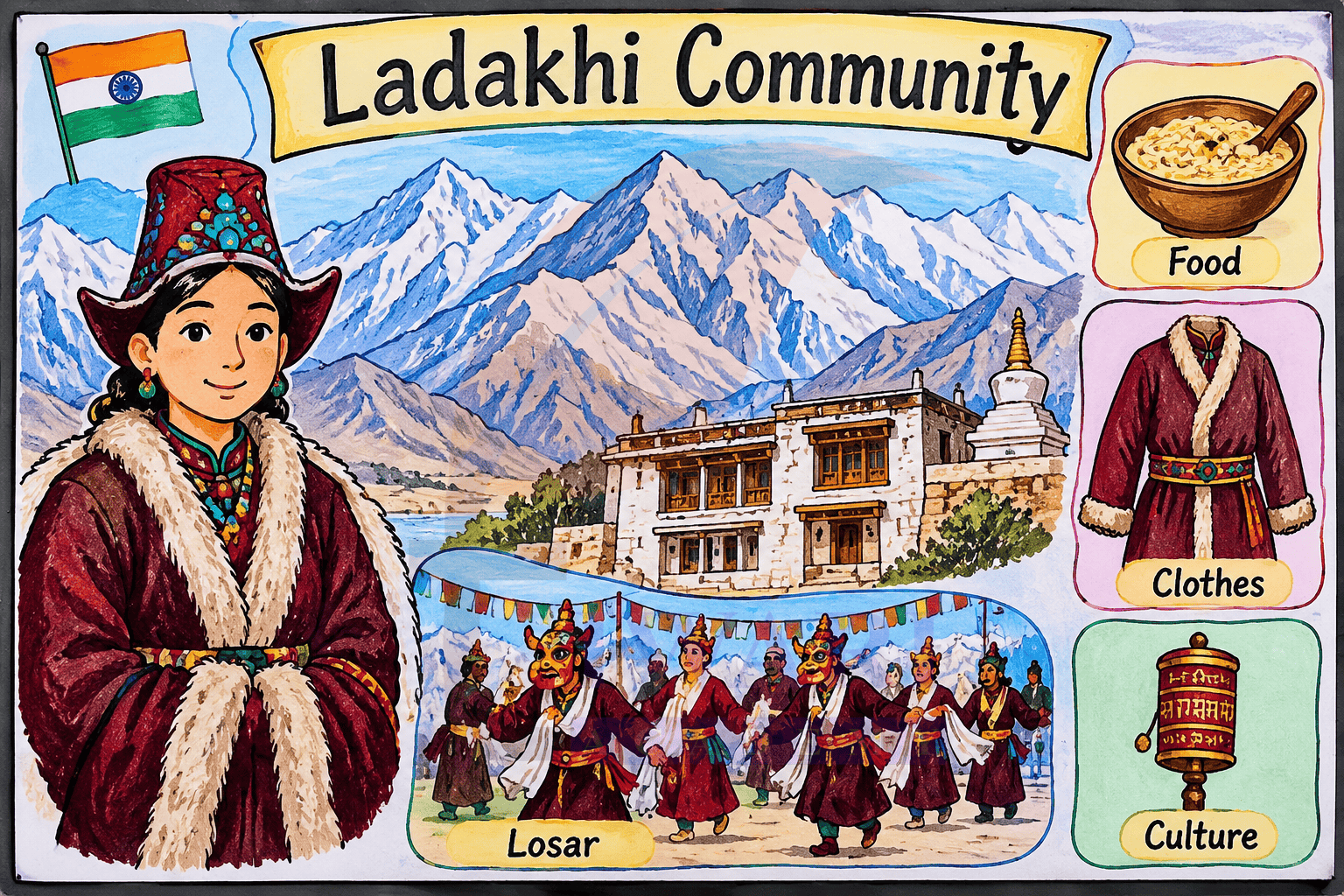
This project helped us learn about the diversity of India and taught us to respect different cultures and traditions.
Class 7 Social Science Part 2 Chapter 5 Extra Questions for Exam Preparation
Class 7 Social Science Part 2 Chapter 5 Very Short Answer Type Questions.
Very Short Answer Type Questions
1. Where did the Bene Israel Jewish community settle in India?
See AnswerThe Bene Israel settled on the Konkan coast, just south of Mumbai, after being shipwrecked.
2. What did the Raja of Kochi grant to the Jews who settled there?
See AnswerThe Raja of Kochi granted the Jews land free of cost to settle and build a synagogue.
3. Why did Syriac Christians flee to India?
See AnswerSyriac Christians fled persecution in the Roman and Persian Empires, seeking refuge on the Malabar coast.
4. Who founded Zoroastrianism?
See AnswerZoroastrianism was founded by the prophet Zarathushtra in Central Asia, worshipping one God, Ahurā Mazdā.
5. Where did the Parsis first settle in India?
See AnswerThe Parsis first settled in Sanjān, coastal Gujarat, under the protection of Raja Jadi Rāṇā.
6. What is India’s oldest mosque, built by Arab merchants?
See AnswerThe Cheraman Juma Masjid in Kerala is considered India’s oldest mosque, built by Arab merchants.
7. Who are the Siddis?
See AnswerThe Siddis are a community of African origin brought to India as slaves between the 7th-19th centuries.
8. Who received the Padma Shri for uplifting Siddi women?
See AnswerHirabai Lobi received the Padma Shri in 2023 for her service to the Siddi community in Gujarat.
9. Where was the earliest Armenian settlement in India established?
See AnswerThe earliest Armenian settlement was in Agra, where Akbar permitted them to build a church.
10. Who founded the Baha’i faith?
See AnswerBaha’u’llah founded the Baha’i faith in Persia in the mid-1800s, teaching unity among all people.
11. Where is the Baha’i Lotus Temple located?
See AnswerThe Baha’i Lotus Temple is located in New Delhi, India’s capital city.
12. Who was the “Good Maharaja” who saved Polish orphans?
See AnswerDigvijaysinhji Ranjitsinhji Jadeja, Maharaja of Nawanagar, saved around a thousand Polish orphans during World War II.
13. When did the Dalai Lama take refuge in India?
See AnswerThe 14th Dalai Lama took refuge in India in 1959, following the Lhasa uprising against China.
14. Where does the Dalai Lama’s government-in-exile function from?
See AnswerThe Central Tibetan Administration functions from Dharamshala in Himachal Pradesh.
15. What does the phrase “vasudhaiva kutumbakam” mean?
See Answer“Vasudhaiva kutumbakam” means “the whole world is family”, reflecting India’s inclusive cultural philosophy.
Class 7 Social Science Part 2 Chapter 5 Short Answer Type Questions.
Short Answer Type Questions
1. Describe how the Bene Israel preserved their faith despite losing their holy books.
See AnswerAfter being shipwrecked on India’s coast, the Bene Israel lost their holy books but remembered their core prayer affirming belief in one God. Over centuries, they grew into India’s largest Jewish community, numbering over 25,000 shortly after independence.
2. Explain the legend of the Parsi wise man, milk, and sugar.
See AnswerWhen Raja Jadi Rāṇā showed the Parsis a full jug of milk to indicate his kingdom had no room, a wise Parsi dissolved sugar into it without spilling any milk, symbolizing that the Parsis would blend into society and enrich it without displacing anyone.
3. What connections exist between Zoroastrianism and Vedic traditions?
See AnswerZoroastrianism and Vedic schools share the concept of cosmic order and importance of fire worship. Interestingly, devas are beneficial in Vedas but evil (daevas) in the Avesta, while Ahurā is the chief Avestan god, showing deep but inverted linguistic and spiritual ties.
4. How did Arab merchants integrate into Indian society?
See AnswerArab merchants who came to India from the 7th century settled along the west coast, married local women and formed new communities. In Kerala, they became part of the Mappila Muslim community and helped build the Cheraman Juma Masjid.
5. Describe the cultural identity of the Siddi community.
See AnswerThe Siddis represent a fusion of African and Indian traditions, featuring a distinctive dance with African-style drumming. They adapted their language to regional influences and integrated African religious practices with adopted faiths like Hinduism, Islam or Christianity.
6. What role did Armenians play in the Mughal administration?
See AnswerArmenians played important roles in the Mughal royal household, army and administration. For example, Abdul Hai served as Chief Justice in Akbar’s court, while Lady Juliana worked as a doctor in the royal palace.
7. How did the Baha’i community come to India?
See AnswerBaha’is faced persecution in Iran, where their leadership branded them as heretics due to differing beliefs. Seeking safety, some Baha’is came to India during the late 19th century and over time, many Indians also joined the faith.
8. Describe Digvijaysinhji Ranjitsinhji Jadeja’s humanitarian efforts during World War II.
See AnswerThe Maharaja of Nawanagar mobilised the Red Cross and other organisations to rescue around a thousand Polish orphans and several thousand refugees during World War II, providing them shelter, food and care in Jamnagar until they safely returned home.
9. What is Sowa Rigpa and how is it connected to Tibetan refugees?
See AnswerSowa Rigpa or “Art of Healing”, is Tibet’s traditional medicine system blending Ayurveda with influences from China, Central Asia and Persia. Tibetan refugees propagated this system in India and it has been integrated into India’s AYUSH programme.
10. What are the Dalai Lama’s “Four Commitments” mentioned in the chapter?
See AnswerThe Dalai Lama’s Four Commitments include promoting human values like compassion and tolerance, promoting religious harmony, preserving Tibetan culture and reviving India’s civilisational heritage, particularly values like karuṇā (compassion) and ahimsa (nonviolence).
Class 7 Social Science Part 2 Chapter 5 Long Answer Type Questions.
Long Answer Type Questions
1. Describe the different waves of Jewish migration to India and their experiences.
See AnswerJews arrived in India in several waves. The Bene Israel came around 175 BCE from the ancient Kingdom of Israel, shipwrecked on the Konkan coast; despite losing their holy books, they preserved their core prayer and became India’s largest Jewish community. Later, between the 12th and 19th centuries, other Jewish groups fleeing persecution settled near Cochin, where the Raja granted them land free of cost, allowing them to build a synagogue. These communities integrated into Indian society while preserving their faith, exemplifying Swami Vivekananda’s remark at the 1893 World Parliament of Religions that India sheltered “the purest remnant of the Israelites” who fled Roman tyranny.
2. Explain the story of the Parsis’ arrival and settlement in India.
See AnswerThe Parsis, followers of Zoroastrianism, fled Persia after the Islamic conquest of the Sassanid Empire in the 7th century, facing forced conversions, religious taxes and destruction of their fire temples. Carrying little except their sacred fire, several groups reached Gujarat’s coast between the 8th and 10th centuries. According to legend, when they sought refuge from Raja Jadi Rāṇā of Sanjān, he showed them a full jug of milk to indicate no space remained; a wise Parsi dissolved sugar into it without spilling, symbolizing peaceful integration and enrichment rather than displacement. The Raja granted them shelter and the sacred fire still burns today in Udvada, Gujarat, with India now home to the world’s largest Zoroastrian population.
3. Discuss the diverse communities that came to India as traders and their contributions.
See AnswerSeveral communities came to India primarily through trade rather than conquest. Arab merchants arrived from the 7th century, settling along the west coast in Kerala, Gujarat and Karnataka; they married local women, formed new communities like the Mappila Muslims, and helped build the Cheraman Juma Masjid, India’s oldest mosque. Armenian merchants traded in spices and muslins, establishing settlements from the 8th century onward, with major hubs developing in Agra, Surat, Kolkata and Chennai under Mughal patronage; they built churches, schools and cemeteries, with figures like Abdul Hai serving as Chief Justice under Akbar. These communities demonstrate how peaceful trade relationships fostered deep and lasting cultural exchange between India and the wider world.
4. How did India provide refuge to persecuted communities during the 20th century? Give examples.
See AnswerIndia continued its tradition of sheltering the persecuted well into the 20th century. During World War II, Maharaja Digvijaysinhji Ranjitsinhji Jadeja of Nawanagar rescued around a thousand Polish orphans and thousands of refugees between 1942-46, providing them safety, food and care until they could return home; this humanitarian act is honoured today by a monument in Warsaw. Similarly, following China’s annexation of Tibet and the 1959 Lhasa uprising, the 14th Dalai Lama fled to India, where he was granted asylum and continues to live in Dharamshala as head of the Central Tibetan Administration. India rehabilitated Tibetan refugees, established settlements and monasteries, especially in Karnataka and supported their education and livelihoods, allowing them to preserve their culture while becoming part of Indian society.
5. What are the core Indian values that explain the country’s tradition of welcoming diverse communities?
See AnswerIndia’s tradition of welcoming persecuted and migrant communities is rooted in deep civilisational values. The Hitopadeśha’s teaching that “for the noble-minded, the whole world is family” (vasudhaiva kutumbakam) reflects this ethos, as does the principle of atithi devo bhava, meaning “a guest is like God”. The concept of sarve bhavantu sukhinah, or “may all creatures be happy” and the Buddhist Karaṇīya Mettā Sutta’s call to “radiate kindness over the entire world” further reinforce this culture of compassion. These values enabled diverse communities – from Jews and Parsis to Syriac Christians, Armenians and Tibetans – to not only find safety in India but also preserve their unique identities while integrating into the broader Indian society, demonstrating that this philosophy has been a lived practice for millennia rather than a mere slogan.
Frequently Asked Questions
Is Class 7 Social Science Chapter 5 India, a Home to Many easy?
Yes, this chapter is relatively easy and story-based compared to other history chapters. It focuses on narratives of different communities like the Jews, Parsis, Syriac Christians, Armenians, Siddis and Tibetan refugees rather than complex political timelines or dynasties. Since it relies on storytelling and cultural values, students generally find it interesting and easy to remember, especially if they focus on why each community came to India and how they were welcomed.
How to prepare Class 7 Social Science Chapter 5 in one day?
To prepare this chapter in one day, first read the chapter once fully to understand the flow of communities covered – Jews, Syriac Christians, Parsis, Arab merchants, Siddis, Armenians, Baha’is, Polish refugees and Tibetan refugees. Make a quick table with three columns: community name, reason for coming to India, and where they settled. Memorise key terms like vasudhaiva kutumbakam, atithi devo bhava and important names like Digvijaysinhji Jadeja and the Dalai Lama. Finally, revise the “Before we move on” summary box and attempt the given questions.
How to score better in Class 7 Social Science Chapter 5?
To score better in this chapter, focus on remembering specific details such as dates, places, and key figures associated with each community – for example, the Bene Israel’s arrival around 175 BCE, the Parsi legend of milk and sugar and the year 1959 for the Dalai Lama’s arrival in India. Practice writing short explanations connecting each story to India’s core values of hospitality and compassion. Use the exact Sanskrit/Pali phrases like vasudhaiva kutumbakam and sarve bhavantu sukhinah in answers, as examiners often look for these terms in value-based questions.
What are the core points in Class 7 Social Science Chapter 5 for exam?
The core exam points include:
- the Bene Israel and Cochin Jews fleeing persecution and settling on India’s west coast;
- Syriac Christians escaping Roman and Persian persecution to reach Kerala;
- the Parsi migration legend of milk and sugar;
- Arab merchants peacefully settling and building the Cheraman Juma Masjid;
- the Siddis’ African-Indian cultural fusion;
- Armenian contributions under Mughal patronage;
- the Baha’i community’s arrival from Persia;
- Maharaja Digvijaysinhji’s rescue of Polish orphans in WWII;
- Tibetan refugees and the Dalai Lama’s asylum in India since 1959; and
- core Indian values like vasudhaiva kutumbakam and atithi devo bhava that explain this culture of acceptance.
Which questions are most likely to be asked from Class 7 Social Science Chapter 5 in exams?
Commonly expected questions include explaining the legend of the Parsi milk and sugar story, describing why Tibetan refugees came to India, listing Indian values that promote inclusion and short-answer questions on communities like the Siddis, Armenians or Bene Israel. Value-based and HOTS (Higher Order Thinking Skills) questions asking students to reflect on vasudhaiva kutumbakam or compare it to modern refugee situations are also common, so practising both factual and reflective answers is important.
Is Class 7 Social Science Chapter 5 important from an exam point of view compared to other chapters in Part 2?
Yes, Chapter 5 is important because it often carries value-based and reasoning questions worth good marks, in addition to factual short-answer questions. While chapters like “Empires and Kingdoms” or “Turning Tides” test factual recall of dynasties and dates, this chapter tests conceptual understanding of Indian culture and civilisational values, which examiners frequently use for long-answer or reflective questions carrying higher weightage.
What is the easiest way to remember all the communities mentioned in Class 7 Social Science Chapter 5?
The easiest way is to group communities by the reason they came to India: those fleeing religious persecution (Jews, Parsis, Syriac Christians, Baha’is, Tibetan refugees) and those who came for trade and prosperity (Arab merchants, Armenians), plus the unique case of the Siddis who were brought as slaves. Creating a mnemonic or a simple mind-map linking each community to its country of origin and Indian settlement location makes recall much faster during revision.