



by Tiwari Academy Team
NCERT Class 7 Social Science Chapter 8 Part 2 Banks and the Magic of Finance Solutions – Exercises and Extra Question Answers for exam and tests preparation. Chapter 8 of NCERT Class 7 Social Science Part 2, Banks and the Magic of Finance, is part of the newly issued textbook Exploring Society: India and Beyond for the academic session 2026-27. This chapter introduces students to financial infrastructure – the network of banks, payment systems and stock markets that keeps money flowing between people, businesses and the government. Through relatable stories of Navdeep depositing his savings and Rima taking a loan for her bamboo business, students learn about the core banking functions of holding deposits and offering loans, along with the fascinating concept of compounding interest, illustrated through the classic tale of the king and the chessboard. The chapter also explores India’s digital payment revolution, including UPI, debit cards, cheques and net banking, along with the role of the Reserve Bank of India (RBI) as the banker to banks. Students also learn about the stock market, how shares represent part-ownership in a company and important safety tips to protect themselves from financial fraud in the digital age.
Quick Links:
- Exercises Question Answers
- Very Short Answer Type Questions
- Short Answer Type Questions
- Long Answer Type Questions
Download Class 7 Social Science App to study Class 7 Social Offline.
NCERT Class 7 Social Science Part 2 Chapter 8 Solutions
Class 7 Social Science Part 2 Chapter 8 Question Answer
Page 193 – The Big Questions?
1. What is financial infrastructure and what does it comprise?
Answer:
Financial infrastructure is a network of institutions and systems that help people, businesses and the government carry out financial transactions and manage money. It supports the smooth flow of money in the economy.
It comprises:
- Banks
- Payment systems (such as UPI)
- Stock markets
- Other financial institutions.
2. What are the main functions performed by banks and how do they impact people’s lives?
Answer:
The main functions performed by banks are:
- Accepting and safeguarding deposits.
- Providing different types of bank accounts (Savings, Current and Fixed Deposit).
- Giving loans for education, housing, businesses, farming and other needs.
- Paying interest on deposits and charging interest on loans.
- Enabling money transfers through cheques, debit cards, ATMs, internet banking and UPI.
Impact on people’s lives:
- Keeps money safe.
- Encourages saving and helps money grow through interest.
- Provides financial support through loans.
- Makes payments and money transfers quick, easy and secure.
- Supports businesses, farmers, students and workers, improving their quality of life.
3. How does financial infrastructure contribute to a nation’s progress?
Answer:
Financial infrastructure contributes to a nation’s progress by:
- Making financial transactions safe and efficient.
- Encouraging savings and investments.
- Providing loans for businesses, agriculture, education and infrastructure development.
- Supporting digital payments and reducing dependence on cash.
- Creating employment and promoting economic growth.
- Ensuring smooth movement of money throughout the economy, leading to overall national development.
Page 194 – Let’s Explore
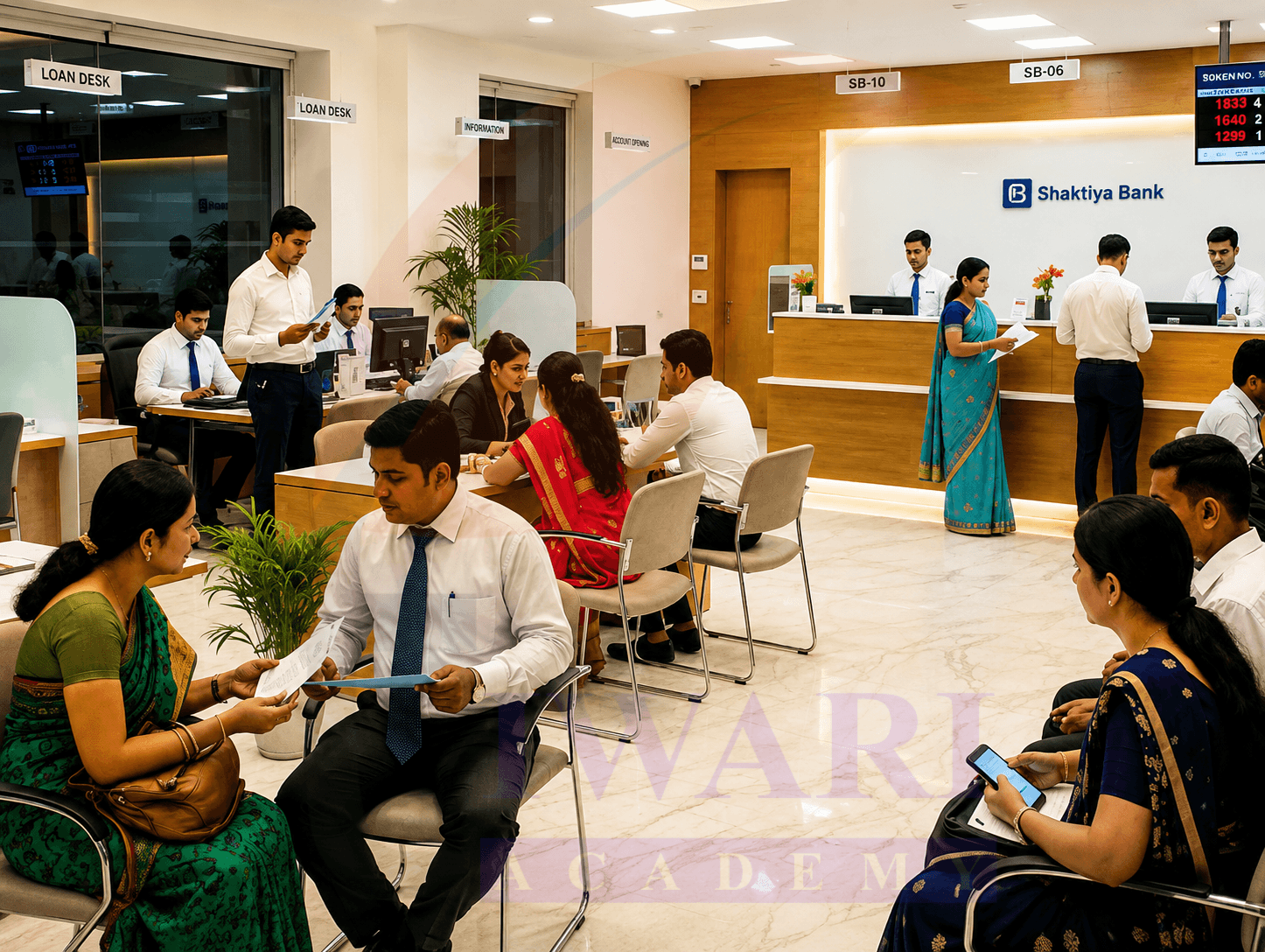
This picture is from a bank. What do you think the people are doing? Ask your family members if they have visited a bank and learn more about the activities there.
Answer:
The picture shows people carrying out different banking activities. Some customers are depositing or withdrawing money, while others are opening bank accounts, updating passbooks, filling out forms, applying for loans, transferring money, or seeking help from bank staff. The bank employees are assisting customers and providing various banking services.
After talking to my family members, I learnt that banks provide many important services such as accepting deposits, allowing withdrawals, opening different types of accounts, granting loans, transferring money, issuing debit cards and cheque books and helping customers with digital banking facilities like internet banking and UPI.
Page 195 – THINK ABOUT IT
1. Why does Navdeep think that saving at the bank is better than keeping cash at home?
Answer:
I think Navdeep feels that saving at the bank is better than keeping cash at home for a few reasons. Firstly, if he keeps ₹3000 every month in his cupboard, it’s not very safe – it could get stolen by a thief, lost or even damaged by fire or water. But when he deposits it in a bank, the bank keeps it safe and secure for him.
Secondly, if Navdeep just keeps the cash at home, it stays the same amount forever. But if he deposits it in the bank, the bank pays him interest on his savings, which means his money actually grows over time, just like we learned in the compounding example. So by saving in the bank, Navdeep’s money is not only safer but also earns him extra money as interest, which wouldn’t happen if he just kept it locked away at home.
2. Can Navdeep and Rima lend to each other directly without the bank? What could happen in that case? Discuss.
Answer:
Technically, Navdeep and Rima could lend money to each other directly without going through a bank, but I think it would create a lot of problems and risks for both of them.
Firstly, Navdeep might not personally know Rima or trust her enough to lend his hard-earned savings directly. What if Rima’s business doesn’t do well and she isn’t able to repay the loan on time or at all? Navdeep would have no legal protection or guarantee to get his money back, unlike a bank which has proper rules, documents and legal systems for loans.
Secondly, it would be really difficult for people like Navdeep to find someone like Rima who actually needs money and for Rima to find someone like Navdeep who has extra savings to lend. Banks make this so much easier because they connect many depositors and many borrowers together in one place.
Also, if Navdeep lent money directly, there would be no fixed interest rate decided fairly and there could be disagreements about how much interest to charge or when to repay. So basically, without a bank, lending money would become risky, complicated and inconvenient and there would be no safety or trust the way a bank provides for both the depositor and the borrower.
Page 209 – THINK ABOUT IT
Why do companies issue shares and why do people buy them? Are there any benefits of owning shares?
Answer:
Companies issue shares because they need money to grow their business, like buying new machines or opening new branches. Instead of taking a loan and paying interest, they sell small parts of the company, called shares, to people.
People buy shares because when you own a share, you become a part-owner of that company. If the company does well, the share price goes up and people can sell their shares later to earn a profit.
Yes, there are benefits of owning shares – your money can grow if the company does well and you get to be a part-owner of a real business. But there’s also a risk, because if the company doesn’t do well, the share price can fall and you might lose money instead.
Page 211 – Questions and activities
1. What is financial infrastructure? How does it complement physical infrastructure?
Answer:
Financial infrastructure is the network of institutions and systems such as banks, payment systems, stock markets and other financial institutions that help people save, borrow, invest and transfer money. It complements physical infrastructure by providing the financial support needed to build and maintain roads, bridges, railways, airports, industries, schools, hospitals and other public facilities.
2. How does having a bank account help people? Should everyone be required to have a bank account?
Answer:
A bank account helps people keep their money safe, earn interest on savings, receive salaries and government benefits, transfer money easily and access loans and other banking services. It also supports digital payments through ATMs, internet banking and UPI. Everyone should have access to a bank account because it promotes financial inclusion and makes financial transactions easier and safer.
3. What could be the possible advantages and disadvantages of compound interest for savers and borrowers?
Answer:
Advantages for savers:
- Savings grow faster because interest is earned on both the principal and previously earned interest.
- It encourages long-term saving.
Advantages for borrowers:
- It allows people to borrow money for education, business, housing, or other needs.
Disadvantages for borrowers:
- If loans are not repaid on time, the amount to be repaid increases because interest is charged on the outstanding balance.
- Borrowing for a long period may become expensive.
4. How does financial infrastructure enable the flow of money between households and businesses? Can you think of how the government can facilitate this flow?
Answer:
Financial infrastructure enables households to deposit their savings in banks. Banks use these deposits to provide loans to businesses, farmers and entrepreneurs. This helps businesses expand, create jobs and produce goods and services. The government can facilitate this flow by promoting financial inclusion, expanding banking services, supporting digital payments and ensuring safe and efficient financial systems.
5. What could be the reason for the higher interest rate earned on fixed deposits as compared to a savings account?
Answer:
Fixed deposits earn a higher interest rate because the money remains with the bank for a fixed period. Since the bank can use these funds for a longer time, it offers a higher rate of interest than a savings account, where money can be withdrawn at any time.
6. Sahil received ₹10,000 as a prize in a poster-making competition. His father promises to pay him 12 per cent interest per year if he does not spend the amount. After 3 years, how much money would Sahil have?
Answer:
Principal = ₹10,000
Rate of interest = 12% per year
Time = 3 years
Using compound interest:
Amount after 3 years = ₹10,000 × (1.12)³
= ₹10,000 × 1.404928
= ₹14,049.28
Therefore, after 3 years, Sahil will have ₹14,049.28 (approximately ₹14,049).
7. How does the stock market help mobilise the savings of individuals? In what ways do companies benefit by issuing shares to people?
Answer:
The stock market allows individuals to invest their savings by purchasing shares of companies. This helps companies raise money for expanding their business, starting new projects and creating employment. Investors may also benefit if the company performs well and the value of their shares increases.
8. How can we balance the convenience of digital payments with the risk of cyber fraud?
Answer:
We can balance convenience and safety by:
- Never sharing PINs, passwords, OTPs or banking details.
- Using trusted banking and UPI applications.
- Verifying payment requests before making transactions.
- Keeping mobile phones and banking apps updated.
- Reporting suspicious calls, messages or transactions immediately to the bank.
- Using strong passwords and enabling security features.
9. Ask your family members or neighbours about –
- how they save money?
- whether they use UPI, ATM or cheques, the kinds of transactions they perform through UPI; do they find UPI better than using cash or not and why.
- if they or their acquaintance have experienced digital fraud, for instance, through a fake call or message asking for bank details. What did they do when they realised it was a scam and what did they learn from that experience?
Summarise your findings in a table or short report. Share one surprising insight with your class.
Answer:
| Topic | Findings |
|---|---|
| How they save money | They save money in savings accounts, fixed deposits and recurring deposits. |
| Use of UPI, ATM or cheques | They mainly use UPI for shopping, bill payments, mobile recharges and money transfers. ATMs are used to withdraw cash, while cheques are used less frequently. They find UPI faster and more convenient than carrying cash. |
| Experience of digital fraud | Some people received fake calls or messages asking for OTPs or bank details. They did not share any confidential information, blocked the callers and informed the bank. They learnt that OTPs, PINs, passwords and banking details should never be shared with anyone. |
Surprising insight:
Most people now prefer digital payments for daily transactions because they are quick, convenient and reduce the need to carry cash, while remaining alert to avoid cyber fraud.
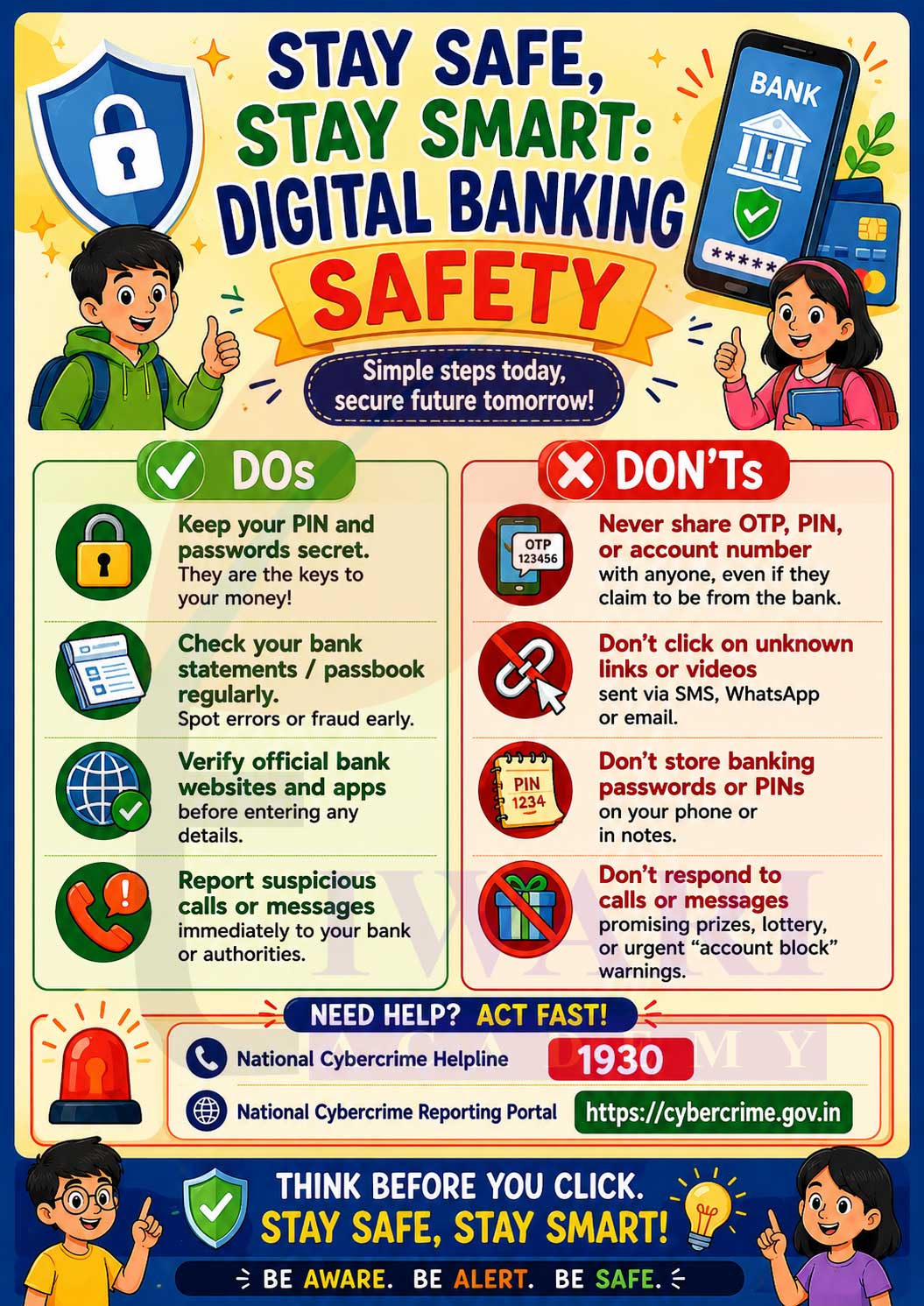
10. Create a Financial Safety Poster:
- Design a poster with dos and don’ts of digital banking safety (for example, not sharing OTPs, reporting frauds).
- Include emergency numbers or websites like https://cybercrime.gov.in or 1930 helpline.
- Hang the posters in school corridors or the library.
Answer:
11. Cheques are often used to pay utility bills. Ask your parents to allow you to fill out the cheques for a few monthly payments.
Answer:
Activity to be done by students with the guidance of their parents or teacher.
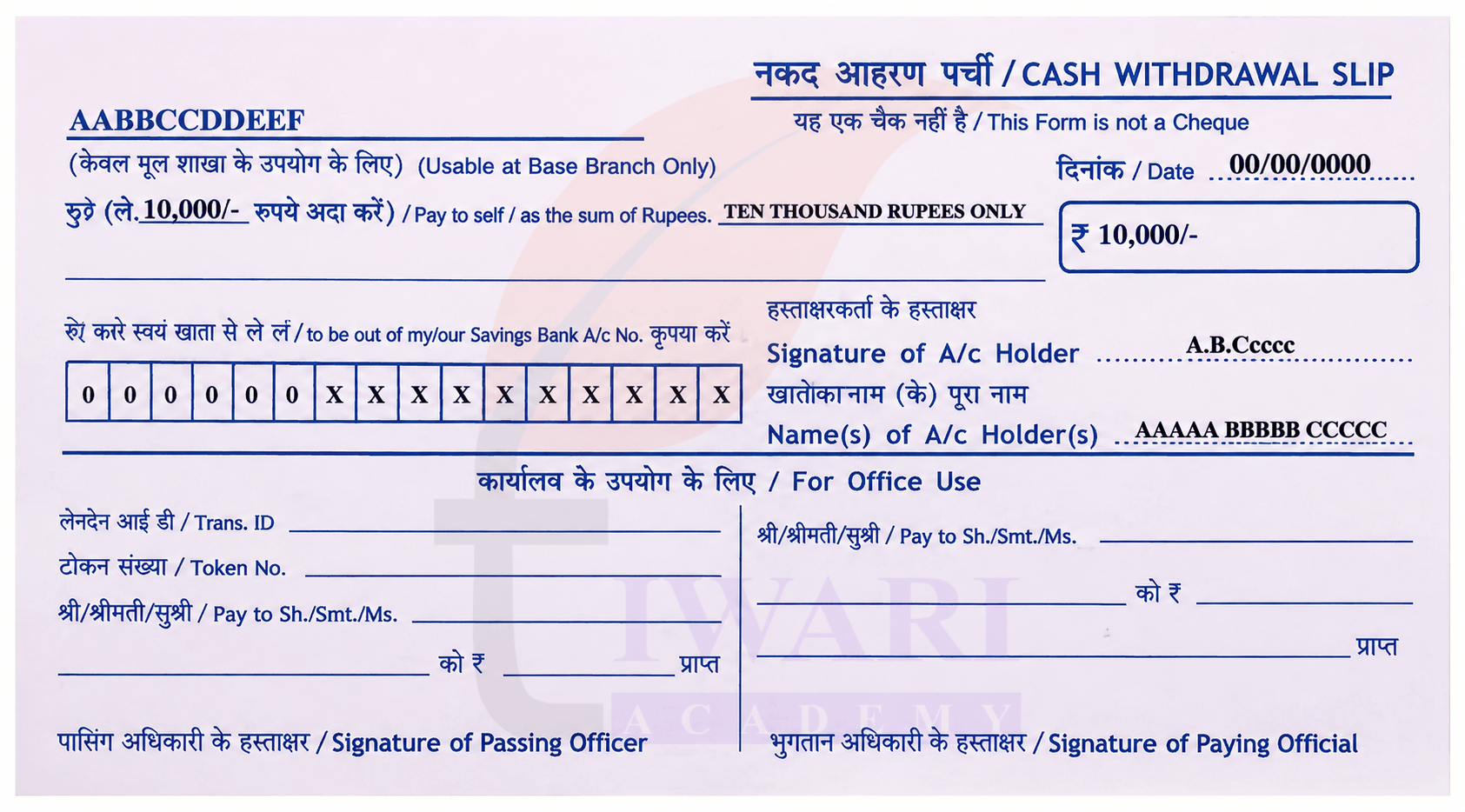
12. Suppose you have to withdraw ₹10,000 from your bank account, how would you fill out the cash withdrawal slip at your bank? Let us try below!
Answer:
Sample Cash Withdrawal Slip
- Date: __/__/____
- Branch: ____________
- Amount (Figures): ₹10,000
- Amount (Words): Ten Thousand Rupees Only
- Savings Bank Account Number: __________________
- Name of Account Holder: __________________
- Signature of Account Holder: __________________
The completed withdrawal slip should be submitted at the bank counter along with the required identification, if asked.
Class 7 Social Science Part 2 Chapter 8 Extra Questions
Class 7 Social Science Part 2 Chapter 8 Very Short Answer Type Questions.
Very Short Answer Type Questions
1. What is a bank?
See AnswerA bank is a financial institution that collects deposits from people and lends money as loans.
2. What is financial infrastructure?
See AnswerFinancial infrastructure is a network of banks, payment systems and stock markets that manages money and transactions.
3. Name the three types of bank accounts mentioned in the chapter.
See AnswerThe three types are savings account, current account and fixed deposit account.
4. What is interest?
See AnswerInterest is the amount charged for borrowing money or gained by lending money, expressed as a percentage.
5. What is compounding?
See AnswerCompounding is the process of earning interest on both the original amount and previously earned interest.
6. What is a loan?
See AnswerA loan is an amount borrowed from a bank with an obligation to repay it with interest.
7. What does debit mean in banking?
See AnswerDebit means taking money out of a bank account.
8. What does credit mean in banking?
See AnswerCredit means receiving money into a bank account.
9. When was the Reserve Bank of India established?
See AnswerThe RBI was established in 1935 and has been India’s central bank since 1949.
10. What is a PIN used for?
See AnswerA PIN is a numeric code used for authentication and security in financial transactions like ATMs.
11. What is UPI, and who launched it?
See AnswerUPI is the Unified Payments Interface, a fast digital payment system launched by NPCI in 2016.
12. What is a share?
See AnswerA share is a unit of ownership in a company, representing a portion of its capital stock.
13. When was the Bombay Stock Exchange established?
See AnswerThe Bombay Stock Exchange (BSE) was established in 1875.
14. What is an OTP?
See AnswerOTP stands for One-Time Password, a temporary code used to verify identity during transactions.
15. Name one financial institution other than banks.
See AnswerThe Indian post office is one such institution, offering schemes like National Savings Certificates.
Class 7 Social Science Part 2 Chapter 8 Short Answer Type Questions.
Short Answer Type Questions
1. How do banks earn money, according to the chapter’s example of Anand and Shreya?
See AnswerBanks earn money through the difference between interest rates. Anand deposits ₹200 and earns 2% interest (₹4), while Shreya borrows the same ₹200 and pays 5% interest (₹10). The bank earns the difference of ₹6 as profit from this transaction.
2. Explain the story of the king and the sage, and what it teaches about compounding.
See AnswerA king agreed to give a sage rice grains doubling on each chessboard square, starting with one grain. By the 32nd square, the amount exceeded 210 crore grains. This story shows how compounding causes small amounts to grow into extremely large sums exponentially over time.
3. What is the difference between a savings account and a current account?
See AnswerA savings account is for individuals who save regularly and earn interest, with limits on withdrawals. A current account is for businesses making frequent transactions; it does not earn interest but allows unlimited deposits and withdrawals.
4. How has the Pradhan Mantri Jan Dhan Yojana changed banking in India?
See AnswerLaunched in 2014, this scheme provided bank accounts to Indians, especially low-income earners, without requiring minimum balance. Over 50 crore accounts have been opened, mostly by women, enabling direct transfer of wages, scholarships and loans, reducing reliance on middlemen.
5. What functions does the Reserve Bank of India perform as the “banker to banks”?
See AnswerThe RBI supervises India’s banking system, maintains accounts of other banks and facilitates fund exchange between them. It also sets rules for printing currency, fixes benchmark interest rates and provides loans to banks and the government.
6. Describe how a cheque works to transfer money between two people.
See AnswerA cheque is a paper instrument from a chequebook that allows payment directly from a bank account. The issuer writes the amount, the payee’s name and signs it. Once deposited, the amount is debited from the issuer’s account and credited to the payee’s account.
7. Explain the process of a UPI transaction using the example of Kumar and Piyush.
See AnswerKumar scans Piyush’s QR code using a payment app, enters the amount and his UPI PIN. His bank forwards the request to NPCI, which verifies the PIN and processes the transfer. The funds are then received in Piyush’s bank account instantly.
8. What role does the stock market play in a country’s economy?
See AnswerThe stock market allows people to buy and sell shares, becoming part-owners of companies. It helps individuals grow their savings when share prices rise, while companies raise funds for their operations by issuing shares to investors.
9. What causes share prices to rise or fall?
See AnswerShare prices rise when a company performs well and people expect profits and fall when a company faces problems like bad products or losses. Government policy changes, tax rules, political instability, wars or economic shocks can also cause price fluctuations.
10. What safety measures does the chapter suggest to prevent digital financial fraud?
See AnswerThe chapter advises never sharing personal information like OTPs, passwords or account numbers with strangers, avoiding unknown links or messages, and not storing sensitive banking details on devices. In case of fraud, one should report it via helpline 1930 or the National Cybercrime Reporting Portal.
Class 7 Social Science Part 2 Chapter 8 Long Answer Type Questions.
Long Answer Type Questions
1. Explain the main functions of a bank with examples.
See AnswerBanks perform two major functions: holding deposits and offering loans. As shown through Navdeep’s story, banks accept money as deposits, keep it safe and pay interest to encourage saving. As shown through Rima’s story, banks lend money to businesses and individuals as loans for purposes like expanding a business, buying a house or funding education, charging interest in return. Banks profit from the difference between the lower interest paid to depositors and the higher interest charged to borrowers, as explained through Anand and Shreya’s example.
2. Describe the evolution of payment systems in India, from cheques to UPI.
See AnswerTraditionally, money was transferred using cheques, which required physically visiting a bank and took time to process. Over time, electronic payment methods emerged, including debit cards used at POS machines and ATMs and internet banking that allows checking balances and transferring money online. The biggest transformation came with UPI, launched by NPCI in 2016, which enables instant, secure digital transfers using QR codes or phone numbers. UPI gained massive popularity during the COVID-19 pandemic for cashless transactions and has now been adopted by countries like Nepal, UAE and France, making it India’s gift to the world.
3. What is the stock market, and how does it benefit both companies and individual investors?
See AnswerThe stock market is a marketplace where people buy and sell shares, which represent part-ownership in a company. When individuals buy shares, they become part-owners and can benefit if the share price rises, helping grow their savings through investment. For companies, issuing shares helps raise funds needed for their operations and expansion, without having to depend entirely on bank loans. However, share prices fluctuate based on company performance, government policies, political stability and economic shocks, meaning stock market investments can bring both gains and losses, as seen in stock market booms and crashes.
4. Explain the role of the Reserve Bank of India and other financial institutions in India’s financial system.
See AnswerThe Reserve Bank of India (RBI), established in 1935 and functioning as India’s central bank since 1949, supervises the entire banking system. It maintains accounts of other banks, facilitates fund exchanges between them, provides loans to banks and the government, sets benchmark interest rates and controls the printing and distribution of currency. Besides RBI and commercial banks, institutions like Indian post offices offer savings schemes such as National Savings Certificates and Sukanya Samriddhi accounts, while specialised institutions like NABARD support rural development by funding agriculture, village industries and rural infrastructure like roads and irrigation.
5. How has India’s financial infrastructure become more inclusive and digital over the years?
See AnswerIndia’s financial infrastructure has transformed significantly through initiatives like the Pradhan Mantri Jan Dhan Yojana, which gave over 50 crore Indians, especially women and low-income earners, access to bank accounts without minimum balance requirements. This allowed direct transfer of wages, scholarships and loans, reducing dependence on middlemen. Alongside this, the launch of UPI in 2016 revolutionised digital payments, making transactions instant, secure, and accessible in multiple languages. However, with increased digital banking comes the risk of financial fraud, which is why the chapter emphasises safety practices like never sharing OTPs or passwords and reporting scams through the 1930 helpline or the National Cybercrime Reporting Portal, ensuring that India’s digital finance revolution remains both inclusive and secure.
Frequently Asked Questions
What is the key concept explained in Class 7 Social Science Chapter 8 “Banks and the Magic of Finance”?
This chapter explains financial infrastructure – the system of banks, payment methods, and stock markets that helps people save, borrow, invest and transfer money safely. It uses simple stories and examples to show how banks accept deposits, offer loans, charge and pay interest and how digital tools like UPI have transformed the way Indians handle money.
How does Class 7 Social Science Chapter 8 explain the concept of compound interest to Class 7 students?
The chapter explains compounding through a relatable example of ₹1000 growing with 6% annual interest and reinforces the idea with the famous story of a king who agreed to double grains of rice on a chessboard, only to realise the total grew to an unimaginable number. This shows students how small savings can grow exponentially over time if left untouched.
What does Class 7 Social Science Chapter 8 teach about digital payment safety for children?
The chapter includes a dedicated section on financial frauds, warning students never to share personal information like OTPs, passwords or account numbers with strangers, avoid clicking unknown links, and avoid storing sensitive banking details on devices. It also mentions the 1930 helpline and the National Cybercrime Reporting Portal for reporting fraud, making it highly relevant for real-life digital safety.
Does Class 7 Social Science Chapter 8 cover UPI and India’s digital payment achievements?
Yes, the chapter highlights UPI (Unified Payments Interface) as “India’s gift to the world of payment systems”, explaining how it was launched in 2016 by the National Payments Corporation of India (NPCI) and has since been adopted by countries like Nepal, UAE, France, Sri Lanka, Bhutan and Mauritius, showcasing India’s leadership in digital finance.
How does Class 7 Social Science Chapter 8 connect banking to Indian history and mythology?
The chapter includes interesting historical notes, such as temples acting as early banks in ancient India, lending money to artisans and merchants with agreements etched on copper plates. It also draws a mythological comparison between the RBI and Kubera, the Hindu god of wealth, since both act as guardians and controllers of treasure.
Is Class 7 Social Science Chapter 8 useful for teaching students practical, real-life financial skills?
Yes, the chapter includes hands-on activities like filling out a cheque and a cash withdrawal slip, understanding a bank passbook, and creating a “Financial Safety Poster”. These practical exercises help students apply banking concepts to real situations they may encounter with their families, making financial literacy tangible and age-appropriate.