



by Tiwari Academy Team
NCERT Exercises Solutions for Class 9 Maths Chapter 2 Polynomials Updated for New Session 2026-27 in Hindi and English Medium. Class 9th NCERT Math Chapter 2 solutions includes topics like the degree of polynomials, types of polynomials and zeroes of a polynomial.
For Session 2026-27, the mathematics textbook is changed. Now Ganita Manjari is NCERT new edition Textbook. Visit here for: Ganita Manjari Chapter 2
Class 9 Maths Chapter 2 Solutions
Class 9 Maths Exercise 2.1
1. Which of the following expressions are polynomials in one variable and which are not? State reasons for your answer.
(i) 4x² – 3x + 7
(ii) y² + √2
(iii) 3√𝑡 + 𝑡√2
(iv) 𝑦 + 2/y
(v) x¹⁰ + y³ + t⁵⁰
See Solution(i) 4x² – 3x + 7 Polynomials in one variables as it contains only one variable x.
(ii) y² + √2 Polynomials is one variable as it contains only one variable y.
(iii) 3√𝑡 + 𝑡√2 = 3𝑡¹/² + 𝑡√2, It is in one variable but not a polynomial as it contains (t¹/²), in which power is not a whole number.
(iv) 𝑦 + 2/y = 𝑦 + 2𝑦⁻¹, It is in one variable but not a polynomial as it contains (y ⁻¹), in which power is not a whole number.
(v) x¹⁰ + y³ + t⁵⁰, It is a polynomials in three variable as it contains three variable (x, y, t).
2. Write the coefficients of 𝑥² in each of the following:
(i) 2 + x² + x
(ii) 2 – x² + x³
(iii)𝜋/2x² + x
(iv) √2𝑥 − 1
See Solution(i) (i) In 2 + 𝑥² + 𝑥 में 𝑥² is 1.
(ii) In 2 – x² + x³ the coefficients of 𝑥² is -1.
(iii) In 𝜋/2x² + x the coefficients of x² is 𝜋/2.
(iv) In √2𝑥 − 1 = 0. 𝑥² + √2𝑥 − 1 the coefficients of 𝑥² is 0.
3. Give one example each of a binomial of degree 35, and of a monomial of degree 100.
See SolutionA binomial of degree 35 = x³⁵ + 3
A monomial of degree 100 = 3x¹⁰⁰
4. Write the degree of each of the following polynomials:
(i) 5x³ + 4x² + 7x
(ii) 4 – y²
(iii) 5t – √7
(iv) 3
See Solution(i) The degree of 5x³ + 4x² + 7x is 3.
(ii) The degree of 4 – y² is 2.
(iii) The degree of 5t – √7 = 5t¹ − √7 is 1.
(iv) The degree of 3 = 3x⁰ is 0.
5. Classify the following as linear, quadratic and cubic polynomials:
(i) x² + x
(ii) x – x³
(iii) y + y² + 4
(iv) 1 + x
(v) 3t
(vi) r²
(vii) 7x³
See Solution(i) x² + x Quadratic polynomial.
(ii) x – x³ Cubic polynomial.
(iii) y + y² + 4 Quadratic polynomial.
(iv) 1 + x Linear polynomial.
(v) 3t Linear polynomial.
(vi) r² Quadratic polynomial.
(vii) 7x³ Cubic polynomial.
Class 9 Maths Exercise 2.2
1. Find the value of the polynomial 5𝑥 − 4𝑥² + 3 at:
(i) 𝑥 = 0 (ii) 𝑥 = −1 (iii) 𝑥 = 2
See SolutionLet 𝑝(𝑥) = 5𝑥 − 4𝑥² + 3
(i) Putting 𝑥 = 0, we get
𝑝(0) = 5 × 0 − 4(0)² + 3 = 3
(ii) Putting 𝑥 = −1, we get
𝑝(−1) = 5 × (−1) − 4(−1)² + 3
= −5 − 4 + 3
= −6
(iii) Putting 𝑥 = 2, we get
𝑝(2) = 5 × 2 − 4(2)² + 3
= 10 − 16 + 3
= −3
2. Find 𝑝(0), 𝑝(1) and 𝑝(2) for each of the following polynomials:
(i) 𝑝(𝑦) = 𝑦² − 𝑦 + 1
See Solution (i) 𝑝(𝑦) = 𝑦² − 𝑦 + 1
Putting 𝑦 = 0, we get
𝑝(0) = 0² − 0 + 1 = 1
Putting 𝑦 = 1, we get
𝑝(1) = 1² − 1 + 1 = 1
Putting 𝑦 = 2, we get
𝑝(2) = 2² − 2 + 1 = 3
(ii) 𝑝(𝑡) = 2 + 𝑡 + 2𝑡² − 𝑡³
See Solution (ii) 𝑝(𝑡) = 2 + 𝑡 + 2𝑡² − 𝑡³
Putting 𝑡 = 0, we get
𝑝(0) = 2 + 0 + 2(0)² − (0)³ = 2
Putting 𝑡 = 1, we get
𝑝(1) = 2 + 1 + 2(1)² − (1)³
= 2 + 1 + 2 − 1
= 4
Putting 𝑡 = 2,
we get 𝑝(2) = 2 + 2 + 2(2)² − (2)³
= 2 + 2 + 8 − 8
= 4
(iii) 𝑝(𝑥) = 𝑥³
See Solution(iii) 𝑝(𝑥) = 𝑥³
Putting 𝑥 = 0, we get
𝑝(0) = (0)³ = 0
Putting 𝑥 = 1, we get
𝑝(1) = (1)³ = 1
Putting 𝑥 = 2, we get
𝑝(2) = (2)³ = 8
(iv) 𝑝(𝑥) = (𝑥 − 1)(𝑥 + 1)
See Solution (iv) 𝑝(𝑥) = (𝑥 − 1)(𝑥 + 1)
Putting 𝑥 = 0, we get
𝑝(0) = (0 − 1)(0 + 1) = −1
Putting 𝑥 = 1, we get
𝑝(1) = (1 − 1)(1 + 1) = 0 × 2 = 0
Putting 𝑥 = 2, we get
𝑝(2) = (2 − 1)(2 + 1) = 3
3. Verify whether the following are zeroes of the polynomial, indicated against them.
(i) 𝑝(𝑥) = 3𝑥 + 1; 𝑥 = −1/3
See Solution(i) 𝑝(𝑥) = 3𝑥 + 1; 𝑥 = −1/3
Putting 𝑥 = −1/3, we get
𝑝(−1/3) = 3 × (−1/3) + 1
= −1 + 1
= 0
Here, 𝑝(−1/3) = 0, Hence, 𝑥 = −1/3 is a solution of 𝑝(𝑥) = 3𝑥 + 1.
(ii) 𝑝(𝑥) = 5𝑥 − 𝜋; 𝑥 = 4/5
See Solution(ii) 𝑝(𝑥) = 5𝑥 − 𝜋; 𝑥 = 4/5
Putting 𝑥 = 4/5, we get
𝑝(4/5) = 5 × (4/5) − 𝜋 = 4 − 𝜋
Here, 𝑝(4/5) ≠ 0, Hence, 𝑥 = 4/5 is not a solution of 𝑝(𝑥) = 5𝑥 − 𝜋.
(iii) 𝑝(𝑥) = 𝑥² − 1; 𝑥 = 1, −1
See Solution(iii) 𝑝(𝑥) = 𝑥² − 1; 𝑥 = 1, −1
Putting 𝑥 = 1, we get
𝑝(1) = (1)² − 1 = 1 − 1 = 0
Here, 𝑝(1) = 0, Hence, 𝑥 = 1 is a solution of 𝑝(𝑥) = 𝑥² − 1.
Putting 𝑥 = −1, we get
𝑝(−1) = (−1)² − 1 = 1 − 1 = 0
Here, 𝑝(−1) = 0, Hence, 𝑥 = −1 is a solution of 𝑝(𝑥) = 𝑥² − 1.
(iv) 𝑝(𝑥) = (𝑥 + 1)(𝑥 − 2); 𝑥 = −1, 2
See Solution(iv) 𝑝(𝑥) = (𝑥 + 1)(𝑥 − 2); 𝑥 = −1, 2
Putting 𝑥 = −1, we get
𝑝(−1) = (−1 + 1)(−1 − 2)
= 0 × (−3)
= 0
Here, 𝑝(−1) = 0, Hence, 𝑥 = −1 is a solution of 𝑝(𝑥) = (𝑥 + 1)(𝑥 − 2).
Putting 𝑥 = 2, we get
𝑝(2) = (2 + 1)(2 − 2)
= 3 × 0
= 0
Here, 𝑝(2) = 0, Hence, 𝑥 = 2 is a solution of 𝑝(𝑥) = (𝑥 + 1)(𝑥 − 2).
(v) 𝑝(𝑥) = 𝑥²; 𝑥 = 0
See Solution(v) 𝑝(𝑥) = 𝑥²; 𝑥 = 0
Putting 𝑥 = 0, we get
𝑝(0) = (0)² = 0
Here, 𝑝(0) = 0, Hence, 𝑥 = 0 is a solution of 𝑝(𝑥) = 𝑥².
(vi) 𝑝(𝑥) = 𝑙𝑥 + 𝑚; 𝑥 = −𝑚/𝑙
See Solution(vi) 𝑝(𝑥) = 𝑙𝑥 + 𝑚; 𝑥 = −𝑚/𝑙
Putting 𝑥 = −𝑚/𝑙, we get
𝑝(−𝑚/𝑙) = 𝑙 × (−𝑚/𝑙) + 𝑚 = −𝑚 + 𝑚 = 0
Here, 𝑝(−𝑚/𝑙) = 0, Hence, 𝑥 = −𝑚/𝑙 is a solution of 𝑝(𝑥) = 𝑙𝑥 + 𝑚.
(vii) 𝑝(𝑥) = 3𝑥² − 1; 𝑥 = −1/√3, 1/√3
See Solution(vii) 𝑝(𝑥) = 3𝑥² − 1; 𝑥 = −1/√3, 2/√3
Putting 𝑥 = −1/√3, we get
𝑝(−1/√3) = 3(−1/√3)² − 1
= 3 × 1/3 − 1
= 1 − 1
= 0
Here, 𝑝(−1/√3) = 0, Hence, 𝑥 = −1/√3 is a solution of 𝑝(𝑥) = 3𝑥² − 1.
Putting 𝑥 = 2/√3, we get
𝑝(2/√3) = 3(2/√3)² − 1
= 3 × 4/3 − 1
= 4 − 1
= 3
Here, 𝑝(2/√3) ≠ 0, Hence, 𝑥 = 2/√3 is not a solution of 𝑝(𝑥) = 3𝑥² − 1.
(viii) 𝑝(𝑥) = 2𝑥 + 1; 𝑥 = 1/2
See Solution(viii) 𝑝(𝑥) = 2𝑥 + 1; 𝑥 = 1/2
Putting 𝑥 = 1/2, we get
𝑝(1/2) = 2 × (1/2) + 1
= 1 + 1
= 2
Here, 𝑝(1/2) ≠ 0, Hence, 𝑥 = 1/2 is not a solution of 𝑝(𝑥) = 2𝑥 + 1.
4. Find the zero of the polynomial in each of the following cases:
(i) 𝑝(𝑥) = 𝑥 + 5
See Solution
(i) 𝑝(𝑥) = 𝑥 + 5
Putting 𝑝(𝑥) = 0, we get
𝑥 + 5 = 0
⇒ 𝑥 = −5
Hence, 𝑥 = −5 is a zero of the polynomial 𝑝(𝑥).
(ii) 𝑝(𝑥) = 𝑥 − 5
See Solution(ii) 𝑝(𝑥) = 𝑥 − 5
Putting 𝑝(𝑥) = 0, we get
𝑥 − 5 = 0 ⇒ 𝑥 = 5
Hence, 𝑥 = 5 is a zero of the polynomial 𝑝(𝑥).
(iii) 𝑝(𝑥) = 2𝑥 + 5
See Solution(iii) 𝑝(𝑥) = 2𝑥 + 5
Putting 𝑝(𝑥) = 0, we get
2𝑥 + 5 = 0 ⇒ 𝑥 = −5/2
Hence, 𝑥 = −5/2 is a zero of the polynomial 𝑝(𝑥).
(iv) 𝑝(𝑥) = 3𝑥 − 2
See Solution(iv) 𝑝(𝑥) = 3𝑥 − 2
Putting 𝑝(𝑥) = 0, we get
3𝑥 − 2 = 0 ⇒ 𝑥 = 2/3
Hence, 𝑥 = 2/3 is a zero of the polynomial 𝑝(𝑥).
(v) 𝑝(𝑥) = 3𝑥
See Solution(v) 𝑝(𝑥) = 3𝑥
Putting 𝑝(𝑥) = 0, we get
3𝑥 = 0
⇒ 𝑥 = 0
Hence, 𝑥 = 0 is a zero of the polynomial 𝑝(𝑥).
(vi) 𝑝(𝑥) = 𝑎𝑥, 𝑎 ≠ 0
See Solution(vi) 𝑝(𝑥) = 𝑎𝑥, 𝑎 ≠ 0
Putting 𝑝(𝑥) = 0, we get
𝑎𝑥 = 0
⇒ 𝑥 = 0
Hence, 𝑥 = 0 is a zero of the polynomial 𝑝(𝑥).
(vii) 𝑝(𝑥) = 𝑐𝑥 + 𝑑; 𝑐 ≠ 0, 𝑐, 𝑑 are real numbers.
See Solution(vii) 𝑝(𝑥) = 𝑐𝑥 + 𝑑; 𝑐 ≠ 0, 𝑐, 𝑑 are real numbers.
Putting 𝑝(𝑥) = 0, we get
𝑐𝑥 + 𝑑 = 0
⇒ 𝑥 = −𝑑/𝑐
Hence, 𝑥 = −𝑑/𝑐 is a zero of the polynomial 𝑝(𝑥).
Class 9 Maths Exercise 2.3
1. Determine which of the following polynomials has x + 1 a factor:
(i) x³ + x² + x + 1
See Solution(i) Let p(x) = x³ + x² + x + 1
Putting x + 1 = 0, we get, x = -1
Using remainder theorem, when p(x) = x³ + x² + x + 1 is divided by x + 1, remainder is given by p(-1)
= (-1)³ + (-1)² + (-1) + 1
= -1 + 1 – 1 + 1
= 0
Since, remainder p(-1) = 0, hence x + 1 is a factor of x³ + x² + x + 1.
(ii) x⁴ + x³ + x² + x + 1
See Solution(ii) Let p(x) = x⁴ + x³ + x² + x + 1
Putting x + 1 = 0, we get, x = -1
Using remainder theorem, when p(x) = x⁴ + x³ + x² + x + 1 is divided by x + 1, remainder is given by p(-1)
= (-1)⁴ + (-1)³ + (-1)² + (-1) + 1
= 1 – 1 + 1 – 1 + 1
= 1
Since, remainder p(-1) ≠ 0, hence x + 1 is not a factor of x⁴ + x³ + x² + x + 1.
(iii) x⁴ + 3x³ + 3x² + x + 1
See Solution(iii) Let p(x) = x⁴ + 3x³ + 3x² + x + 1
Putting x + 1 = 0, we get, x = -1
Using remainder theorem, when p(x) = x⁴ + 3x³ + 3x² + x + 1 is divided by x + 1, remainder is given by p(-1)
= (-1)⁴ + 3(-1)³ + 3(-1)² + (-1) + 1
= 1 – 3 + 3 – 1 + 1
= 1
Since, remainder p(-1) ≠ 0, hence x + 1 is not a factor of x⁴ + 3x³ + 3x² + x + 1.
(iv) x³ – x² – (2 + √2)x + √2
See Solution(iv) Let p(x) = x³ – x² – (2 + √2)x + √2
Putting x + 1 = 0, we get, x = -1 Using remainder theorem, when p(x) = x³ – x² – (2 + √2)x + √2 is divided by x + 1, remainder is given by p(-1)
= (-1)³ – (-1)² – (2 + √2)(-1) + √2
= -1 – 1 + 2 + √2 + √2
= 2√2
Since, remainder p(-1) ≠ 0, hence x + 1 is not a factor of x³ – x² – (2 + √2)x + √2.
2. Use the Factor Theorem to determine whether g(x) is a factor of p(x) in each of the following cases:
(i) p(x) = 2x³ + x² – 2x – 1, g(x) = x + 1
See Solution(i) p(x) = 2x³ + x² – 2x – 1 and g(x) = x + 1
Putting x + 1 = 0, we get, x = -1
Using remainder theorem, when p(x) = 2x³ + x² – 2x – 1 is divided by g(x) = x + 1, remainder is given by p(-1)
= (-1)³ + (-1)² + (-1) + 1
= -1 + 1 – 1 + 1 = 0
Since, remainder p(-1) = 0, hence g(x) is a factor of p(x).
(ii) p(x) = x³ + 3x² + 3x + 1, g(x) = x + 2
See Solution (ii) p(x) = x³ + 3x² + 3x + 1 and g(x) = x + 2
Putting x + 2 = 0, we get, x = -2
Using remainder theorem, when p(x) = x³ + 3x² + 3x + 1 is divided by g(x) = x + 2, remainder is given by p(-2)
= (-2)³ + 3(-2)² + 3(-2) + 1
= -8 + 12 – 6 + 1
= -1
Since, remainder p(-2) ≠ 0, hence g(x) is not a factor of p(x).
(iii) p(x) = x³ – 4x² + x + 6, g(x) = x – 3
See Solution (iii) p(x) = x³ – 4x² + x + 6 and g(x) = x – 3
Putting x – 3 = 0, we get, x = 3
Using remainder theorem, when p(x) = x³ – 4x² + x + 6 is divided by g(x) = x – 3, remainder is given by p(3)
= (3)³ – 4(3)² + (3) + 6
= 27 – 36 + 3 + 6 = 0
Since, remainder p(3) = 0, hence g(x) is a factor of p(x).
3. Find the value of k, if x – 1 is a factor of p(x) in each of the following cases:
(i) p(x) = x² + x + k
See Solution (i) p(x) = x² + x + k
Putting x – 1 = 0, we get, x = 1
Using remainder theorem, when p(x) = x² + x + k is divided by x – 1, remainder is given by p(1)
= (1)² + (1) + k
= 2 + k
Since x – 1 is a factor of p(x), hence remainder p(1) = 0
⇒ 2 + k = 0 ⇒ k = -2
(ii) p(x) = 2x² + kx + √2
See Solution (ii) p(x) = 2x² + kx + √2
Putting x – 1 = 0, we get, x = 1
Using remainder theorem, when p(x) = 2x² + kx + √2 is divided by x – 1, remainder is given by p(1)
= 2(1)² + k(1) + √2 = 2 + k + √2
Since x – 1 is a factor of p(x), hence remainder p(1) = 0
⇒ 2 + k + √2 = 0
⇒ k = -2 – √2
(iii) p(x) = kx² – √2x + 1
See Solution (iii) p(x) = kx² – √2x + 1
Putting x – 1 = 0, we get, x = 1
Using remainder theorem, when p(x) = kx² – √2x + 1 is divided by x – 1, remainder is given by p(1)
= k(1)² – √2(1) + 1 = k – √2 + 1
Since x – 1 is a factor of p(x), hence remainder p(1) = 0
⇒ k – √2 + 1 = 0
⇒ k = √2 – 1
(iv) p(x) = kx² – 3x + k
See Solution(iv) p(x) = kx² – 3x + k
Putting x – 1 = 0, we get, x = 1
Using remainder theorem, when p(x) = kx² – 3x + k is divided by x – 1, remainder is given by p(1)
= k(1)² – 3(1) + k = 2k – 3
Since x – 1 is a factor of p(x), hence remainder p(1) = 0
⇒ 2k – 3 = 0 ⇒ k = 3/2
4. Factorise:
(i) 12x² – 7x + 1
See Solution (i) 12x² – 7x + 1
= 12x² – (4 + 3)x + 1
= 12x² – 4x – 3x + 1
= 4x(3x – 1) – 1(3x – 1)
= (3x – 1)(4x – 1)
(ii) 2x² + 7x + 3
See Solution (ii) 2x² + 7x + 3
= 2x² + (6 + 1)x + 3
= 2x² + 6x + x + 3
= 2x(x + 3) + 1(x + 3)
= (x + 3)(2x + 1)
(iii) 6x² + 5x – 6
See Solution (iii) 6x² + 5x – 6
= 6x² + (9 – 4)x – 6
= 6x² + 9x – 4x – 6
= 3x(2x + 3) – 2(2x + 3)
= (2x + 3)(3x – 2)
(iv) 3x² – x – 4
See Solution(iv) 3x² – x – 4
= 3x² – (4 – 3)x – 4
= 3x² – 4x + 3x – 4
= x(3x – 4) + 1(3x – 4)
= (3x – 4)(x + 1)
5. Factorise:
(i) x³ – 2x² – x + 2
See Solution (i) x³ – 2x² – x + 2
Let p(x) = x³ – 2x² – x + 2
Putting x = 1, we get
p(1) = (1)³ – 2(1)² – (1) + 2 = 1 – 2 – 1 + 2 = 0
⇒ x – 1 is a factor of p(x).

So, p(x) = (x – 1)(x² – x – 2)
= (x – 1)(x² – x – 2) = (x – 1)[x² – (2 – 1)x – 2]
= (x – 1)[x² – 2x + x – 2] = (x – 1)[x(x – 2) + 1(x – 2)]
= (x – 1)(x – 2)(x + 1)
(ii) x³ – 3x² – 9x – 5
See Solution(ii) x³ – 3x² – 9x – 5
Let p(x) = x³ – 3x² – 9x – 5
Putting x = 1, we get
p(1) = (1)³ – 3(1)² – 9(1) – 5 = 1 – 3 – 9 – 5 = -16 ≠ 0
Putting x = -1, we get
p(-1) = (-1)³ – 3(-1)² – 9(-1) – 5 = -1 – 3 + 9 – 5 = 0
⇒ x + 1 is a factor of p(x).

So, p(x) = (x + 1)(x² – 4x – 5)
= (x + 1)(x² – 4x – 5)
= (x + 1)[x² – (5 – 1)x – 5]
= (x + 1)[x² – 5x + x – 5]
= (x + 1)[x(x – 5) + 1(x – 5)]
= (x + 1)(x – 5)(x + 1)
(iii) x³ + 13x² + 32x + 20
See Solution(iii) x³ + 13x² + 32x + 20
Let p(x) = x³ + 13x² + 32x + 20
Putting x = -1, we get
p(-1) = (-1)³ + 13(-1)² + 32(-1) + 20 = -1 + 13 – 32 + 20 = 0
⇒ x + 1 is a factor of p(x).
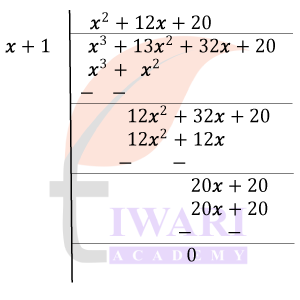
So, p(x) = (x + 1)(x² + 12x + 20)
= (x + 1)(x² + 12x + 20)
= (x + 1)[x² + (10 + 2)x + 20]
= (x + 1)[x² + 10x + 2x + 20]
= (x + 1)[x(x + 10) + 2(x + 10)]
= (x + 1)(x + 10)(x + 2)
(iv) 2y³ + y² – 2y – 1
See Solution(iv) 2y³ + y² – 2y – 1
Let p(y) = y³ + y² – 2y – 1
Putting y = -1, we get
p(-1) = 2(-1)³ + (-1)² – 2(-1) – 1 = -2 + 1 + 2 – 1 = 0
⇒ y + 1 is a factor of p(y).

So, p(y) = (y + 1)(2y² – y – 1)
= (y + 1)(2y² – y – 1)
= (y + 1)[2y² – (2 – 1)y – 1]
= (y + 1)[2y² – 2y + y – 1]
= (y + 1)[2y(y – 1) + 1(y – 1)]
= (y + 1)(y – 1)(2y + 1)
Class 9 Maths Exercise 2.4
1. Use suitable identities to find the following products:
(i) (x + 4)(x + 10)
See Solution(i) (x + 4)(x + 10)
= x² + (4 + 10)x + 4 × 10 [∵ (x + a)(x + b) = x² + (a + b)x + ab]
= x² + 14x + 40
(ii) (x + 8)(x – 10)
See Solution(ii) (x + 8)(x – 10)
= x² + (8 – 10)x + 8 × (-10) [∵ (x + a)(x + b) = x² + (a + b)x + ab]
= x² – 2x – 80
(iii) (3x + 4)(3x – 5)
See Solution(iii) (3x + 4)(3x – 5)
= (3x)² + (4 – 5)3x + 4 × (-5) [∵ (x + a)(x + b) = x² + (a + b)x + ab]
= 9x² – 3x – 20
(iv) (y² + 3/2)(y² – 3/2)
See Solution(iv) (y² + 3/2)(y² – 3/2)
= (y²)² – (3/2)² [∵ (a + b)(a – b) = a² – b²]
= y⁴ – 9/4
(v) (3 – 2x)(3 + 2x)
See Solution(v) (3 – 2x)(3 + 2x)
= (3)² – (2x)² [∵ (a + b)(a – b) = a² – b²]
= 9 – 4x²
2. Evaluate the following products without multiplying directly:
(i) 103 × 107
See Solution (i) 103 × 107
= (100 + 3)(100 + 7)
= (100)² + (3 + 7)100 + 3 × 7 [∵ (x + a)(x + b) = x² + (a + b)x + ab]
= 10000 + 1000 + 21
= 11021
(ii) 95 × 96
See Solution (ii) 95 × 96
= (100 – 5)(100 – 4)
= (100)² + (-5 – 4)100 + (-5) × (-4) [∵ (x + a)(x + b) = x² + (a + b)x + ab]
= 10000 – 900 + 20
= 9120
(iii) 104 × 96
See Solution(iii) 104 × 96
= (100 + 4)(100 – 4)
= (100)² – (4)² [∵ (a + b)(a – b) = a² – b²]
= 10000 – 16 = 9984
3. Factorise the following using appropriate identities:
(i) 9x² + 6xy + y²
See Solution (i) 9x² + 6xy + y²
= (3x)² + 2 × 3x × y + y²
= (3x + y)² [∵ a² + 2ab + b² = (a + b)²]
(ii) 4y² – 4y + 1
See Solution (ii) 4y² – 4y + 1
= (2y)² – 2 × 2y × 1 + 1²
= (2y – 1)² [∵ a² – 2ab + b² = (a – b)²]
(iii) x² – y²/100
See Solution(iii) x² – y²/100
= x² – (y/10)²
= (x + y/10)(x – y/10) [∵ a² – b² = (a + b)(a – b)]
4. Expand each of the following, using suitable identities:
(i) (x + 2y + 4z)²
See Solution(i) (x + 2y + 4z)²
= x² + (2y)² + (4z)² + 2 × (x) × (2y) + 2 × (2y) × (4z) + 2 × (4z) × (x)
[∵ (a + b + c)² = a² + b² + c² + 2ab + 2bc + 2ca]
= x² + 4y² + 16z² + 4xy + 16yz + 8xz
(ii) (2x – y + z)²
See Solution(ii) (2x – y + z)²
= (2x)² + (-y)² + (z)² + 2 × (2x) × (-y) + 2 × (-y) × (z) + 2 × (z) × (2x)
[∵ (a + b + c)² = a² + b² + c² + 2ab + 2bc + 2ca]
= 4x² + y² + z² – 4xy – 2yz + 4zx
(iii) (-2x + 3y + 2z)²
See Solution(iii) (-2x + 3y + 2z)²
= (-2x)² + (3y)² + (2z)² + 2 × (-2x) × (3y) + 2 × (3y) × (2z) + 2 × (2z) × (-2x)
[∵ (a + b + c)² = a² + b² + c² + 2ab + 2bc + 2ca]
= 4x² + 9y² + 4z² – 12xy + 12yz – 8zx
(iv) (3a – 7b – c)²
See Solution(iv) (3a – 7b – c)²
= (3a)² + (-7b)² + (-c)² + 2 × (3a) × (-7b) + 2 × (-7b) × (-c) + 2 × (-c) × (3a)
[∵ (a + b + c)² = a² + b² + c² + 2ab + 2bc + 2ca]
= 9a² + 49b² + c² – 42ab + 14bc – 6ca
(v) (-2x + 5y – 3z)²
See Solution(v) (-2x + 5y – 3z)²
= (-2x)² + (5y)² + (-3z)² + 2 × (-2x) × 5y + 2 × 5y × (-3z) + 2 × (-3z) × (-2x)
[∵ (a + b + c)² = a² + b² + c² + 2ab + 2bc + 2ca]
= 4x² + 25y² + 9z² – 20xy – 30yz + 12zx
(vi) [1/4a – 1/2b + 1]²
See Solution(vi) [1/4a – 1/2b + 1]²
= (1/4a)² + (-1/2b)² + 1² + 2 × (1/4a) × (-1/2b) + 2 × (-1/2b) × 1 + 2 × 1 × (1/4a)
[∵ (a + b + c)² = a² + b² + c² + 2ab + 2bc + 2ca]
= 1/16a² + 1/4b² + 1 – 1/4ab – b + 1/2a
5. Factorise:
(i) 4x² + 9y² + 16z² + 12xy – 24yz – 16xz
See Solution(i) 4x² + 9y² + 16z² + 12xy – 24yz – 16xz
= (2x)² + (3y)² + (-4z)² + 2 × (2x) × 3y + 2 × 3y × (-4z) + 2 × (-4z) × (2x)
= (2x + 3y – 4z)²
[∵ a² + b² + c² + 2ab + 2bc + 2ca = (a + b + c)²]
(ii) 2x² + y² + 8z² – 2√2xy + 4√2yz – 8xz
See Solution(ii) 2x² + y² + 8z² – 2√2xy + 4√2yz – 8xz
= (√2x)² + (-y)² + (-2√2z)² + 2(√2x)(-y) + 2(-y)(-2√2z) + 2(-2√2z)(√2x)
= (√2x – y – 2√2z)²
[∵ a² + b² + c² + 2ab + 2bc + 2ca = (a + b + c)²]
6. Write the following cubes in expanded form:
(i) (2x + 1)³
See Solution(i) (2x + 1)³
= (2x)³ + 1³ + 3(2x)²(1) + 3(2x)(1)²
[∵ (a + b)³ = a³ + b³ + 3a²b + 3ab²]
= 8x³ + 1 + 12x² + 6x
(ii) (2a – 3b)³
See Solution(ii) (2a – 3b)³
= (2a)³ + (-3b)³ + 3(2a)²(-3b) + 3(2a)(-3b)²
[∵ (a + b)³ = a³ + b³ + 3a²b + 3ab²]
= 8a³ – 27b³ – 36a²b + 54ab²
(iii) [3/2x + 1]³
See Solution (iii) [3/2x + 1]³
= (3/2x)³ + 1³ + 3(3/2x)²(1) + 3(3/2x)(1)²
[∵ (a + b)³ = a³ + b³ + 3a²b + 3ab²]
= 27/8x³ + 1 + 27/4x² + 9/2x
(iv) [x – 2/3y]³
See Solution (iv) [x – 2/3y]³
= (x)³ + (-2/3y)³ + 3(x)²(-2/3y) + 3(x)(-2/3y)²
[∵ (a + b)³ = a³ + b³ + 3a²b + 3ab²]
= x³ – 8/27y³ – 2x²y + 4/3xy²
7. Evaluate the following using suitable identities:
(i) (99)³
See Solution(i) (99)³
= (100 – 1)³
= (100)³ + (-1)³ + 3(100)²(-1) + 3(100)(-1)²
[∵ (a + b)³ = a³ + b³ + 3a²b + 3ab²]
= 1000000 – 1 – 30000 + 300
= 970299
(ii) (102)³
See Solution(ii) (102)³
= (100 + 2)³
= (100)³ + (2)³ + 3(100)²(2) + 3(100)(2)²
[∵ (a + b)³ = a³ + b³ + 3a²b + 3ab²]
= 1000000 + 8 + 60000 + 1200 = 1061208
(iii) (998)³
See Solution(iii) (998)³
= (1000 – 2)³
= (1000)³ + (-2)³ + 3(1000)²(-2) + 3(1000)(-2)²
[∵ (a + b)³ = a³ + b³ + 3a²b + 3ab²]
= 1000000000 – 8 – 6000000 + 12000 = 994011992
8. Factorise each of the following:
(i) 8a³ + b³ + 12a²b + 6ab²
See Solution (i) 8a³ + b³ + 12a²b + 6ab²
= (2a)³ + (b)³ + 3(2a)²(b) + 3(2a)(b)²
[∵ (a + b)³ = a³ + b³ + 3a²b + 3ab²]
= (2a + b)³
(ii) 8a³ – b³ – 12a²b + 6ab²
See Solution(ii) 8a³ – b³ – 12a²b + 6ab²
= (2a)³ + (-b)³ + 3(2a)²(-b) + 3(2a)(-b)²
[∵ (a + b)³ = a³ + b³ + 3a²b + 3ab²]
= (2a – b)³
(iii) 27 – 125a³ – 135a + 225a²
See Solution(iii) 27 – 125a³ – 135a + 225a²
= (3)³ + (-5a)³ + 3(3)²(-5a) + 3(3)(-5a)²
[∵ (a + b)³ = a³ + b³ + 3a²b + 3ab²]
= (3 – 5a)³
(iv) 64a³ – 27b³ – 144a²b + 108ab²
See Solution (iv) 64a³ – 27b³ – 144a²b + 108ab²
= (4a)³ + (-3b)³ + 3(4a)²(-3b) + 3(4a)(-3b)²
[∵ (a + b)³ = a³ + b³ + 3a²b + 3ab²]
= (4a – 3b)³
(v) 27p³ – 1/216 – 9/2p² + 1/4p
See Solution(v) 27p³ – 1/216 – 9/2p² + 1/4p
= (3p)³ + (-1/6)³ + 3(3p)²(-1/6) + 3(3p)(-1/6)²
[∵ (a + b)³ = a³ + b³ + 3a²b + 3ab²]
= (3p – 1/6)³
9. Verify:
(i) x³ + y³ = (x + y)(x² – xy + y²)
See Solution (i) x³ + y³ = (x + y)(x² – xy + y²)
RHS:
= (x + y)(x² – xy + y²)
= x(x² – xy + y²) + y(x² – xy + y²)
= x³ – x²y + xy² + yx² – xy² + y³
= x³ + y³
= LHS
(ii) x³ – y³ = (x – y)(x² + xy + y²)
See Solution(ii) x³ – y³ = (x – y)(x² + xy + y²)
RHS:
= (x – y)(x² + xy + y²)
= x(x² + xy + y²) – y(x² + xy + y²)
= x³ + x²y + xy² – yx² – xy² – y³
= x³ – y³
= LHS
10.Factorise each of the following:
(i) 27y³ + 125z³
See Solution(i) 27y³ + 125z³
= (3y)³ + (5z)³
= (3y + 5z)[(3y)² – (3y)(5z) + (5z)²]
[∵ x³ + y³ = (x + y)(x² – xy + y²)]
= (3y + 5z)(9y² – 15yz + 25z²)
(ii) 64m³ – 343n³
See Solution(ii) 64m³ – 343n³
= (4m)³ – (7n)³
= (4m – 7n)[(4m)² + (4m)(7n) + (7n)²]
[∵ x³ – y³ = (x – y)(x² + xy + y²)]
= (4m – 7n)(16m² + 28mn + 49n²)
11. Factorise: 27x³ + y³ + z³ – 9xyz
See Solution27x³ + y³ + z³ – 9xyz
= (3x)³ + y³ + z³ – 3(3x)yz
= (3x + y + z)[(3x)² + y² + z² – (3x)y – yz – z(3x)]
[∵ a³ + b³ + c³ – 3abc = (a + b + c)(a² + b² + c² – ab – bc – ca)]
= (3x + y + z)(9x² + y² + z² – 3xy – yz – 3zx)
12. Verify that: x³ + y³ + z³ – 3xyz = 1/2(x + y + z)[(x – y)² + (y – z)² + (z – x)²]
See Solution RHS
= 1/2(x + y + z)[(x – y)² + (y – z)² + (z – x)²]
= 1/2(x + y + z)[x² + y² – 2xy + y² + z² – 2yz + z² + x² – 2zx]
[∵ (a – b)² = a² + b² – 2ab]
= 1/2(x + y + z)(2x² + 2y² + 2z² – 2xy – 2yz – 2zx)
= 1/2 × 2(x + y + z)(x² + y² + z² – xy – yz – zx)
= (x + y + z)(x² + y² + z² – xy – yz – zx)
= x³ + y³ + z³ – 3xyz = LHS
[∵ (a + b + c)(a² + b² + c² – ab – bc – ca) = a³ + b³ + c³ – 3abc]
13. If x + y + z = 0, show that x³ + y³ + z³ = 3xyz.
See SolutionWe know that x³ + y³ + z³ – 3xyz = (x + y + z)(x² + y² + z² – xy – yz – zx)
If x + y + z = 0, then
x³ + y³ + z³ – 3xyz
= (0)(x² + y² + z² – xy – yz – zx)
⇒ x³ + y³ + z³ – 3xyz = 0
⇒ x³ + y³ + z³ = 3xyz
14. Without actually calculating the cubes, find the value of each of the following:
(i) (-12)³ + (7)³ + (5)³
See Solution (i) (-12)³ + (7)³ + (5)³
Let, a = -12, b = 7, c = 5
So, a + b + c = -12 + 7 + 5 = 0
We know that if a + b + c = 0, then a³ + b³ + c³ = 3abc
Therefore, (-12)³ + (7)³ + (5)³
= 3(-12)(7)(5)
= -1260
(ii) (28)³ + (-15)³ + (-13)³
See Solution(ii) (28)³ + (-15)³ + (-13)³
Let, a = 28, b = -15, c = -13
So, a + b + c = 28 – 15 – 13 = 0
We know that if a + b + c = 0, then a³ + b³ + c³ = 3abc
Therefore, (28)³ + (-15)³ + (-13)³
= 3(28)(-15)(-13)
= 16380
15. Give possible expressions for the length and breadth of each of the following rectangles, in which their areas are given:
(i) Area: 25a² – 35a + 12
See Solution(i) Area: 25a² – 35a + 12
= 25a² – 20a – 15a + 12
= 5a(5a – 4) – 3(5a – 4)
= (5a – 4)(5a – 3)
Therefore, length = (5a – 3) and breadth = (5a – 4) [as (5a – 3) > (5a – 4)]
(ii) Area: 35y² + 13y – 12
See Solution(ii) Area: 35y² + 13y – 12
= 35y² + 28y – 15y – 12
= 7y(5y + 4) – 3(5y + 4)
= (5y + 4)(7y – 3)
Therefore, length = (5y + 4) and breadth = (7y – 3)
16. What are the possible expressions for the dimensions of the cuboids whose volumes are given below?
(i) Volume = 3x² – 12x
See Solution(i) Volume = 3x² – 12x
= 3x(x – 4)
= (3)(x)(x – 4)
Hence, the possible dimensions of the cuboids are 3, x and x – 4.
(ii) Volume = 12ky² + 8ky – 20k
See Solution(ii) Volume = 12ky² + 8ky – 20k
= 4k(3y² + 2y – 5)
= 4k(3y² + 5y – 3y – 5)
= 4k[y(3y + 5) – 1(3y + 5)]
= (4k)(3y + 5)(y – 1)
Hence, the possible dimensions of the cuboids are 4k, (3y + 5) and (y – 1).
NCERT Maths Solutions for Polynomials Class 9 offer detailed explanations for each exercise, helping students solve even the most challenging problems with ease. Polynomials Class 9 Maths NCERT PDF Solutions ensures students grasp the application of factorization, remainder theorem and the graphical representation of polynomials effectively. This chapter is vital for building a strong mathematical foundation for future topics.
Class 9 Maths Exercise 2.1 in English
Class 9 Maths Exercise 2.2 in English
Class 9 Maths Exercise 2.3 in English
Class 9 Maths Exercise 2.4 in English
NCERT Class 9 Mathematics Textbook Chapter 2 Solutions are designed to help students tackle the various exercises in the chapter systematically. The Polynomials Chapter Class 9 NCERT Math material simplifies complex concepts like the relationship between zeroes and coefficients of a polynomial, making it easy for students to understand. Students can access the NCERT Textbook Class 9 Maths Chapter 2 PDF Download for offline study, which proves invaluable during revision sessions.
Class 9 Maths Chapter 2 Solution for State Boards
Each exercise in the Class 9 Mathematics Book Chapter 2 Polynomials Solutions is solved in a detailed manner, making it easier for students to follow and apply the methods independently. Polynomials Chapter 2 Class 9 Maths Solutions also highlight the importance of understanding algebraic identities, which play a crucial role in higher mathematics. For better preparation, students can rely on NCERT Exercise Class 9 Math Chapter 2 Solutions PDF to practice regularly and improve their problem-solving skills.
Class 9 Maths Chapter 2 Exercise 2.1
Class 9 Maths Chapter 2 Exercise 2.2
Class 9 Maths Chapter 2 Exercise 2.3
Class 9 Maths Chapter 2 Exercise 2.4
Class 9 Maths Chapter 2 Exercise 2.5
NCERT Solutions for Class 9 Maths Chapter 2
Polynomials are a key topic in the Class 9 Mathematics CBSE Syllabus and NCERT Textbook Solutions for Class 9 Math Textbook Polynomials provide an excellent resource for mastering this chapter. The Class 9 Maths NCERT Chapter 2 Solutions PDF Download option offers the flexibility to study anywhere. These NCERT Textbook Solutions for Class 9 Mathematics Chapter 2 Exercises focus on building a solid foundation by covering all exercises thoroughly, ensuring students excel in both academic and competitive exams. The Class 9 Maths Book Chapter 2 NCERT Answers emphasize the step-by-step approach, helping students understand the logic behind every solution.
Class 9 Maths Chapter 2 Solution in Hindi
The NCERT Book Class 9th Math Chapter 2 Solutions PDF also serves as a quick reference guide during exam preparations. By solving the Polynomials Class 9 NCERT Mathematics Solutions, students gain confidence in tackling polynomial-related problems and develop a deeper understanding of algebraic concepts essential for advanced studies. In addition to solutions, Tiwari Academy may also provide practice questions and additional exercises related to each topic. This extra practice can be valuable for reinforcing learning and improving problem-solving skills.
Class 9 Maths Exercise 2.1 in Hindi
Class 9 Maths Exercise 2.2 in Hindi
Class 9 Maths Exercise 2.3 in Hindi
Class 9 Maths Exercise 2.4 in Hindi
Important Points in Class 9 Maths Chapter 2 Polynomials
Definition and types of polynomials (linear, quadratic, cubic).
Degree of a polynomial and its significance.
Zeroes of a polynomial and their graphical representation.
Relationship between zeroes and coefficients.
Factorization methods: Remainder and Factor Theorem.
Algebraic identities and their applications.
| Day | Topic | Activities | Time (Hours) |
|---|---|---|---|
| Day 1 | Introduction to Polynomials | Read NCERT textbook, watch video lessons | 2 |
| Day 2 | Degree and Types of Polynomials | Practice examples and NCERT exercises | 2 |
| Day 3 | Zeroes of a Polynomial | Solve NCERT problems and test understanding | 2 |
| Day 4 | Relationship Between Zeroes and Coefficients | Review concepts and solve additional problems | 2 |
| Day 5 | Factorization of Polynomials | Practice NCERT examples and exercises | 2 |
| Day 6 | Algebraic Identities | Memorize identities, solve related problems | 2 |
| Day 7 | Revision and Practice | Take a mock test, review mistakes | 3 |
NCERT Textbook Solutions for Class 9 Maths Chapter 2 Polynomials in Hindi and English Medium revised and modified for academic year 2026-27. The solutions offered by Tiwari Academy often aim to simplify complex mathematical concepts, making it easier for students to understand and grasp the subject matter. Questions are based on latest NCERT books following new syllabus for exams.
| Class: 9 | Mathematics |
| Chapter 2: | Polynomials |
| Number of Exercises: | 4 (Four) |
| Content: | Chapter Exercises Solution |
| Mode: | Online Text and Videos |
| Academic Session: | 2026-27 |
| Medium: | English and Hindi Medium |
As per the Uttar Pradesh Board, Prayagraj – the NCERT Books are now implemented for class 9 Maths for 2026-27. So, the students of class 9 (High School) can download UP Board Solutions for Class 9 Maths Chapter 2 from the links given below. 9th Maths Chapter 2 Solutions are available in Hindi and English Medium.
Videos related to each exercise are also given below, which help the students to know the steps of solutions. Download NCERT (https://ncert.nic.in/) Solutions Apps and UP Board Solutions app and Offline Solutions based on latest Curriculum for 2026-27.
Study Materials on 9th Maths Chapter 2
Important Terms on 9th Maths Chapter 2
Important Questions on 9th Maths Chapter 2
Determine whether polynomials x³ + x² + x + 1 has x + 1 a factor?
Let p(x) = x³ + x² + x + 1 Putting x + 1 = 0, we get, x = – 1 Using remainder theorem, when p(x)= x³ + x² + x + 1 is divided by x + 1, remainder is given by p(-1) = (-1)³ + (-1)² + (-1) + 1 = – 1 + 1 – 1 + 1 = 0 Since, remainder p(-1) = 0, Hence x + 1 is a factor of x³ + x² + x + 1.
Use the Factor Theorem to determine whether g(x) is a factor of p(x): p(x) = 2x³ + x² – 2x – 1, g(x) = x + 1.
p(x) = 2x³ + x² – 2x – 1 and g(x) = x + 1 Putting x + 1 = 0, we get, x = -1 Using remainder theorem, when p(x) = 2x³ + x² – 2x – 1 is divided by g(x) = x + 1, remainder is given by p(-1) = (-1)³ + (-1)² + (-1) + 1 = – 1 + 1 – 1 + 1 = 0 Since, remainder p(-1) = 0, hence g(x) is a factor of p(x).
Find the value of k, if x – 1 is a factor of p(x) = x² + x + k.
p(x) = x² + x + k Putting x – 1 = 0, we get, x = 1 Using remainder theorem, When p(x) = x² + x + k is divided by x – 1, remainder is given by p(1) = (1)² + (1) + k = 2 + k Since x – 1 is a factor of p(x), hence remainder p(1) = 0 ⇒ 2 + k = 0 ⇒ k = -2
Find the zero of the polynomial p(x) = x + 5.
p(x) = x + 5 Putting p(x) = 0, we get x + 5 = 0 ⇒ x = – 5 Hence, x = – 5 is a zero of the polynomial p(x).
1. A combination of constants and variables, connected by four fundamental arithmetical operations +, -, x and / is called an algebraic expression. e.g. 6x² – 5y² + 2xy
2. An algebraic expression which have only whole numbers as the exponent of one variable, is called polynomial in one variable. e.g. 3x³ + 2x² – 7x + 5 etc.
3. The part of a polynomial separated from each other by + or – sign is called a term and each term of a polynomial has a coefficient.
4. Highest power of the variable in a polynomial, is known as degree of that polynomial.
5. The value obtained on putting a particular value of the variable in polynomial is called value of the polynomial at the value of variable.
6. Zero of a polynomial p(x) is a number alpha, such that p(alpha) = 0. It is also called root pf polynomial equation p(x) = 0.
7. Let f(x) be any polynomial of degree n,(n ≥ 1) and a be any real number. If f(x) is divided by the linear polynomial (x-a), then the remainder is f(a).
8. Let f(x) be a polynomial of degree n,(n ≥ 1) and a be any real number. Then,
i). If f(a) = 0, then (x – a) is a factor of f(x).
ii). If (x – a) is a factor of f(x), then f(a) = 0.
Polynomial on the Basis of Number of Terms
Polynomial on the Basis of Number of Terms
A polynomial containing one non-zero term, is called a monomial.
A polynomial containing two non-zero terms, is called a binomial.
A polynomial containing three non-zero terms, is called a trinomial.
Polynomial on the Basis of Degree of Variables
A polynomial of degree 0, is called a constant polynomial.
A polynomial of degree 1, is called a linear polynomial.
A polynomial of degree 2, is called a quadratic polynomial.
A polynomial of degree 3, is called a cubic polynomial.
A polynomial of degree 4, is called a biquadratic polynomial.
What is covered in NCERT Solutions for Class 9 Maths Chapter 2 Polynomials?
NCERT Textbook Solutions for Class 9 Maths Chapter 2 Polynomials cover all the essential topics in the chapter, including the definition and classification of polynomials, the degree of a polynomial and the types of polynomials based on the number of terms. It also explains crucial concepts like the zeroes of a polynomial, the relationship between zeroes and coefficients and algebraic identities. The solutions provide step-by-step explanations for all exercises, ensuring students gain a thorough understanding. These solutions help students prepare for exams by offering clear guidance on solving problems effectively.
What is the core motive of the chapter 2 Polynomials of class 9 Maths?
The core motive of chapter 2 Polynomials of class 9 Maths is to make the meaning of the following things clear to students.
- 1. Meaning of polynomials in one variable.
- 2. Terms of the polynomials.
- 3. Meaning of coefficients.
- 4. Meaning of zero polynomial.
- 5. Degree of the polynomial.
- 6. Types of the polynomial (Linear, Quadratic, Cubic).
- 7. Zeroes of a polynomial.
- 8. Factorization of polynomial, Factor theorem.
- 9. Algebraic identities.
How can NCERT Class 9 Maths Chapter 2 PDF Download help students?
The NCERT Class 9 Maths Chapter 2 PDF Download offers students a convenient way to study the chapter offline. The PDF contains detailed solutions for all exercises, helping students tackle problems systematically. It also provides a structured approach to learning key topics like the remainder theorem, factorization and graphical representation of polynomials. With the PDF, students can revise concepts, refer to step-by-step answers during practice and strengthen their problem-solving skills. This resource is particularly useful during exam preparation, as it ensures students have easy access to accurate and reliable solutions at your choice.
Is the chapter 2 Polynomials of class 9th Maths complicated?
No, chapter 2 Polynomials of class 9th Maths is not that complicated. Basically, in exercises 2.3 and 2.4, most of the students face a little problem. Exercises 2.1, and 2.2 are quite easy compared to exercise 2.3 and 2.4.
Why are Polynomials Class 9 NCERT Solutions PDF important for students?
Polynomials Class 9 Math NCERT Exercise Solutions PDF is an essential resource because it simplifies complex concepts and helps students build a strong foundation in algebra. These solutions explain each topic clearly, from understanding the types and degrees of polynomials to solving challenging problems using algebraic identities. The PDF format allows students to study at their own pace, making it a flexible tool for learning. Regular practice with these solutions improves accuracy and confidence in solving polynomial-related questions. This resource also helps students prepare for competitive exams by reinforcing their mathematical understanding and problem-solving techniques.
How many exercises are there in 9th Maths Chapter 2 with least number of difficult questions?
In chapter 2 of class 9th Maths, there are four exercises. The first exercise (Ex 2.1) contains five questions, the second exercise (Ex 2.2) contains four questions, the third exercise contains five questions, and the fourth exercise (Ex 2.4) contains sixteen questions. So the second exercise (Ex 2.2) has the least number of questions.
What is the significance of solving NCERT Solutions for Class 9 Polynomials?
Solving NCERT Complete Solutions for Class 9 Polynomials is crucial for mastering the chapter and excelling in exams. These solutions provide a clear and systematic approach to understanding polynomials, ensuring students grasp the fundamental concepts. Topics like the relationship between zeroes and coefficients, factorization and remainder theorem are explained with practical examples, making them easy to comprehend. Practicing these solutions regularly enhances students’ analytical and problem-solving skills. These solutions are aligned with the latest NCERT syllabus, ensuring comprehensive preparation for both school exams and competitive tests that include algebraic topics.
How many theorems are there in the chapter 2 Polynomials of class 9 Maths?
There are two theorems (Remainder theorem and Factor theorem) in chapter 2 Polynomials of class 9 Maths. Both the theorems are important for the exams. The remainder theorem is used in exercise 2.3, and the Factor theorem is used in exercise 2.4.