
Tiwari Academy  – Free CBSE NCERT Books and Solutions
  • Apps
    • CBSE Apps
    • Hast Rekha App
  • NCERT Solutions
    • NCERT Solutions for Class 12
      • NCERT Solutions for Class 12 Maths
      • NCERT Solutions for Class 12 Physics
      • NCERT Solutions for Class 12 Chemistry
      • NCERT Solutions for Class 12 Biology
      • NCERT Solutions for Class 12 English
      • NCERT Solutions for Class 12 Accounts
      • NCERT Solutions for Class 12 Business Studies
      • NCERT Solutions for Class 12 Economics
      • NCERT Solutions for Class 12 Geography
      • NCERT Solutions for Class 12 Physical Education
      • NCERT Solutions for Class 12 Political Science
      • NCERT Solutions for Class 12 Psychology
      • NCERT Solutions for Class 12 Sociology
    • NCERT Solutions for Class 11
      • NCERT Solutions for Class 11 Maths
      • NCERT Solutions for Class 11 Physics
      • NCERT Solutions for Class 11 Chemistry
      • NCERT Solutions for Class 11 Biology
      • NCERT Solutions for Class 11 English
      • NCERT Solutions for Class 11 Business Studies
      • NCERT Solutions for Class 11 Sociology
      • NCERT Solutions for Class 11 Political Science
      • NCERT Solutions for Class 11 Psychology
      • NCERT Solutions for Class 11 Physical Education
    • NCERT Solutions for Class 10
      • NCERT Solutions for Class 10 Maths
      • NCERT Solutions for Class 10 Science
      • NCERT Solutions for Class 10 English
      • NCERT Solutions for Class 10 Hindi Course A and B
      • NCERT Solutions for Class 10 Sanskrit
      • NCERT Solutions for Class 10 Social Science
    • NCERT Solutions for Class 9
      • NCERT Solutions for Class 9 Maths
      • NCERT Solutions for Class 9 Science
      • NCERT Solutions for Class 9 English
      • NCERT Solutions for Class 9 Hindi
      • NCERT Solutions for Class 9 Sanskrit
      • NCERT Solutions for Class 9 Social Science
    • NCERT Solutions for Class 8
      • NCERT Solutions for Class 8 Maths
      • NCERT Solutions for Class 8 Science
      • NCERT Solutions for Class 8 English
      • NCERT Solutions for Class 8 Hindi
      • NCERT Solutions for Class 8 Sanskrit
      • NCERT Solutions for Class 8 Social Science
      • NCERT Solutions for Class 8 Computer
    • NCERT Solutions for Class 7
      • NCERT Solutions for Class 7 Maths
      • NCERT Solutions for Class 7 Science
      • NCERT Solutions for Class 7 English
      • NCERT Solutions for Class 7 Hindi
      • NCERT Solutions for Class 7 Sanskrit
      • NCERT Solutions for Class 7 Social Science
      • NCERT Solutions for Class 7 Computer
    • NCERT Solutions for Class 6
      • NCERT Solutions for Class 6 Maths
      • NCERT Solutions for Class 6 Science
      • NCERT Solutions for Class 6 English
      • NCERT Solutions for Class 6 Hindi
      • NCERT Solutions for Class 6 Sanskrit Deepakam โ€“ Session 2026-27
      • NCERT Solutions for Class 6 Social Science
      • NCERT Solutions for Class 6 Computer
    • NCERT Solutions for Class 5
      • NCERT Solutions for Class 5 Hindi
      • NCERT Solutions for Class 5 English
      • NCERT Solutions for Class 5 Maths
      • NCERT Solutions for Class 5 EVS
      • NCERT Solutions for Class 5 Computer
      • NCERT Solutions for Class 5 GK
    • NCERT Solutions for Class 4
      • NCERT Solutions for Class 4 Hindi
      • NCERT Solutions for Class 4 English
      • NCERT Solutions for Class 4 Maths
      • NCERT Solutions for Class 4 EVS
      • NCERT Solutions for Class 4 Computer
      • NCERT Solutions for Class 4 GK
    • NCERT Solutions for Class 3
      • NCERT Solutions for Class 3 Hindi
      • NCERT Solutions for Class 3 English
      • NCERT Solutions for Class 3 Maths
      • NCERT Solutions for Class 3 EVS
      • NCERT Solutions for Class 3 Science
      • NCERT Solutions for Class 3 Computer
      • NCERT Solutions for Class 3 GK
    • NCERT Solutions for Class 2
      • NCERT Solutions for Class 2 Hindi
      • NCERT Solutions for Class 2 English
      • NCERT Solutions for Class 2 Maths
      • NCERT Solutions for Class 2 EVS
      • NCERT Solutions for Class 2 Science
      • NCERT Solutions for Class 2 Computer
      • NCERT Solutions for Class 2 GK
    • NCERT Solutions for Class 1
      • NCERT Solutions for Class 1 Hindi
      • NCERT Solutions for Class 1 English
      • NCERT Solutions for Class 1 Maths
      • NCERT Solutions for Class 1 EVS
      • NCERT Solutions for Class 1 Computer
      • NCERT Solutions for Class 1 Science
      • NCERT Solutions for Class 1 GK
    • Study Material for KG
      • Study Material for KG English
      • Study Material for KG Hindi
      • Study Material for KG Maths
    • Study Material for Nursery
      • Study Material for Nursery Maths
      • Study Material for Nursery English
      • Study Material for Nursery Hindi
  • MCQ
  • NEWS
    • Educational NEWS
    • Explore More
  • Grammar
    • Class 1 English Grammar
      • Class 1 Hindi Vyakaran
    • Class 2 English Grammar
      • Class 2 Hindi Vyakaran
    • Class 3 English Grammar
      • Class 3 Hindi Vyakaran
    • Class 4 English Grammar
      • Class 4 Hindi Vyakaran
    • Class 5 English Grammar
      • Class 5 Hindi Vyakaran
    • Class 6 English Grammar
      • Class 6 Hindi Vyakaran
    • Class 7 English Grammar
      • Class 7 Hindi Vyakaran
    • Class 8 English Grammar
      • Class 8 Hindi Vyakaran
  • Sample Papers
    • CBSE Sample Papers for Class 9
    • CBSE Sample Papers for Class 10
    • CBSE Sample Papers for Class 11
    • CBSE Sample Papers for Class 12
  • NCERT Books
    • NCERT Books for Class 1 All Subjects
    • NCERT Books for Class 2 All Subjects
    • NCERT Books for Class 3 All Subjects
    • NCERT Books for Class 4 All Subjects
    • NCERT Books for Class 5 All Subjects
    • NCERT Books for Class 6 All Subjects
    • NCERT Books for Class 7 All Subjects
    • NCERT Books for Class 8 All Subjects
    • NCERT Books for Class 9 All Subjects
    • NCERT Books for Class 10 All Subjects
    • NCERT Books for Class 11 All Subjects
    • NCERT Books for Class 12 All Subjects
  • Syllabus
    • CBSE Date Sheet 2025
    • CBSE Syllabus
    • NCERT Exemplar
    • What is NIOS?
    • NIOS Online Admission
  • Contact
    • Contact Us
    • About Us
    • Online Tutors
    • Career Options
  • Apps
    • CBSE Apps
    • Hast Rekha App
  • NCERT Solutions
    • NCERT Solutions for Class 12
      • NCERT Solutions for Class 12 Maths
      • NCERT Solutions for Class 12 Physics
      • NCERT Solutions for Class 12 Chemistry
      • NCERT Solutions for Class 12 Biology
      • NCERT Solutions for Class 12 English
      • NCERT Solutions for Class 12 Accounts
      • NCERT Solutions for Class 12 Business Studies
      • NCERT Solutions for Class 12 Economics
      • NCERT Solutions for Class 12 Geography
      • NCERT Solutions for Class 12 Physical Education
      • NCERT Solutions for Class 12 Political Science
      • NCERT Solutions for Class 12 Psychology
      • NCERT Solutions for Class 12 Sociology
    • NCERT Solutions for Class 11
      • NCERT Solutions for Class 11 Maths
      • NCERT Solutions for Class 11 Physics
      • NCERT Solutions for Class 11 Chemistry
      • NCERT Solutions for Class 11 Biology
      • NCERT Solutions for Class 11 English
      • NCERT Solutions for Class 11 Business Studies
      • NCERT Solutions for Class 11 Sociology
      • NCERT Solutions for Class 11 Political Science
      • NCERT Solutions for Class 11 Psychology
      • NCERT Solutions for Class 11 Physical Education
    • NCERT Solutions for Class 10
      • NCERT Solutions for Class 10 Maths
      • NCERT Solutions for Class 10 Science
      • NCERT Solutions for Class 10 English
      • NCERT Solutions for Class 10 Hindi Course A and B
      • NCERT Solutions for Class 10 Sanskrit
      • NCERT Solutions for Class 10 Social Science
    • NCERT Solutions for Class 9
      • NCERT Solutions for Class 9 Maths
      • NCERT Solutions for Class 9 Science
      • NCERT Solutions for Class 9 English
      • NCERT Solutions for Class 9 Hindi
      • NCERT Solutions for Class 9 Sanskrit
      • NCERT Solutions for Class 9 Social Science
    • NCERT Solutions for Class 8
      • NCERT Solutions for Class 8 Maths
      • NCERT Solutions for Class 8 Science
      • NCERT Solutions for Class 8 English
      • NCERT Solutions for Class 8 Hindi
      • NCERT Solutions for Class 8 Sanskrit
      • NCERT Solutions for Class 8 Social Science
      • NCERT Solutions for Class 8 Computer
    • NCERT Solutions for Class 7
      • NCERT Solutions for Class 7 Maths
      • NCERT Solutions for Class 7 Science
      • NCERT Solutions for Class 7 English
      • NCERT Solutions for Class 7 Hindi
      • NCERT Solutions for Class 7 Sanskrit
      • NCERT Solutions for Class 7 Social Science
      • NCERT Solutions for Class 7 Computer
    • NCERT Solutions for Class 6
      • NCERT Solutions for Class 6 Maths
      • NCERT Solutions for Class 6 Science
      • NCERT Solutions for Class 6 English
      • NCERT Solutions for Class 6 Hindi
      • NCERT Solutions for Class 6 Sanskrit Deepakam โ€“ Session 2026-27
      • NCERT Solutions for Class 6 Social Science
      • NCERT Solutions for Class 6 Computer
    • NCERT Solutions for Class 5
      • NCERT Solutions for Class 5 Hindi
      • NCERT Solutions for Class 5 English
      • NCERT Solutions for Class 5 Maths
      • NCERT Solutions for Class 5 EVS
      • NCERT Solutions for Class 5 Computer
      • NCERT Solutions for Class 5 GK
    • NCERT Solutions for Class 4
      • NCERT Solutions for Class 4 Hindi
      • NCERT Solutions for Class 4 English
      • NCERT Solutions for Class 4 Maths
      • NCERT Solutions for Class 4 EVS
      • NCERT Solutions for Class 4 Computer
      • NCERT Solutions for Class 4 GK
    • NCERT Solutions for Class 3
      • NCERT Solutions for Class 3 Hindi
      • NCERT Solutions for Class 3 English
      • NCERT Solutions for Class 3 Maths
      • NCERT Solutions for Class 3 EVS
      • NCERT Solutions for Class 3 Science
      • NCERT Solutions for Class 3 Computer
      • NCERT Solutions for Class 3 GK
    • NCERT Solutions for Class 2
      • NCERT Solutions for Class 2 Hindi
      • NCERT Solutions for Class 2 English
      • NCERT Solutions for Class 2 Maths
      • NCERT Solutions for Class 2 EVS
      • NCERT Solutions for Class 2 Science
      • NCERT Solutions for Class 2 Computer
      • NCERT Solutions for Class 2 GK
    • NCERT Solutions for Class 1
      • NCERT Solutions for Class 1 Hindi
      • NCERT Solutions for Class 1 English
      • NCERT Solutions for Class 1 Maths
      • NCERT Solutions for Class 1 EVS
      • NCERT Solutions for Class 1 Computer
      • NCERT Solutions for Class 1 Science
      • NCERT Solutions for Class 1 GK
    • Study Material for KG
      • Study Material for KG English
      • Study Material for KG Hindi
      • Study Material for KG Maths
    • Study Material for Nursery
      • Study Material for Nursery Maths
      • Study Material for Nursery English
      • Study Material for Nursery Hindi
  • MCQ
  • NEWS
    • Educational NEWS
    • Explore More
  • Grammar
    • Class 1 English Grammar
      • Class 1 Hindi Vyakaran
    • Class 2 English Grammar
      • Class 2 Hindi Vyakaran
    • Class 3 English Grammar
      • Class 3 Hindi Vyakaran
    • Class 4 English Grammar
      • Class 4 Hindi Vyakaran
    • Class 5 English Grammar
      • Class 5 Hindi Vyakaran
    • Class 6 English Grammar
      • Class 6 Hindi Vyakaran
    • Class 7 English Grammar
      • Class 7 Hindi Vyakaran
    • Class 8 English Grammar
      • Class 8 Hindi Vyakaran
  • Sample Papers
    • CBSE Sample Papers for Class 9
    • CBSE Sample Papers for Class 10
    • CBSE Sample Papers for Class 11
    • CBSE Sample Papers for Class 12
  • NCERT Books
    • NCERT Books for Class 1 All Subjects
    • NCERT Books for Class 2 All Subjects
    • NCERT Books for Class 3 All Subjects
    • NCERT Books for Class 4 All Subjects
    • NCERT Books for Class 5 All Subjects
    • NCERT Books for Class 6 All Subjects
    • NCERT Books for Class 7 All Subjects
    • NCERT Books for Class 8 All Subjects
    • NCERT Books for Class 9 All Subjects
    • NCERT Books for Class 10 All Subjects
    • NCERT Books for Class 11 All Subjects
    • NCERT Books for Class 12 All Subjects
  • Syllabus
    • CBSE Date Sheet 2025
    • CBSE Syllabus
    • NCERT Exemplar
    • What is NIOS?
    • NIOS Online Admission
  • Contact
    • Contact Us
    • About Us
    • Online Tutors
    • Career Options
เคนเคฟเค‚เคฆเฅ€ เคฎเฅ€เคกเคฟเคฏเคฎเคนเคฟเค‚เคฆเฅ€ เคฎเฅ€เคกเคฟเคฏเคฎ Latest BlogsLatest Blogs Ask QuestionsAsk Questions
Tiwari Academy  /  Latest News  /  NCERT Solutions for Class 9 Maths - Ganita Manjari Part 1 (2026-27) Complete Guide for Students and Parents

NCERT Solutions for Class 9 Maths – Ganita Manjari Part 1 (2026-27) Complete Guide for Students and Parents

NCERT Class 9 mathematics new Textbook Ganita Manjari
Post Date: April 17, 2026

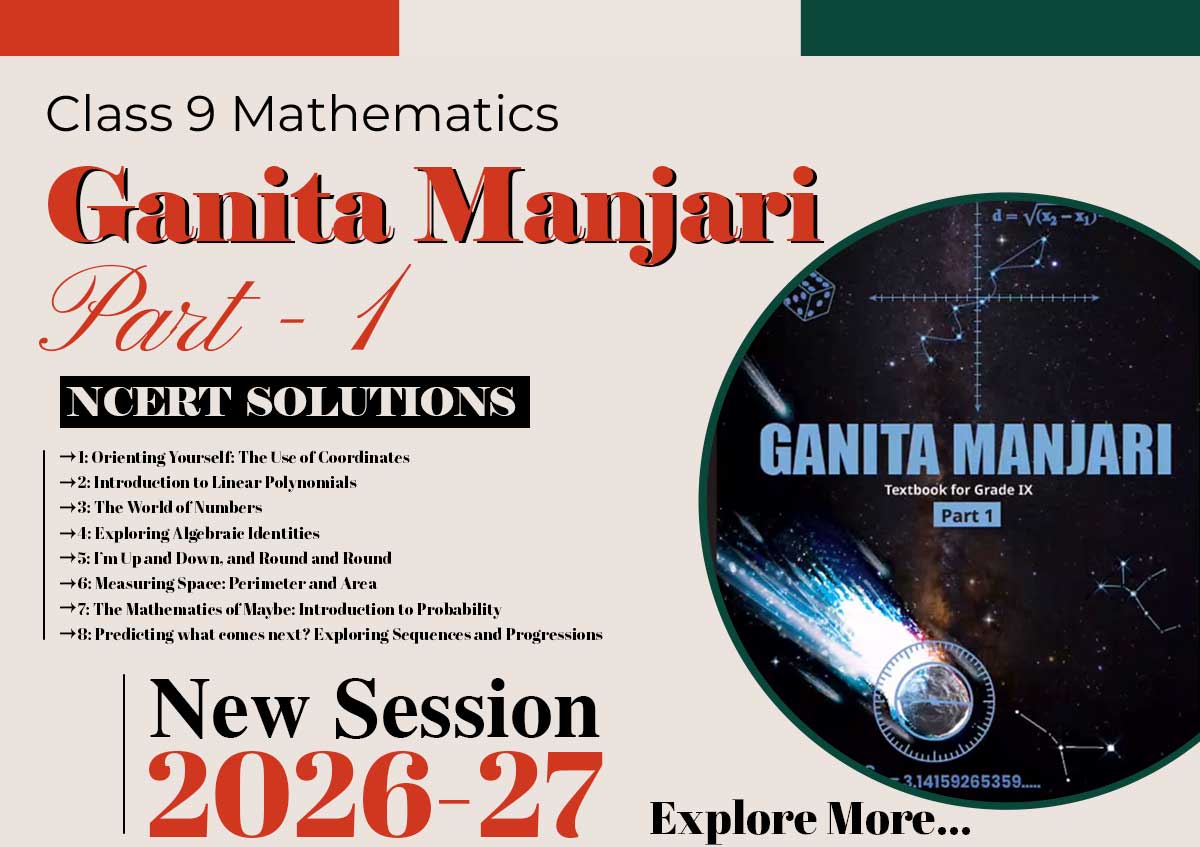
Session 2026-27 brought the most significant change to Class 9 Mathematics in over a decade. NCERT replaced the previous 12-chapter textbook with Ganita Manjari Part 1 โ€” eight redesigned chapters that approach mathematics differently, asking students to reason and explain rather than simply calculate and memorise.
Most students opening this new book for the first time notice immediately that something feels different. Questions appear before the method is taught. Chapter titles read more like conversations than topics. Some exercises have no single correct approach. None of this is accidental โ€” it reflects a deliberate shift in how NCERT wants mathematics to be learned at the secondary level under NEP 2020 and NCF-SE 2023.
This guide is for students who want to go deeper than the chapter content itself โ€” understanding which chapters are hardest and why, what is the solutions of class 9 mathematics Ganita Manjari, what mistakes are most common, how the new curriculum connects forward to Class 10 mathematics and how parents can support their child through a textbook that looks and works very differently from what came before.

Why Ganita Manjari Part 1 Feels Different from the Previous Textbook

Students and parents expecting a reorganised version of the old NCERT Class 9 Maths book have been surprised this session. Ganita Manjari Part 1 is not a reorganisation โ€” it is a reimagination of what Class 9 mathematics should involve.
The previous textbook followed a predictable structure: introduce a concept, state the formula, show a worked example, then give practice problems in increasing difficulty. Students who recognised patterns and memorised procedures did well. Those who needed to understand the reasoning before applying a method often struggled without knowing why.
The new textbook reverses this. You frequently encounter a question before being given the method to solve it. You are expected to observe, notice a pattern and reach a conclusion โ€” and only then does the book confirm and formalise it. This is genuinely how mathematics is practised, but it demands a different relationship with the textbook. Reading becomes as important as solving.
Three things that specifically feel unfamiliar in the new curriculum:

  1. Problems with multiple valid approaches โ€” Particularly in Chapters 4 and 5, more than one method can be correct. Students accustomed to the old format of one method per question type find this disorienting at first.
  2. Written reasoning expected โ€” Several exercises ask you to justify or explain a result in words, not just state it. This is a new skill for most Class 9 students and worth building early in the session.
  3. Chapters that reference each other โ€” In the previous book, chapters were largely independent. In Ganita Manjari Part 1, ideas from Chapter 1 reappear in Chapter 2, Chapter 3 supports Chapter 4, and Chapter 8 draws on Chapter 2. Missing a concept early has a larger downstream effect than it did before.

Ganita Manjari Chapters Difficulty Ratings for Session 2026-27

Not all eight chapters in the new textbook demand equal time and effort. This table gives an honest assessment based on the nature of the content, the type of questions asked and where students are most commonly getting stuck this session.

ChapterDifficultyKey Reason
1. Orienting Yourself: The Use of CoordinatesModerateProcedural โ€” distance and midpoint formulas are learnable with consistent practice
2. Introduction to Linear PolynomialsModerateโ€“HighGraph interpretation and slope intuition require conceptual thinking, not just calculation
3. The World of NumbersHighProof-based chapter โ€” irrationality proofs require a style of thinking most students have not encountered before
4. Exploring Algebraic IdentitiesModerateFamiliar topic area but geometric visualisation and algebra tile approach is genuinely new
5. I’m Up and Down, and Round and RoundHighMost abstract chapter in the book โ€” no formula to memorise, entirely pattern and reasoning based
6. Measuring Space: Perimeter and AreaModerateCalculation-heavy but logical โ€” Brahmagupta’s formula and arc length derivation are the new additions
7. Introduction to ProbabilityLowโ€“ModerateAccessible conceptually โ€” tree diagrams and sample space reward organised thinking
8. Sequences and ProgressionsHighMultiple formula types, GP applications and Tower of Hanoi require sustained, structured effort

Where to invest extra time this session: Chapters 3, 5 and 8 consistently require more sessions than students initially plan for. Chapter 3 especially โ€” students often feel they understand it after reading, only to find proof questions difficult in practice.
Where to build early confidence: Chapters 1, 6 and 7 reward regular practice without the conceptual leap that Chapters 3 and 5 demand. Starting here builds momentum for the harder chapters later.

Common Mistakes Students Make – Chapter-wise

Knowing what typically goes wrong is one of the fastest ways to avoid making the same errors yourself. These are the most frequent mistakes observed in the new textbook this session.

Chapter 1 – Coordinates

  • Writing the distance formula as โˆš[(xโ‚‚ – xโ‚) + (yโ‚‚ – yโ‚)] instead of โˆš[(xโ‚‚ – xโ‚)ยฒ + (yโ‚‚ – yโ‚)ยฒ] – the squaring step is missed under exam pressure. Write the formula in full before substituting every time.
  • Swapping x and y coordinates when plotting points. Remember: always horizontal first, then vertical – across before up.

Chapter 2 – Linear Polynomials

  • Confusing slope and y-intercept in y = ax + b. A simple fix: “a travels with x, so a is the slope.”
  • Drawing linear graphs with only two plotted points and connecting them with a curve. Linear means straight – always use a ruler and plot at least three points to confirm.

Chapter 3 – The World of Numbers

  • Memorising the โˆš2 irrationality proof word-for-word but being unable to adapt it to โˆš3 or โˆš5. The structure matters more than the words: assume rational, derive a contradiction, conclude irrational. Practise applying the structure, not reciting specific lines.
  • Confusing “dense” with “infinite.” Rational numbers are dense because between any two of them another always exists – not simply because there are infinitely many.

Chapter 4 – Algebraic Identities

  • Expanding (a + b)ยณ incorrectly as aยณ + bยณ – one of the most persistent errors across all of Class 9 Maths. Derive the expansion yourself from (a+b)(a+b)(a+b) at least twice rather than memorising the final form directly.
  • Sign errors in subtraction identities – treating (a – b)ยฒ as simply the addition version with a minus sign. They are separate cases and must be treated as such.

Chapter 5 – Up and Down, Round and Round

  • Searching for a formula to memorise for every question. This chapter is not formula-based. Treat each question as an observation exercise – describe what you see before attempting any calculation.

Chapter 6 – Measuring Space

  • Forgetting to halve the perimeter in Heron’s formula. The semi-perimeter is s = (a+b+c)/2, not (a+b+c). This single error invalidates the entire calculation.
  • Confusing arc length with sector area. Arc length is a one-dimensional measurement using 2ฯ€r. Sector area is a two-dimensional measurement using ฯ€rยฒ. They are fundamentally different things.

Chapter 7 – Probability

  • Listing incomplete sample spaces, especially in two-coin, two-dice or combined event problems. Always draw a table or tree diagram before listing outcomes – never list from memory.
  • Calculating a probability greater than 1. This is always wrong. Use P(E) + P(not E) = 1 as a built-in checking tool after every probability answer.

Chapter 8 – Sequences and Progressions

  • Confusing AP and GP in mixed questions. Test for common difference first (AP). If that fails, test for common ratio (GP). Never assume.
  • Using n = 0 as the first term. The first term corresponds to n = 1 in aโ‚™ = a + (n-1)d. Substituting n = 0 gives a value that does not belong to the sequence.


How Ganita Manjari Part 1 Connects to Class 10 Maths

A common mistake is to study Class 9 in isolation. Ganita Manjari Part 1 is specifically designed to feed forward – several chapters lay the direct conceptual groundwork for major Class 10 Maths topics. Knowing these connections helps you study smarter this session.

Ganita Manjari ChapterConnects Directly To in Class 10
Chapter 1 – CoordinatesCoordinate Geometry โ€” distance formula, section formula, area of triangle on a plane
Chapter 2 – Linear PolynomialsPolynomials โ€” zeroes of polynomials, relationship between zeroes and coefficients
Chapter 3 – Number SystemReal Numbers โ€” Euclid’s division lemma, irrationality proofs revisited at higher level
Chapter 4 – Algebraic IdentitiesPolynomials and Quadratic Equations – factorisation, discriminant, roots
Chapter 6 – MensurationSurface Areas and Volumes – combined solids, frustum of a cone
Chapter 7 – ProbabilityProbability โ€” theoretical probability, complementary events, real-life word problems
Chapter 8 – Sequences and ProgressionsArithmetic Progressions – full dedicated chapter, sum formula, real-life applications

Chapter 8 deserves special mention. Arithmetic Progressions is a complete, high-weightage unit in NCERT Class 10 Maths. Students who genuinely understand Chapter 8 of Ganita Manjari Part 1 – not just the formulas but the reasoning behind them โ€” enter Class 10 with a measurable advantage over those who rushed through it.

A Parent’s Guide to the New Class 9 Maths Textbook – Ganita Manjari

If your child came home with Ganita Manjari Part 1 this session and you are trying to understand what changed and how to help, this section is specifically for you.
What is fundamentally different this session?
The previous textbook could be supported at home by checking whether your child had memorised the right formula. Ganita Manjari Part 1 cannot be supported that way. A student can know the correct formula and still answer a question incorrectly if they do not understand when and why to use it. The shift is from procedural memory to conceptual understanding โ€” and it requires a different kind of support at home.
Five ways to help without knowing Class 9 Maths yourself:

  1. Ask “what is this chapter about?” not “have you finished the exercises?” – explaining a concept in your own words is itself one of the most effective learning techniques known to work.
  2. Make sure the textbook is being read, not just the NCERT Solutions. Ganita Manjari is written to be read like a conversation. The understanding lives in the chapter text, not in the exercise answers alone.
  3. Check that solutions are being used to understand mistakes, not to avoid making them in the first place. The right use of step-by-step solutions is: attempt first, check after, understand where the reasoning went wrong.
  4. Help your child plan backwards from unit test dates, allocating extra days to Chapters 3, 5 and 8 which consistently take longer than expected.
  5. If your child says “I don’t understand why we have to prove things” – that is a normal and healthy reaction to Chapter 3. Let them know that constructing a logical argument that cannot be disputed is a life skill, not just a Maths requirement.

Three signs your child may be struggling beyond normal adjustment:

  • Finishing chapter exercises unusually quickly – Ganita Manjari exercises are not meant to be completed in one sitting. Speed here usually indicates copying rather than understanding.
  • Being unable to explain a concept without looking at notes – genuine understanding means being able to describe an idea in your own words without reference material.
  • Consistently avoiding Chapters 3 and 5 – these are the chapters students find hardest and are most tempted to defer indefinitely.

Smart Exam Strategy for Session 2026-27 School Tests

School unit tests and half-yearly exams based on Ganita Manjari Part 1 test differently from exams based on the old textbook. Understanding the new question types before your first test makes a significant difference.
The four main question types in the new exam pattern:

  1. Concept-based MCQs – These test understanding, not recall. “Which of the following is always irrational?” requires genuine understanding of Chapter 3, not just memory of a list.
  2. Reasoning and explanation questions – Short answers where you write one or two sentences explaining a step or result. New to most Class 9 students but increasingly common in 2026-27 assessments.
  3. Application problems – Real-life context questions where you identify which mathematical tool applies. Reading the question carefully before calculating is the key skill here.
  4. Proof-based questions – Primarily from Chapter 3 and the geometry sections of Chapter 6. Step marks are awarded even for incomplete proofs, so always write what you know.

Time allocation strategy for a 3-hour exam:

  • First 10 minutes: Read all questions before writing anything. Mark questions you can answer confidently and those you need to return to.
  • Attempt high-confidence questions first to build momentum and secure available marks early.
  • For proof questions: state the given information clearly, then state what is to be proved, then begin. Examiners award marks at each step – a correct beginning earns marks even if the proof is not completed.
  • For MCQs: eliminate clearly wrong options before selecting. Ganita Manjari-style MCQs often have two plausible options – elimination improves accuracy significantly.
  • Final 15 minutes: review all calculation-based answers specifically for arithmetic errors and missed steps. These are the easiest marks to recover on review.

Chapters offering the best marks-per-revision-hour ratio:

  • Chapter 1 and Chapter 7 – Relatively structured, reward consistent practice.
  • Chapter 6 – Formula-based with clear application – Heron’s formula alone appears across multiple question types.
  • Chapter 4 – Identity questions are predictable in format. Master the standard identities and the marks follow reliably.

How Teachers Are Approaching the New Textbook

Understanding how your teacher is likely teaching Class 9 Mathematics Ganita Manjari Part 1 this session helps you get more out of every class.

  • More discussion, less dictation: Teachers using the new textbook are increasingly moving toward discussion-led lessons – asking what students notice before explaining. Passive listening is less effective here than it was with the previous textbook. Students who read the chapter before class participate more actively and retain concepts far longer.
  • Activity-based class time: Ganita Manjari includes activities built into the chapters – the square root spiral construction, algebra tile factorisation, probability experiments with coins and dice. Many teachers are using classroom time for these rather than just working through exercises. Understanding the activity before class lets you contribute meaningfully and builds stronger conceptual clarity than any amount of post-class reading.
  • Greater emphasis on written responses in internal assessment: The NCF 2023 framework places increased importance on reasoning and communication in mathematics. Schools adopting the new approach are beginning to include short explanation questions in internal tests. Practising writing a clear, one-sentence mathematical justification is increasingly a marks-earning skill in Session 2026-27 and beyond.
  • Less repetitive drilling, more varied application: Teachers are assigning fewer problems of identical type and more varied application questions. This means doing twenty identical problems of the same format is less valuable than doing five problems each from four different contexts. Quality of practice matters more than quantity this session.

Frequently Asked Questions – New Class 9 Maths Textbook 2026-27

My school issued Ganita Manjari Part 1 but my tuition teacher is still using the old NCERT book. Which should I follow?

Follow Ganita Manjari Part 1 as your primary resource since your school exams will be based on it. The old book covers several overlapping topics and works well as supplementary practice – particularly for polynomials, quadrilaterals and probability. Using both is not a problem as long as the new textbook remains your main focus.

Chapter 5 of the new textbook of 9th mathematics has no clear formula. How should I prepare it for exams?

Chapter 5 – “I’m Up and Down, and Round and Round” – is assessed through observation and description rather than formula application. Read the chapter carefully twice, write notes about what types of patterns are discussed and practise describing mathematical behaviour in simple sentences. Questions from this chapter test pattern recognition and interpretation, not calculation.

Is Brahmagupta’s formula examinable or just background reading?

It is part of the prescribed content in Chapter 6 of Ganita Manjari Part 1 and can be examined. School-level questions typically ask you to apply the formula to a straightforward cyclic quadrilateral rather than derive it from scratch. Know the formula, understand what a cyclic quadrilateral is and practise substituting values correctly.

The irrationality proof in Chapter 3 of 9th new Maths book confuses me. Is there a simpler way to understand it?

The proof has three steps and once you see the structure, it applies permanently.

  • First – assume โˆš2 equals p/q in its simplest form.
  • Second – show this forces both p and q to be even, which contradicts them being in simplest form.
  • Third – conclude the assumption was wrong, so โˆš2 must be irrational.

The key moment is step two: squaring both sides gives pยฒ = 2qยฒ, meaning pยฒ is even, therefore p is even. Writing p = 2k and substituting forces q to be even by the same logic. That is the complete proof – the rest is just formal presentation.

How much weightage does Chapter 8 – Sequences and Progressions – carry in exams?

In most CBSE schools that have adopted the new textbook for Session 2026-27, Chapter 8 carries approximately 15 to 20 percent of the annual exam marks. It is among the highest-weightage chapters in the new syllabus, making it worth significant preparation time despite being one of the more demanding chapters.

Can students from UP Board, MP Board and other state boards use these solutions?

Yes. Students from state boards that follow NCERT textbooks – including UP Board, MP Board, Rajasthan Board and several others – can use these NCERT Textbook Solutions directly for exam preparation. If your board follows its own prescribed textbook rather than NCERT, verify with your teacher before using these as your primary resource.

Is there a Ganita Manjari Part 2 for Class 9 as well?

Currently for Session 2026-27, only Ganita Manjari Part 1 is published for Class 9. There is no Part 2 for Class 9 so far. The “Part 1” in the title indicates it is part of an ongoing series under the NEP 2020 curriculum, but this does not means that Class 9 students only require Part 1 for the current academic session.

My child did well in Class 8 Maths but is struggling with the new Class 9 book. Is this expected?

Yes, and it is one of the most common concerns raised by parents this session. The difficulty is not in the mathematics itself but in the style of engagement required. Class 8 Maths still relies predominantly on calculation and procedure. Class 9 Maths Ganita Manjari Part 1 demands reasoning and explanation at a level that is genuinely new for most students. The adjustment typically takes four to six weeks. Students who stay engaged with the textbook through that period consistently report finding it more interesting than the old format โ€” not less.

Ganita Manjari Part 1 asks more of Class 9 students than any previous NCERT Maths textbook – more thinking, more patience with uncertainty and more willingness to reason before arriving at an answer. That is uncomfortable at first and genuinely valuable once you move through the initial unfamiliarity.

The free chapter-wise solutions, discussion forum and study resources at Tiwari Academy are here to support that process for every student in Session 2026-27 – whether you are working through a proof that does not quite land yet, preparing for your first unit test on the new syllabus or trying to understand as a parent what this new textbook actually demands of your child.

Recent Posts
  • NCERT Solutions for Class 10 Maths 2026-27 – Welcome to Your New Session
  • CBSE Class 10 English Exam Paper 2026: Solutions, Answer Key & Analysis
  • CBSE Class 10 Science Board Exam Paper 2026: Complete Solutions and Answer Key
  • Class 10 Maths CBSE Exam Paper 2026 Solutions
  • Class 9 Maths Chapter 6 Lines and Angles Preparation


Important Links
  • What is NCERT?
  • Important Questions
  • Vedic Maths Tricks
  • Link Study Materials
  • Useful Resources & Formulae
  • Holiday Homework Solutions


Buy NCERT Books Online

NCERT Books for 2026-27

NCERT Solutions
  • NCERT Solutions for Class 6 Maths
  • NCERT Solutions for Class 7 Maths
  • NCERT Solutions for Class 8 Maths
  • NCERT Solutions for Class 11 Maths
  • NCERT Solutions for Class 12 Maths
  • NCERT Solutions for Class 11 Physics
  • NCERT Solutions for Class 12 Physics


High School
  • Class 9 NCERT Maths Solutions
  • Class 9 NCERT Science Solutions
  • Class 9 NCERT English Solutions
  • Class 10 NCERT Maths Solutions
  • Class 10 NCERT Science Solutions
  • Class 10 NCERT English Solutions
  • Class 10 NCERT Social Solutions

Quick Links
  • NCERT Books
  • NCERT Solutions
  • CBSE Syllabus
  • Home Tutors
  • NIOS Admissions
  • CBSE Sample Papers
  • Vedic Maths Tricks
Help & Support
  • About Us
  • Contact Us
  • Advertise With Us
  • Discussion
  • Latest Blogs
  • Holiday Homework
  • Useful Resources
Copyright 2026 by Tiwari Academy | A step towards Free Education
facebook
twitter
linkedin
youtube
instagram
pinterest
google-news