



by Tiwari Academy Team
NCERT Textbook Solutions for Class 9 Science Exploration in Hindi and English Medium at Tiwari Academy provide Notes and Exercises Question Answers. It covers both the current Session 2026-27 based on the new NCF-SE 2023 aligned textbook and the previous syllabus, which many schools across India continue to follow. Both versions include 13 chapters each, though the chapter names, topics and subject structure differ significantly between the two.
Whether your school has adopted the updated curriculum or is still working with the earlier textbook, the chapter-wise solutions here are organised clearly by session so you can go directly to what your examination requires — without any confusion about which syllabus applies to you.
NCERT Solutions Class 9 Science Updated 2026-27 Exploration Textbook
The Class 9 Science Exploration syllabus for Session 2026-27 has been restructured under the NCF-SE 2023 framework. It takes an integrated approach, combining Biology, Chemistry, Physics and Earth Science into a single curriculum. The 13 chapters of textbook Exploration are organised by subject area as shown below.
| Chapters | Subject Area |
|---|---|
| 1. Exploration: Entering the World of Secondary Science | General Science |
| 2. Cell: The Building Block of Life | Biology |
| 3. Tissues in Action | Biology |
| 4. Describing Motion Around Us | Physics |
| 5. Exploring Mixtures and their Separation | Chemistry |
| 6. How Forces Affect Motion | Physics |
| 7. Work, Energy and Simple Machines | Physics |
| 8. Journey Inside the Atom | Chemistry |
| 9. Atomic Foundations of Matter | Chemistry |
| 10. Sound Waves: Characteristics and Applications | Physics |
| 11. Reproduction: How Life Continues | Biology |
| 12. Patterns in Life: Diversity and Classification | Biology |
| 13. Earth as a System: Energy, Matter and Life | Earth Science |
Class 9 Science: Biology – Chapters 2, 3, 11 and 12 Solutions
Biology in the new syllabus opens with the cell and builds outward — from organelles to tissues, from reproduction to the classification of all living organisms.
- Chapter 2. Cell: The Building Block of Life
The chapter introduces plant and animal cells, prokaryotic and eukaryotic cells, and the structure and function of key organelles including the nucleus, mitochondria, chloroplast, endoplasmic reticulum, vacuoles, plasma membrane and cell wall. Cell membrane permeability, cellular division through mitosis and meiosis, and their link to cancer are also covered. Explore here Class 9 Exploration Chapter 2. - Chapter 3. Tissues in Action
Building on cellular knowledge, this chapter covers meristematic and permanent plant tissues and all four types of animal tissues — epithelial, connective, muscular and nervous. The musculoskeletal system, types of joints, and the role of nutrition and exercise in maintaining musculoskeletal health are included. Extra Questions and Solutions of Chapter 3. - Chapter 11. Reproduction: How Life Continues
This chapter addresses asexual and sexual reproduction in plants — covering pollination, fertilisation and seed dispersal — and in humans, covering the structure of male and female reproductive systems, gamete formation, pregnancy, embryo development, the menstrual cycle, reproductive health and birth control. Practice here Class 9 Exploration Chapter 11 with Extra Questions. - Chapter 12. Patterns in Life: Diversity and Classification
The chapter introduces the five-kingdom classification system, the major divisions of animals and plants, binomial nomenclature and acellular entities such as viruses. Explore here Class 9 Exploration Chapter 12.
Class 9 Science: Chemistry – Chapters 5, 8 and 9 Solutions
- Chapter 5. Exploring Mixtures and their Separation
Covers homogeneous and heterogeneous mixtures, solutions, suspensions, colloids and six separation techniques — crystallisation, distillation, paper chromatography, sublimation, centrifugation and coagulation. Methods of expressing the concentration of a solution are also included. See Chapter 5 Solutions here. - Chapter 8. Journey Inside the Atom
Traces the development of atomic theory through Thomson’s, Rutherford’s and Bohr’s models. Topics include subatomic particles, electron distribution in K, L, M, N shells for elements up to atomic number 18, atomic number, mass number, isotopes, isobars and valency. Learn more about Exploration Chapter 8. - Chapter 9. Atomic Foundations of Matter
Covers the Law of Conservation of Mass, Law of Constant Proportion, Dalton’s Atomic Theory, ionic and covalent compounds, writing chemical formulae using valency and calculations of molecular mass and formula unit mass. Get the Solutions of Class 9 Exploration Chapter 9.
Class 9 Science: Earth Science – Chapter 13 Solutions
- Chapter 13. Earth as a System: Energy, Matter and Life
A new addition to the syllabus, this chapter presents the Earth as an interconnected system of five spheres — biosphere, geosphere, hydrosphere, cryosphere and atmosphere. Topics include solar radiation, the electromagnetic spectrum, differential heating of the Earth’s surface, wind patterns, the four major biogeochemical cycles (water, carbon, nitrogen and oxygen) and human impact on Earth’s systems. Explore here Class 9 Exploration Chapter 13.
Class 9 Science: Physics – Chapters 4, 6, 7 and 10 Solutions
- Chapter 4. Describing Motion Around Us
Introduces displacement, velocity, and acceleration, graphical representation of motion through position-time and velocity-time graphs, kinematic equations derived by the graphical method and uniform circular motion. Visit to Class 9 Exploration Chapter 4 Solution Page. - Chapter 6. How Forces Affect Motion
Covers balanced and unbalanced forces, friction and Newton’s three laws of motion with mathematical formulations and real-life applications.Explore here Class 9 Exploration Chapter 6. - Chapter 7. Work, Energy and Simple Machines
Explains work done by a constant force, the Work-Energy theorem, kinetic and potential energy derivations, energy conservation, power and the mechanical advantage of pulleys, inclined planes and levers. Class 9 Exploration Chapter 7 Solution Page. - Chapter 10. Sound Waves: Characteristics and Applications
Covers the production and propagation of sound as a longitudinal wave, characteristics of sound waves (wavelength, frequency, time period, amplitude, intensity, speed), pitch and loudness, propagation through solids and liquids, echo, reverberation and echolocation. Class 9 Science Chapter 10 Solutions.
Class 9 Science NCERT Solutions – Session 2026-27 (Previous Syllabus)
The following solutions are based on the NCERT Science textbook published for Previous Session. Schools and students following the previous syllabus can access complete chapter-wise solutions for all 12 chapters below.
- Chapter 1. Matter in Our Surroundings
- Chapter 2. Is Matter Around Us Pure
- Chapter 3. Atoms and Molecules
- Chapter 4. Structure of the Atom
- Chapter 5. The Fundamental Unit of Life
- Chapter 6. Tissues
- Chapter 7. Motion
- Chapter 8. Force and Laws of Motion
- Chapter 9. Gravitation
- Chapter 10. Work and Energy
- Chapter 11. Sound
- Chapter 12. Improvement in Food Resources
Class 9 Science Exploration Notes in English Medium
Class 9 Science New Edition Notes, download in PDF for first term preparation.
Class 9 Science Exploration Chapter-wise Notes PDF Download
Chapter-wise Key Concepts and Solutions
Each chapter in the old book builds on the previous one — starting with the physical and chemical nature of matter, moving through atomic structure and living organisms, and concluding with the forces, energy, sound and food resources that shape everyday life. The descriptions below outline what each chapter covers and what students should focus on while preparing for their examinations.
Chapter 1. Matter in Our Surroundings
Class 9 Science Chapter 1 describes Physical Nature of matter like matter is made up of particle and the size of these particles. It further explains the characteristics of the particle of matter like they have space between them, they are moving with some kinetic energy and they attract each other with a particular force. We all know that there are three states of matter – Solid, Liquid and Gas. In Chemistry Chapter 1 of Class 9 Science, we will go through the properties of matter in different states. Changing of state with the application of temperature, pressure or other factors are also important for the exams.
Science relies on empirical evidence to support claims and theories. Learning science reinforces the importance of evidence-based reasoning and teaches students to make decisions and form opinions based on data and facts rather than unfounded beliefs.
Chapter 2. Is Matter Around Us Pure
Class 9 Science Chapter 2 explains about all types of substances, whether it is pure or a mixture of two or more pure substances. Homogeneous and heterogeneous mixture and their properties are frequently asked in school exams of class 9 Science. We have to learn here about how many types of solutions are there, how to prepare these solutions and how to find the concentration of a given solution. After doing this, we will be able to understand about Suspension and Colloidal also. Properties of Suspension and Colloidal are also helpful as exams point of view. Separating the components from the mixture using various methods are given at the end of this chapter. We can apply these ways in day to day life to understand in a better way.
Chapter 3. Atoms and Molecules
Class 9 Science Chapter 3 deals with Law of Chemical Combination, Law of Conservation of Mass and Law of Constant Proportion. Here, we will study that Atoms and Molecules are the fundamental building blocks of all matter. What is an atom? How big are they? What are the ancient or modern symbols of atoms? These type of questions are new for standard nine students. Atomic Mass and their symbols usually start from grade 9 and play an important role in higher classes. We should understand carefully about important Molecules and their valency along with the knowledge of ions – cation or anion. Using Criss-cross method, writing the formula of any compound is the most important part of Chemistry Chapter 3 of Class 9 Science. Questions based on Molecular mass and Mole concepts are also crucial for the class test or school terminal exams.
Chapter 4. Structure of the Atom
Class 9 Science Chapter 4 is based on sub-atomic particle like a proton – p, neutron – n and electron – e. It also explains the various steps of the discovery of the structure of atoms and its subparts. Structure of Atom includes the atomic models of J. J. Thomson, Rutherford and Bohr. Rutherford’s experiment, its observation and conclusion are considered as important topics of Chemistry Chapter 4 of Class 9 Science textbook. We have to learn here about Valency, Atomic Number, Mass Number and their correlation with each other. We should understand the difference between Isotopes and Isobars to remove any confusion in further classes.
Chapter 5. The Fundamental Unit of Life
Class 9 Science Chapter 5 is the first chapter of Biology in standard 9. This chapter tells us how Robert Hooke discovered the cell using a slice of cork. Cells are too small to see through naked eyes, but we can see the cell by microscope making temporary mounts of peels of onions. Here, we will be able to know about cells in the human body like Bone cells, Blood cells, Smooth muscles cells, Nerve cells, etc. The structural organisation of a cell, Plasma membrane and its phenomena with Isotonic, Hypotonic and Hypertonic solutions are briefly described in grade 9 Science, Chapter 5 Biology section. We should know about the function of Cell wall, Nucleus and Cytoplasm in a cell. A complete description of Plant cell and Animal cell with their components like Golgi Apparatus, Lysosomes, Mitochondria, Plastid, Vacuoles and Cell division is the main point of this chapter to study.
Chapter 6. Tissues
Class 9 Science Chapter 6 describes about the plant and animal tissues. Plant tissues include the explanation about Meristematic tissue – for the growth of plants and Permanent tissue – permanent in shape, size and function (simple and complex permanent tissues). Animal tissues cover the topics related to Epithelial tissue (also known as covering or protective tissue), Connective tissue, Muscular tissue and Nervous tissue. Nerve cells or Neurons are the fundamental units of the nervous system. Nervous tissues are made up of these Neurons. Neurons are the longest cells in the human body. An individual nerve cell may be up to a metre long.
Chapter 7. Motion
Class 9 Science Chapter 7 includes all the terms which describe the motion of an object. Most of the topics are based on the motion on a straight line or uniform motion. During the study of uniform or non-uniform motion, we will learn to find the average speed or speed during a specific duration. Chapter 7 of Class 9 Science contains many numerical problems in Physics following the three equation of motion. We should understand about the difference between velocity and speed as well as distance and displacement. Graphical representation of motion and the derivation of three equations of motion with a graphical method are frequently asked in school examination. Concepts of uniform circular motion and numerically based on it are also important for exams.
Chapter 8. Force and Laws of Motion
Class 9 Science Chapter 8 starts with focusing on the balanced and unbalanced force. Later on, it includes the impact of Friction force and Inertia also. The main motive to study Chapter 8 of Class 9 Science is to understand the laws of motion under the influence of force. Here, we will start from First law of motions and Inertia of body. Later on Second law of motion along with the law of conservation of momentum. We have to do all the intext questions and exercises questions based on particular on laws of motions and momentum. In the end, there are many reasoning questions based on the Third law of motion are given to understand about the law of Action-Reaction.
Chapter 9. Gravitation
Class 9 Science Chapter 9 is based on the concepts of Gravitation, Universal Law of Gravitation and Gravity. We should know that every object is attracted by other objects with a variable gravitational pull according to what the Gravitational Law states. The relation between Universal Gravitational Constant G and Gravitational Acceleration g is also important for terminal exams or class test. Chapter 9 of Class 9 Science also states about the difference between Mass and Weight considering the values of g. We know that G is constant, but the value of gravity varies according to the varying radius of Earth. Value of g is maximum at poles and least at the equator due to the elliptical structure of Earth. Concepts of Buoyancy, Buoyant force, Pressure and Thrust, Archimedes’ principle of floatation and Relative Density are the topic for exam preparation.
Chapter 10. Work and Energy
Class 9 Science Chapter 10 explains that Work and Energy are the same things only the states are changed. Work is concerted to different from of Energy or from Energy we can do work. Questions based on constant force and uniform motions are given as intext questions. Mechanical Energy is basically divided into two kinds as Kinetic Energy and Potential Energy. Kinetic Energy of an object is due to its motion whereas Potential Energy is due to its current position. The sum of Potential and Kinetic Energy is considered as Mechanical Energy. The other forms of energies are Heat Energy, Chemical Energy, Electrical Energy and Light Energy. The Law of Conservation of Energy, Work done, Power and Commercial unit of Energy are the main topics for numerical practice. The relation between 1 Unit and Joules are important for derivation as well as for numerical problems.
Chapter 11. Sound
Class 9 Science Chapter 11 deals with the production and motion of sound. We know that sound travels with different speed in different materials but does not travel in the vacuum as it needs a material medium to travel. Characteristic of a sound wave or Longitudinal wave and concepts of Compression and Rarefaction with Frequency, Amplitude and Speed is important for this segment of class 9 Science. We should also know about the Intensity, Softness, Loudness, Low and High Pitch of sound waves. Most of the numerical in Chapter 11 of Class 9 Science is based on speed, wavelength and frequency. Reflection of sound, including the concept of Echo, are important for conceptual questions. At the end of chapter 11 of 9th Physics, the concepts of Reverberation, instruments based on multiple reflections of sound, range of hearing, Sonar and application of Ultra-Sound waves are given for practice.
Chapter 12. Improvement in Food Resources
Class 9 Science Chapter 12 is based on various methods of improvement of food resources. Improvement of various crops like wheat, rice, maize, millets, etc. yield and improvement of crop variety are an exciting topic to read. Crop production management includes nutrient management like Compost and vermi-compost, Green manure, etc. manure and fertilisers. Irrigation, cropping pattern, crop production management, storage facility, animal husbandry, cattle farming, poultry farming, egg and broiler and fish production are the main points of focus.
How to Study Class 9 Science Effectively
Scoring well in Class 9 Science requires consistent effort across all chapters rather than selective preparation. Here is a five-step approach that has helped many students structure their study effectively.
- Step 1: Make a Realistic Study Plan
- Step 2: Complete One Topic Per Day
- Step 3: Summarise and Practice After Each Chapter
- Step 4: Follow a Fixed Study Timetable
- Step 5: Prioritise NCERT Textbook and Exemplar
Step 1: Make a Realistic Study Plan
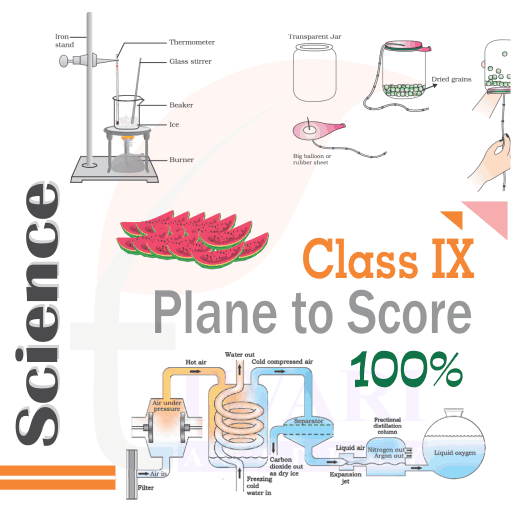
Step 2: Complete One Topic Per Day
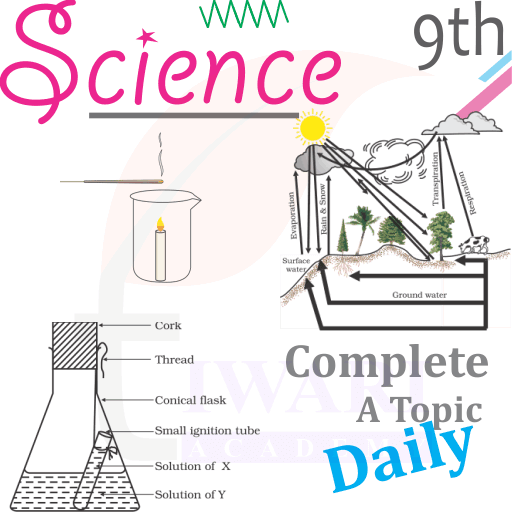
Step 3: Summarise and Practice After Each Chapter
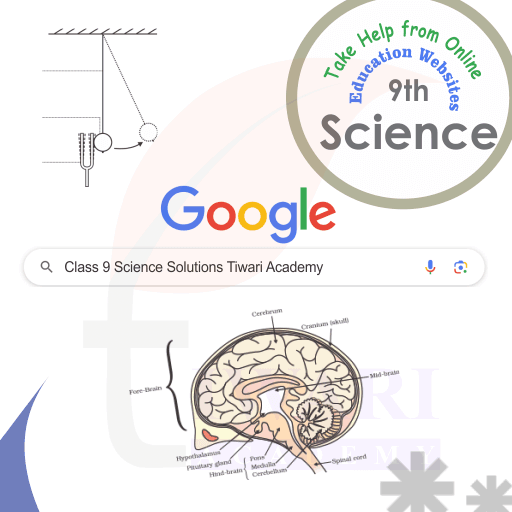
Step 4: Follow a Fixed Study Timetable
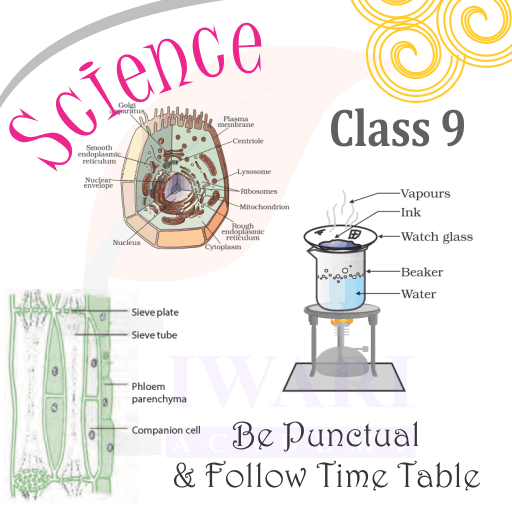
Step 5: Prioritise NCERT Textbook and Exemplar
Study Time Table for Class 9 Science
Session 2026-27 – New Syllabus Weekly Plan
| Day & Time Slot | Chapter | Focus Task |
|---|---|---|
| Monday: 5:00 PM – 6:00 PM | Cell | Read NCERT, note organelle functions |
| Tuesday: 5:00 PM – 6:00 PM | Tissues | Differentiate plant and animal tissues |
| Wednesday: 5:00 PM – 6:00 PM | Reproduction | Compare asexual and sexual reproduction |
| Thursday: 5:00 PM – 6:00 PM | Diversity + Mixtures | Classification + separation techniques |
| Friday: 5:00 PM – 6:00 PM | Structure of Atom + Atoms and Molecules | Atomic models + chemical formulae |
| Saturday: 5:00 PM – 6:00 PM | Motion + Force | Numerical problems + Newton’s laws |
| Sunday: 5:00 PM – 6:00 PM | Weekly Review | Revise all chapters, solve practice questions |
Previous Session Based – Previous Syllabus Weekly Plan
| Day & Time Slot | Chapter | Focus Task |
|---|---|---|
| Monday: 5:00 PM – 6:00 PM | Matter in Our Surroundings | States of matter, properties, changes |
| Tuesday: 5:00 PM – 6:00 PM | Is Matter Around Us Pure | Mixtures, solutions, separation |
| Wednesday: 5:00 PM – 6:00 PM | Atoms and Molecules | Laws, formulae, molecular mass |
| Thursday: 5:00 PM – 6:00 PM | Structure of the Atom | Atomic models, subatomic particles |
| Friday: 5:00 PM – 6:00 PM | Fundamental Unit of Life + Tissues | Cell + tissue types |
| Saturday: 5:00 PM – 6:00 PM | Motion + Force + Gravitation | Numerical problems + laws |
| Sunday: 5:00 PM – 6:00 PM | Weekly Review | Work, Energy, Sound, Food Resources |
Frequently Asked Questions – FAQs for Class 9 Science Exploration
How many chapters are in Class 9 Science?
Both the previous and 2026-27 versions of the Class 9 Science Exploration syllabus have 13 chapters each. However, the chapter names and content are significantly different between the two. The new 2026-27 syllabus removes Gravitation and Improvement in Food Resources and introduces Reproduction, Diversity, Earth as a System, and Work, Energy and Simple Machines as revised or new chapters.
Which syllabus should I follow – Previous or 2026-27?
This depends entirely on which textbook your school has issued you. If your NCERT Science textbook opens with Chapter 1 “Matter in Our Surroundings”, you are on the previous syllabus. If it opens with Exploration Chapter 1 “Exploration: Entering the World of Secondary Science”, you are on the new 2026-27 syllabus. When in doubt, confirm with your subject teacher.
Which chapters are in the Chemistry section?
Previous Session: Chemistry covers the first four chapters — Matter in Our Surroundings, Is Matter Around Us Pure, Atoms and Molecules and Structure of the Atom.
Session 2026-27: Chemistry is covered in Chapters 5, 6 and 7 — Mixtures and Their Separation, Structure of an Atom and Atoms and Molecules.
Which are the most important chapters for Class 9 Science exams?
Every chapter carries marks in CBSE examinations. That said, chapters involving numerical problems — Motion, Force and Laws of Motion, Work and Energy (or Work, Energy and Simple Machines in the new syllabus) – and conceptual Biology chapters — Cell, Tissues and Reproduction – typically require more preparation time and appear consistently in question papers.
Are these solutions available in Hindi medium?
Yes. Solutions for Class 9 Science are available in both English and Hindi medium. The Hindi medium solutions follow the same chapter structure and cover identical concepts and exercises.
Which is the best book for Class 9 Science exam preparation?
The NCERT textbook is the most important resource for CBSE examinations — nearly all questions are rooted in it. Once you have completed the textbook exercises thoroughly, the NCERT Exemplar is the best next step for additional practice, particularly for application-based and higher-order thinking questions.
How much time should I spend on Class 9 Science daily?
One to two hours of focused daily study is sufficient for most students to cover the syllabus comfortably across the academic year. The key is consistency — short daily sessions are more effective than occasional long ones.
Download Class 9 Science App
Access Class 9 Science solutions offline through the Tiwari Academy apps, available for Android and iOS. Once downloaded, no internet connection is required.
| Platform | App |
|---|---|
| Android — Science (English) | Class 9 Science App |
| Android — Science (Hindi) | Class 9 Science in Hindi |
| Android — All Subjects | Class 9 All Subjects App |
| iOS — iPad and iPhone | Tiwari Academy iOS App |