


by Tiwari Academy
NCERT Solutions for Class 4 Maths Mela Chapter 10 Elephants, Tigers and Leopards with Math-Magic Play with Patterns prepared for Session 2025-26. It helps students understand addition and subtraction through interesting activities and real-life examples. This chapter includes number games, addition charts, patterns, word problems based on animals and mental Maths. The solutions explain concepts step by step using simple language, helping students improve calculation skills, logical thinking and confidence in solving Maths problems effectively while enjoying learning.
Class 4 Maths Mela Chapter 10 MCQ
Class 4 Math Magic Chapter 10 MCQ
Chapter 10 Play with Patterns Solutions
Practice Questions from Chapter 10 Maths Mela
Page 149
Can you win the game if
a) The other player has reached the total of 6 and it is your turn?
Answer:
If I add 1: Total becomes 7
If I add 2: Total becomes 8
Both options leave me in a losing position. So I cannot win if the other player has reached 6.
b) The other player has reached the total of 7 and it is your turn?
Answer:
If I add 1: Total becomes 8
If I add 2: Total becomes 9
If I make it 9, the opponent can only add 1 to reach 10 and win.
So I should add 1 to make it 8, then: If opponent adds 1, total is 9, I can add 1 to reach 10 and win.
If opponent adds 2, total is 10, opponent wins.
Therefore, I can win if I play optimally.
c) The other player has reached the total of 8 and it is your turn?
Answer:
If I add 1: Total becomes 9.
If I add 2: Total becomes 10 and I win.
Therefore, I can win by adding 2.
Page 150
Play the game to reach other target number (like 10, 11, or 12) by adding 1 or 2 each time.
Can you find a number in each case when you are sure that you can win?
Answer:
For target numbers 10, 11 or 12: The winning strategy is to reach certain “key positions”:
For target 10: Key positions are 7 and 4 and 1.
For target 11: Key positions are 8 and 5 and 2.
For target 12: Key positions are 9 and 6 and 3.
If you can force your opponent to be at a position where they’re not at these key positions, I can win.
Page 150
Addition Chart
Look at the given below and discuss how the table is made.

Answer:
► The top row shows numbers from 0 to 12.
► The left column also shows numbers from 0 to 12.
► The + sign in the top-left corner tells us that this is an addition table.
► Each box (cell) in the table shows the sum of the number from the row and the number from the column.
1. Identify some patterns in the table.
Answer:
► The numbers increase by 1 as we move from left to right in any row.
► The numbers also increase by 1 as we move from top to bottom in any column.
► Each number in the table is formed by adding the row number and the column number.
► Numbers on the diagonal (from top-left to bottom-right) increase by 2 each time (0, 2, 4, 6, 8, …).
2. Observe the cell where the number 9 appears in the table. How many times do you see number 9? What about other numbers?
Answer:
The number 9 appears one time in left column and one time at top row. The number 9 also appears 10 times in the table.
It appears wherever the row number + column number = 9.
Examples: (0 + 9), (1 + 8), (2 + 7), (3 + 6), (4 + 5), (5 + 4), (6 + 3), (7 + 2), (8 + 1), (9 + 0)
So, 9 appears total of 12 times.
For the other numbers:
Each number appears a fixed number of times.
Numbers near the middle (like 9, 10, 11) appear more times.
Smaller numbers (like 0 or 1) and larger numbers (like 24) appear fewer times.
3. Are there any rows or columns that contain only even numbers or only odd numbers? Explain your observation.
Answer:
Yes.
The row starting with 0 (row 0) has: 0, 2, 4, 6, 8, 10, 12, …
This row contains only even numbers.
So, the column starting with 0 also has only even numbers.
No row or column contains only odd numbers, because adding an even number + odd number gives an odd result.
Adding an odd number + odd number gives an even result.
So, odd and even numbers get mixed in most rows and columns.
4. Look at the window frame highlighted in red colour in the table.
a) Find the sum of the two numbers in each row.
Answer:
Sum of two numbers in each row:
10 + 11 = 21
11 + 12 = 23
b) Find the sum of the two numbers in each column. What do you notice?
Answer:
Sum of two numbers in each column:
10 + 11 = 21
11 + 12 = 23
The result is same as for the rows.
c) Now, find the sum of the numbers in each of two diagonals marked by arrows. What do you notice?
Answer:
Sum of two numbers in each diagonal:
10 + 12 = 22
11 + 11 = 22
The sum of the numbers in two diagonals are same.
d) Now, put the red window frame in other places and find the sums as above. What do you notice?
Answer:
Sum of rows:
4 + 5 = 9
5 + 6 = 11
Sum of column:
4 + 5 = 9
5 + 6 = 11
Sum of its diagonals:
4 + 6 = 10
5 + 5 = 10.

Word Problems on Elephants, Tigers and Leopards
5. Now, put the red patterns and relationships among the numbers in the blue window frame.
Answer:
Sum of rows:
7 + 8 + 9 = 24
8 + 9 + 10 = 27
9 + 10 + 11 = 30
Sum of column:
7 + 8 + 9 = 24
8 + 9 + 10 = 27
9 + 10 + 11 = 30
Sum of its diagonals:
7 + 9 + 11 = 27
9 + 9 + 9 = 27
Page 151
Reverse and Add
a) Take a 2 digit number say, 27. Reverse its digits (72). Add them (99). Repeat for different 2-digit numbers.
Answer:
Take 45, reverse is 54, sum is 99.
Take 36, reverse is 63, sum is 99.
b) What sums can we get when we add a 2 digit number with its reverse?
Answer:
When adding a 2-digit number with its reverse:
If the sum of digits equals or exceeds 10, we get a 3-digit sum.
If not, we get a 2-digit sum.
All sums will be multiples of 11.
c) List down all numbers which when added to their reverse give
i) 55
ii) 88
Answer:
i) 55: Numbers that sum to 5 (digits): 05, 14, 23, 32, 41, 50
ii) 88: Numbers that sum to 8 (digits): 08, 17, 26, 35, 44, 53, 62, 71, 80
d) Can we get a 3 digit sum? What is the smallest 3 digit sum that we can get?
Answer:
Smallest 3-digit sum:
45 + 54 = 99 (not 3 digits)
46 + 64 = 110 (3 digits)
So, the smallest 3-digit sum is 110.
Page 151
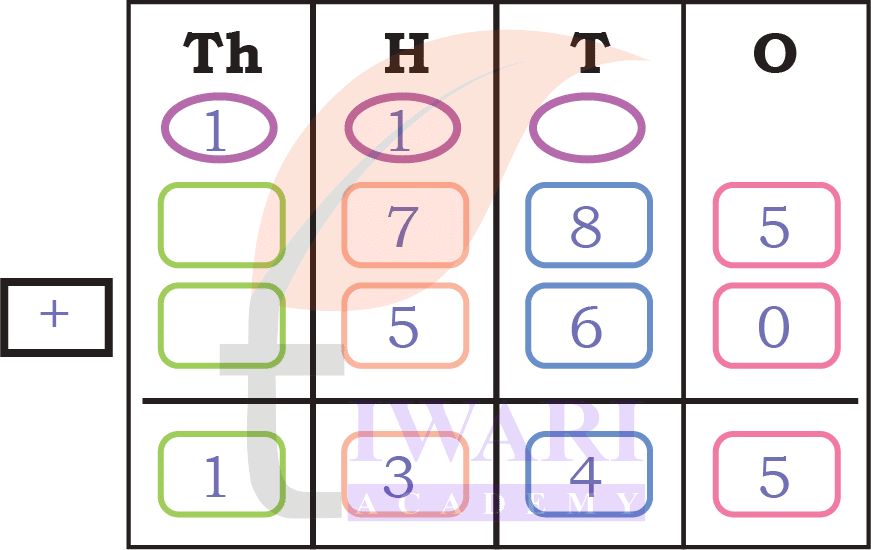
Fill in the blanks with appropriate numbers.

Answer:

Page 152
How Many Animals?
1. The population of elephants in Karnataka is 6049 and in Kerala is 3045. How many total elephants are there in these two states?
Answer:
Elephants in Karnataka = 6049
Elephants in Kerala = 3045
Total Elephants = 6049 + 3045 = 9103
So, 9103 elephants are there in these states.
2. The highest number of leopards found in three states. Gujarat has 1355, Karnataka has 1131 and Madhya Pradesh has 1817. Hoe many total leopards are there in these states?
Answer:
Number of leopards in Gujarat = 1355
Number of leopards in Karnataka = 1131
Number of leopards in Madhya Pradesh = 1817
Total number of leopards = 1400 + 1100 + 1800 = 4300
3. Maharashtra has 444 tigers. Madhya Pradesh has 341 more tigers than Maharashtra. Uttarakhand has 116 tigers more than Maharashtra.
a) How many tigers does Madhya Pradesh have?
Answer:
Maharashtra has 444 tigers
Madhya Pradesh has 341 more tigers:
444 + 341 = 785 tigers.

b) How many tigers does Uttarakhand have?
Answer:
Uttarakhand has 116 more tigers than Maharashtra:
444 + 116 = 560 tigers.

c) How many tigers does Madhya Pradesh and Uttarakhand have?
Answer:
Madhya Pradesh and Uttarakhand together: 785 + 560 = 1345 tigers.
d) How many tigers are there in total across the three states?
Answer:
Total tigers in all three states:
444 + 785 + 560 = 1789 tigers.

More or Less?
1. Assam has 5719 elephants. It has 3965 more elephants than Meghalaya. How many elephants are there in Meghalaya?
Answer:
Number of elephants in Assam = 5719 elephants
Assam has 3965 more elephants than Meghalaya,
So, number of elephants in Meghalaya = 5700 – 4000 = 1700
2. The population of leopards as per the 2022 census was 8820 in the Central India and the Eastern Ghats. It had increased by 749 in comparison to the number of leopards in 2018 in the same region. How many leopards were there in 2018?
Answer:
Number of Leopards in 2022 = 8820
Leopards Increased by 749 since 2018.
So, Number of Leopards in 2018 = 8820 – 749 = 8071
Therefore, 8071 leopards were there in 2018.
3. Write the number of animals on this based on the data from the problems in the previous pages.

Answer:

Page 157
Let Us Do
1. The board in the ticket office in the Kaziranga National Park shows the following:
a) How many more visitors came in December than in November?
b) The number of visitors in November is 1587 more than October. How many visitors were there in October?

Answer:
Kaziranga National Park visitors:
a) Difference between December and November = 8591 – 6415 = 2176
b) November had 1587 more visitors than October.
So, October visitors = 6415 – 1587 = 4828
2. In a juice making factory, women make different types of juices as given below:

a) The number of bottles of guava juice is 759 more than the number of bottles of pineapple juice. Find the number of bottles of guava juice.
Answer:
Guava juice bottles: 1348 + 759 = 2107 bottles.
b) The number of bottles of orange juice is 1257 more than the number of bottles of guava juice and 1417 less than the number of bottles of passion fruit juice. How many bottles of orange juice are made in a month?
Answer:
Orange juice bottles:
1257 more than guava juice = 2107 + 1257 = 3364 bottles
1417 less than passion fruit juice = 4781 – 1417 = 3364 bottles
So, 3364 bottles of orange juice are made in a month.
c) Is the total number of bottles of guava juice and orange juice more or less than the number of bottles of passion fruit juice? How much more or less?
Answer:
Comparison of guava and orange juice with passion fruit:
Guava + Orange = 2107 + 3364 = 5471
Passion fruit = 4781
Difference = 5471 – 4781 = 690
So, 690 more bottles of guava and orange juice combined.
3. In a small town, the following vehicles were registered in the year 2022. Find the number of vehicles as per the conditions given below.
a) The number of buses is 253 more than the number of jeeps. How many busses are there in the town?
b) The number of tractors in 5247 less than the number of busses. How much tractors are in the town?
c) The number of taxis is 1579 more than the number of tractors? How many taxis are there?
d) Arrange the numbers of each type of vehicle from lowest to highest.

Answer:
a) Number of buses: 6304 + 253 = 6557.
b) Number of tractors: 6557 – 5247 = 1310.
c) Number of taxis: 1310 + 1579 = 2889.
d) Arranging from lowest to highest: Tractors (1310), Taxis (2889), Jeeps (6304), Buses (6557).
Important Concepts Covered in Chapter 10 Maths Mela
4. Solve
a) 1459 + 476
b) 3863 + 4188
c) 5017 + 899
d) 4285 + 2132
e) 3158 + 1052
f) 7293 – 2819
g) 3105 – 1223
h) 8006 – 5567
i) 5000 – 4124
j) 9018 – 487
Answer:

5. The children in a school in Chittoor are planning to organise a Baal Mela in their school.
Raju, Rani and Roja decided to raise some money to make arrangements for the mela. The money is available in notes of 500, 100, 50, 10 and coins of 5, 2 and 1. They decide to put the money in the School Panchayat Bank.

Answer:
Amount of Raju: ₹2045
Amount of Rani: ₹3578
Amount of Roja: ₹1240.
Help each of the children fill the deposit slip given below. Different combinations of notes can give the same amount. Can you guess a possible combination of notes they might have? Fill in the amounts appropriately.

Answer:

Page 161
Let Us Solve
1. Solve.

Answer:

2. Arrange the following in columns and solve in your notebook.
a) 3683 – 971
b) 8432 – 46
c) 4011 – 3666
d) 5203 – 2745
e) 1465 + 632
f) 3567 + 77
g) 8263 + 3737
h) 5429 + 3287
Answer:

Page 162
Let Us Solve
1. Find easy ways to solve the following problems. Write the answers in the given space. Share your thinking with the grade.
a) 8787 – 99 = __________
b) 4596 + 104 = __________
c) 3459 + 21 = __________
d) 5010 + 95 = __________
e) 4990 + 310 = __________
f) 7844 – 15 = __________
g) 260 + 240 = __________
h) 1575 – 125 = __________
i) 3999 + 290 = __________
Answer:
a) 8787 – 99 =__________
= 8787 – 100 + 1 = 8688
b) 4596 + 104
= 4596 + 100 + 4 = 4700
c) 3459 + 21
= 3459 + 20 + 1 = 3480
d) 5010 + 95
= 5010 + 100 – 5 = 5105
e) 4990 + 310
4990 + 10 + 300 = 5300
f) 7844 – 15
7844 – 10 – 5 = 7829
g) 260 + 240
= 200 + 200 + 60 + 40 = 500
h) 1575 – 125
= 1450 – 100 – 25 = 1325
i) 3999 + 290
3999 + 1 + 289 = 4000 + 289 = 4289
2. Use the signs <, =, > as appropriate to compare the following without actually calculating. Try to reason them out and share in grade.
54 + 97 > 54 + 90
84 – 68 < 90 – 68
76 + 85 < 80 + 86 73 – 54 > 73 – 56
Answer:
54 + 97 > 54 + 90 (Since 97 > 90, so result is larger)
84 – 68 < 90 – 68 (Since 84 < 90, so result is smaller)
76 + 85 < 80 + 86 (Since 76 < 80 and 85 < 86) 73 – 54 > 73 – 56 (Subtracting smaller number gives larger result)
3. Use the given information to find the values. Share your reasoning with the grade.
► 139 + 175 = 314
314 – 175 = _________
► 845 – 394 = 451
845 – 395 = _________
► 354 + 167 = 521
354 + 168 = _________
► 456 + 209 = 665
446 + 219 = _________
Answer:
► 314 – 175 = 139 (addition and subtraction are inverse operations).
► 845 – 395 = 450 (subtracting 1 more decreases result by 1).
► 354 + 168 = 522 (adding 1 more gives 1 more in result).
► 446 + 219 = 665 (decreased first number by 10, increased second by 10, sum remains same).
Page 163
1. Add
a) 2783 + 378
b) 8948 + 97
c) 7006 + 367
d) 8009 + 485
e) 6062 + 3809
f) 3792 + 2688
g) 4999 + 3888
h) 5005 + 4895
i) 5768 + 4053
j) 3480 + 479
Answer:

2. Subtract
a) 4456 – 2768
b) 5300 – 467
c) 8067 – 4546
d) 5302 – 1034
e) 8004 – 3107
f) 3400 – 897
g) 9382 – 4857
h) 7561 – 2933
i) 6478 – 5986
j) 3444 – 2555
Answer:

3. Fill the squares with the numbers 1-9. The difference between any two neighbouring squares (connected by a line) must be odd.
Can you find other ways to fill the squares?
Can you do the same thing such that the difference between any two neighbouring squares is even?

Answer:

NCERT Solutions for Class 4 Maths Chapter 10 Play with Patterns
Download CBSE App Class 4


Class 4 NCERT Maths Chapter 10 Use of Patterns
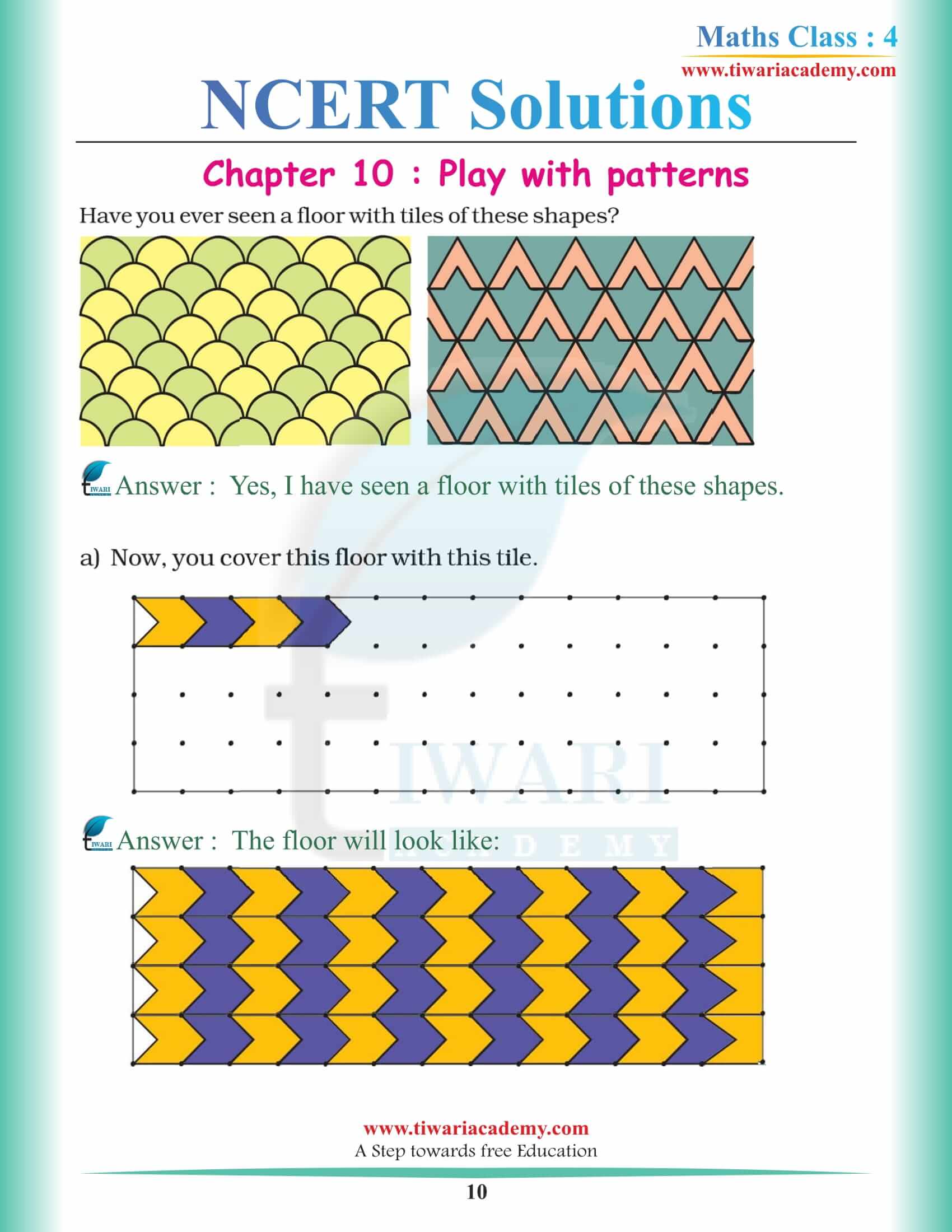
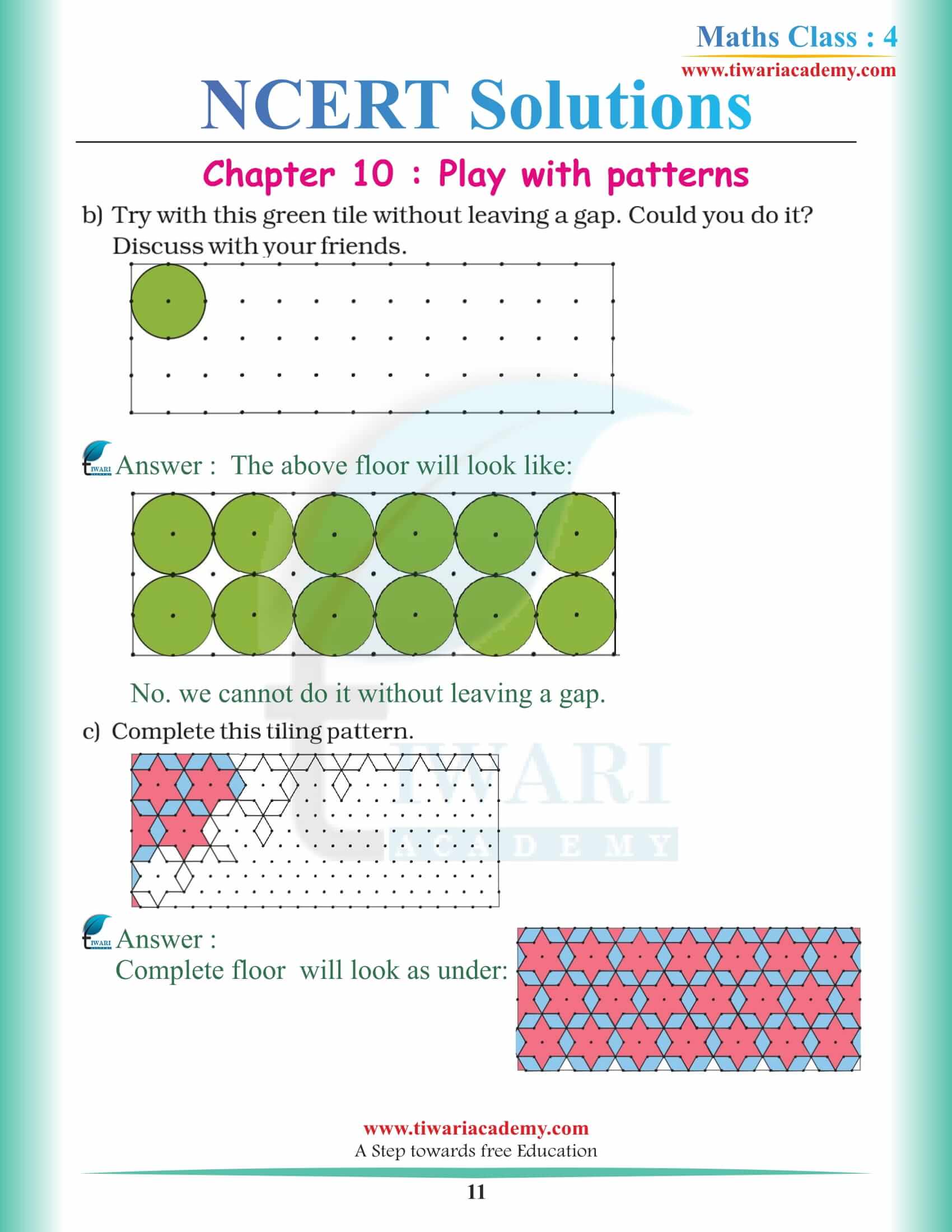
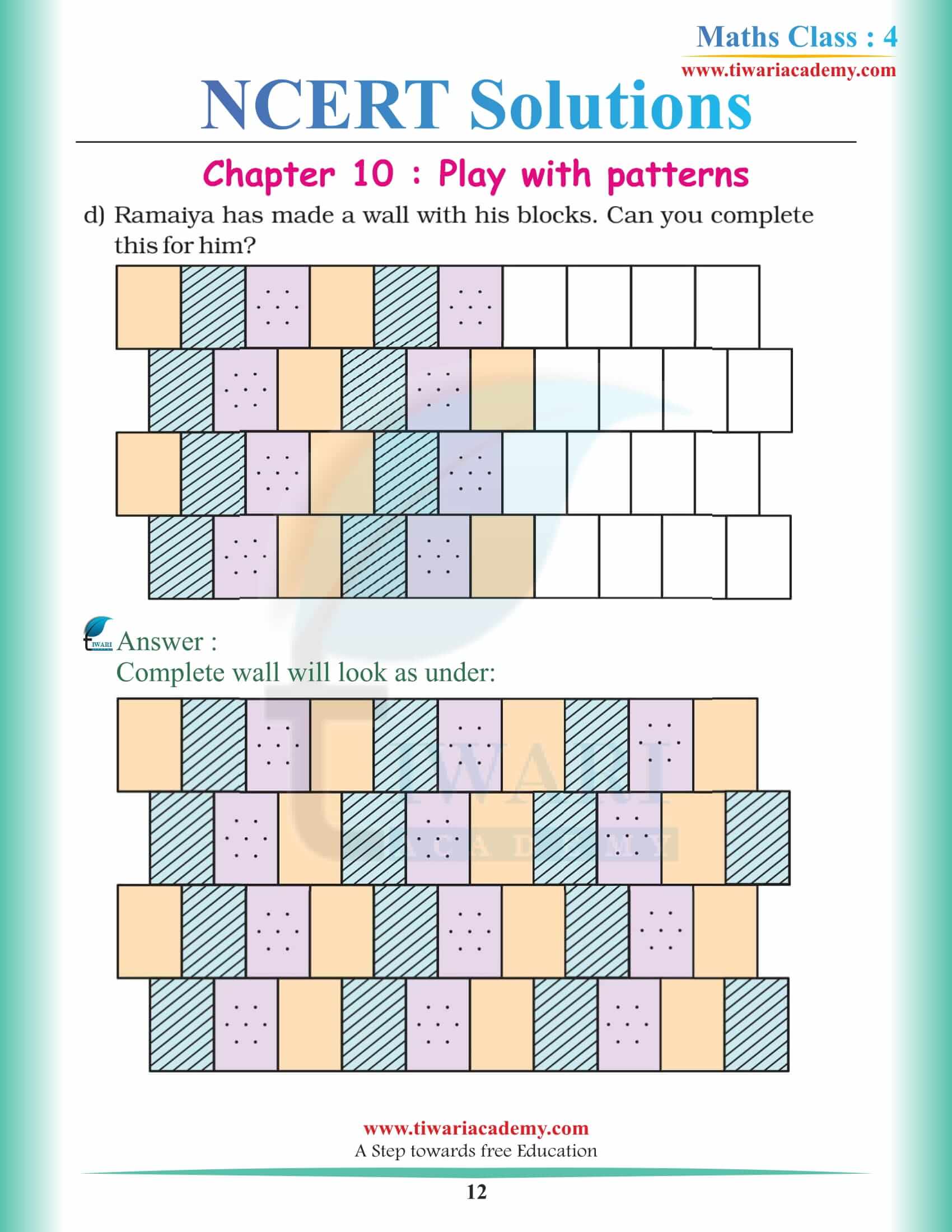
We have already studied to make the patterns and how the patterns look like and what are the places where we can look for the patterns and now the question is where we can use the patterns?
Well, I can answer this question in one Word. Everywhere! You can look around you and you will see even the clothes you are wearing contains patterns and Saree that your teacher is wearing right now much have patterns. Now the thing is to remember is that pattern does not necessarily contain big prints only some plain are also patterns. Anything that justifies its design we can call it a pattern. Now the point is how and where you want to draw these patterns. You will see the patterns on the wall of your home and you can spot it even where no one is looking on the wheels of your car and maybe on the tire.
CBSE Class 4 NCERT Maths Chapter 10 Fun with Patterns
This is how you can find the patterns but how can you use the patterns to make fun is another interesting topic to discuss in the chapter you will learn how to make the fun stuff that can make you wonder how does that happen and how amazing it is. So if you want to know where and how you can implement the designs in your work you can study the chapter because it is important to understand how that pattern worked before you start making one yourself.
4th Standard NCERT Maths Chapter 10 Pattern Design on Saree
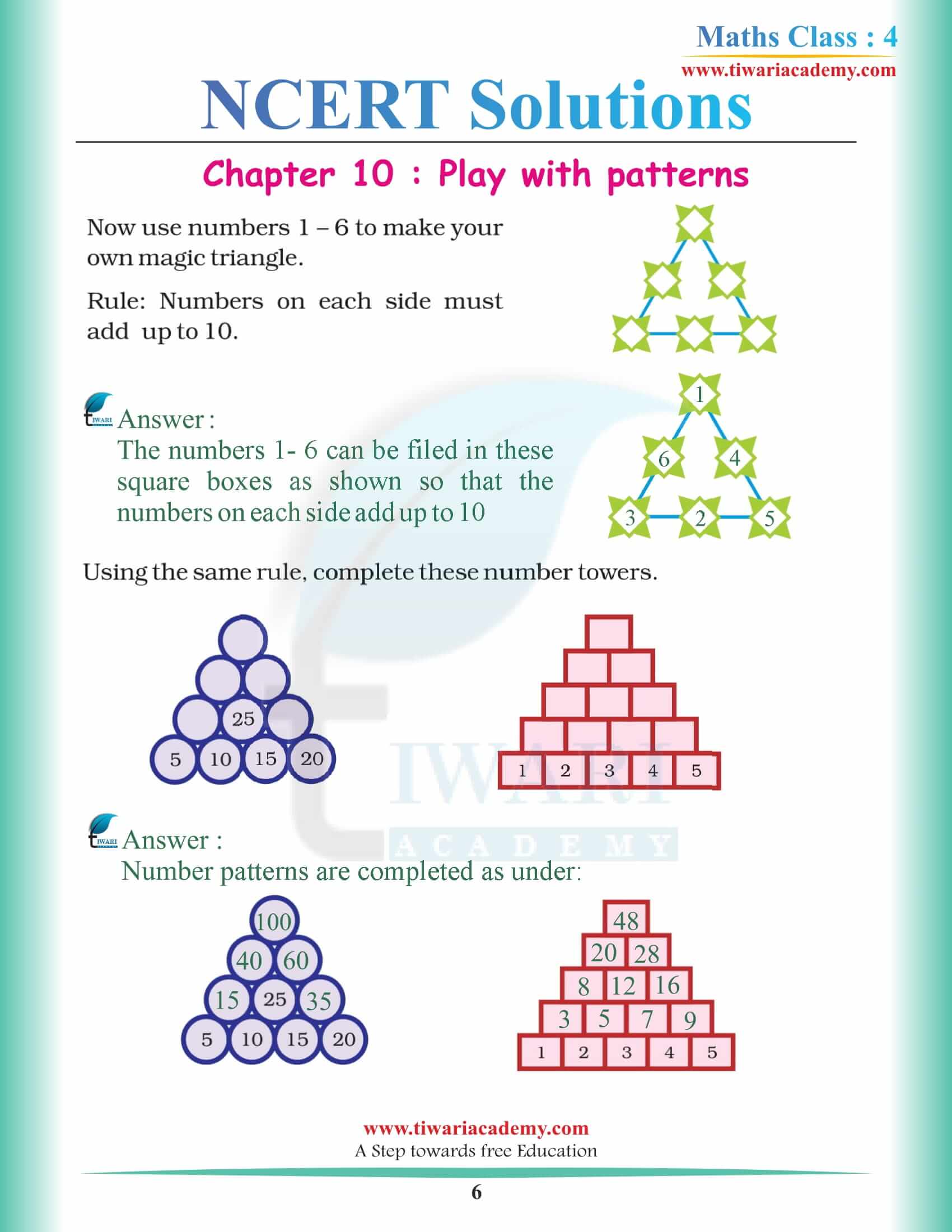
Like the other kid in the chapter, Raju started to make a Saree. Number Tower and Magic triangles are one of the designs with numbers are beings set up in such a way so that not only you can use it to make a number that can give you one desired result irrespective of the fact the number and design you choose under the result.
Class 4 NCERT Maths Textbook Chapter 10 Activity
Can you make some designs that are not given in the chapter and you can show them to your friends and amaze them with the results?
Class 4 NCERT Maths Book Chapter 10 Coding and Decoding
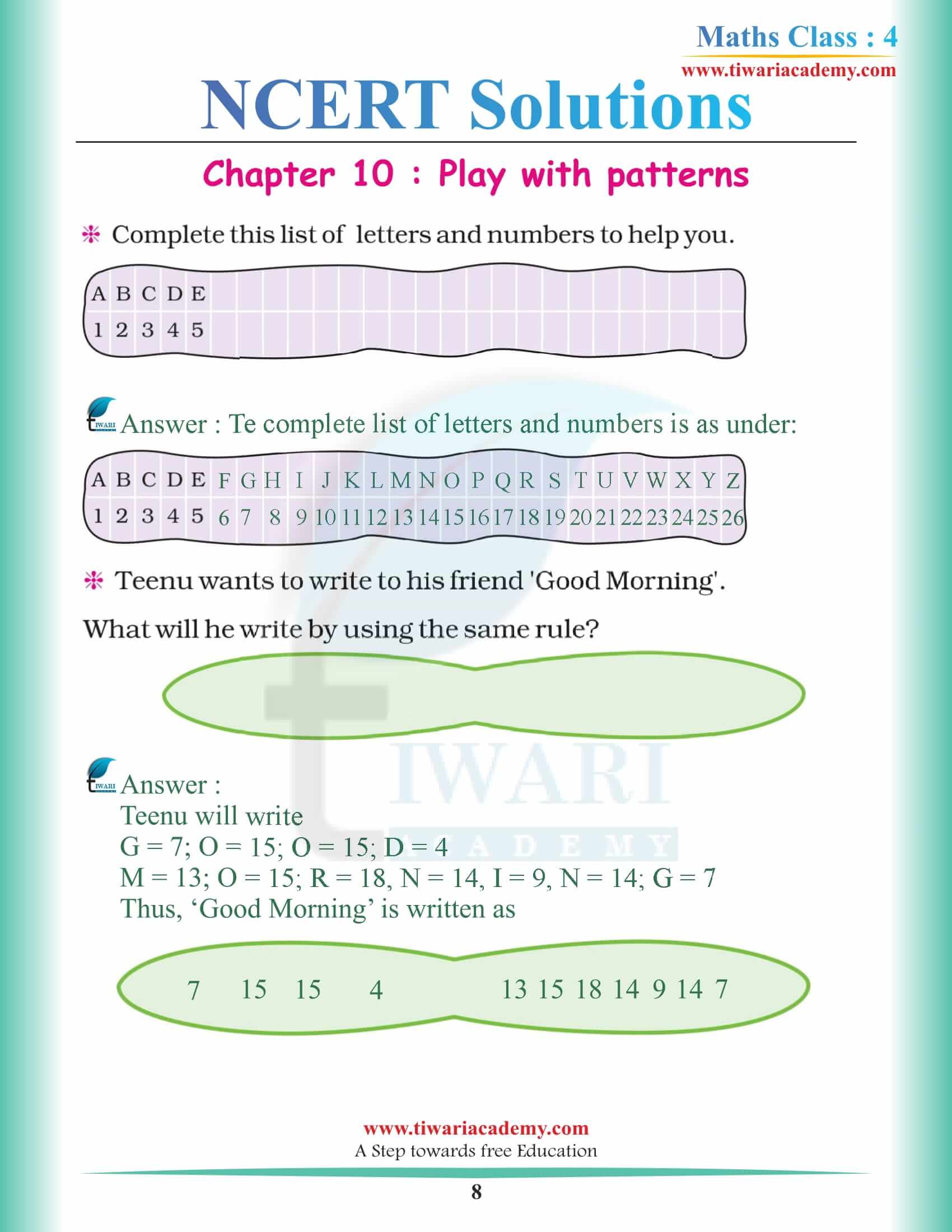
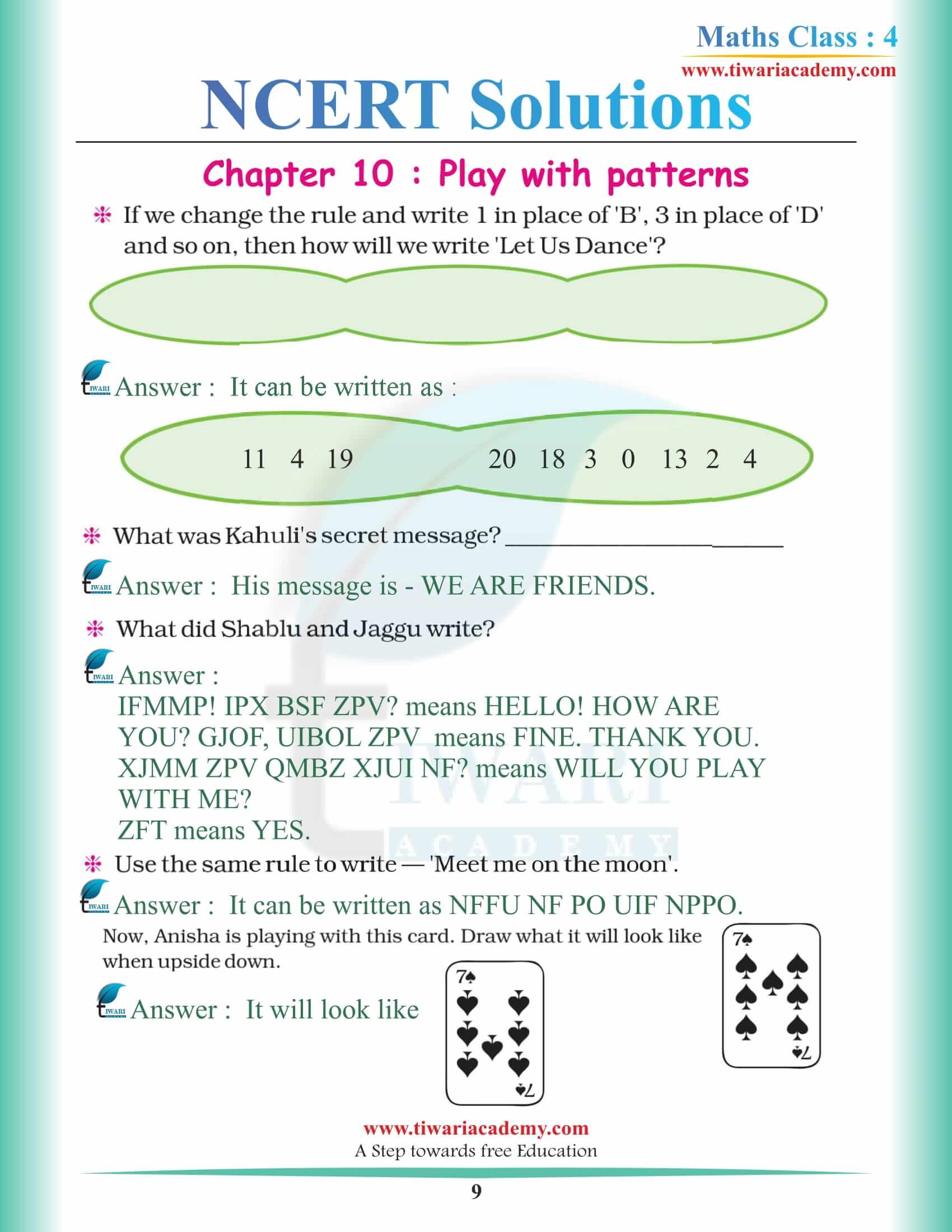
Coding and decoding secret messages is also a part of recognizing patterns. Recognizing rules is important for the development of mathematical thinking.
In unit 10 what students of class 4th will be able to learn?
In unit 10 students will be able to learn different types of patterns and shapes and how to use them in designs. Basically, this chapter is an advanced form of what the students of class 4th math already learned in the previous chapters.
How do you suggest students of class 4th Maths cover chapter 10?
I think the best way to understand the core knowledge of class is to learn through preparing the designs through the patterns to understand how the shapes are like. This will develop the understanding of shapes and how to name them so that they can use the knowledge to solve the question.
Do you think the students of class 4th Mathematics can cover unit 10 themselves?
The knowledge given in unit 10 is about shapes and students will get an opportunity to develop creativity. However, instruction and guidance is something that is required because not all students have the same developed understanding.