


by Tiwari Academy
Class 4 Maths Mela Chapter 5 Sharing and Measuring and Math-Magic Chapter 5 The Way The World Looks in Hindi and English. Maths Mela Chapter 5 helps students understand the concept of fractions through simple daily-life situations such as sharing paper, dhokla, gardens and dosas. In this chapter, children learn about parts and wholes, one-half (½), one-quarter (¼) and how equal sharing changes when the number of people increases. Using stories, pictures, paper-folding activities and hands-on exercises, this chapter builds a strong foundation for fractions in an easy and enjoyable way.
Class 4 Maths Mela Chapter 5 MCQ
Class 4 Math Magic Chapter 5 MCQ
Chapter 5 Sharing and Measuring Solutions
Introduction to Sharing and Measuring – Class 4 Maths
Page 62
Let Us Discuss
1. Which part of the paper would you have chosen—one half or two quarters? Why?
Answer:
Both one half and two quarters are equal in amount. I would choose either because they represent the same quantity of paper (1/2 = 2/4).
2. Do you think Ikra shared the paper equally? Why? Try with a paper.
Answer:
Yes, Ikra shared the paper equally. When we divide a paper into halves, we get two equal parts. When we divide it into quarters, we get four equal parts. Two quarters equals one half, so the sharing was equal.
3. How do you know that the paper has been divided equally?
Answer:
We know that the paper is divided equally by:
► Folding and checking if the parts overlap perfectly.
► Measuring each part to confirm they’re the same size.
► Comparing the areas visually.
4. Why do you think Samina chose two quarters of the paper?
Answer:
Samina chose two quarters because it sounded like more paper than one half. She didn’t realize that two quarters (2/4) is equal to one half (1/2).
Page 63
Let Us Do
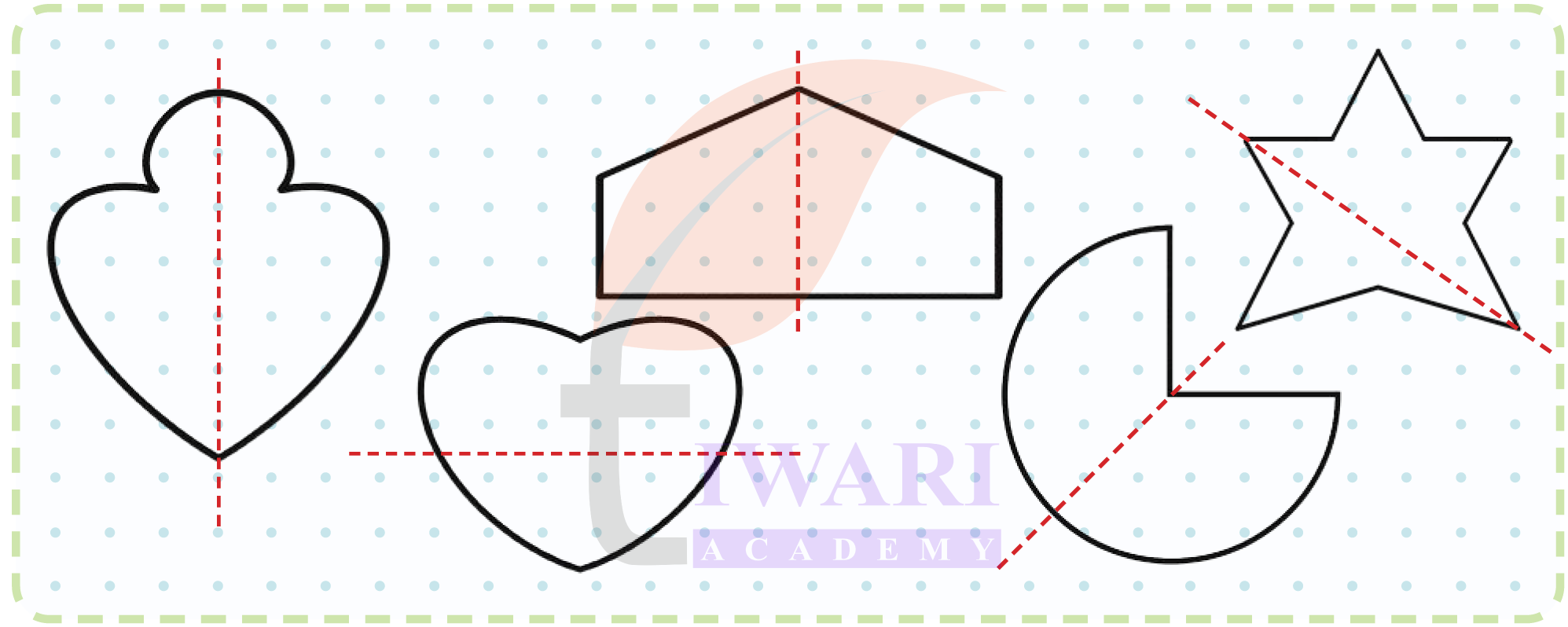
1. Samina has divided some figures into two parts. Colour the figures that are divided into halves correctly. How did you get the answer?
Answer:
I confirm that the figure is divided equally by folding and checking if the parts overlap perfectly.
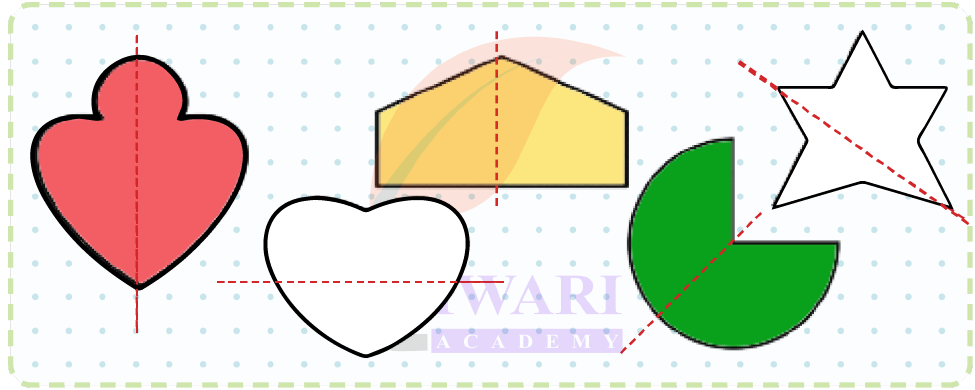
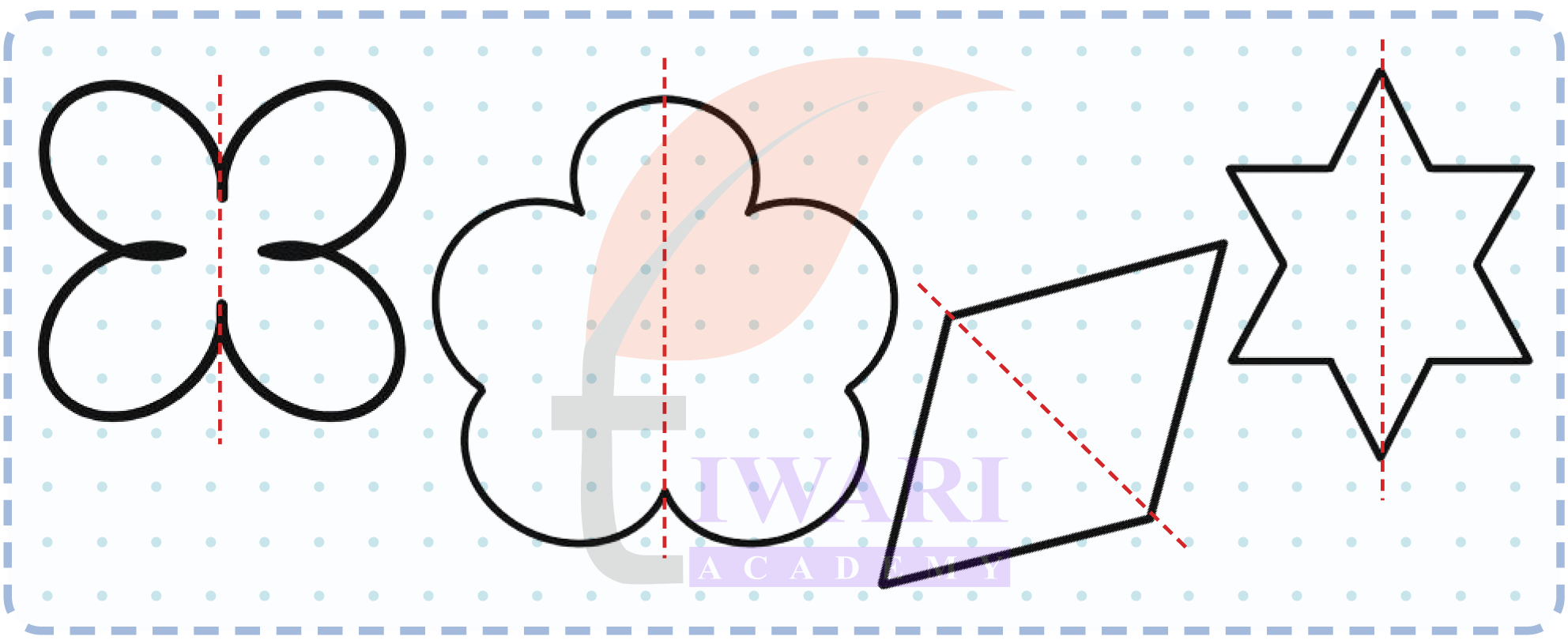
2. Divide the shapes into halves by drawing a line.
Answer:
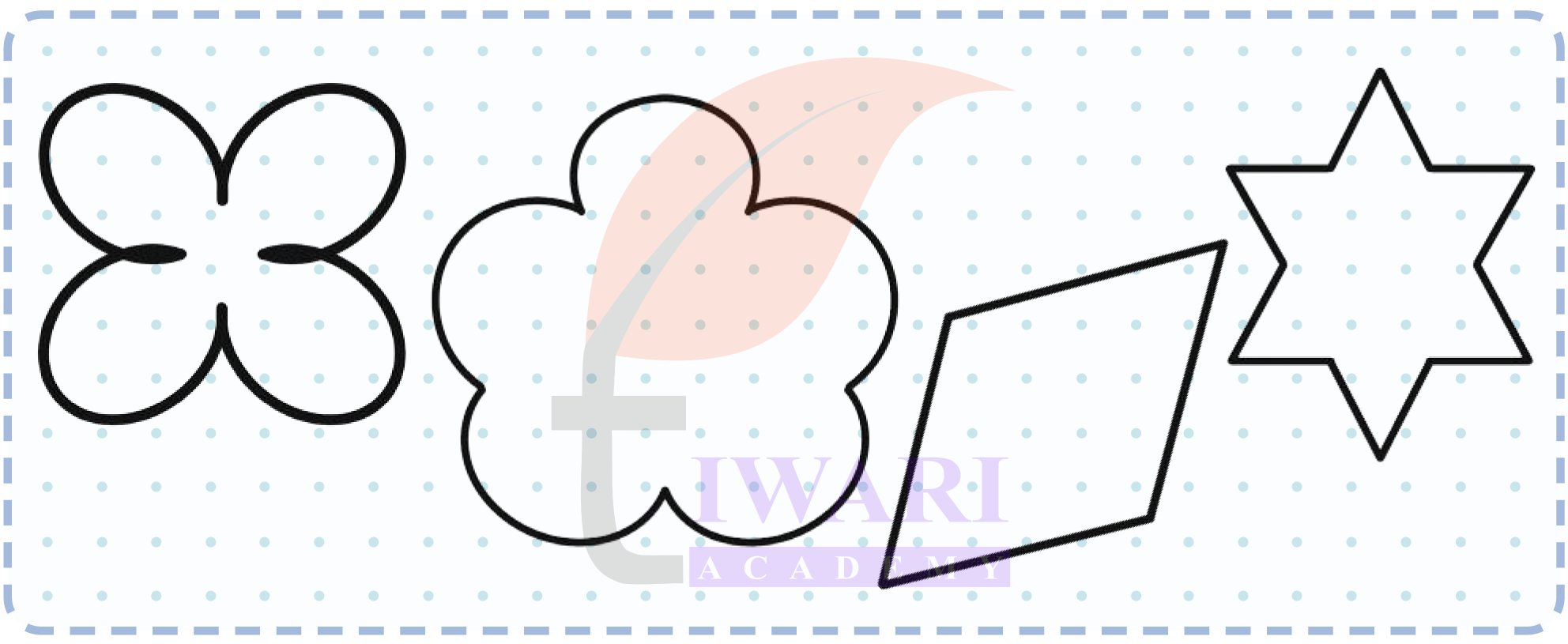
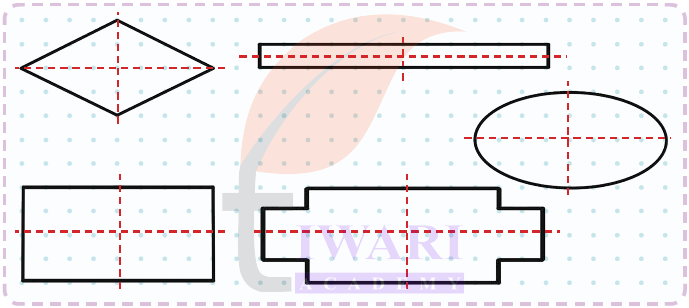
3. Divide these shapes into 4 equal parts/quarters.
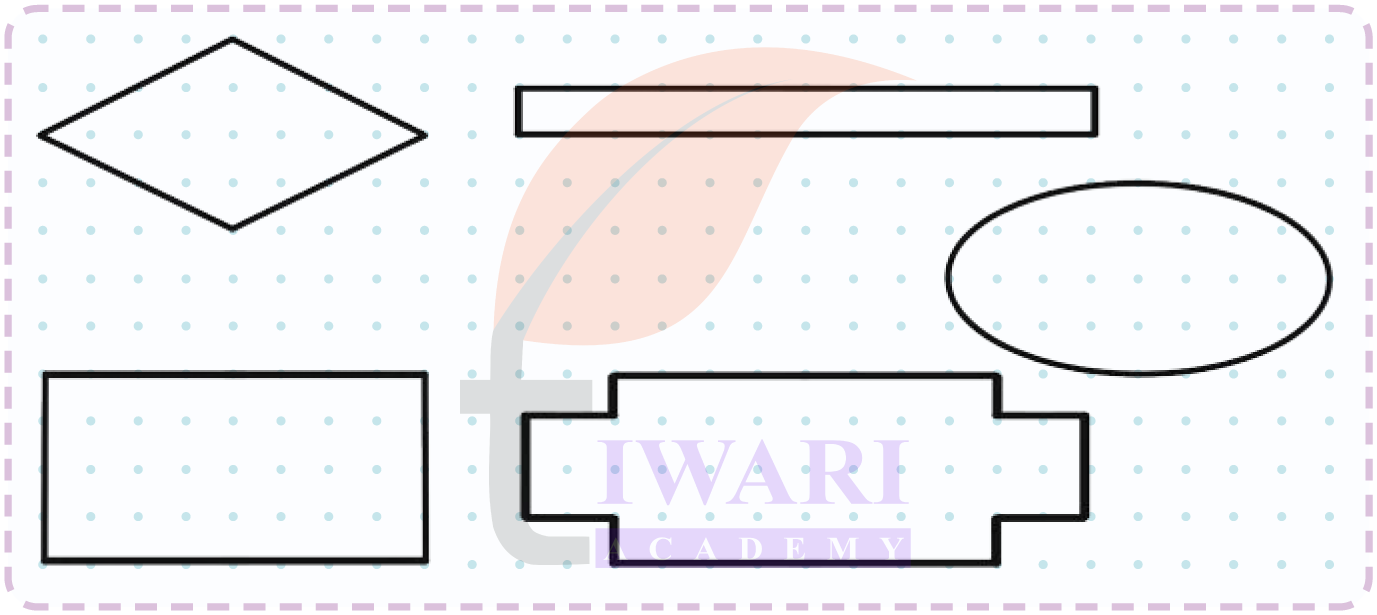
Answer:
Concepts Covered in Class 4 Maths Chapter 5
Page 64
Let Us Try
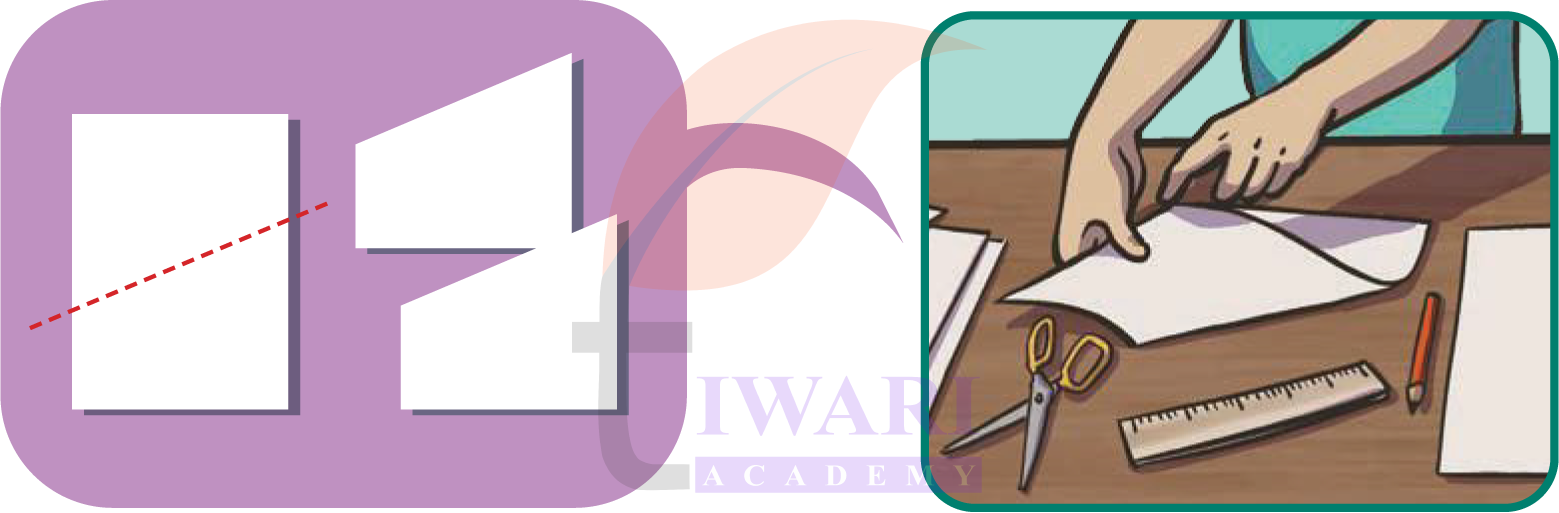
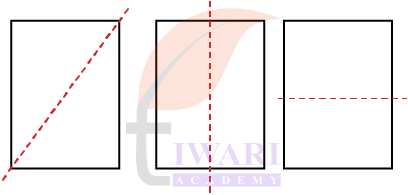
1. In how many different ways can you fold/cut a rectangular paper in two equal parts? Try it with a rectangular paper.
Answer:
A rectangular paper can be folded/cut into halves in these other ways:
► Horizontally (from middle of top to middle of bottom)
► Vertically (from middle of left side to middle of right side)
► Diagonally (from one corner to the opposite corner).
2. Now try to draw and show five different ways in which we can fold/cut a rectangle into four equal parts (1/4 or quarter).
Answer:

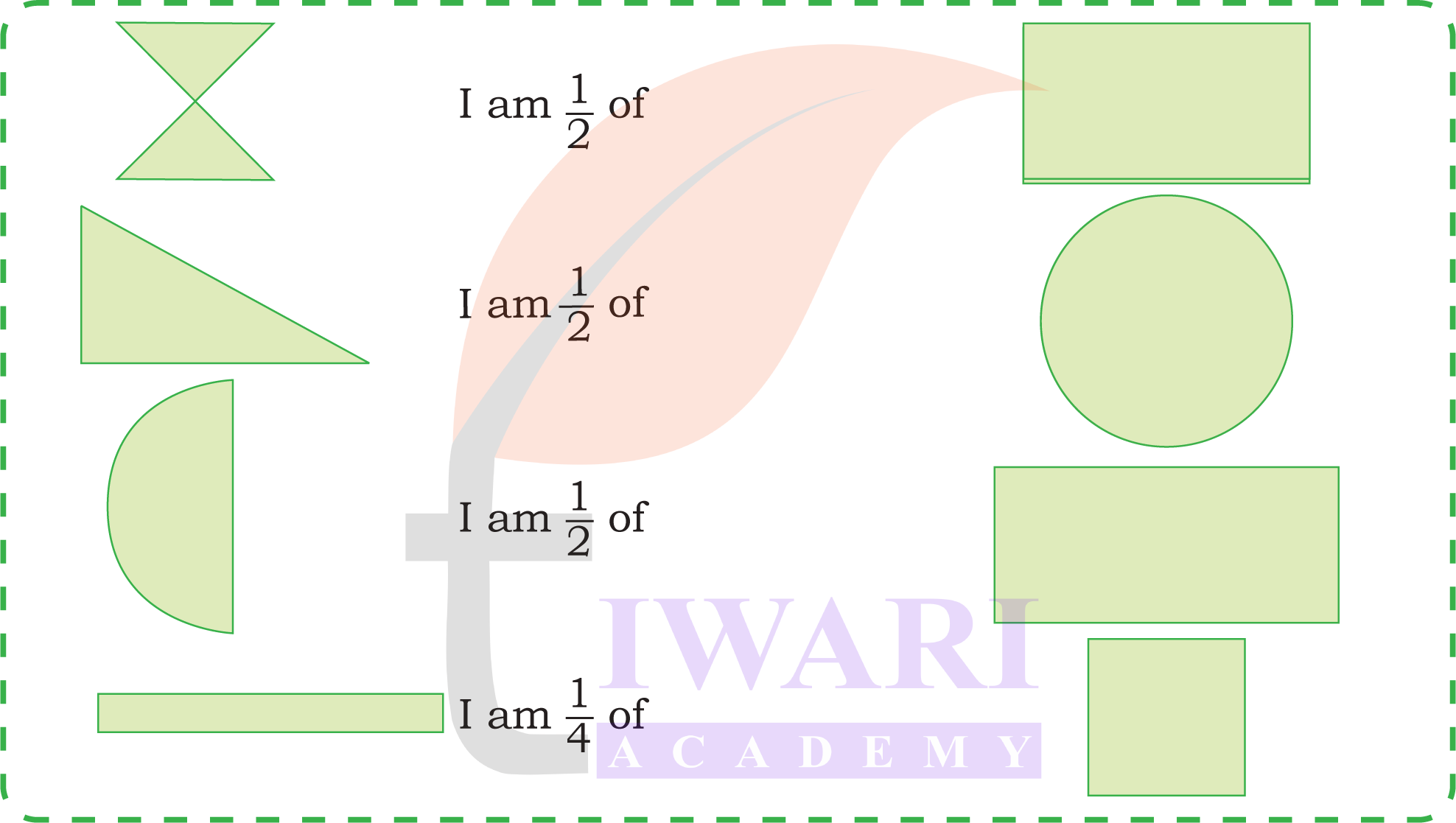
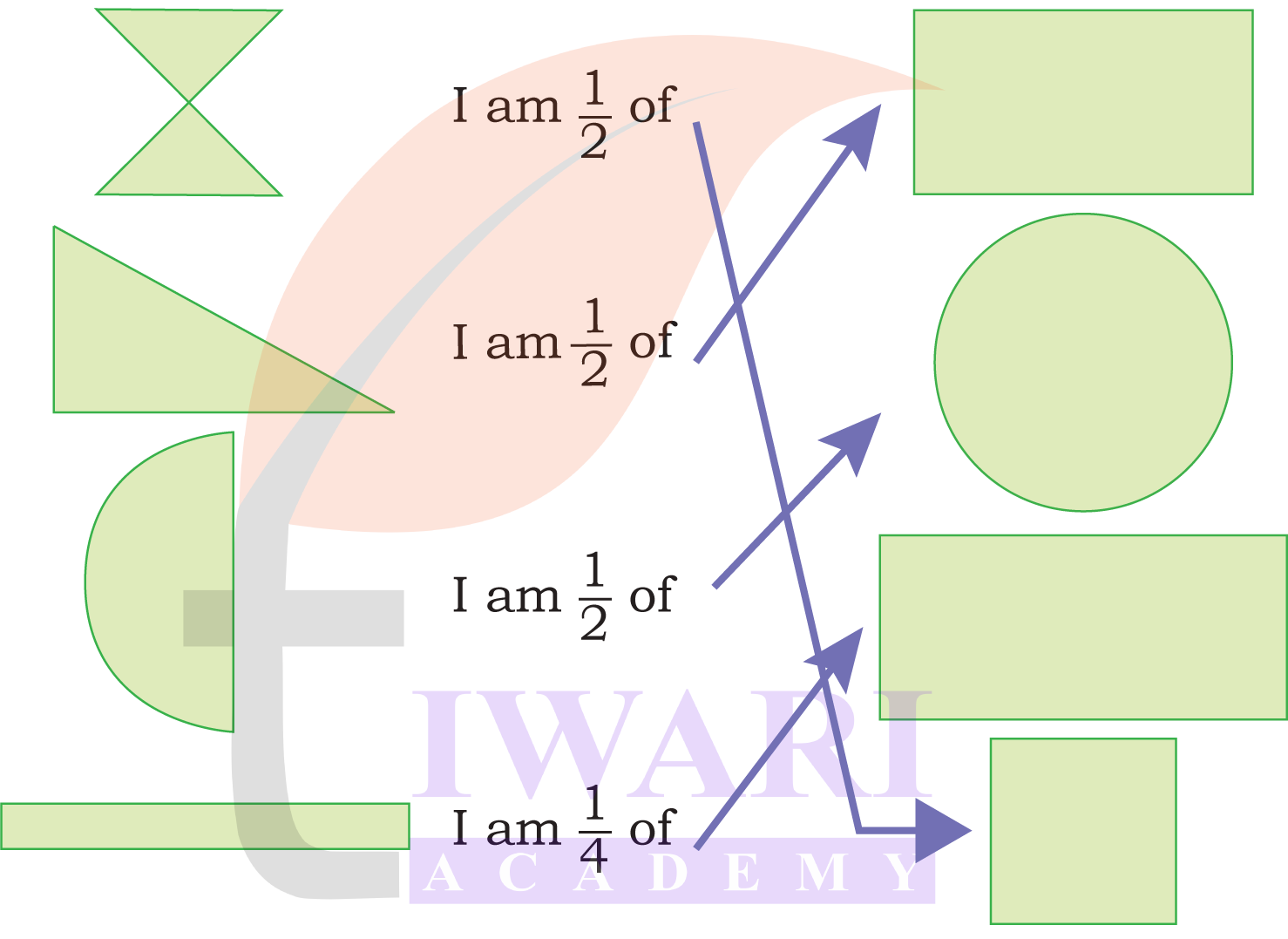
3. Match the following parts with their corresponding wholes.
Answer:
Page 68
Let Us Discuss
1. What is Sumedha observing about her share as each guest comes in?
Answer:
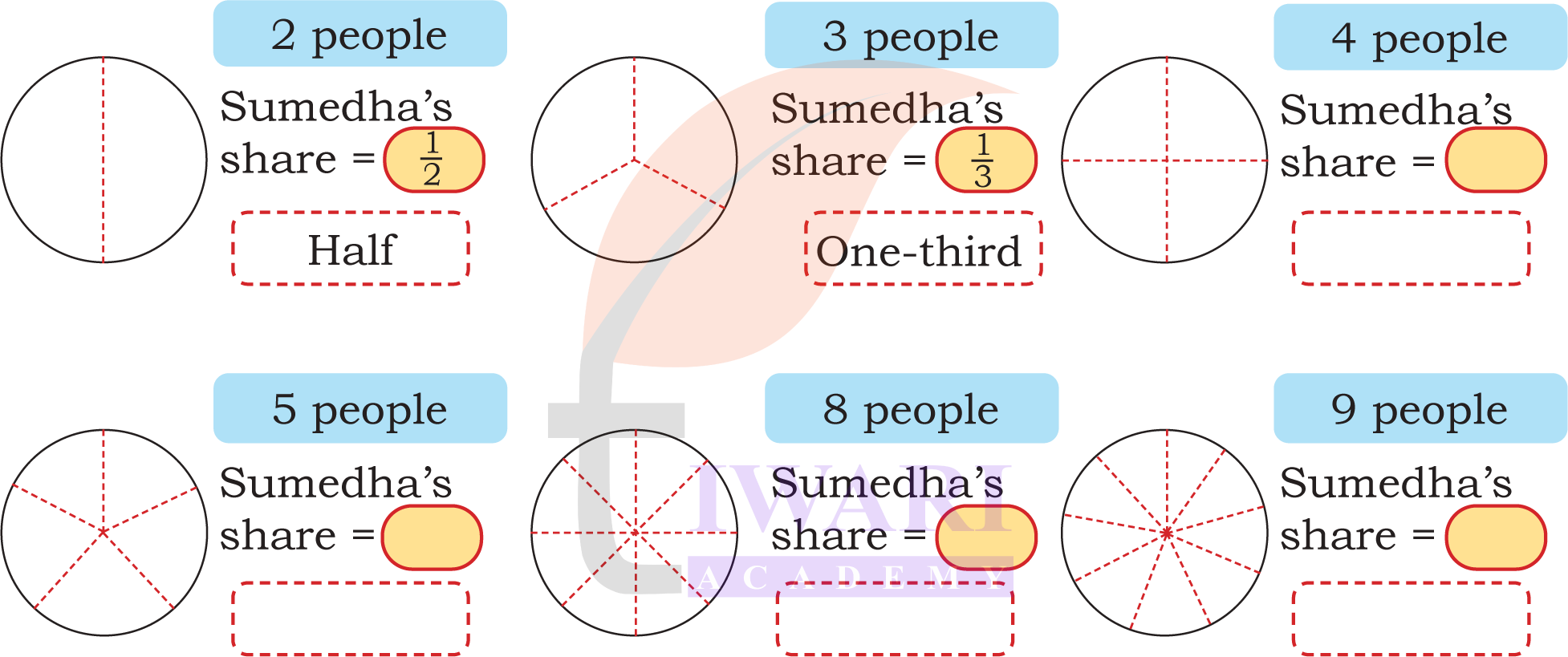
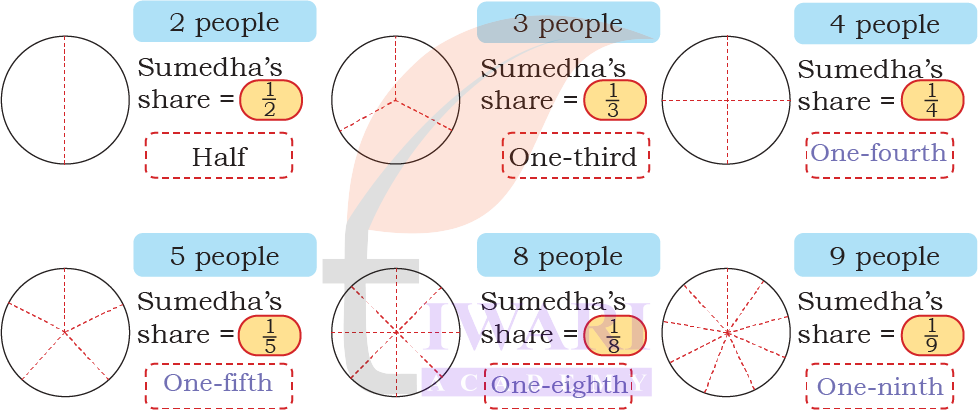
Sumedha is observing that her share of dhokla gets smaller with each additional guest. Initially, she gets 1/2, then 1/3, then 1/4 and finally 1/5 of the dhokla as more people arrive.
2. In which situation will Sumedha get to eat more dhokla: when shared among 9 people or 11 people?
Answer:
Sumedha will get more dhokla when shared among 9 people (1/9 share) than when shared among 11 people (1/11 share), because 1/9 is greater than 1/11.
3. How many pieces of 1/6 would make a complete dhokla?
Answer:
Six pieces of 1/6 would make a complete dhokla (6 × 1/6 = 6/6 = 1 whole).
4. What would be Sumedha’s share, if Idha and Vinayak both give their share of dhokla to her?
Answer:
When the dhokla is shared among 5 people, each gets 1/5. If Idha and Vinayak give their shares to Sumedha, she would get her own share plus their shares: 1/5 + 1/5 + 1/5 = 3/5 of the dhokla.
Page 68
Let Us Do
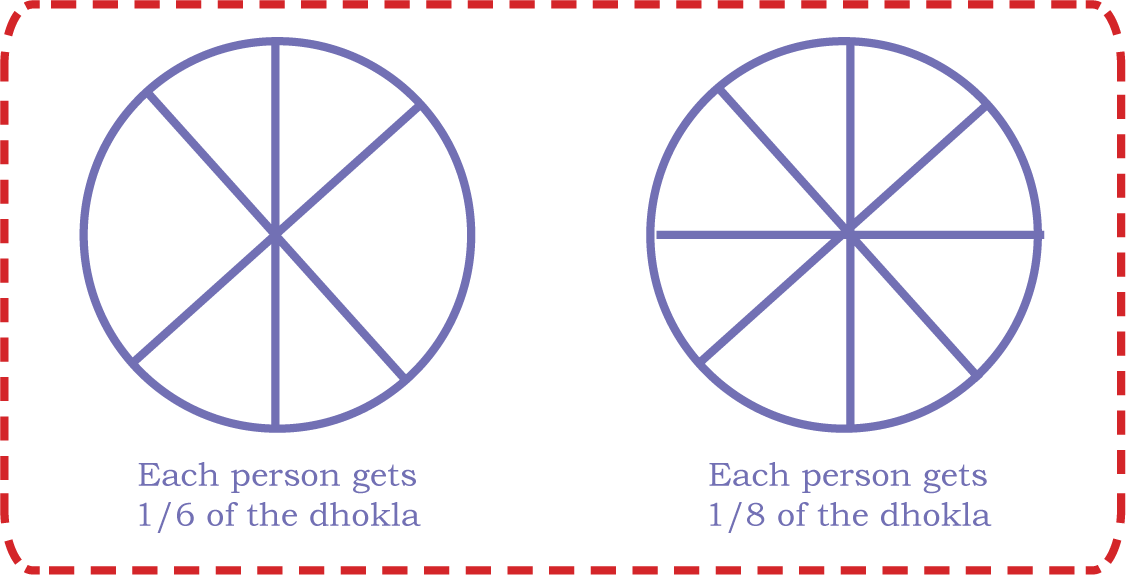
1. How much dhokla would each person get if it was shared equally among 6 people? Try also with 8 people. Who will get the bigger pieces of dhokla? Draw and explain.

Answer:
If shared among 6 people: Each person gets 1/6 of the dhokla.
If shared among 8 people: Each person gets 1/8 of the dhokla.
People will get bigger pieces when shared among 6 people because 1/6 > 1/8.
2. Shade a portion of the dhokla to represent the fraction Sumedha would get when the dhokla is shared equally among the given number of people. Discuss why the fractions get smaller.
Answer:
Page 69
Let Us Discuss
Use the fraction kit given at the end of your textbook and answer the following questions.
1. Share your observations about the different pieces and the whole.
Answer:
Using the fraction kit, we can observe that:
► The whole can be divided into equal parts in many ways.
► As the denominator increases, the size of each piece gets smaller.
► Different fractions can be combined to form a whole.
2. Take any two different pieces of the fraction kit and compare them. Discuss which one is smaller and why?
Answer:
Example comparison:
1/2 is larger than 1/3 because when we divide a whole into fewer equal parts, each part is larger. Similarly, 1/3 is larger than 1/4.
3. Sumedha noticed that when a whole is equally divided in a larger number of parts, each part gets smaller. Do you agree with Sumedha?
Answer:
Yes, I agree with Sumedha. When we divide a whole into more equal parts, each individual part becomes smaller. For example, 1/8 is smaller than 1/4.
4. Sumedha says, “When I join 5 pieces of 1/5, it makes a whole dhokla.” Try to do it yourself with your fraction kit.
Answer:
I also observed that this is correct. Five 1/5 pieces together make a whole (5 × 1/5 = 5/5 = 1).
5. Sumedha says that this part is one-third of the complete whole. Why is she saying so?
Answer:
Sumedha is saying this because when a whole is divided into three equal parts, each part is 1/3 of the whole.
Page 70
Let us try to fill in the blanks. Both the fractions are parts of the same whole. Use your fraction kit, if necessary. Share your thoughts.
1. ___ is greater than ___ (1/5, 1/4).
2. ___ > ___ (1/9, 1/6).
3. 1/6 ___ 1/8.
4. ___ is smaller than ___ (___, ___).
Answer:
1. 1/4 is greater than 1/5.
2. 1/6 > 1/9.
3. 1/6 > 1/8.
4. 1/8 is smaller than 1/4.
Page 70
My Flower Garden>
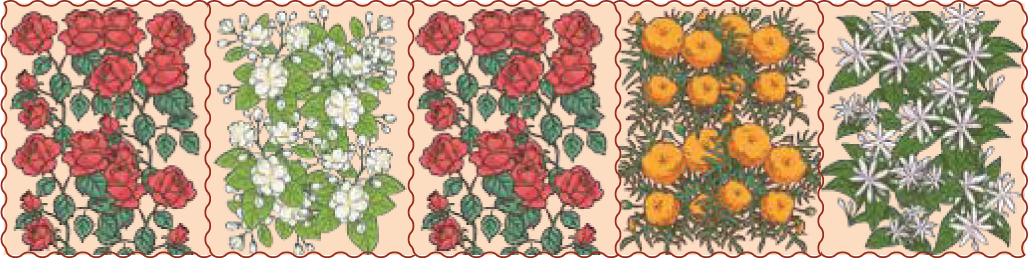
Look at the garden and answer the questions.
Mogra in 1/5 or one-fifth part of the garden.
Marigold in _____________ part of the garden.
Jasmine in _____________ part of the garden.
Rose in 1/5 and 1/5 part or a total of 2/5 (two-fifths) part of the garden.
Answer:
Marigold in 1/5 (one-fifth) part of the garden
Jasmine in 1/5 (one-fifth) part of the garden
Look at the garden and answer the questions.
Mogra in _____________ part.
Marigold in _____________ part.
Rose in 1/5 + 1/5 + 1/5 part or a total of 3/5 (three-fifths) part.
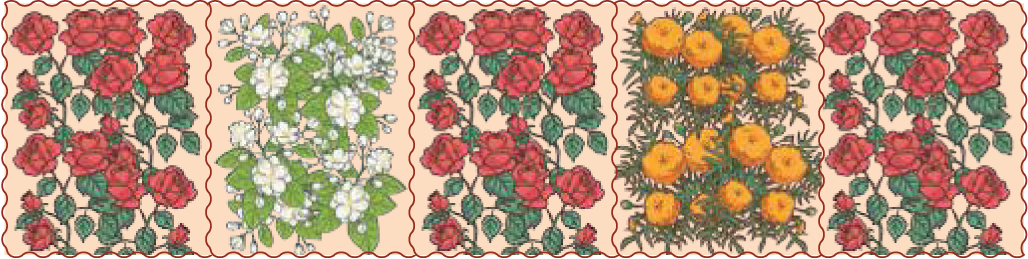
Answer:
Mogra in 1/5 (one-fifth) part
Marigold in 1/5 (one-fifth) part
Look at the garden and answer the questions.
Marigold in _____________ part.
Rose in 1/5 + 1/5 + 1/5 + 1/5 or a total of 4/5 (four-fifths) part.
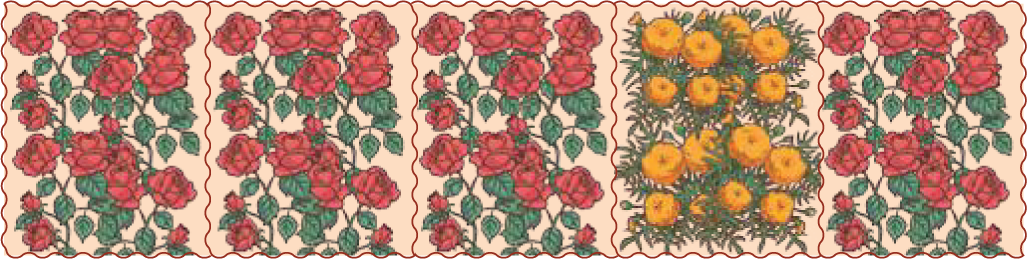
Answer:
Marigold in 1/5 (one-fifth) part
Page 71
Let Us Do
Make a flower garden with seven flowering seeds -Mogra, marigold, Jasmine, Rose, Lily, Hibiscus, and Periwinkle?
a) Marigold in one-seventh (1/7) and Rose and Hibiscus in three-sevenths (3/7) part each.

Answer:

b) Lily in three-sevenths (3/7), Marigold in two-sevenths (2/7) and Periwinkle in another two-sevenths (2/7).

Answer:

c) Mogra in five-sevenths (5/7) part and Hibiscus in two-sevenths (2/7).
Answer:

Page 73
Do It Yourself
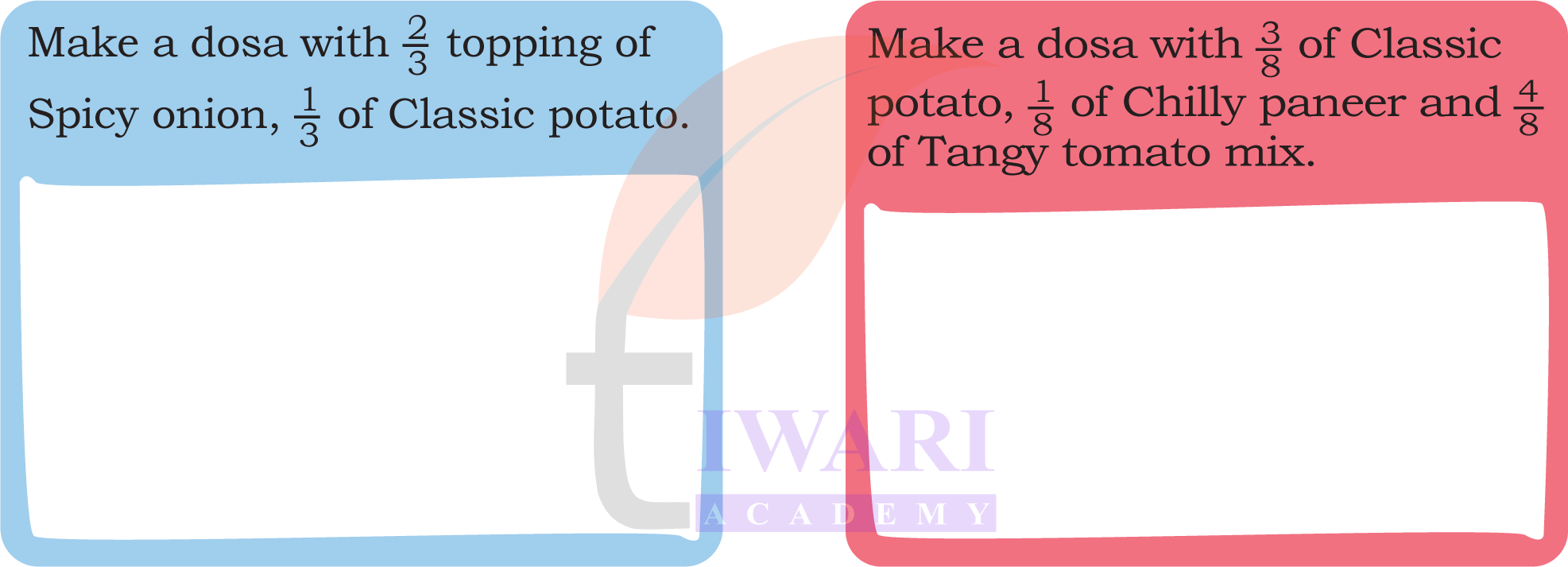
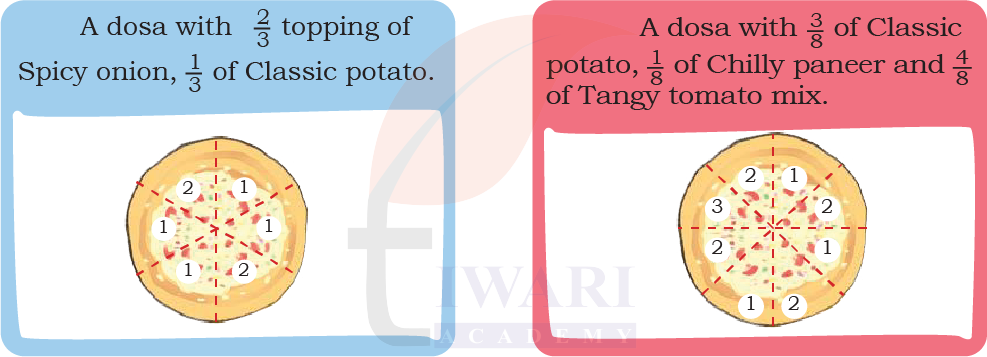
Write the fractions for each of the toppings in the following dosas.
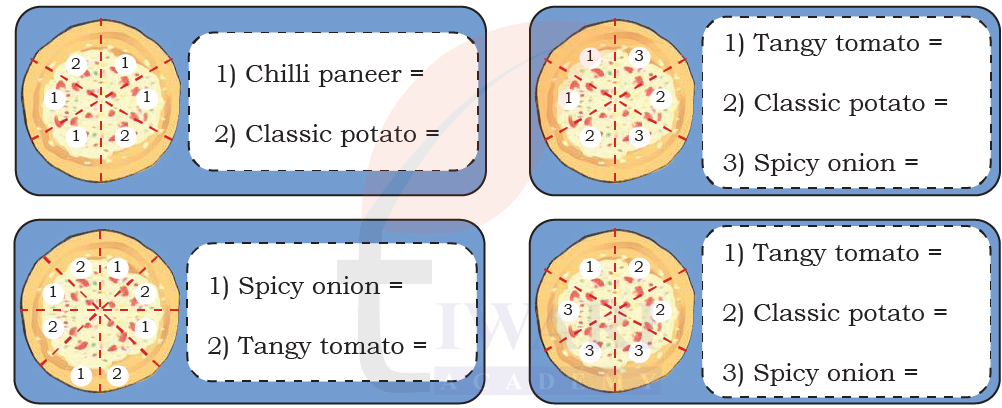
Answer:
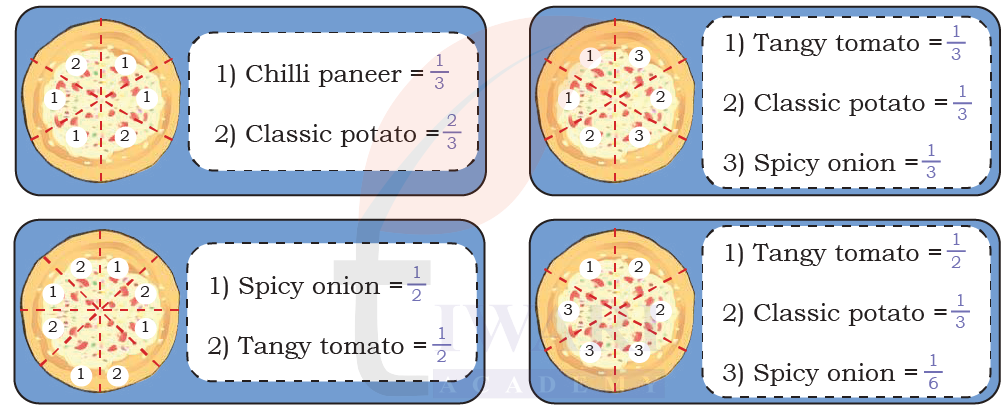
Now you can make different dosas based on demand.
Answer:
Page 74
Let Us Do
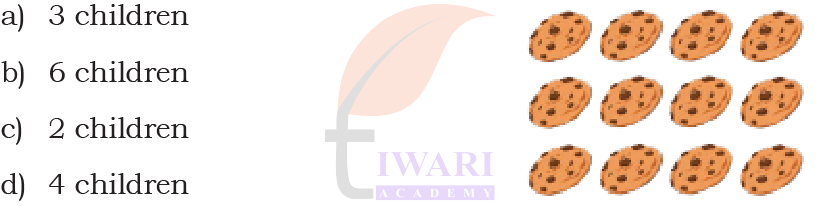
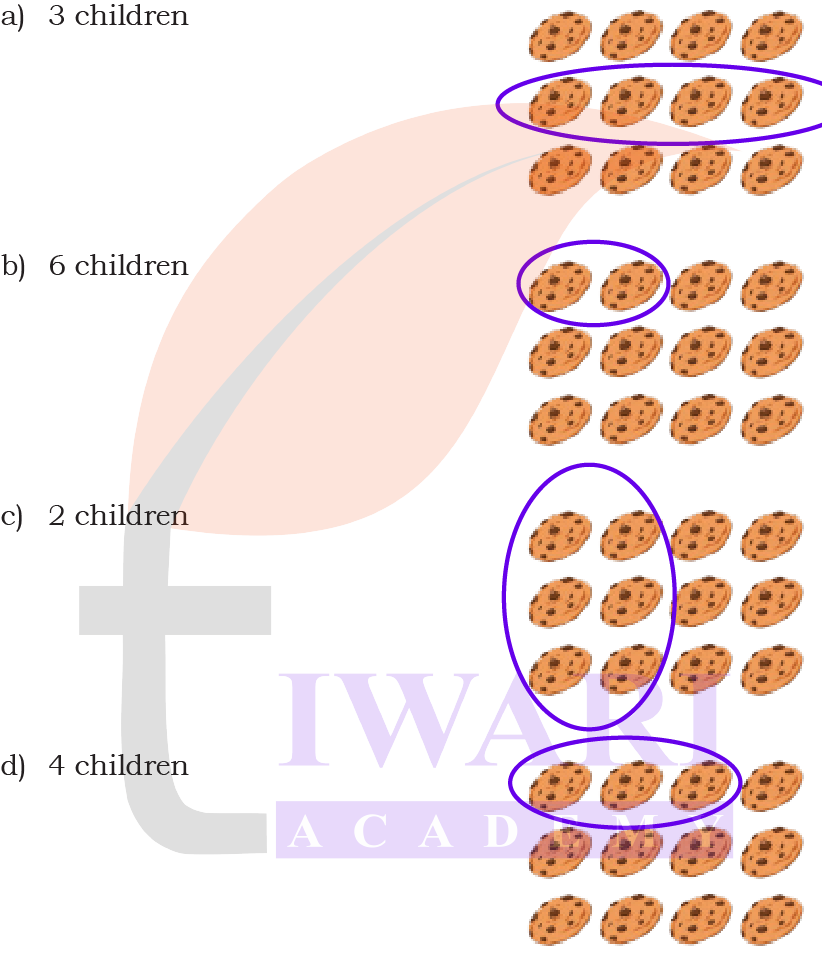
Now let us try to find fractions for the situations given below. Circle the appropriate parts in the pictures.
1. There are 12 cookies. What fraction of cookies will each get if the number of children are as follows:
Answer:
a) 3 children:
Each child gets 12 ÷ 3 = 4 cookies
Each child gets 4/12 = 1/3 of the total cookies
b) 6 children:
Each child gets 12 ÷ 6 = 2 cookies
Each child gets 2/12 = 1/6 of the total cookies
c) 2 children:
Each child gets 12 ÷ 2 = 6 cookies
Each child gets 6/12 = 1/2 of the total cookies
d) 4 children:
Each child gets 12 ÷ 4 = 3 cookies
Each child gets 3/12 = 1/4 of the total cookies.
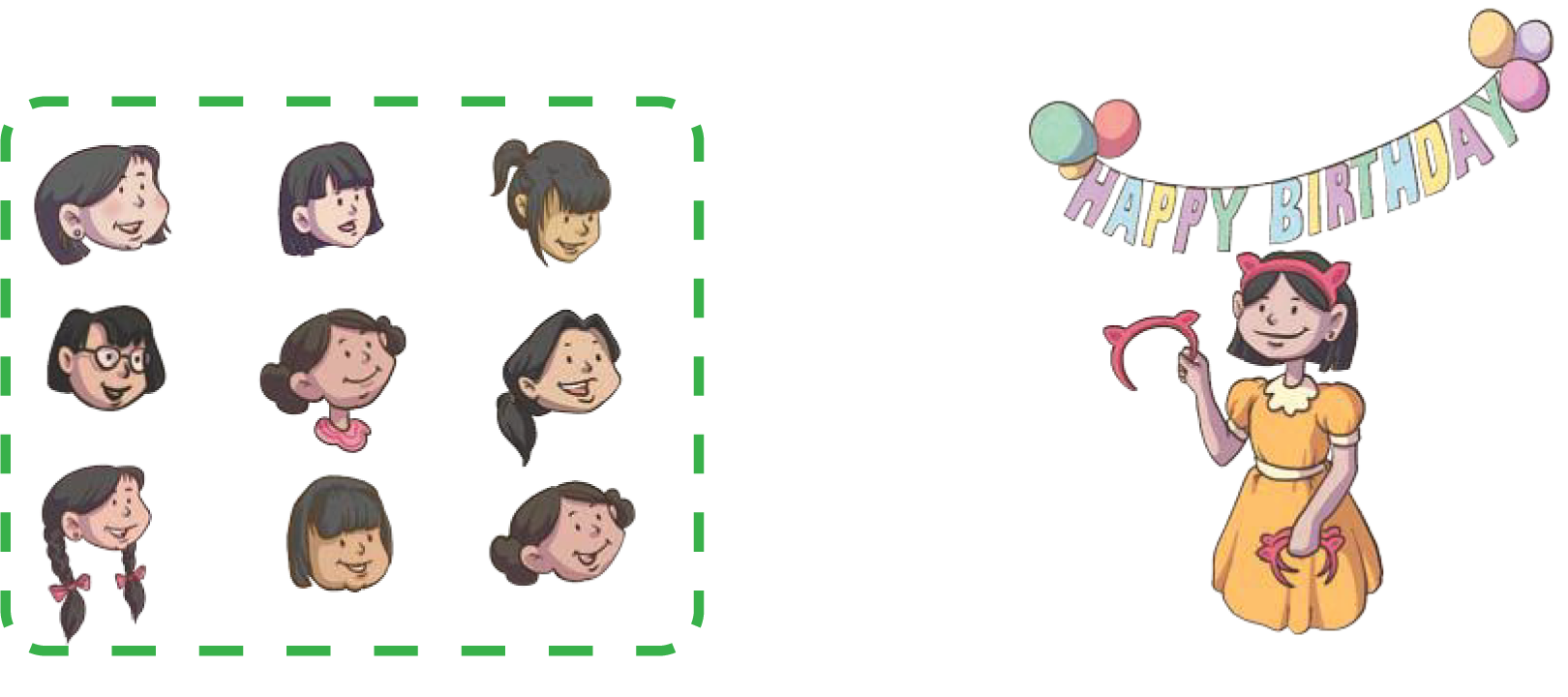
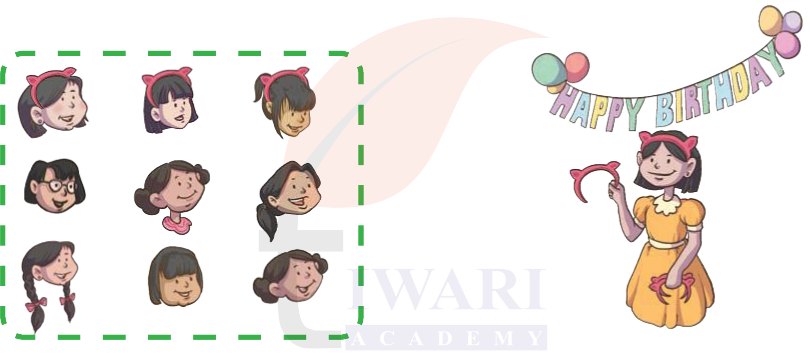
2. Simran calls her school friends for her birthday party. 1/3 of her friends receive a hairband as their return gift. Place hairbands on 1/3 of her friends.
Answer:
If there are 9 friends, then 9 ÷ 3 = 3 friends would receive hairbands.
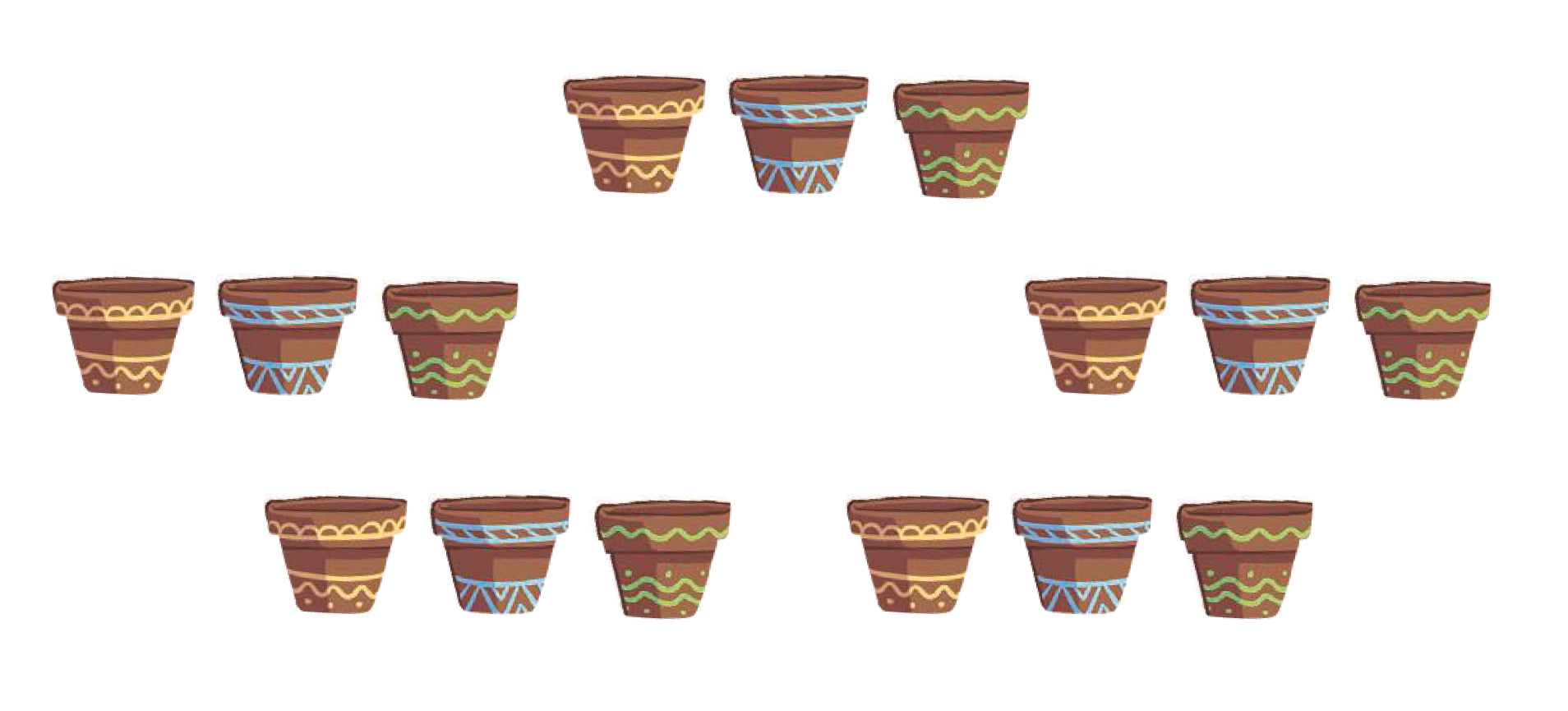
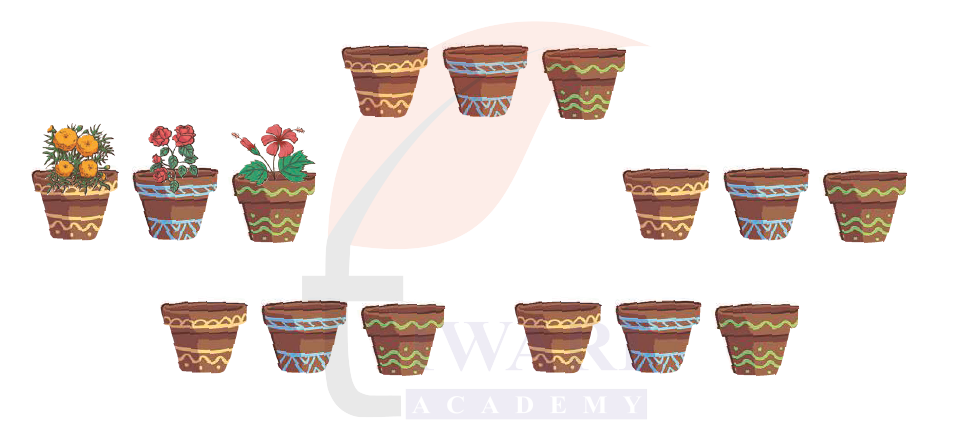
3. Draw flowers in 1/5 of the given number of pots.
Answer:
It is confirmed that there are 15 pots total in the image
To find 1/5 of 15 pots: 1/5 × 15 = 3 pots
Therefore, I should draw flowers in 3 of the 15 pots.
Page 75
Let Us Find Fractions in Our Surroundings
1. Yesterday Mummy asked to divide a box of barfis into four equal parts. There are 16 barfis in the box. Draw a picture of 16 barfis and find 1/4 of the whole. How many barfis are in each part?
Answer:
To find 1/4 of 16 barfis:
Divide 16 barfis into 4 equal groups: 16 ÷ 4 = 4
1/4 of 16 barfis is 4 barfis
Each part would have 4 barfis.
In figure, 1/4 is shown by the box.
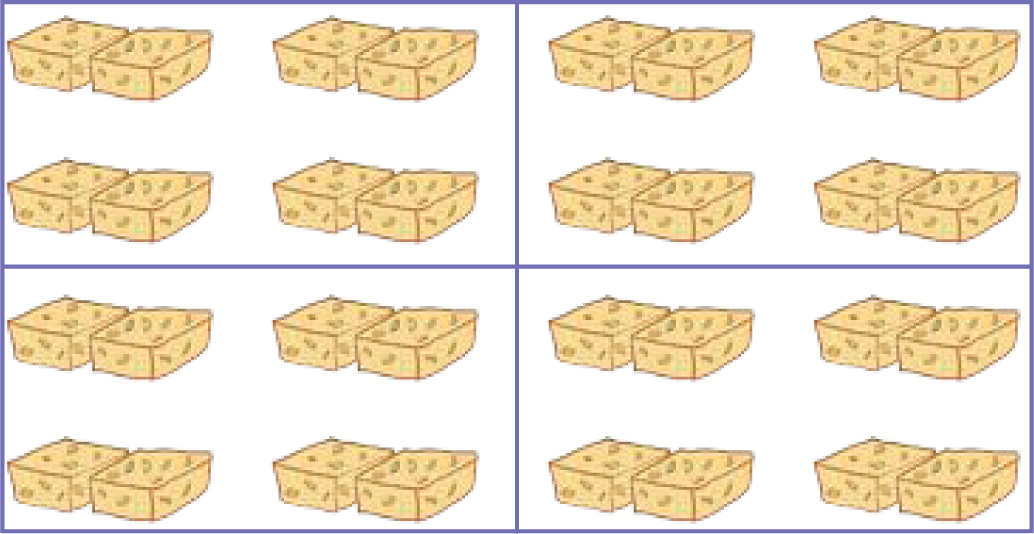
2. Rohan has a piece of ribbon to decorate his notebook. Mohan’s ribbon is one-fourth as long as Rohan’s ribbon. How long will Rohan’s ribbon be? Draw it.
Answer:
If Mohan’s ribbon is 1/4 of Rohan’s ribbon, then Rohan’s ribbon is 4 times as long as Mohan’s ribbon.

Try Yourself
Observe your surroundings and think of situations where we use fractions and write any two of them in the space provided below.
Answer:
I see fractions being used in my daily life in many situations.
► When we cut a pizza or cake into equal parts, each piece is a fraction of the whole. For example, if a pizza is cut into 8 slices, each slice is 1/8 of the pizza.
► When my mother measures ingredients while cooking, she uses fractions like 1/2 cup of milk or 1/4 spoon of salt.
Let Us Do
Write down what fraction you observe after each fold.
1/3 = 2/6 = ____ = ____ = ____
Answer:
The fractions would be 1/3 = 2/6 = 4/12 = 8/24 = 16/48.
Page 77
Let Us Try
Take another piece of paper and try the same starting with two equal parts, and halving every time. Share the findings with your friends.
1/2 = 4/2 = ______ = ______ = ______
Answer:
1/2 = 2/4 = 4/8 = 8/16 = 16/32
Let Us Discuss
Observe the fraction chart and discuss the following questions. You may use your fraction kit also to explore the answers.
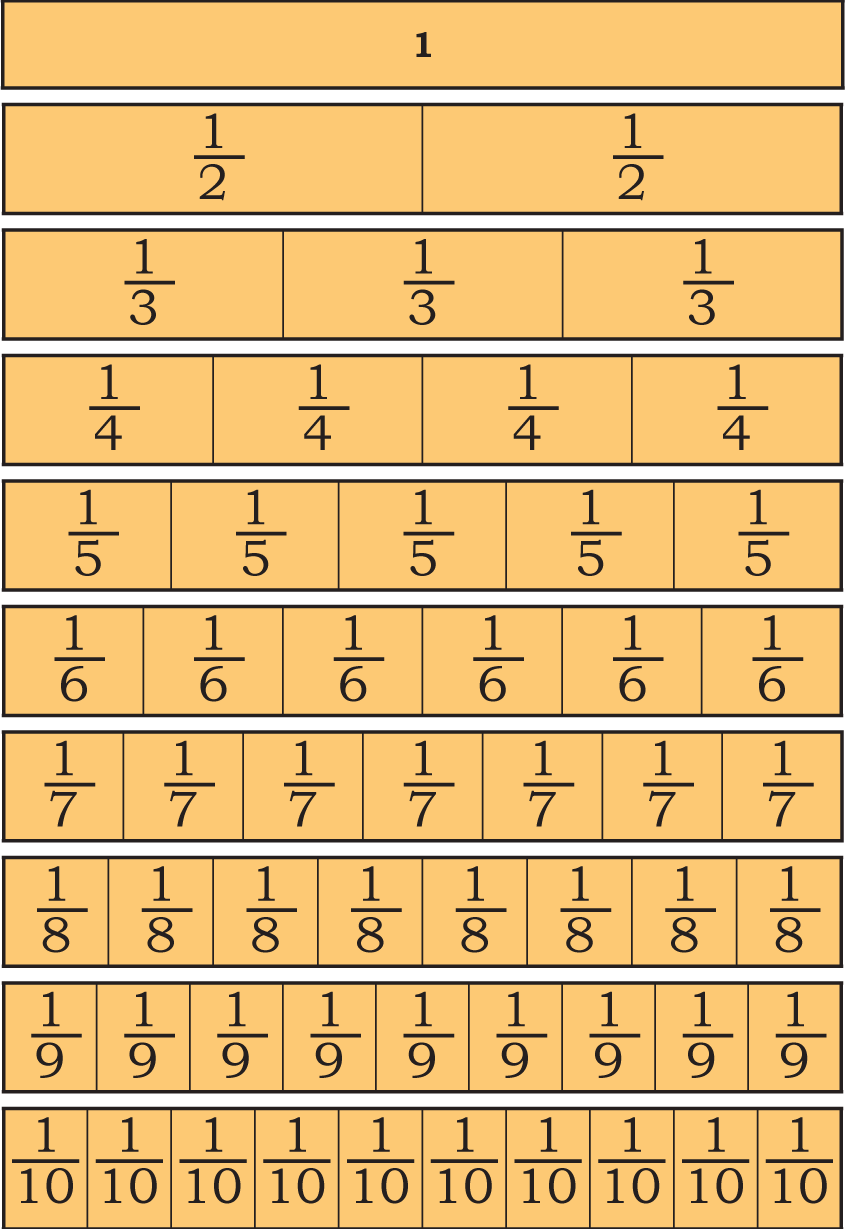
1. How many 1/4s are equal to 1/2?
Answer:
Two 1/4s are equal to 1/2. (1/4 + 1/4 = 2/4 = 1/2).
2. Is 2/3 less than or greater than 1/2?
Answer:
2/3 is greater than 1/2.
3. Ten pieces of 1/10 make a complete whole. Is this statement true?
Answer:
Yes, this statement is true. (10 × 1/10 = 10/10 = 1).
4. Three pieces of 1/6 are equal to two pieces of 1/8. Is this true?
Answer:
No, this is not true. Three pieces of 1/6 are 3/6 = 1/2
Two pieces of 1/8 = 2/8 = 1/4
We can observe that 1/2 ≠ 1/4.
5. How many pieces of 1/8 make 1/4?
Answer:
Two pieces of 1/8 make 1/4. (2 × 1/8 = 2/8 = 1/4).
6. Find the pieces that you can put together to make another bigger piece.
Answer:
Two 1/4 pieces make 1/2
Three 1/9 pieces make 1/3
Two 1/10 pieces make 1/5.
Page 78
Let Us Do
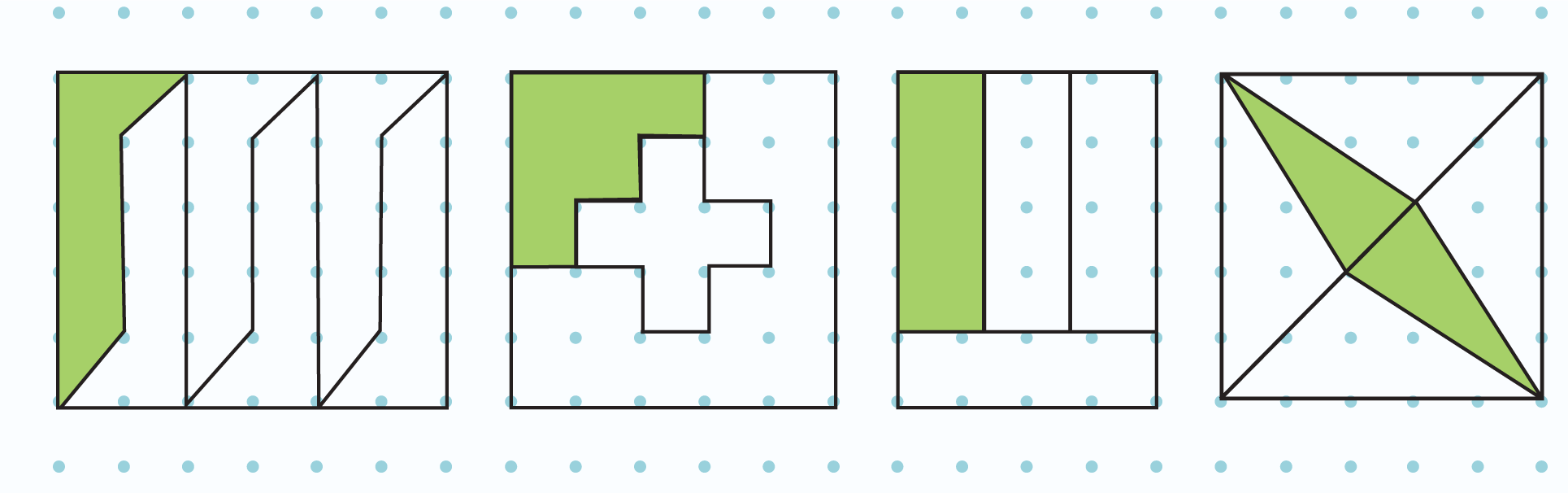
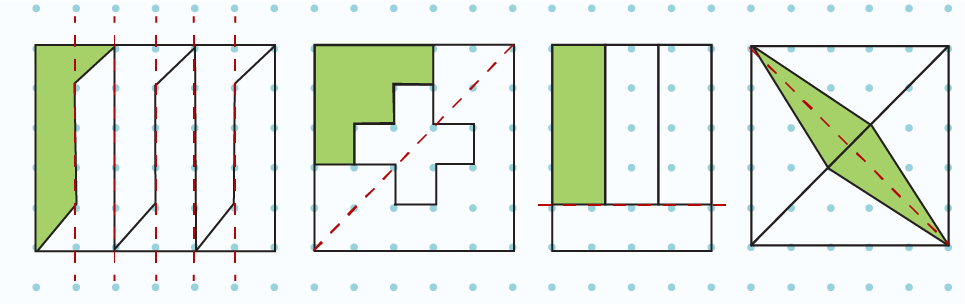
1. Bablu is playing with square shapes. He wants to cut them in such a way that each piece is equal in size. Circle the squares which have been cut into equal parts. Write the fraction for the shaded part, whenever possible.
Answer:
I need to circle squares with equal parts and write the fraction for shaded parts:
a) First square (vertical strips): The parts appear equal.
b) Second square (plus shape cut-out): The parts are not simillar.
c) Third square (Horizontal strips): The parts are equal. The shaded part is 1/3.
d) Fourth square (diagonal cuts): The parts are equal.
2. Check if the children’s claim below about the shaded parts of each of the pictures is correct. Circle the ones which you think are correct, cross out the ones which are not correct. You can draw additional lines to make the parts equal. Discuss your thinking.
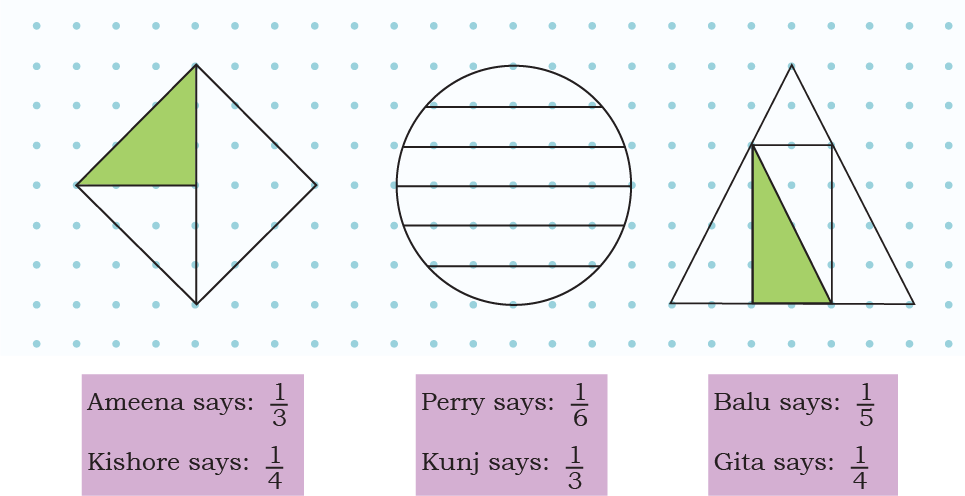
Answer:
a) Diamond shape:
The square is divided into 4 equal triangles with 1 shaded, so Kishore is correct with 1/4.
b)Circle with horizontal lines:
The circle appears to be divided into 6 equal parts, so Perry is correct with 1/6.
c) Triangle:
The triangle doesn’t appear to be divided into completely equal parts, but the shaded portion looks closer to 1/5 than 1/4, so Balu is more likely correct.
3. Identify the fractions represented by the coloured parts in the given pictures.
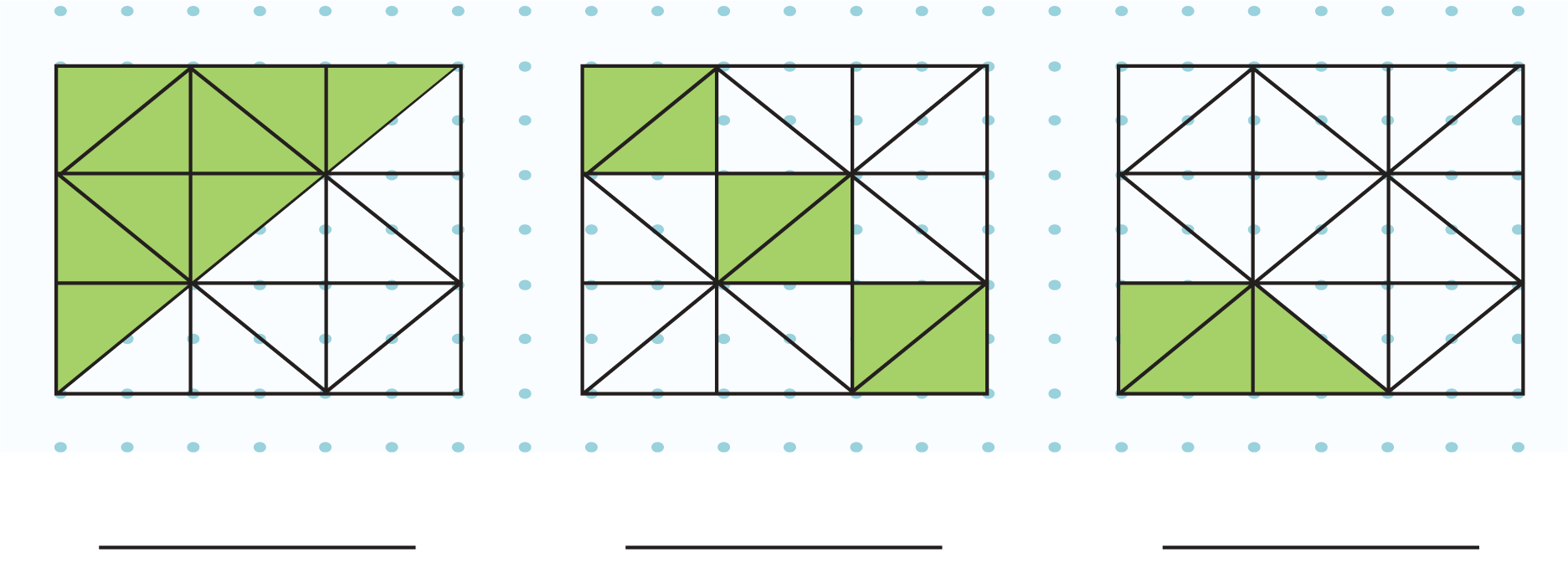
Answer:
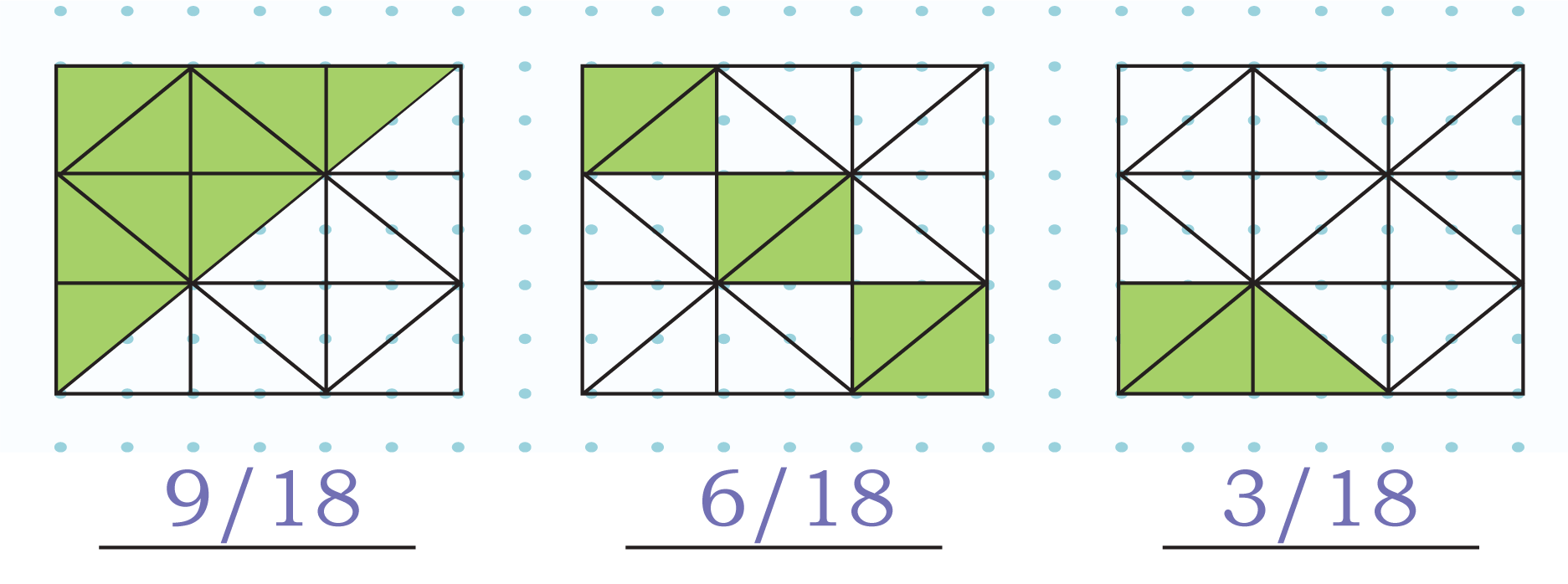
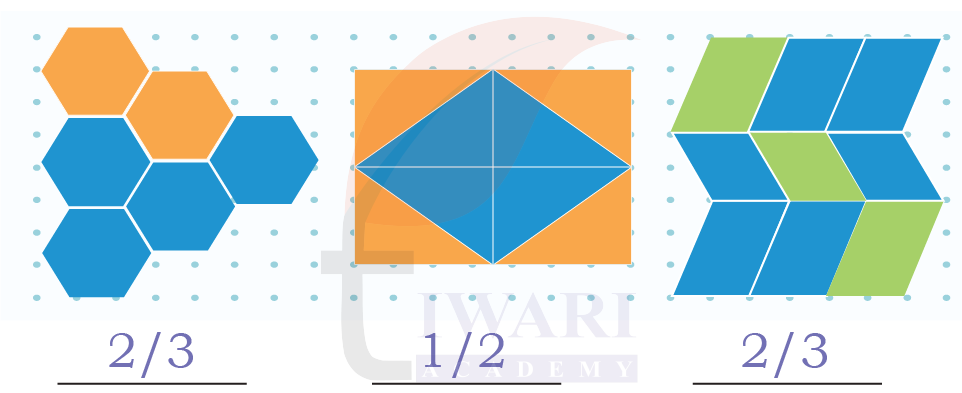
4. Identify the fraction of the whole that the blue parts make in each of the pictures given below.
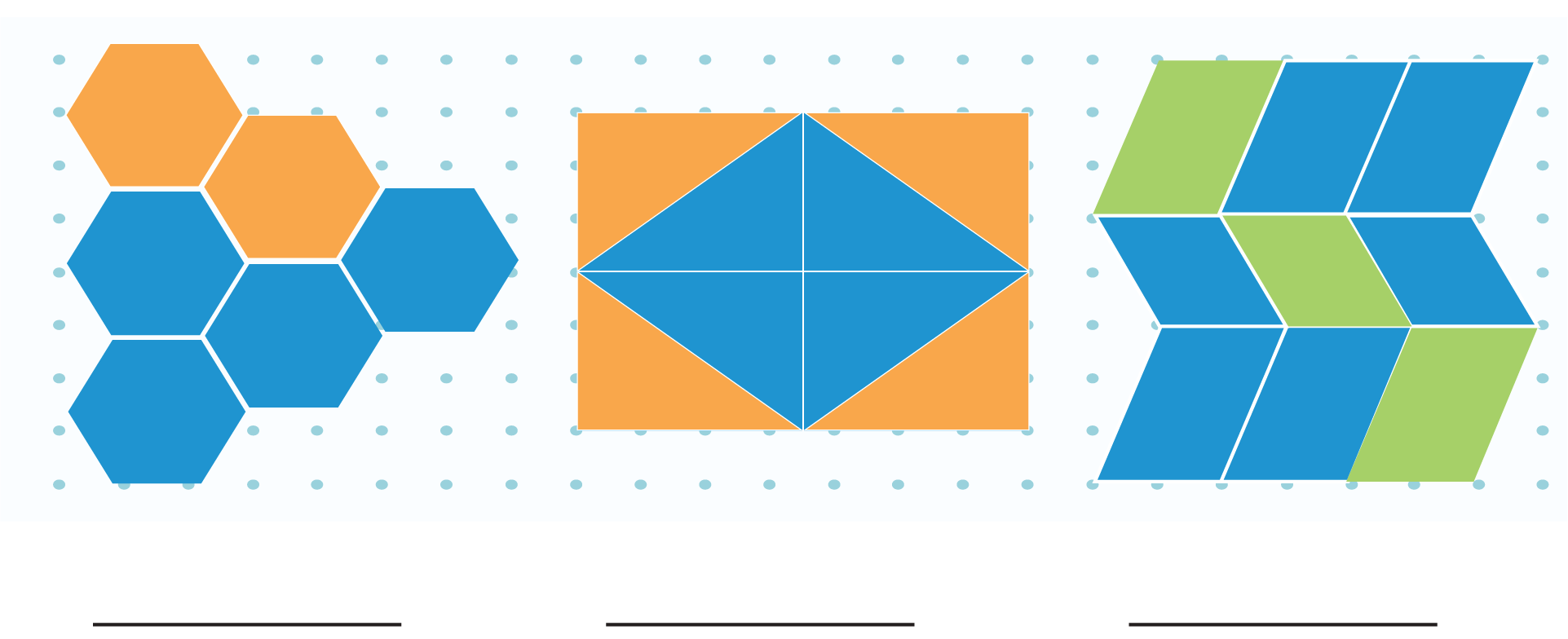
Answer:
a) First hexagon pattern: There are 6 hexagons total with 4 blue hexagons. The fraction is 4/6 or 2/3.
b) Second diamond in square: The blue diamond makes up 1/2 of the square.
c) Third parallelogram pattern: There are 9 equal parts with 6 blue parts. The fraction is 6/9 or 2/3.
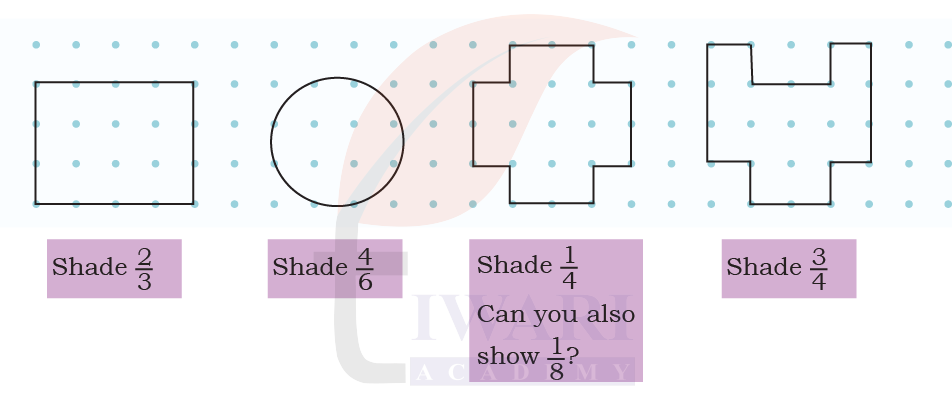
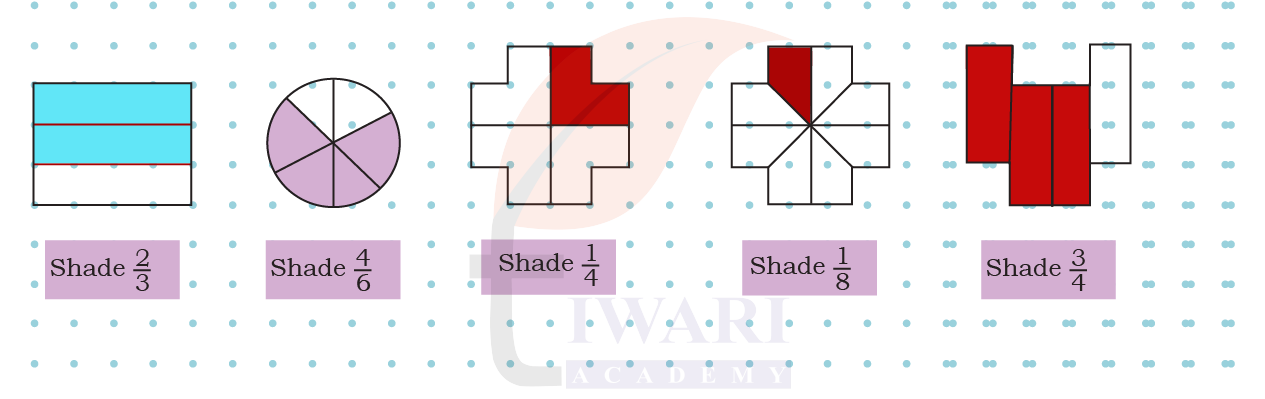
5. Divide the following into equal parts and shade the appropriate parts in each.
Answer:
NCERT Solutions for Class 4 Maths Chapter 5 The Way The World Looks
NCERT Solutions for Class 4 Maths Chapter 5
App for Class 4 NCERT Solutions


Class 4 NCERT Maths Chapter 5 Summary of Chapter
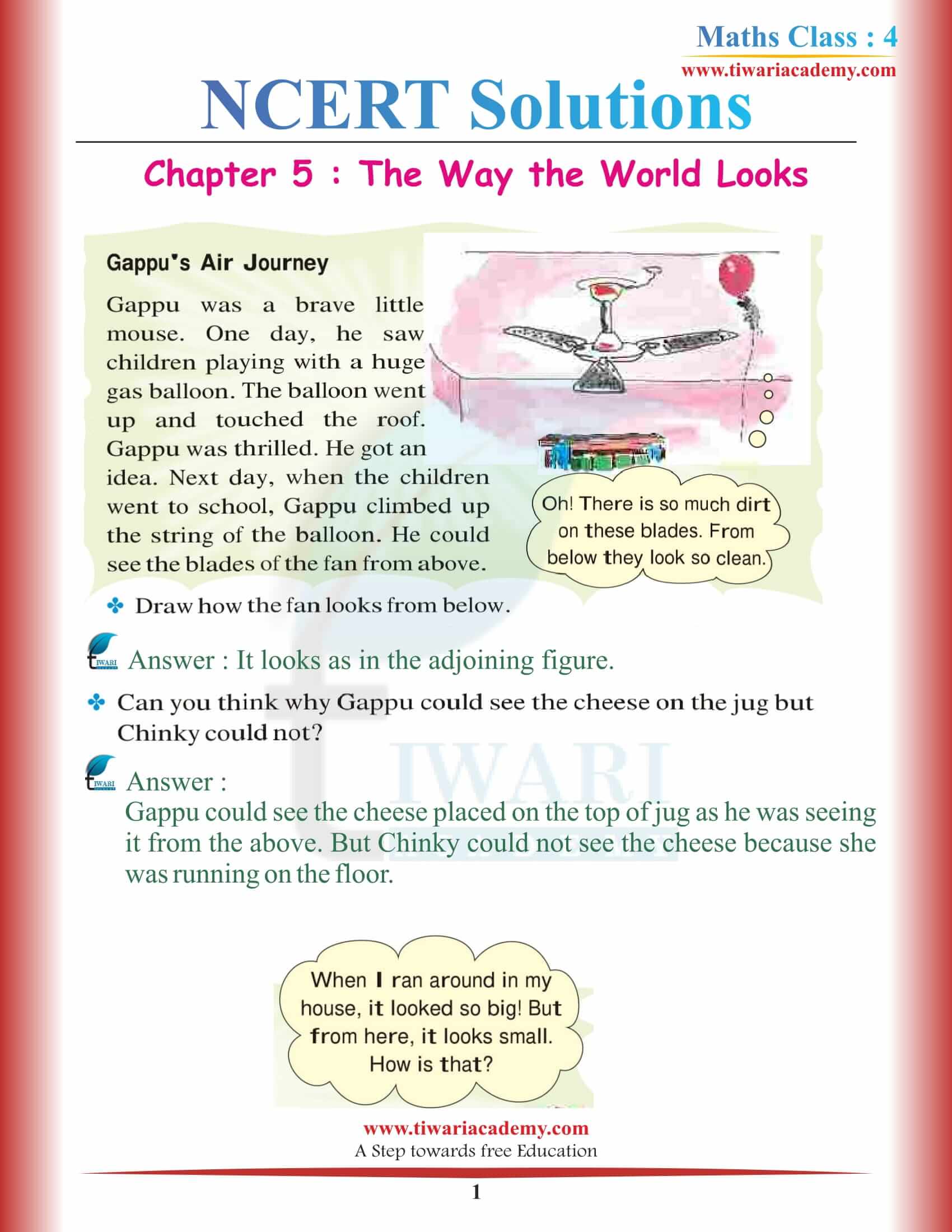
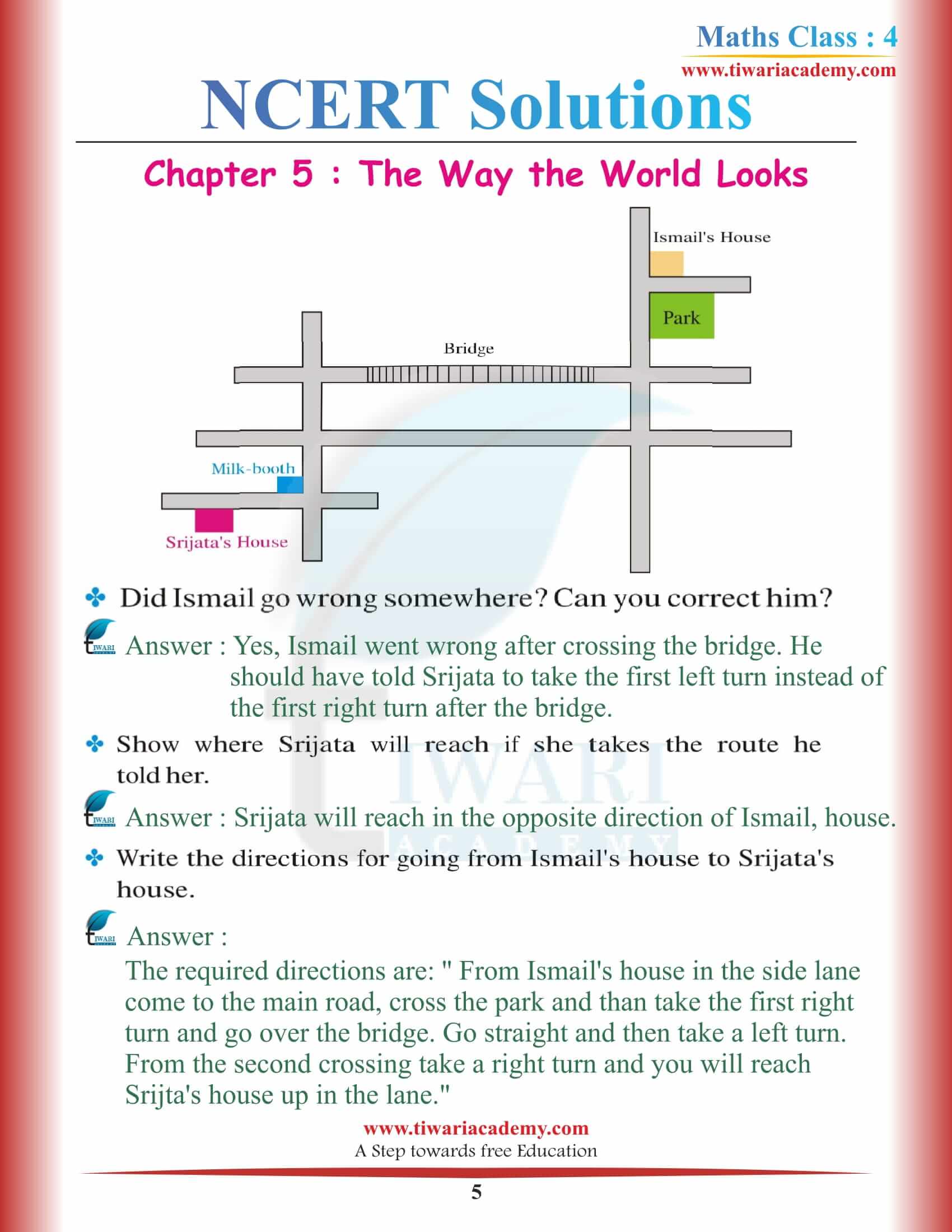
The way the world looks is the story of a mouse that you have to read in this chapter but I can say this chapter might have given inspiration to many of the members of the world because there are so many curious people in the world who wonders how the world looked from far above and maybe this the reason the Aeroplanes are invented and developed.
This could be the reason there are people who are so curious about reaching the top of Mount Everest so that they can reach on the top of it see from there the way the world looks from such a height or maybe the curious nature of ours to go higher and higher is an inspiration for the mouse in the story.
CBSE Class 4 NCERT Maths Chapter 5 View from High rise
Have you ever wondered how would the world look like if you go high enough over the terrace of your building and see below the cars parking and kids playing and imagine the more you go high the tiny it gets? Think what if you go higher than clouds what would see then? When you read this chapter imagine yourself on top of the room from where you can see everything. This is how you will understand the perspective of this mouse and then discuss this with your friends and get their views on what they imagine about such situations.
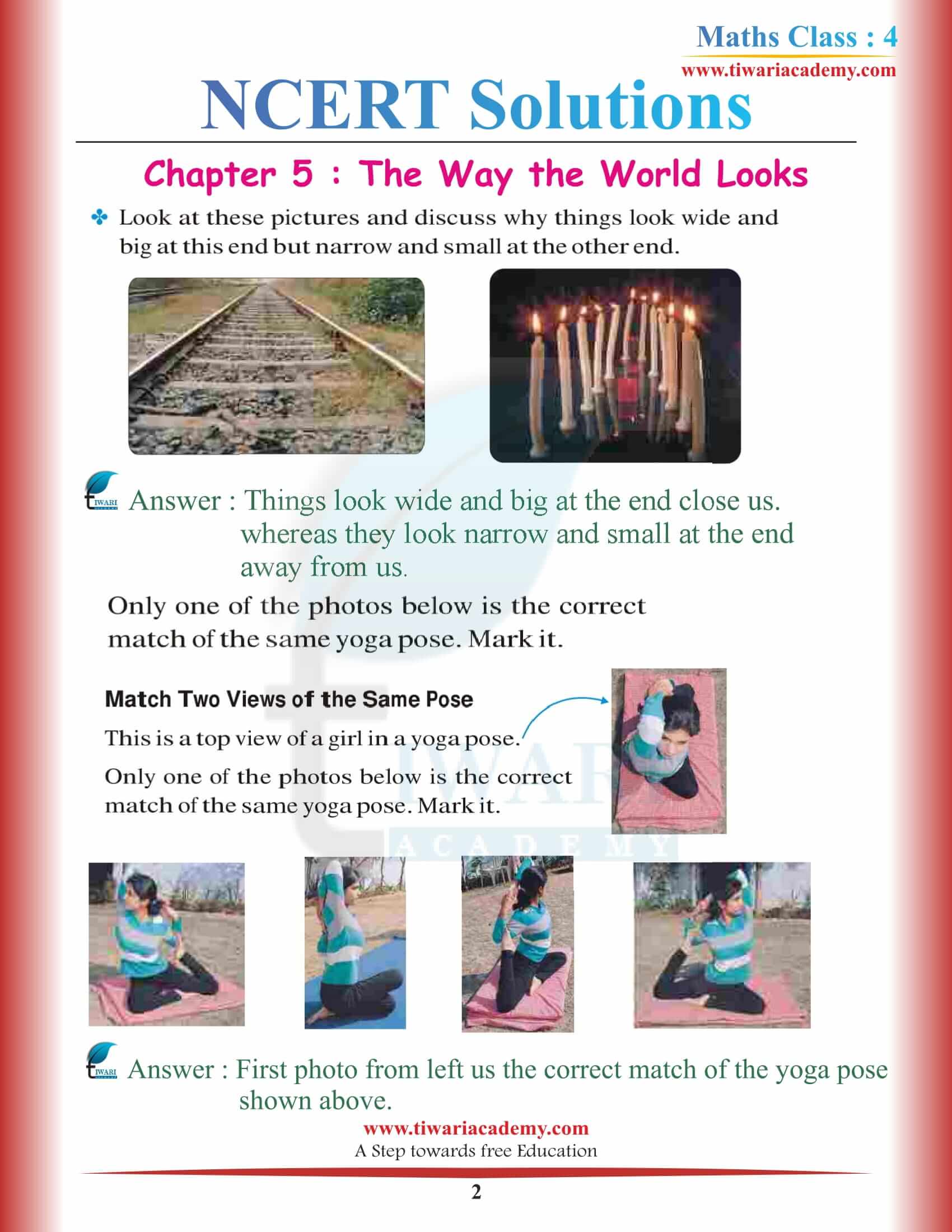
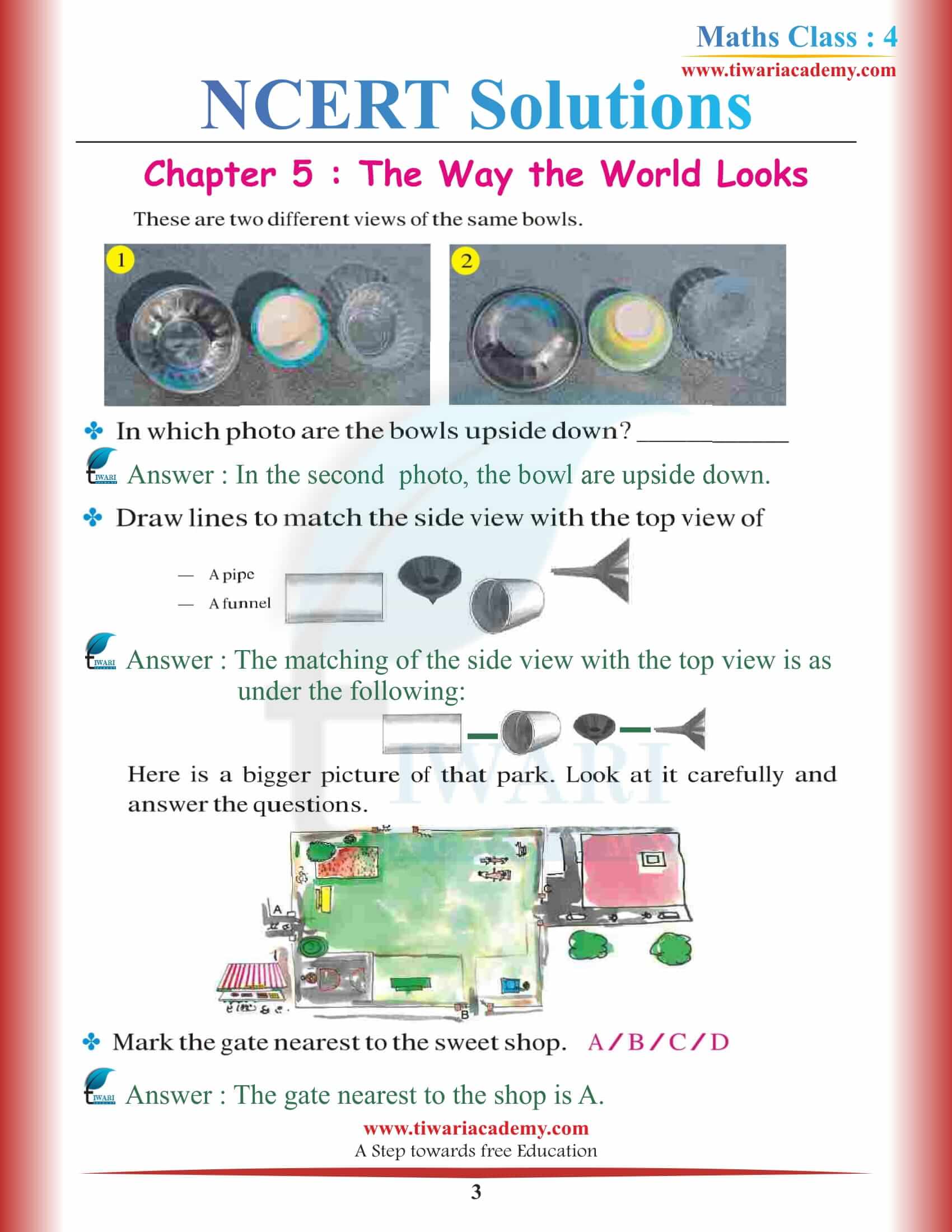
4th Standard NCERT Maths Book Chapter 5 Height, Distance and Perception
This chapter will teach you something different about the height distance and perception from above and below which is important to write about something and draw too. So if you have understood the things and how does it looks then I suggest you take a pen and paper and start drawing.
The picture what is mentioned in the chapter and more if you can imagine but one thing is for sure you will get after reading this chapter is things are viewed differently from a different angle and the is a very important thing to understand if you want to build and draw something on paper.
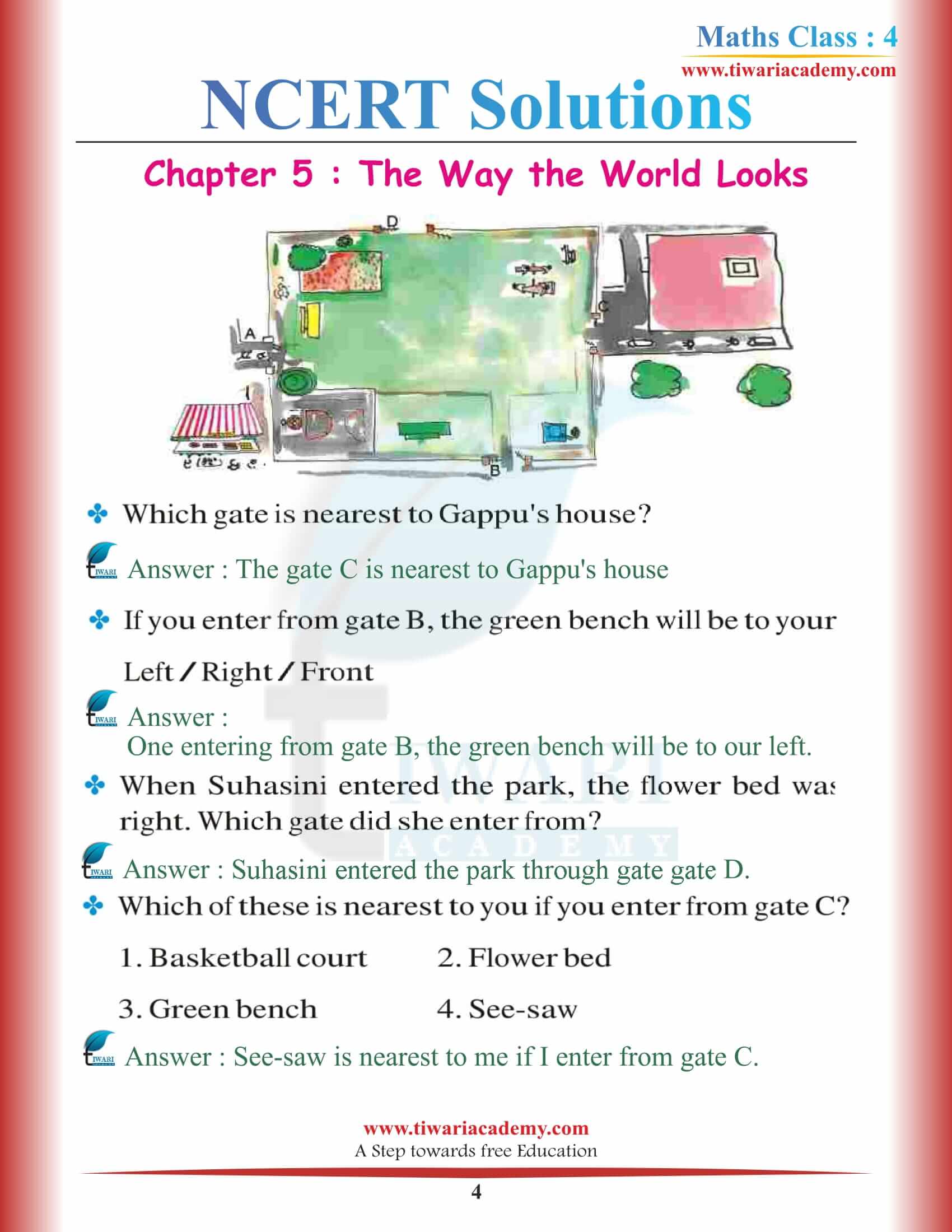
Class 4 NCERT Maths Text book Chapter 5 Know about Directions
Young children tend to think of directions like left, front etc. in absolute terms. It is important for the development of spatial understanding to make them aware that directions are relative to one’s position. Something that is towards the left from one position can be towards the right from another position. More activities can be done in the class based on this concept.
Class 4 Maths Mela Chapter 5 – FAQs
Is Class 4 Maths Mela Chapter 5 difficult?
No, Class 4 Maths Mela Chapter 5 is not difficult. The chapter explains fractions using simple stories, pictures and daily-life examples like sharing paper and food. Concepts such as half, quarter and equal sharing are taught step by step, making it easy for students to understand.
How to learn Class 4 Maths Chapter 5 easily?
Students can learn Class 4 Maths Chapter 5 easily by using paper folding, drawing equal parts and relating fractions to real-life situations like sharing food. Practising the “Let Us Do” and “Let Us Discuss” activities helps children understand fractions naturally.
Is Grade 4 Maths Mela Chapter 5 interesting?
Yes, Grade 4 Maths Mela Chapter 5 is very interesting because it uses stories, colourful pictures and activities like sharing dhokla, designing dosas and making flower gardens. These examples make learning fractions fun and engaging for students.
What are the main topics in Class 4 Maths Mela Chapter 5?
The main topics include parts and wholes, fractions, one-half (½), one-quarter (¼), comparison of fractions, equal sharing and finding fractions in daily life. The chapter focuses on understanding rather than memorising formulas.
Do students need to memorise formulas in Chapter 5 Sharing and Measuring?
No, students do not need to memorise formulas in Chapter 5. The chapter focuses on conceptual understanding through activities, drawings and practical examples, helping students learn fractions logically and confidently.